Choosing a private label apron manufacturer is not only a price comparison exercise. For bulk apron programs, the buyer is usually balancing fabric durability, fit consistency, logo execution, packaging requirements, compliance documents, and a delivery date tied to store launches or distributor commitments.
From the factory side, the best projects start with a clear product brief and a realistic understanding of trade-offs. A 220 GSM cotton twill waist apron, a 10 oz canvas barista apron, and a recycled polyester bib apron may all look simple on a quotation sheet, but they behave differently in cutting, sewing, washing, shrinkage control, embroidery, and carton packing.
This guide explains the step-by-step process for developing a private label apron with an apron supplier China buyers can use for repeat programs. The numbers below reflect common production ranges we see in Zhejiang and nearby textile supply chains, but final pricing and lead time always depend on fabric availability, order quantity, branding method, and inspection requirements.
- Fabric selection drives cost and performance, with common apron weights ranging from 180 GSM polyester to 12 oz cotton canvas.
- Sampling should confirm fit, shrinkage, logo placement, and packaging before bulk fabric is purchased.
- MOQ varies by fabric and color, typically from 300-500 pcs for stock fabric and 1,000-3,000 pcs for custom-dyed fabric.
- Logo method affects both unit price and lead time, especially for embroidery, woven labels, leather patches, and heat transfer.
- Final inspection must measure real apron construction, including strap strength, pocket position, stitch density, and carton labeling.
Start with the right private label apron manufacturer brief
A good private label apron project starts with a technical brief, not only a reference photo. Aprons appear simple, but a small difference in strap width, pocket depth, fabric weight, or neck adjustment can change the product category. A kitchen bib apron for retail might need soft hand feel and attractive packaging, while a restaurant uniform apron must survive frequent industrial washing and staff turnover.
For a private label apron manufacturer, the first review is usually about use case, target price, and volume. If the buyer asks for a heavy canvas apron with brass hardware, cross-back straps, embroidery, custom hangtag, and individual kraft box at USD 2.50/pc, the factory needs to explain the gap early. If the buyer targets USD 3.80-5.50/pc FOB for 3,000 pcs, more realistic options become available, depending on fabric and branding.
The brief should also identify whether this is a retail private label apron, a promotional white label apron, a uniform program, or a custom apron OEM project for a brand collection. These categories use different assumptions. Promotional aprons often prioritize price and fast delivery. Retail aprons require stronger packaging presentation and consistent appearance. Uniform aprons usually require repeatable color lots and practical reinforcement.
- Define the apron type: bib, waist, bistro, cross-back, cobbler, denim, canvas, chef, barista, salon, garden, or industrial.
- State the target fabric: for example 180-220 GSM polyester-cotton, 240 GSM cotton twill, 280 GSM denim, 10 oz canvas, or 12 oz waxed canvas.
- Confirm target order quantity by color and size, because MOQ is usually calculated per fabric color, not only total order.
- Provide the logo file in AI, PDF, or high-resolution PNG and specify approximate logo size in centimeters.
- Share target market requirements, such as REACH, OEKO-TEX, California Prop 65, food service use, or retailer carton labeling.
Choose apron fabric by use case, not only by unit price
Fabric is the largest cost driver in most apron orders. A basic 180 GSM polyester apron may be suitable for promotional campaigns, cooking schools, or short-term events. It is easy to dye, dries quickly, and can be cut efficiently. However, it does not give the same hand feel or durability as cotton canvas. A 240-260 GSM cotton twill apron is more suitable for retail kitchen aprons and casual hospitality uniforms, but it may shrink 3-5% if not properly controlled.
For barista, workshop, and premium restaurant aprons, buyers often request 10 oz or 12 oz cotton canvas, denim, or poly-cotton canvas. These fabrics create a stronger product, but they also increase cutting time, sewing needle wear, carton weight, and freight cost. A 12 oz canvas cross-back apron with metal hardware may weigh 450-650 g per piece before packing, compared with 160-220 g for a simple polyester bib apron.
Color also matters. Stock black, white, navy, khaki, red, and grey fabrics are easier to source in small quantities. Custom-dyed colors need lab dips, bulk dyeing, and color approval. For custom dyeing, many mills require 800-1,500 meters per color, which may translate to roughly 1,000-3,000 aprons depending on apron size and cutting efficiency. If the order is only 300 pcs, choosing stock fabric is usually more practical.
- 180-200 GSM polyester is common for low-cost promotional aprons, with fast drying and low shrinkage.
- 200-240 GSM TC twill, usually polyester-cotton, is suitable for uniforms where wrinkle resistance and price control matter.
- 240-280 GSM cotton twill gives a softer retail hand feel but needs shrinkage checking before production.
- 8-10 oz cotton canvas is a balanced option for barista and workshop aprons with visible durability.
- 11-12 oz canvas or denim creates a premium appearance but increases sewing difficulty, unit price, and freight weight.
- Recycled polyester or organic cotton can support sustainability claims, but certificates must be verified before quotation is finalized.
Build a realistic private label apron cost structure
A reliable apron manufacturer should break down the quotation logic clearly enough for a buyer to understand what is included. In many Zhejiang apron factories, a simple bib apron using stock 200 GSM poly-cotton fabric may quote from USD 1.40-2.20/pc FOB at 3,000-5,000 pcs, depending on size, logo, and packing. A mid-range cotton twill apron may fall around USD 2.30-3.80/pc. A heavier canvas or denim apron with metal accessories, multiple pockets, and embroidery may range from USD 4.50-9.00/pc or higher.
The same apron can change price quickly when the buyer adds private label details. A woven neck label may add USD 0.03-0.08/pc after label setup. A custom hangtag with string may add USD 0.04-0.15/pc. Individual opp bag packing may add USD 0.03-0.08/pc, while printed kraft retail boxes can add USD 0.25-0.80/pc depending on size and paper quality. Embroidery is usually costed by stitch count, not only logo width. A 6 cm chest logo may be cheap if it is simple text, but expensive if it is a dense filled artwork.
Buyers should ask whether the quoted price includes fabric testing, sample courier cost, third-party inspection support, spare buttons or hardware, and export carton markings. These are not large items compared with fabric, but they affect landed cost and project control. For repeat private label apron orders, it is better to lock a clear bill of materials than to chase the lowest first quotation.
- Basic stock-fabric promotional apron: commonly USD 1.20-2.20/pc FOB at 3,000 pcs or above.
- Retail cotton twill bib apron with printed logo and hangtag: commonly USD 2.30-4.20/pc FOB depending on GSM and packaging.
- Canvas barista apron with embroidery, metal buckle, and reinforced pockets: commonly USD 4.50-8.50/pc FOB.
- Custom-dyed fabric may add lab dip time, mill MOQ, and 7-15 days before bulk cutting can start.
- Small orders below 300 pcs can be possible with stock fabric, but unit price is normally much higher due to setup and cutting loss.
Control sampling before bulk fabric and trims are ordered
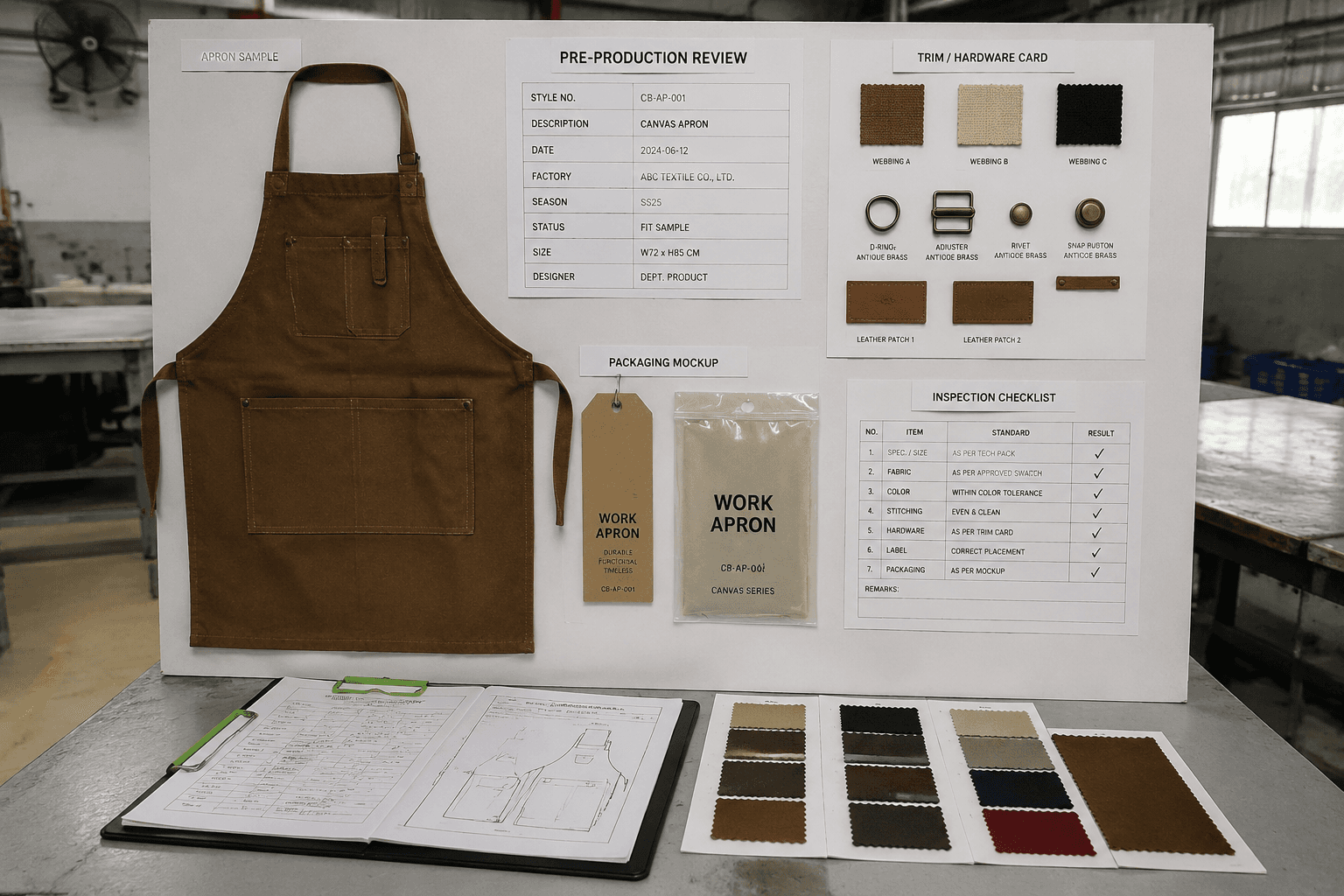
Sampling is where many apron sourcing problems can be prevented. A buyer may approve a digital mockup, but the factory still needs to confirm the real sewing construction. Strap length, pocket position, neck loop adjustment, logo height, and bottom hem width should be measured on a physical sample. For a bib apron, a common adult size is around 70 x 80 cm or 72 x 86 cm, but hospitality buyers often need longer coverage, such as 75 x 90 cm. Waist aprons can vary from 45 x 70 cm to 80 x 100 cm depending on restaurant style.
A normal first sample lead time is 5-10 days if stock fabric and standard trims are used. If custom-dyed fabric, custom metal hardware, printed packaging, or special wash treatment is required, sampling may take 12-25 days. Buyers should not approve a sample only by appearance. Measurements should be checked after ironing and, when required, after washing. Cotton and denim aprons can shrink, twist, or change hand feel after laundering.
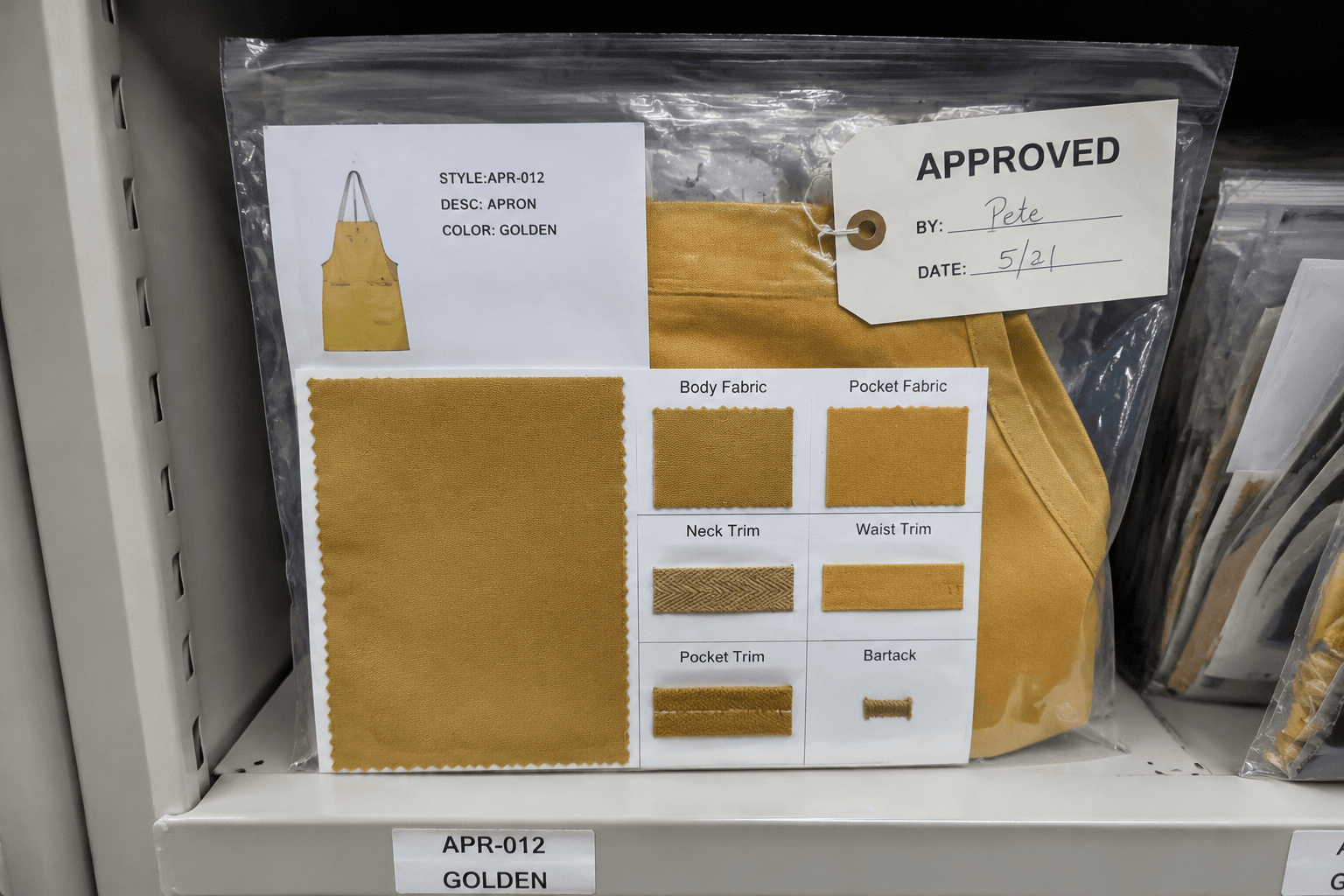
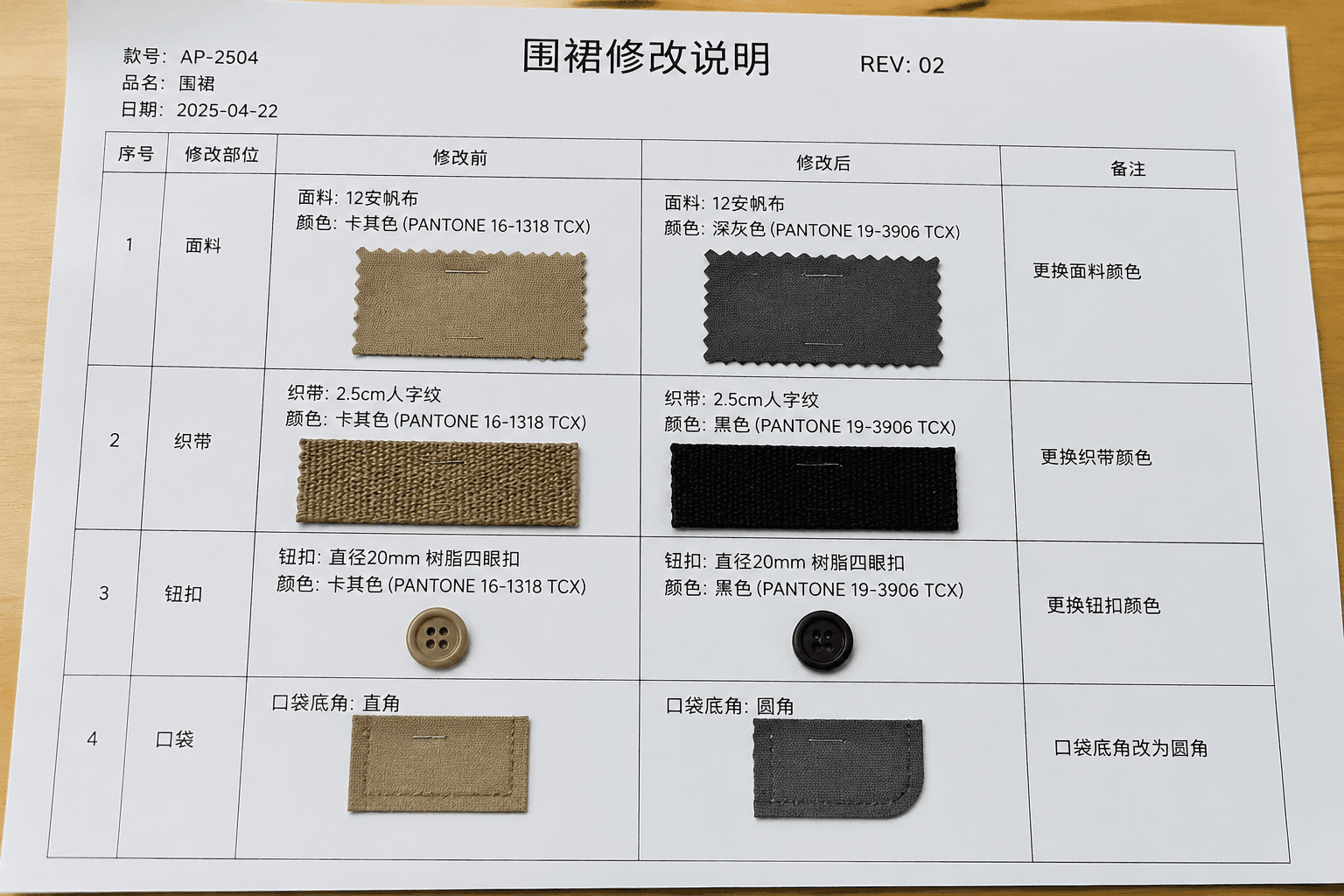
For custom apron OEM development, we recommend treating the sample as a miniature production file. The approved sample should match the tech pack, artwork file, packing instruction, and QC standard. If the buyer changes pocket layout after approval, the factory may need to remake the paper pattern and recalculate fabric consumption. A clear sample approval record reduces disputes later when the bulk goods are inspected.
- Check apron body size tolerance, usually +/-1 cm for small parts and +/-2 cm for full length or width.
- Confirm strap length, strap width, and whether neck straps use ties, buckles, snaps, buttons, or adjustable sliders.
- Measure logo placement from fixed points, such as top edge, side seam, pocket edge, or center line.
- Test pocket usability by placing actual tools, order pads, thermometers, pens, or kitchen towels if relevant.
- Wash one sample when cotton, denim, canvas, pigment dye, or enzyme wash is used.
- Approve packaging with the sample, including folding method, barcode location, warning label, and carton quantity.
Select branding methods for private label apron programs
Private label branding for aprons can be subtle or highly visible. The most common methods are screen printing, embroidery, heat transfer, woven labels, printed labels, leather patches, PU patches, rubber patches, and custom packaging. Each method has different strengths. Screen printing is cost-effective for larger logos and simple colors. Embroidery gives a durable, premium look but is not ideal for very small text or high-detail gradients. Heat transfer can reproduce fine artwork, but the buyer should confirm wash resistance and hand feel.
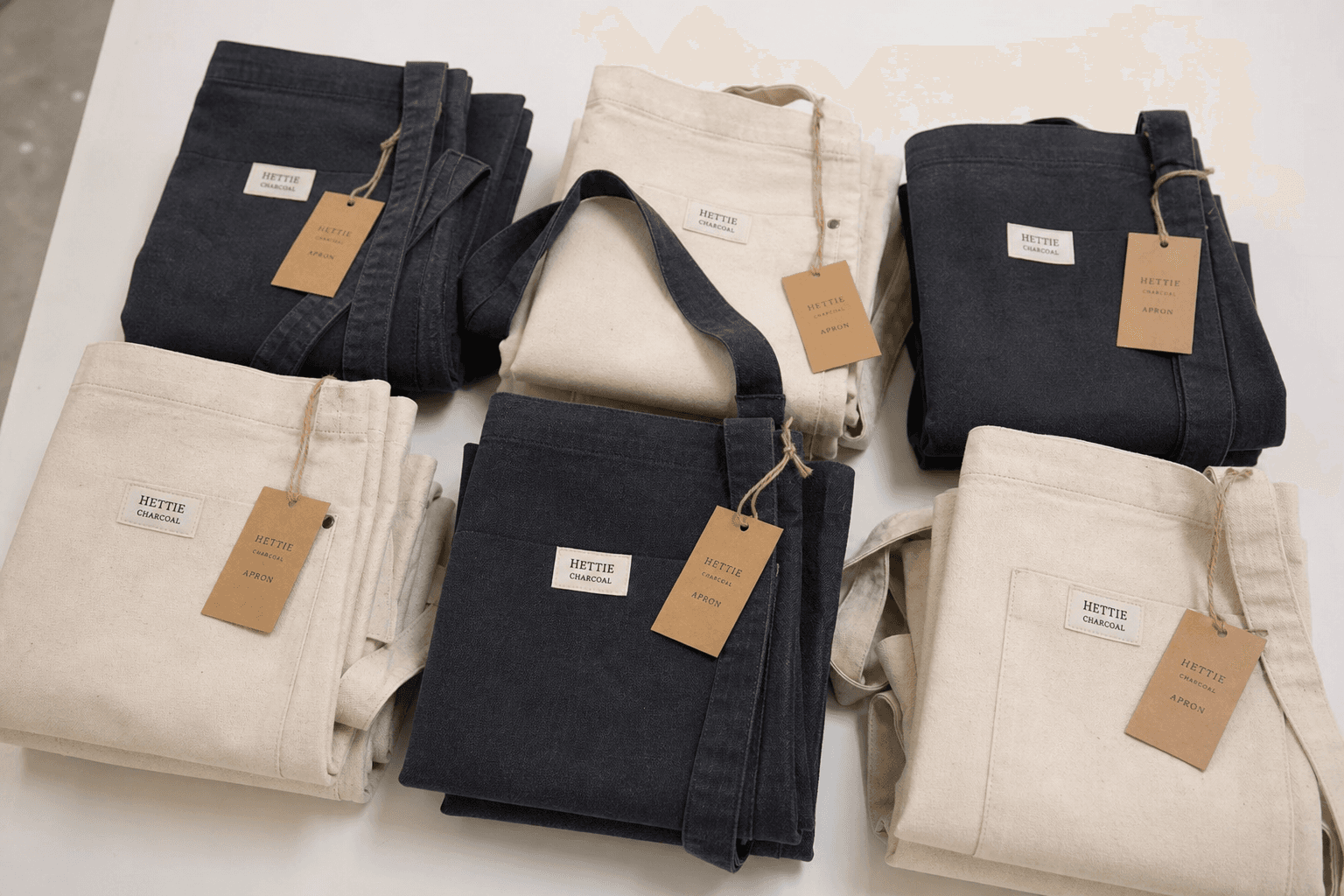
For hospitality uniforms, branding should survive repeated washing. Embroidery and woven labels usually perform well, while low-quality transfer printing can crack after repeated commercial laundering. For retail private label apron products, packaging and labels are often as important as the chest logo. A clean woven neck label, care label, hangtag, and barcode sticker create a complete product ready for warehouse receiving or store display.
A professional apron supplier China buyers work with should ask for the final logo size, color standard, placement, and end-use washing requirements before recommending a branding method. The wrong choice can create both quality issues and unnecessary cost. For example, a large 25 cm embroidery across a heavy canvas apron may look premium but can make the chest panel stiff and expensive. A screen print or patch may be better depending on the brand style.
- Screen print is efficient for 1-4 color logos and larger quantities, often with plate charges of USD 20-60 per color.
- Embroidery is durable and premium, with cost driven by stitch count; small logos may start around USD 0.20-0.60/pc.
- Heat transfer supports detailed artwork, but wash testing is recommended for uniforms and food service use.
- Woven labels are suitable for brand identity, size labels, and neck labels, with typical MOQ around 1,000-3,000 pcs per design.
- Leather or PU patches work well on canvas and denim aprons, but buyers should confirm colorfastness and wash limitations.
- Custom retail packaging should be quoted together with apron packing size because heavy aprons need stronger box board.
Plan MOQ, production lead time, and approval dates
MOQ is often misunderstood in apron sourcing. A factory may accept 300 pcs for a private label apron using stock fabric, but that does not mean every fabric, color, trim, and packaging component is available at 300 pcs. Custom dyeing, custom webbing, custom buttons, metal accessories, and printed retail packaging each have their own MOQ. A buyer ordering 500 pcs across five colors may create more sourcing difficulty than a buyer ordering 1,500 pcs in one color.
For stock fabric and standard trims, normal bulk production is often 20-30 days after sample approval and deposit. For custom-dyed fabric, the timeline may be 35-50 days because lab dips, fabric dyeing, shrinkage control, and bulk fabric inspection come before cutting. For large retail orders above 10,000 pcs, production may require 45-60 days depending on line capacity, packaging complexity, and inspection schedule.
A buyer should build the calendar backward from the required warehouse date. Ocean freight to the US West Coast may take around 18-28 days port to port, while US East Coast can take 30-40 days or more depending on routing. Europe often requires 28-40 days by sea. Air freight is faster, but heavy canvas aprons can make air cost unattractive. A 12 kg carton of promotional aprons is manageable; a 22 kg carton of canvas aprons becomes expensive quickly.
- Stock fabric sample: usually 5-10 days, excluding international courier time.
- Custom fabric lab dip: usually 3-7 days per round, with additional time if the buyer requests revision.
- Bulk production with stock fabric: usually 20-30 days after approval and deposit.
- Bulk production with custom-dyed fabric: usually 35-50 days depending on mill schedule.
- Third-party inspection booking: usually arranged 5-7 days before goods are fully packed.
- Reorder lead time can be shorter if fabric, labels, and packaging materials are kept consistent.
Set apron QC standards before cutting starts
Quality control for aprons should be specific to apron construction. A generic garment inspection checklist may miss practical issues such as pocket strength, strap bar-tack position, uneven topstitching on visible pockets, loose threads around embroidery, and apron body twisting after washing. For bulk orders, factories normally inspect fabric before cutting, check semi-finished goods on the sewing line, and perform final inspection after packing.
Common inspection levels follow AQL standards, but the buyer should define what counts as critical, major, and minor defects. A broken needle fragment, wrong care label, mold, or sharp metal burr is critical. A wrong logo color, missing pocket, or incorrect size ratio is major. Small thread ends or slight shade variation within agreed tolerance may be minor. For restaurant chains and retailers, carton label accuracy is also a major point because receiving errors cause chargebacks.
A good custom apron OEM file should include measurement specs, artwork placement, stitch requirements, packing method, and carton marks. For heavy aprons, stress points need reinforcement. Bar-tacks at pocket corners and tie attachment points are inexpensive but important. Stitch density is commonly 8-10 stitches per inch for many apron constructions, adjusted by fabric type. Too few stitches weaken the product; too many stitches can damage dense canvas or create puckering.
- Check fabric GSM or oz weight against approved standard, allowing normal mill tolerance if agreed.
- Inspect shade consistency between apron body, straps, pockets, and replacement panels.
- Measure apron length, width, pocket size, strap length, logo placement, and label position.
- Pull-test waist ties, neck straps, buckles, snaps, buttons, and pocket corners where practical.
- Review embroidery backing, loose threads, print adhesion, transfer edges, and patch attachment.
- Confirm carton quantity, gross weight, carton dimensions, shipping marks, barcode labels, and polybag warnings.
Prepare repeat orders with an apron supplier China buyers can scale
The first order is only one part of a private label apron program. For buyers who plan seasonal launches, restaurant rollouts, distributor stock, or retail replenishment, the important question is whether the factory can repeat the same apron consistently. Fabric shade, hand feel, shrinkage, pocket placement, logo color, and packing method should be controlled from order to order. This requires a clear production file and retained approval samples.
A responsible apron manufacturer should keep records of fabric supplier, GSM, composition, dye lot information, trim codes, label artwork, carton specifications, and inspection results. Buyers should also keep their own approved sample and final signed spec. When reordering after six or twelve months, fabric mills may change yarn lots or finishing recipes, so shade and hand feel still need confirmation. For black, navy, khaki, and denim, small shade differences are common unless the fabric is booked from the same lot.
For scaling, buyers should discuss capacity early. A factory that handles 2,000 pcs of cotton waist aprons may need a different line plan for 30,000 pcs of multi-pocket canvas aprons. Cutting room capacity, sewing line allocation, embroidery capacity, washing capacity, and packing labor all affect delivery. When orders include several SKUs, it is often more efficient to approve common fabrics, shared trims, and standardized packaging across the range.
- Keep a signed gold sample at both buyer and factory side for each approved apron SKU.
- Use consistent fabric codes, color standards, label files, and packing instructions for reorders.
- Forecast repeat quantity 60-90 days ahead if custom-dyed fabric or special trims are required.
- Standardize carton quantities by apron type to simplify warehouse receiving and freight planning.
- Review customer returns or field feedback before the next production run, especially for strap length, pocket usability, and washing performance.