For B2B buyers sourcing pet bakery aprons, the challenge is not simply matching pastel branding to packaging, shelving and store interiors. The harder task is buying an apron that still looks clean after repeated contact with biscuit crumbs, treat dust, kraft bags, fleece lint, airborne pet hair and 3 to 5 washes per week. In this segment, the apron is part uniform and part visual merchandising, so appearance retention matters nearly as much as seam strength.
That shifts the buying logic. A pastel bib apron can pass sample approval, then start to grey at the pocket mouth, tie path and lower front after only 2 or 3 store days if the fabric face is fuzzy, the cloth is under 190 GSM or every touchpoint uses the same pale shade. In most mid-volume programs, buyers get more dependable results from 200-240 GSM smooth twill than from brushed fabrics under 170 GSM, even when the lighter option is cheaper by $0.50-$0.90 per piece FOB.
The best sourcing decisions treat pet bakery aprons as an operating-cost item rather than a one-time trim purchase. If a $4.60 apron stays presentable for 8 months at 3 washes per week while a $3.75 apron looks tired after 5 months, the cheaper piece increases annual replacement cost. Strong briefs therefore start with wash frequency, lint visibility, MOQ, lead time, construction details and measurable standards such as shrinkage under 3%, colorfastness grade 4 and AQL 2.5 for major defects.
- Pastel aprons expose lint, crumb dust and pet hair faster than dark service uniforms, so smooth fabric faces and darker high-contact trims are safer than overly soft finishes.
- For most pet bakery aprons, 200-240 GSM 65/35 or 80/20 poly-cotton twill is the most reliable range for drape, pocket stability and commercial wash durability.
- Aprons under 170 GSM can cut FOB by $0.50-$0.90 per piece, but they usually wrinkle faster, twist after washing and lose a clean retail appearance sooner.
- Stock-fabric logo styles often start at 200-300 pcs per color per style, while custom-dyed pastel programs typically require 500-1000 pcs per color per style.
- Sampling usually takes 7-12 days for the first proto, 5-7 days for a revision and 25-40 days for bulk production after approval and deposit.
- AQL 2.5 major and AQL 4.0 minor remains a practical inspection benchmark for mid-volume apron sourcing programs.
Why pet bakery aprons need a stricter sourcing brief than café aprons
Buyers often benchmark against coffee shop aprons, but the wear pattern in pet-focused retail is harsher on pale fabrics. Staff handle treat jars, powdered toppings, biscuit crumbs, bakery boxes, parchment, plush accessories and mobile POS devices while standing close to customers whose coats shed visible fibers. On blush, cream or pale sage aprons, that combination creates faster visible build-up than the black or charcoal aprons common in cafés.
That means the sourcing brief cannot stop at logo size, body length and color approval. Buyers need to define whether the apron is for front-of-house sales, light food prep or mixed duty; how many hours per shift it is worn; and how often it will be laundered. A weekend boutique counter using aprons 2 days a week does not need the same build as a 6-day pet bakery rotating the same pieces through 3 to 5 washes weekly.
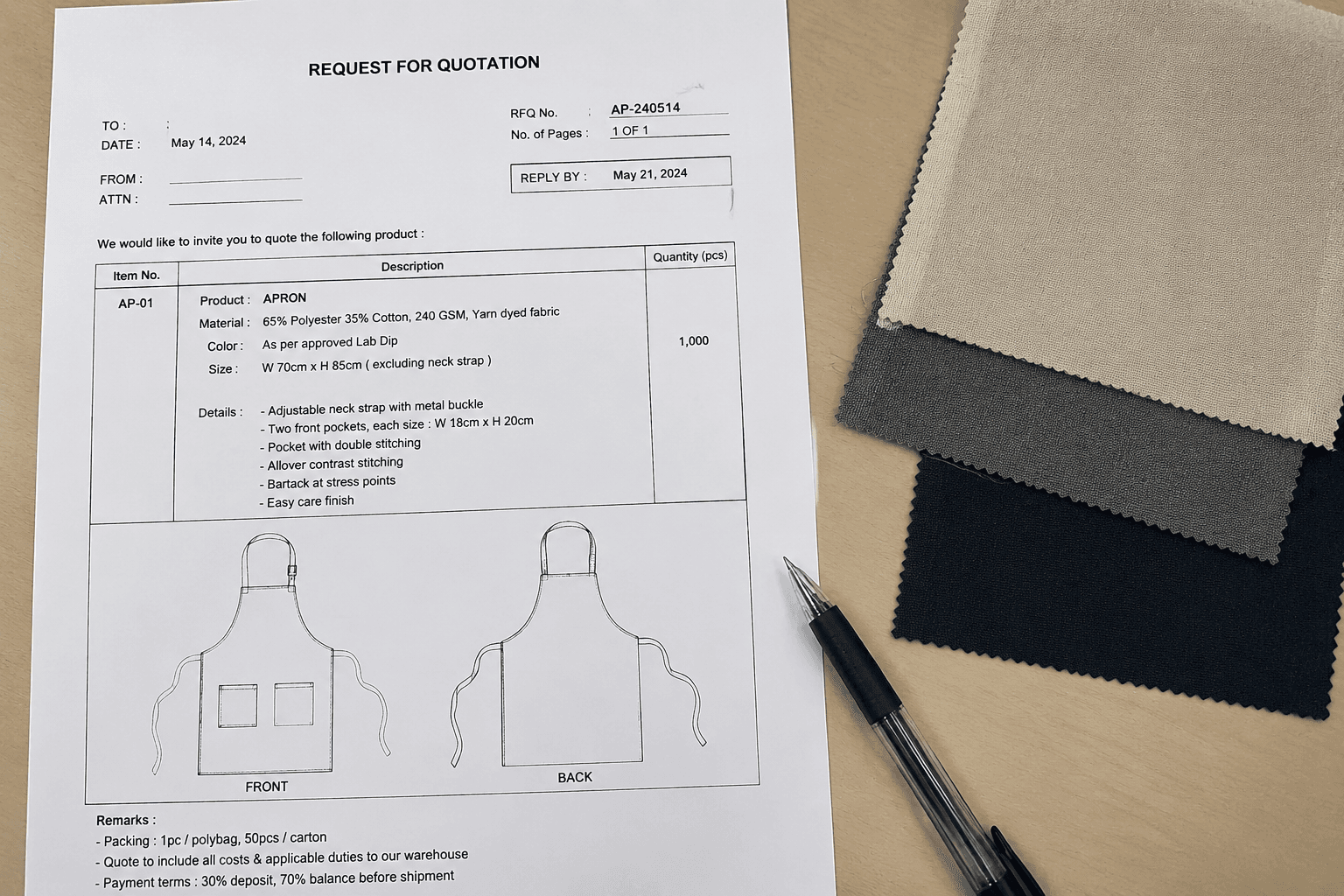
In practice, appearance retention should be quoted and approved at the same time as price. Two pastel aprons can photograph almost identically, yet perform very differently after 20 wash cycles if one uses 210 GSM smooth twill and the other uses 165 GSM brushed cloth. Buyers should require every supplier to quote by fabric weight, blend, weave, shrinkage target, trim strategy, reinforcement points and inspection standard before comparing FOB.
- Define duty level as front-of-house, light prep or mixed duty before RFQ release.
- State the wear pattern clearly, such as 8-10 hour shifts, 5-6 days per week and 3-5 washes weekly.
- Set measurable requirements including shrinkage under 3%, colorfastness grade 4 and AQL 2.5 major.
- Request swatches in the approved pastel plus one darker trim option for ties, pocket openings or neck straps.
Fabric specs for pet bakery aprons: why 200-240 GSM is the commercial sweet spot
For most professional pet bakery aprons, the safest balance of cost, structure and wash durability sits between 200 and 240 GSM, or about 5.9 to 7.1 oz. In OEM production, 210 GSM and 230 GSM twill are common benchmarks because mills can supply them consistently and sewing lines can process them with predictable shrinkage and seam behavior. In this range, the apron has enough body to hold a clean silhouette, support pockets and resist the collapsed look that makes pastel uniforms appear worn early.
Blend choice matters almost as much as weight. A 65/35 poly-cotton twill typically gives the best price-to-life ratio for mid-market retail programs and often lands around $3.20-$4.80 per piece FOB for a simple bib style at 500-1000 pcs. An 80/20 blend usually dries faster, wrinkles less and holds dimensions better after frequent laundering, but it can feel less natural by hand. Pure cotton can support an artisanal brand story, yet it normally brings slower drying, more wrinkling and 3%-5% shrinkage unless pre-shrinking and wash testing are tightly controlled.
Surface finish is where many pastel programs fail. Buyers ask for a soft hand feel and receive a brushed or peach-finish fabric that looks attractive at sample stage but traps lint after the first shift. For this category, smooth-faced twill or firm plain weave is safer than fuzzy finishes, slub textures or low-density cottons. If the fabric face is too hairy, the apron can look old after one week of store use even when seams are still sound.
- 180-190 GSM / 5.3-5.6 oz: workable for low-duty service, but often too light for 3-5 washes per week.
- 200-220 GSM / 5.9-6.5 oz: strongest baseline for most bib apron programs.
- 230-240 GSM / 6.8-7.1 oz: better for embroidery, segmented pockets and heavier wash schedules.
- 65/35 poly-cotton twill: usually the best commercial balance of cost, drying speed and wear life.
- 80/20 poly-cotton twill: stronger dimensional stability and faster overnight turnaround between shifts.
Pastel branding on pet bakery aprons: keep light body colors, darken touch zones
Many retailers initially request fully pastel aprons to match packaging, fixture colors and social imagery. In use, that creates a maintenance issue. The lower front, side tie path, pocket top and towel-contact zone are the first places to show greying, floury dust, syrup transfer and handling marks. On cream, lavender, blush or pale mint, those zones can look untidy long before the apron is structurally worn out.
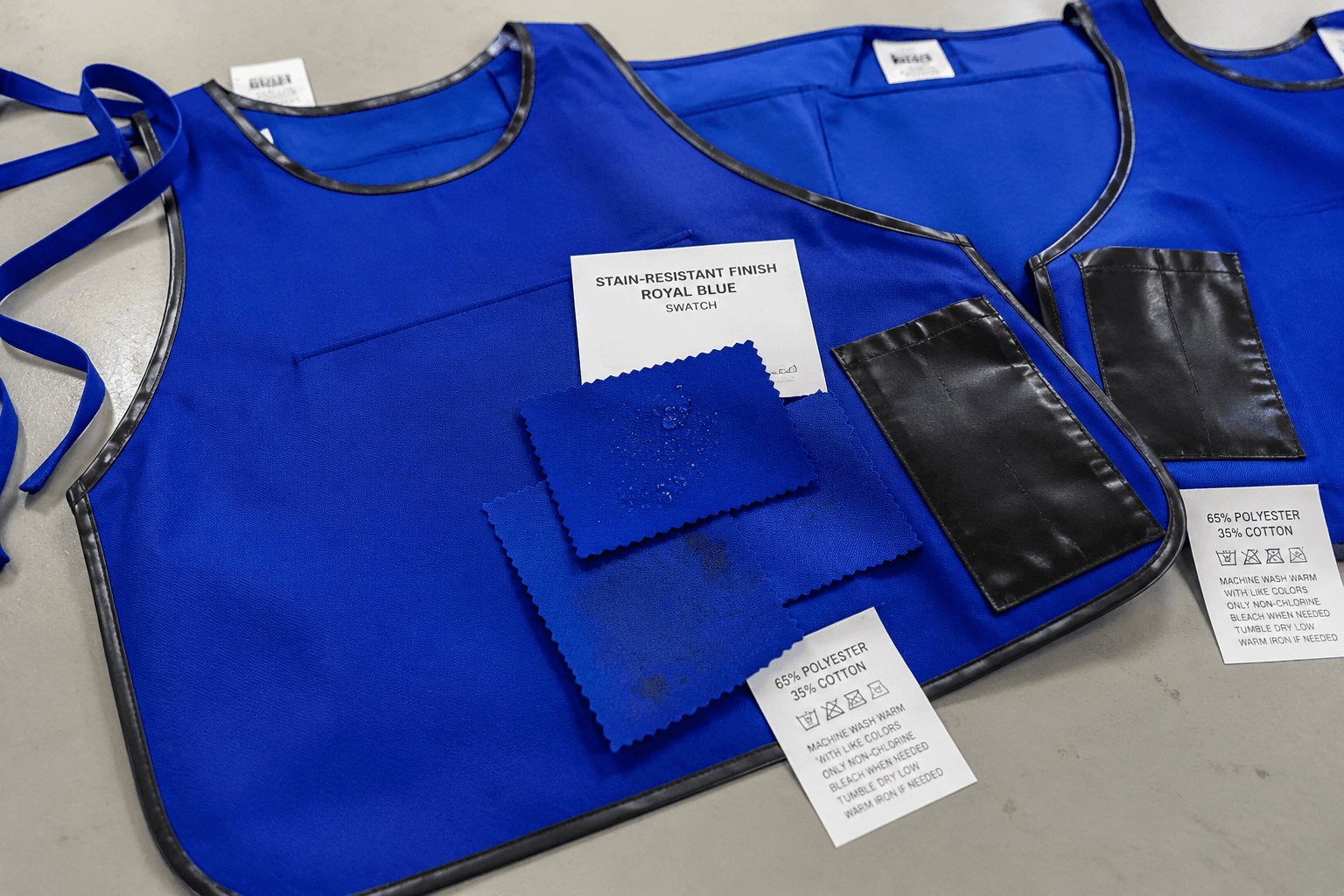
A stronger commercial solution is to keep the body in the approved brand pastel while shifting the highest-contact details one or two tones darker. A pale sage body with olive straps, a blush body with cocoa binding, or a powder-blue body with slate pocket welts still reads on-brand, but it hides hand soil and edge wear much better. This small adjustment can extend presentable floor life by several wash cycles and reduce replacement volume across a 10-store or 30-store program.
Color approval also needs to move beyond flat lab dips. Pastels usually look cleaner on a swatch than on a sewn bib apron with folds, topstitching and shadows. Buyers should review a sewn sample under 3000K-4000K warm retail lighting and again in daylight, then run at least one full-shift wear test followed by a wash. That step quickly reveals which shade attracts lint fastest and which trim placement keeps the apron looking cleaner on the sales floor.
- Use darker neck straps and waist ties to reduce visible hand soil at the most touched areas.
- Avoid very pale pocket openings if staff handle kraft bags, syrup bottles, scoops or handheld POS units.
- Approve color from lab dip plus sewn sample, not flat fabric alone.
- Check the sample under both store lighting and daylight before bulk dyeing approval.
Wash frequency planning: cost per presentable month matters more than FOB
Wash planning is where apron programs either save money or quietly lose it. Buyers should estimate annual wash cycles per piece before issuing the PO. If each employee rotates 2 aprons and each apron is washed 3 times per week, one piece reaches roughly 150 cycles per year. At 4 washes per week, the count passes 200 cycles. Under that level of use, a lightweight $3.60 apron can become the more expensive option if fading, twisting or pocket sag forces replacement after 4 or 5 months.
Suppliers should therefore provide wash data at 10, 20 and 50 cycles, with attention to shrinkage, skew, color loss, seam distortion and pocket-edge stretching. For pastel aprons, the visual threshold matters more than total physical failure. An apron may still be wearable at 90 cycles, but if the lower panel looks dull and the tie path is permanently greyed, it no longer supports the store standard. That is why seam strength data alone is not enough for this category.
From a cost standpoint, paying an extra $0.45-$0.75 per piece for heavier twill, bartacks and better trim placement often lowers annual uniform spend. Moving from a $3.85 apron with a 5-month presentable life to a $4.45 apron with an 8-month presentable life usually improves replacement economics, especially for chains operating 20-50 stores. Procurement should compare quotes by cost per presentable month, not only by unit FOB.
- Estimate annual wash exposure at 120, 150 or 180+ cycles before finalizing fabric weight.
- Request reports covering shrinkage, skew, color change and pocket stability after repeated laundering.
- Specify bartacks at pocket corners and tie joins if aprons are washed more than 2 times weekly.
- Favor faster-drying 65/35 or 80/20 twill when stores need overnight apron turnaround.
Construction details that reduce lint visibility, pocket sag and early replacement
Small construction decisions directly affect service life and visual neatness. For specialty food retail aprons, neck strap width, pocket segmentation, stitch density and reinforcement determine whether the garment still hangs cleanly after months of wear. A 3.0-3.5 cm neck strap usually distributes weight better than a narrow 2.5 cm strap when staff carry pens, order slips, treat tongs or a small POS device. Wider straps also help the apron lie flatter across the upper chest, which improves presentation on lighter colors.
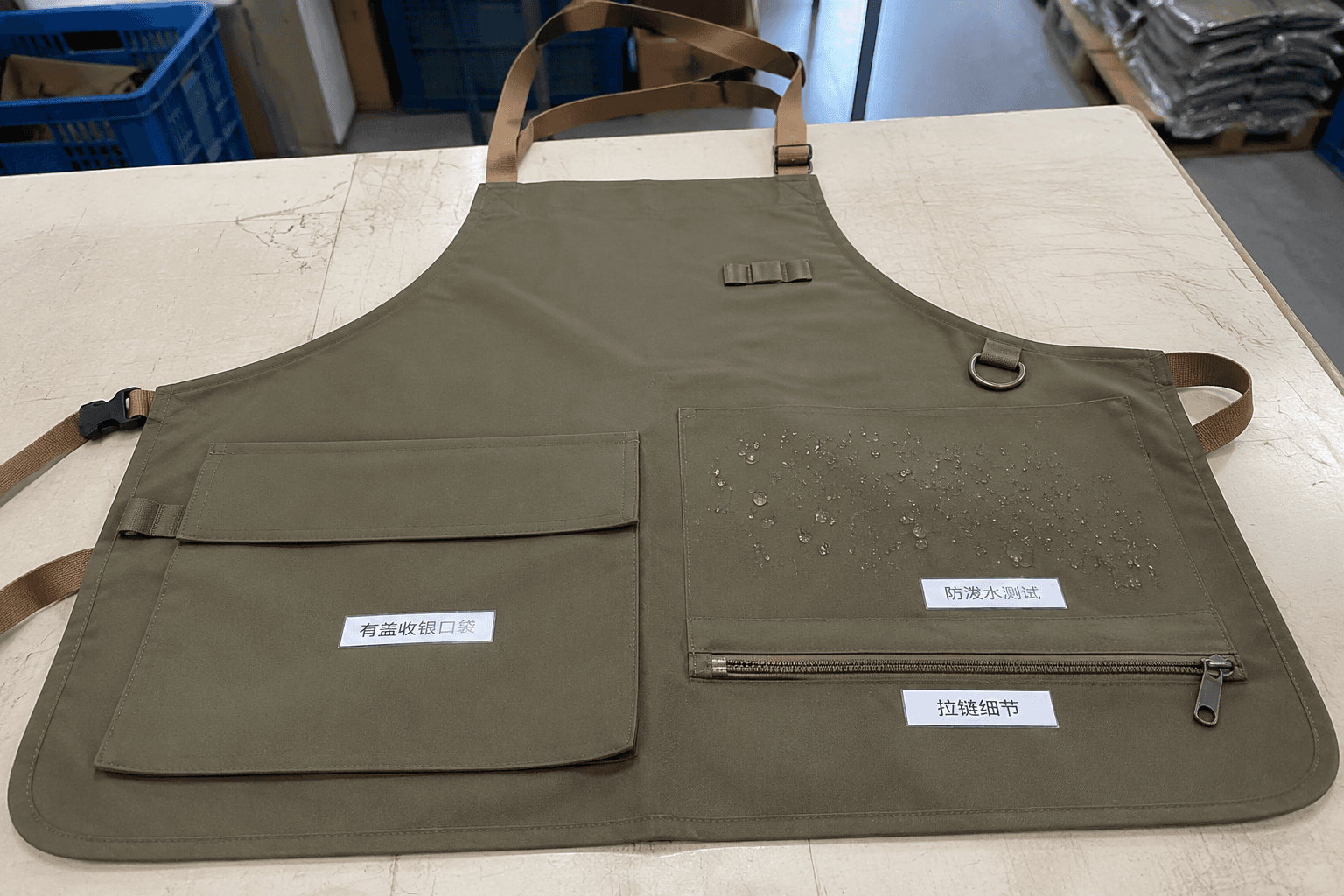
Pocket design should follow store workflow rather than sample-room styling. A single wide pocket may look minimal and low-cost, but it tends to stretch at the mouth and sag once staff store multiple items. A divided pocket with two or three compartments generally holds shape better and spreads weight more evenly. On pastel aprons, that matters because stretched pocket edges create darker shadow lines that make the front panel look tired sooner under bright retail lighting.
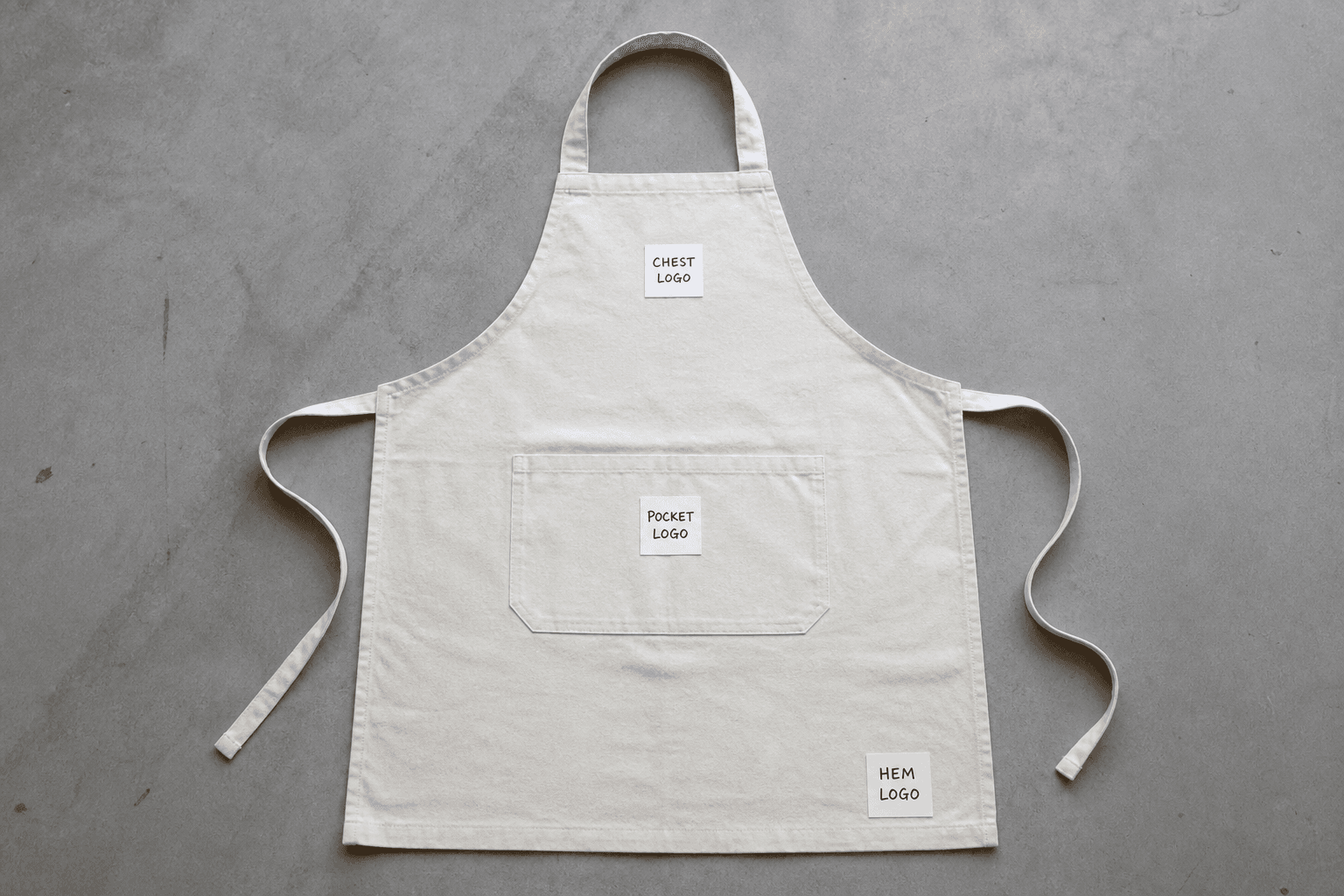
Quality tolerances should be written into the tech pack and purchase order, not left to verbal alignment. Buyers can reasonably request key measurement tolerance of plus or minus 1 cm, balanced strap length, consistent stitch density, clean thread trimming and embroidery that does not pucker after washing. If embroidery is included, the sample should be checked before and after laundering because stitch fill that looks flat on day one can distort a pale panel after only a few washes.
- Specify 3.0-3.5 cm neck straps for all-day bib styles.
- Use 2-3 compartment pockets when staff carry more than one tool or device.
- Add bartacks at pocket corners, strap joins and tie attachment points.
- Set key measurement tolerance at +/-1 cm before bulk cutting.
- Review embroidery puckering on a washed sample, not only on the original proto.
MOQ, lead time, pricing and AQL benchmarks for bulk pet bakery aprons
The commercial picture depends on how customized the apron is. A stock-fabric bib style with one-color print or simple embroidery can often start at 200-300 pcs per color per style. Once the program adds custom-dyed pastel cloth, contrast binding, metal adjusters, cross-back straps or individual packaging, MOQ usually rises to 500-1000 pcs per color per style and can go higher if the mill must run a dedicated dye lot. Buyers planning multi-store launches should limit unnecessary SKU splits so MOQ is not diluted across too many color variants.
Lead time should match the real approval path. A first proto commonly takes 7-12 days when artwork, dimensions and trim instructions are complete. A revision or pre-production sample usually needs another 5-7 days. Bulk production then runs 25-40 days after final approval and deposit, while custom dyeing, peak-season capacity pressure or delayed accessories can push total production to 45 days. For pastel programs, a prudent calendar also leaves 5-7 days for lab dip review and shade confirmation before fabric booking.
Price should always be read alongside inspection level and defect tolerance. A simple 200-220 GSM poly-cotton bib apron with one logo application commonly sits around $3.20-$4.60 per piece at moderate volume. A 230-240 GSM style with custom dye, darker trims, segmented pockets and reinforcement details often lands around $4.80-$6.80 per piece. For this category, AQL 2.5 major and AQL 4.0 minor is a practical baseline, with inspection focused on color shading, sewing consistency, measurement tolerance, logo position and hardware finish.
- MOQ, stock-fabric logo styles: typically 200-300 pcs per color per style.
- MOQ, custom-dyed pastel styles: typically 500-1000 pcs per color per style.
- First sample: usually 7-12 days.
- Revision sample: usually 5-7 days.
- Bulk production: usually 25-40 days after approval and deposit.
- Inspection target: AQL 2.5 major and AQL 4.0 minor.
Pre-production approval checklist for professional apron buyers
The safest approval process combines brand review with short real-use testing. Buyers should not approve from swatches and quotations alone. Test at least two candidate constructions in store conditions for 3-5 working days, then wash them using the actual laundry method. This quickly shows whether the fabric grabs lint, whether pocket openings stretch, whether ties twist and whether the chosen pastel still looks clean halfway through a normal shift.
A trial also aligns internal stakeholders. Design teams often prioritize softness and exact shade, store managers want the cleanest-looking apron at hour eight, and procurement wants the best landed cost. A side-by-side wear test turns those competing priorities into measurable decisions. If one style is $0.55 cheaper but shows visible pet hair and crumb residue by midday, the nominal saving usually disappears through faster replacement and weaker store presentation.
From the factory side, projects run more smoothly when the buyer supplies acceptance criteria at the start. State the target wash life, shrinkage limit, expected pocket load, trim color strategy and inspection benchmark before sampling begins. That reduces sample rounds, limits bulk misunderstanding and makes repeat orders 6 or 12 months later more consistent.
- Run a 3-5 day store trial on at least two apron constructions before bulk approval.
- Score each sample for lint visibility, wrinkle recovery, shrinkage and pocket stability.
- Set a target replacement window such as 6 months, 8 months or 9 months.
- Keep one sealed approved sample as the production reference for repeat POs.
- Confirm final approval against the actual laundry method, not assumed home-wash conditions.