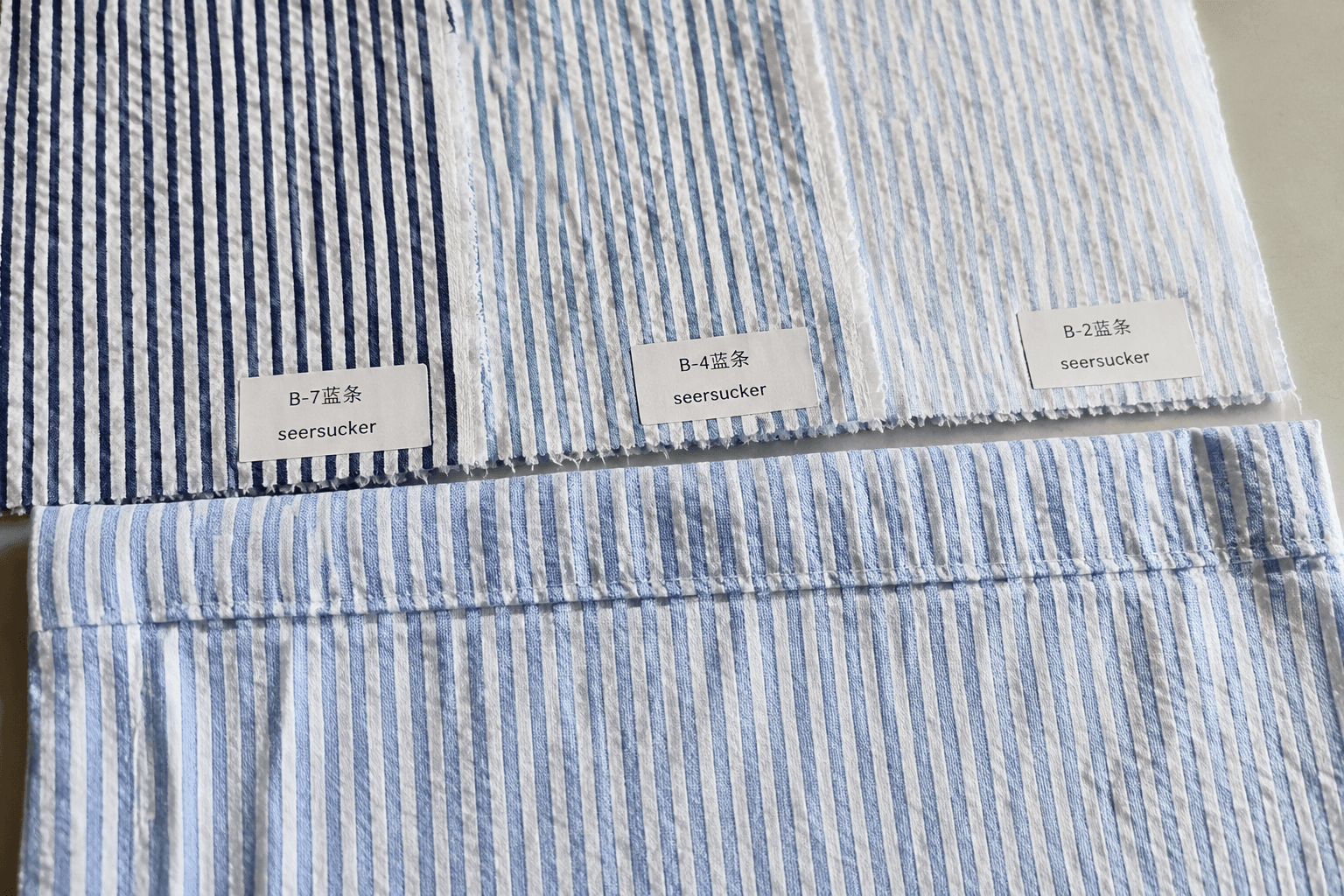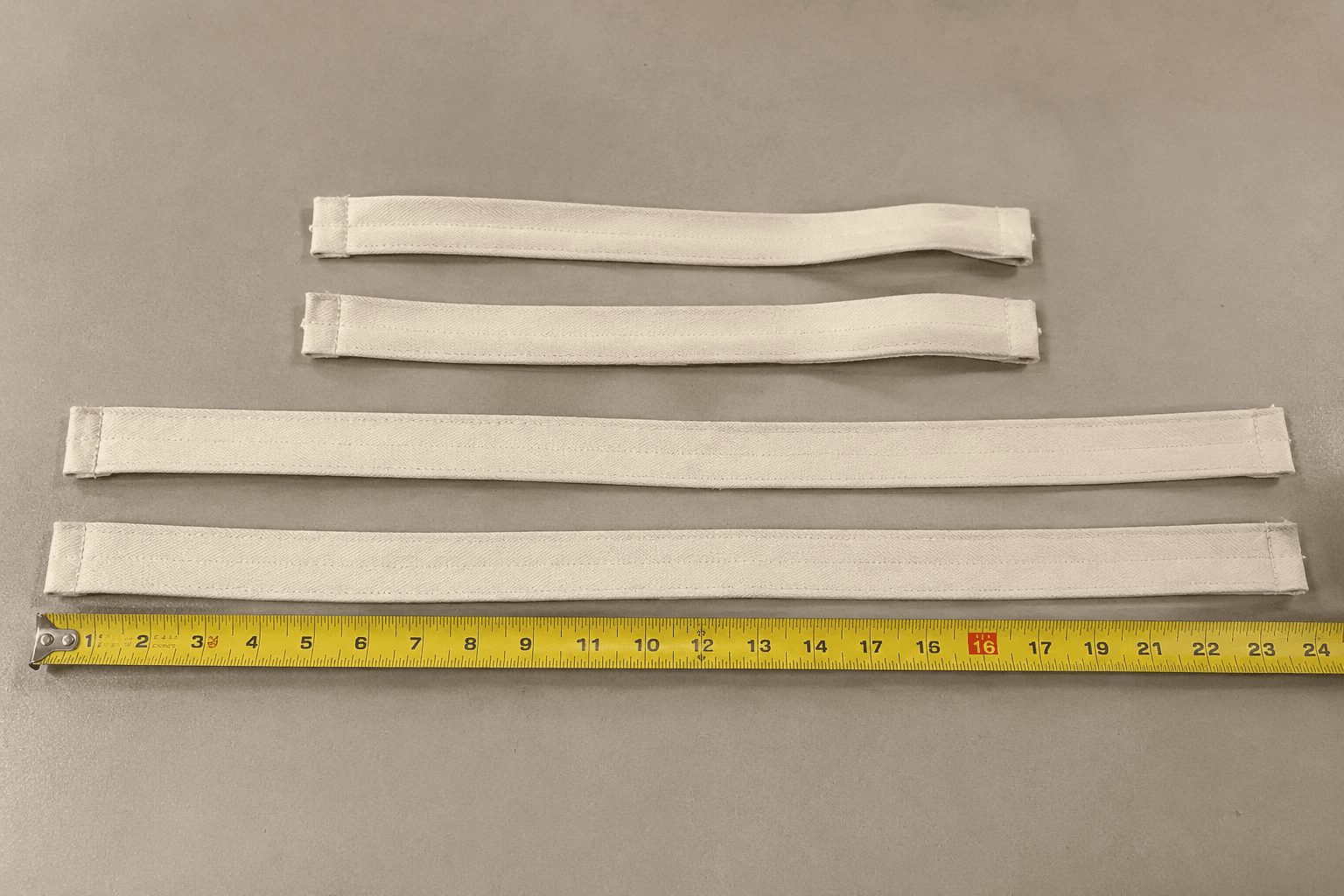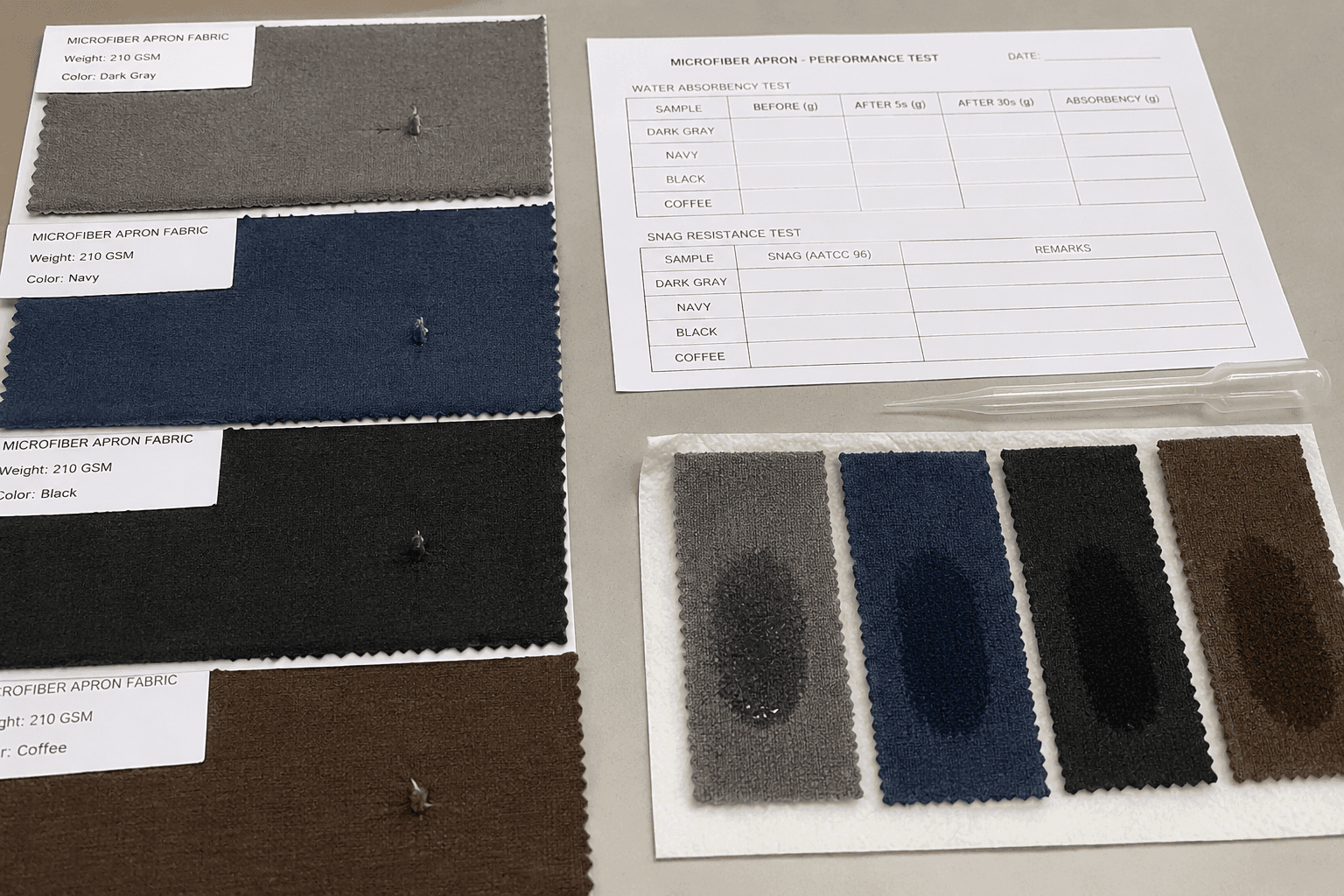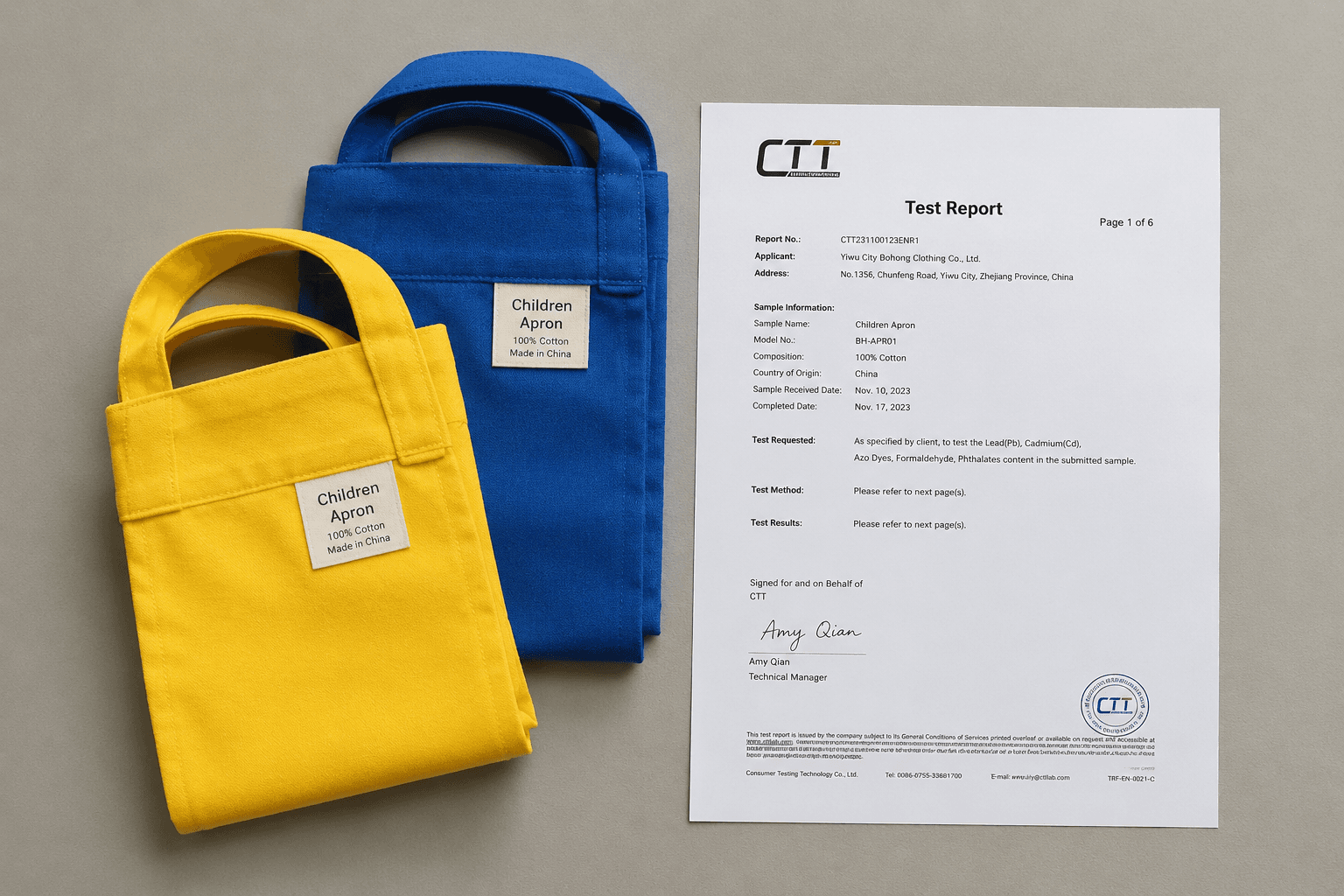
For B2B buyers, the real question in open end vs ring spun cotton aprons is not which yarn sounds better on a sales sheet. It is which fabric specification gives the right apron result at the target FOB: acceptable handfeel at the neck and chest, stable seams at pocket corners, clean logo edges on the front panel and consistent appearance across 1,000 to 5,000 pcs.
In apron manufacturing, yarn type should be decided with the end use, fabric weight and decoration method together. A 7 oz waist apron for promotions, a 8.3 oz to 9 oz café bib apron and a 10 oz to 11 oz workshop apron do not need the same surface, drape or finish. In many factory programs, shifting from open-end to ring-spun cotton at similar GSM adds about $0.18 to $0.45 per piece and can extend bulk lead time from 28 to 35 days to 38 to 50 days when custom dyeing, wash finishing or extra print approval is required.
Open-end cotton canvases and twills are widely used for aprons in the 240 to 340 GSM range because they are commercially efficient and readily available in core colors. Ring-spun cotton is more common when the buyer needs a softer face, lower visible fuzz after washing or sharper print results on the bib panel. The correct choice depends on target price, wash standard, logo detail, inspection level and how refined the finished apron needs to look in service or at retail.
- Open-end cotton aprons usually lower fabric cost and can reduce FOB by roughly $0.18 to $0.45 per piece versus comparable ring-spun apron fabrics.
- Ring-spun cotton aprons usually deliver a smoother hand and cleaner print surface, especially for small chest logos, fine outlines and white ink on dark bib aprons.
- Apron durability depends on more than yarn type; GSM, weave density, stitch count, bartacks and wash finish have equal impact on service life.
- Typical MOQ is about 800 to 1,500 pcs per color for stock-supported open-end apron fabrics, while custom ring-spun fabric programs often start at 2,000 to 3,000 pcs per color.
- Bulk lead time is commonly 28 to 35 days for standard open-end apron orders and 38 to 50 days for ring-spun orders requiring custom fabric, lab dips, sanforizing or added print testing.
- Sampling should include wash, rub and print checks on the finished apron, because surface fuzz, shrinkage and logo edge definition often change after laundering.
Open end vs ring spun cotton aprons: what actually changes on the finished apron
For apron buyers, yarn choice matters only when it changes the finished product in visible or measurable ways. Open-end yarn is rotor spun and usually delivers a bulkier, drier and slightly hairier fabric face at a lower conversion cost. In aprons, that typically creates a more rugged workwear look suited to utility bib aprons, butcher aprons, florist aprons and entry-price uniform programs.
Ring-spun yarn is more compact and more even, so the apron face is usually smoother at the same nominal weight. On a standard 70 x 85 cm bib apron, buyers tend to notice the difference on the chest area, top pocket edge and front-panel flatness rather than on hidden seam allowances. The effect is most obvious in black, navy, charcoal and dark olive, where stray surface fibers show more clearly under shop lighting and in product photography.
That is why open end vs ring spun cotton aprons should be evaluated as a full apron-construction decision, not as an isolated yarn note. The yarn influences handfeel, logo sharpness, visible fuzz after washing, response to softening finishes and the overall presentation level of the apron. For a café or branded retail apron, these details can influence perceived quality as much as pocket layout, hardware or packaging.
- Open-end fabrics usually feel drier and show a more textured, matte apron face.
- Ring-spun fabrics usually feel smoother and present a cleaner bib panel at equal GSM.
- The difference shows most on dark colors, large front panels and printed chest-logo areas.
- Yarn choice should be reviewed with GSM, weave, finish and wash requirement together.
Handfeel and drape by apron category: 240 GSM promo styles to 340 GSM workwear
Handfeel matters because aprons are worn for long shifts and sit directly on the neck, chest and waist. In practice, a 240 to 280 GSM open-end cotton twill can be acceptable for low-cost waist aprons or simple bib aprons, but it often still feels drier than a ring-spun fabric at similar weight. At 300 to 340 GSM, open-end canvas gives a firm, structured body that suits workshop, grill and warehouse aprons where stiffness is not a drawback and the buyer wants a sturdy workwear look.
Ring-spun cotton usually performs better when the brief calls for softer drape or more comfortable all-day wear. A 260 GSM ring-spun twill often feels more pliable than a 240 GSM open-end canvas while still holding a clean front shape. That makes ring-spun a common choice for café bib aprons, cross-back aprons, bakery aprons and higher-tier hospitality programs where the apron should look neat without feeling harsh against the chest.
Finishing can reduce the gap, but the commercial effect needs to be priced honestly. Enzyme wash, silicone softener or garment wash can make an open-end apron noticeably softer, but these steps usually add $0.20 to $0.55 per piece and around 3 to 6 extra production days. On a target FOB below $3.00, that additional finishing can remove most of the original open-end savings. Buyers should therefore approve handfeel from a washed full apron sample, not from a mill hanger or a small fabric swatch.
- For 7 oz to 8 oz promotional aprons, open-end is often adequate if price is the first priority.
- For 8.3 oz to 9.5 oz café and hospitality aprons, ring-spun usually gives a cleaner drape and softer touch.
- For 10 oz to 11 oz grill or workshop aprons, open-end canvas often matches the rugged product brief.
- Softening finishes improve comfort, but they add real cost and several lead-time days.
Strength, seam performance and wash appearance in commercial apron use
A common sourcing mistake is to assume that ring-spun cotton automatically means a stronger apron. In actual use, apron durability depends at least as much on fabric weight, weave density, stitch construction and reinforcement details. A 300 GSM open-end canvas apron sewn with 3.5 to 4 stitches per cm, bartacks at pocket corners and reinforced tie joins can outlast a 220 GSM ring-spun apron built mainly for softness.
Where ring-spun fabric more often helps is retained appearance after repeated laundering. After 20 to 30 home-wash cycles, or after 10 to 15 commercial laundry cycles, ring-spun aprons generally show less visible fiber lift around pocket mouths, side hems and strap attachment points. The gain is not always a dramatic difference in lab tensile or tear values, but it often produces a tidier apron face for longer, which matters in hotel, café and branded service programs where appearance is part of the value.
Buyers should separate structural durability from visual aging during approval. Aprons usually fail first at stress points such as top pocket corners, towel-loop joins, waist-tie insertions and neck-strap seams, not in the center of the body fabric. At the same time, an apron can be commercially rejected even if seams hold, simply because the front panel looks old too quickly. Inspection and testing should therefore cover seam slippage, tear, tensile, wash appearance and measurement stability together.
Shrinkage also needs to be specified before sampling. Many 100% cotton apron fabrics still show 3% to 5% shrinkage after washing unless sanforized, pre-washed or otherwise controlled. If bib length, pocket height or strap position has a tight tolerance, the factory needs that requirement up front, not after bulk cutting has started.
- Use bartacks or box stitches at pocket corners, towel loops, tie joins and neck-strap attachments.
- Review seam slippage, tear and tensile results together instead of relying on one test number.
- Expect around 3% to 5% shrinkage on many cotton aprons unless pre-shrunk or sanforized.
- Apply AQL 2.5 for major defects and AQL 4.0 for minor defects on packed apron goods.
Open end vs ring spun cotton aprons for screen print and logo clarity
For many custom apron programs, print quality decides the fabric choice. Open-end cotton has more exposed fiber ends on the surface, so the print field is less even than on ring-spun fabric. On bold one-color graphics, large rustic logos or distressed branding, that surface can be acceptable and sometimes desirable. On fine typography, thin outlines or dense white ink on black aprons, it usually gives softer edges and more visible pinholing.
Ring-spun cotton generally provides the cleaner print base. In screen printing, pigment printing and many transfer applications, the smoother apron face helps the ink sit more evenly and keeps logo edges sharper. This matters when the buyer needs a 5 to 7 cm chest logo, small text under a brand mark or a front panel that will be photographed close up for e-commerce, catalogues or franchise rollout approvals.
The cost premium is often lower than the risk of poor print results. Moving from a 270 GSM open-end canvas apron to a ring-spun apron fabric at similar weight commonly adds about $0.18 to $0.40 per piece, depending on color, mill source and finish. If the order depends on logo precision, that extra cost is often cheaper than heavier ink laydown, repeated strike-offs or accepting a lower-grade print appearance on the final apron.
Approvals should always be made on the actual apron fabric and color planned for bulk. A natural 280 GSM open-end canvas and a black 280 GSM ring-spun twill may share the same fiber content and similar weight, but they will not print, wash or photograph the same way.
- Open-end cotton works best for bold, simple and intentionally textured logo styles.
- Ring-spun cotton is safer for fine lines, small text and white-on-black chest prints.
- Require strike-offs on the exact bulk fabric, color and finish before PP approval.
- Check print edge breakup again after one to two wash cycles, not only before washing.
MOQ, FOB and lead-time ranges buyers can expect from apron factories
From a sourcing perspective, open-end cotton is usually the easier apron buy. Stock-supported canvases and twills in black, natural, navy and khaki are widely available from Chinese mills, which supports faster booking and lower material cost. For a basic 70 x 85 cm bib apron with one front pocket, self-fabric ties and simple screen print, a realistic FOB range is often $2.10 to $3.60 per piece at 1,000 to 3,000 pcs. A heavier 320 GSM to 340 GSM utility apron with webbing, rivets or contrast hardware will price higher.
Ring-spun cotton usually brings a moderate fabric premium and sometimes a narrower supplier base if the buyer needs repeatable softness and cleaner face quality. For a comparable bib apron silhouette, FOB is often around $2.35 to $4.20 per piece at similar volumes. Washed finishes, custom trims, individual retail packing or metal hardware can push the price further. The gap between open-end and ring-spun is not fixed; it moves with cotton market conditions, dye depth, accessory count and finishing route.
MOQ depends heavily on whether the fabric is stock-supported or custom made. Open-end apron programs using stock colors commonly work from 800 to 1,500 pcs per color. Custom-dyed ring-spun fabrics, or ring-spun constructions developed to a specified handfeel and weight, more often need 2,000 to 3,000 pcs per color for efficient mill production. If the buyer also requires custom Pantone approval, sewn-in brand labels, barcode stickers and individual polybags, order economics improve notably above 2,000 pcs.
Lead time should be fixed before the quotation is confirmed. A standard open-end apron order based on available fabric can often run in 28 to 35 days after deposit and PP approval. A ring-spun order requiring lab dips, custom weaving, sanforizing, wash finish and print confirmation typically runs 38 to 50 days. Repeat orders can be shorter, but only if the same mill, same finish and same approval standard are maintained without mid-order changes.
- Open-end cotton usually offers lower FOB and easier replenishment in core apron colors.
- Ring-spun cotton usually needs earlier planning when custom fabric development is involved.
- Typical MOQ is 800 to 1,500 pcs for stock apron fabrics and 2,000 to 3,000 pcs for custom ring-spun fabric.
- Adding lab dips, wash finishing and print approvals can extend the schedule by 10 to 15 days.
How to sample and specify the right apron program without costly revisions
The most reliable sourcing results come from a complete apron brief rather than a simple request for cotton canvas. At minimum, the buyer should specify apron style, finished size, target weight in GSM or oz, weave, color standard, decoration method, wash requirement, shrinkage tolerance, seam reinforcement points, inspection standard and target FOB. Without that information, two factories can quote very different apron builds while both claiming to offer the same product.
When comparing open end vs ring spun cotton aprons, use like-for-like samples. If one development sample is a 240 GSM open-end canvas apron and the other is a 300 GSM ring-spun twill apron with heavy softener, the comparison is commercially meaningless. A better method is to request the same apron pattern, same dimensions, same pocket layout and same logo placement in both fabric options, then assess drape, print definition, wash appearance and cost side by side.
A practical approval path is fabric swatch first, print strike-off second and a full pre-production apron third. Print strike-offs usually need about 5 to 7 days, and a PP apron sample often needs 7 to 10 days depending on trim availability and sampling load. If washing, embroidery or hardware approval is involved, buyers should allow extra time before bulk cutting. Rushing this stage usually leads to preventable disputes over logo sharpness, handfeel or shrinkage.
Most costly problems in apron sourcing are not catastrophic failures. They are expectation gaps: a black apron that pills too quickly, a logo edge that looks fuzzy under retail lighting, or a handfeel that does not support the intended price tier. Those problems are manageable when the yarn choice, finish and decoration method are tested on finished aprons early in development.
- Put GSM or oz, weave, finish, shrinkage target and decoration method on one approved spec sheet.
- Compare open-end and ring-spun aprons in the same style, color and logo position.
- Allow about 5 to 7 days for strike-offs and 7 to 10 days for PP apron samples.
- Lock inspection points for print, measurements, seams, color shading and packing before bulk production.