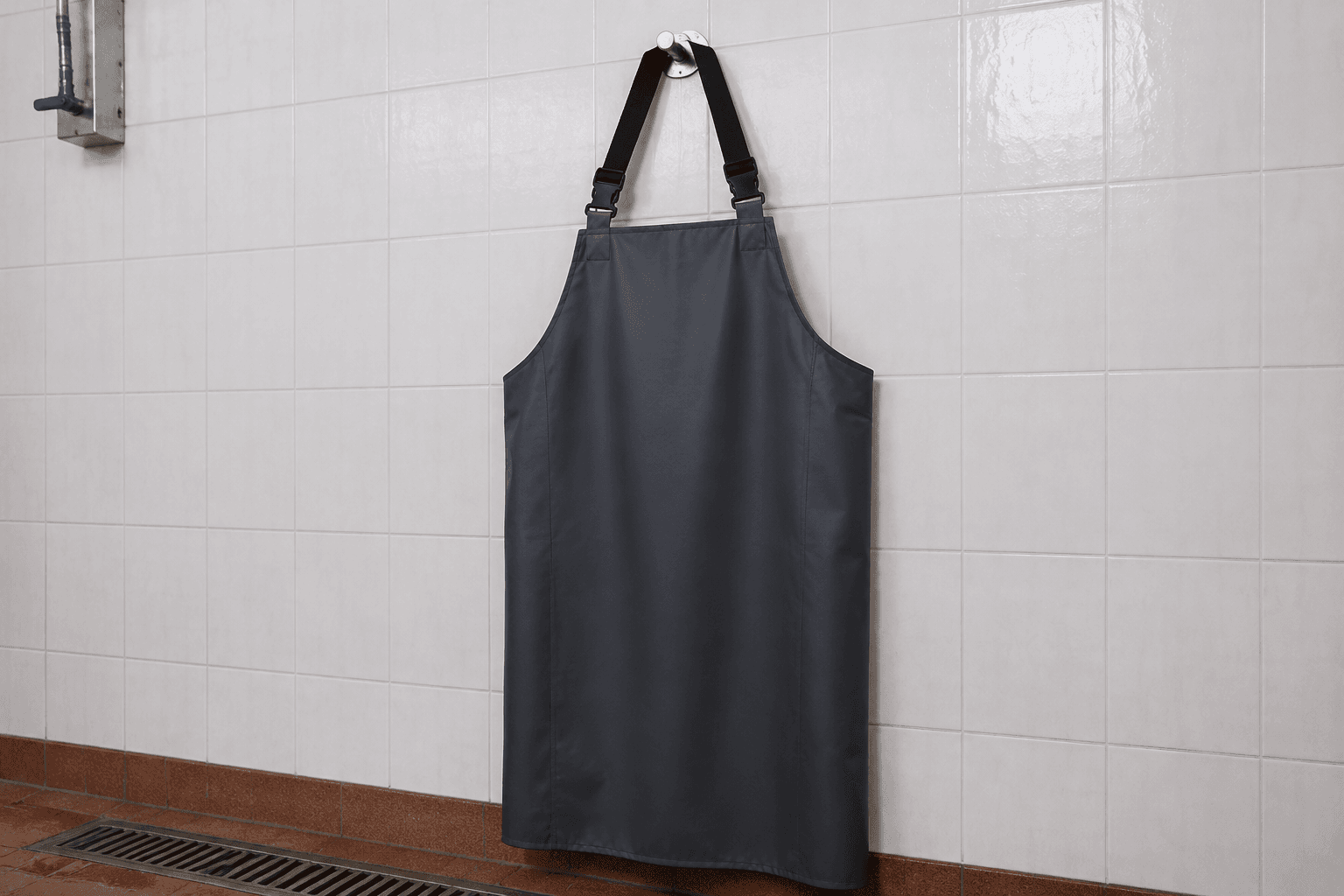
When buyers source aprons for dishwashing, food processing, lab support, car wash, industrial cleaning, or light chemical handling, the material decision matters more than the pattern. A standard cotton twill apron may look fine on a sample, but it will fail fast once the job includes constant rinsing, detergents, oils, acids, or repeated wipe-downs. For these programs, coated apron fabric is usually the first material family we evaluate, because it gives the buyer a controlled balance of water resistance, cleanability, weight, and cost.
In our factory work, the most common request is not simply “make it waterproof.” Buyers need a waterproof work apron that can be sewn at scale, printed or branded cleanly, packed efficiently, and priced to meet margin targets. They also need to know where the limits are. A PVC apron material may be the best choice for hard splash protection at a low cost, while a neoprene apron can be better where flexibility and wearer comfort matter more than absolute chemical resistance.
The right spec depends on exposure profile, cleaning method, and shift length. Two aprons that look similar on a line sheet can perform very differently in production if one uses a 0.18 mm PU coating on 210D base cloth and the other uses 0.35 mm PVC laminated on 500D polyester. The trade-off is usually between softness, seam construction, solvent resistance, heat tolerance, and final landed cost. This article lays out how we advise buyers when they are building a wet-work or light chemical apron program from China.
- Coated apron fabric is the most flexible starting point for wet-work programs because it can be tuned by coating type, base fabric, and finish weight.
- A neoprene apron usually costs more than basic PVC styles, but it improves comfort, drape, and cold-weather wearability for long shifts.
- For splash-only applications, 0.18-0.25 mm PU or 0.25-0.35 mm PVC can be enough; for stronger chemical exposure, buyers should verify the exact liquid and concentration before approving the spec.
- A well-built chemical resistant apron depends as much on seams, binding, and hardware as on the face fabric.
- Factory MOQ commonly starts at 500-1,000 pcs per color/spec, with 25-35 day bulk lead time after sample approval and deposit.
- The lowest unit price is not always the lowest landed cost once scrap, rejects, cleaning life, and replacement frequency are included.
What coated apron fabric actually means in production
In sourcing language, coated apron fabric is not one single material. It is a base fabric, usually polyester, cotton-poly, or nylon, finished with a functional layer that blocks water, grease, or certain chemicals. The coating can be PU, PVC, TPU, acrylic, or a laminated film. For apron buyers, the important variables are coating thickness, base cloth density, hand feel, seam process, and whether the material remains flexible after repeated folding.
A typical waterproof work apron for food service or cleaning might use 210D polyester with a 0.18-0.25 mm PU coating, or 300D polyester with a 0.25-0.30 mm PVC finish. Heavier industrial styles may move to 500D or 600D base cloth with thicker lamination. We measure not only the face weight but also how the finished apron behaves after sewing. A material that looks robust on paper can still crack at the fold line if the coating is too brittle or if the apron is stored cold and folded tightly.
For buyers, the cost difference between coating systems can be meaningful. A basic PU-coated apron can land around $1.20-$2.20 per piece at moderate volumes, depending on size, print, straps, and pocket count. PVC versions with heavier weight and welded details often sit in the $1.80-$3.50 range. TPU or specialty laminated styles can go higher. The price spread is not just material cost; it also reflects sewing difficulty, reject rate, and whether the factory must use high-frequency welding or ultrasonic sealing instead of normal stitching.
- PU-coated styles are usually lighter and softer, which helps wearer comfort in food and cleaning programs.
- PVC apron material is generally more abrasion-resistant and more tolerant of aggressive wiping and splashes.
- TPU and laminated structures can improve flexibility and reduce cracking, but they raise material cost.
- The coating weight must match the job; overspecifying thickness adds cost without always improving field life.
Neoprene apron vs PVC apron material: where each one wins
A neoprene apron is a different category from a simple coated cloth apron. Neoprene is a foamed synthetic rubber material, normally used where the buyer wants better insulation, elasticity, and a more comfortable drape. In wet work, it performs well because it resists water and gives the user more mobility than a stiff film-coated apron. It is common in fish processing, washdown areas, cold-room handling, brewery support, and certain laboratory or cleaning applications where the wearer bends and reaches all day.
PVC apron material remains the more economical choice for many industrial programs. It is especially useful when the job involves frequent splash contact, a need for easy wipe-down, and a requirement to keep unit cost low. A PVC apron can be produced in 0.25-0.50 mm thickness, with the heavier versions offering better durability but also more stiffness and higher shipping weight. If the buyer wants a simple bib apron, chest protector, or sleeve apron for repeated washdown use, PVC is often the first quote we prepare.
The choice between the two is usually decided by the wearer's movement and the site's cleaning chemistry. Neoprene is comfortable and flexible, but it is not the cheapest option, and it is not automatically the best answer for strong solvents. PVC can be more resistant in some splash applications, but it can become stiff in low temperatures and may not feel as good during long shifts. For a buyer, the correct question is not “which material is better” but “which one lasts longer at the required exposure level while keeping labor acceptance high.”
- Choose neoprene when wearer comfort, flexibility, and cold-weather use matter.
- Choose PVC when the site needs harder splash resistance and the apron will be wiped clean frequently.
- Ask for bend, fold, and low-temperature testing if the apron will be used in refrigerated or outdoor conditions.
- Confirm whether the customer needs a full bib, waist apron, sleeve set, or combination kit, because material selection changes with coverage area.
Designing a chemical resistant apron for real site conditions
A true chemical resistant apron is not defined by one marketing term. It is defined by the liquid list, concentration, contact time, temperature, and cleaning routine. Mild detergents, bleach solution, degreasers, and food acids are very different from concentrated solvents or strong acids. We ask buyers for the actual SDS or at least the product family before we approve the fabric. Without that information, the result is often overbuilt, underbuilt, or misquoted.
For wet work and light chemical exposure, we often build with coated polyester and reinforce the top edge, side seams, and strap anchors. If the program includes splash risk above the waist, we may extend the bib height, add a chest coverage panel, and use welded or taped seams in sensitive areas. If the environment involves rough handling, the apron can be specified with 1-inch webbing ties, adjustable neck buckles, bar-tacked stress points, and corner reinforcement patches. These features add cost, but they reduce return rates and replacement cycle frequency.
A common mistake is to choose a thick material and ignore the sewing method. Stitch holes can become failure points in a liquid barrier unless the seam structure is chosen correctly. For splash-heavy jobs, we often recommend heat sealing, RF welding, or internal seam tape, depending on the coating system. A buyer sourcing for chain restaurants, car wash groups, or cleaning contractors should ask not only about fabric but also about whether the factory has the right sealing equipment for repeatability.
- Request the liquid name, concentration, temperature, and contact time before approving the fabric.
- Confirm whether the apron needs splash protection, full barrier behavior, or only wipe-clean performance.
- Specify reinforced neck and waist attachment points if the apron will be used for long shifts.
- Ask the factory what seam method it uses: stitching, sealing, taping, or a hybrid structure.
Sizing, weight, and comfort trade-offs for bulk orders
For bulk apron orders, comfort is a production issue, not a soft factor. If the apron is too stiff, workers pull it off, tie it loosely, or stop using it. If it is too light, it may not hold up to wash cycles or abrasion. The optimum depends on shift duration and movement. For a standard adult bib apron, the finished weight might sit around 180-350 grams for a light coated style, 350-600 grams for a heavier PVC apron, and higher for thick protective constructions. In U.S. terms, buyers often think in ounces: roughly 6-12 oz equivalent fabric weight for lighter coated styles, and above that for heavier duty variants.
Size also affects perception. A 70 x 90 cm apron may be sufficient for beverage service or kitchen prep, but a 90 x 110 cm or 100 x 120 cm format gives better coverage for washdown and chemical splash protection. Extra width and length increase material use and shipping cost, but they can reduce complaint rates. We routinely advise buyers to compare a standard and extended version before locking the tech pack, because a 3-5 cm change at the chest or hem can materially affect how much splash reaches clothing.
Adjustability should be treated as part of the spec. Neck straps, cross-back systems, buckle materials, and waist ties all affect operator acceptance. For long wear, cross-back straps reduce neck load. For short, task-specific use, a simple neck loop may be fine. A buyer ordering 5,000 pcs for a chain account should not assume one strap style works across all branches; different body types and use durations can change the rejection rate by several percentage points.
- Light duty coated aprons often fall around 180-350 g finished weight.
- Heavier PVC or laminated aprons can reach 350-600 g or more, depending on size.
- Extended patterns improve protection but raise fabric use, freight cost, and storage volume.
- Cross-back straps improve comfort in long shifts; neck loops are simpler and cheaper.
Printing, color, and brand requirements on coated apron fabric
Brand buyers often underestimate how coating affects decoration. A smooth PU or PVC face can take screen print, heat transfer, or embossed branding, but the result depends on surface energy and post-print handling. If the apron is for front-of-house use, the buyer may want a crisp logo in one or two colors, but if it is for industrial use, durability matters more than visual detail. We normally test ink adhesion, rub resistance, and crack behavior after folding before confirming a final decoration method.
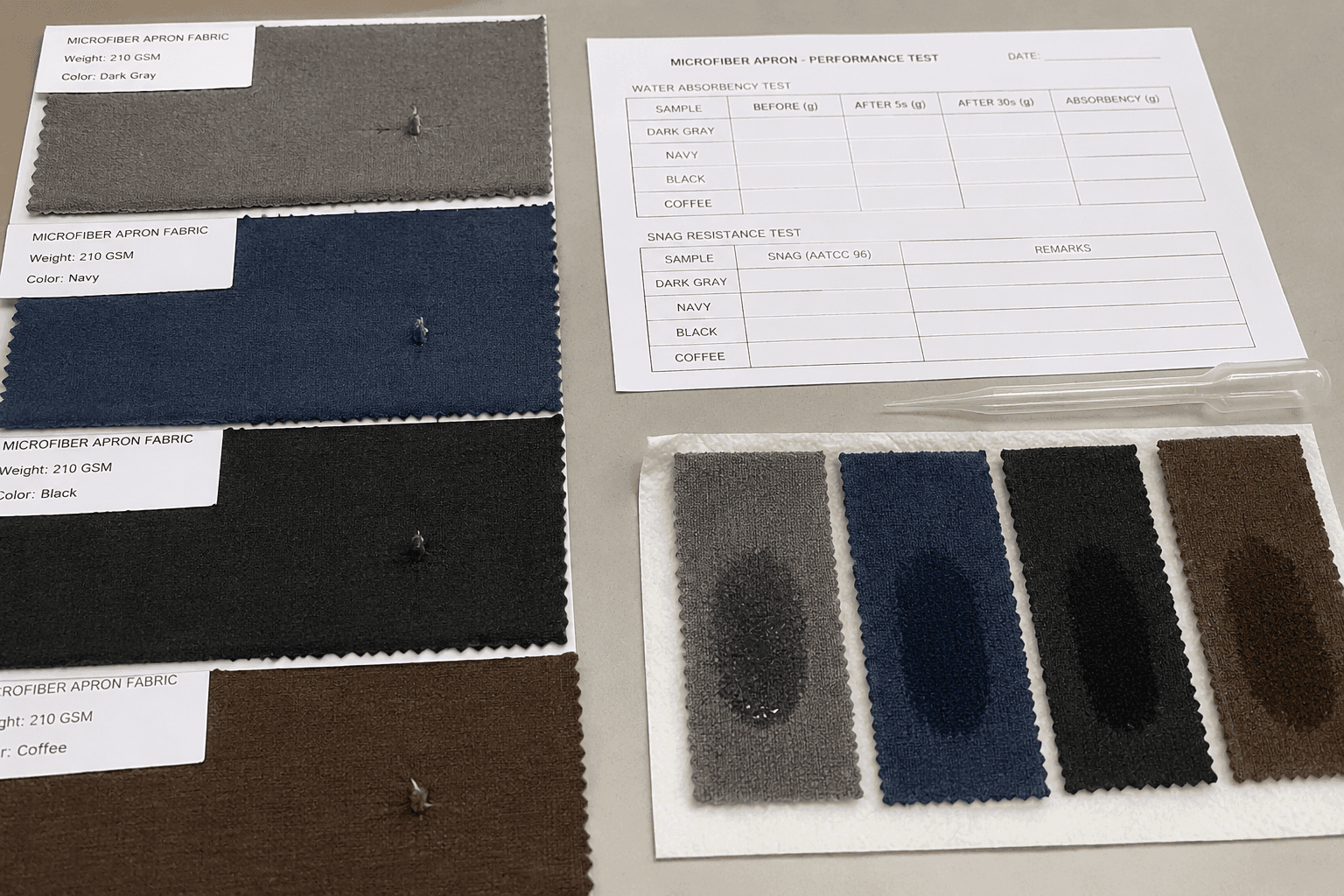
Color choice also has operational value. Black, navy, and dark gray are common for hospitality and cleaning because they hide marks better. White is useful in food or lab contexts where contamination visibility matters, but it requires more frequent washing and replacement. Bright colors can help with role identification, though some coated materials show scuffs faster. If the apron will be used in sunlight, outdoor wash bays, or warm climates, we also check whether the pigment choice affects surface tack or aging.
For OEM and private-label programs, buyers should define the branding zone early. Logo position, size, and the number of print colors influence screen setup cost and MOQ. A one-color chest print may be economical at 1,000 pcs, while a large all-over print or custom pattern typically needs more volume to be viable. If a program is expected to reorder in smaller batches later, it is better to keep the base fabric and cut size stable and vary only the print or label package.
- Test print adhesion after folding and wiping, not just on a flat sample.
- Keep high-volume programs to one or two logo colors if the budget is tight.
- Choose darker colors for cleaning and wet-work programs to reduce visible staining.
- Lock the branding area early so the factory can align screen setup and cut placement.
MOQ, lead time, and pricing for OEM apron sourcing from China
For most custom apron programs in our factory, MOQ starts at 500-1,000 pcs per color or per material spec, depending on complexity. A simple coated apron with standard cutting and one print can sometimes be pushed lower, but the unit cost rises quickly. If the buyer wants custom molds, special buckles, welded seams, or multiple colors, the MOQ and lead time both increase. Sampling typically takes 7-12 days if the material is in stock, or 12-18 days if we need to source a special coating or hardware.
Bulk production usually runs 25-35 days after sample approval and deposit for standard coated styles. If the apron requires imported material, special printing, or RF welding, 35-45 days is more realistic. Air freight can compress transit, but the production clock does not change much. Buyers who work on store openings or seasonal launches should plan a buffer because fabric dye lots, coating consistency, and print registration can add small delays that matter when the ship date is fixed.
Pricing is driven by five main variables: material thickness, size, seam method, decoration, and packing. As a practical range, a basic PU-coated apron can sit around $1.20-$2.20 FOB, a heavier PVC apron around $1.80-$3.50 FOB, and a neoprene apron or welded chemical-resistant structure can land above that depending on size and accessory count. The most efficient way to reduce cost is usually not to downgrade protection blindly, but to simplify construction: one material color, one logo color, standard strap hardware, and a size range that minimizes waste.
- Typical MOQ: 500-1,000 pcs per spec, higher for complex builds.
- Sampling: 7-12 days with stock materials, 12-18 days if sourcing is needed.
- Bulk lead time: 25-35 days for standard programs, 35-45 days for complex welded or imported-material jobs.
- FOB pricing often ranges from about $1.20-$3.50 per piece depending on construction and material choice.
How we recommend buyers qualify a supplier before PO release
The biggest sourcing risk in coated apron fabric programs is assuming the sample is the production standard. For splash and chemical applications, the buyer should request a pre-production sample made from the exact bulk material, not a showroom proxy. We also recommend checking seam consistency, buckle pull strength, coating pinholes, odor, edge curl, and wipe-clean behavior after repeated folding. If the apron will be shipped to food or lab channels, packaging cleanliness and carton odor matter as much as the garment itself.
A supplier should be able to explain the material stack clearly. If the factory cannot tell you the base fabric denier, coating type, coating thickness, seam process, and expected life cycle, it is probably not controlling the program tightly enough. For a professional buyer, that is a warning sign. A good factory quote should separate fabric cost, cutting/sewing cost, print cost, accessory cost, and packing cost so the buyer can see where value is created or lost.
We usually tell buyers to order one field-test round before committing to full annual volume. Put the sample into actual use for 1-2 weeks, then compare it against the old apron or against a competing material. Look at cleaning speed, user acceptance, cracking, and odor retention. If the apron is part of a multi-site rollout, test across at least two locations with different temperatures or shift lengths. That process costs time upfront, but it avoids expensive rework after the first replenishment cycle.
- Approve only samples made from the same bulk material and hardware as production.
- Ask for a clear material breakdown: base cloth, coating, thickness, seam method, and accessories.
- Use a short field test in real conditions before locking annual volume.
- Require separate pricing lines so you can see where savings or risk are coming from.