For bulk apron sourcing, waterproof apron seam leakage becomes a claim risk when the buyer approves only coated fabric swatches. A 240 GSM PVC-coated polyester can block splashes on a flat panel, yet the same apron may leak through neck strap box stitches, waist tie insertions, pocket corners, side seams, or hem turns after bending, washing, and detergent exposure.
Stitched waterproof aprons can perform well, but the specification has to match the workplace. A 180 GSM restaurant wipe-clean apron, a 260 GSM dishwashing bib, a 320 GSM seafood-processing apron, and a 450 GSM industrial cleaning apron need different thread, needle, tape chemistry, reinforcement layout, and test criteria. Buyers should define exposure time, wash temperature, acceptable seepage, and inspection level before comparing quotes.
In OEM production, a USD 0.18 to 0.55 per piece price difference often reflects seam coverage, tape width, sealing speed, rework allowance, and whether the factory tests flexed finished aprons instead of flat fabric only. The same drawing can produce different results when one supplier seals every pierced zone and another seals only long side seams.
- Waterproof apron seam leakage usually appears first at dense stitch zones: tie insertions, neck straps, pocket corners, labels, hems, side seams, and hardware tabs.
- Needle size, thread ticket, stitch length, seam allowance, tape width, heat, pressure, and sealing speed must be controlled as one process set.
- For many 200 to 320 GSM PU or PVC coated aprons, Nm 80 to 100 needles and 3.0 to 4.0 mm stitch length reduce unnecessary perforation damage.
- Narrow 14 to 16 mm tape, unsealed pockets, skipped flex testing, or vague pass/fail wording can explain low quotes and later claims.
- Finished-apron testing should include high-risk seams after bending or washing, not only supplier fabric reports.
- Buyers should state end use, seam coverage, AQL 2.5 or agreed inspection level, test method, and acceptable seepage before sample approval.
Where waterproof apron seam leakage starts on finished aprons
Leakage follows the construction map, not the fabric description. PU, PVC, TPU, EVA, and rubberized coatings can block liquid on a flat panel, but each stitch line opens a row of holes. Under directed spray, apron flexing, detergent, body pressure, or repeated folding, those holes can become channels. If the thread absorbs moisture, water can also wick along the stitch path and appear on the wearer side several centimeters from the splash point.
The highest-risk areas are short, thick, and reinforced. A neck strap box stitch can place 20 to 40 holes inside a 25 x 35 mm area. A waist tie insertion may combine folded fabric, backtacking, and a stress point that flexes whenever the wearer ties or unties the apron. A stitched patch pocket can leak at the top corners even when the main bib panel remains dry.
This is why bulk waterproof aprons should not be approved from GSM, color, logo, and size alone. The seam map, reinforcement method, stitch length, and sealing coverage often decide whether the apron works in a wet production area.
- High-risk points include waist tie insertion seams, neck strap reinforcement, bib joins, side seams, pocket corners, hem turns, stitched labels, and hardware tabs.
- Backtacking improves pull strength but increases perforation density unless the zone is covered by compatible seam tape.
- Assemblies above 1.2 to 1.8 mm total thickness are harder to seal evenly than flat two-layer seams.
- Reflective tape, logo patches, folded binding, rivets, snaps, and eyelets can create unsealed leak paths if placed inside wet zones.
Fabric, needle, and stitch settings that drive waterproof apron seam leakage
Waterproof apron programs commonly use PVC-coated polyester, PU-coated polyester, TPU-laminated fabric, EVA blends, or rubberized sheet material. Light restaurant and retail aprons often sit around 170 to 220 GSM. Dishwashing, food processing, and janitorial aprons commonly use 220 to 320 GSM. Heavy splash or industrial cleaning styles may use 300 to 500 GSM material with a thicker PVC or rubberized coating.
Each substrate reacts differently to sewing. Soft PVC can close slightly around a puncture, but a brittle coating may crack after cold folding. PU is lighter and more flexible, but thin coatings require tighter control of thread tension and tape adhesion. TPU can give strong barrier performance, although the sealing window is narrower: too much heat distorts the laminate, while too little heat leaves weak tape edges.
Needle size should match fabric thickness and thread ticket. For medium waterproof aprons, factories often use Nm 80 to 100 needles. Oversized needles enlarge punctures without improving strength. Undersized needles can overheat, drag coating, or skip stitches. Stitch length is another trade-off: 3.0 to 4.0 mm is common, while shorter stitches add more holes per centimeter and increase the sealing burden.
Thread selection matters because seam strength and waterproofness are separate targets. Bonded polyester is common and economical, but it can still wick moisture. Thicker thread may look stronger in a sample photo, yet it usually requires a larger needle and a larger hole. Buyers should approve needle size, thread ticket, stitch length, and seam allowance as one sewing specification.
- Record actual needle size, thread ticket, SPI or stitch length, seam allowance, and machine type in the tech pack.
- Avoid cosmetic double-needle topstitching in wet zones unless the buyer accepts higher perforation risk.
- Use final bulk fabric for testing because coating thickness and hand feel can shift between supplier lots.
- Treat extra stitching as a strength decision, not a waterproofing decision.
Seam sealing methods for OEM waterproof aprons
Factories normally use three construction routes: unsealed stitched seams, stitched seams covered with hot-air seam tape, or welded construction in selected areas. Unsealed stitching may be acceptable for water-resistant promotional aprons, light kitchen retail aprons, or wipe-clean styles with no long exposure. It is not suitable for seafood processing, sanitation wash-down, or long dishwashing shifts where the wearer expects a true liquid barrier.
Hot-air seam tape is the standard solution for many OEM waterproof apron orders. After sewing, operators bond compatible tape over the stitch line. Common apron tape widths are 18 to 22 mm. Narrow 14 to 16 mm tape may miss needle holes at curved seams, backtacks, pocket corners, and bulky strap areas. Line speed often ranges from 4 to 10 meters per minute depending on tape chemistry, coating type, seam shape, and operator skill.
Welded or high-frequency bonded seams can reduce needle holes, especially on PVC and some TPU constructions, but they affect design flexibility and order economics. Tooling, setup time, and machine availability make welded designs less flexible for small custom orders. A stitched-and-taped apron may be practical at 1,000 to 2,000 pieces per color, while a welded program may require 2,000 to 5,000 pieces to spread setup cost.
Seam tape cannot compensate for poor sewing. If the seam is puckered, dusty, over-trimmed, misaligned, or too bulky, the tape may bridge raised areas and lift after flexing. Reliable factories stabilize the sewn seam first, then seal it with controlled heat, roller pressure, and dwell time.
- Unsealed stitched seams have the lowest unit cost and the highest leakage risk.
- Hot-air tape is the usual choice for seam sealing waterproof aprons in mid-volume OEM production.
- Welded construction reduces perforations but may restrict pockets, strap attachment, branding placement, and MOQ flexibility.
- Tape material must be matched to PVC, PU, TPU, or EVA coatings before bulk cutting begins.
Factory controls that reduce waterproof apron seam leakage
Most leakage claims come from process variation rather than from seam sealing as a concept. If panels are cut off-grain, operators may force the seam through the machine and create puckers. If thread tension is too high, the stitch line can cut into the coating. If seam allowance varies, the tape may sit partly over bulk and partly over a void. These small errors become visible only when water reaches the seam.
Standard waterproof apron body seams often use 8 to 12 mm seam allowance, adjusted for material thickness. Consistent allowance keeps the stitch line centered under the tape and gives the sealing roller a flat surface. Reinforcement layout also deserves review. A strap can be anchored with a wider sealed patch instead of a dense narrow box stitch. A pocket can be moved, welded, or redesigned to reduce topstitching in the wettest area.
During sealing, line inspectors should check tape centering, edge lift, incomplete adhesion, skipped feed, wrinkles at curves, contamination, scorching, and adhesive squeeze-out. Rework is possible, but repeated heating can deform soft 170 to 220 GSM coatings. On repeat materials with locked settings, a disciplined line may keep sealing defects below 2 to 3 percent before final audit. On new fabric and tape combinations, pilot reject rates of 5 to 8 percent are realistic until settings are stabilized.
- Confirm whether all seams are sealed or only critical seams; this can change cost by USD 0.12 to 0.40 per piece.
- Run 50 to 100 pre-production pieces for new fabric, new tape, or a new reinforcement layout.
- Keep seam allowance, stitch length, and tape width consistent across sizes so grading does not create new leak paths.
- Separate cosmetic defects from functional sealing defects during in-line inspection and final QC.
Finished-apron tests for waterproof apron seam leakage
A credible test plan must evaluate the finished apron, not only a fabric coupon. Supplier coating reports are useful for screening, but they do not prove that pocket corners, strap joins, side seams, and hem turns remain waterproof after sewing. For sourcing, use a layered plan: visual seam audit, tape adhesion check, localized water exposure, finished-apron splash test, and flex or wash retest when the apron is sold for repeated use.
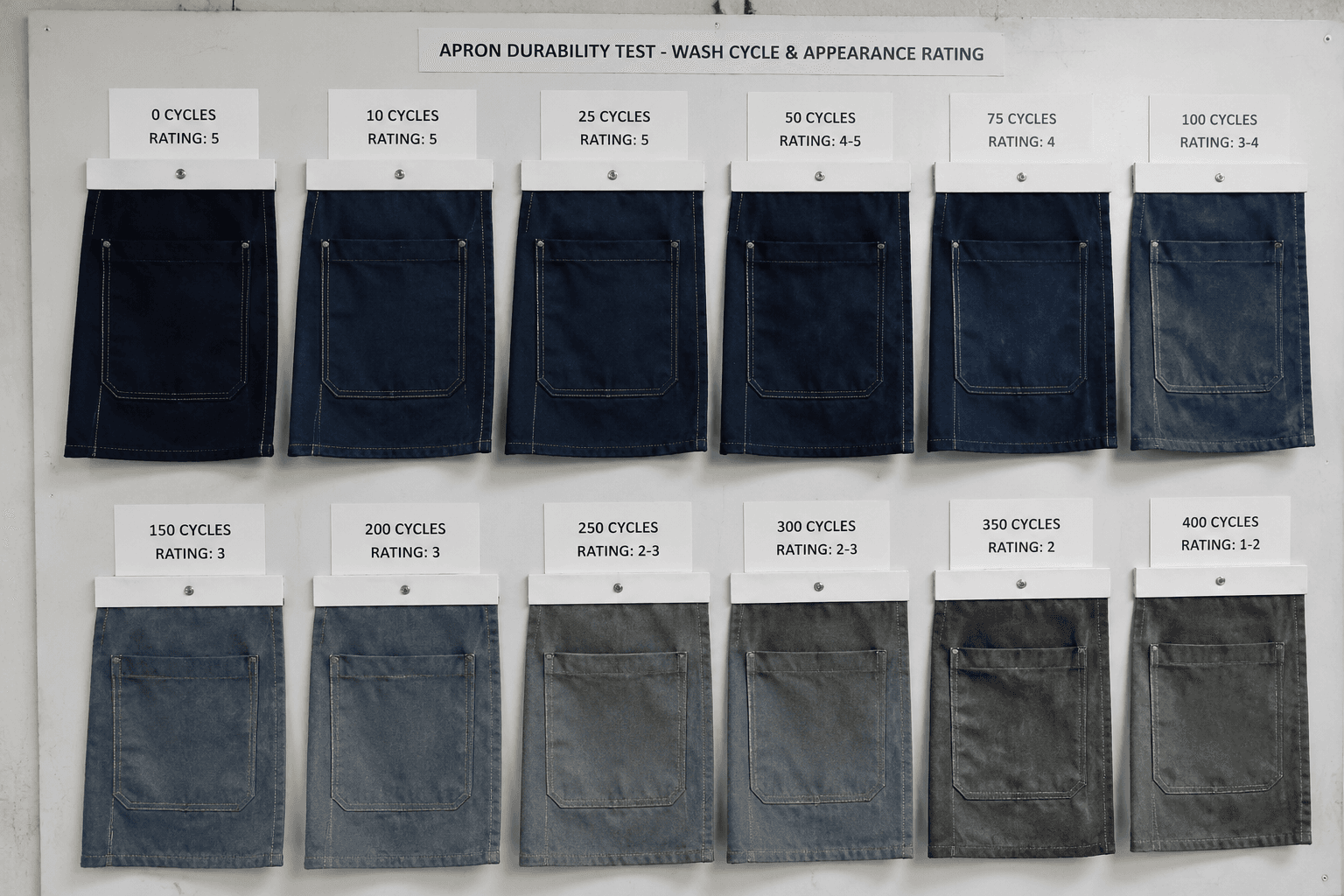
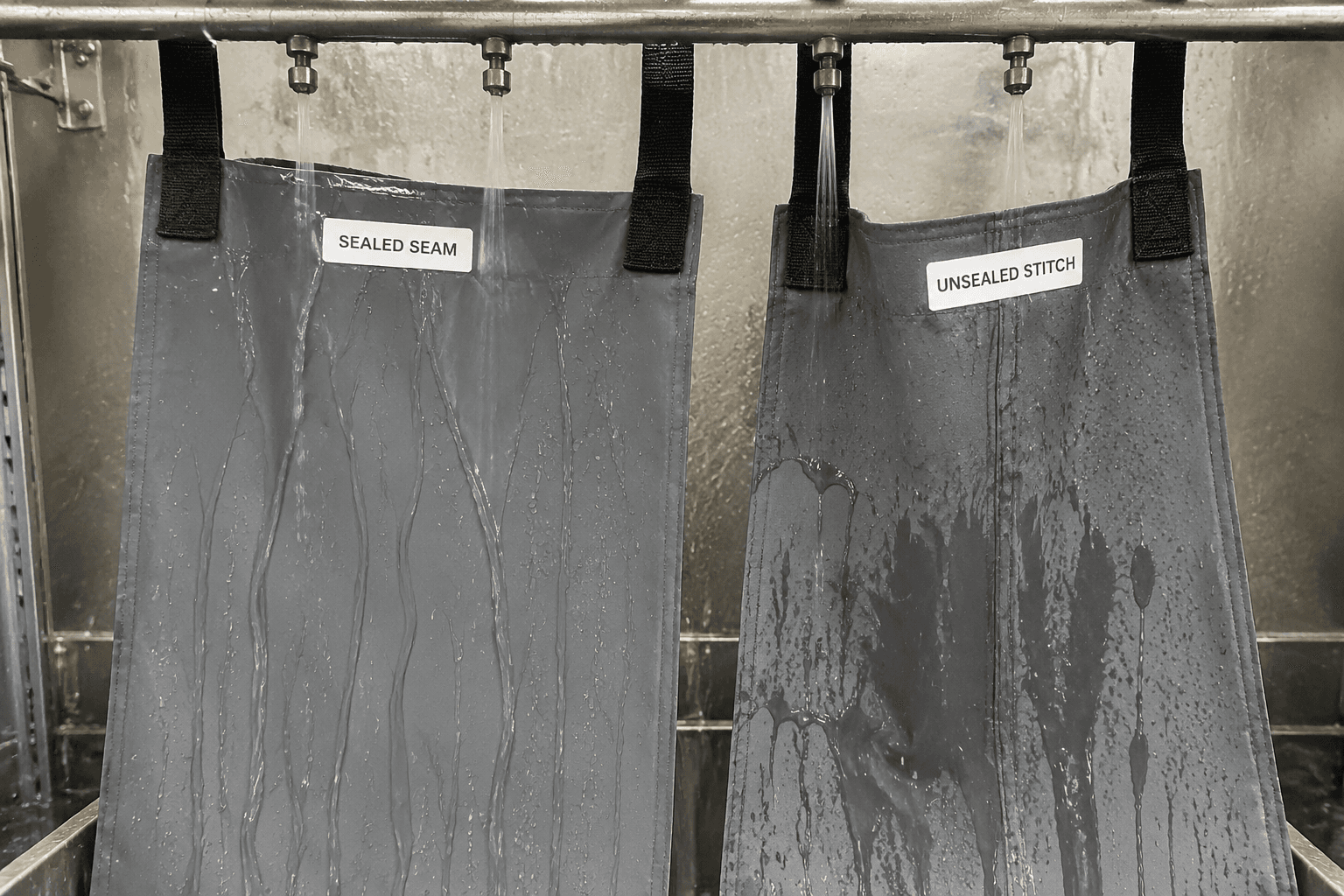
For routine OEM screening, factories can perform a localized seam water-hold test on high-risk zones and a hanging-form splash test on the finished apron. Directed spray for 3 to 10 minutes is more meaningful than a quick wipe test. For seafood, sanitation, or heavy dishwashing programs, add 200 to 500 flex cycles before retesting. Some seams pass when flat but leak after bending because the tape edge lifts or the stitch channel opens.
Acceptance criteria must be written in operational language. One buyer may require zero visible water penetration on the wearer side after 5 minutes of directed splash. Another may allow slight dampness at reinforcement points for a light-duty wipe-clean apron. Without a stated standard, buyer and factory end up disputing broad terms such as waterproof, water-resistant, and leakproof after shipment.
For final inspection, many buyers use AQL 2.5 for major visual defects and AQL 4.0 for minor cosmetic defects, then add a small functional seam test sample because waterproof testing may be destructive or time-consuming. For high-risk orders, test 3 to 5 finished aprons per lot or per color, with extra focus on the first bulk lot from a new supplier.
- Test bib seams, side seams, tie insertions, neck strap reinforcement, hem corners, and pocket corners if pockets are stitched.
- For washable programs, retest after 5, 10, or 20 wash cycles at the contracted temperature, commonly 40 to 60 degrees Celsius.
- Record exposure time, spray method or water pressure, pass/fail definition, and whether flexing or washing was performed before testing.
- Keep failed samples with lot number, operator line, fabric batch, and tape batch for root-cause review.
Cost, MOQ, and lead time for sealed seam apron sourcing
On adult waterproof aprons made from 200 to 300 GSM coated polyester or PVC/polyester, seam sealing commonly adds USD 0.18 to 0.55 per piece. The low end usually applies to a simple bib apron with few seams and no stitched pocket. Adjustable neck straps, divided pockets, side openings, reinforced tie points, longer lengths, and multiple sizes increase sealed meters and labor minutes.
MOQ depends on material availability and construction method. For stock colors and standard stitched-and-taped construction, many factories can support 1,000 to 2,000 pieces per color. Custom-dyed coating, special TPU tape, welded tooling, low-migration printing, or branding close to sealed zones can push MOQ to 3,000 to 5,000 pieces. Buyers should confirm fabric stock, seam tape stock, and sealing machine capacity before accepting an urgent delivery promise.
Lead time usually includes 5 to 10 days for material booking if fabric is not in stock, 7 to 14 days for lab dips or pre-production sample approval, and 20 to 35 days for bulk production after deposit and sample sign-off. New seam tape qualification can add 3 to 7 days because peel strength, flex resistance, and water exposure should be checked before full cutting.
Quotation comparison should be based on seam coverage, not only apron dimensions and GSM. One supplier may seal every exposed stitch line, while another seals only side seams and leaves pockets, labels, hems, and straps unsealed. That construction difference can explain an 8 to 15 percent price gap without any change in fabric.
- Ask for seam coverage by construction point or estimated sealed meters per apron.
- Confirm whether pockets, straps, labels, hardware tabs, and hem corners remain pierced and unsealed.
- Budget 25 to 45 days after sample approval and deposit for most sealed seam apron bulk orders.
- Separate tooling cost, tape cost, and added sealing labor when comparing stitched-and-taped versus welded construction.
Specification checklist to prevent waterproof apron seam leakage claims
The strongest purchase specification starts with the end use. State whether the apron will face light kitchen splashes, continuous dishwashing spray, seafood processing, salon chemicals, janitorial wash-down, oils, food acids, cold-room flexing, or repeated laundering. The factory can then select a suitable coating, stitch setting, tape chemistry, and reinforcement layout instead of guessing from a generic waterproof apron request.
The tech pack should identify fabric composition, GSM, coating or laminate type, finished dimensions, strap construction, pocket layout, hardware, branding position, seam allowance, stitch length, care method, and carton packing. It should also mark which seams must be sealed and which features are allowed to remain unsealed. If the apron will be washed at 60 degrees Celsius with detergent, that condition must be included before sample approval because tape durability depends on care conditions.
For a new supplier or new material, request a pre-production sample made with bulk fabric, bulk tape, and the intended thread. Ask for a seam map, sealing parameters, and test records. A capable apron factory should also state residual risks, such as leakage around rivets, eyelets, snaps, stitched logo patches, or unsealed pocket openings. Clear limits reduce claims more effectively than broad promises.
Final approval should include signed counter samples, a seam coverage drawing, AQL level, functional test method, and packaging requirements that avoid hard folding through sealed zones. If aprons are compressed tightly in cartons for 30 to 45 days, tape edges and folded coatings can be stressed before the goods reach the buyer.
- Define the application: food service, dishwashing, seafood processing, salon splash, janitorial work, industrial cleaning, or light kitchen retail.
- Specify seam coverage, AQL level, test method, exposure time, wash-cycle target, and acceptable seepage level.
- Require pre-production approval using bulk materials before releasing the full cutting order.
- For sealed seam apron sourcing, keep the signed seam map and test record with the purchase order.