For B2B apron buyers, staff turnover often moves faster than apron wear. A bib or waist apron made in 245 to 300 GSM poly-cotton twill, 280 to 320 GSM cotton canvas, or 9 to 12 oz denim may stay serviceable for 9 to 18 months in front-of-house use, while the employee name on that apron can become obsolete in 30 to 90 days. That mismatch is why replaceable apron name branding has become a practical sourcing requirement for restaurant chains, hotel dining teams, bakery groups, coffee brands, food halls, and specialty counters.
The sourcing question is not simply whether a factory can add a name area. Buyers need a system that stays straight, readable, and durable after repeated laundering, reissue, and staff changes. A modular apron program still has to meet the same controls as any other custom order: stable fabric shrinkage, clean bib shape, consistent stitch density, secure reinforcement behind the name zone, and inspection standards that cover both apron bodies and replacement identifiers.
The most efficient programs separate permanent brand assets from variable identity. The apron body carries the logo, brand color details, woven labels, and trim that should remain fixed through the garment lifecycle. The replaceable component carries the variable data: employee name, title, department, or language version. When buyers lock badge dimensions, attachment method, MOQ, AQL, and replenishment lead time during development, they turn name changes from an exception into a routine reorder process.
- Replaceable apron name branding usually lowers 12-month ownership cost when quarterly staff turnover exceeds about 15% and the apron body stays in use for at least 6 months.
- For most bib apron programs, a standardized 2.5 x 9 cm, 2.5 x 10 cm, or 3 x 10 cm name zone balances readability, chest proportion, and reorder control better than custom sizing by store.
- Hook-and-loop is usually the most flexible option for frequent name changes, but buyers should specify tape grade, four-side perimeter stitching, reinforced corners, and a 40 to 60 wash-cycle target.
- Replacement name units commonly start at 50 to 100 pieces MOQ, while custom apron bodies more often start at 300 to 500 pieces per color per style.
- Many buyers inspect both apron bodies and replacement identifiers to AQL 2.5 for major defects and AQL 4.0 for minor defects.
- Permanent logo branding should stay on the apron body, while employee-specific information should stay on the removable component.
Why replaceable apron name branding matters when apron life exceeds staff tenure
In professional apron programs, replacement demand is driven by staffing changes as much as by fabric wear. Restaurant chains, café groups, hotel F&B teams, bakeries, and concession operators often manage weekly onboarding, transfers, resignations, and role changes. If each employee name is embroidered directly onto the apron, a personnel change can turn a usable garment into dead stock even when the fabric, seams, pockets, and straps still have months of service life remaining.
That is the operating case for replaceable apron name branding. Instead of replacing the full apron when one employee leaves, the buyer keeps the apron body in circulation and replaces only the name unit. On a 1,000-piece bib apron program, it is common to place one bulk order for bodies and then reorder names in 50 to 200 piece batches by location, region, or hiring cycle. The garment follows its actual wear life; the name follows the staffing cycle.
The model becomes more valuable as apron durability increases. A 245 to 280 GSM poly-cotton twill apron for café service, a 280 to 320 GSM canvas apron for bakery and casual dining use, or a 10 oz denim apron for bar service should not be retired after a single staff change. For operators with recurring turnover, a modular name system aligns apron sourcing with how the garment is actually consumed in the field rather than with a fixed sample-room presentation.
- Direct name embroidery may add only $0.25 to $0.60 per apron, but replacing the full apron later often costs $4.20 to $8.80 FOB per piece.
- A replacement name patch or badge commonly costs $0.18 to $0.95 per unit, depending on size, face material, stitch count, and backing method.
- For operators with 20 or more locations, one standardized name zone makes it easier to reissue aprons across stores without mixed branding.
- Programs with quarterly turnover above 15% to 20% usually see the clearest savings from modular naming.
Selecting replaceable apron name branding by wash-cycle target, visual standard, and change frequency
There is no single best attachment method for every apron order. The right choice depends on laundering conditions, expected name-change frequency, target appearance, and replenishment budget. In most sourcing projects, the realistic shortlist narrows to four constructions: hook-and-loop patches, snap badges, slot-in holders, and magnetic badges used over a prepared chest zone.
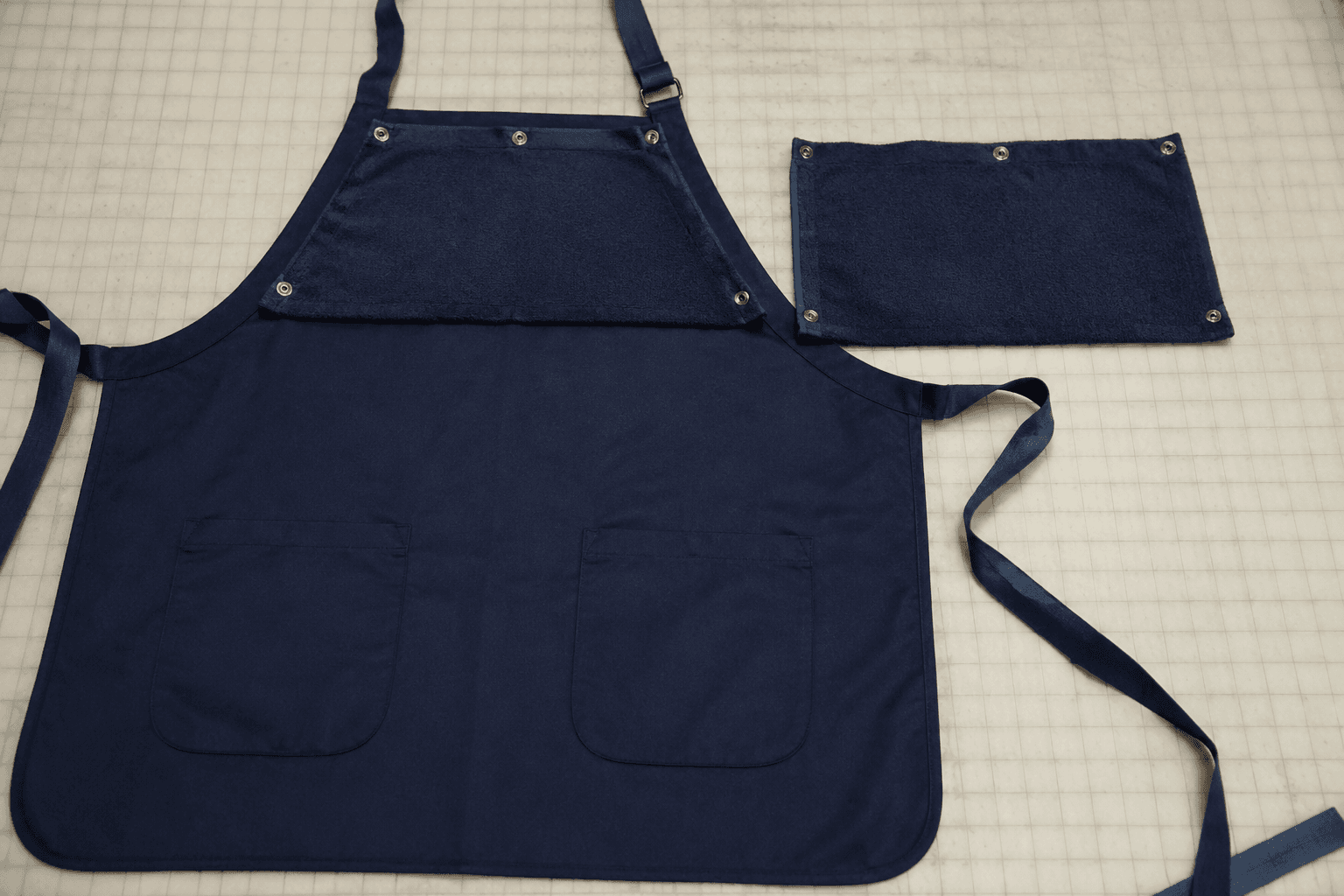
Hook-and-loop remains the most common option because it is inexpensive, quick to swap, and easy to reorder in mixed names. On bib aprons, the loop panel is typically sewn at 2 x 8 cm, 2.5 x 9 cm, 2.5 x 10 cm, or 3 x 10 cm. For bulk use, buyers should specify four-side perimeter stitching, backstitch reinforcement at the corners, and tape quality proven for at least 40 wash cycles, with 60 cycles a safer benchmark for high-use coffee, bakery, and quick-service programs. Low-grade tape is a frequent failure point: grip weakens, corners lift, and the bib panel puckers after repeated washing.
Snap badges create a cleaner chest appearance and suit hotel dining, premium café concepts, and upscale counters where exposed hook texture looks too operational. The trade-off is tighter assembly tolerance. A snap misalignment of even 2 to 3 mm can make the badge sit visibly crooked. Clear insert holders are more practical for commissary kitchens, temporary staffing, and role allocation than for customer-facing brand presentation. Magnetic badges are easy to issue, but they are usually a weak choice for aprons that are washed regularly, tumble dried, or used in fast-paced service where the badge can shift or detach.
- Hook-and-loop: lowest reorder cost, fastest swapping, strongest fit for frequent staff changes.
- Snap badge: cleaner appearance, better for premium concepts, but higher hardware and assembly cost.
- Slot-in holder: practical for temporary names or role cards, but less refined on customer-facing aprons.
- Magnetic badge: convenient for short-term use, but generally unreliable for repeated wash-and-wear apron programs.
Apron body specifications that keep replaceable apron name branding straight and durable
A modular name system is only as stable as the apron body underneath it. Buyers often review the patch face closely but overlook the bib panel construction. If the fabric is too light, the name area ripples. If the badge zone has no backing reinforcement, repeated attachment and removal can distort the chest panel. If the zone crosses a seam, dart, pocket edge, or curved area, alignment will vary from piece to piece and the aprons will look inconsistent in service.
For most professional bib aprons, the name zone performs best on fabrics from 210 to 300 GSM. Below about 180 GSM, the body usually needs a hidden backing layer or fusible reinforcement to keep the area flat. Washed canvas and enzyme-washed denim often need extra stabilization because the softened hand feel allows the badge zone to twist more easily after laundering. Perimeter lockstitching with reinforced corners is usually more dependable than a single loose run once the apron passes 40 or more wash cycles.
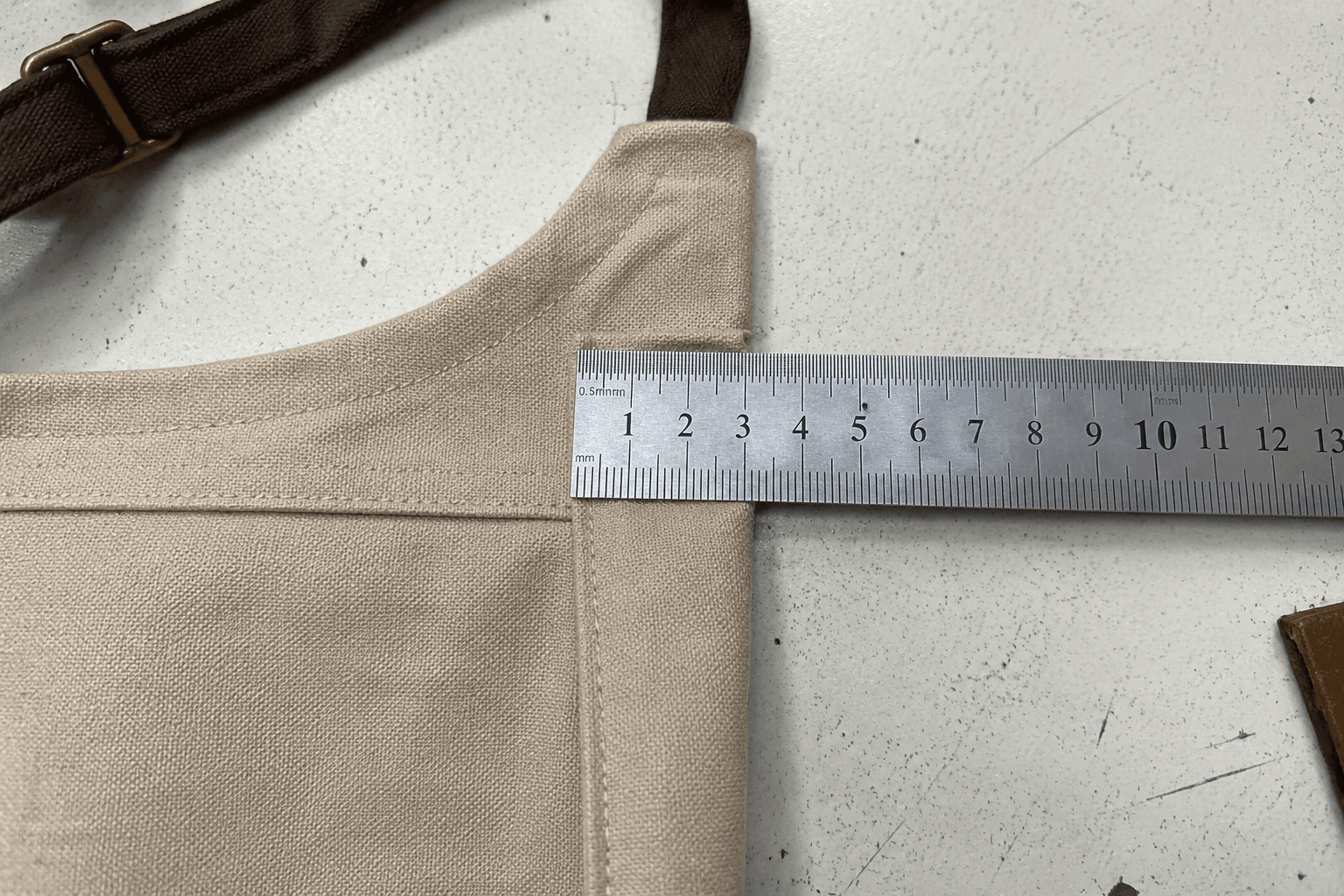
Placement should be written into the tech pack in measurable terms. A common requirement is a centered name zone positioned 6 to 8 cm below the top bib edge with a tolerance of plus or minus 0.5 cm. Shrinkage tolerance should also be controlled before bulk production, especially on cotton-rich canvas and denim styles. If badge placement is approved only on a prewash sample and not checked after wash testing, the final apron can lose alignment in use.
- Specify apron fabric by composition and weight, such as 245 GSM 65/35 poly-cotton twill or 10 oz cotton denim, not only by color name.
- Add reinforcement behind the name zone when using washed canvas, soft denim, or any fabric under 200 GSM.
- Keep the badge zone off seams, darts, and pocket edges to reduce skew and puckering.
- Write placement tolerance in centimeters so replacement units stay aligned across all production lots.
QC, AQL, and wash testing for replaceable apron name branding programs
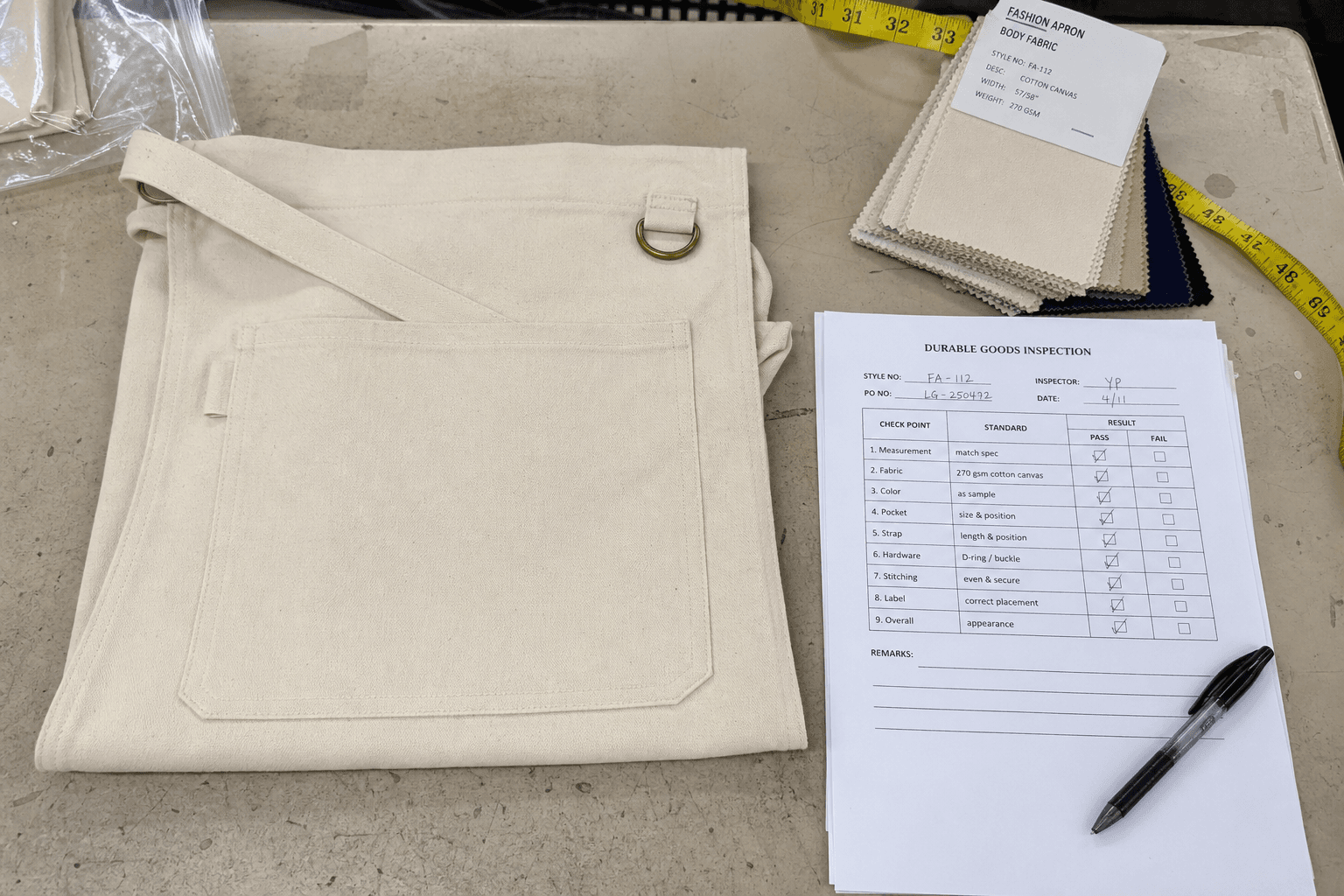
A replaceable name program should be controlled through the same QC discipline as the apron itself. Many buyers use AQL 2.5 for major defects and AQL 4.0 for minor defects on bulk apron orders, then apply the same standard to replacement name units. That keeps replenishment orders from becoming the weak point of the program.
For aprons, major defects typically include wrong fabric, incorrect dimensions, broken bartacks, severe panel skew, wrong logo position, or badge-zone placement outside tolerance. For replacement identifiers, major defects usually include wrong spelling, unreadable text, incorrect thread or background color, weak backing adhesion or stitching, missing hardware, or attachment failure during pull testing. Minor defects may include slight edge fray, small stitch inconsistency, or light distortion within approved limits.
Wash testing should be defined before mass production. For hook-and-loop programs, the factory should test grip retention, edge curl, and chest-panel distortion after repeated laundering. For snap badges, buyers should confirm hardware alignment and rust resistance. For insert-card systems, they should verify that the holder remains flat and does not crack at corners after wash and handling. A modular program saves money only if the badge area survives repeated service conditions without degrading the look of the apron.
- Apply AQL 2.5 major and AQL 4.0 minor to both apron bodies and replacement identifiers.
- Treat wrong spelling, unreadable names, and attachment failure as major defects, not cosmetic issues.
- Set a wash target before approval, such as 40 cycles minimum for light commercial use or 60 cycles for heavy rotation.
- Include pull testing or attachment checks in the QC checklist for each replacement-name production lot.
Cost model, MOQ, and lead times for modular apron name reorders
For sourcing managers, the commercial advantage of modular naming is controlled replacement cost. A replaceable system adds a small amount to the first bulk apron order, then sharply reduces spend when names change during the year. The buyer stops replacing a full sewn garment and starts replacing a small identity component, which is usually the more efficient model once staff movement becomes routine.
In typical FOB China pricing, a standard bib apron in 245 to 270 GSM poly-cotton twill often lands at $3.40 to $5.60 per piece at 500 to 2,000 units, depending on pocket count, bartacks, adjusters, embroidery, and strap construction. A heavier 280 to 320 GSM canvas apron or 10 to 12 oz denim apron with hardware and contrast stitching often runs $5.80 to $9.80. Adding a loop panel plus hidden reinforcement usually adds about $0.20 to $0.45 to the apron body. Replacement hook-back embroidered names often cost $0.22 to $0.55 each at 100 to 500 pieces, while faux-leather snap badges commonly range from $0.65 to $1.20 each.
MOQ and timing should be planned separately for bodies and names. Full custom apron MOQ commonly starts at 300 pieces per color per style, with 500 pieces preferred for more stable fabric and trim allocation. Once dimensions, artwork, backing, and thread colors are approved, replacement names can often be reordered at 50 to 100 pieces including mixed individual names in one lot. A first custom sample with a modular name feature usually takes 7 to 14 days. After PP approval, bulk apron production commonly runs 25 to 40 days, while replacement-name orders often run 7 to 12 days before transit. Peak seasons, dyed fabric, and metal trim can push full bulk lead time to around 45 days.
- Loop-panel construction often costs less than adding another permanent embroidery position to the apron body.
- Typical initial MOQ is 300 to 1,000 apron bodies per color, depending on fabric weight and trim complexity.
- Typical replacement MOQ is 50 to 100 name units after program approval.
- Sample lead time is usually 7 to 14 days; bulk apron lead time 25 to 40 days; replacement-name lead time 7 to 12 days.
Design rules that make replaceable apron name branding look intentional on the floor
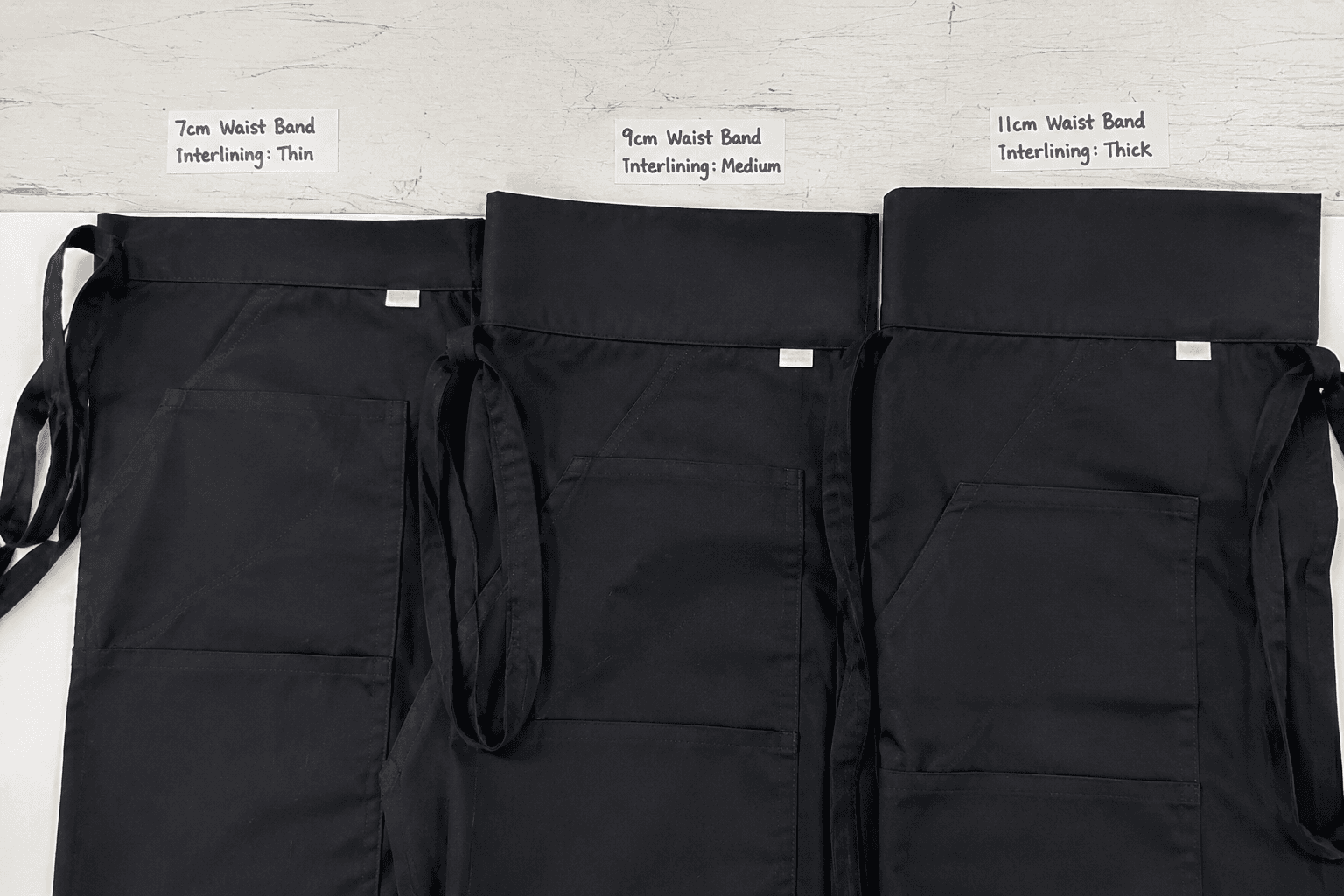
A modular name zone should look designed into the apron, not added after the fact. On bib aprons, the name area usually works best 6 to 10 cm below the top edge, either centered or offset to balance a permanent logo. On waist aprons, it generally works best above the pocket opening or on a stable waistband panel. Position should be tested on the worn body, not only on the flat pattern, because the badge can shift once the apron is tied under tension.
Permanent branding and variable identity should remain separate. The house logo, store mark, or brand wordmark is usually better applied directly to the apron body through embroidery, woven-label insertion, or print. The employee name, role, or language version should stay on the removable piece. Combining logo and employee name on the same replaceable patch may seem efficient during sampling, but it complicates reorder control and increases the chance of brand inconsistency across stores.
Standardized dimensions improve consistency across multiple apron styles. For most English-language names, 2.5 x 9 cm and 2.5 x 10 cm are dependable starting sizes. For bilingual programs, long surnames, or titles such as 'Assistant Manager' or 'Head Barista', 3 x 10 cm or 3 x 11 cm is usually safer. Contrast should also be checked under real service lighting. Black text on charcoal may look refined in the showroom but become unreadable across a dining room, bakery case, or café counter during peak hours.
- Keep one standard badge size across related bib and waist apron families whenever possible.
- Place permanent logos on the apron body and reserve the replaceable piece for variable identity only.
- Test long names, bilingual text, and job titles before approving final badge dimensions.
- Match edge finish to apron style: merrow edge for casual canvas, cleaner cut edge for more premium programs.
When fixed-name apron branding is still the better buying decision
Despite the advantages of replaceable apron name branding, it is not the right fit for every apron program. If the concept requires a formal luxury look, exposed hook-and-loop texture on the chest may not meet the visual standard. If aprons go through aggressive industrial laundry with high heat finishing, some faux-leather surfaces, low-grade hook tape, or insert materials may deform faster than direct embroidery. In those cases, buyers may be better served by a clean snap format, a role-based identifier, or a fixed-name apron.
It is also a weaker fit for low-turnover teams. If a buyer orders 80 aprons for a stable staff and expects very few name changes over 12 months, direct embroidery can remain the simpler and cheaper option. The same applies to short-life programs such as seasonal promotions, temporary openings, event staffing, and campaigns where the apron itself may only be used for 30 to 90 days. In those cases, the cost savings from modular naming may not offset the extra development, inventory control, and QC work.
The decision should be based on replacement behavior, laundering method, and expected apron life rather than on sample-room preference alone. Buyers should estimate annual staff-change volume, target wash cycles, service-life months, and acceptable chest appearance before locking the branding method. If names change often and the apron body is built to last, modular naming usually makes commercial sense. If names change rarely or the apron is intentionally short-life, fixed-name branding can still be the stronger sourcing decision.
- Avoid exposed hook-and-loop when the apron concept requires a seamless luxury chest presentation.
- Check industrial laundry conditions before approving faux leather, magnetic, or insert-based badge elements.
- Choose direct embroidery when turnover is low, order volume is small, and apron service life is short.
- Base the decision on annual name-change volume and garment lifespan rather than on initial sample appearance.