For buyers sourcing museum shop aprons, the brief is narrower than for café, kitchen, or workshop styles. Staff work beside books, stationery, textiles, framed prints, ceramics, and premium gift merchandise, so the apron must stay neat at close viewing distance, move quietly around glass counters and shelving, and remain presentable through 8- to 10-hour shifts.
The most common sourcing error is not poor sewing; it is selecting an apron material package that conflicts with the sales floor. A 12 oz heavily washed canvas may impress in a sample room but often feels stiff, traps lint, and throws more surface dust after a full day at the register. A metal neck slider may look elevated in photos but can click against vitrines, counters, and badge clips during movement. The best museum shop aprons usually stay within 210 to 260 GSM, use smooth low-hair surfaces, and keep hardware to quiet functional points.
For OEM buying, this category should be judged against measurable controls: lint pickup, trim acoustics, pocket load, shrinkage, crocking, colorfastness, MOQ efficiency, and replenishment speed. In most mid-volume programs, a practical timeline is 7 to 10 days for the first proto, 5 to 7 days for one fit revision, and 30 to 45 days for bulk after final approval. Repeat orders often ship in 20 to 30 days when the same apron fabric and trims remain in stock.
- 210 to 260 GSM or 8 to 10 oz is the most reliable apron fabric range for museum and gallery retail because it balances drape, opacity, and all-day comfort.
- A true quiet hardware build removes loose metal contact points and uses self-fabric loops, bartacks, hidden webbing adjusters, or low-profile resin snaps.
- Dust resistance depends more on compact weave, smooth surface finish, and low hairiness than on heavy apron fabric alone.
- For premium retail presentation, branding usually stays limited to a 1-color woven label or tonal embroidery under 5 cm.
- Typical OEM pricing runs about US$3.40 to US$8.80 per piece, with most custom MOQs at 300 to 800 pcs per color.
- Bulk orders should be approved against AQL 2.5 major / 4.0 minor, shrinkage under 3%, and acceptable dark-shade crocking before shipment.
Why museum and gallery retail aprons need a narrower spec than standard shop uniforms
Museum and gallery stores do not need aprons built for grease, wet prep, or tool abrasion. They need aprons that stay visually calm under bright track lighting, resist visible lint from books and paper goods, and move quietly in controlled retail spaces. In this setting, the apron is part of the store presentation rather than a decorative lifestyle item or heavy-duty utility garment.
That changes the buying priorities. An apron that looks premium in a showroom can fail on the shop floor if the face fabric attracts dust, the bib is too wide and reads as foodservice, or the waist ties swing into display edges. Professional buyers usually get better results with clean front panels, reduced stitch contrast, controlled pocket volume, and trims that do not tap, scrape, or swing.
Small technical adjustments usually matter more than expensive upgrades. Reducing bib width by 1 to 2 cm, shifting from heavily washed canvas to compact twill, or replacing a loose metal slider with a hidden adjuster can improve presentation and comfort without moving the ex-factory price by more than US$0.10 to US$0.35 per piece. For museum shop aprons, these specification choices have more impact than decorative rivets, oversized labels, or contrast webbing.
- Set a visual target: low-contrast topstitching, limited front bulk, and clean seam lines.
- Set a noise target: no loose clips, D-rings, chains, or oversized buckles.
- Set a stability target: shrinkage below 3%, pilling grade 3-4 or better, and repeatable shade tolerance.
- Set a reorder target: mill-stable fabric, standard trims, and fixed QC tolerances for replenishment.
Fabric specs for museum shop aprons: 210-260 GSM, smooth face, low lint pickup
When buyers ask for dust-resistant aprons, they often focus first on fiber content. In practice, apron surface behavior depends more on weave density, yarn quality, and finishing than on cotton versus poly-cotton alone. A brushed 100% cotton canvas can collect lint faster than a compact 65/35 poly-cotton twill, even when the cotton sample feels more premium in hand.
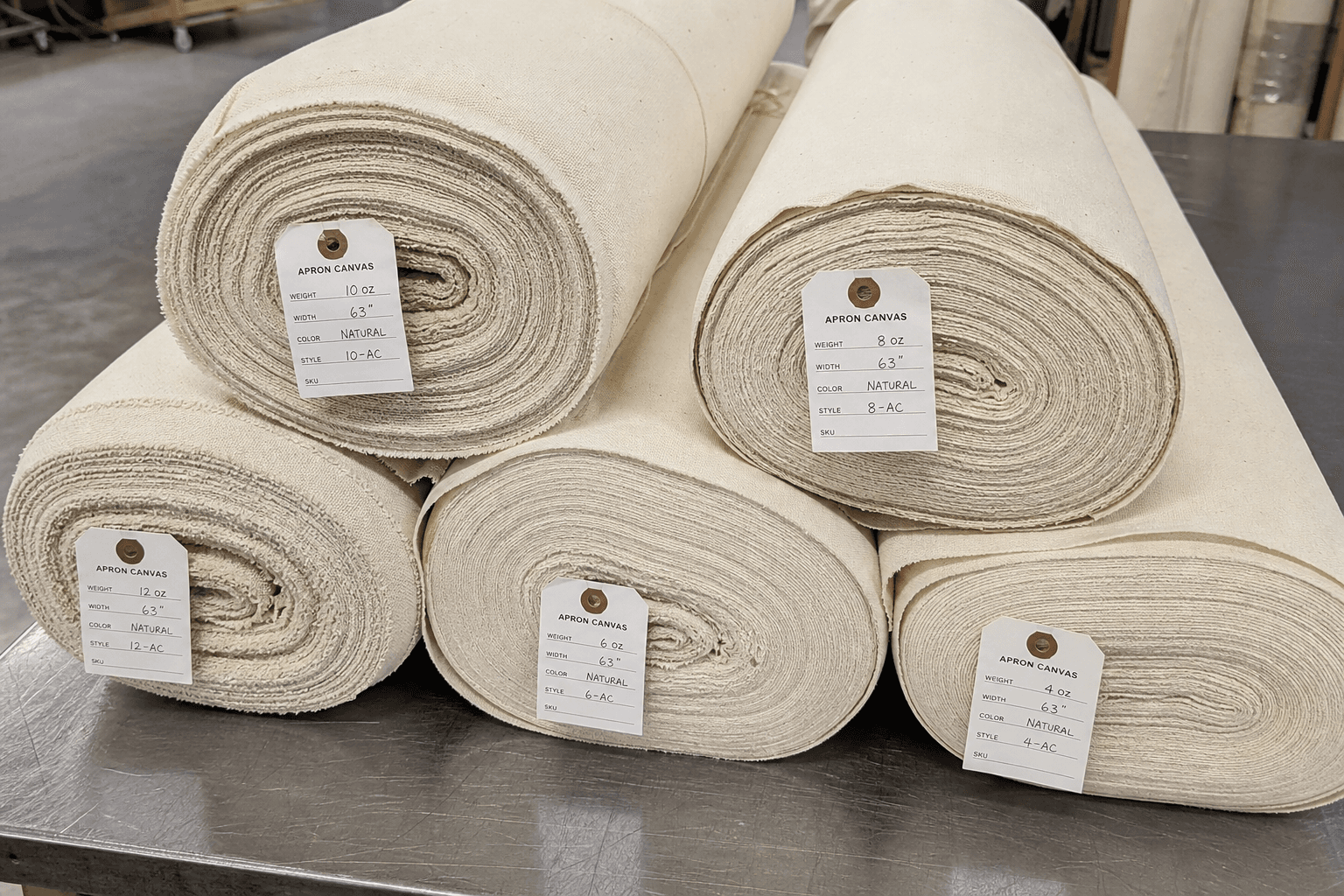
For most museum shop aprons, the safest base is 210 to 240 GSM twill for daily wear, 220 to 260 GSM compact plain weave for a cleaner minimalist look, or 8 to 10 oz smooth canvas when the brand wants more body without stiffness. Once the apron fabric moves above 280 GSM, bib styles often become too rigid for cashwrap movement and repeated bending. Below 190 GSM, darker shades can lose opacity and the garment can read as promotional rather than uniform grade.
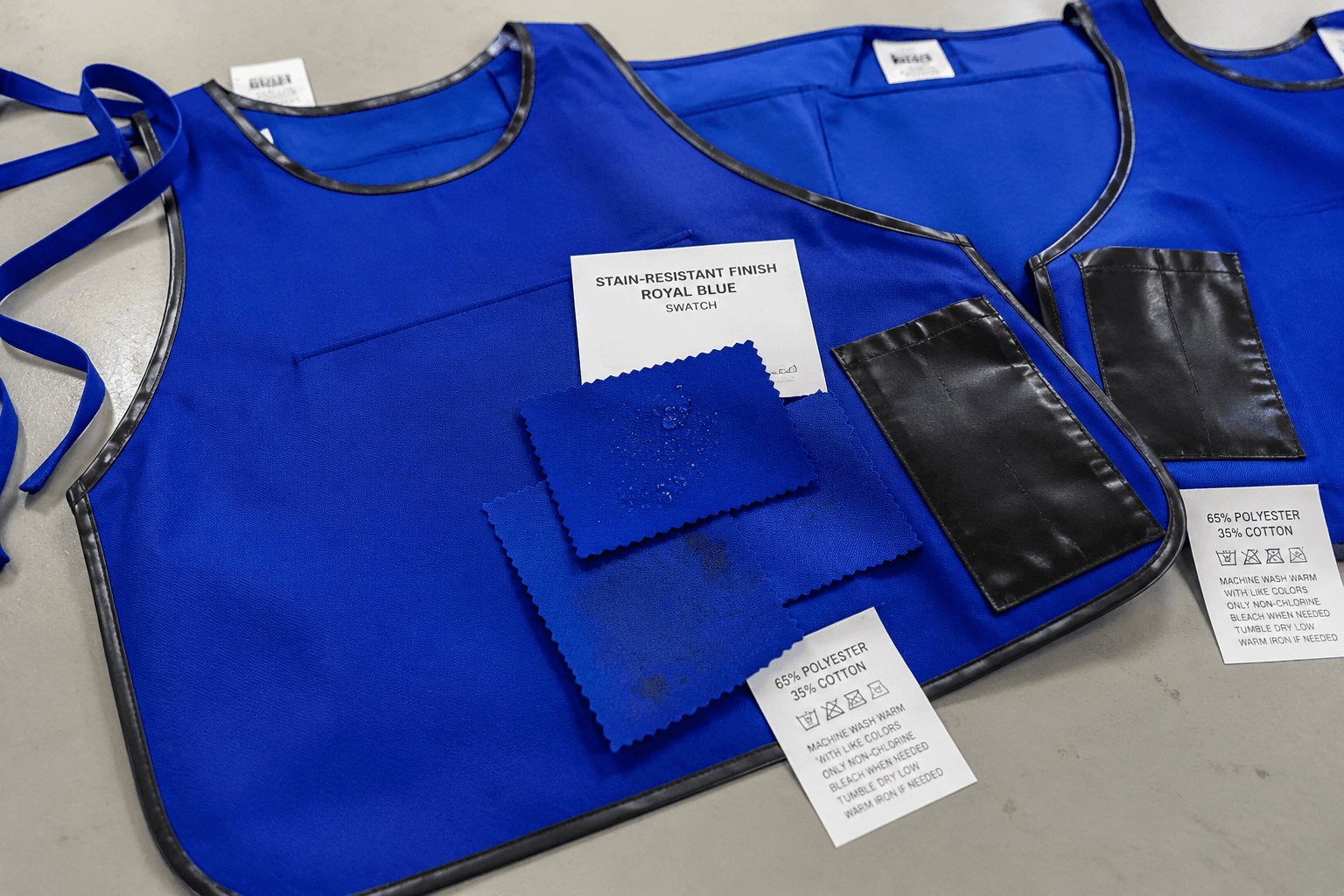
Finishing is critical. Light silicone softening usually keeps the face smoother than aggressive enzyme washing. Heavy washes raise surface fibers, which makes paper dust, lint, and shelf debris more visible, especially on black, navy, and deep olive. Buyers should ask for three parallel swatches in standard finish, light softening, and washed finish, then compare them under D65 light and warm 3000K to 3500K retail lighting before locking the material.
Color choice affects perceived cleanliness as much as the weave. Black gives the sharpest visual frame but shows pale lint fastest. Mid-charcoal, muted navy, taupe, olive-grey, and stone usually perform better in mixed-merchandise stores because they hide dust, minor abrasion, and fold marks while still reading as formal. In bookstore-heavy environments, a compact mid-tone weave often outperforms both natural cotton and dense black in day-to-day appearance.
- Use 210 to 240 GSM twill for the broadest range of bib and waist apron programs.
- Use 220 to 260 GSM compact plain weave when the brief calls for a cleaner architectural silhouette.
- Use 8 to 10 oz smooth canvas only if the surface is low-hair and not heavily washed.
- Require shrinkage below 3%, pilling grade 3-4 or better, and colorfastness to rubbing suitable for dark shades worn over light shirts.
- Request lint-visibility comparison photos on black, charcoal, taupe, and navy before bulk approval.
Quiet hardware for museum shop aprons near glass counters, vitrines, and framed displays
In museum retail, hardware noise is not a minor styling issue. Loose sliders, clips, rings, and decorative rivets create repeated clicking during bending, shelving, folding, and payment-desk work. The sound becomes obvious near vitrines, framed prints, and glass counters. Good apron engineering reduces moving contact points instead of using industrial trim as decoration.
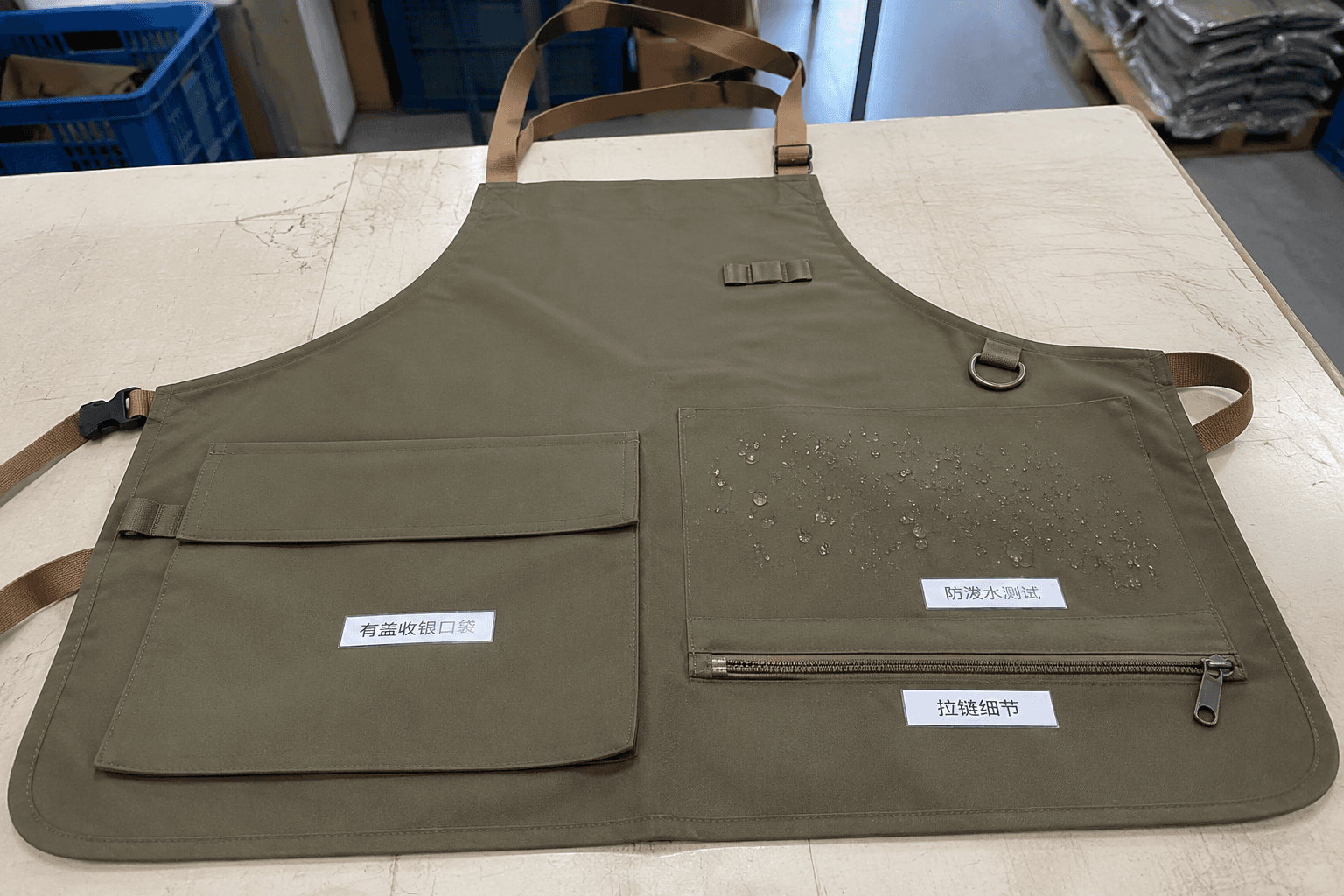
The most dependable solution is selective simplification. Neck adjustment can shift from an exposed metal buckle to a hidden webbing adjuster, a two- or three-position button system, or a back-neck resin slider placed where it cannot strike the bib. Waist closure can use self-fabric ties, cotton herringbone tape, or low-profile resin snaps depending on staff change speed and laundering method. In many programs, stitched strap loops and bartacks do the work of metal hardware at lower cost and lower noise.
Metal still has a place in premium apron programs, but only where it adds clear function. If metal is required, buyers should specify compact matte brass or stainless parts with tight tolerances and limited swing. Oversized antique-finish hardware usually adds weight, noise, and visual bulk. For most institutional retail stores, quiet resin hardware or concealed adjusters deliver a cleaner apron result while trimming US$0.15 to US$0.45 per piece versus custom metal sets.
- Replace loose clips and rings with stitched loops or bartack-fixed strap constructions.
- Use hidden webbing adjusters, resin snaps, or button-position neck systems where silence matters more than visible trim.
- Keep exposed metal to essential adjustment points only, not decoration.
- Ask the factory to test counter contact, bending, shelving movement, and strap swing during sample review.
Pocket dimensions and silhouette control for cashier, bookstore, and gallery-floor aprons
Pocket planning should follow store tasks, not café styling. Museum and gallery staff usually carry pens, price tags, receipt slips, small notebooks, radios, or a mobile POS device. They rarely need oversized utility pockets designed for towels, bottles, or tools. Large pockets add front weight, distort drape, and make the apron look bulkier than the environment requires.
A practical pocket package is usually one center pocket with internal division or two low-profile waist pockets with limited depth. In most apron projects, 16 to 19 cm pocket depth is enough for stable carry without obvious sagging. Pocket openings of 13 to 16 cm per compartment work well for pens, handheld devices, and small paper goods. For bib aprons, a slim chest pocket can work for a pen or small notepad, but it should stay narrow, around 10 to 12 cm wide, and should not dominate the upper panel.
Silhouette control matters as much as storage. Narrower bib widths, straighter side seams, moderate hem width, and limited stitch contrast help the garment read as a premium retail apron rather than a kitchen uniform. Waist apron finished length usually falls between 45 and 60 cm depending on whether the wearer is mainly at the till or walking the floor. If the first fit sample looks too casual, buyers should adjust proportion before upgrading materials. Pattern changes are usually faster and cheaper than moving to a more expensive fabric.
- Use 16 to 19 cm pocket depth to prevent front sag under normal retail load.
- Keep pocket opening widths around 13 to 16 cm per compartment for controlled access.
- Keep waist apron length at 45 to 60 cm based on cashier versus floor-staff use.
- Limit chest pockets to pen or slim-notepad scale, not broad utility storage.
- Reduce bib width by 1 to 2 cm if the sample reads too foodservice-oriented.
Branding, color approval, and pack-out standards for premium retail aprons
Branding in this category should support the institution, not compete with it. Most buyers get the best result with a small woven label, tonal embroidery, or subtle inside identity marking. Large chest prints often feel too promotional for museum retail, especially when the store carries exhibition-led merchandise, design books, or premium gifting. On most programs, visible branding under 5 cm keeps the apron discreet and professional.
Branding method affects both cost and MOQ. A woven label usually adds about US$0.08 to US$0.18 per piece after artwork approval. Small tonal embroidery typically adds US$0.25 to US$0.65 depending on stitch count, backing, and placement. Screen print can be economical above 1,000 pcs, but it suits this category only when the artwork is restrained and the print hand remains soft. Debossed leather patches and custom-branded hardware often push effective MOQ to 500 to 1,000 pcs per component because accessory suppliers impose their own minimums.
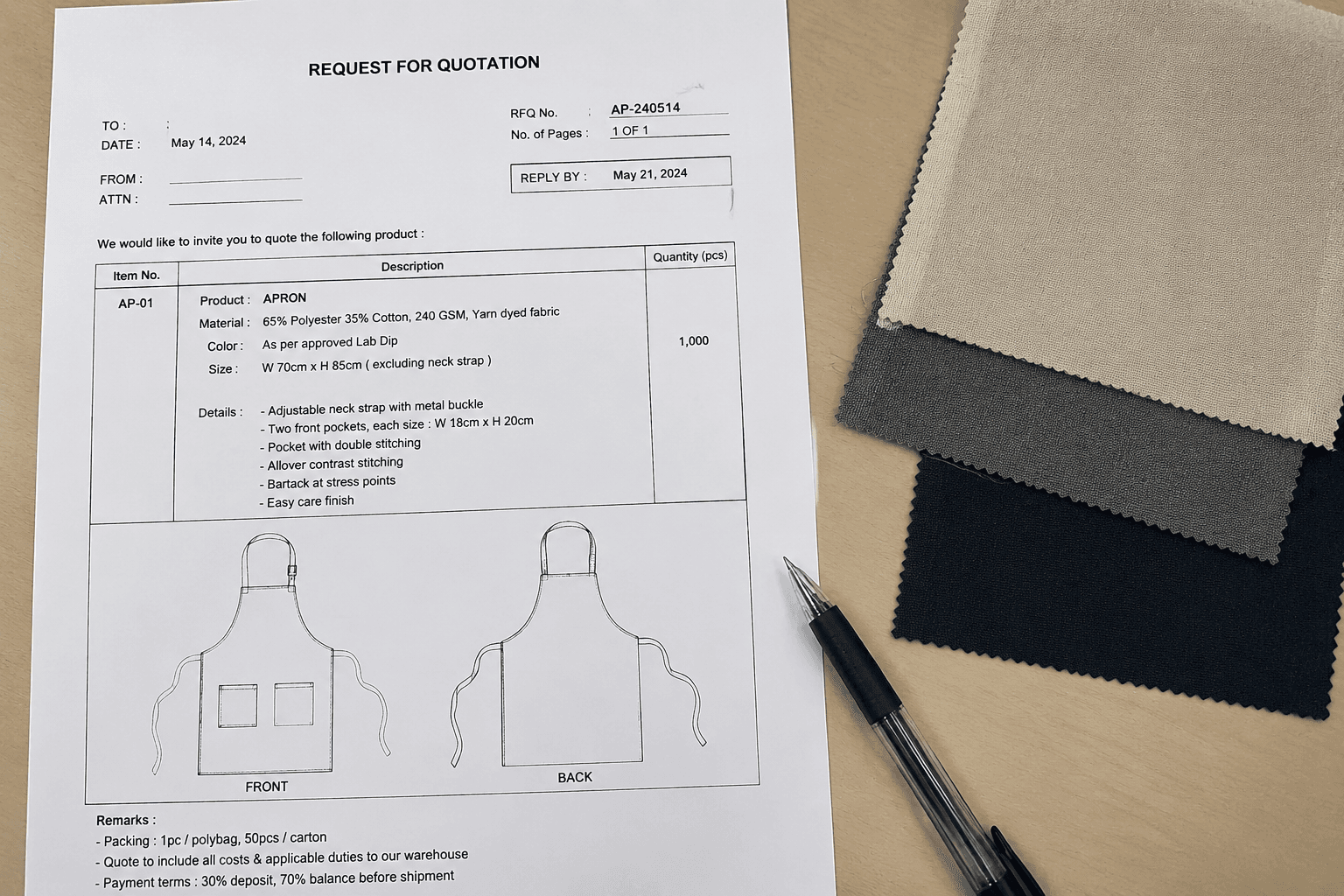
Color approval needs discipline because muted institutional palettes can shift noticeably under different lighting. Charcoal, taupe, stone, olive-grey, and deep navy should be checked under D65 light and warm retail lighting before bulk dyeing. For repeat orders, buyers should lock the approved mill, weave construction, GSM tolerance of plus or minus 5%, and Pantone reference to reduce reorder variation.
Packaging should be decided early because it affects ex-factory cost and store rollout labor. Standard polybag pack-out is usually the lowest-cost option. Recycled polybags, flat-fold presentation packs, or paper belly bands typically add US$0.05 to US$0.35 per piece. Those choices also change fold lines, carton quantity, and handling time at store level, which matters when dozens of branches are launching at once.
- Keep visible branding under 5 cm for most museum and gallery apron programs.
- Budget US$0.08 to US$0.18 for woven labels and US$0.25 to US$0.65 for small embroidery.
- Approve lab dips under two lighting conditions before bulk dyeing.
- Lock mill, Pantone reference, weave, and GSM tolerance for repeat orders.
- Confirm pack-out by store rollout method, not only by lowest unit cost.
MOQ, pricing, lead times, and QC checkpoints for OEM museum shop aprons
For custom OEM apron production, MOQ depends on how far the program moves away from stock materials and standard trims. A straightforward waist or bib apron in stock twill with standard ties and a woven label can often start at 300 pcs per color. Once buyers add custom-dyed fabric, embroidery, multiple sizes, private trims, or special packaging, practical MOQ usually rises to 500 to 800 pcs per colorway. If custom hardware, leather branding, or exclusive accessories are involved, 1,000 pcs is often more realistic because each trim supplier applies its own minimums.
Cost is mainly driven by apron fabric, make, trims, and packaging. A simple waist apron in 210 to 230 GSM poly-cotton twill typically lands around US$3.40 to US$4.80 per piece at moderate volume. A refined bib style in 230 to 260 GSM custom-dyed fabric with tonal embroidery, quiet adjusters, and upgraded pack-out is more often US$5.40 to US$8.80 per piece. Programs using real leather, custom metal hardware, low-volume color splits, or hand finishing can exceed US$9.50 per piece quickly.
Lead time should be broken into stages rather than quoted as one number. First proto samples usually take 7 to 10 days. One fit or trim revision often adds 5 to 7 days. If fabric needs custom dyeing, allow 10 to 18 days for mill preparation, lab dips, and shade approval. Sewing, finishing, inline inspection, and final packing typically require 15 to 25 days depending on order size. In total, most museum shop aprons should be planned on a 30- to 45-day bulk window after final approval, while repeats in stocked materials can move in 20 to 30 days.
QC should be defined before the purchase order is confirmed. For this category, many professional buyers work to AQL 2.5 major / 4.0 minor with carton sampling on packed goods. Approval points should include measurement tolerance, shade consistency, visible soil, stitch security, strap symmetry, hardware noise, shrinkage below 3%, and acceptable dry and wet crocking on dark shades worn over light shirts.
- Standard custom MOQ: 300 pcs for simple apron styles and 500 to 800 pcs for customized builds.
- Typical price: US$3.40 to US$4.80 for simple waist aprons and US$5.40 to US$8.80 for refined bib aprons.
- Typical lead time: 30 to 45 days after approval; repeat orders at 20 to 30 days when materials are ready.
- QC benchmark: AQL 2.5 major / 4.0 minor with pre-shipment inspection on packed goods.
- Test dark shades for dry and wet crocking and confirm tolerances on GSM, shade, and measurements.
Pre-production approval checklist before placing a museum shop apron order
The biggest apron failures usually do not show in the first presentation sample. They appear after several days of real use: lint becomes obvious on black fabric, a neck strap twists, a pocket mouth collapses, dye rubs onto pale shirts, or a metal part taps against a glass counter. These issues are preventable if the approval process matches live retail conditions instead of relying only on tabletop review.
Buyers should request side-by-side samples whenever possible, such as 100% cotton twill versus 65/35 compact twill, or metal slider versus hidden resin adjuster. Quietness, drape, and dust visibility are easier to judge comparatively than in isolation. Samples should be worn during bending, reaching, shelving, and register work, then checked with normal pocket contents in place. If the program is expected to reorder seasonally, the factory should lock the exact fabric mill, trim source, pattern version, and construction notes in the tech pack.
A precise end-use brief leads to a better bulk result. A bookstore apron, a design-store apron, and a ticket-counter apron can look similar, but their pocket load, cleaning frequency, and movement pattern differ enough to change the right fabric and trim choice. The more specific the buyer brief, the easier it is for the factory to engineer museum shop aprons that stay consistent across multiple production runs.
- Review samples under actual store lighting, not only office light.
- Compare at least two fabrics for drape, lint pickup, and shade appearance.
- Test pocket load, strap comfort, hardware noise, and counter contact during real movement.
- Lock mill, GSM tolerance, trim finish, pattern version, and approved color standard for replenishment.
- Require inspection against AQL, shrinkage, and crocking before shipment release.