For buyers building a premium apron line, a moleskin apron fills a specific space between rigid 10 to 12 oz cotton duck and lighter 210 to 260 GSM twill. The fabric is usually a dense cotton weave with a brushed face, giving a smooth matte hand and fuller first-touch feel without losing the body needed for bib stability, pocket support, and clean topstitching. In retail apron programs and branded workshop kits, that tactile difference can support a higher ex-factory cost only if the full specification is controlled from the start.
From a factory and sourcing perspective, moleskin is not a universal upgrade. It typically costs more per meter than canvas, requires one-way cutting to control nap direction, and shows pressing marks, panel shading, and carton compression more easily than plain weaves. For buyers supplying museum stores, café brands, culinary labels, hardware retailers, and workshop programs, the fabric makes commercial sense when the brief calls for stronger shelf presentation, refined branding, and a softer hand than standard utility aprons.
The sourcing decision should be based on measurable targets, not on the word premium. Buyers should lock GSM, finished oz, shrinkage after wash, colorfastness grade, branding method, MOQ, AQL level, target FOB, and replenishment lead time before approving proto samples. A well-developed moleskin apron can support repeat business for 6 to 12 months or longer, but only when fabric, construction, and channel economics are aligned before bulk cutting.
- Moleskin apron programs usually work best at 300 to 340 GSM for gift retail, 340 to 380 GSM for café and branded workwear, and 380 to 420 GSM for light workshop use.
- Compared with a similar canvas apron, moleskin commonly adds $0.80 to $2.20 per piece FOB at 500 to 1,000 pcs, depending on fabric route, hardware, labeling, and packing.
- Practical MOQ is often 300 to 500 pcs per style per color with stock fabric, while custom-dyed moleskin may require 800 to 1,500 meters at mill level before bulk approval.
- Sampling usually needs 7 to 14 days with stock cloth and 14 to 25 days with custom fabric; bulk production is commonly 35 to 55 days after PP approval, with garment-washed styles often adding 7 to 10 days.
- Because the face is brushed, buyers should control nap direction, panel shading, logo definition, lint pickup, and carton compression more tightly than on standard canvas or twill.
- For repeat orders, lock the mill reference, approved GSM tolerance, color standard, and inspection criteria early; brushed fabrics show lot-to-lot drift more clearly than basic canvas.
Where a moleskin apron fits in premium retail and workshop sourcing
In apron sourcing, fabric choice sets both the selling position and the defect risk. A moleskin apron is usually selected when the buyer wants a softer, more refined product than standard cotton duck but still needs enough body for bib shape, lower-pocket support, and durable topstitching. The brushed face gives a matte, suede-like hand that reads as premium on shelf without turning the apron into a fashion-only item.
This matters most when the apron is sold as merchandise rather than issued only as basic uniform stock. Coffee roasters, cookware labels, specialty hardware chains, museum stores, culinary brands, and workshop programs often need an apron that still looks like workwear but feels less stiff than 10 oz canvas. In these channels, first-touch appeal, fold presentation, and logo finish can influence sell-through as much as seam strength.
The wrong approach is to approve moleskin from a swatch book alone. A weekend gift apron for home use has different demands from a bib apron worn 8 hours per day, 5 days per week, in a café, stockroom, or light workshop. Buyers should define wear frequency, target garment weight, wash expectation, and price tier before locking fabric. Otherwise, the softer hand only adds cost without improving the program economics.
- Use 300 to 340 GSM for giftable retail bib aprons with softer drape and lower finished weight.
- Use 340 to 380 GSM for core branded aprons sold through café, culinary, and premium specialty retail channels.
- Use 380 to 420 GSM for light workshop programs needing stronger pocket support and more body.
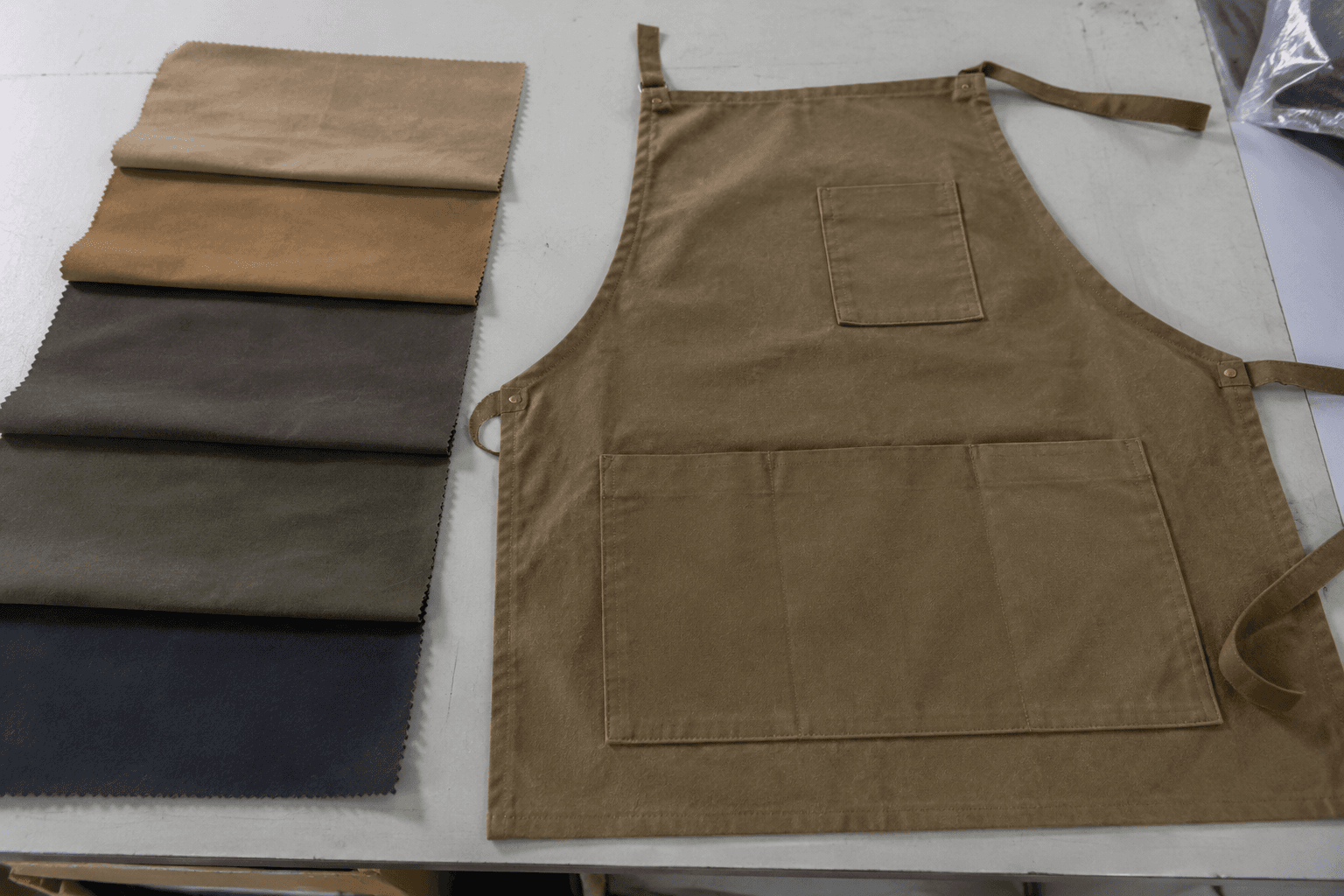
- Expect black, navy, olive, tobacco, and charcoal to perform best because they hide handling marks and show the brushed surface more consistently.
Moleskin apron fabric specifications to confirm before proto approval
Many sampling delays start because buyers and suppliers use the word moleskin too loosely. For apron production, the working specification should state fiber content, GSM or oz, usable width, brushing finish, shrinkage target, color route, and whether the cloth is stock, custom-dyed, or garment-washed. A broad range such as 300 to 420 GSM covers very different products, so the approved target should be tighter, for example 330 GSM plus or minus 5 percent or 12 oz plus or minus 0.5 oz.
Compared with twill, moleskin usually looks more solid and less visibly diagonal, especially in black, charcoal, and deep olive. Compared with canvas, it feels less dry and less boardy. That makes it a stronger choice for aprons sold on tactile value and clean branding, but not automatically the best option for rough industrial use. If the brief is a raw utility look at the lowest workable FOB, heavy duck often communicates that better.
Trim planning should match the fabric weight. A simple bib apron with one chest pocket and two lower pockets can work well in 320 to 370 GSM. Once the design adds leather straps, metal adjusters, rivets, towel loops, deep segmented pockets, or large woven labels, the total garment weight rises quickly. Buyers should approve the full apron sample, not just the cloth hanger, because the wearer experiences the complete garment system.
- Specify an exact weight, such as 330 GSM plus or minus 5 percent, instead of approving generic 'midweight moleskin'.
- Confirm width before costing; 57/58 inch versus 59/60 inch goods can change marker efficiency and FOB by several percentage points.
- Set shrinkage below 3 percent after one home-launder test if the apron is sold as pre-shrunk or stable fit.
- Approve handfeel and color from the same mill route intended for bulk, not from a showroom substitute.
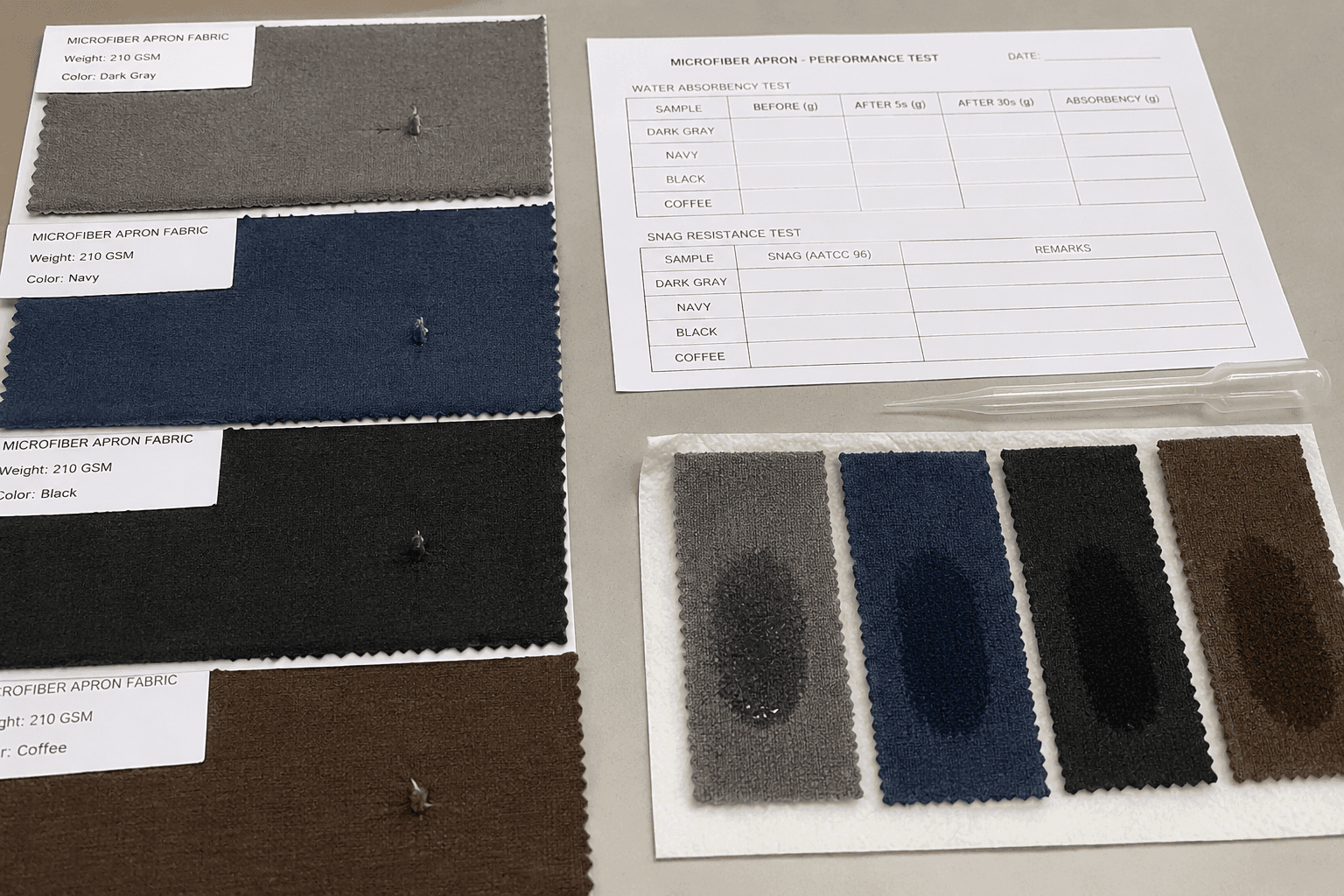
- Request test data for colorfastness to washing and rubbing if the apron will be used in uniform programs, not only retail display.
Realistic cost, MOQ, and lead-time benchmarks for moleskin apron orders
A custom moleskin apron generally costs more than a comparable canvas apron for three practical reasons. First, the finished cloth is usually higher priced. Second, the brushed face needs tighter lot control and one-way cutting to keep nap direction consistent. Third, packing has to reduce crush marks, lint pickup, and hardware abrasion. For a basic OEM bib apron in stock black or navy moleskin, FOB often starts around $4.80 to $6.50 per piece at 500 pcs. A more developed retail style with branded webbing, woven labels, antique-brass hardware, bartacks, and individual retail packing often lands between $7.20 and $11.80 per piece at 500 to 1,000 pcs.
MOQ depends more on fabric route than on sewing capacity alone. If the buyer accepts stock shades from an approved mill, many factories can support 300 to 500 pcs per style per color. If the buyer needs a brand-matched Pantone, a custom brushed finish, or reserved lot continuity for repeat apron orders, the mill may require 800 to 1,500 meters before production is viable. That is why annual forecast matters. A launch order of 300 pcs is commercially safer when the same fabric can support a second or third PO within the same season.
Lead-time planning should stay disciplined. Proto samples with stock cloth usually take 7 to 14 days. If lab dips, custom dyeing, or special finishing are required, sample development more often moves to 14 to 25 days. After PP approval and deposit, bulk production is commonly 35 to 55 days. Garment wash, custom hardware plating, barcode ticketing, or rigid gift-box packing can add another 7 to 10 days. For B2B buyers, a delayed launch can erode margin faster than a $1.20 fabric premium, so last-minute spec changes are expensive.
- Stock-fabric MOQ usually starts at 300 to 500 pcs per style per color.
- Custom-dyed moleskin commonly needs 800 to 1,500 meters at mill level before bulk approval.
- Typical FOB premium versus standard canvas is about $0.80 to $2.20 per piece at 500 to 1,000 pcs.
- Proto sampling is often 7 to 14 days with stock fabric and 14 to 25 days with custom fabric.
- Bulk lead time is usually 35 to 55 days after PP approval, excluding ocean or air transit.
Construction choices that keep a moleskin apron commercially viable
Premium fabric does not compensate for weak apron construction. Because moleskin has a smoother, more even face than open canvas, crooked topstitching, inconsistent seam allowance, and distorted pocket placement are easier to see. On a premium apron, buyers should expect stable stitches per inch, even topstitch tension, strong bartacks at stress points, and clean handling through sewing and pressing. Tolerances that may pass on a low-cost promotional apron often look unacceptable on a brushed surface under retail lighting.
Pattern design should reflect actual end use. Moleskin drapes well, but large lower pockets can sag once loaded with thermometers, tasting spoons, notebooks, handheld devices, box cutters, or small tools. Reinforcement may require self-fabric facings, hidden backing cloth, or wider bartack spans than on lighter twill. Strap selection matters as well. Cotton webbing keeps the apron cleaner in cost and assembly, while leather or PU details can raise perceived value but also add sewing minutes, hardware risk, and total garment weight.
Wear testing should be practical rather than cosmetic. A 390 GSM bib apron with a narrow neck strap can feel heavier after 3 hours than a 410 GSM cross-back style with balanced pocket loading. For café, culinary, and workshop buyers, wearer comfort affects reorder rates because staff acceptance drives actual use. A sound approval routine includes loaded-pocket wear for 2 to 4 hours, one or two wash cycles, and a review of pocket edge stability, strap anchors, and logo presentation after use.
- Use cross-back construction for many styles above 350 GSM or for aprons expected to carry heavier lower-pocket loads.
- Reinforce pocket corners, waist ties, and strap anchors when notebooks, handheld devices, or tools are part of the use case.
- Keep finished garment weight within roughly 650 to 900 grams for most retail and light-duty professional apron programs.
- Match thread size to cloth weight; ticket 20 or 30 is often more suitable than fine decorative thread on heavier moleskin.
Branding and color control on a brushed moleskin apron
Branding on a moleskin apron should be chosen for the brushed surface, not copied directly from a canvas spec. Embroidery is often the safest premium option because it remains legible on dark cloth and adds depth without depending on a perfectly flat face. Dense fills still need the correct backing and stitch density, or puckering becomes visible. Screen print can work well for simple graphics and larger logos, but fine lines and small text may lose edge definition on the brushed nap. Heat transfer is useful for detailed marks, yet excessive press temperature can flatten the face and leave a visible press box.
Color control is equally important. Brushed fabrics reflect light differently depending on nap direction, so panel shading can appear even when the dye lot is technically within tolerance. This is managed through one-way cutting, lot segregation, clear cutting-room marking, and stable pressing conditions. For repeat B2B apron programs, dark colors are usually safer than pale shades because they show less retail handling dirt and less visible surface inconsistency. Black, navy, charcoal, olive, and tobacco remain the most practical core colors for replenishment.
Finishing route changes both appearance and risk. Garment washing can create a softer, broken-in look suited to lifestyle retail, but it also increases shrinkage variation, seam torque risk, and shade movement between lots. For repeat café, corporate, and hardware-store programs, pre-shrunk mill-finished cloth is usually easier to control. If a washed look is required, buyers should define acceptable tolerance for measurement change, color variation, and nap appearance before bulk cutting starts.
- Embroidery is usually the most reliable branding method for premium brushed aprons.
- Screen print works best with simple artwork and larger logo zones rather than small fine-detail graphics.
- Approve heat transfer only after testing for nap flattening, press marks, and wash retention.
- Use one-way cutting to reduce visible panel shading on dark brushed cloth.
- Treat garment wash as a separate risk factor affecting shrinkage, handfeel, and lot consistency.
QC standards and repeat-order control for premium apron programs
On moleskin apron orders, the main quality risk is often appearance drift rather than outright fabric failure. A buyer may approve a sample with a rich brushed hand and receive bulk that looks flatter, glossier, or slightly uneven in shade. To control that, the PP stage should lock a sealed fabric standard showing GSM, width, color code, finish notes, and handfeel reference. If the apron is washed after sewing, approvals should also include measured shrinkage, skew, and colorfastness results before cutting starts.
In-line inspection should go beyond seam and measurement checks. Inspectors need to review nap-direction consistency, panel shading, pressure marks from bundling, lint pickup, chalk residue, seam grin at loaded pockets, hardware scratches, and visible pocket asymmetry. Final inspection should also review packing method. Over-compressed cartons can flatten the brushed face, create hardware rub, and weaken first impression when goods reach a retail DC, distributor, or brand warehouse.
For most premium apron programs, AQL 2.5 for major defects and AQL 4.0 for minor defects is a practical baseline. Some retail buyers tighten appearance standards further on dark brushed fabrics because surface variation is easy to see under store lights. If the apron is planned as a repeat SKU for 6 to 12 months, mill reference locking or fabric reservation is strongly advised. Brushed goods can shift more in hand and visual depth between lots than plain canvas, so repeatability has to be managed before reorder season, not after a claim.
- Seal a fabric standard with GSM tolerance, width, color code, and finishing route before PP approval.
- Confirm one-way cutting if nap direction changes the appearance across bib and pocket panels.
- Request wash-test results for shrinkage, skew, rubbing fastness, and logo retention before bulk approval.
- Use at least AQL 2.5 major and AQL 4.0 minor unless the retailer requires tighter appearance thresholds.
- Review carton count, fold method, and polybag protection to reduce nap crush and hardware marks in transit.
When moleskin is the right apron sourcing choice for B2B buyers
A moleskin apron is usually the right sourcing choice when the buyer needs stronger tactile value, better shelf presentation, and a softer hand than stiff canvas can offer. It fits premium retail aprons, branded workshop kits, selective café uniforms, museum-store merchandise, and collaboration programs where the apron is a considered product rather than a low-cost accessory. In those channels, the added fabric cost is visible to the end customer and easier to defend in the margin model.
It is a weaker choice when the brief is driven by the lowest FOB, very high wash frequency, heavy grease saturation, or a deliberately rough industrial look. For promotional giveaways, event programs, or price-sensitive uniform rollouts, standard canvas or twill usually gives simpler replenishment, lower appearance risk, and easier first-production control. Buyers serving harder-use maintenance or abrasive workshop environments should also test moleskin carefully, because repeated abrasion and aggressive laundering can reduce the premium surface effect faster than on plain weaves.
The strongest sourcing decisions start with channel, annual volume, target FOB, wash expectation, MOQ, and reorder cadence. Then the buyer builds the apron around those facts. When developed against a clear B2B brief, moleskin can produce a commercially strong apron with better touch and shelf appeal. When chosen only because it sounds upscale, it becomes an avoidable cost layer in the apron BOM.
- Choose moleskin for premium touch, giftable presentation, and stronger branded retail appeal.
- Choose canvas for lower FOB, simpler repeat sourcing, and a more rugged abrasion image.
- Choose twill for lighter-weight aprons, easier printing, and lower sewing bulk.
- Reserve fabric early if the apron is expected to become a repeat SKU or seasonal carryover item.