In a grooming van, apron performance is defined by three measurable limits: repeated splash exposure, slow drying in a humid enclosed vehicle, and very little clean-storage volume. B2B buyers sourcing mobile dog wash aprons for route teams usually need a narrower specification than salon buyers. The apron must cover the upper chest through the knee area during bathing, resist diluted shampoo and rinse splash, and still fold small enough that each groomer can carry 3-5 clean units in the van.
The most common buying mistake is to source on waterproof claims alone. For mobile work, the better commercial result usually comes from balancing denier, coating weight, GSM, cut length, strap layout, pocket count and realistic dry-down time. A fully waterproof PVC-backed apron that stays wet for 90-120 minutes inside a van is often less useful than a PU-coated splash-resistant apron that dries in 45-60 minutes and stores flat after a rinse-off.
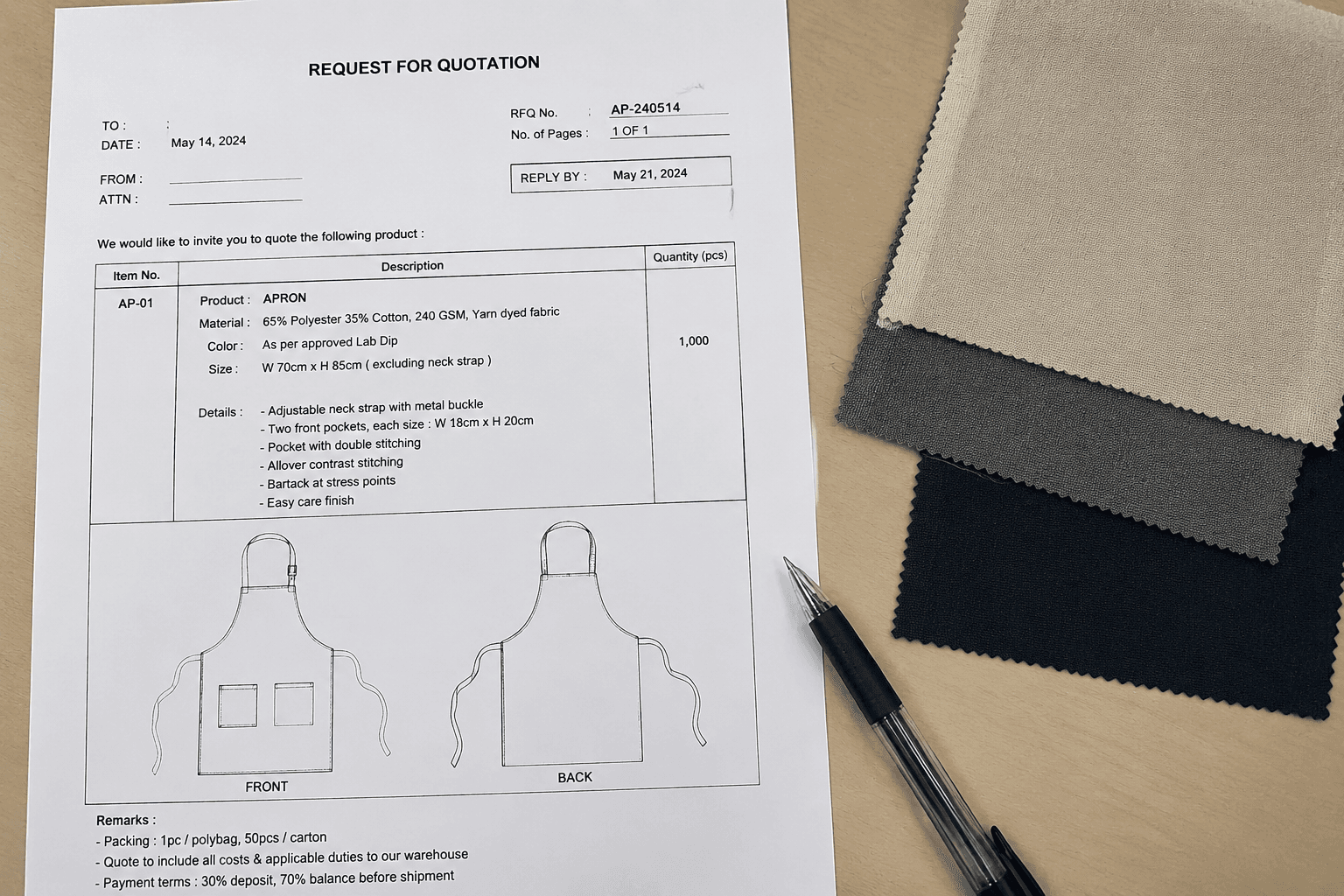
For importers, distributors and private-label buyers, the specification should match route density and replacement planning. A team running 6-10 appointments per day, rotating 3 aprons per groomer, and reordering every 4-6 months will judge value differently from a fixed-site salon. Bulk approval should therefore be tied to measurable points: GSM tolerance, folded size, strap strength, MOQ, FOB cost, AQL level and production lead time after PP sample confirmation.
- PU-coated 210D-300D polyester at 150-190 GSM is usually the fastest-drying option for route teams, while 420D PU-coated oxford at 190-230 GSM is the usual middle ground for better wear life.
- The most practical size range for mobile dog wash aprons is 70-75 cm wide by 85-95 cm long, giving chest-to-knee splash coverage without catching on van steps, tub rims or cabinet corners.
- Large lower patch pockets are usually a sourcing mistake on bathing aprons because they retain water, loose hair and shampoo residue, increasing cleaning time and slowing dry-down.
- Typical OEM MOQ is 300-500 pcs per color for a simple one-size apron; multi-size or trim-custom programs usually move to 600-1,000 pcs total.
- Development samples usually take 5-10 days, PP samples 3-5 days, and bulk production 25-40 days after approval, with an additional 7-10 day peak-season buffer.
- Realistic FOB pricing is around US$3.20-6.80 per piece, depending on denier, coating, pocket count, logo method, packaging and trim complexity.
- Bulk inspection should use AQL 2.5 for major defects and AQL 4.0 for minor defects, with coating consistency, stitch density, strap pull strength and fold-pack accuracy checked before shipment.
Why mobile dog wash aprons need a different buy spec from salon aprons
A salon apron and a van-use bathing apron may look similar in a catalog, but they perform under different constraints. Inside a mobile unit, the wearer turns in a 65-80 cm aisle, leans over a tub wall, works around hoses and restraints, and steps in and out of the vehicle several times per day. That shifts the sourcing requirement from broad front protection to controlled splash coverage, lower folded bulk and faster recovery between appointments.
For that reason, mobile dog wash aprons should be specified around wet-zone exposure, not around maximum body wrap. In field use, the heaviest splash normally hits the upper chest, mid-abdomen and upper thigh. Buyers who understand this usually avoid overbuilt full-wrap styles that add roughly 80-150 g of unnecessary fabric weight, hold more surface moisture and reduce turning clearance in narrow work areas.
This category also needs better drape than many low-cost waterproof aprons provide. A rigid PVC-backed garment can pass a water-resistance claim and still fail on route because it stands away from the body, catches on tub edges or cabinet handles, and becomes tiring after 3-4 consecutive washes. In commercial terms, the better product is usually an apron that blocks repeated splash, hangs close to the body and returns to wearable condition before the next stop.
- Typical route density is 6-10 appointments per day, so dry-down time directly affects usable stock per groomer.
- Main exposure is repeated splash and rinse runoff, not full immersion.
- The useful protection zone is upper chest to knee; extra side wrap often adds bulk without improving performance.
- Van aisles, raised steps and tub rims penalize stiff, oversized or heavily trimmed apron bodies.
Fabric selection for mobile dog wash aprons: 210D, 300D and 420D compared
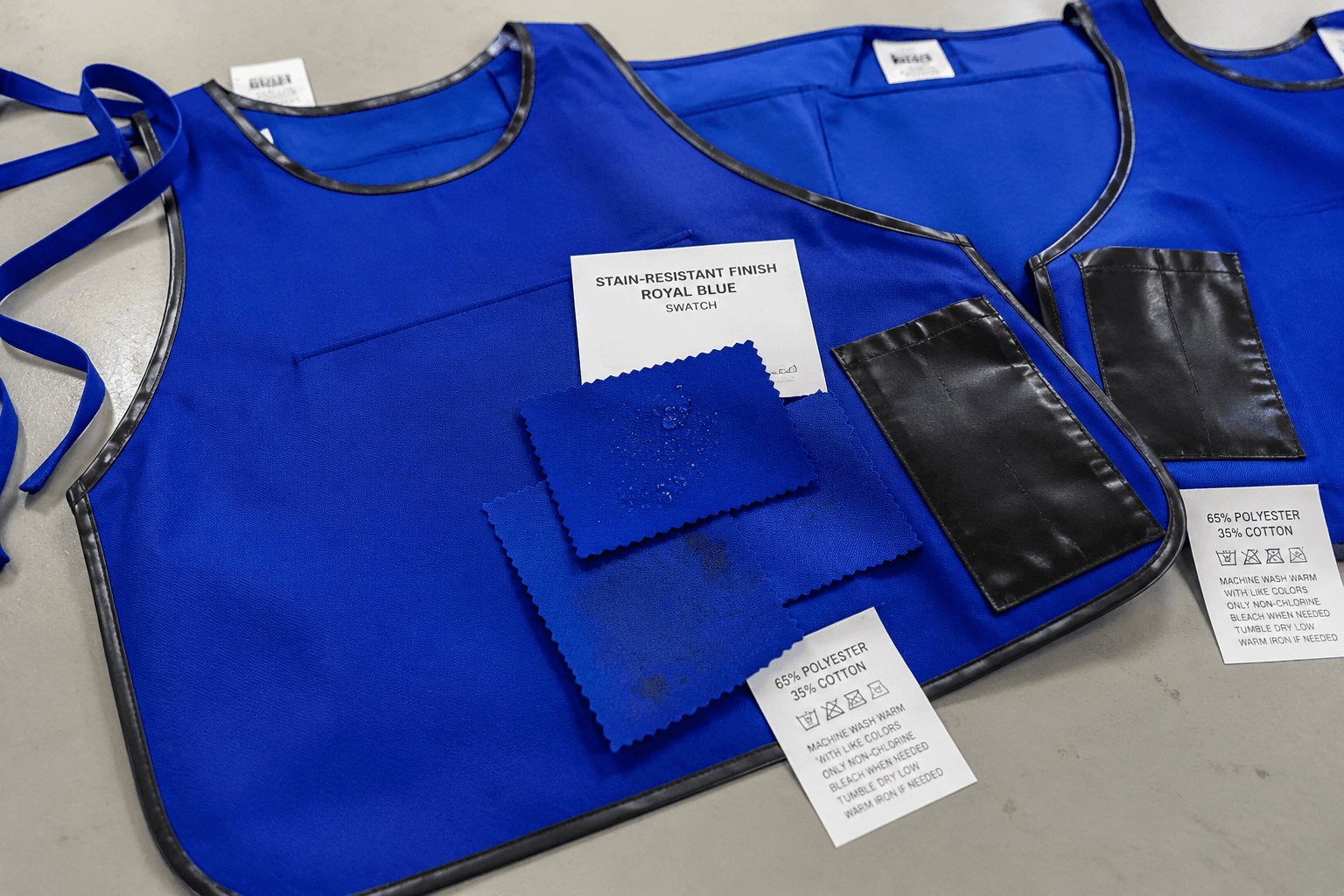
The main product decision is the fabric package. In practical OEM production, the most common options are 210D, 300D and 420D polyester oxford with PU coating, usually landing between 150 and 230 GSM depending on yarn denier, back-coating weight and finish. For professional van teams, 420D PU-coated oxford with an approximately 0.10-0.15 mm coating layer is often the safest middle ground because it gives solid splash resistance, acceptable flexibility and stable sewing at commercial scale.
Lighter 210D-300D constructions deserve serious consideration when fast dry-down is the priority. At about 150-190 GSM, these fabrics generally dry faster after rinse exposure, create less folded volume and are easier to rotate when each worker carries only a few clean replacements. In practical wear checks, these lighter aprons often return to usable condition in 30-60 minutes under ventilated conditions, while 420D goods more commonly need 45-75 minutes. Inside a humid van with weak airflow, both can take longer, but the lighter fabric still recovers faster.
Heavier 600D polyester or PVC-backed constructions should be used selectively. They can improve abrasion resistance where aprons rub against metal table edges, crate corners or rough hardware, but they usually feel hotter, fold thicker and retain surface moisture longer at seams and pocket joins. In many mobile programs, that extra denier adds about US$0.40-1.10 per piece and increases carton cube without improving route efficiency. Unless abrasion is the main failure mode, 210D to 420D PU-coated polyester is usually the more commercial choice.
- 210D PU-coated polyester: about 150-170 GSM, lower FOB cost, quickest drying, lowest fold bulk.
- 300D PU-coated polyester: about 170-190 GSM, balanced option for distributor and private-label lines.
- 420D PU-coated oxford: about 190-230 GSM, firmer handfeel and better wear life for heavier route use.
- PVC-backed or 600D styles: slower drying, thicker fold, useful only when abrasion exposure is unusually high.
- A practical sample test is a 5-minute spray exposure followed by dry-down checks at 30, 60 and 90 minutes.
Coverage dimensions and strap layouts that work inside grooming vans
Cut and size are often mis-specified in this category. Buyers regularly ask for maximum width and length to increase protection, but oversized coverage slows movement in a narrow vehicle. A practical bathing apron should protect from the upper chest to below the knee while leaving enough side openness for turning, climbing into the van and working around the tub without drag.
Across bulk programs, a body width of 70-75 cm and a length of 85-95 cm is usually the most stable adult unisex range. Below 80 cm in length, lap and upper-thigh protection often becomes insufficient when the groomer bends or kneels. Above 100 cm, the lower edge can interfere with van steps, rubber clogs and boot movement, especially after the fabric becomes damp. A slight lower-side taper, usually trimming 2-4 cm per side from hip to hem, often improves stride and reduces wet cling without sacrificing frontal coverage.
Strap configuration deserves equal attention. Cross-back straps reduce neck load during long shifts, but they add webbing length, extra sewing operations and slightly more packed bulk. Adjustable neck-loop designs are cheaper and simpler for one-size programs. For many B2B buyers, the most efficient solution is a reinforced adjustable neck strap in 2.5 cm polyester webbing with waist ties positioned slightly above the natural waist so the lower panel stays close to the body during bending instead of swinging forward.
- Recommended body size baseline: 70-75 cm width x 85-95 cm length.
- Aprons longer than 100 cm often interfere with raised van entries and quick stepping.
- A lower-side taper of 2-4 cm per side improves turning clearance.
- 2.5 cm polyester webbing is a common commercial standard for neck and waist adjustment.
- Cross-back straps improve comfort but usually add about US$0.20-0.45 per piece.
Storage-led construction: folded size, trim reduction and dry-space limits
Storage is part of the product specification, not an afterthought. Many mobile grooming vans have one small dry shelf, a short hanging area and limited separation between clean and used garments. That means apron construction must support compact folding, quick handling and low snag risk. Every extra layer, oversized pocket, thick binding tape and decorative accessory increases folded volume and slows drying in a confined compartment.
A simple PU-coated polyester apron with low-profile construction can usually fold flat to about 24 x 30 cm or 26 x 32 cm, depending on size and strap layout. By comparison, a heavier PVC-backed style with multiple pockets, thicker webbing and extra hardware can consume 20-35% more storage volume per piece. For operators issuing 3-5 aprons per groomer across 4-8 vans, that difference affects shelf planning, spare-stock allocation and import carton cube in a measurable way.
Trim discipline matters here. Deep utility pockets, hanging loops, metal D-rings and decorative clips may look useful in product presentations, but they often snag when stacked on narrow shelves or pulled from bins in a hurry. In mobile service, a clean front panel with minimal external structure usually performs better than feature-heavy styling. Buyers should ask suppliers for folded measurements, unit weight and carton pack-out during sampling, not after the bulk order is placed.
- Target folded size: about 24 x 30 cm to 26 x 32 cm for adult one-size aprons.
- Extra trim can increase storage cube by 20-35% per unit.
- Request unit net weight; many practical van aprons fall between 180 g and 320 g.
- Ask for carton loading early, especially when each groomer carries 3-5 aprons per route.
Pockets, hardware and branding decisions on mobile dog wash aprons
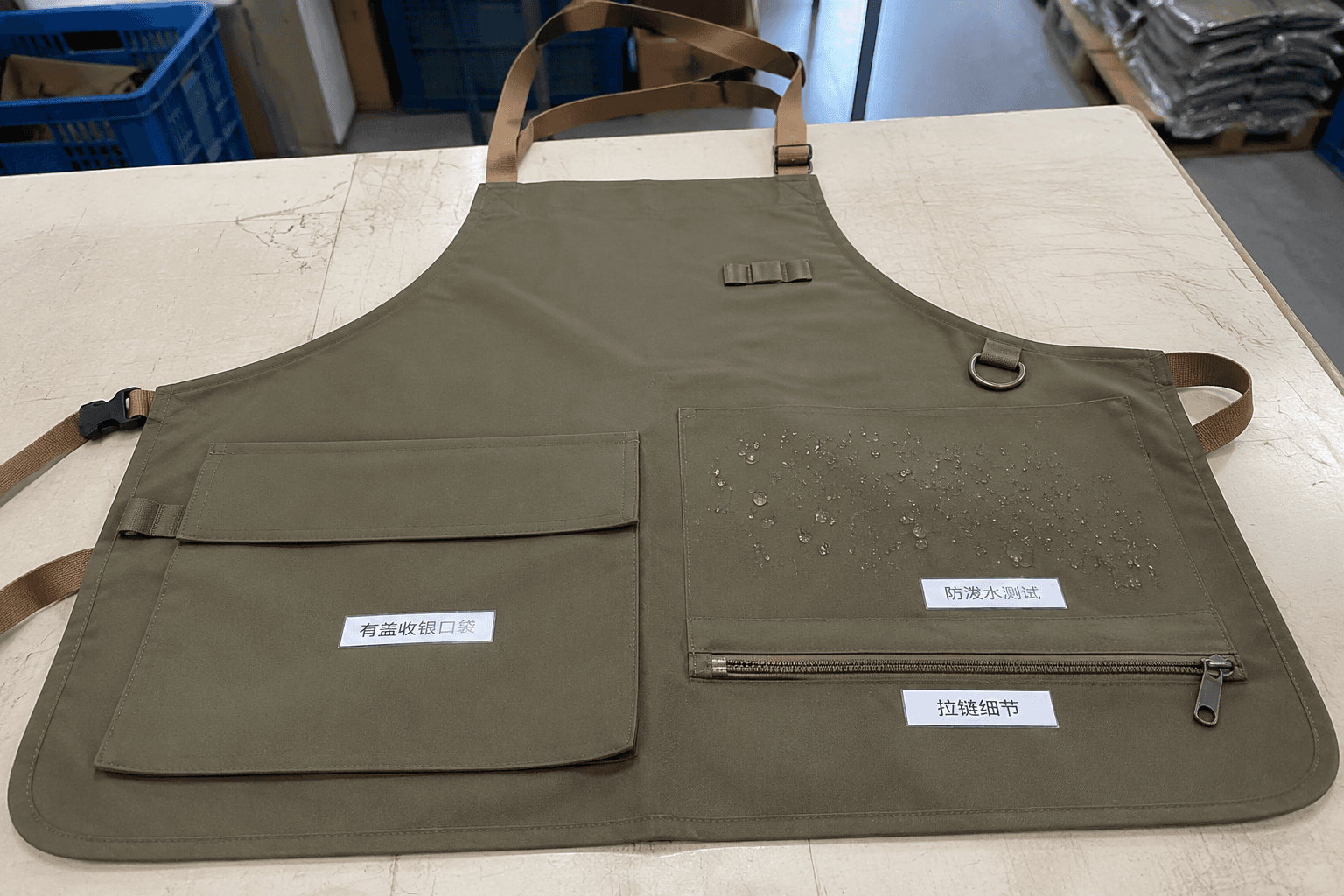
Accessory design should follow the bathing workflow. In most van operations, large lower patch pockets are a liability because they collect water, loose hair and shampoo residue. That leaves the garment wet longer and creates more cleanup between appointments. For professional use, one small chest pocket with a drain eyelet, or one narrow waterproof zip pocket for a key card or phone, is usually enough. More than that should be justified by a specific route requirement.
Hardware should be chosen for wet-service reliability rather than appearance. Acetal adjusters and tested plastic buckles usually outperform low-grade plated metal because they are less likely to corrode, stain fabric or seize after repeated wet-dry cycles. Reinforcement at strap joints matters more than decorative hardware. In factory inspections, failed box stitches at the neck or waist are more common than buckle breakage when the apron is otherwise correctly specified.
Logo method also needs discipline. Heat transfer works well on smooth coated surfaces when care temperature is controlled. Flexible screen printing is economical at 1,000 pcs and above, but the ink system must resist cracking after repeated folding. Embroidery can create needle holes in coated fabric and should be used only when the backside can be sealed or when placement is outside the main splash zone. For most OEM programs, a small upper-chest logo, usually 6-10 cm wide, gives the best balance of visibility, durability and production stability.
- Avoid large lower-front pockets on bathing-focused aprons.
- Use acetal hardware or equivalent plastic trims for wet environments.
- Require reinforced box stitching at neck and waist stress points.
- Preferred logo area: upper chest center or left chest, about 6-10 cm wide.
- Embroidery on coated fabric should be approved only with sealing or low-splash placement.
MOQ, FOB cost, lead time and inspection controls for bulk apron programs
Commercial planning is more accurate when buyers separate standard programs from trim-heavy custom programs. A basic apron in one fabric, one color and one size can often start at 300-500 pcs per color. Once the brief adds custom webbing colors, multiple body sizes, woven branding, printed care labels, recycled-content claims or separate fit blocks, the practical MOQ usually rises to 600-1,000 pcs total so the factory can manage material utilization and cutting efficiency.
FOB pricing should be discussed with realistic breakpoints. Simple 210D-300D PU-coated aprons with standard neck adjustment and no zipper pocket often land around US$3.20-4.30 per piece at 1,000 pcs. A 420D PU-coated style with reinforced stitching, one functional chest pocket and a custom heat-transfer logo typically sits around US$4.20-5.60. More complex constructions with detachable straps, TPU lamination, multiple trim colors or individual retail packaging can move above US$5.80 and reach US$6.80 or more. Quotes should always confirm the agreed GSM range and coating spec, not only the fabric name.
Lead time should be broken into stages. Development samples usually take 5-10 days when greige or stock fabric is available. PP sample approval normally adds 3-5 days. Bulk production commonly runs 25-40 days after final approval and deposit, with another 7-10 days of buffer in peak season. For quality control, AQL 2.5 for major defects and AQL 4.0 for minor defects is a practical baseline. Inspection points should include coating consistency, stitch density, strap attachment strength, measurement tolerance, logo placement, fold-pack method and carton assortment accuracy.
- Simple MOQ: 300-500 pcs per color for one-size programs.
- Custom or multi-size programs: 600-1,000 pcs total is more realistic.
- FOB range: about US$3.20-6.80 per piece depending on fabric and trim complexity.
- Sample time: 5-10 days; PP approval: 3-5 days; bulk production: 25-40 days.
- Recommended QC baseline: AQL 2.5 major, AQL 4.0 minor, with strap pull tests and measurement checks.
PP approval checklist and field testing before bulk cutting
The safest way to approve mobile dog wash aprons is to test samples in actual route conditions, not by office review alone. An apron that looks acceptable on a hanger can fail once the wearer bends over a tub, kneels at the van step, lifts a dog or hangs the garment in a humid compartment. For most buyers, a 3-5 day wear trial with at least two users of different body sizes is enough to expose the main design weaknesses before bulk cutting begins.
The trial should record specific points. Measure water shedding after a standard rinse or spray exposure, note inside dampness after 15-20 minutes of work, and compare drying time inside the van versus outside in open air. Check whether the hem curls after drying, whether straps twist, whether the apron rides up when bending, and whether seams or pockets trap hair. This data is more useful than general wearer comments because it identifies exactly which construction details need correction.
Before sign-off, the buyer and factory should lock a written PP checklist. It should include body measurements and tolerance, target GSM with acceptable variance, coating type, logo position, webbing width, stitch reinforcement, folded method, packing quantity and carton marks. In OEM terms, one extra sample round can add 5-7 days, but that is usually cheaper than a rejected shipment or a route team replacing poorly specified aprons after one season.
- Run a 3-5 day field trial in an actual van with at least 2 wearers.
- Measure dry-down after rinse exposure at 30, 60 and 90 minutes.
- Check hem curl, strap twist, wet cling, hair retention and step clearance.
- Approve tolerances, GSM range, fold method, packing quantity and carton marks before bulk.