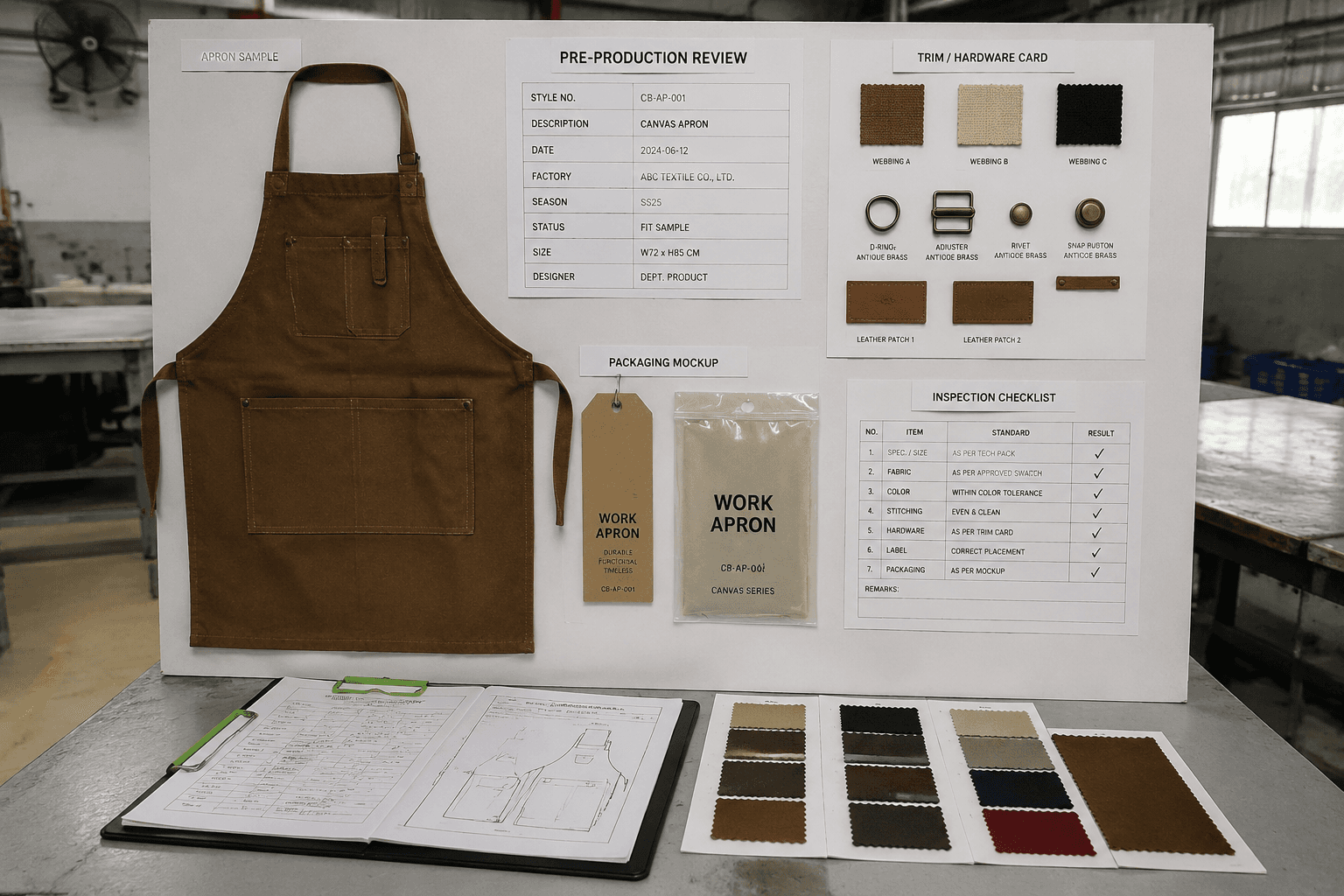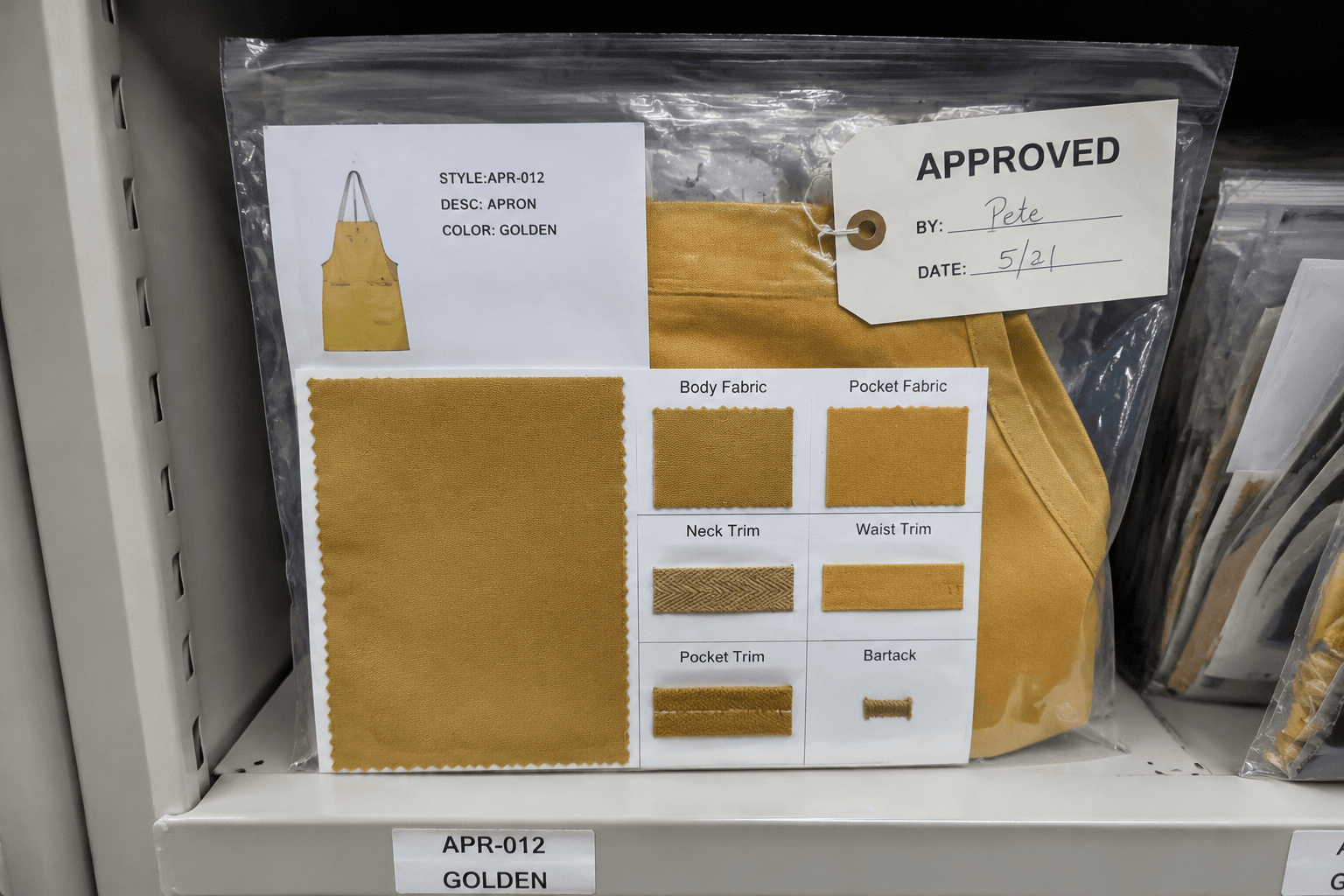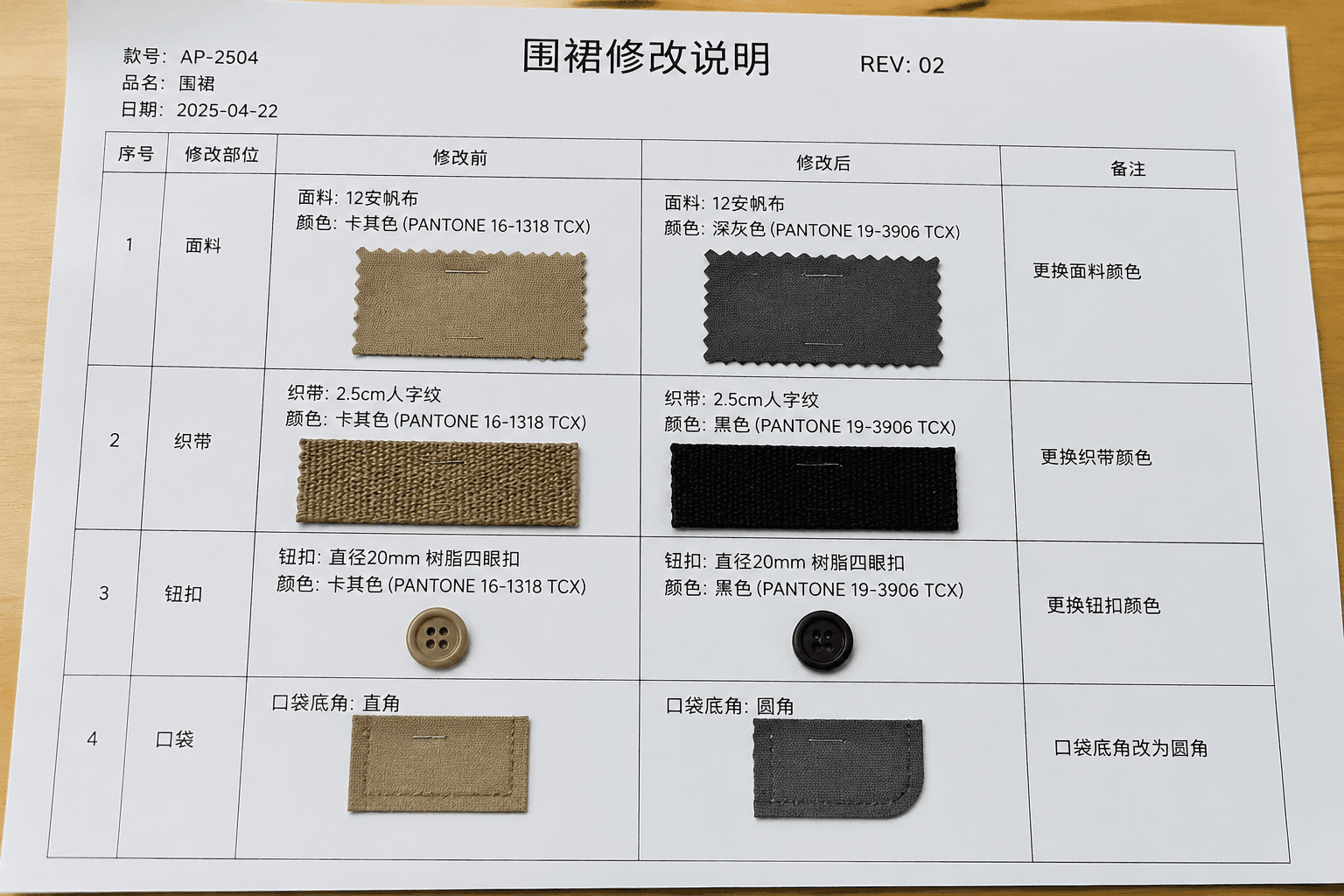
For sourcing managers, franchise buyers and private-label teams, mixed sku apron orders are a normal purchasing requirement, not a special case. One program may need black, navy and khaki bib aprons for restaurant operations, short and long waist aprons for service staff, and separate logo versions for regional accounts. Buyers think in finished units, but factories cost aprons by fabric lot, dye lot, marker yield, trim booking, decoration setup, line efficiency and carton assortment.
MOQ problems start when a healthy total order is divided into weak apron sub-SKUs. A 3,600-piece order can still behave like several short runs if it is split into six colors, three size groups and three logo versions, leaving some variants below workable levels for dyeing, webbing purchase, embroidery setup or mixed packing. The usual result is a cost revision of US$0.18-US$0.85 per apron, a forced quantity rebalance, or a 4-8 day delay before bulk cutting.
The practical solution is to decide early which apron variables can share MOQ and which must stand alone. Fabric construction, GSM, dye route, strap material, hardware finish, logo method and packing format usually determine whether variants can be combined. When those rules are defined up front, mixed sku apron orders become easier to quote, easier to inspect and much less likely to trigger late-stage MOQ disputes.
- Apron MOQ follows fabric, color, trim and decoration route more than total PO quantity.
- A 2,400-piece apron order can still price like several small runs if low-volume colors or logo versions require separate dye lots or setups.
- Lock apron size ratios before marker approval; late ratio changes often add 3-7 days and US$0.08-US$0.22/pc.
- Logo versions combine best when placement, method, stitch count and thread palette stay consistent across the apron program.
- A usable RFQ for mixed sku apron orders must show units by style, color, size, logo version, packing method and destination channel.
- Typical custom-apron lead time is 25-35 days after approvals with stock-supported fabric and 35-45 days with custom dyeing.
How mixed sku apron orders break down into real factory MOQ triggers
The main reason mixed sku apron orders fail is that buyers treat one PO as one production condition. An apron factory does not. It breaks the order into shell fabric, color route, trim package, decoration route and packing method. A bib apron in 245 GSM polycotton twill is a different sourcing platform from the same shape in 280 GSM enzyme-washed canvas or 10 oz indigo denim, even if the pattern is identical.
For a standard bib apron using stock-supported 240-260 GSM twill or canvas, many factories can sew efficiently from about 300-500 pcs per color per style. Once custom Pantone dyeing is required, the practical MOQ usually moves upstream to the mill. With typical consumption around 0.90-1.15 meters per apron and dye-lot minimums of 500-800 meters per shade, the efficient level often becomes 450-850 pcs per color. Below that point, the order is still possible, but it prices like a short run.
Decoration adds another threshold. A one-position screen print may be workable from 150-300 pcs per artwork. Direct embroidery usually needs at least 100-150 pcs per file to absorb machine setup, thread matching and approval checks. If stitch count rises from 6,000 to 18,000 stitches, embroidery cost can move from US$0.28-US$0.45 to US$0.65-US$1.10 per apron. Buyers should therefore ask for MOQ by apron color, size group and logo route, not just total order quantity.
- Stock-fabric apron sewing MOQ is often 300-500 pcs per color for one base style.
- Custom-dyed apron fabric often needs 450-850 pcs per color to stay efficient.
- Embroidery below 100-150 pcs per logo file usually carries setup surcharge.
- Short-run apron variants often add US$0.25-US$0.80/pc before freight.
Costing mixed sku apron orders across fabric, straps, hardware and decoration
When suppliers quote mixed sku apron orders, they usually separate hard MOQ from soft MOQ. Hard MOQ comes from the mill and trim vendors: fabric lot size, dyed webbing minimum, custom woven label run, branded buckle purchase or printed carton minimum. Soft MOQ comes from factory efficiency: marker utilization, line changeover, inline QC, decoration batching and mixed-carton reconciliation. A factory may accept 120 pcs of one apron variant, but the unit cost will reflect trial-order economics rather than bulk production.
The first pricing question is whether all variants share one material platform. If black, navy and khaki bib aprons all use the same 245 GSM stock canvas, 3.2 cm cotton herringbone straps, antique brass buckle and one-color care label, the factory can usually combine them under one raw-material plan. If olive requires custom dyeing, natural uses self-fabric ties and black switches to polyester webbing with nickel hardware, the apron variants no longer share the same MOQ logic.
Logo planning follows the same rule. Three logo versions are manageable when each uses the same left-chest embroidery placement, similar stitch density and the same thread family. If one apron uses embroidery, one uses a woven patch and one uses a screen print on the pocket, the supplier is managing three process routes, three approval paths and usually three different cost structures. That directly affects both unit price and lead-time risk.
- Hard MOQ includes fabric lot, dye lot, custom trim purchase and decoration setup.
- Soft MOQ includes marker efficiency, line balancing, inline QC and mixed-carton handling.
- Variants combine best when they share GSM, finish, strap material, hardware finish and logo method.
- Different decoration methods on one apron body should be quoted as separate process routes.
Color planning for mixed sku apron orders: stock shades versus custom Pantone dyeing
Color is usually the main reason buyers request mixed assortments, but the best split depends on whether the apron program uses stock-supported shades or fresh dyeing. For common colors such as black, navy, beige, olive and natural in 8-10 oz canvas or 240-260 GSM twill, many suppliers can support 200-300 pcs per color when the total order reaches 1,200-2,000 pcs on one style. In that structure, a simple bib apron with one pocket, adjustable neck strap and small chest embroidery often lands around US$3.60-US$5.20 FOB, depending on fabric composition, hardware and packing.
Custom shades are less flexible. If a hospitality group needs exact Pantone references for chain-wide consistency, the mill may require 500-800 meters per shade, plus lab-dip charges and shade-control handling. A split such as 1,000 black / 800 navy / 400 rust / 200 sage may look balanced commercially, but the 200-piece custom color can push the whole order off the efficient dye route. The factory may then recommend a stock replacement, an increased quantity to reach dye minimum, or a short-lot premium of US$0.20-US$0.55/pc on that color.
Matching accessories are the hidden weak point. Shell fabric may meet MOQ, but matching webbing, bias binding, neck straps, PU tabs or woven-label backgrounds may not. Accessory vendors often work at 500-1,000 meters per dyed tape color or 3,000-5,000 labels per colorway. That is why buyers should never approve apron color splits on shell fabric availability alone.
- Stock-supported apron shades often work from 200-300 pcs per color with solid total volume.
- Custom Pantone shades usually need about 500+ pcs per color for efficient dyeing.
- Matching straps, tapes and labels can trigger MOQ issues even when apron body fabric is available.
- Ask suppliers to quote both a stock-color route and a custom-dye route before PO confirmation.
Size ratio control before marker approval and bulk cutting
Aprons are simpler than tailored garments, but size planning still affects yield, trim usage and shipment accuracy. Bib aprons may vary by body width, body length, neck-drop and waist-tie length. Waist aprons often split into short, regular and long lengths. Cross-back aprons need especially clear grading because fit depends on torso depth and strap length. If size ratios stay open after pre-production approval, the factory may have to remake markers, rebalance fabric usage and change carton assortments.
A realistic case is 1,800 bib aprons in S/M, L/XL and XXL using 280 GSM enzyme-washed canvas, booked at a 35/45/20 ratio. If XXL consumes 9-12% more fabric and 15-20 cm more strap length than S/M, the extra usage is manageable when reserved early. If the buyer later changes the ratio to 20/50/30 after fabric booking, the supplier may need new markers, more webbing and revised carton counts. That kind of change commonly adds 3-7 days and US$0.08-US$0.22 per apron.
Size ratios also affect final inspection. If the assortment is heavily mixed, the factory should confirm carton pack rules, over-and-under tolerance and final audit method in advance, commonly at AQL 2.5 major / 4.0 minor for export orders. Without a locked ratio, final reconciliation becomes slower and shortage claims become more likely, especially when cartons are pre-sorted by account or store group.
- Lock apron size ratios at PO stage or no later than PPS approval.
- Canvas and denim aprons usually show larger size-based consumption differences than light twill aprons.
- Late ratio changes often add 3-7 days and US$0.08-US$0.22/pc.
- Confirm carton assortment and inspection level early, such as AQL 2.5/4.0.
Managing multiple logo versions without turning one apron PO into mini-runs
Many B2B buyers need one apron platform for several channels: restaurant operations, franchise stores, distributors or private-label retail. The apron body can stay the same while the logo changes, but the order stays efficient only when logo architecture is controlled. The cleanest structure is one base apron, one fabric platform, one color family, one placement and one decoration method. In that model, cutting and sewing can run as one bulk lot, while decoration and packing split later by version.
Problems begin when buyers treat logo differences as minor. A 7 cm left-chest embroidery, a center-pocket screen print, a hem woven patch and a neck transfer are not simple artwork options. They are separate process routes with different setups, approvals and QC points. Even when the apron body is unchanged, five logo versions with mixed placements can add roughly US$0.12-US$0.40/pc in handling and setup, plus a 2-4 day pre-production delay if embroidery-outs, strike-offs or placement approvals are needed for each version.
A practical method is to divide logo variants into primary and secondary versions. Primary versions change method, placement or patch construction and should meet a stronger MOQ. Secondary versions keep the same route but change wording, account code or thread color within an approved palette. In many apron programs, factories can combine secondary versions in one decoration batch while costing primary versions separately.
- Keep logo placement constant wherever possible to preserve one apron production flow.
- Treat changes in method or placement as primary variants with stronger MOQ rules.
- Treat text-only or thread-color changes as secondary variants when stitch count stays stable.
- Request a logo matrix with artwork code, size, placement, method and unit split before bulk approval.
RFQ, QC and lead-time rules that prevent MOQ surprises on apron assortments
The simplest way to avoid MOQ disputes is to issue a complete apron variant map at RFQ stage. A factory can quote accurately only when it sees the split by style, color, size, logo version, packaging format and destination channel. A request that says 3,000 assorted aprons with logos forces the supplier either to price conservatively or to issue a provisional quote that changes after sampling. Neither helps a buyer compare vendors fairly.
For a standard custom apron order using stock-supported 240-300 GSM fabric, standard trims, one decoration route and export packing, a realistic schedule is 5-7 days for sample revision, 3-5 days for artwork or embroidery approval, 25-35 days for bulk production after approvals and deposit, and 2-4 days for final inspection and booking. If custom dyeing is added, allow another 4-7 days for lab dips and fabric readiness. If the order includes four colors, three logo versions and mixed carton assortments by sales channel, pre-production alignment can add 3-6 days before sewing starts.
Quality control should be specified as clearly as price. Buyers should confirm measurement tolerance, shade tolerance, logo position tolerance, barcode rules, carton assortment rules and final audit method before PO release. For export apron programs, common practice is inline inspection during sewing plus final random inspection at AQL 2.5 major / 4.0 minor. If logo assortments are complex, request a 100% visual sort by version before final packing. That step costs far less than shipping the correct apron body with the wrong logo or account label.
- RFQ should show exact split by style, color, size, logo version, packing and channel.
- Standard custom apron bulk lead time is often 25-35 days; custom-dye programs often need 35-45 days.
- Use clear QC terms for measurement, shade, logo placement and final audit level.
- Ask the factory to flag any sub-SKU below practical MOQ before PO placement and sample approval.