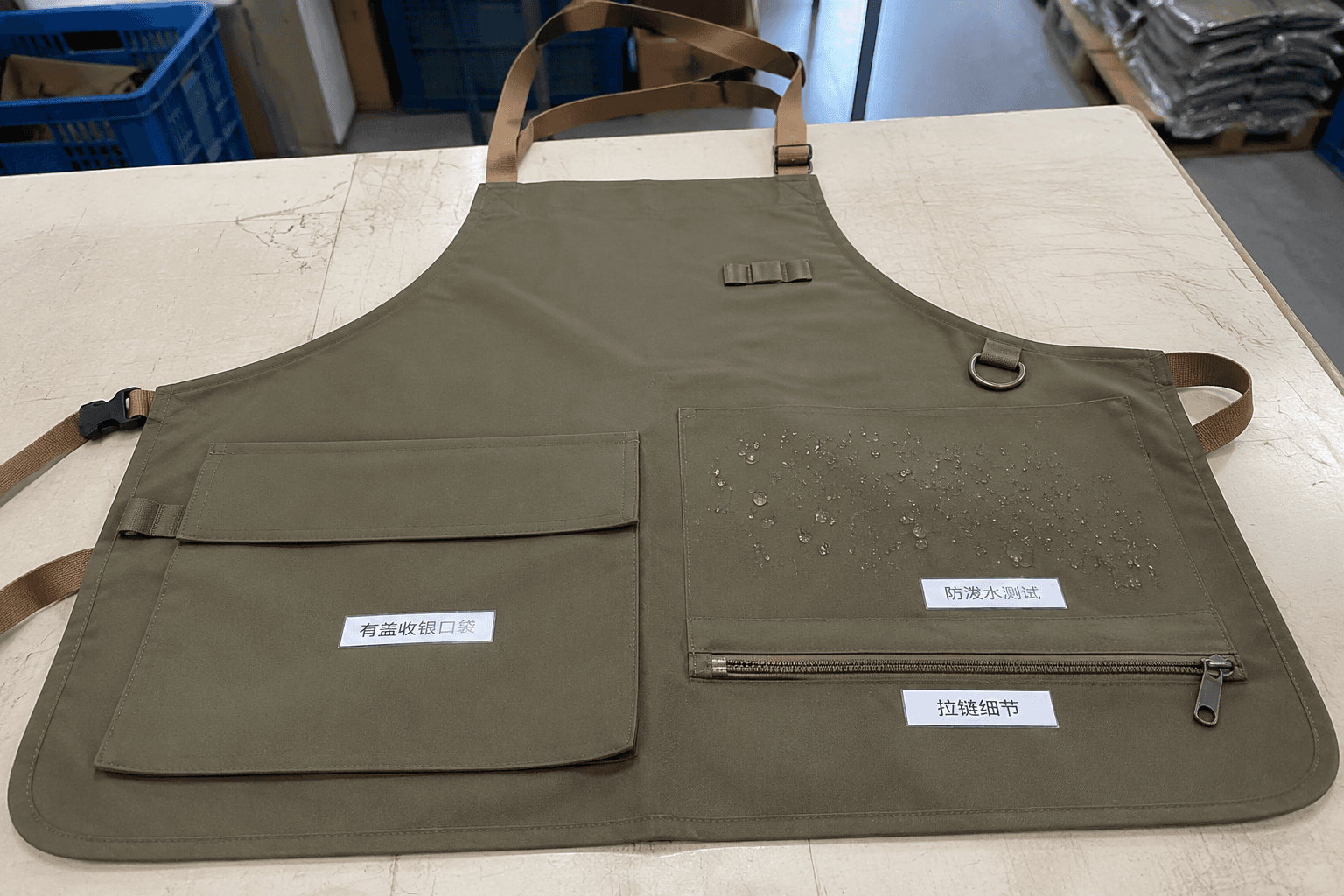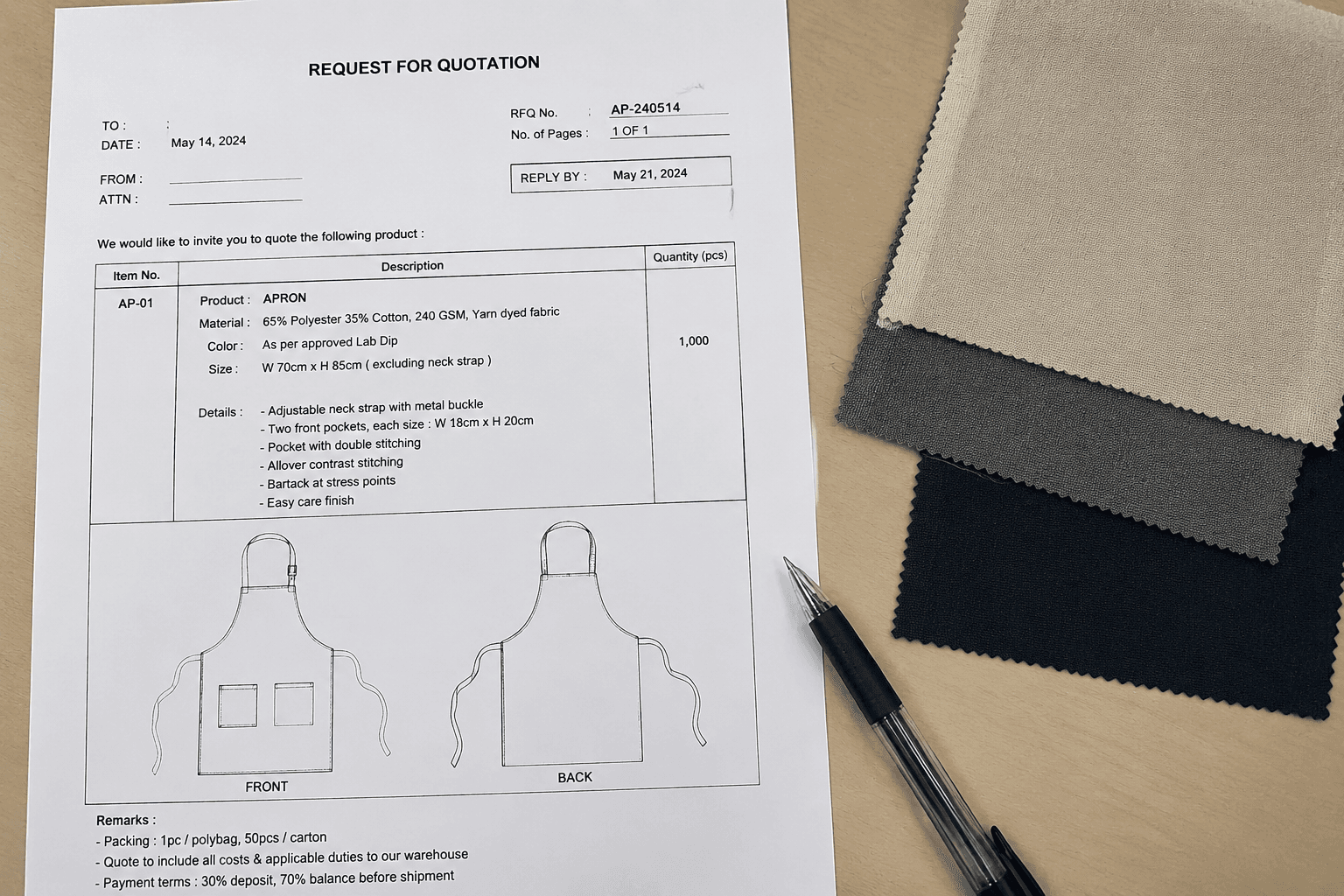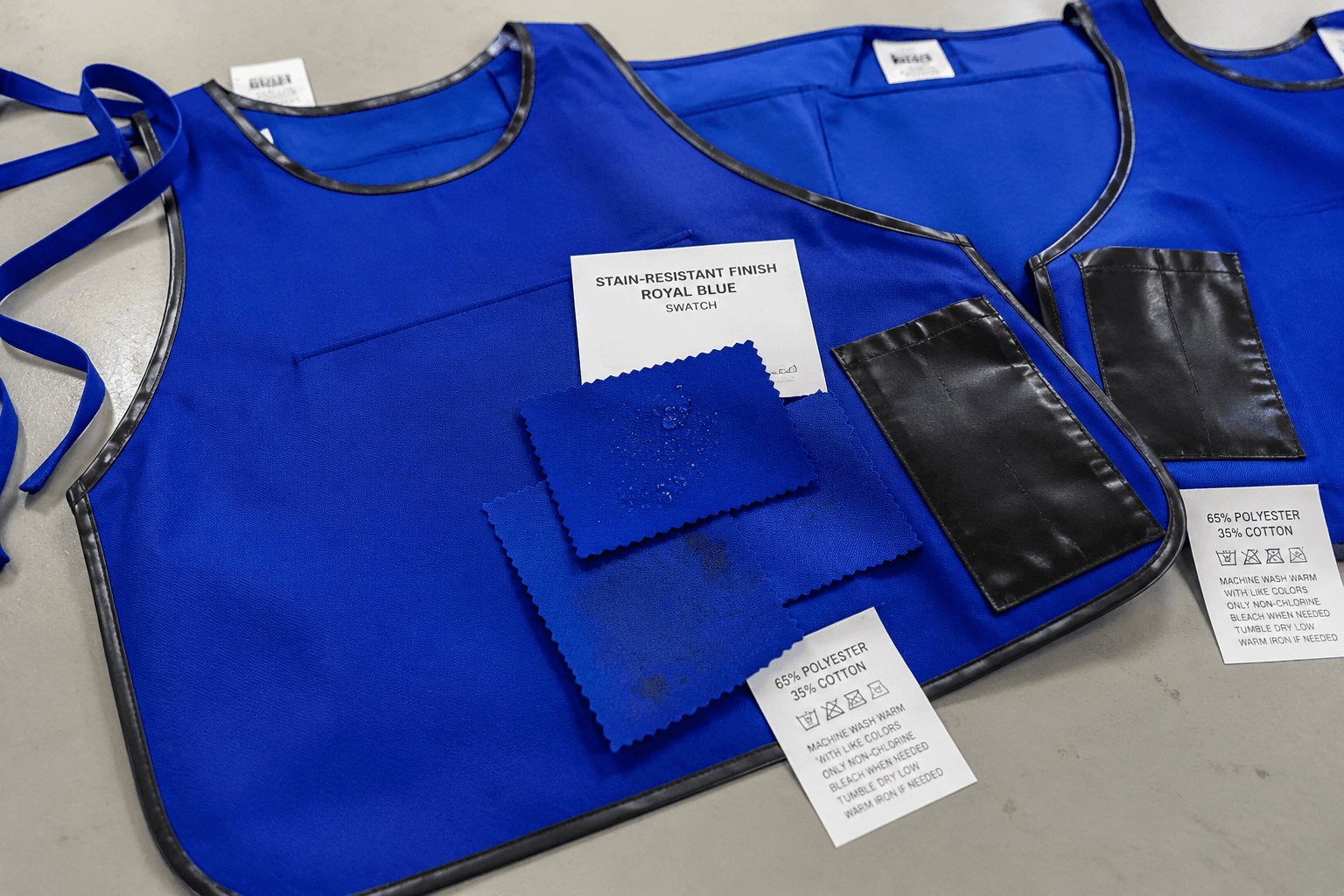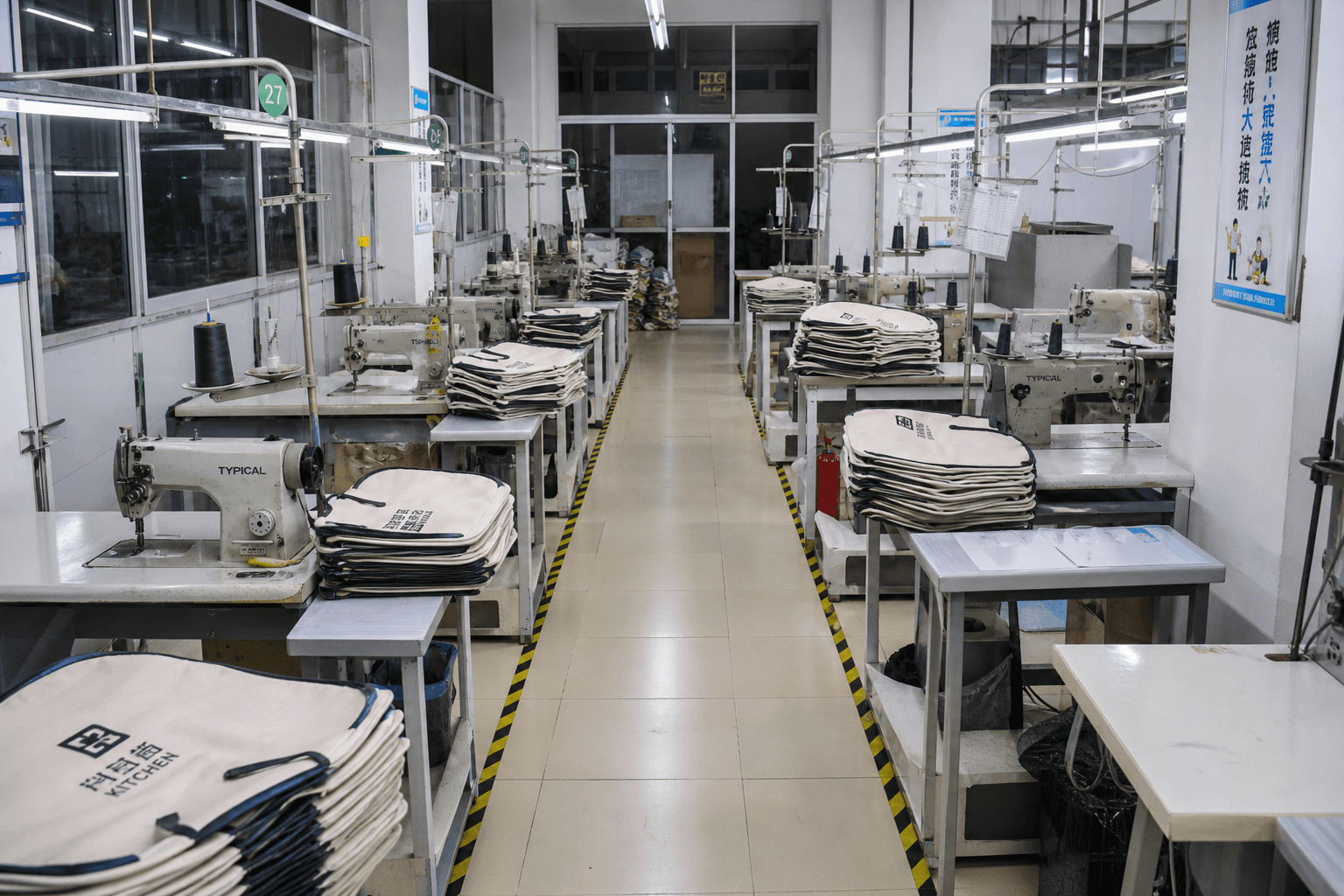
For museum shops, makers markets, florist groups, kitchen retailers, coffee equipment chains, and home-goods stores, an apron is a retail softgood with margin expectations, not a giveaway. It has to justify a $24 to $48 shelf price, hold shape on display, fold cleanly, and still feel good when the customer picks it up. Buyers sourcing craft retail aprons are usually managing three constraints at once: premium handfeel, opening MOQs low enough to test assortment, and repeat terms that work when one colorway sells faster than plan.
That sourcing model is different from promotional apron buying. A promo order can accept 180 to 220 GSM poly-cotton, large print, and broad visual variance. Retail apron programs usually cannot. In-store customers notice fabric density, drape, seam cleanliness, logo placement, hardware finish, and wash response immediately. In factory terms, that usually means 240 to 320 GSM fabrics, cleaner pressing, tighter sewing tolerance, and branding methods that still look deliberate at 100 to 300 pieces.
The practical goal is not to overbuild the product. It is to build a repeatable apron platform: one fabric family, a narrow trim menu, realistic branding, separate launch and repeat MOQs, and inspection rules that cover presentation as well as function. When those inputs are fixed early, Chinese apron suppliers can often complete first production in 35 to 45 days and repeats in 25 to 35 days, depending on fabric availability, wash process, and retail packing.
- Retail-grade apron handfeel usually starts at 240 to 320 GSM, or about 7.1 to 9.4 oz/sq yd, in cotton twill, canvas, or cotton-rich blends.
- A realistic opening MOQ for craft retail aprons is often 100 to 200 pcs per colorway when buyers use stock-supported fabric, standard webbing, and shared hardware.
- Branding can shift cost by $0.25 to $1.80 per piece; low-risk options at small volume are usually chest embroidery, woven labels, printed patches, and swing tags.
- Repeat performance improves when one apron program shares the same fabric base, webbing width, hardware finish, and pack format across multiple SKUs.
- Professional buyers should ask for three separate numbers: launch MOQ, repeat MOQ, and repeat lead time. In apron production, those figures are rarely identical.
- Finished-goods inspection should include appearance and pack presentation, with standards such as AQL 2.5 major / 4.0 minor, fabric weight tolerance of +/-5%, and logo placement tolerance of +/-0.5 cm to 1.0 cm.
Why craft retail aprons need a retail sourcing model from the first RFQ
The most common buying mistake is quoting a retail apron as if it were an event item. Promotional aprons are judged mainly on low FOB cost and basic wearability. Craft retail aprons are judged first on handfeel, drape, fold quality, logo neatness, and whether the piece looks worth buying before it is tried on. If the apron sits beside ceramics, candles, garden tools, coffee brewers, or baking accessories, it is competing as finished merchandise, not as branded collateral.
That difference changes the cost floor quickly. A basic bib apron in 180 to 210 GSM poly-cotton with one-color print may land at $1.90 to $3.20/pc at 1,000 units, but that spec usually reads promotional on a retail table. A retail-ready bib apron in 260 to 300 GSM cotton canvas with cleaner stitching, better pressing, neater webbing, and small chest embroidery is more likely to land at $4.80 to $7.20/pc at 200 to 500 units. Add cross-back straps, enzyme wash, branded labels, and individual retail packing, and cost commonly moves to $7.20 to $10.80/pc at 100 to 300 units.
For B2B buyers, the implication is simple: define the apron as a retail program before sampling starts. If the product must feel soft out of pack, specify enzyme wash or pre-softened finishing in the RFQ. If the target shelf price is $32 to $42, define expected handfeel, branding position, and pack format in the first brief. If replenishment may run every 30 to 60 days, ask the supplier to quote the style as a repeatable program with separate first-order and repeat-order terms, not as a one-off make.
- Retail-ready fabrics usually sit at 240 to 320 GSM, versus 180 to 220 GSM for many promo programs.
- A practical launch MOQ is 100 to 300 pcs per SKU when fabric and trims are standardized.
- Retail inspection commonly uses AQL 2.5 major / 4.0 minor with appearance checks included, not function alone.
Fabric weights and finishing that give craft retail aprons a premium handfeel
Fabric has the largest effect on how an apron is perceived in-store. Buyers usually want a fuller hand, enough body to hold shape on display, and enough softness that the apron does not feel stiff when first handled. Those targets do not always point to the heaviest cloth. A harsh 11 oz canvas can still feel cheap, while a better-finished 8.5 oz twill can feel more premium because the surface is smoother and the fold is cleaner.
In practical sourcing terms, 270 to 320 GSM cotton canvas, roughly 8.0 to 9.4 oz/sq yd, is a dependable base for utility-led retail aprons. It gives visible structure, more stable pocket shape, and good durability for pottery studios, hardware-oriented assortments, and coffee gear retail. For softer categories such as floristry, candle retail, baking, or gift-led merchandising, 240 to 280 GSM brushed cotton twill often performs better because it drapes more naturally, folds flatter, and feels better on first touch. Linen-cotton blends in the 200 to 250 GSM range support a natural brand story, but buyers should approve them with realistic tolerance for wrinkling, slub variation, and a less uniform surface in bulk.
Finishing matters almost as much as raw weight. Enzyme wash or garment wash typically adds $0.35 to $0.90/pc and 3 to 7 days to production, but it can move a plain canvas apron from stiff to shelf-ready. Pre-shrunk finishing helps protect measurement consistency on repeats, especially on bib widths and body length. Buyers should compare development samples in three states: pressed, packed, and after one home wash. That comparison often decides whether the apron still reads as premium after the customer opens it.
- 240 to 280 GSM cotton twill: softer handfeel, easier fold, lower stiffness, suited to gift and lifestyle retail.
- 270 to 320 GSM cotton canvas: stronger structure, cleaner pocket profile, better for utility-focused assortments.
- 200 to 250 GSM linen-cotton: natural look, but expect more wrinkling and visible slub variation.
- Enzyme or garment wash usually adds $0.35 to $0.90/pc and 3 to 7 days to lead time.
- A practical shrinkage target is within 3% to 5% in warp and weft after one home wash.
Low-MOQ branding methods that keep retail aprons commercially clean
Branding should support sell-through, not quietly consume margin. At 100 to 300 pieces, the best decoration method is usually the one that looks intentional without creating extra trim minimums or long approval loops. For apron retail, understated branding generally performs better than oversized graphics: small chest embroidery, a woven label, a printed patch, and a retail swing tag usually read more premium than a large front print.
Direct embroidery is still the most reliable starting point for low-volume retail aprons. A chest logo at 5,000 to 8,000 stitches often adds $0.35 to $0.85/pc at 200 to 500 units, depending on stitch density, backing, and thread count. Printed cotton or canvas patches create a stronger workshop look, but patch production plus attachment often lands at $0.55 to $1.20/pc. Woven labels are efficient on repeats, yet separate trim vendors may ask for 500 to 1,000 pcs per design unless the apron factory uses a flexible local label source. Leather or PU patches can look premium in concept, but at low volume they add more risk in edge finish, shade consistency, and alignment.
The stronger commercial structure is to separate permanent branding from seasonal branding. Keep the sewn-in main label stable across the apron line, then vary swing tags, barcode stickers, belly bands, or carton marks by season. That preserves repeat speed, reduces dead trim exposure, and avoids paying new setup cost every time the merchandising calendar changes.
- Small embroidery is usually the cleanest branding method at 100 to 300 pcs per SKU.
- Printed patches suit workshop and heritage positioning, but usually cost more than simple embroidery.
- Adding a second decoration method often adds $0.25 to $0.90/pc before extra approval time.
- Swing tags, barcode labels, and size stickers often add retail value more cheaply than another on-garment logo treatment.
Program architecture: how to make craft retail aprons reorderable at 100 to 300 pieces
A low-MOQ launch only works if the second purchase order is simpler than the first. Many apron programs fail here. The opening order includes too many variables: several body shapes, different strap widths, mixed hardware finishes, separate logo methods, and custom packaging for each SKU. A sewing line can often absorb that complexity once, but replenishment slows because every repeat reopens fabric, trim, and approval minimums.
A stronger model is to platform the assortment. Use one or two core apron bodies, one base fabric, one webbing width, and one hardware finish across the collection, then vary pocket layout, strap format, logo color, or packaging sticker. For example, a buyer might run one bib apron and one cross-back apron in the same 280 GSM canvas, both using 32 mm cotton webbing, antique brass adjusters, and one woven main label. Under that structure, a first order may sit at 150 pcs per style, while a repeat can often drop to 100 pcs if fabric and trims remain active at the factory.
Color strategy also affects reorder speed. If the program stays on mill-supported shades such as black, natural, olive, or navy, post-approval production can often hold at 25 to 35 days. Once a buyer requests a custom seasonal color, lead time usually moves to 35 to 50 days because dyeing minimums commonly start at 300 to 500 meters per shade and require lab-dip approval. Buyers should ask two direct questions before placing the first PO: what is the launch MOQ, and what is the real replenishment MOQ if the same apron platform repeats within 60 to 90 days?
- Use 1 to 2 base bodies across the assortment to simplify cutting, markers, and fit approval.
- Standardize webbing width, buckle finish, thread color, and main label where possible.
- Keep at least 2 stock-supported colors for faster in-season repeats.
- Ask how long the factory can hold leftover trims or labels, such as 60, 90, or 180 days, to support replenishment.
Cost, MOQ, and lead-time benchmarks for China-made retail aprons
Buyers need a realistic benchmark set before sampling starts. In the current sourcing range, a retail-grade cotton canvas apron in 260 to 300 GSM with one front pocket, adjustable neck strap, and small chest embroidery commonly quotes at $4.50 to $6.80/pc at around 300 pcs. A more developed style with cross-back straps, multiple pockets, contrast webbing, enzyme wash, and individual retail packing is more likely to quote at $6.90 to $10.50/pc at 100 to 300 pcs. Linen-rich blends can sit in a similar range or add $0.40 to $1.20/pc depending on yarn cost, finishing loss, and vendor availability.
The real MOQ pressure usually comes from materials outside the sewing line. Most apron factories can sew 100 pieces without difficulty. The constraint is whether the order requires custom-dyed fabric, logo webbing, special labels, branded buckles, or rigid gift boxes. Once those inputs are simplified, suppliers can usually support smaller opening runs than buyers expect. That matters for specialty retail, where a brand may want to test one bib apron in two colors before extending into a wider line.
Lead time should be broken into development, pre-production, and bulk production rather than treated as one generic number. A repeat order using approved fabric and active trims can often ship in 25 to 30 days. A first order with custom color, decoration strike-off, and printed packaging usually needs 35 to 45 days. During August through November, prudent buyers should add 5 to 10 days for line queue, finishing, and export booking. Without that buffer, small apron programs often miss floor-set dates even when sewing finishes on time.
- Basic retail canvas apron: $4.50 to $6.80/pc at around 300 pcs.
- Higher-detail retail apron: $6.90 to $10.50/pc at 100 to 300 pcs.
- Repeat order with approved materials: 25 to 30 days production lead time.
- New order with custom dye, special trim, or printed retail box: 35 to 45 days, plus peak-season buffer of 5 to 10 days.
QC standards that prevent retail complaints and protect repeat business
Retail apron approval often fails because buyers sign off the fabric swatch and logo sample, then move too quickly through the bulk standard. That is where expensive problems begin. On open display, customers immediately notice pocket symmetry, strap balance, fold quality, loose threads, and hardware shade mismatch when several aprons hang together. A technically wearable apron can still fail at retail if presentation is uneven.
A workable QC process starts with a signed spec pack that defines finished measurements, composition, target GSM, shrinkage, logo position, hardware finish, thread color, fold method, polybag or belly-band format, and carton ratio. If the apron is garment washed, the buyer needs to state whether approved measurements are pre-wash or post-wash. If the range uses natural shades such as ecru, oat, or stone, acceptable shade variation should be agreed before bulk cutting because those colors usually show more lot-to-lot movement than black or navy.
Final inspection should cover both function and appearance. Bartacks, buckle operation, rivet setting, and webbing attachment are baseline functional checks. For retail programs, presentation checks are equally important: aprons should hang evenly, open without severe creasing, show no oil marks, and arrive with consistent pressing. When those standards are fixed on first production, the second and third orders become much easier because the supplier is not renegotiating expectations after launch.
- Confirm fabric weight tolerance, commonly +/-5% against approved spec.
- Set logo placement tolerance at +/-0.5 cm to 1.0 cm, depending on decoration method and apron size.
- Approve one final packed sample in the exact retail fold and pack format before bulk shipment.
- Use a finished-goods standard such as AQL 2.5 major / 4.0 minor.
- Check carton count, barcode position, and size labeling during final inspection, not after DC arrival.
Pre-PO questions experienced apron buyers ask suppliers
The best sourcing discussions are specific. Instead of asking whether a factory can make custom aprons, experienced buyers ask how the supplier will manage MOQ, material continuity, branding cost, and repeat lead time for the exact retail program. That detail matters because the lowest launch quote often comes from an apron configuration that cannot be repeated cleanly once the style starts selling.
From the factory side, the most useful buyer input is the expected demand pattern. A brand testing 150 pcs in one color with a monthly replenishment plan should usually stay on stock-supported fabric, standard hardware, and one stable decoration method. A one-off holiday capsule can tolerate more packaging complexity because there is no long reorder tail to protect. The correct apron structure depends on whether the buyer is prioritizing margin, shelf presentation, or speed to store.
A disciplined pre-order discussion reduces sample loops and keeps both sides aligned on what can scale. In B2B apron sourcing, continuity usually delivers better margin than chasing the lowest opening quote. Strong buyers negotiate second-order and third-order terms at the same time as the first PO, especially for craft retail aprons intended for repeat replenishment.
- What is the first-order MOQ and the repeat-order MOQ if fabric and trims stay unchanged?
- Which colors are mill-supported, and which require custom dye with 300 to 500 meters minimum per shade?
- What branding method gives the cleanest appearance at 100, 200, and 300 pcs without creating a separate trim MOQ?
- Can the factory hold labels, webbing, or retail boxes for 90 days to support replenishment?
- Which part of lead time is most likely to move: dyeing, decoration approval, trim sourcing, sewing, or packing?