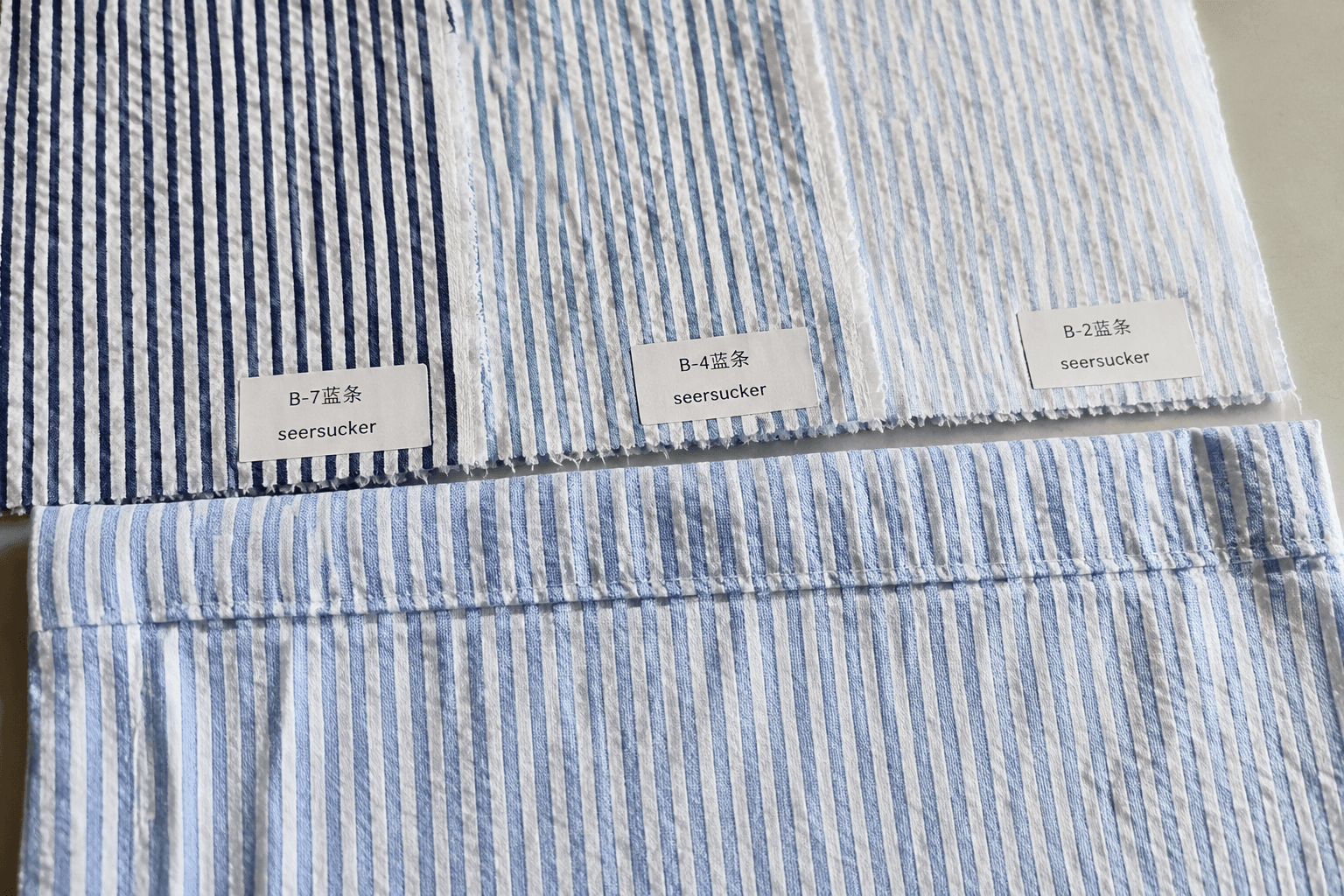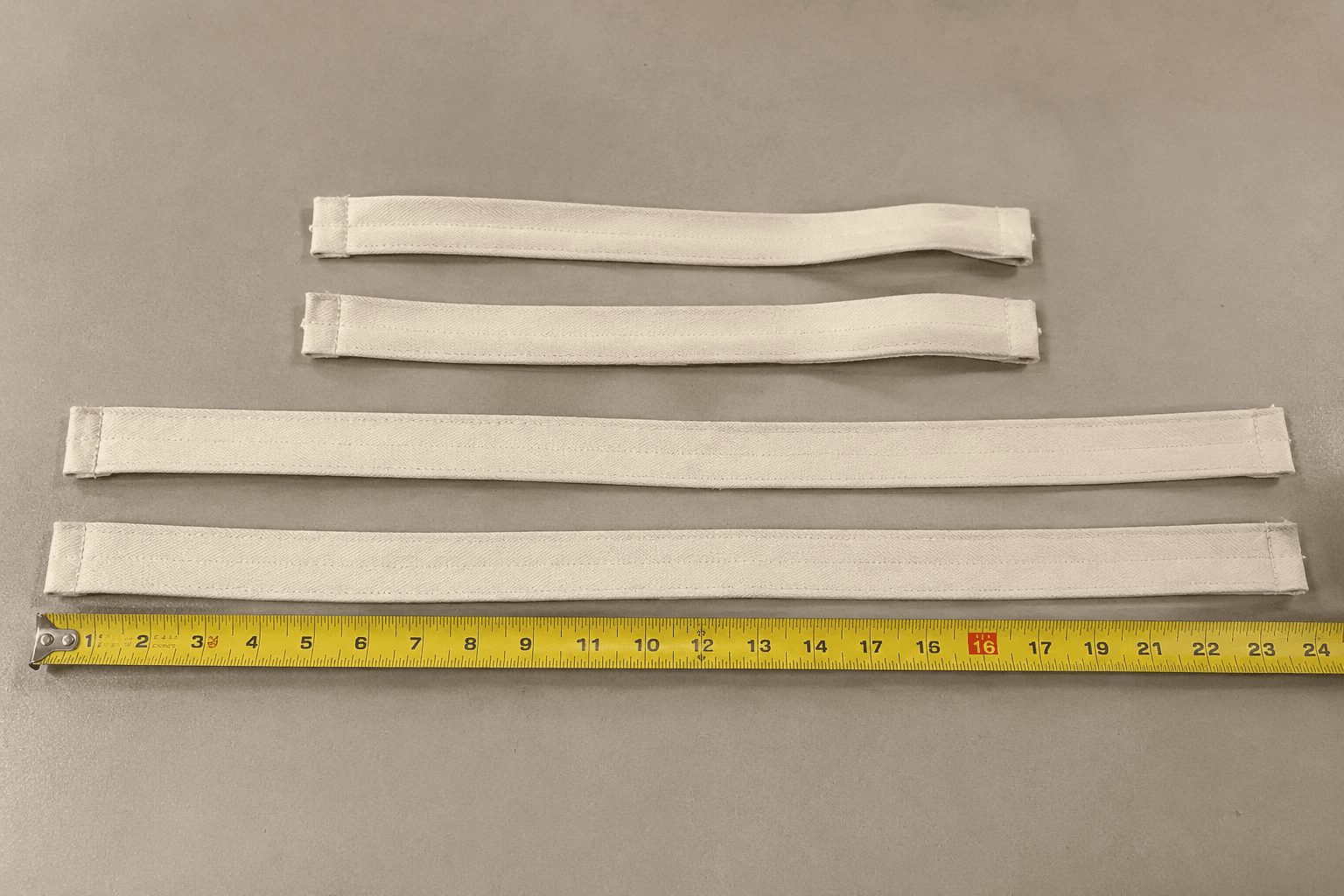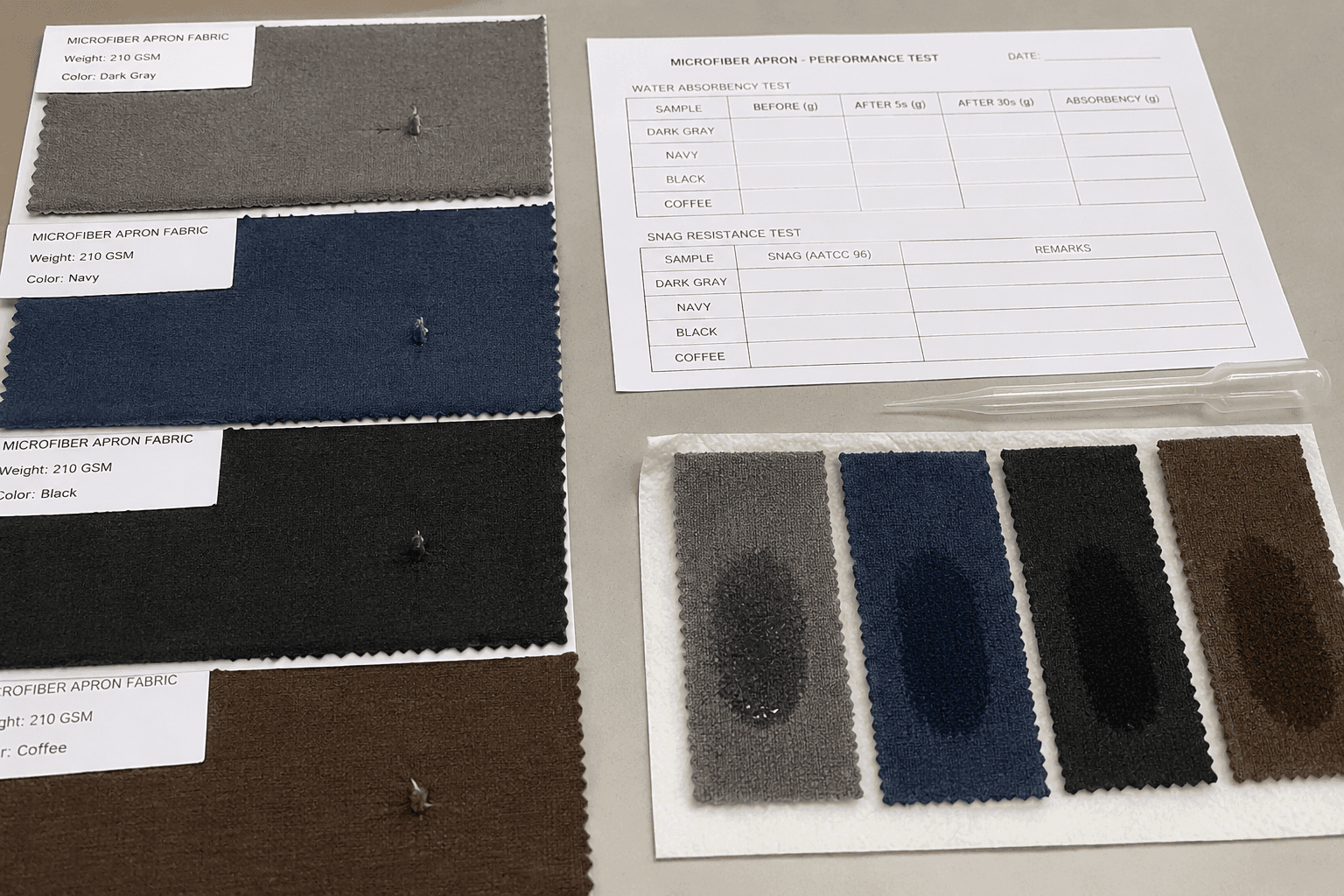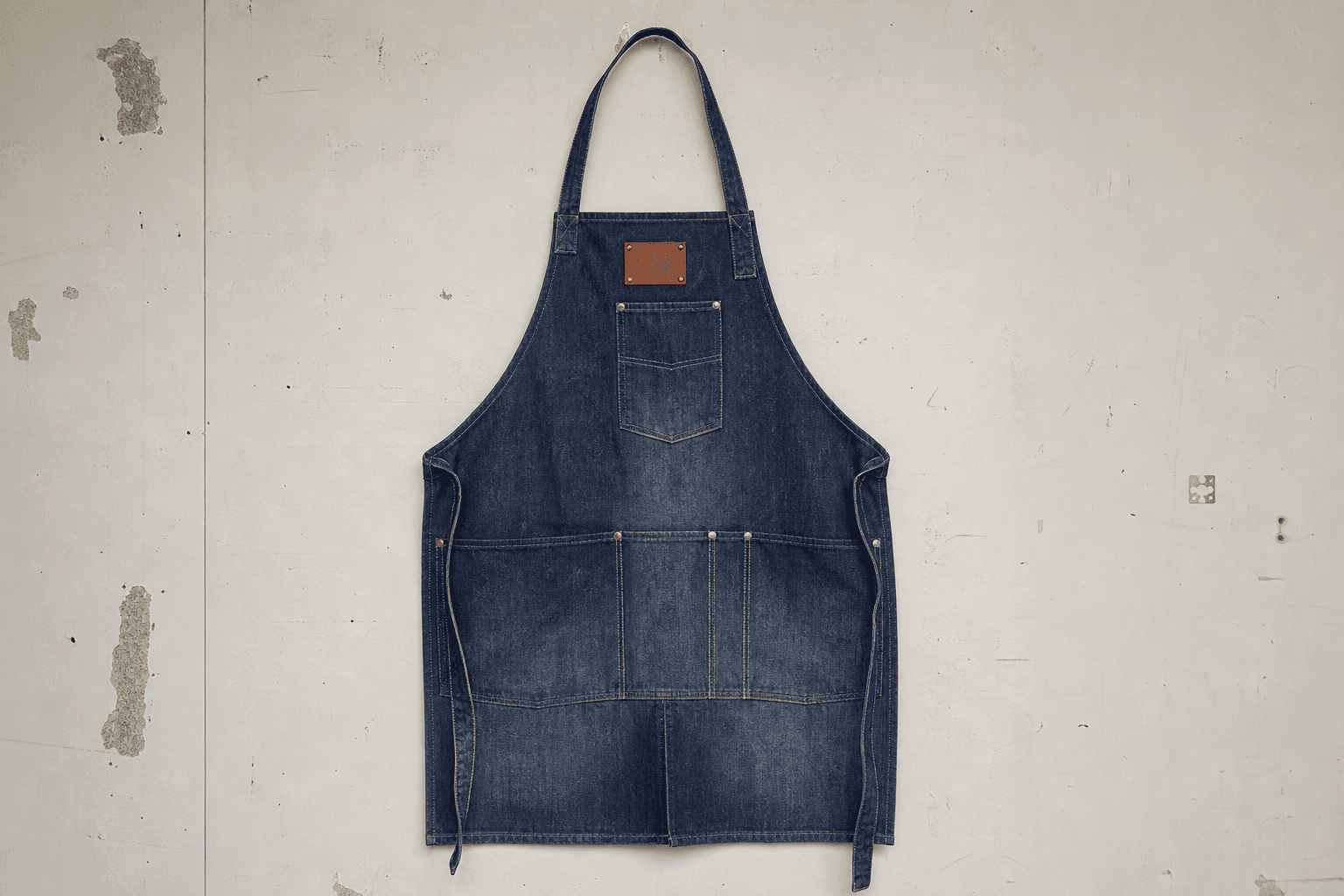
For B2B sourcing teams, lightweight apron fabric is a technical buying decision, not a styling phrase. Lower GSM changes wearer comfort, opacity, drape, seam holding, print and embroidery behavior, packing weight, and garment life. The right question is not whether the hand sample feels soft. It is whether the finished apron still looks presentable after 20, 30, or 50 wash cycles with real pocket load, daily tying, and 8-10 hour shifts.
Under 200 GSM is too broad to specify on its own. A 145 GSM recycled polyester plain weave waist apron for event staff behaves very differently from a 175 GSM 65/35 poly-cotton twill bib apron for baristas, and both differ again from a 190 GSM cotton twill apron with divided pockets and embroidery. Buyers need to read GSM together with fiber blend, weave, finish, apron length, pocket design, bartack plan, shrinkage control, and expected replacement window.
This guide sets practical floors for lightweight apron fabric by apron type, wash frequency, service target, MOQ, lead time, FOB range, and inspection level. The scope is strictly apron sourcing for cafes, bakeries, salons, florists, retail chains, hospitality groups, and branded uniform programs where comfort matters but replacement claims still need to stay inside budget.
- For most professional apron programs, 170-190 GSM is the safest low-weight band for daily wear; 155-169 GSM suits lighter-duty service; 135-149 GSM is usually best limited to promotional or occasional-use programs.
- At the same weight, twill usually performs better than plain weave in abrasion resistance, drape, wrinkle appearance, and pocket stability.
- Long bib lengths, divided front pockets, metal neck hardware, towel loops, and dense embroidery can make underbuilt aprons fail even when the base swatch looks acceptable.
- A lower FOB price only helps if the apron reaches its target life, such as 4-6 months for light service or 8-12 months for daily hospitality rotation.
- Bulk approval should define AQL 2.5 major / 4.0 minor, shrinkage limit, colorfastness target, wash count, and reinforcement points before PO release.
- Typical stock-fabric OEM orders start around 500-1,000 pcs per color per style, while custom fabric programs often move to 1,500-3,000 pcs and add 10-25 days to total lead time.
How to write an RFQ for lightweight apron fabric that factories can quote accurately
In apron sourcing, the word lightweight is too loose to quote against. One factory may price a 150 GSM plain-weave polyester bib apron to hit $2.10/pc FOB, while another quotes a 180 GSM poly-cotton twill version at $3.20/pc FOB built for daily cafe wear. Both can claim they offered a lightweight apron, but they are not comparable products. A usable RFQ needs a GSM band, blend, weave, color method, finished dimensions, pocket layout, trim specification, wash target, inspection level, and replacement expectation.
For most OEM apron programs, under 200 GSM breaks into three practical bands. 135-149 GSM is normally short-life territory for event staffing, promotions, and one-season campaigns. 150-169 GSM can work for salons, florists, retail counters, and low-load service when the apron is short and the pocketing is minimal. 170-199 GSM is the most dependable low-weight range for buyers who want cooler wear than a 220-250 GSM apron without a steep drop in service life.
The specification has to describe the finished garment, not just the base cloth. A 165 GSM fabric may be acceptable on a 45 cm waist apron with one receipt pocket, yet fail early on an 82 cm bib apron with a divided kangaroo pocket, adjustable neck buckle, and towel loop. A stronger RFQ would state: 170-185 GSM 65/35 poly-cotton twill, reactive/disperse dyed, shrinkage within 3 percent after 3 washes at 40 C, target 30 home-laundry cycles, bartacks at tie joins and pocket corners, AQL 2.5 major / 4.0 minor. That level of detail reduces quotation drift, sample disputes, and hidden downgrades in bulk.
- Use a defined GSM band such as 170-185 GSM, not a vague phrase like lightweight or around 180 GSM.
- State blend and weave together, for example 65/35 poly-cotton twill, 80/20 poly-cotton twill, or 100% cotton twill.
- Add a service target such as 20, 30, or 50 wash cycles and an expected replacement window such as 6 months or 9-12 months.
- Fix tolerance points in writing, including AQL 2.5/4.0, shrinkage limit, finished size tolerance, and required reinforcement points.
Where lightweight apron fabric creates measurable value for B2B buyers
The main commercial reason to buy lighter aprons is better wear compliance. In hot cafes, bakeries, outdoor beverage service, salons, and retail activation programs, staff often loosen or remove heavier aprons during an 8-10 hour shift. A bib apron in the 170-185 GSM range usually reduces neck drag and heat buildup enough to improve full-shift wear rates when compared with canvas or heavy twill at 230-270 GSM. For branded service programs, consistent apron use matters as much as absolute garment life.
Mobility is the second gain. Baristas, servers, florists, stylists, and demonstrators bend, reach, and turn continuously. A lighter apron reduces pull at the neck strap and bulk at the waist knot, especially on simple patterns with moderate pocketing. If the brand wants a softer drape rather than a rigid utility look, moving to a lower-weight twill is usually more effective than trying to soften a heavy base cloth with extra finishing.
There is also a real cost and freight argument, but it only works with actual numbers. A standard adult bib apron typically consumes about 0.82-0.95 m of fabric depending on width, hem depth, and pocket configuration. Moving from 240 GSM cloth to 180 GSM cloth can reduce fabric cost by roughly $0.16-$0.34 per piece on standard dyed poly-cotton, with another $0.03-$0.07 per piece sometimes saved in freight and inland handling on larger runs. On 20,000 pcs, that is roughly $3,800-$8,200. The saving is meaningful only if replacements do not rise enough to consume it within the same contract period.
- Best-fit programs include cafe, bakery, salon, florist, retail counter, event staffing, and seasonal outdoor hospitality.
- The most comfortable daily-wear zone is often 170-185 GSM in twill construction.
- Typical combined material and freight benefit versus heavier cloth is about $0.19-$0.41/pc.
- The freight and FOB advantage becomes easier to see at volumes above 10,000 pcs.
Where lightweight apron fabric drops below a safe durability floor
Low-weight aprons rarely fail first in the center body panel. The first complaints usually start at stress points: pocket corners, tie joins, upper bib seams, bottom hems, side seams, and areas distorted by embroidery backing or neck hardware. Once the cloth falls below the right threshold for the pattern, complaint rates climb quickly. In daily foodservice use, the practical risk line is often around 155-165 GSM for simple pocket-light styles and closer to 170 GSM for long bib aprons with working pockets.
Pocket load is the main dividing line between a viable lightweight apron and a false economy. A sales sample can look clean in the meeting room, then sag in use once staff start carrying pens, order pads, thermometers, towels, phones, or a payment device. On bib aprons above 80 cm finished length, the fabric has to carry both garment weight and repeated drag from the pocket area. In claim reviews, styles pushed below 170 GSM without enough reinforcement often show seam slippage, stretched pocket mouths, or distorted topstitch lines within 6-10 weeks of daily wear.
Laundry frequency usually decides whether a low GSM apron is commercially safe. A 140-145 GSM event apron worn a few times each year may be acceptable. The same fabric in a cafe rotation washed 2-3 times per week can show edge curl, opacity loss, puckering, and fabric thinning after only 12-20 washes. That is why buyers should ask whether the apron still presents well after a defined wash count, not whether the fabric is durable in general.
- High-risk failure points are pocket corners, tie joins, neck joins, side seams, lower hems, and embroidered zones.
- Below about 150 GSM, most daily-use bib aprons become high-risk unless the style is short, pocket-free, and low-wash.
- For long bib aprons with divided front pockets, 170 GSM is usually a more credible minimum than 155 GSM.
- Swatch approval alone is weak control because many underbuilt aprons fail after 15-30 washes, not at first fit.
Best under-200 GSM constructions for apron sourcing and repeat orders
When the brief calls for lighter weight, construction matters as much as nominal GSM. At the same weight, twill usually performs better than plain weave in abrasion resistance, drape, wrinkle appearance, and shape retention. For professional apron programs, the most dependable low-weight options are usually 65/35 poly-cotton twill at 170-190 GSM, 80/20 poly-cotton twill at 165-185 GSM, and 100% cotton twill at 180-195 GSM when a more natural hand is needed.
Among these, 65/35 poly-cotton twill remains the broadest commercial standard because it balances price, wash stability, color consistency, and replenishment ease. It is widely available in stock-supported shades such as black, navy, khaki, dark green, burgundy, and beige, which helps keep MOQ lower and lead times shorter. 80/20 blends can be slightly cheaper and hold color well, but the hand can feel more synthetic. 100% cotton twill supports a more premium cafe or bakery image, yet buyers should expect tighter control on shrinkage, wrinkling, and shade continuity between lots.
Finishing changes performance enough that finished-cloth approval is essential. A softener can improve first handfeel but reduce crispness. Oil-release or water-repellent finishing may help in coffee or bakery service, but on very light bases it can add stiffness or reduce breathability. Finished weight can shift by 3-8 GSM after dyeing and finishing, which is why greige or unfinished lab swatches are a weak basis for final approval when the finished apron has to perform in production conditions.
- For daily service, 170-190 GSM twill is usually the safest lightweight apron fabric band.
- 65/35 poly-cotton twill is the lowest-risk standard for repeat orders and stable pricing.
- 100% cotton twill can support a softer natural hand but needs tighter wash and shrinkage testing.
- Approve finished fabric after dyeing and finishing because handfeel, weight, and stiffness can shift materially.
MOQ, lead times, and FOB ranges for lightweight apron fabric programs
Lighter fabric does not automatically make sourcing easier. Availability depends on blend, color, certification, and finish. Stock black, navy, beige, and dark green poly-cotton twills in the 170-190 GSM band are usually straightforward for established apron factories. By contrast, certified recycled blends, yarn-dyed stripes, slub textures, coated finishes, or custom low-weight cottons often require fabric booking and higher commitments.
For stock-supported OEM apron programs, workable MOQ is commonly 500-1,000 pcs per color per style. A pre-production sample usually takes 5-7 days for a basic style and 7-10 days if there is embroidery, woven labeling, contrast binding, or metal neck hardware. After sample approval and deposit, bulk production is commonly 25-35 days. If the fabric must be custom dyed to Pantone, specially finished, or woven to a nonstandard composition, MOQ often moves to 1,500-3,000 pcs and total lead time extends to 40-60 days.
FOB pricing also needs realistic brackets. A basic bib apron in stock 170-190 GSM poly-cotton twill with one front pocket and self-fabric ties typically lands around $2.30-$3.80/pc FOB China at mid-volume orders of 3,000-10,000 pcs. A more developed style with custom dyeing, adjustable metal hardware, extra bartacks, woven labels, and embroidery often falls around $4.10-$6.90/pc. Quotes far below those levels often hide a lighter actual GSM, narrower fabric-width assumption, weaker reinforcement plan, or a looser inspection standard than the buyer expects.
- Stock-fabric MOQ is often 500-1,000 pcs per color and style.
- Custom fabric programs commonly require 1,500-3,000 pcs and add 10-25 days to total lead time.
- Sample lead time is usually 5-10 days; bulk lead time is usually 25-35 days with stock fabric.
- A practical FOB range for a basic lightweight bib apron is about $2.30-$3.80/pc.
How to test and approve lightweight apron fabric before bulk production
The most common approval mistake is judging low-weight apron material by swatch handfeel alone. Under-200 GSM fabrics are more sensitive than heavier aprons to seam construction, reinforcement placement, logo method, and pocket design. The real approval unit should be the finished apron in nominated bulk fabric. A swatch that feels acceptable in isolation can fail once it carries a divided pocket, bartacks, neck buckle, embroidery backing, or a large printed logo.
A workable approval process starts with one fit sample and one wash-test sample in production fabric. Buyers should check shrinkage after 3 washes at 40 C or the agreed care standard, verify seam slippage at pocket corners and tie joins, inspect colorfastness, and confirm that the apron does not twist off grain after laundering. For daily-use programs, a short wearer trial over 7-14 days is usually enough to expose the main problems: neck discomfort, show-through, pocket sag, wrinkling, hem curl, or poor recovery after sitting and bending.
Inspection standards should be fixed before the PO is released. For apron production, a common baseline is AQL 2.5 for major defects and 4.0 for minor defects, with checks on finished size, logo placement, bartack security, loose threads, shade continuity, weave faults, and needle damage. Buyers should also ask the factory to classify the proposed lightweight apron fabric by service level: promotional use, light weekly use, or daily hospitality use. If the answer stays broad, the risk has not been engineered out of the program.
- Approve against a finished apron sample, not only a fabric swatch.
- Run wash testing, seam-stress checks, and a short wearer trial before bulk confirmation.
- Set AQL 2.5 major / 4.0 minor, finished measurement tolerances, and reinforcement points in writing.
- Check shrinkage, seam slippage, shade variation, pocket stability, and decoration distortion before release.
Recommended GSM bands by apron end use, wash rate, and replacement target
The correct weight depends on wear frequency, wash frequency, pocket load, and the replacement interval the buyer is willing to fund. For event and campaign aprons, where cost and comfort matter more than long life, 135-150 GSM can be acceptable if the style is simple, the logo method is light, and the expected life is under 10 wears. For retail counters, salons, florists, and light cafe use, 155-175 GSM is usually the more credible band, especially on short or medium-length styles with small pockets. For daily hospitality bib aprons with usable front pockets, experienced buyers usually start at 170-190 GSM.
When the apron has to carry towels, order pads, or heavier daily pocket loads, dropping below 200 GSM often stops making commercial sense. A lower quote may look attractive at PO stage, but the math changes if the garment lasts only 90-120 days instead of 240-300 days. An apron at $2.60/pc replaced three times per year costs more than an apron at $3.35/pc replaced once every nine to ten months. Stronger sourcing teams compare cost per wear, complaint rate, and replacement frequency rather than unit FOB alone.
The practical conclusion is direct. Use lightweight apron fabric where lower weight clearly improves wearer compliance, mobility, or freight efficiency and where the service conditions match the construction. Do not force a low-GSM cloth into a long-life kitchen, heavy-pocket, or high-abrasion apron program just to meet a target price. In apron sourcing, the best result usually comes from choosing the lowest weight that still survives the real duty cycle with acceptable appearance after repeated washing.
- Promotional and event aprons: about 135-150 GSM for low-frequency wear and short service life.
- Retail, salon, florist, and light cafe aprons: about 155-175 GSM depending on length and pockets.
- Daily hospitality bib aprons with practical pockets: about 170-190 GSM as a safer starting point.
- Heavy-pocket, kitchen, or utility apron programs usually perform better at 200 GSM+.