For buyers sourcing jewelry workshop aprons, the brief should begin with bench protection and process flow, not with fashion or generic durability claims. In polishing, stone setting, watch service and repair, the apron front touches trays, bench pins, loupe cloths, plated components, unfinished castings and finished metal surfaces throughout the shift. If the fabric sheds lint, if a rivet sits in the contact zone, or if the pocket opening collapses during forward lean, the apron becomes a production risk.
Standard cafe or maker aprons are usually the wrong benchmark. A 10-12 oz canvas bib with metal adjusters and deep kangaroo pockets may look robust, but it often runs hot in seated wear, bunches at the lap and introduces hard points that can mark finished parts. Professional jewelry workshop aprons usually work better in a 200-240 GSM window, roughly 5.9-7.1 oz, with a flatter front body, shallow segmented pockets above the seated bend line and only soft or shielded trims on the contact surface.
The cleanest sourcing method is to define the apron by job type before sampling starts. Polishing lines, bench assembly, watch technicians, training rooms and retail repair counters do not use aprons in the same way. When the buyer states the exact process, the factory can lock the fabric, pocket map, strap system, tolerance window and QC checkpoints from the first sample. That shortens development, makes quotations comparable and improves bulk consistency.
- Jewelry workshop aprons usually perform best at 210-230 GSM, about 6.2-6.8 oz, where seated comfort, front stability and pocket control stay balanced.
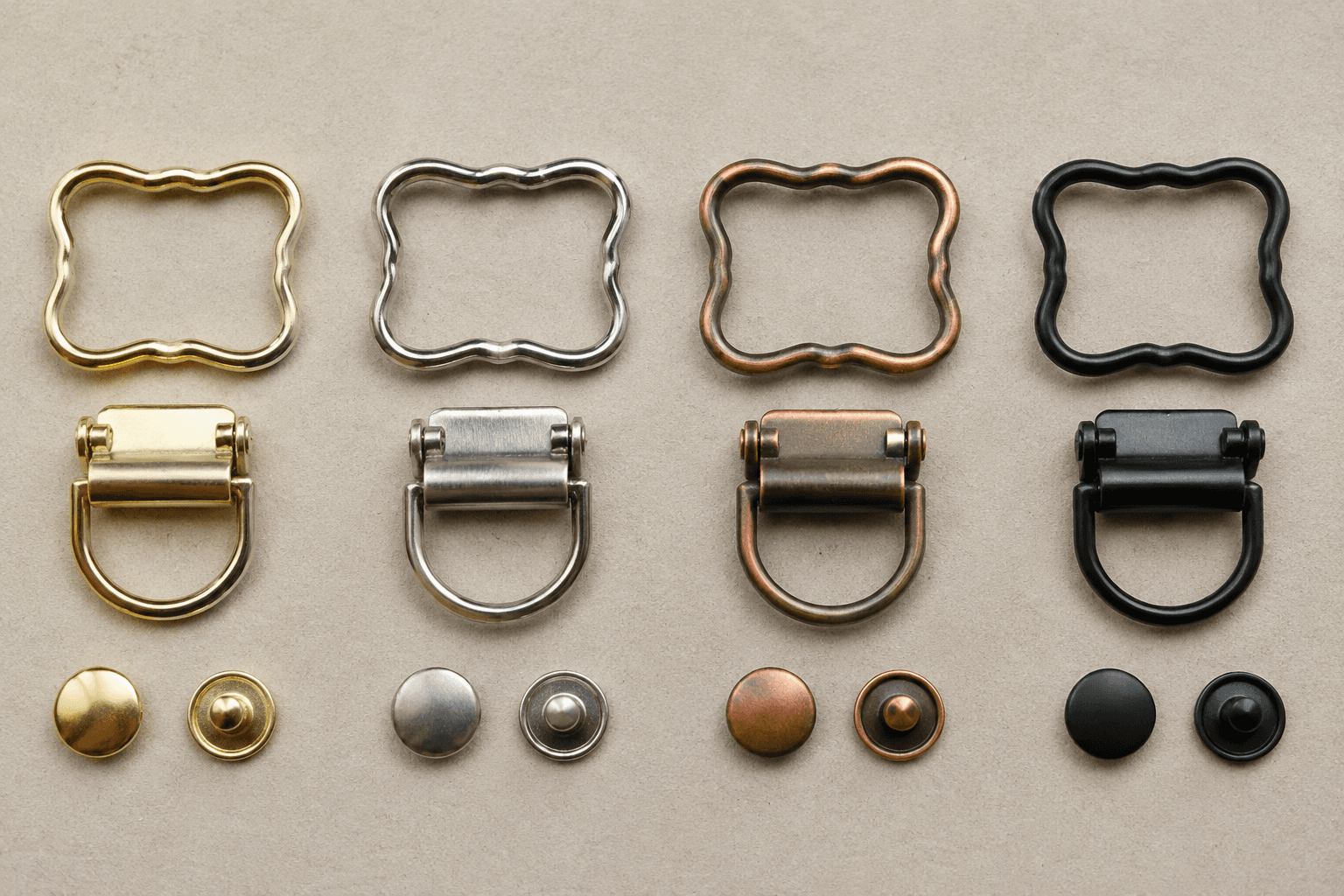
- For polished metal, plated parts and watch work, front-contact trims should be limited to self-fabric ties, hidden adjustment or acetal plastic hardware; exposed rivets, metal D-rings, snap caps and hard badges should be excluded from the tech pack.
- Pocket layouts should be built around actual tool dimensions, with segmented compartments about 11-15 cm deep placed above the lap crease to reduce spills during forward lean.
- MOQ commonly runs 150-300 pcs for a stock-body logo program, 500 pcs per color for custom pocket engineering and 800-1,200 pcs when custom-dyed fabric or lab-dip approved brand colors are required.
- A realistic timeline is 7-10 days for the first development sample, 5-7 days for one revision, 3-5 days for PPS confirmation and 25-35 days for bulk production with stock fabric.
- Most buyers use AQL 2.5 for major defects and AQL 4.0 for minor defects, then add lint, front-surface smoothness and loaded-pocket wear checks before shipment release.
1. Why jewelry workshop aprons need bench-specific specifications
A jewelry bench creates a use environment that is different from hospitality, woodworking or general craft. Operators stay seated for 6-8 hour shifts, lean forward repeatedly and keep the apron front close to bench pins, catch trays, polishing residue, watch cases and unfinished metal pieces. In that setting, apron construction directly affects contamination control, scratch exposure, tool access and operator fatigue. These are operating variables with cost impact, not styling details.
For B2B buyers, the first sourcing step is to write the brief around real work stages. Polishing teams usually need a smooth, low-lint face that releases compound dust easily. Assembly and repair teams usually need compact segmented storage for tweezers, scribes, wax tools, spring-bar tools or slim pliers. Retail-facing repair counters often need the same scratch-safe build but with tighter branding and cleaner presentation. One apron can sometimes cover two adjacent tasks, but forcing one style across polishing, repair and front-of-house service usually leads to avoidable compromise.
Many importers, distributors and private-label brands therefore split the program into two SKUs. A common setup is a 210-220 GSM 65/35 poly-cotton twill bib apron for polishing and assembly, paired with a 230-240 GSM compact cotton twill apron for client-facing repair or training. At a total order of 1,000 pcs, the material and make-up difference is often only $0.45-0.85 per piece ex works, but the process fit is better and replacement claims are easier to isolate by department.
- Typical seated-work finished length: 72-78 cm to reduce bunching at the lap.
- Common finished width: 66-72 cm for coverage without excess side bulk on stools.
- A two-SKU program usually makes sense when one team prioritizes low lint and another prioritizes presentation.
- Bench approval should include at least one full-shift wearer trial of 6-8 hours before PPS release.
2. Fabric and GSM choices for jewelry workshop aprons with lower lint risk
Fabric selection should start with surface behavior, not just fiber label. Buyers often ask for 100% cotton because embroidery is straightforward and the handfeel is familiar, but cotton alone does not guarantee clean performance. Brushed canvas, peached finishes, garment-washed faces and heavy slub yarns can feel premium in hand while releasing more visible fiber during early wear. At the jewelry bench, a tighter weave and smoother face usually outperform a softer fabric with more surface fuzz.
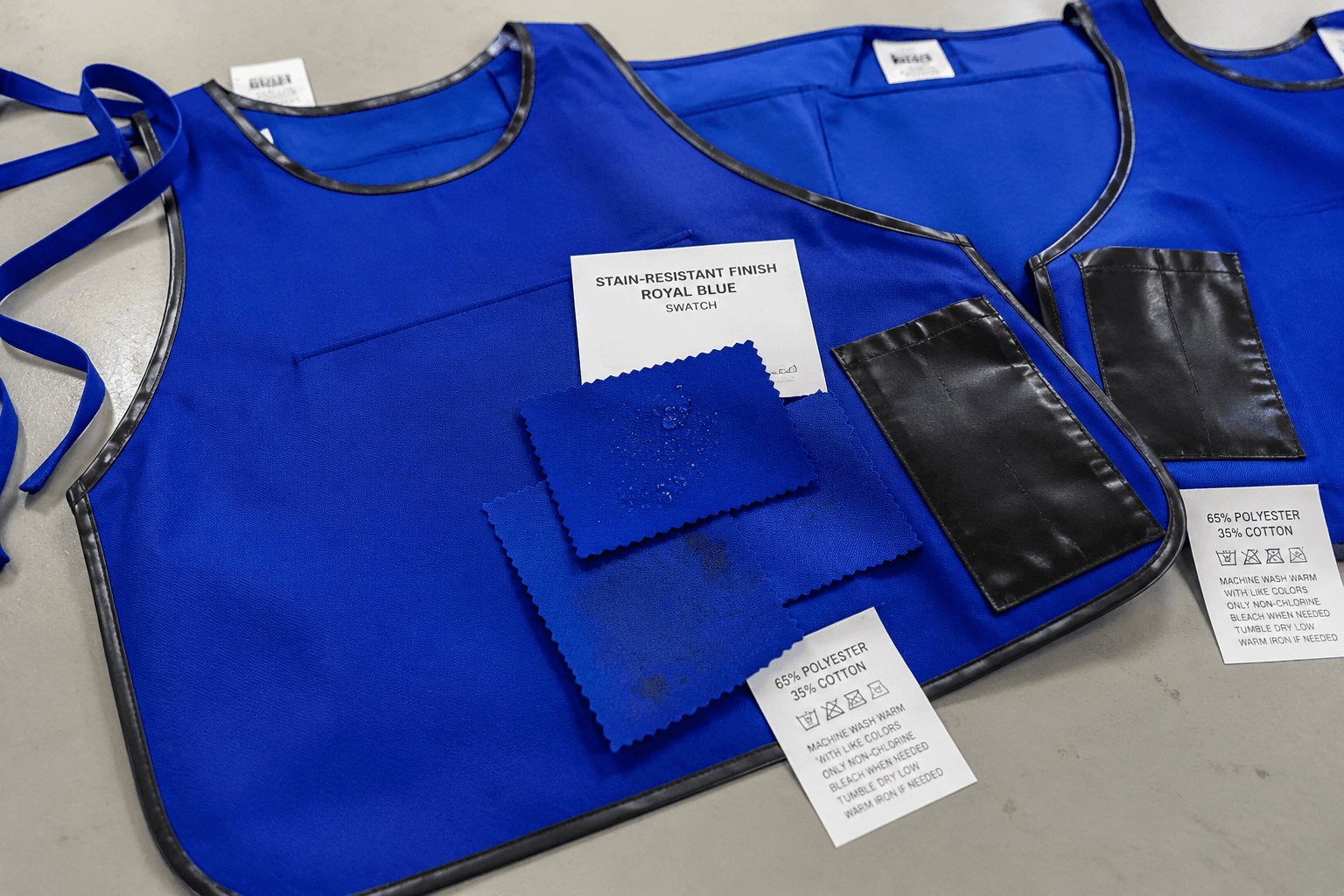
For most OEM programs, the practical weight window is 200-240 GSM, roughly 5.9-7.1 oz. Below 180 GSM, the apron often shifts too easily once pockets are loaded, and the front panel can collapse during seated work. Above 260 GSM, the body tends to feel hot and stiff, especially in neck-hung designs worn for full shifts. The strongest middle ground is usually 210-230 GSM in either 65/35 poly-cotton twill or compact 100% cotton twill. If repeat wash stability and lot-to-lot shade consistency matter more than a pure-cotton label, 65/35 twill is usually the safer commercial option.
Color also affects perceived cleanliness. Jet black remains common, but it shows polishing dust, loose thread and compound residue immediately under LED bench lighting. Charcoal, graphite and deep anthracite usually hide dust better while still reading as formal workshop uniform colors. If black is mandatory, ask the factory for a white-cloth rub check, a visual lint review under cool white light and a pre-production shade standard before bulk approval. These checks are simple, but they prevent disputes about whether the issue is true shedding or only visible surface residue.
- Preferred range for most programs: 210-230 GSM twill, about 6.2-6.8 oz.
- Commonly workable constructions: 65/35 poly-cotton twill, compact cotton twill and tightly woven recycled poly-cotton twill.
- Higher-risk options for bench use: brushed canvas, garment-washed canvas, loose basket weave and heavy slub-yarn fabric.
- Typical reusable-program wash target: shrinkage within 3% in both warp and weft after 3 home-launder cycles at 40 C.
3. Scratch-safe surface choices for jewelry workshop aprons
When buyers specify scratch-safe construction, the term needs to be translated into measurable sourcing rules. Some suppliers respond by changing shiny nickel hardware to matte black metal, but that only changes appearance. The real question is whether any exposed hard part can touch a polished surface, plated component, watch case or tray when the wearer leans forward. If the answer is yes, that trim should be removed, relocated or covered in the pattern and bill of materials.
For most jewelry workshop aprons, the safest setup is a bib style with self-fabric waist ties and either cross-back straps or a neck strap with hidden internal adjustment. Cross-back designs reduce neck fatigue during 6-8 hour seated shifts, especially when pockets carry tools. When visible adjustment is unavoidable, acetal plastic sliders are usually the most practical option because they are light, quiet and less likely to mark delicate surfaces. Rivets at pocket corners should generally be excluded unless they are fully buried between layers and cannot be felt from the apron face.
Branding needs the same discipline. Thick embroidery backing, raised rubber badges, rough woven labels and exposed hook-and-loop can all create contact points. For bench use, the safest branding is usually a small chest embroidery about 6-8 cm wide placed above the main contact zone, plus an inside printed main label instead of a woven label on the front panel. This keeps the body flatter, reduces post-wash edge abrasion and avoids unnecessary hard spots.
- Preferred trim choices: self-fabric ties, hidden strap adjustment, acetal sliders and covered reversed-coil zippers.
- Avoid on the front body: exposed rivets, metal D-rings, snap caps in contact zones, hard logo plaques and rough hook-and-loop.
- Recommended chest logo width: 6-8 cm to keep the panel flat.
- If detachable straps are required, request a 20-cycle open-close test and one wash test before PPS approval.
4. Pocket engineering in jewelry workshop aprons: shallow, segmented and above the lap crease
Pocket layout is where many otherwise acceptable aprons fail in real use. Buyers often start from a standard utility bib and add more storage across the lower front. In jewelry work, that usually creates bulk, tool collision and poor retention once the operator sits down. A bench jeweler does not need cargo volume at the stomach. The operator needs fast access to a small tool set while keeping the apron front stable and the pocket mouth controlled.
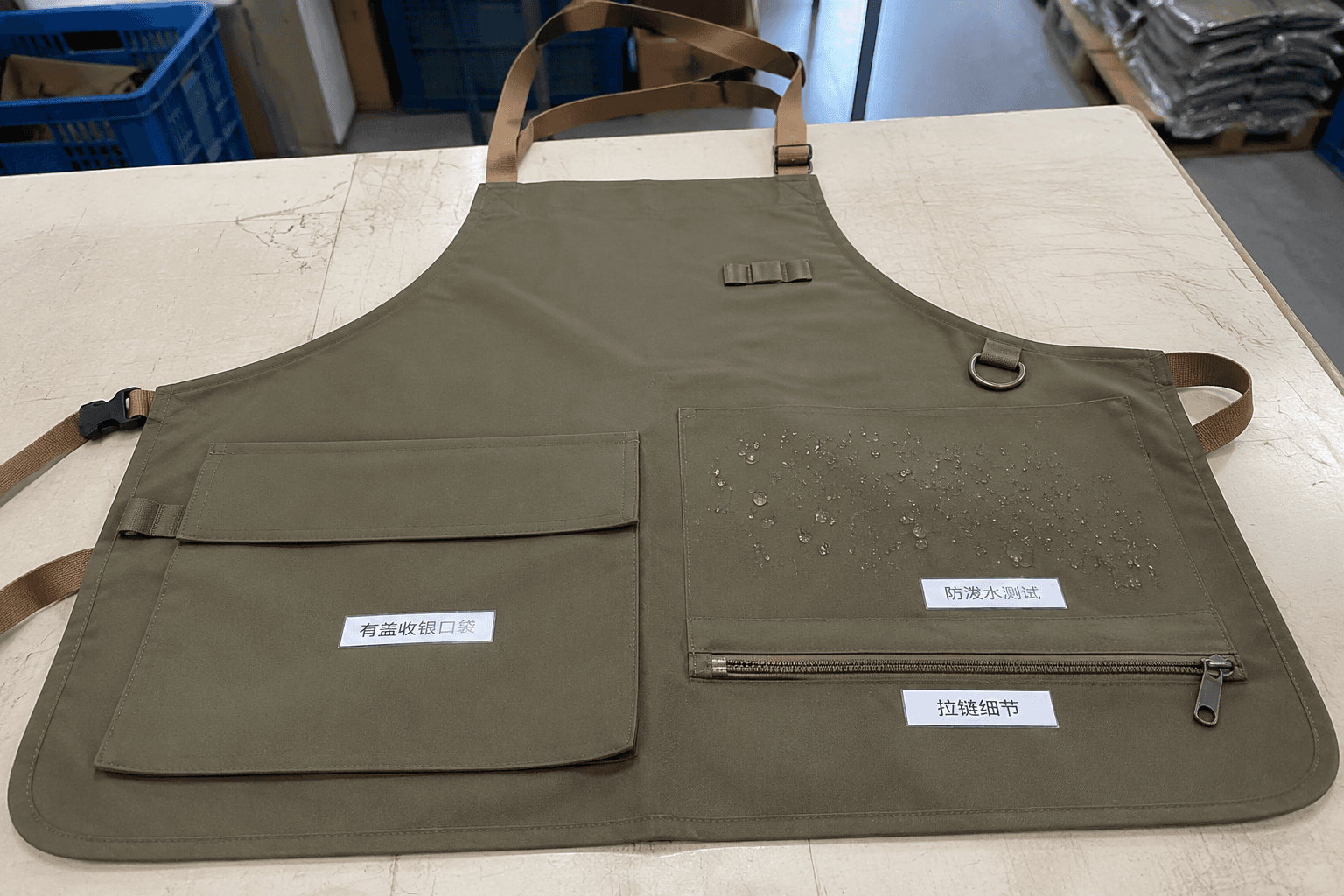
A stronger layout separates storage into two zones. The first is a compact chest pocket for a marker, loupe cloth or slim notebook, often about 11 x 13 cm. The second is a segmented lower pocket block positioned above the lap bend line rather than near the hem. Compartment depth usually works best at 11-15 cm depending on the tool set. Tweezers, scribes, wax tools, spring-bar tools and slim pliers are easier to retrieve from shallower divisions, and the shorter depth reduces outward tipping during forward lean. If the user needs one secure compartment for findings or spare parts, a concealed pocket with a covered reversed-coil zipper is safer than an open deep pouch.
This engineering changes cost because sewing minutes rise faster than fabric consumption. A basic stock bib apron may require about 9-11 minutes of sewing time. A jewelry-specific layout with segmented divisions, cleaner internal finishing and reinforced stress points often moves to 16-20 minutes. At 500-1,000 pcs, that can shift ex-works price from around $2.00-2.80 for a basic style to $3.30-4.90 for a bench-specific style in the same base fabric. Buyers get better quotations when they understand that cost is being driven by labor content, not by cloth weight alone.
- Keep pointed or heavier tools away from the center lower belly area.
- Place main segmented pockets in the upper-lower front zone above the seated bend line.
- Use bartacks or box stitches at pocket-division tops; decorative topstitching alone is not enough.
- Approve pocket depth with actual tweezers, pliers, scribes or burnishers during sample review.
5. MOQ, target pricing and lead times for custom jewelry workshop aprons
MOQ depends less on the apron category than on how far the style moves away from an existing factory block. A standard bib apron in stock fabric with one logo application may be available at 150-300 pcs. Once the buyer asks for custom body length, revised pocket mapping, cross-back construction, hidden hardware or no-scratch trim substitutions, MOQ usually rises to 500 pcs per color. If the fabric must be custom dyed to a brand standard, the practical MOQ often climbs to 800-1,200 pcs because the mill minimum becomes the real constraint.
Sampling should be staged around function, not appearance alone. With stock fabric, a first development sample usually needs 7-10 days. One revision round commonly takes 5-7 days after comments are confirmed. PPS approval can take another 3-5 days once all changes are closed. Bulk production is commonly 25-35 days after approvals and material booking. If trims are imported, if the fabric must be custom dyed, or if the program requires certified recycled or organic material with document review, 35-50 days is more realistic.
Pricing should also be framed in the correct commercial terms. At common East China OEM levels, a basic 210-230 GSM poly-cotton bib apron with one standard pocket usually falls around $1.90-2.70 per piece ex works at 1,000 pcs. A developed jewelry workshop style with segmented pockets, cross-back straps, hidden plastic adjustment and cleaner internal finishing usually sits around $3.20-5.20. Individual polybags, barcode stickers, printed inserts and retail hanger packing can add another $0.12-0.45 per piece depending on format and order size. Compare quotations line by line, because one supplier may include standard export carton packing while another prices it separately.
- Stock-body logo program MOQ: usually 150-300 pcs.
- Custom body or custom pocket-map MOQ: commonly 500 pcs per color.
- Custom-dyed fabric programs: often 800-1,200 pcs practical MOQ depending on mill minimums.
- Typical stock-fabric timing: 7-10 days first sample, 5-7 days revision, 3-5 days PPS, 25-35 days bulk.
6. QC checkpoints and AQL for jewelry workshop aprons
Visual inspection alone is not enough for this category. An apron can pass final carton inspection and still fail on the bench because it sheds fiber, traps loose thread inside pockets or reveals a hard trim edge after pressing and washing. Buyers sourcing jewelry workshop aprons should pair a normal AQL plan with function checks based on actual bench use.
A common baseline is AQL 2.5 for major defects and AQL 4.0 for minor defects, but the value is in the defect definitions. On this product, major defects often include exposed hard front-body components, wrong pocket placement, significant shade variation within a shipment, broken stitching at stress points, open seams, zipper malfunction on secure pockets or contamination inside compartments. Minor defects may include light pressing marks, slight topstitch irregularity, small measurement deviation within tolerance or minor thread-end cleanup issues. Many buyers work with tolerances of plus or minus 1.0 cm on finished body size and plus or minus 0.5 cm on pocket placement.
Functional approval should include a dark-fabric lint review under strong white light, a white-cloth rub test on the front panel, inspection for loose thread and trimming waste inside every compartment and a loaded wear test with representative tools for 20-30 minutes. If the apron is sold as reusable uniform, a 3-cycle laundry test often reveals twisted straps, puckering, edge abrasion and pocket tunneling. These defects are much cheaper to catch before shipment than after rollout to a bench team of 50 or 100 staff.
- Typical inspection baseline: AQL 2.5 major, AQL 4.0 minor.
- Useful tolerance: +/- 1.0 cm on finished body size and +/- 0.5 cm on pocket placement.
- Run lint and wear checks on dark colors before shipment, not only at sample stage.
- Add a signed checklist for front-surface smoothness, pocket retention and seated access.
7. The pre-sampling spec sheet B2B buyers should send
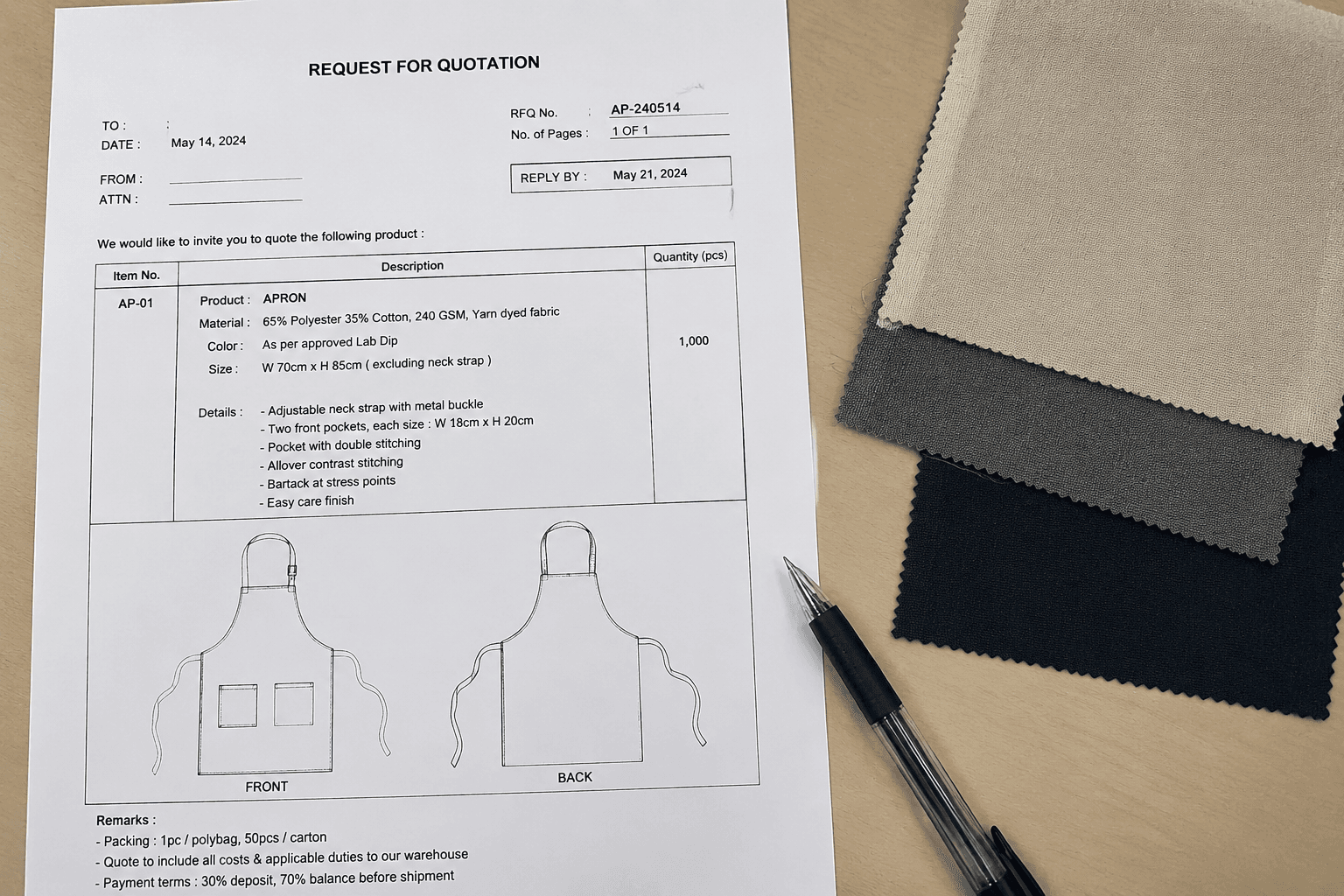
The fastest way to reduce revision rounds is to issue a short but exact spec sheet before the factory starts pattern work. For jewelry workshop aprons, that sheet should define end use, target dimensions, fabric composition, GSM, color, strap system, prohibited trims, pocket map, branding method, packing format and quality standard. A clear brief makes supplier quotations more comparable because each factory is pricing the same construction logic rather than guessing from a reference image.
A practical starting specification could read like this: bib apron; finished size 75 x 69 cm; fabric 65/35 poly-cotton twill, 220 GSM, reactive-dyed charcoal; cross-back straps in self fabric, 3.0 cm wide; self-fabric waist ties, each 78 cm long; no exposed metal on front body; one chest pocket 11 x 13 cm; one lower right segmented pocket block with three divisions, each 12 cm deep; one lower left concealed pocket with covered reversed-coil zipper; inside printed main label; chest embroidery 7 cm wide; bulk pack 50 pcs per export carton; individual polybag only if required by the distribution center. That level of detail is enough to produce a useful first sample and a realistic cost offer.
When comparing suppliers, ask direct operating questions. Which low-lint fabrics are already stocked in 210-230 GSM. Which scratch-safe hardware options are standard rather than custom. Can the factory show previous segmented-pocket styles with clean division stitching. How is front-surface hardness checked before packing. In this niche, the stronger supplier usually shows capability through precise questions and early risk identification, not through the lowest headline price.
- State end use first: polishing, assembly, watch service, repair, training or mixed bench work.
- Lock the fabric range early: composition, GSM, color standard and wash expectation.
- List every prohibited front-body trim explicitly in the tech pack.
- Provide actual tool dimensions when requesting segmented pockets.
- Request one wearer-trial sample before PPS on programs above 500 pcs.