Apron buyers rarely struggle with the idea of offering one style in several colors. The real sourcing issue is where the commercial logic breaks. A factory may accept eight shades on paper, but once units per color fall too low, fabric MOQs, lab dips, trim matching, marker efficiency, and carton control start working against the PO. In apron sourcing, the pressure point is usually quantity per colorway, not total units on the purchase order.
That is why a multiple colorways apron order behaves differently from a single-color repeat even when the bib shape, pocket layout, strap construction, and stitch method stay unchanged. Each added shade creates another material path: shell fabric booking, color approval, strap or tape matching, bundle separation, in-line control, final inspection records, and carton segregation. On an apron targeting $2.90 to $5.80 FOB, an extra $0.08 to $0.20 in handling may look minor, but once dye-lot charges and mixed-pack labor are added, the impact becomes material.
For professional B2B buyers, the aim is not to reduce every apron program to black and navy. The aim is to structure color depth so it still fits realistic mill minimums, normal AQL 2.5 major / 4.0 minor control, and a line schedule that can run without repeated stop-start loss. When that structure is right, one PO can support useful color variety. When it is wrong, the order carries the documentation of one PO but the cost and risk of several fragmented apron runs.
- For most apron factories, one PO holds normal bulk economics at 3 to 5 colorways, provided total volume is roughly 2,400 to 6,000 pcs and each shade carries at least 300 to 600 pcs.
- Stock-supported twill or canvas aprons can sometimes run at 250 to 300 pcs per color; custom-dyed cotton twill, canvas, or denim usually needs 400 to 600 pcs per color to protect price and delivery.
- The first breakdown in a multiple colorways apron order usually comes from fabric and trim coordination, followed by short cutting lays, mixed-carton packing, and slower final inspection.
- Once a shade drops below 200 to 250 pcs, many factories move to small-lot pricing, with common FOB increases of $0.12 to $0.48 per piece and lead-time extensions of 5 to 18 days.
- A practical allocation model is to place 60% to 75% of total volume into one or two core apron colors, then keep secondary shades above workable minimums instead of splitting evenly.
- If a colorway also changes embroidery, webbing color, rivet finish, barcode set, or retail packing method, the workable color limit usually drops by one tier, such as from 5 colors to 3 or 4.
What quantity range keeps a multiple colorways apron order commercially stable
The cleanest way to judge one apron PO is by pieces per colorway. A 4,800 pc bib apron order split into three colors at 1,600 pcs each still behaves like normal bulk production in many factories. A 2,100 pc order split into seven colors at 300 pcs each does not. Both may use the same pattern, same patch pocket, same neck buckle, and same lockstitch construction, but the second order forces the factory to run the style as several short apron lots.
For common apron fabrics, the thresholds are predictable. A 200 to 240 GSM poly-cotton twill bib apron, an 8 oz to 10 oz cotton canvas waist apron, or a 10 oz to 12 oz denim cross-back apron can usually hold standard FOB only when each colorway generates enough fabric demand to justify efficient purchasing and cutting. In practice, that usually means 300 to 500 pcs per color for stock shades and 400 to 600 pcs per color for custom dye lots.
The breakdown comes in stages. First, fabric demand per shade falls below mill-friendly levels. Then cutting lays get shorter, marker utilization weakens, and bundle control becomes more manual. After that, final packing and carton assortment absorb disproportionate labor. The PO still looks large on the order sheet, but inside the factory it functions like multiple fragmented apron runs.
For B2B sourcing, total units create leverage, but units per color determine whether the order remains operationally efficient. That is the practical limit most buyers need to measure before adding another shade.
- Commercially stable range: 1 apron style, 3 to 5 colorways, 2,400 to 6,000 pcs total.
- Usable stock-color level: 250 to 300 pcs per color, often with a light surcharge.
- Safer custom-dyed level: 400 to 600 pcs per color.
- Higher-risk zone: below 200 to 250 pcs per color, where many suppliers shift to small-lot pricing or recommend color consolidation.
Why FOB rises after 4 to 5 colorways on one apron PO
Buyers often assume the cost issue is sewing time because the apron construction does not change. Usually it does not. A basic bib apron may still run at roughly 9 to 12 SAM, while a canvas cross-back with rivets and bartacks may run 14 to 18 SAM. The price movement usually comes from fabric buying, dye-lot exposure, trim matching, cut-part handling, inspection segregation, and mixed-carton packing. Those are the cost lines that stop scaling well once the color split gets too fine.
Fabric is normally the biggest variable. A standard adult bib apron in 220 GSM twill often consumes about 0.95 to 1.10 meters of shell fabric per piece, depending on finished width, pocket size, and tie construction. At 300 pcs, one colorway may need only 285 to 330 meters. Many dye houses quote more efficiently at 600 to 1,000 meters per shade, especially for reactive-dyed cotton canvas and denim. If the PO carries five or six custom colors, the factory may need to accept short-lot dyeing fees, buy buffer yardage it cannot reuse quickly, or spread dead-stock risk into the unit price.
Handling cost is the second layer. A 3,000 pc one-color apron order allows longer cutting lays, fewer bundle tickets, simpler in-line feeding, and repetitive carton packing. Split the same quantity into five colorways and the sewing minutes stay close to the same, but handling increases across every stage. On a simple twill bib apron, that often adds $0.12 to $0.22 per piece. On a heavier canvas or denim apron with webbing straps, antique-brass hardware, embroidery, and retail hangtags, the increase can reach $0.28 to $0.48 per piece.
That change matters because many apron programs are cost-sensitive. If the target FOB on a hospitality bib apron is $3.10, an extra $0.30 is not noise. It can remove the commercial advantage of consolidating every shade into one PO.
- Simple bib apron, 220 GSM poly-cotton twill, 3,000 pcs in one color: about $2.85 to $3.35 FOB.
- Same apron, same total quantity, split across five colorways: about $3.00 to $3.58 FOB.
- Canvas and denim aprons usually absorb a larger color penalty because shell fabric value is higher and trims are heavier.
- Typical surcharge band from short-lot dyeing, trim matching, and mixed-pack labor: $0.12 to $0.48 per piece.
Fabric MOQ and approval timing in a multiple colorways apron order
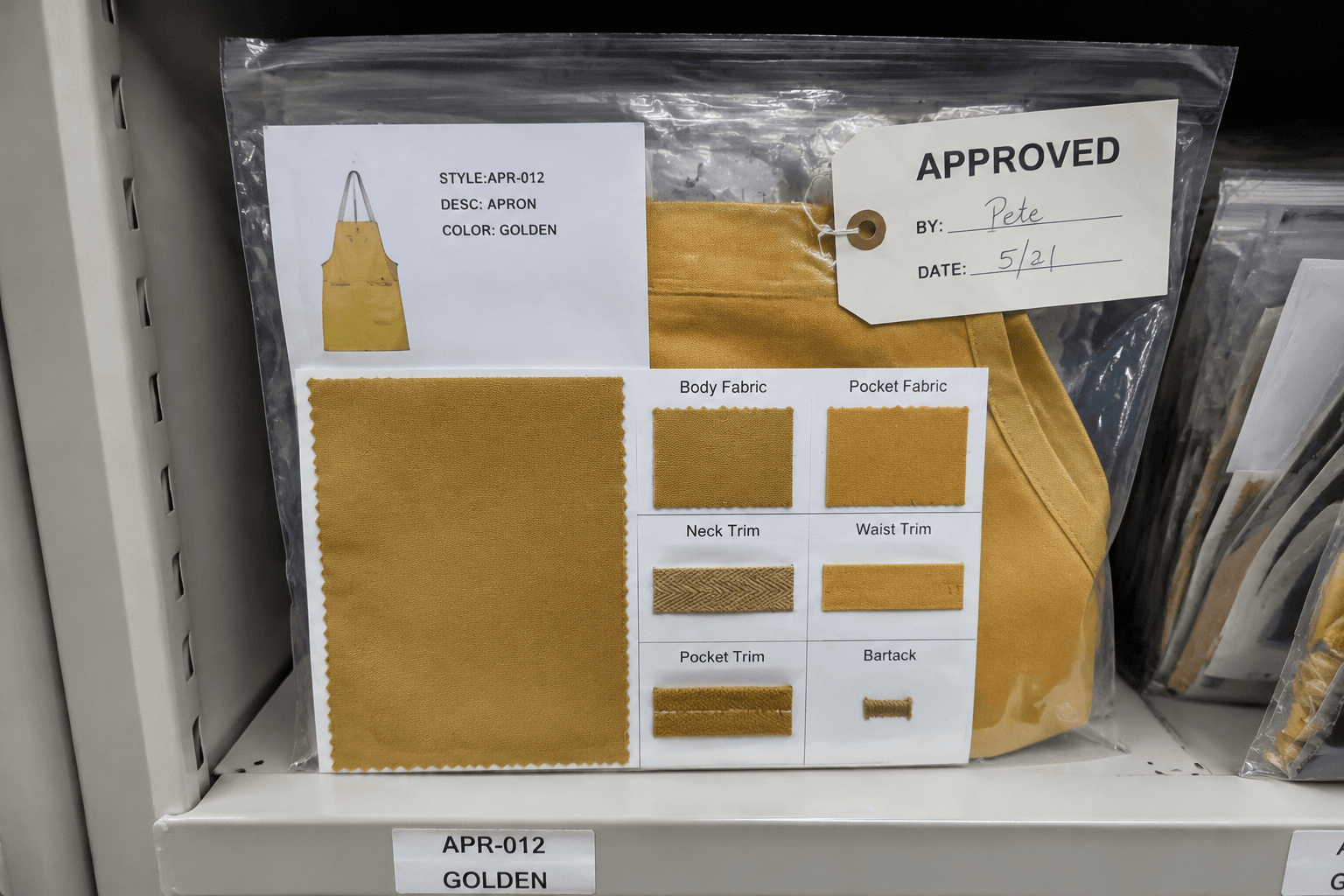
The key technical distinction is whether the apron body fabric comes from a stock color program or must be dyed for the order. If the factory already holds black, navy, khaki, olive, and burgundy in the required apron weight, adding a fourth or fifth shade may still be manageable. If each shade needs its own lab dip, bulk approval, and incoming fabric inspection, every added colorway becomes a separate material-development path.
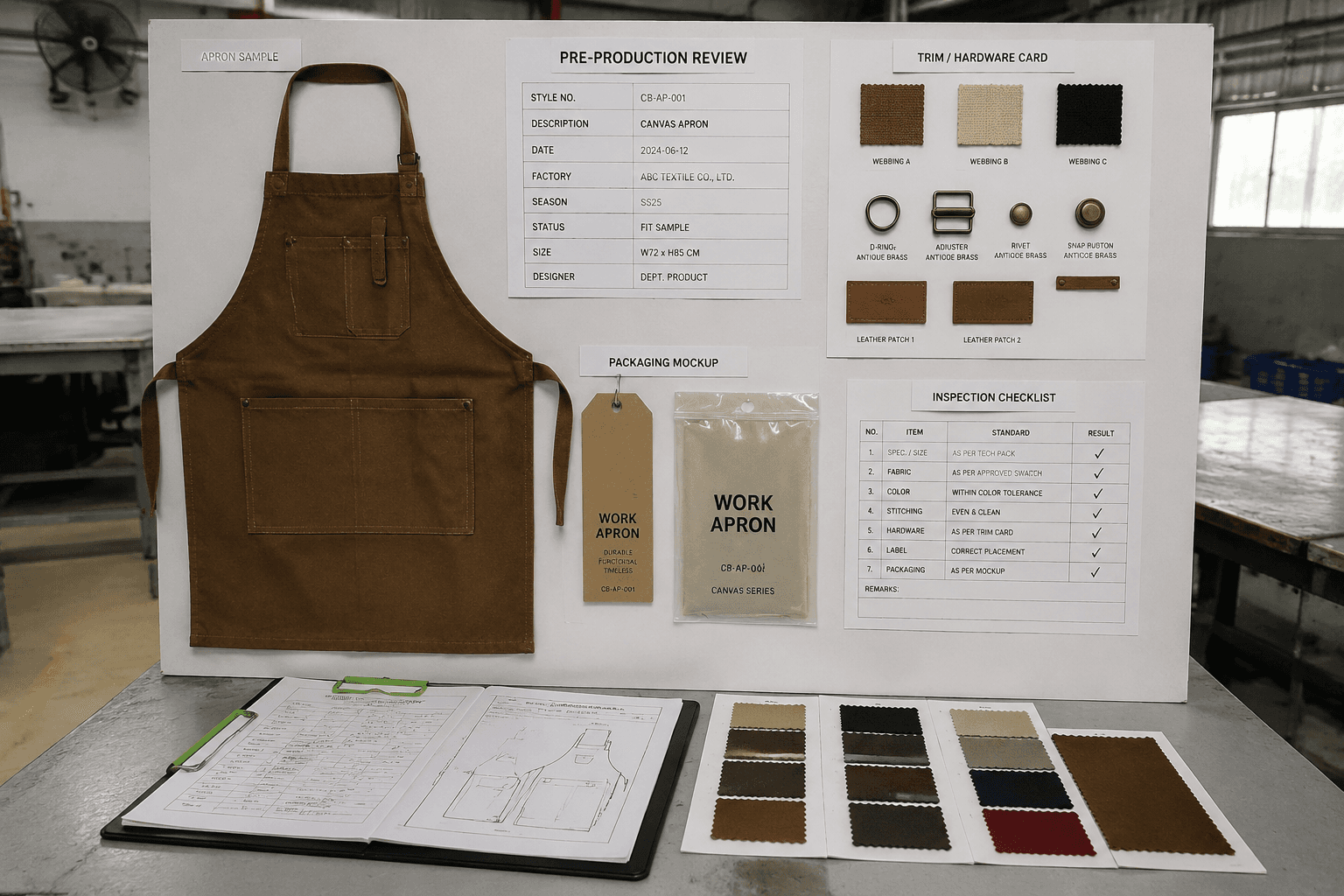
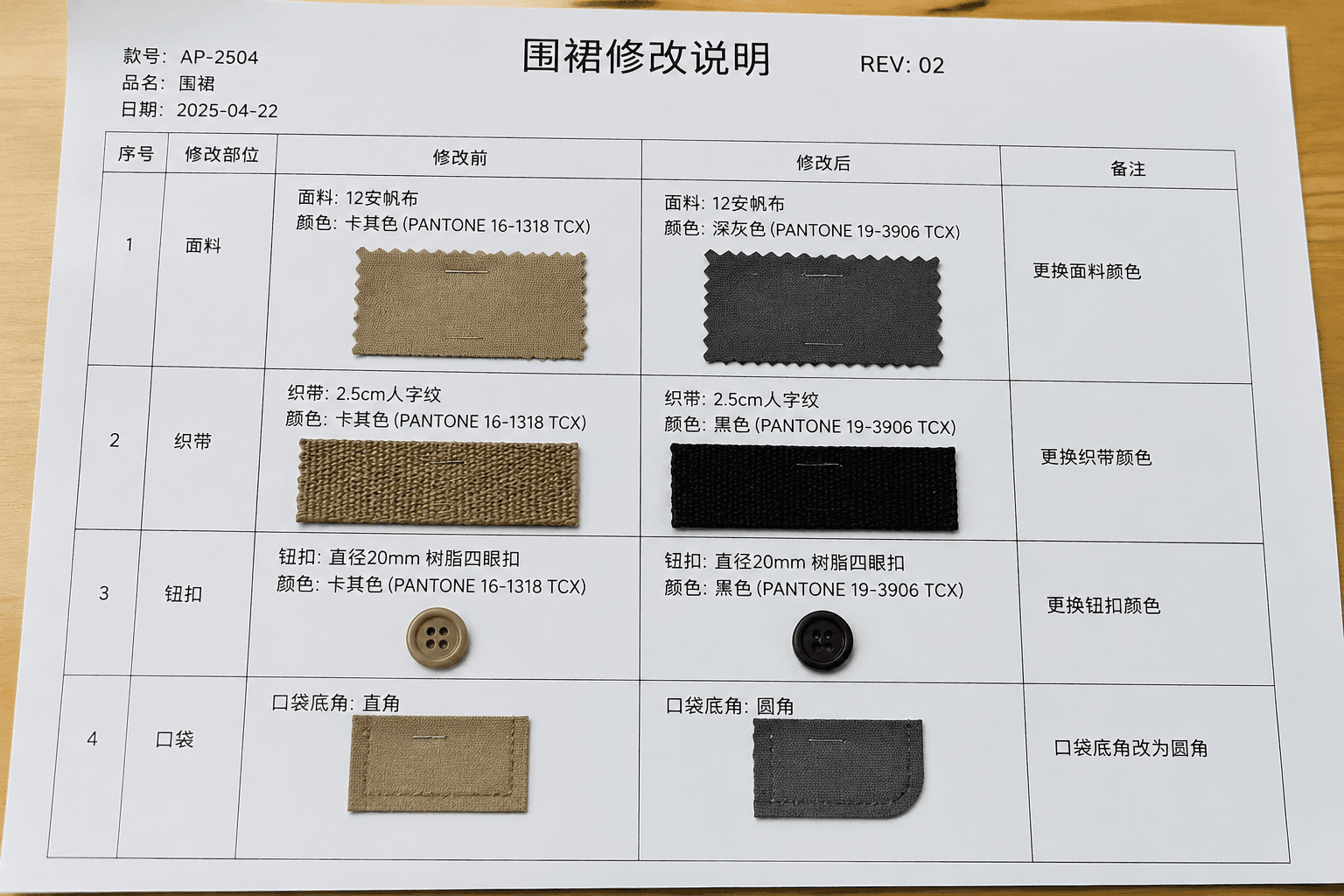
Apron color control also goes beyond shell fabric. Buyers need to check neck straps, waist ties, herringbone tape, cotton webbing, woven labels, embroidery thread, snaps, rivets, and printed care labels. In back-of-house or industrial apron programs, a close commercial match between body fabric and tape is often acceptable. In hospitality, brand retail, and licensed merchandise programs, tolerance is usually tighter because mismatch is easier to see under venue or store lighting.
This is where approval timing starts to stretch the schedule. A stock-supported apron color can often move into bulk within 7 to 10 days after PP sample approval. A custom-dyed shade usually needs another 12 to 18 days for lab dips, comments, bulk dyeing, shade band review, fabric testing, and incoming inspection. If matching tape, webbing, labels, or thread also need custom development, add another 4 to 7 days. One late shade can delay the full shipment if the PO is booked as one lot.
For serious apron buyers, every non-stock shade should be treated as a material event rather than a simple merchandising choice. That is the point where color count begins to affect price, delivery reliability, and defect exposure.
- Stock apron fabric after PP approval: bulk start often possible in 7 to 10 days.
- Custom-dyed shell fabric: usually adds 12 to 18 days before cutting can start.
- Color-matched tapes, webbing, or woven labels: often add 4 to 7 more days.
- Define inspection tolerance early, such as AQL 2.5 major / 4.0 minor, and state whether visible shade mismatch is scored as a major defect.
Lead-time breakpoints by color count, packing method, and inspection level
Sewing is rarely the first bottleneck in apron production. Many bib and waist aprons run with moderate sewing content, so delays in pre-production and packing show up faster in mixed-color orders. If one shade's body fabric, adjuster buckle, or printed care label arrives late, that issue can hold the entire shipment unless partial delivery is allowed.
For repeat apron orders using stock colors and standard bulk packing, many factories can ship in about 20 to 28 days from deposit, final approval, and material readiness. Once the same apron expands to 3 to 5 colors with a mix of stock fabric and custom trims, 30 to 38 days is more realistic. At 5 to 8 colorways with custom dyeing, barcode sticker sets, individual polybags, and destination-specific assortments, a planning window of 42 to 55 days is usually safer than a nominal 30-day promise.
Inspection and packing consume more time than many buyers expect. A one-color apron run can be checked and packed quickly because carton content repeats. A mixed-color run needs clearer ticketing, ratio verification, carton mark control, and stronger segregation during final audit. If the order also requires store packs or channel-specific labels, many factories need another 2 to 5 days after sewing ends to complete final inspection and shipment packing.
The planning rule is simple: the slowest colorway controls the order unless the PO explicitly allows split shipment. That is why a single late custom shade can destabilize an otherwise straightforward apron program.
- Repeat apron order, 1 to 2 stock colors: about 20 to 28 days.
- New apron order, 3 to 5 colors, mixed stock fabric and custom trims: about 30 to 38 days.
- New apron order, 5 to 8 colors, custom dyeing and retail packing: about 42 to 55 days.
- Mixed-color final inspection and packing commonly add 2 to 5 days after sewing completion.
Best color allocation model before a multiple colorways apron order starts to fragment
The strongest color plan is usually uneven by design. An equal split across every shade may look tidy in a buy plan, but it is often the least efficient way to source aprons. A better structure is to let one or two core colors carry most of the volume while secondary shades stay above workable minimums. That keeps range depth without forcing the supplier to price every colorway like a marginal lot.
A practical example is a 5,000 pc bib apron PO split into 1,900 black, 1,500 navy, 700 khaki, 500 olive, and 400 rust. That is still a five-color apron program, but the first two shades absorb most of the fabric booking and line loading. Compare that with an even split of 1,000 pcs each across five colors. The equal split may look balanced, yet it increases approval pressure, shortens cutting lays, raises trim leftovers, and complicates carton packing.
This allocation approach becomes more important when the apron includes premium details such as antique-brass hardware, embroidery, faux-leather patches, contrast webbing, or individual retail labeling. In those cases, high-volume colors can carry the full trim package, while lower-volume shades may need trim standardization to protect cost and lead time.
For launch orders, this model also limits forecast risk. Core apron colors can be repeated quickly. Experimental shades stay controlled instead of being overbought in the first bulk order.
- Put 60% to 75% of total quantity into 1 or 2 core colors.
- Keep secondary colors at roughly 300 to 500 pcs each whenever possible.
- If the PO is below 2,500 pcs total, reduce minor shades aggressively.
- Add proven colors on repeat orders instead of loading too many trial shades into the first apron PO.
When one apron PO should stay unified and when it should be split
Keeping all shades under one commercial PO makes sense when the aprons share the same shell fabric, same GSM or oz weight, same trim package, same decoration method, and the same ship window. Under those conditions, the factory can still plan the job as one apron family with controlled variation. Buyers get cleaner negotiation, simpler documentation, and better leverage on consolidated volume.
The structure stops working when the color split hides real production differences. If two apron colors use 230 GSM poly-cotton twill for foodservice while three others use 10 oz washed canvas for retail, the order no longer follows one clean manufacturing logic. The same applies when one group uses screen print, another uses embroidery, or one channel requires individual barcode stickers while another accepts bulk pack. Those differences create separate material paths, separate approvals, and separate inspection exposure even if the silhouette is identical.
A disciplined sourcing method is to keep the commercial discussion unified but ask the factory for clear breakpoints. Request apron pricing at the same total quantity for 1 color, 3 colors, and 5 colors. Ask for MOQ by colorway, surcharge by custom-dyed shade, and lead-time impact if trims or packaging differ. A capable apron supplier should be able to show where the blended price stops being valid and where the order should be split into separate production lots.
Quality control needs the same clarity. A mixed-color apron order with multiple trim or pack variations should have color-specific checkpoints, a defined shade standard, and a pre-agreed final inspection level such as AQL 2.5/4.0 or a tighter buyer protocol where appearance standards are stricter.
- Keep one PO when aprons share the same fabric, same weight, same trims, same decoration, and the same delivery window.
- Split lots when colorways require different fabric weights, wash effects, hardware finishes, or packing methods.
- Ask the supplier for price breakpoints at 1 color, 3 colors, and 5 colors using the same total units.
- Confirm whether shade variation is inspected under AQL 2.5 major / 4.0 minor or a tighter customer rule before bulk starts.