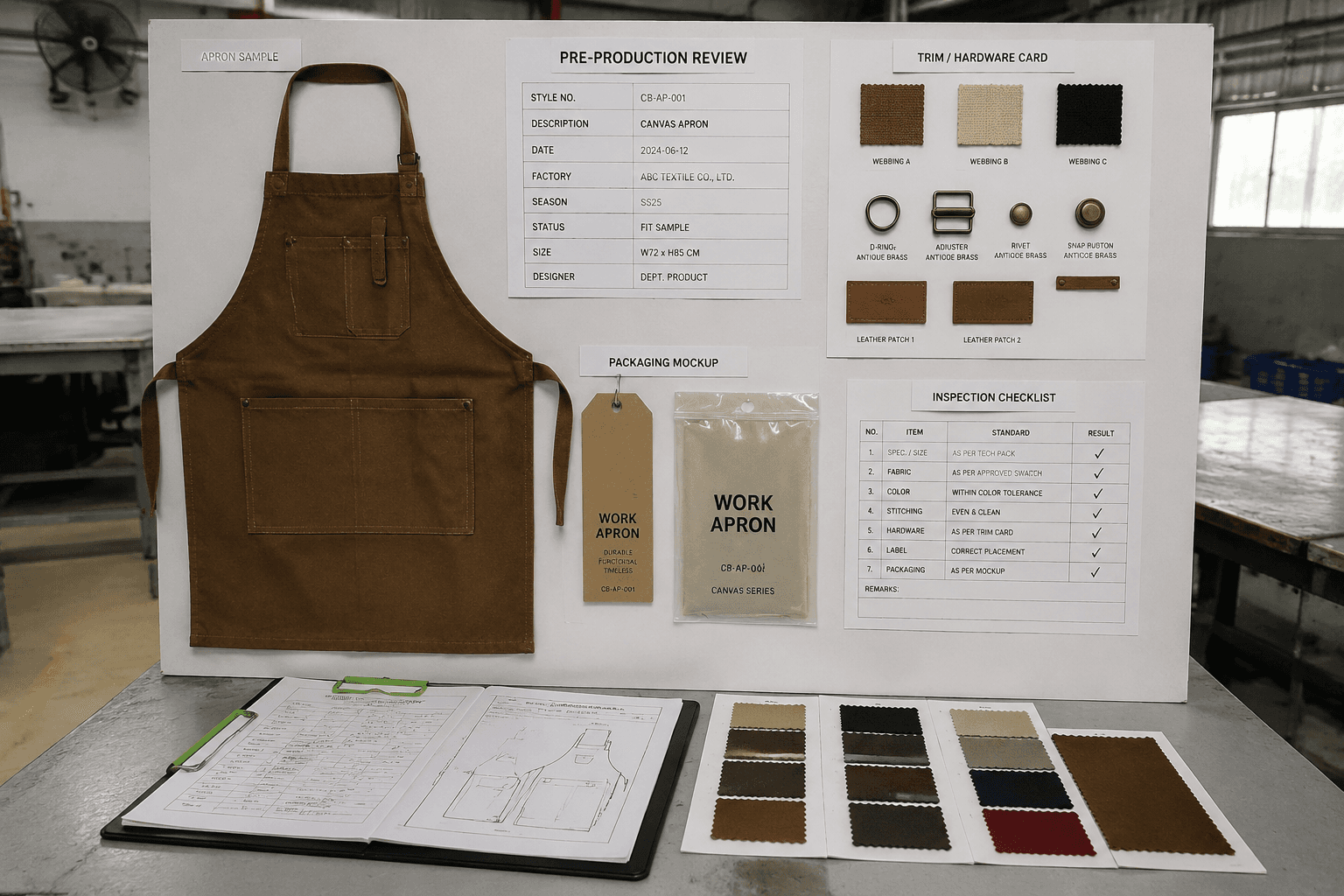
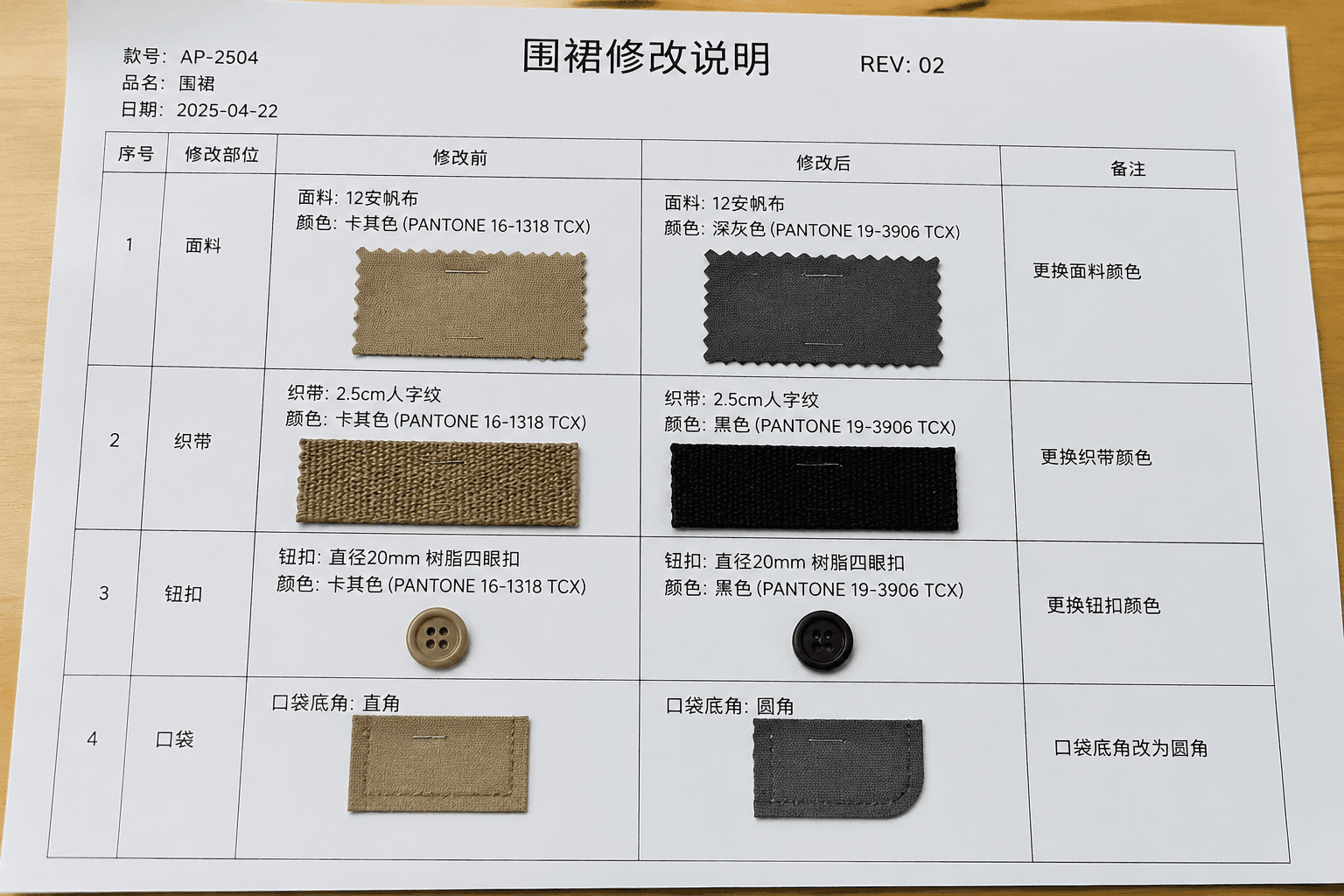
In apron sourcing, color feasibility is usually decided at the fabric mill before the sewing factory confirms final pricing. Apron fabric dyeing minimums control whether a 65/35 polycotton twill bib apron can use a stocked navy or black, or whether a branded Pantone requires a custom dye booking of 500-1,500 meters per color. That upstream choice affects not only color accuracy, but also fabric yield, cutting efficiency, and whether the quoted MOQ in pieces is commercially workable once actual meter consumption is calculated.
For common export apron programs in China, stock shades in 210-240 GSM polycotton twill, 240-300 GSM cotton twill, and 8-12 oz cotton canvas usually support lower sewing MOQs because the fabric is already dyed or routinely replenished. Custom colors are different. Even when the apron factory can sew 300-500 pieces, the mill may still require 800 meters for a straightforward twill shade, 1,000 meters for a regular branded bib apron program, or 1,200-1,500 meters for heavier canvas, tighter shade tolerance, or difficult tones such as muted olive, dusty terracotta, or cool gray-green.
For professional buyers, the key question is not whether a custom apron color is technically possible. It is whether the color value justifies the meter MOQ, lab dip cycle, process loss, surcharge, and reorder risk. This article explains how mills calculate apron fabric dyeing minimums, where stock shades usually outperform custom colors, and what numbers buyers should check before approving an apron PO.
- Stock-dyed apron fabric usually supports lower order quantities, often 300-1,000 pcs depending on style, width, and stock depth.
- Custom apron colors typically require 500-1,500 meters per color, even when the sewing MOQ in pieces is lower.
- Small-lot custom dyeing often adds $0.20-$0.80 per apron or a fixed $120-$350 per color surcharge.
- One lab dip round plus bulk dyeing usually adds 7-12 days; two or three approval rounds can extend that to 12-18 days.
- Commercial shades such as black, navy, khaki, beige, dark gray, burgundy, and bottle green are usually easier to source from stock than exact branded seasonal tones.
- Before PO approval, buyers should review meter consumption, dye MOQ by color, process loss, AQL target, and ex-factory timing in one quote set.
Why apron fabric dyeing minimums are quoted in meters instead of finished pieces
Many apron buyers first negotiate MOQ in pieces because that is how finished goods are purchased. Mills do not work that way. Dye houses schedule production by fabric type, width, lot size, dye recipe, finishing route, and machine loading efficiency. Whether the finished product becomes a short café waist apron or a long canvas bib apron, the dye line still needs enough meterage to justify setup cost, chemical dosing, water treatment, heat setting, and expected shade correction.
That is why apron fabric dyeing minimums are quoted by meters per color, not by apron count. A 600-piece order may look substantial on a purchase order, but if the style uses only 0.78 meter per piece on 150 cm width fabric, total demand is about 468 meters before adding process allowance. That is below the practical booking level for many custom-dyed apron fabrics. By contrast, an 850-piece bib apron in 10 oz canvas using 1.22 meters per piece can exceed 1,000 meters and fit a normal custom dye run more easily.
Meters also matter because fixed loss is proportionally higher on short runs. Mills normally add extra greige for start-end loss, lab adjustment, shrinkage, skew correction, shade variation control, and replacement fabric for defects found during inspection. On a 500-meter custom lot, a 5% to 8% total process allowance has a noticeable effect on usable yield and price per apron. On a 1,500-meter lot, those fixed losses are spread more efficiently across the order.
- Typical custom dye entry point for apron twill: 500-800 meters/color.
- Common booking level for branded bib aprons in standard twill: 800-1,200 meters/color.
- Frequent range for 10-12 oz canvas or stricter shade control: 1,000-1,500 meters/color.
- Normal process allowance before final cutting yield: 3%-8% depending on fabric and finish.
Stock shades under apron fabric dyeing minimums: when they save cost and time
For most repeat B2B apron programs, stock-dyed fabric is the lowest-risk route. Mills and fabric traders in China commonly keep apron-friendly constructions in commercial colors that turn quickly across restaurant, hotel, bakery, café, and retail uniform accounts. The most available bases are usually 65/35 polycotton twill at 210-240 GSM, 100% cotton twill at 240-300 GSM, and cotton canvas at 8-12 oz. Stock depth varies by season, but black, navy, beige, khaki, dark gray, burgundy, and bottle green are usually easier to confirm than trend-driven muted shades.
The real advantage of stock color is not only lower MOQ. It also cuts approval steps. If the body fabric already exists in a proven shade and finish, the factory can verify stock lot, check hand feel and width, run basic color comparison, and move into cutting after trim approval. That can compress fabric lead time to 7-20 days depending on inventory position and sewing capacity, versus a custom route that must wait for lab dips, bulk dyeing, and inspection release.
Stock shades are especially practical for launch orders of 300-800 pieces, event programs, and private-label apron lines still testing demand. In these cases, a near-stock dark olive, wine red, or warm gray often makes better commercial sense than insisting on an exact Pantone that adds 10 days and a visible surcharge. Buyers can always shift to custom color later if annual volume grows and the brand case becomes stronger.
- Typical stock-supported apron MOQ: 300-1,000 pcs depending on style and available fabric.
- Common stock fabrics for aprons: 210-240 GSM polycotton twill, 240-300 GSM cotton twill, 8-12 oz cotton canvas.
- Frequent stock shade families: black, navy, beige, khaki, dark gray, burgundy, bottle green.
- Usual fabric-to-cutting timeline on confirmed stock shades: 7-20 days.
Custom colors and apron fabric dyeing minimums by fabric weight, style, and annual volume
Custom dyeing becomes sensible when the apron body color has a clear brand function: matching a chain café identity, aligning with existing staff uniforms, or differentiating licensed merchandise from commodity uniforms. Even then, buyers should compare custom color volume in meters, not only the launch quantity in pieces. A 900-piece opening order may not meet the best dye economics, but a 12-month forecast of 3,600 pieces in the same fabric often will.
Fabric weight changes the threshold. Standard twills at 210-240 GSM or 240-280 GSM usually have more flexible custom booking levels than 10-12 oz canvas, because heavier fabrics absorb more cost in dyeing, drying, finishing, and wastage. Style also matters. A waist apron may consume only 0.70-0.85 meter per piece, a standard bib apron around 0.95-1.10 meters, and a longer bib apron with chest pocket, patch pockets, and self-fabric ties about 1.20-1.45 meters. The same 1,000-meter dye lot therefore supports very different finished quantities depending on the apron body.
Professional buyers should also watch style splits. A 1,200-piece order divided across waist aprons, standard bib aprons, and cross-back aprons may look large enough for custom color, but marker efficiency, width utilization, and replacement allowance differ by style. Once the order is broken into three cutting plans, the fabric economics may be weaker than one unified body. That is why experienced factories ask for style ratio, size ratio, and fabric width before confirming that a custom color route is commercially sound.
- Approximate apron consumption on 150 cm width fabric: 0.70-0.85 meter for waist aprons, 0.95-1.10 meters for standard bib aprons, 1.20-1.45 meters for longer bib aprons.
- A 1,000-meter dye lot may support about 1,175-1,430 waist aprons, 910-1,050 standard bib aprons, or 690-830 long bib aprons before final replacement allowance.
- Annual demand above roughly 2,000-4,000 pcs per color usually makes custom dyeing easier to justify than one-off launch orders.
- Heavier 10-12 oz canvas generally needs a higher effective volume than 210-240 GSM twill to absorb dye setup cost cleanly.
Custom-color surcharge math for apron orders: realistic FOB impact at low meter volume
When a buyer wants a custom shade below the mill's preferred lot size, the mill may still accept the run with a surcharge. This is normal in apron sourcing. The problem is not the existence of the surcharge; it is unclear quoting. Some suppliers express it as an added cost per meter, some as an upcharge per apron, and others as a fixed small-lot fee per color. Unless that structure is shown clearly, comparing quotations is difficult and buyers can misread where the FOB increase is coming from.
In current apron sourcing ranges, realistic small-lot custom color charges often fall between $0.20 and $0.80 per piece or $120 and $350 per color for shorter runs. On a 500-piece bib apron order, a $0.45 per piece color upcharge adds $225 to the FOB total before logo, packaging, or trim changes are considered. If the apron body is 300 GSM cotton twill or 10 oz canvas, the upcharge may sit at the upper end of the range because dye uptake, drying time, and wastage are higher than for a lighter 210 GSM polycotton twill.
Buyers should also ask what is included in the number. One factory may fold lab dip work, process wastage, and retesting into the surcharge, while another may quote only the mill fee and add the rest later. For sourcing managers trying to control margin, the useful comparison is total landed factory impact per color, not just the smallest surcharge line on the proforma.
- Frequent surcharge formats: $0.20-$0.80/pc, $0.08-$0.35/meter, or $120-$350/color.
- Example: 500 pcs x $0.45/pc = $225 added FOB cost for a short-run custom apron color.
- Heavier apron fabrics such as 300 GSM cotton twill or 10 oz canvas usually sit above 210-240 GSM twill on custom-color surcharge.
- Buyers should confirm whether the custom color charge covers lab dips, bulk dyeing, extra wastage, and retesting.
Lead-time exposure tied to apron fabric dyeing minimums and lab dip approval
Schedule risk is often more damaging than the surcharge itself. A stock shade can move quickly if the fabric is available and prior test performance is acceptable. A custom apron color introduces at least four upstream gates: shade standard confirmation, lab dip submission, approval or revision, and bulk dyeing plus finishing. If the buyer's approvals are slow, or if the target color is difficult to hit on the chosen base cloth, the sewing line may be ready while body fabric is still at the mill.
In straightforward cases, one lab dip round takes about 3-5 days. After approval, bulk dyeing, finishing, and internal inspection usually add another 4-10 days. That means a simple custom color often adds 7-12 days before cutting begins. If two more lab dip rounds are required, total delay commonly reaches 12-18 days. Peak season can stretch this further, especially before spring hospitality openings, summer event programs, or Q4 branded merchandise shipments.
This is why experienced B2B buyers approve body color earlier than minor packaging details. A carton mark or barcode revision rarely stops production; a missed dye slot does. If the ex-factory date matters, the purchase order should show the custom-color route, the agreed approval calendar, and the last acceptable date for lab dip sign-off.
- One lab dip cycle usually requires 3-5 days.
- Bulk dyeing, finishing, and release to cutting often need 4-10 days after approval.
- Two additional lab dip rounds can add 5-8 days without changing sewing capacity.
- For urgent apron programs, body color should be locked before PO issue or immediately after sample approval.
A practical buyer checklist for managing apron fabric dyeing minimums before PO approval
The cleanest way to control apron color cost is to confirm the fabric route in writing before the purchase order is issued. Buyers should ask the supplier to state the exact composition, weight, width, finish, stock-versus-custom status, custom dye MOQ in meters per color, expected process loss, surcharge method, and lead-time impact. These are routine sourcing controls for aprons. Without them, a low unit quote can change after the mill reviews actual color volume and confirms that the planned lot is too small for standard pricing.
It is also smart to evaluate color in annual fabric terms. A custom shade that looks expensive on an 800-piece opening order may become efficient if the same bib apron fabric will be reordered four times within 12 months. Consolidation helps as well. If bib aprons, waist aprons, and cross-back aprons can share one dark navy body fabric, total meter demand rises quickly and the custom color becomes easier to support. Splitting similar programs into three near-identical blues usually creates extra dye fees, more approvals, and higher reorder risk with little visual gain.
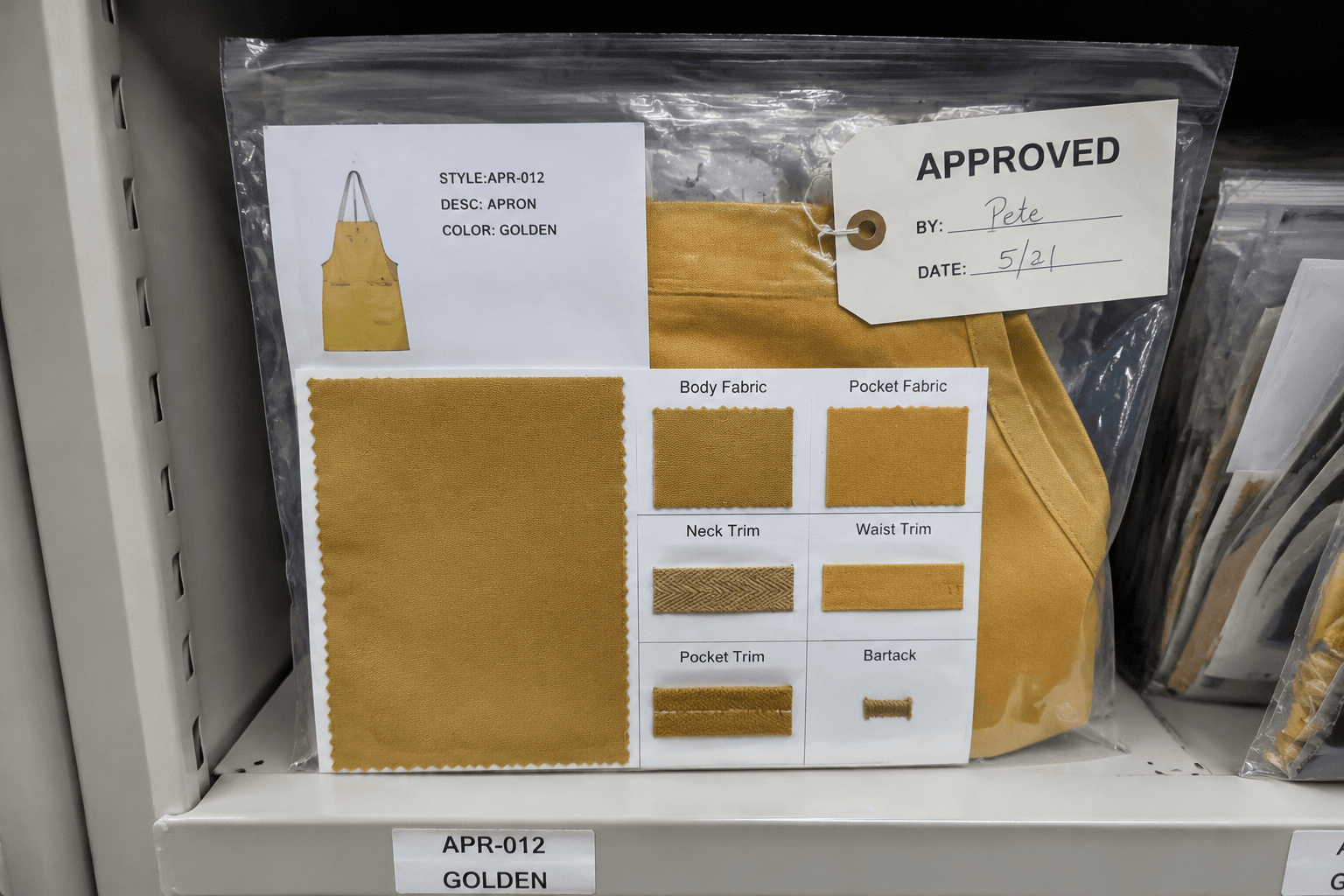
Finally, document the approval standard carefully. Keep signed swatches, approved lab dips, bulk cutting references, and test records in the reorder file. For finished apron inspection, align the acceptance plan in advance, commonly AQL 2.5 for major defects, with some branded programs tightening to AQL 1.5/2.5. Good records reduce disputes when repeat apron orders must match an earlier lot under tight delivery dates.
- Confirm composition, GSM or oz, width, and finish before approving color.
- Request custom dye MOQ in meters per color, not only pieces.
- Check whether the surcharge is per piece, per meter, or per color and how it changes FOB.
- Record the added timeline in days and attach the approved color standard to the PO file.
- Keep reorder references including signed swatches, lot records, and target AQL level.