In apron production, a late trim is not a minor purchasing inconvenience. If a nominated 25 mm neck slider, logo snap, copper rivet, or antique brass D-ring arrives 5 to 8 days late, the factory may still cut shell fabric and prepare pockets, but it cannot complete sewing, washing, final inspection, and packing on the original calendar. On a 6,000-piece bib apron order running three lines, one missing hardware item can extend shipment by 7 to 11 calendar days after line resequencing, re-approval, and vessel rebooking are counted.
That is why capable suppliers treat apron trim substitution as a technical change under document control, not as an ad hoc sourcing shortcut. A substitute trim must match width, installation method, pull strength, plating stability, and wash performance. If the original trim is a 25 mm antique brass slider rated to 15 kg pull on 32 mm cotton webbing, the substitute should meet the same functional standard and run on the same construction, even if the finish shifts slightly within a pre-approved tolerance.
For B2B buyers, the decision is usually commercial before it is emotional. A substitute that adds $0.04 to $0.14 per apron is often cheaper than a 7-day delay, split shipment, line idling, or partial air freight. The right process protects delivery first, then controls appearance, quality, and margin through written approval and measurable limits.
- Apron trim substitution works best when backup buckles, snaps, sliders, rivets, and eyelets are approved during development by size, finish, installation method, pull strength, and wash result.
- A single late trim can delay a 3,000- to 15,000-piece apron program by 5 to 10 days if no alternate is written into the tech pack and approved before bulk cutting.
- Approved substitutes should hold the same performance target, corrosion behavior, and inspection standard as the original, typically AQL 2.5 for major defects and AQL 4.0 for minor defects.
- Buyers should request exact MOQ, available stock, replenishment lead time, and cost delta in writing; common alternates raise MOQ from 3,000 pieces to 5,000 or 10,000 pieces and add $0.03 to $0.18 per apron.
- The factory trim approval process should define what may change, who signs off, and the latest decision date, usually 5 to 7 days before bulk cutting on a 30- to 40-day apron calendar.
- The lowest trim price is rarely the lowest total cost if it creates a line stop, missed vessel, partial shipment, or retail launch failure.
Why apron trim substitution becomes a schedule issue within days
On apron orders, trims are low-cost items with high schedule leverage. A waist apron may use only two eyelets and one snap, while a bib apron may need a neck slider, two D-rings, two rivets, and branded metal buttons. If one nominated trim misses delivery, the factory can often keep cutting 8 oz to 10 oz cotton canvas or 65/35 poly-cotton shell fabric, but it cannot move the order to ship-ready condition. In practice, a trim shortage behaves more like a fabric delay than a small purchasing gap.
The timing problem compounds quickly. A nominal 3-day trim delay often becomes 6 to 9 calendar days once inbound transit, incoming QC, substitute review, line resequencing, and inspection rebooking are added. In an apron factory running 3 to 5 sewing lines with daily output of 1,200 to 2,500 pieces, that disruption can push another order behind it, especially before spring promotions or Q4 hospitality replenishment.
Risk is highest when the missing trim is visible, load-bearing, or brand-specific. A 20 mm slider that looks identical in a photo may differ in wire gauge, burr control, plating thickness, or pull resistance. On a garment-washed 9 oz cotton canvas apron, those differences can show after laundering even if inline appearance looks acceptable. That is why apron trim substitution should be planned during development, not argued over after bulk cutting starts.
- A 3-day supplier delay often becomes 6 to 9 calendar days at factory level.
- Line resequencing can affect orders beyond the delayed apron style.
- Visible and load-bearing trims carry more substitution risk than hidden trims.
- Photo similarity does not confirm equal strength, finish, or wash behavior.
Which apron trims should enter an apron trim substitution matrix
Not every trim needs the same level of backup planning. Standard stock items such as 20 mm plastic sliders, generic nickel snaps, black cord locks, and common brass eyelets are usually replaceable because domestic supply is broad and installation methods are stable. Higher-risk trims include logo snaps, enamel buckles, custom-plated rivets, antique brass hardware, imported D-rings, and any item requiring a dedicated die, mold, or long plating cycle. These parts need pre-approved alternates if the production window is tight.
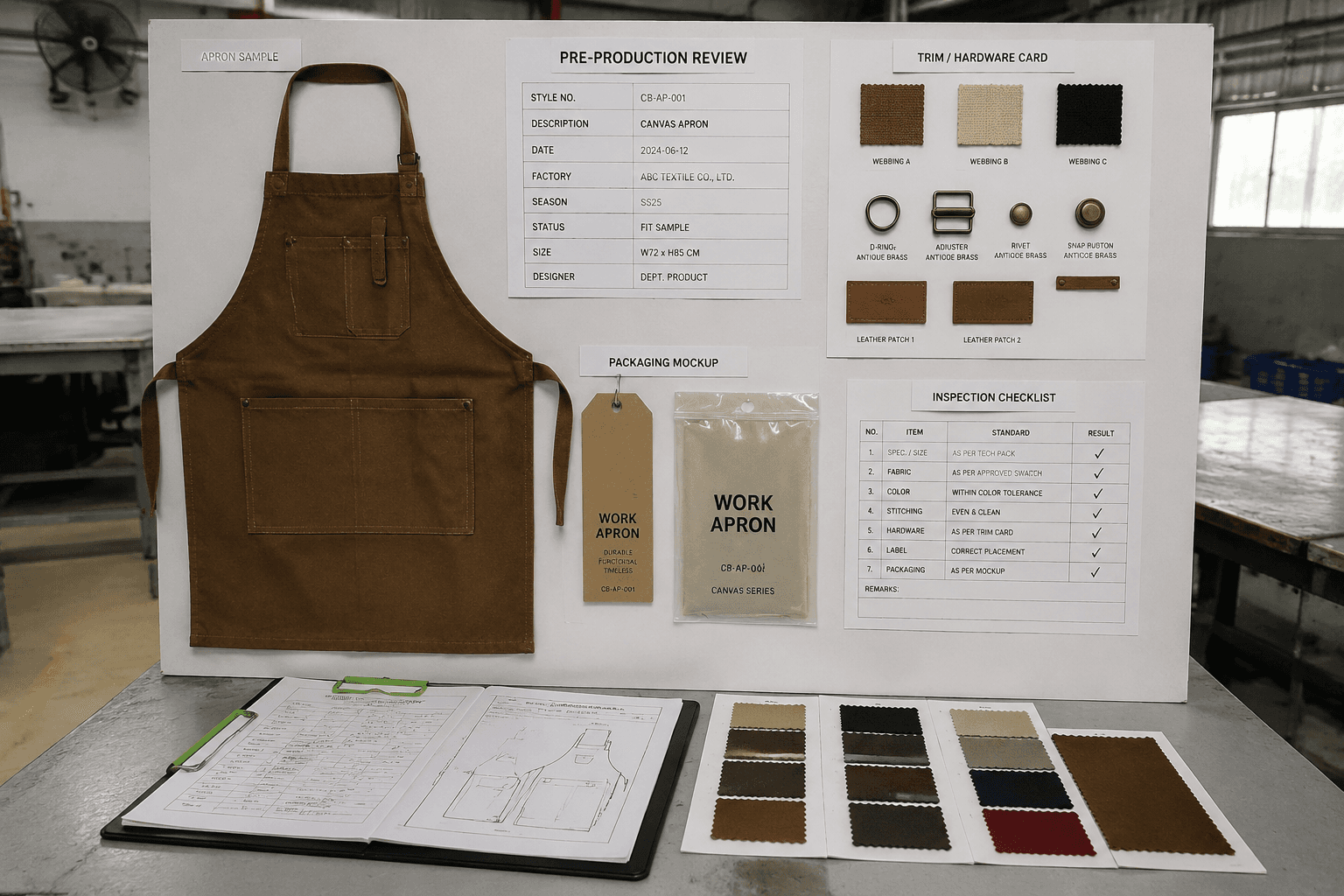
A practical apron trim substitution matrix should list each component by exact size, base material, finish, installation method, nominated supplier, MOQ, normal lead time, and approved alternate. For example, a 25 mm zinc-alloy slider in antique brass may have one stock alternate available in 7 days at $0.11 each and one made-to-order alternate available in 12 days at $0.14 each. The matrix should also record whether the alternate works on the same 32 mm webbing fold, the same press die, and the same carton assortment without relabeling.
For sourcing decisions, buyers should divide trims into three control categories. Category A is non-substitutable because the trim defines brand appearance, compliance, or signature styling. Category B is substitutable only within written limits such as finish family, supplier origin, or ±0.5 mm size tolerance. Category C covers standard function parts that may switch freely if fit, performance, and inspection level stay unchanged. This structure shortens decision time when a shortage appears in bulk.
- List each trim by size, finish, base material, and install method.
- Record MOQ, stock status, and replenishment days for each alternate.
- Classify trims as non-substitutable, limited substitution, or standard substitution.
- Confirm whether the alternate uses the same die-set, webbing width, and folding method.
Approval workflow and AQL controls for apron trim substitution
A disciplined factory starts trim risk review during sample development, not after PO release. During proto or salesman-sample review, the merchandiser should flag any trim with a lead time above 20 days, imported content, custom plating, or branding. If bulk sewing is planned for day 18 and the nominated trim needs 30 to 35 days from order confirmation, the order already requires a backup route. Waiting for the shortage to become visible usually means paying for recovery instead of preventing the problem.
The approval workflow should test four points: fit, appearance, processability, and durability. Fit means the trim works with the actual apron strap width, seam allowance, eyelet hole, or rivet post length. Appearance means the finish sits within tolerance against shell fabric, thread, label, and packaging presentation. Processability means operators can install the alternate at normal speed without bent posts, cracked plating, skipped snaps, or excessive rework. Durability means the trim survives real use, including repeated strap adjustment, 10 to 20 home-laundry cycles, and routine abrasion in hospitality or workshop settings.
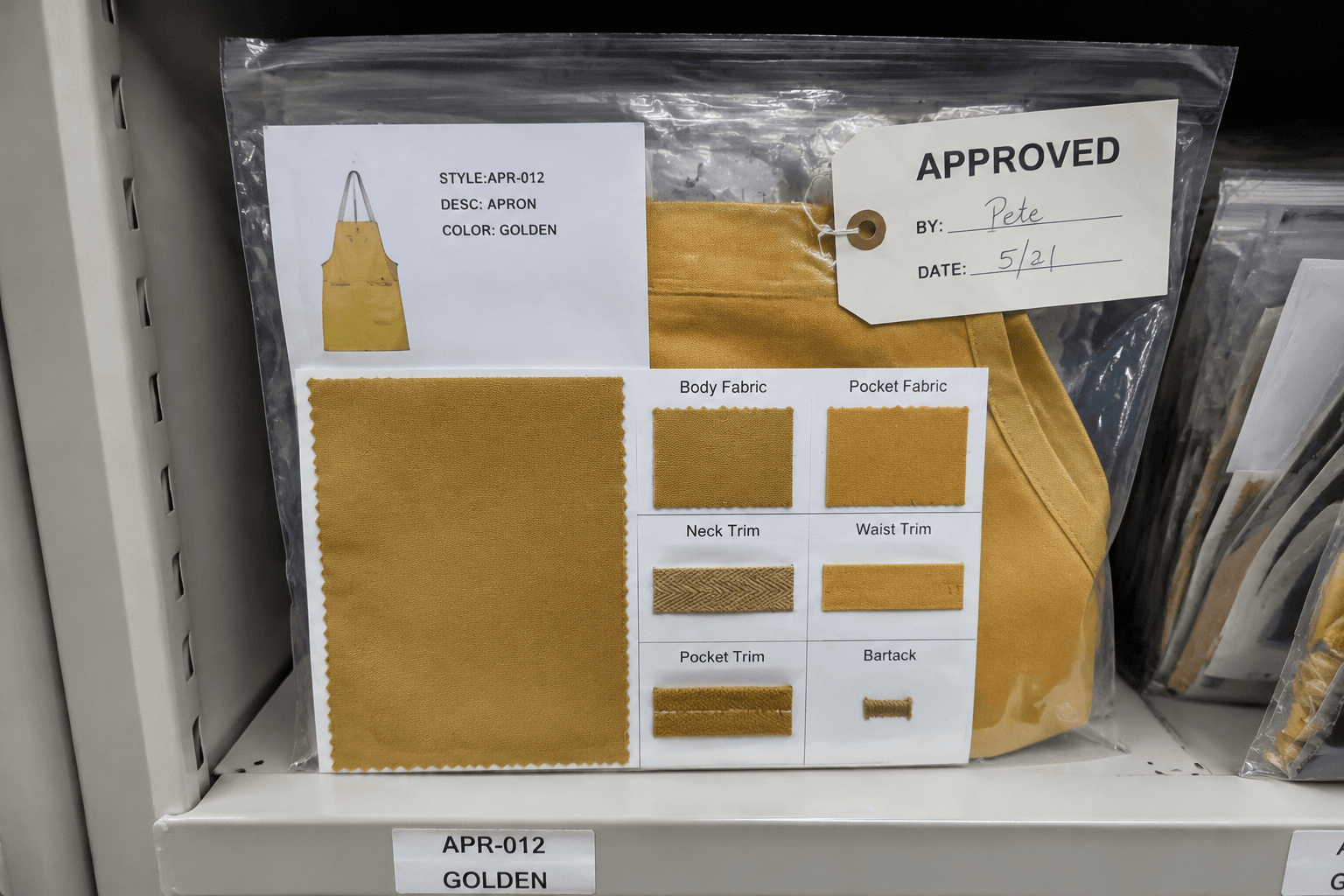
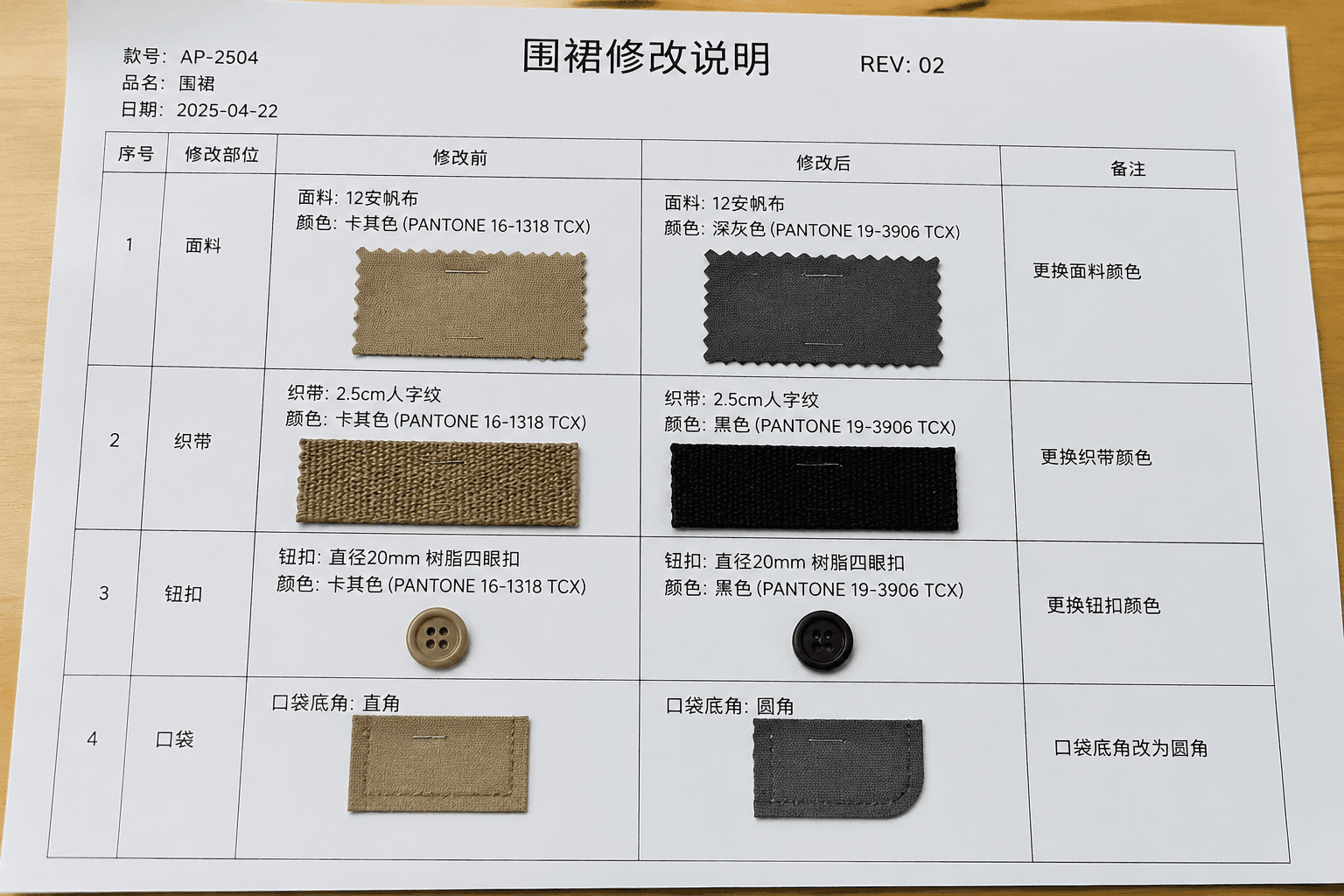
For most apron programs, a three-stage approval path is sufficient. First, approve nominated trims and ranked alternates during development. Second, confirm which alternates remain valid at PPS stage, usually 7 to 10 days before cutting. Third, require written buyer sign-off before any alternate enters bulk. The decision should appear in the tech pack, PO attachment, trim card, and production file so QA, merchandising, and sewing supervisors work to the same instruction.
Inspection criteria must remain unchanged when the trim changes. If the order is set to AQL 2.5 major and AQL 4.0 minor, the substitute trim should be checked to the same level, with defect focus on plating marks, burrs, snap release weakness, rivet looseness, shade inconsistency, and installation security. Substitution is controlled only when the quality bar stays fixed.
- Flag trims above 20-day lead time during sample review.
- Freeze valid alternates before PPS and before bulk cutting.
- Require buyer approval in writing before bulk use of an alternate.
- Inspect substitute trims to the same AQL and defect criteria as the original.
Cost, MOQ, and lead-time numbers buyers should request from apron factories
Professional buyers should ask for numbers, not reassurance. When a factory proposes a substitute trim, it should provide the trim MOQ, current stock, replenishment lead time, unit price, and cost delta per apron. A common pattern is simple: the nominated imported trim has a 30- to 45-day lead time and a lower nominal price, while a domestic alternate ships in 5 to 10 days but adds $0.05 to $0.16 per apron. The real comparison is not trim price alone; it is trim price against total delay cost.
Consider a 10,000-piece bib apron order quoted at $3.80 FOB per piece. If a replacement slider adds $0.07 per apron, the trim substitution cost is $700. If the buyer refuses the alternate and the order misses its vessel by 7 days, the added cost may include warehouse handling, split inspection, revised trucking, overtime finishing, and partial air freight for launch cartons. Even a modest recovery plan can exceed $1,800 to $3,200 before retailer penalties or stock-out losses are counted.
MOQ also changes the commercial answer. A standard domestic buckle may be available from stock or with a 5,000-piece MOQ, while a nominated custom-plated version may require 10,000 or 20,000 pieces. For repeat apron programs, it is often smarter to standardize a stable hardware platform across seasons than to chase a slightly cheaper but less reliable trim. That reduces emergency purchasing, short-lot plating, and line instability on replenishment orders.
Factories that manage this well usually hold safety stock on fast-moving trims. Keeping 20,000 to 50,000 pieces of common black sliders, nickel snaps, or standard D-rings is inexpensive compared with the cost of an idle line. Buyers should ask whether that stock is reserved for repeat customers, how quickly it turns, and whether it is dedicated inventory or shared across all open POs.
- Request exact MOQ, stock quantity, and replenishment days for each alternate.
- Compare the cost delta against delay cost, not against trim price only.
- Review whether repeat apron styles should standardize core hardware.
- Ask if safety stock is dedicated to your program or shared inventory.
Where apron trim substitution fails: finish match, wash performance, and wear
Most trim substitution failures on aprons start with finish and wear, not with basic size. A matte antique brass slider, a shiny antique brass slider, and a dark brass slider may all fit the same 25 mm strap, but they do not present the same way on a natural 10 oz canvas apron or a black 7.5 oz poly-cotton bib apron. If production is split across cartons or dates, visible finish variation quickly becomes a claim issue even when the garment remains functional.
Wash performance is the next failure point. Aprons used in restaurants, cafés, bakeries, workshops, floristry, and retail promotions face moisture, detergent, oil, and repeated handling. If the nominated trim has passed 20 home-laundry cycles or basic corrosion screening such as a 24-hour salt-spray benchmark, the alternate should show comparable internal results. A cheaper plated part may spot, chip, or dull after 5 to 10 washes, which creates complaints long after the shipment has cleared inspection.
Mechanical wear matters just as much. Burrs on a buckle edge can cut cotton tape. A weak spring in a snap can release after repeated use. A rivet with incorrect post length may feel secure at packing but loosen after several days on the wearer. On commercial apron programs, buyers should expect a short comparison record covering dimensions, finish, pull resistance, wash result, and installation stability. Without that record, the approval decision is based on appearance only.
When uncertainty remains, the factory should test the alternate on the actual apron build. A loose trim sample on a desk proves little. A sewn panel using the real shell fabric, webbing, stitch density, and wash treatment gives a better reading on finish match, operator handling, and durability.
- Finish mismatch creates complaints faster than small dimension differences.
- Ask for internal wash and corrosion evidence before approving a substitute.
- Check burr control, snap retention, and rivet security on sewn samples.
- Approve trims on actual apron construction, not as loose components only.
Case example: 12,000-piece café bib apron program with a late slider
A 12,000-piece café bib apron order shows how a controlled process works. The style used 9 oz enzyme-washed cotton canvas, 25 mm cotton webbing at the neck, one antique brass slider, and two lower rivets per piece. The nominated imported slider hit a plating issue at the sub-supplier, moving confirmed readiness from day 14 to day 24. Bulk cutting had started, and four sewing lines were reserved from day 18 with a planned daily output of about 2,000 to 2,400 aprons.
Because the buyer had approved two alternates during sampling, the factory could respond immediately. Alternate A was a domestic stock slider in antique brass at $0.12 each with 6-day availability. Alternate B was a darker brass tone at $0.10 each with 4-day availability. Both met the 25 mm requirement, worked on the same folded webbing construction, and passed the same 15 kg pull test as the nominated trim. The buyer selected Alternate A because its finish aligned more closely with the approved PPS sample.
The cost increase remained controlled. At one slider per apron, the substitution added about $0.07 per piece, or $840 total. Waiting for the original trim would likely have delayed shipment by 9 to 11 days and forced either a split shipment or expedited freight for launch cartons. By using the approved substitute, the order shipped only 2 days behind target, inline defect rate stayed within tolerance, and final inspection still passed at AQL 2.5 major and AQL 4.0 minor.
This outcome was not luck. It came from approving ranked alternates before bulk, setting a cost threshold in advance, and defining who could authorize apron trim substitution once the nominated trim failed its delivery date.
- Order size was 12,000 pieces across four reserved sewing lines.
- The original slider delay was 10 days due to plating nonconformance.
- The approved alternate added about $840 total, or $0.07 per apron.
- Shipment delay was reduced from a likely 9 to 11 days to 2 days.
Buying rules that keep apron sourcing changes controlled
For professional apron buyers, the safest approach is procedural and narrow. Treat critical buckles, snaps, sliders, rivets, eyelets, and D-rings the same way you treat critical fabric, labels, or packaging. If a hardware item can stop production or change retail appearance, require a documented backup before the PO is released. The factory should be able to state stock status, MOQ, unit-cost change, and lead time in days for every serious alternate.
The most useful discipline is a latest decision date. On a typical 30- to 40-day apron production calendar, alternates should usually be frozen 5 to 7 days before bulk cutting and no later than 10 to 12 days before planned packing. After that point, any unresolved trim becomes a direct schedule threat. Buyers should also state which changes may be approved by clear photo, which require a couriered sample, and which are prohibited entirely because of branding or compliance.
Finally, keep specifications exact. Avoid phrases such as similar hardware acceptable. Instead, define width, finish family, load requirement, corrosion expectation, allowed supplier range, and inspection level. That keeps sourcing, production, and QA aligned. When handled this way, apron trim substitution is not a loose compromise; it is a controlled sourcing tool that protects ship date, quality consistency, and cost on repeat apron programs.
- Require backup trims before PO release for any critical hardware item.
- Freeze approved alternates 5 to 7 days before cutting whenever possible.
- Define whether approval may be by photo, physical sample, or not allowed.
- Write exact size, finish, load, and quality tolerances into the tech pack.