For uniform and procurement teams, the most expensive mistake in hotel housekeeping utility aprons is usually poor compartment planning rather than weak shell fabric. A room attendant may carry a handheld radio, a 180-320 g key set, 2-3 pens, gloves, microfiber cloths, a room checklist and one or two 50-100 ml refill bottles through an 8-10 hour shift. If those items share oversized front pockets, the apron twists at the waist, rigid edges print through the front, and failure starts at pocket corners, loop seams or tie joins long before the body panel wears out.
A workable sourcing brief begins with one operational rule: what stays on the housekeeping cart, and what must stay on the apron in every guest room? That answer determines finished width, pocket depth, opening size, reinforcement layers, bartack count, waistband build and target fabric weight. In OEM production, each of those choices affects sewing minutes, carton density, wash recovery, replacement frequency and landed cost per piece.
The objective is not to maximize pocket count. It is to create hotel housekeeping utility aprons with controlled load placement, fast one-hand retrieval and predictable wear life over a 12-24 month replacement cycle. The best B2B programs balance comfort, laundry durability and replenishment cost, then lock those decisions into a repeatable specification that factories can sample and scale without drift.
- Separate hard-load and soft-load zones so radios and keys do not abrade the same pocket used for gloves, cloths or paperwork.
- Most hotel housekeeping utility aprons work best with 4-5 compartments, including one vertical radio zone and one secured key position.
- For daily hotel use, 210-240 GSM poly-cotton twill is the baseline; 230-270 GSM suits heavier radio-and-key programs better than sub-190 GSM shells.
- Reinforcement usually adds only $0.08-0.22/pc in sewing cost when specified early, but it can materially reduce early returns and replacement orders.
- Commercially efficient MOQ is usually 500-1,000 pcs per style-color, with repeat-order production commonly shipping in 25-35 days.
- Approve against measurable standards: exact pocket dimensions, shrinkage under 3%, stress-point seam security and final inspection at AQL 2.5 major / 4.0 minor.
Why hotel housekeeping utility aprons fail when pockets are planned for appearance instead of shift load
Many housekeeping aprons are approved from a flat sketch or fitting sample that looks balanced but does not behave well in live hotel use. A two-pocket front layout may appear neat, yet once a radio, key set and refill tools are added, the apron starts to swing forward during bed stripping, bathroom cleaning and cart pushing. The result is concentrated strain at the pocket mouth, upper corner and side tie attachment rather than across the full front panel.
The core sourcing mistake is treating all carried items as equal. In practice, housekeeping tools fall into three different groups. Heavy rigid items include handheld radios and metal key bundles. Medium rigid items include pens, markers, note cards and mini bottles. Soft-load items include gloves, cloths and sachets. If these categories are mixed in one catch-all pocket, retrieval slows down and abrasion increases with every shift.
For B2B buyers, the cheapest correction is usually not a heavier full-shell fabric. It is better load zoning. A 220 GSM twill apron with reinforced stress areas often outlasts a 280 GSM apron with poor pocket planning, because the weak point in service is normally the compartment structure, not the center body panel.
- Place items above 250 g in a dedicated reinforced compartment or looped attachment zone.
- Keep the heaviest load slightly off center front so the apron does not pitch forward during bending.
- Require bartacks at pocket corners, tie joins and key-loop attachments as standard, not optional.
- Test samples while walking, kneeling and reaching; standing fit alone does not reveal bounce or swing.
Compartment planning for hotel housekeeping utility aprons carrying radios, keys and refill tools
A practical layout for hotel housekeeping utility aprons usually includes one vertical radio compartment, one secured key position, one narrow pen slot and one or two larger pockets for soft consumables or small refill items. This structure keeps rigid tools upright and separated. It also cuts search time. If retrieval is delayed by even 4-6 seconds per room across a 16-room assignment, the accumulated time loss becomes meaningful at department scale.
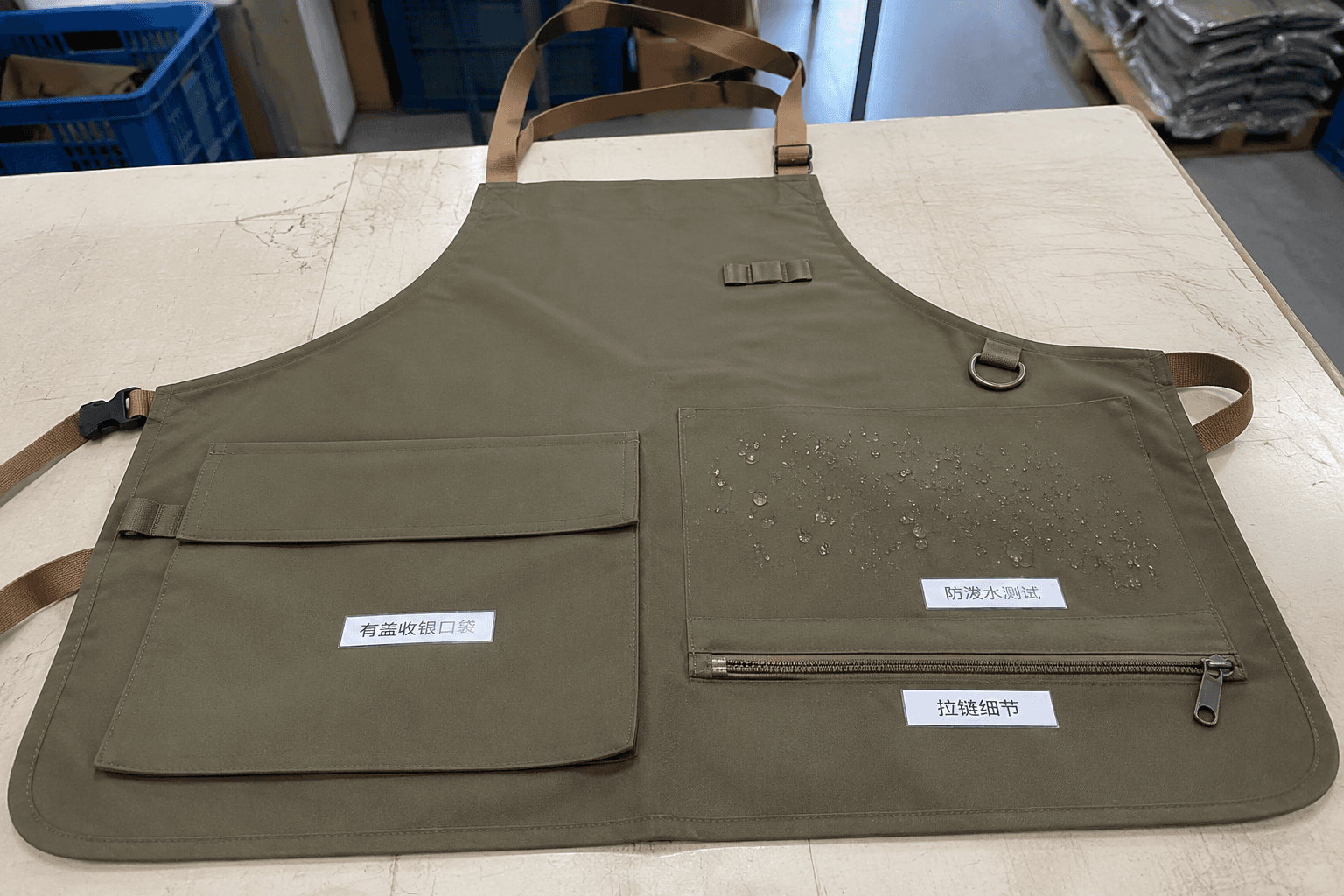
Radio sizing should follow the actual device, but a useful working range for most hotel handhelds is 6.5-8.5 cm pocket width with 13-16 cm depth. That is enough to stabilize the lower body while allowing the antenna and top controls to remain accessible. If the radio clips externally, the shell behind the clip point still needs a backing layer; otherwise fabric distortion appears quickly after repeated loading and laundering.
Keys should not be dropped loose into an open front pocket. A 180-320 g key set will abrade fabric, create noise and strike the thigh when the wearer moves quickly. A sewn tape loop, short webbing tab with D-ring, or semi-enclosed key sleeve fixed near the side front usually gives better control. Pens are best in a closed-bottom channel 2.5-3.5 cm wide so they stay vertical. Gloves and cloths need wider openings, typically 16-20 cm, to support one-hand access. Small bottles should sit in their own compartment with backing if the program carries 50-100 ml refills daily.
- Radio pocket: 6.5-8.5 cm wide, 13-16 cm deep for common hotel handsets.
- Key solution: side-front loop, D-ring tab or enclosed sleeve instead of loose storage.
- Pen slot: 2.5-3.5 cm wide with a closed lower end for upright retention.
- Consumables pocket: 16-20 cm opening width for gloves, cloths or amenity sachets.
- Bottle zone: double fabric or backing layer for repeated carry of 50-100 ml refills.
Fabric and reinforcement specs that hold pocket shape without overbuilding the apron
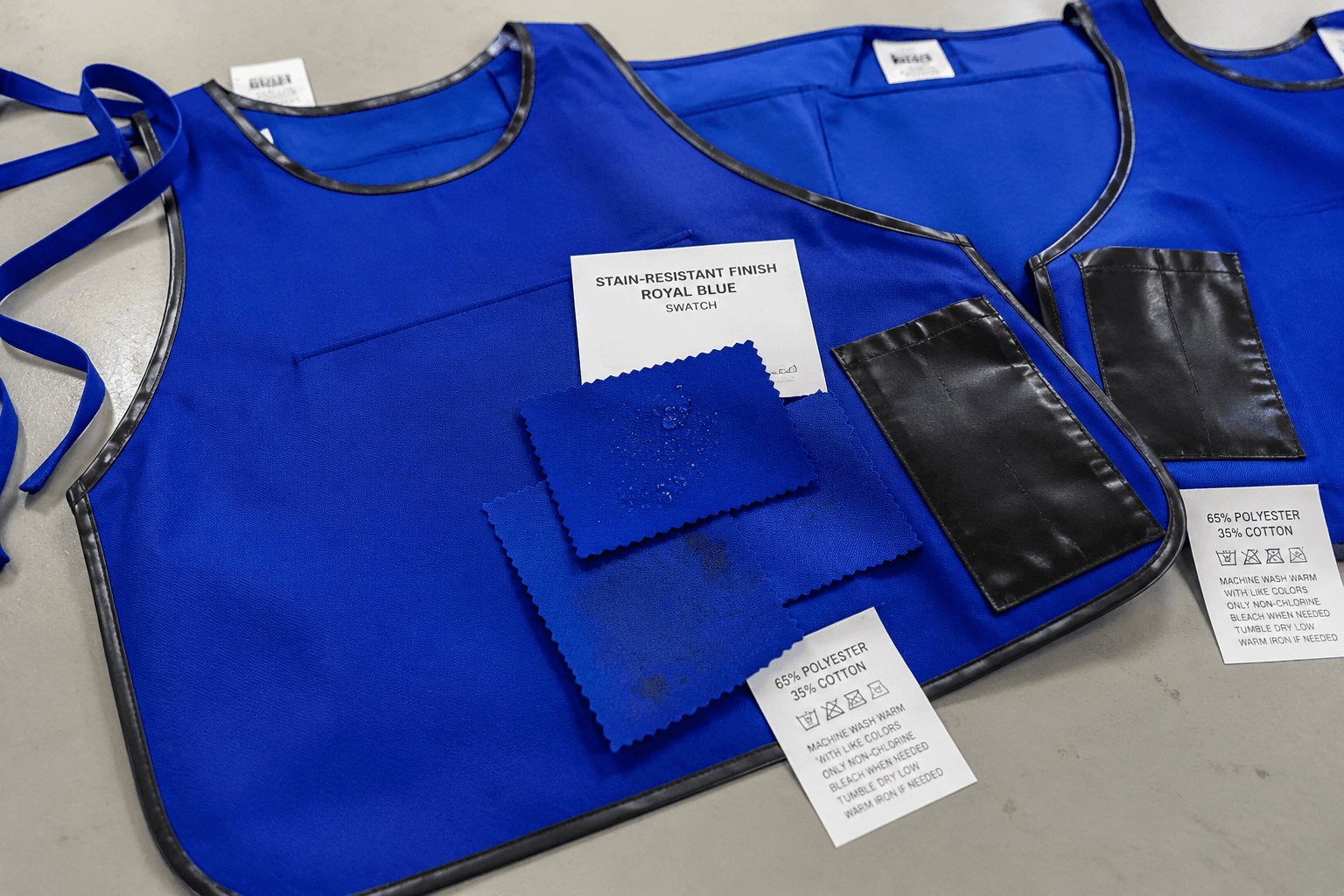
For most hotel housekeeping programs, 210-240 GSM poly-cotton twill is the safest starting point. It has enough body to support shaped pockets, dries faster than heavy canvas and remains comfortable across long shifts in warm back-of-house conditions. Common blends are 65/35 polyester-cotton for a more balanced hand and 80/20 for faster drying, easier care and lower wrinkle visibility after laundry.
When the apron must carry a radio, keys and refill bottles every day, moving up to 230-270 GSM is usually more effective than staying at 190-200 GSM. Below 190 GSM, loaded compartments often collapse, tilt outward or show early edge distortion. Above roughly 300 GSM, the benefit usually drops off for housekeeping use because the apron becomes stiffer at the waist, slower to dry and bulkier where pocket layers overlap.
Fabric weight alone is not enough. Buyers should specify reinforcement by zone. A second shell layer or pocket backing behind the radio area, pocket-mouth turn-backs, bartacked corners and reinforced tie joins normally extend service life more efficiently than increasing the weight of every panel. Performance requirements should also include shrinkage under 3%, acceptable color retention through at least 30-50 industrial wash cycles, and a clean visual face with limited pilling on dark shades such as black, charcoal or navy.
- Baseline shell: 210-240 GSM poly-cotton twill for most room-attendant programs.
- Heavy-use shell: 230-270 GSM when radios, keys and bottles are carried daily.
- Avoid light shells below 190 GSM for any loaded-pocket housekeeping apron.
- Set shrinkage at <3% and confirm wash appearance to at least 30-50 cycles.
Construction details that lower replacement cost on housekeeping apron programs
Pocket layout determines function, but construction detail determines replacement rate. A four-compartment apron with turned pocket edges, double-needle joins, reinforced radio backing and clean bartack placement usually outperforms a more complicated style with unsupported openings. For procurement teams managing replenishment across multiple properties, a few cents spent on structure can prevent months of avoidable replacement demand.
Waistband construction is a common weak point when the apron carries tools. Self-fabric ties are acceptable on medium-load styles, but higher-load programs perform better with a wider waistband, firmer interlining or webbing-supported tie attachment. Typical finished tie lengths run 75-90 cm per side, while waistband width commonly falls in the 3-4 cm range. Those numbers should still be checked against wearer size range and whether the apron sits over a tunic, dress or trousers.
Branding should stay secondary to access. Dense embroidery placed near a radio opening can reduce flexibility. Heavy piping at the pocket mouth can obstruct one-hand entry. Decorative trims that look acceptable on a showroom sample may complicate repairs, slow sewing throughput or reduce usable pocket volume. For professional B2B sourcing, appearance should support the apron function rather than compete with it.
- Require bartacks at every pocket corner, tie attachment and key-loop seam.
- Use double-layer backing behind the radio zone instead of upgrading the entire shell unnecessarily.
- Confirm tie length and waistband width on the PP sample with actual uniforms underneath.
- Keep embroidery, binding and trims clear of high-load compartment openings.
MOQ, target cost and lead-time ranges for custom hotel housekeeping utility aprons
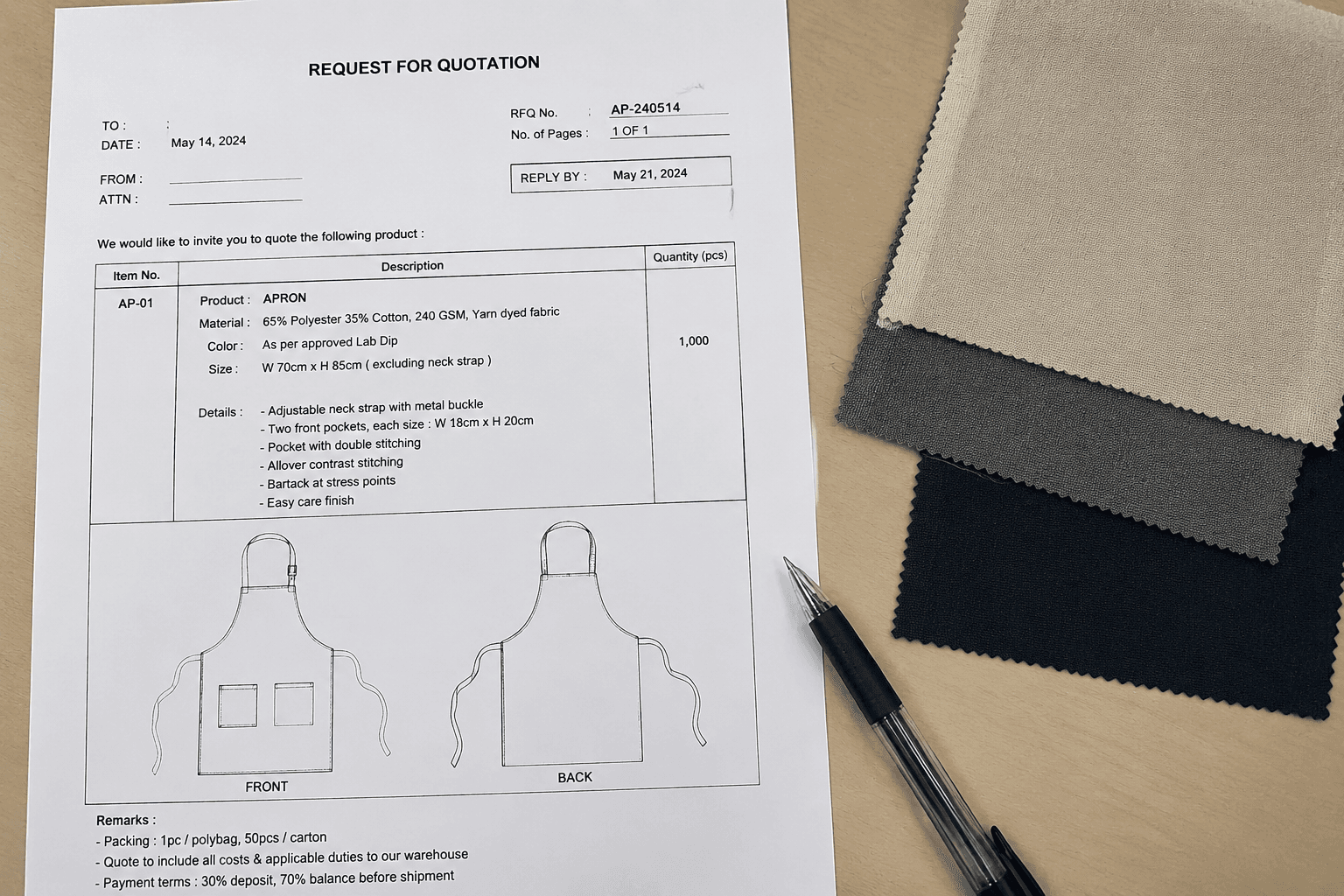
In bulk apron sourcing, the main cost drivers are shell fabric, number of operations, reinforcement details, trim count and logo application. A basic waist apron in 210-220 GSM poly-cotton twill with three functional compartments and standard self ties often prices around $2.40-3.10/pc at workable volume. Add a reinforced radio compartment, key hardware, extra backing, woven branding and individual packing, and the normal range moves to about $3.30-4.80/pc. Programs with embroidery, custom-dyed fabric or complex multi-color trim can exceed $5.00/pc.
MOQ depends largely on whether the program uses stock fabric or custom materials. Factories may accept trial orders at 300 pcs per color in stock twill, but unit cost is less efficient because pattern setup, line balancing and quality control are spread over fewer pieces. For most buyers, the stable commercial range is 500-1,000 pcs per style-color. That volume usually improves material utilization, operator efficiency and replenishment pricing.
Lead time should be broken down by stage. A first prototype normally needs 5-7 days after a complete tech pack is received. A revised pre-production sample often takes another 5-7 days. After approval, bulk fabric booking, cutting, sewing, finishing and packing commonly require 20-30 days. In practice, repeat orders of established hotel housekeeping utility aprons often ship in 25-35 days, while new developments with pocket revisions or custom trims usually take 30-40 days.
- Trial MOQ: around 300 pcs/color for stock-fabric styles.
- Efficient MOQ: 500-1,000 pcs per style-color for stronger pricing and line efficiency.
- Typical custom price band: $2.40-4.80/pc depending on reinforcement and branding.
- Repeat-order lead time: commonly 25-35 days after approvals are closed.
Inspection and wear-test standards before approving bulk housekeeping aprons
Sampling improves quickly when buyers provide real carry data instead of descriptive labels. A factory can build a better first sample when it receives the radio model, approximate handset dimensions, key-bundle weight, refill bottle size and expected carry count per shift. Saying 'walkie-talkie' or 'master keys' leaves too much room for pattern error. A radio that is 15 cm tall and 5.5 cm deep requires a different opening and reinforcement choice than a smaller unit, even if both seem similar at briefing stage.
Wear habits also matter. Left-side or right-side access changes pocket placement. An apron worn over a housekeeping tunic needs a different width feel than one worn over slim trousers. Laundry conditions matter as well. In-house washing, outsourced industrial laundry and high-alkali chemistry each influence blend choice, shrinkage allowance and trim durability. These details should be fixed before PP approval, not discovered after bulk shipment.
Before production is released, the buyer should run a loaded motion test with actual attendants and actual tools. The test should include bed stripping, reaching into a tub or shower area, lifting linen, opening doors and pushing a loaded cart for at least 20-30 minutes. This is where key noise, radio tilt, pocket bounce or slow retrieval becomes visible. Final inspection should follow a defined standard such as AQL 2.5 major / 4.0 minor, supported by measurement checks, stitching review, shade consistency and carton verification.
- Provide actual tool dimensions, weights and carry quantities at sampling stage.
- State dominant left- or right-side access for radio, keys and pens before patterning.
- Run a loaded wear test for at least 20-30 minutes using real shift motions.
- Approve shipment only after inspection to AQL 2.5 major / 4.0 minor.
A standard specification buyers can scale across multi-property hotel apron programs
For many midscale, upscale and long-stay hotel groups, a disciplined standard specification is enough to cover most room-attendant needs. A waist or short-bib utility apron in 210-240 GSM poly-cotton twill with 4-5 compartments is usually the most balanced format. That layout should include one reinforced radio zone, one secured key position, one writing-tool slot and one or two larger pockets for gloves, cloths or small refills. It delivers function without adding unnecessary sewing complexity or front-panel bulk.
Standardization improves sourcing economics. When several properties share one base pattern, buyers can consolidate MOQ, stabilize fit, simplify replenishment and hold safety stock more efficiently. Branding, color accents or woven labels can vary by property while the functional structure stays consistent. This approach is especially useful when replacement orders are placed quarterly or twice per year.
The key is to standardize only what supports the operation. Resort housekeeping teams may carry different refill items than city-center hotels. Luxury properties may require cleaner front presentation with lower visible bulking. Even so, the sourcing discipline remains the same: define the real carry set, match the GSM to the load, reinforce the stress points and approve only what works in movement. That is how professional buyers turn housekeeping aprons into a repeatable, cost-controlled category instead of a constant replacement issue.
- Suggested shell: 210-240 GSM for general use, 230-270 GSM for heavier daily carry.
- Suggested layout: 4-5 compartments with one radio zone and one secured key position.
- Suggested service target: 12-24 months depending on wash frequency and issue rate.
- Suggested replenishment model: one stable base pattern with limited logo or color changes by property.