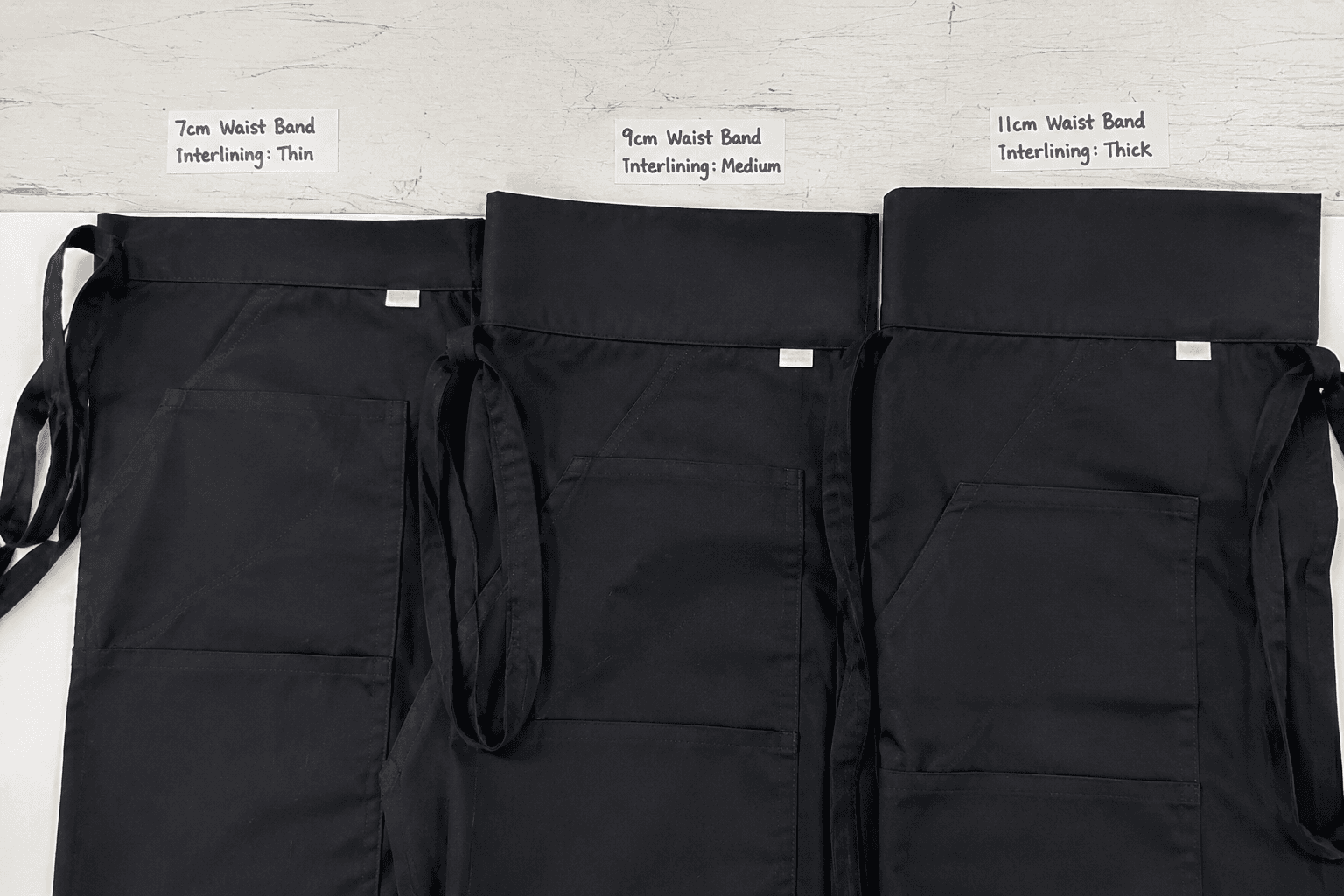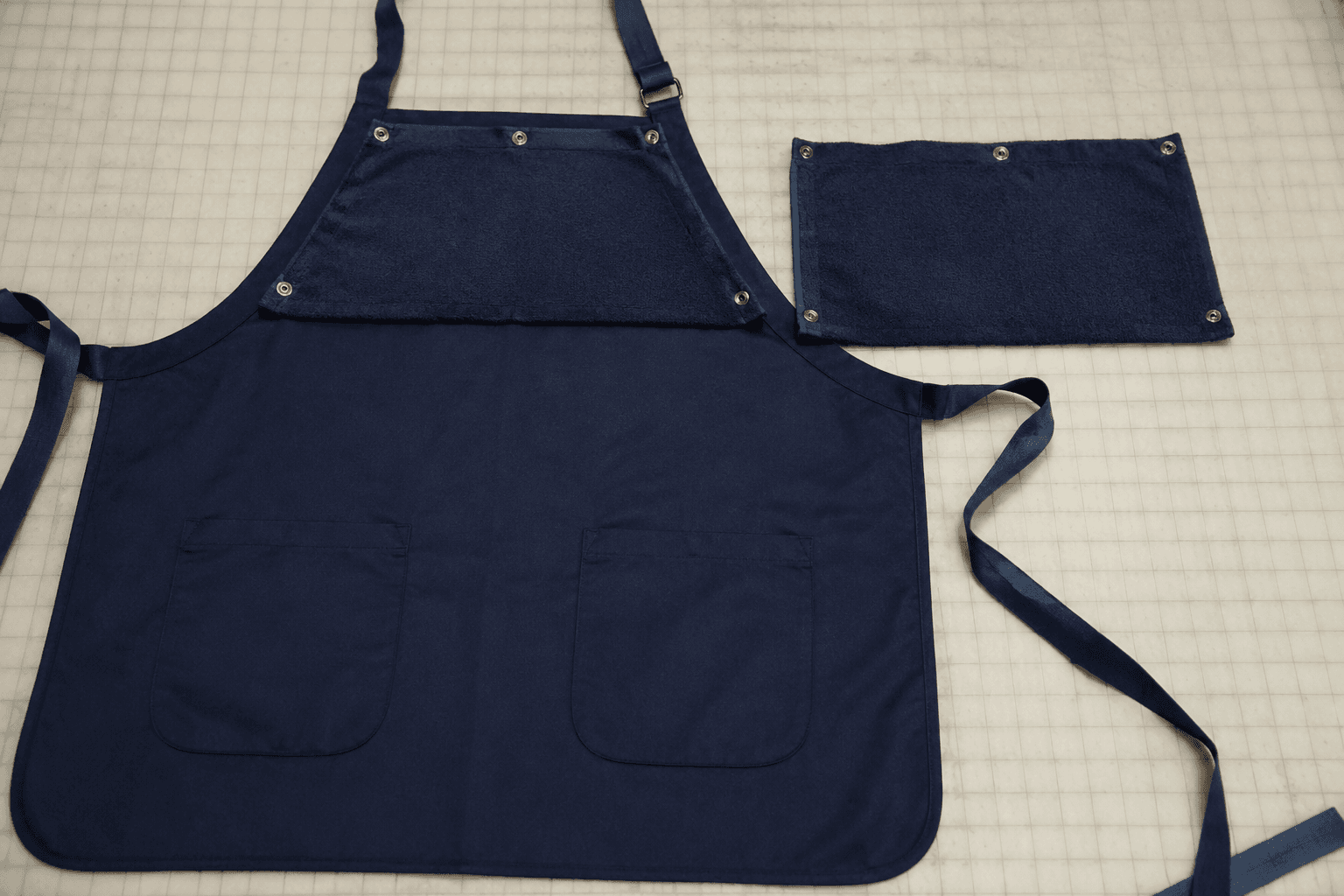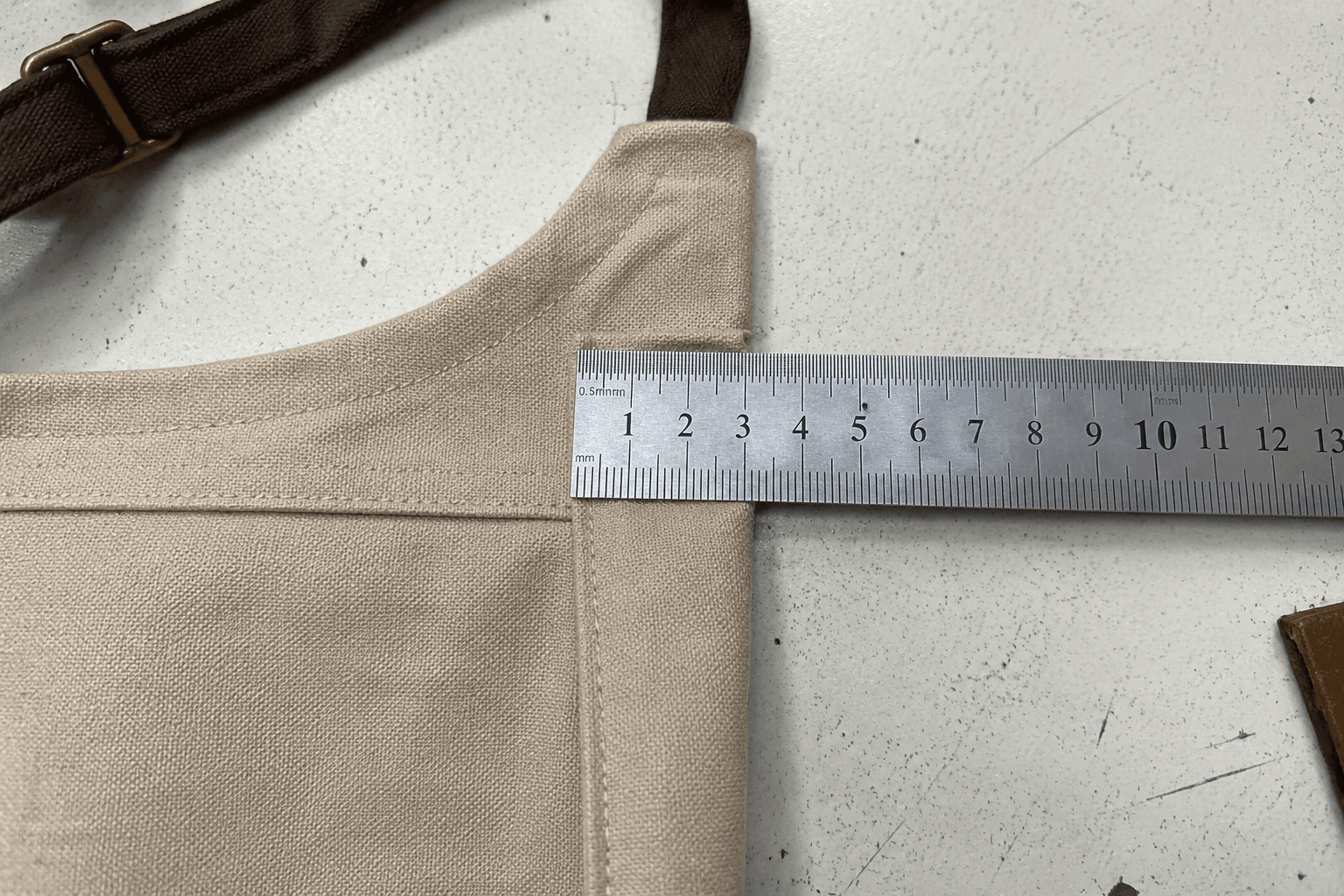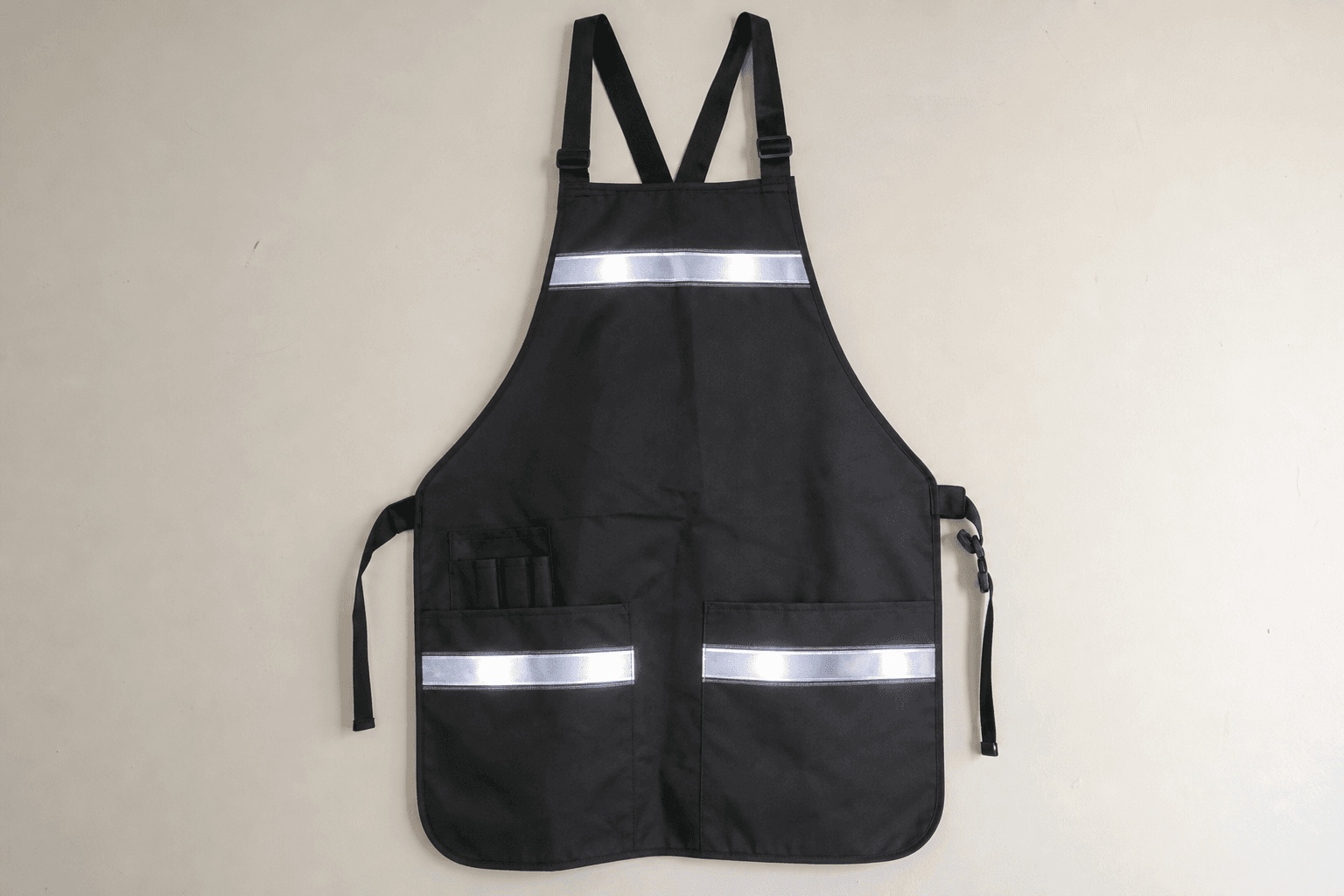
A hi vis apron is not simply a bright version of a standard work apron. For bulk sourcing, the buyer has to define visibility level, fabric base, trim width, placement, print method, wash life and packaging before the factory can quote with confidence. Small changes, such as moving reflective tape away from a pocket seam or changing from 190 gsm polyester to 240 gsm poly-cotton, can affect unit price, lead time and inspection criteria.
At factory level, we see high visibility apron programs used for food service back-of-house teams, event crews, warehouse staff, mobile technicians, cleaning contractors, trade shows, road-adjacent hospitality and safety campaign merchandise. These buyers often want the apron to look branded, not like a generic safety vest. That is achievable, but the development process must respect the technical limits of reflective tape, fluorescent fabric dyes, heat transfer logos and industrial laundering.
This article explains the practical sourcing decisions behind a reflective apron program: suitable fabrics, reflective trim options, color and logo choices, compliance references, cost drivers, MOQ, sampling and production timelines. The goal is to help sourcing managers write a usable specification and avoid surprises after the first sample.
- Specify the apron use environment first, because warehouse, food service and outdoor roadside use do not need the same fabric or trim construction.
- Reflective trim width and placement drive both visibility and cost, with 25 mm, 50 mm and segmented heat-transfer tape behaving differently in production.
- Fluorescent fabric color must be tested against wash and rubbing standards, especially when the apron will be rented, laundered or used outdoors.
- Logo method should be chosen after fabric and trim are fixed, because screen print, embroidery and heat transfer react differently near reflective tape.
- A realistic China bulk timeline is usually 7-10 days for sampling and 25-40 days for production, depending on fabric stock, trim availability and artwork approvals.
Where a hi vis apron fits in safety branding
A hi vis apron sits between uniform, PPE accessory and branded workwear. It normally does not replace certified high-visibility garments required for road work or regulated industrial tasks, unless the full garment design is tested and certified to the relevant standard. For many buyers, the purpose is more specific: make staff easier to identify in busy environments while keeping the practical utility of pockets, coverage and wipeable front panels.
Common end uses include supermarket loading areas, commercial kitchens with delivery doors, warehouse picking, event catering, parking attendants, cleaning teams, factory visitor programs and promotional safety campaigns. In these settings, the apron may be worn over a polo shirt, chef coat, hoodie or jacket. That layering affects fit. A 70 cm wide bib apron that works over a T-shirt may feel tight over winter outerwear, while a 90 cm waist apron can interfere with tools or trolleys if the ties are too long.
For sourcing, the first question is whether the buyer needs visibility-inspired branding or a truly performance-oriented safety apron. The first can use bright fabric and reflective-look trim with normal garment testing. The second needs defined reflective performance, fluorescent colorfastness, wash-cycle claims and possibly third-party testing. These two routes can look similar in photos, but their cost and documentation are different.
- Use a bright branded apron when the priority is staff identification in moderate-risk indoor areas.
- Use a reflective apron with specified tape when workers are seen under vehicle headlights, low light or warehouse lighting transitions.
- Use a certified high visibility apron only when the buyer requires documented compliance and accepts the added testing cost and longer lead time.
- Confirm whether the apron is worn alone, over a uniform or over outerwear before approving the size chart.
Fabric choices for a durable hi vis apron
Most hi vis apron programs use polyester or polyester-rich fabric because fluorescent colors are easier to maintain, shrinkage is lower and the surface accepts reflective trim consistently. A common economy option is 150-190 gsm 100% polyester twill or plain weave. It is light, quick drying and suitable for event staff or promotional programs, but it can feel thin for heavy daily use. For regular workwear, 220-260 gsm polyester-cotton twill gives better hand feel and seam strength, though fluorescent color brightness may be less intense than on full polyester.
For food service and cleaning, buyers often ask for a wipeable safety apron. In that case, 210D or 300D polyester Oxford with PU coating is practical, with a finished weight around 180-240 gsm depending on coating thickness. It resists splashes and can be wiped between shifts, but it is less breathable than twill and may crease around the bib. PVC coating can be cheaper and more waterproof, but it is heavier, less flexible in cold conditions and not always acceptable for brands with restricted substance policies.
Cotton canvas in fluorescent color is possible but rarely ideal for high visibility apron sourcing. Cotton absorbs dye differently, fades faster, shrinks more and usually needs reactive dyeing at custom MOQ. If a buyer wants a workwear fashion look, a 280-320 gsm cotton canvas in safety yellow or orange can be developed, but it should be treated as a branded apron rather than a performance reflective apron unless testing proves otherwise.
- 150-190 gsm polyester is suitable for short-term events, visitor aprons and lower-cost safety branding.
- 220-260 gsm polyester-cotton twill is a balanced option for daily staff uniforms with better comfort and durability.
- 180-240 gsm coated polyester Oxford is suitable where wipe-clean performance is more important than breathability.
- 280-320 gsm cotton canvas gives a workwear look, but colorfastness and shrinkage require more careful control.
Reflective apron trim: tape type, width and placement
Reflective tape is the main cost and quality variable in a reflective apron. The most common choices are glass-bead reflective tape, microprismatic tape and segmented heat-transfer reflective tape. Glass-bead sew-on tape is widely used, flexible and cost-effective. Microprismatic tape can give stronger reflectivity but is stiffer and less suitable for areas that bend sharply, such as waist ties. Segmented heat-transfer tape gives a modern look and better flexibility, but it requires stable heat press conditions and compatible fabric.
Width is usually 25 mm or 50 mm. A 25 mm reflective trim apron looks cleaner and costs less, but a 50 mm tape is more visible and aligns better with safety garment conventions. On aprons, tape is often placed vertically on the bib, horizontally near the lower body, or around pocket openings. The factory should avoid placing reflective tape directly across thick seam intersections where skipped stitches, wrinkling or tape lifting can occur.
Trim placement also changes production efficiency. Two vertical strips on the bib are faster than complex angled trim around a curved pocket. A simple full-width horizontal tape across the lower apron can be economical, but it may be interrupted by center splits or large patch pockets. For heat-transfer segmented tape, the cutting and pressing process must be separated from sewing flow, so the production line needs a clear operation sheet.
- 25 mm sew-on reflective tape is economical and suitable for light visibility branding.
- 50 mm sew-on reflective tape is more visible and easier to justify for safety-oriented programs.
- Segmented heat-transfer tape improves flexibility but needs fabric compatibility testing before bulk approval.
- Avoid reflective tape across heavy pocket seams, waist tie joins and curved hems unless a sample has been tested.
- Keep left and right trim placement symmetrical, with a factory tolerance such as +/- 5 mm for bulk inspection.
Color, logo and brand execution on high visibility apron styles
Safety yellow and safety orange are the two strongest choices for a high visibility apron. Lime yellow is often preferred for warehouse, logistics and cleaning teams because it contrasts well with darker interiors. Orange is common for construction-adjacent, road-adjacent and industrial programs. Some buyers request fluorescent pink, green or red for campaigns, but these colors are usually brand-led and may not correspond to recognized high-visibility standards.
Logo placement must be planned around reflective trim. On bib aprons, the central chest area is the most visible, but it may be narrow if two vertical reflective strips are used. A 90-110 mm wide logo often fits between vertical tapes on a standard adult bib. Larger logos may need to move to the lower front panel, but pockets and tape can reduce the printable area. For waist aprons, logo visibility is usually best on the upper corner or pocket face, not close to the bottom hem where it is hidden by counters or equipment.
Screen printing is cost-effective for 1-3 color logos on polyester or poly-cotton, especially at 500 pcs and above. Heat transfer is cleaner for multi-color logos and smaller runs, but the transfer film must tolerate the intended wash process. Embroidery gives a premium workwear effect but is less common on thin fluorescent polyester and can pucker coated fabric. Reflective ink can be used for branding, but it should not be treated as a substitute for certified reflective tape unless tested.
- Use safety yellow or safety orange for the strongest visual signal and the most available fabric supply.
- Reserve at least 120 mm x 80 mm of clear space if a chest logo must sit between vertical reflective strips.
- Choose screen print for simple logos and larger runs where cost per piece matters.
- Choose heat transfer for multi-color logos, gradients or smaller order quantities.
- Avoid embroidery on thin 150 gsm polyester unless the factory adds backing and checks puckering on the pre-production sample.
Compliance references and realistic testing expectations
Buyers sometimes ask for EN ISO 20471 or ANSI/ISEA 107 compliance on an apron. These standards are written for high-visibility clothing systems with minimum areas of fluorescent background material and retroreflective material. A standard apron may not meet the area requirements because it does not cover the full torso or back, and it can be obscured by the body position. Therefore, a supplier should not casually claim certification for a hi vis apron unless the actual garment design has been assessed by a qualified lab.
That said, components can be tested. Reflective tape can be supplied with EN ISO 20471 or ANSI-compatible performance reports from the trim supplier. Fluorescent fabric can be checked for color coordinates, luminance factor, washing colorfastness, rubbing colorfastness and lightfastness. Finished aprons can be tested for dimensional stability, seam strength, tear strength, azo-free compliance, formaldehyde, pH value and nickel-free metal parts if buckles are used.
For many private-label apron orders, the most practical route is to specify component-level performance and garment-level durability rather than full PPE certification. For example: 50 mm glass-bead reflective tape with supplier test report, 240 gsm polyester-cotton fluorescent orange fabric, 20 domestic wash cycles at 40 C without tape delamination, colorfastness to washing grade 4, and seam strength above buyer requirement. This gives the purchasing team measurable acceptance criteria without overstating the product.
- Do not claim EN ISO 20471 or ANSI certification unless the finished apron design has been tested and certified.
- Request reflective tape reports from the trim supplier when visibility performance is important.
- Set a wash-cycle target, such as 10, 20 or 50 washes, before choosing tape and logo method.
- Test fluorescent fabric for colorfastness and rubbing if the apron will be worn daily.
- Include restricted substance requirements at quotation stage, not after bulk fabric has been purchased.
Cost structure, MOQ and lead time from a China apron factory
A simple promotional hi vis apron in 150-190 gsm polyester with one-color screen print may start around USD 1.20-2.00 per piece at 1,000-3,000 pcs, depending on size, pocket count and packaging. Adding 25 mm reflective tape can increase cost by roughly USD 0.20-0.60 per piece. A stronger 220-260 gsm poly-cotton safety apron with 50 mm reflective tape, two pockets and branded heat transfer is more likely to sit around USD 2.80-5.50 per piece at 1,000 pcs, depending on trim quality and print area.
MOQ depends on fabric and trim availability. If the factory can use stock fluorescent polyester and standard reflective tape, MOQ may be 300-500 pcs per color for a basic apron. Custom dyed fabric usually pushes MOQ to 800-1,500 meters, which can equal 1,500-4,000 aprons depending on style yield. Custom reflective trim with woven logo or special color backing may require 1,000-3,000 meters. For buyers testing a new program, it is often better to use stock color fabric first and customize logo, pocket layout and packaging.
Lead time is controlled by approvals. A normal development schedule is 3-5 days for pattern and first sample if stock materials are available, 5-7 days for logo sample, and 7-10 days total for a complete pre-production sample. Bulk production after approval is usually 20-30 days for 500-3,000 pcs. Add 5-10 days if fabric dyeing, special trim sourcing or third-party testing is required. Ocean shipping may take 25-40 days port-to-port, while air freight can be 3-7 days but may be expensive for coated or heavy aprons.
- Basic stock-material MOQ is often 300-500 pcs per color, subject to fabric and tape availability.
- Custom fabric dyeing can require 800-1,500 meters, so the effective MOQ may be much higher than the sewing MOQ.
- Sampling normally needs 7-10 days when logo, reflective tape and pocket layout are all included.
- Bulk sewing for 500-3,000 pcs usually needs 20-30 days after sample approval and deposit.
- Third-party testing can add 5-10 working days, especially when wash testing is included.
Quality control points for reflective trim apron production
Quality control for a reflective trim apron must check both normal garment construction and visibility-specific details. Standard apron checks include size tolerance, strap length, bartack position, pocket dimensions, stitching density, loose threads, fabric defects, shade consistency, print alignment and packaging accuracy. For reflective styles, inspectors also need to check tape straightness, tape width, distance from edge, reflective surface scratches, heat-transfer adhesion and tape continuity after washing if wash testing is part of the order.
The most common bulk defects are not dramatic; they are small and repetitive. Reflective tape may wave slightly if it is sewn with too much tension. Heat-transfer tape may lift at corners if pressure or dwell time is inconsistent. Fluorescent fabric panels may show shade variation when cut from different fabric lots. Logo transfers may look dull when pressed too close to reflective trim because operators reduce pressure to avoid damaging the tape. These issues can be controlled if they are written into the pre-production meeting notes and first-line inspection checklist.
For AQL inspection, many buyers use general inspection level II with AQL 2.5 for major defects and 4.0 for minor defects. However, for safety-facing orders, the buyer may define reflective tape detachment, wrong trim width, missing tape or incorrect fluorescent color as major defects. The factory should keep approved samples, trim cards, Pantone references, measurement charts and wash-test records available during inspection.
- Check reflective tape placement with a ruler, not only by visual comparison.
- Classify missing tape, wrong tape width and serious tape lifting as major defects.
- Keep fabric shade lots separated during cutting if the apron uses bright fluorescent colors.
- Run a pilot wash test before bulk packing when the order claims wash durability.
- Use carton labels that identify style, color, size, PO number and quantity to support warehouse receiving.
Spec sheet details buyers should confirm before quotation
The best quotations come from complete specifications. For a hi vis apron, the buyer should provide apron type, finished dimensions, fabric composition and GSM, color reference, reflective tape type and width, logo artwork, print position, pocket structure, neck and waist strap details, packaging, compliance requirements and target order quantity. A photo reference is useful, but it cannot replace measurements and material descriptions.
If the buyer is still developing the style, the supplier can quote two or three controlled options. For example: option A, 190 gsm polyester with 25 mm reflective tape for event use; option B, 240 gsm poly-cotton with 50 mm reflective tape for daily uniform use; option C, 300D PU-coated Oxford with segmented heat-transfer tape for wipe-clean use. This lets the buyer compare performance and price without mixing too many variables.
Clear decision-making at the start reduces re-sampling. Changing from screen print to heat transfer after the sample is made may require new artwork setup. Moving reflective tape after production pattern approval can change pocket size and sewing sequence. Upgrading to certified tape after bulk price approval may change both cost and lead time. In practical apron sourcing, the fastest orders are not the simplest designs; they are the orders where the specification is stable.
- Confirm apron dimensions, strap length and pocket layout before the factory makes the first pattern.
- State fabric composition, GSM and color reference instead of only sending a product photo.
- Define reflective tape width, type, placement and wash requirement in the same spec sheet.
- Send vector logo artwork and exact print size to avoid rework during sampling.
- Confirm whether the product needs component reports, garment testing or no formal compliance documentation.
- Lock packaging details, carton quantity and barcode requirements before bulk packing begins.