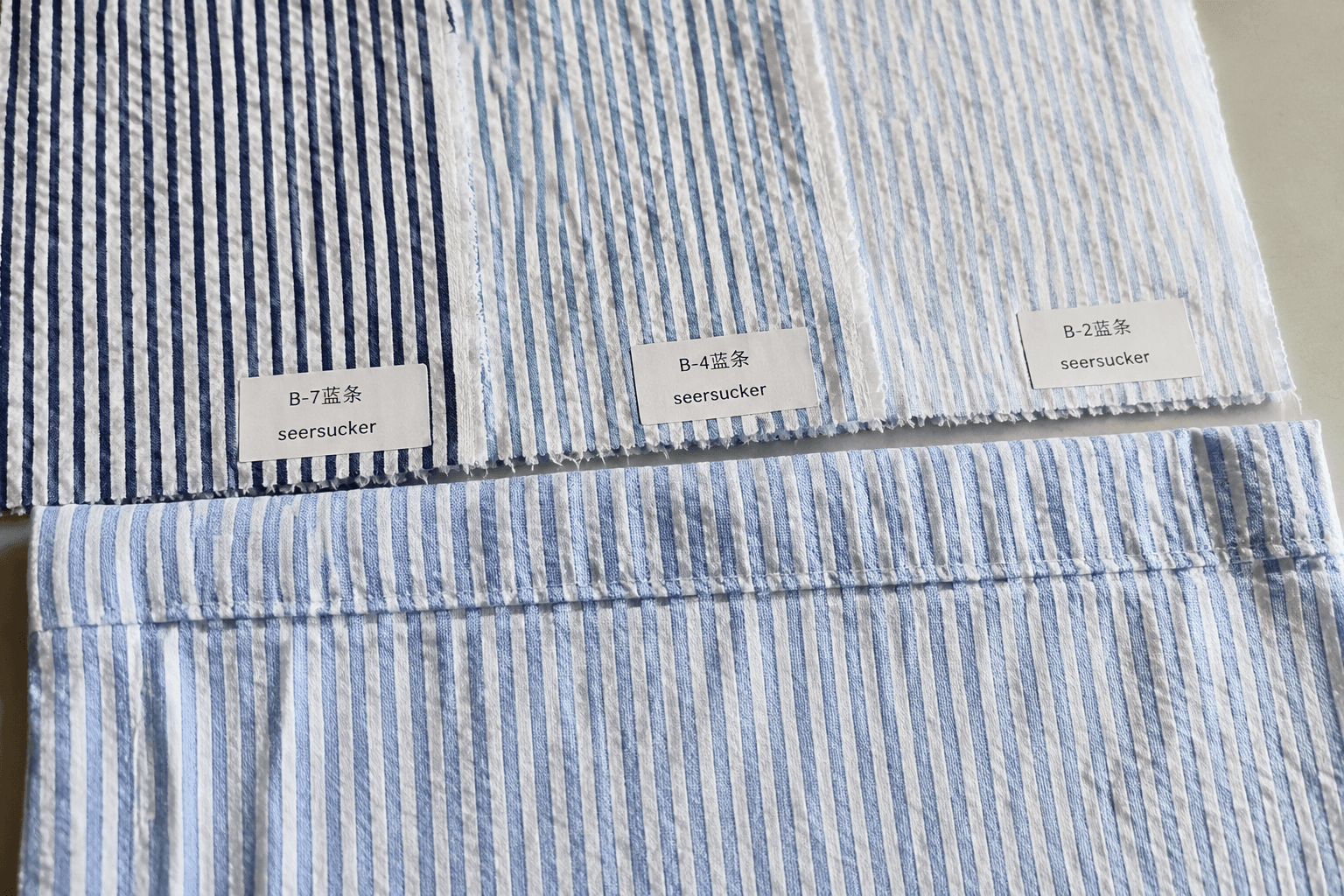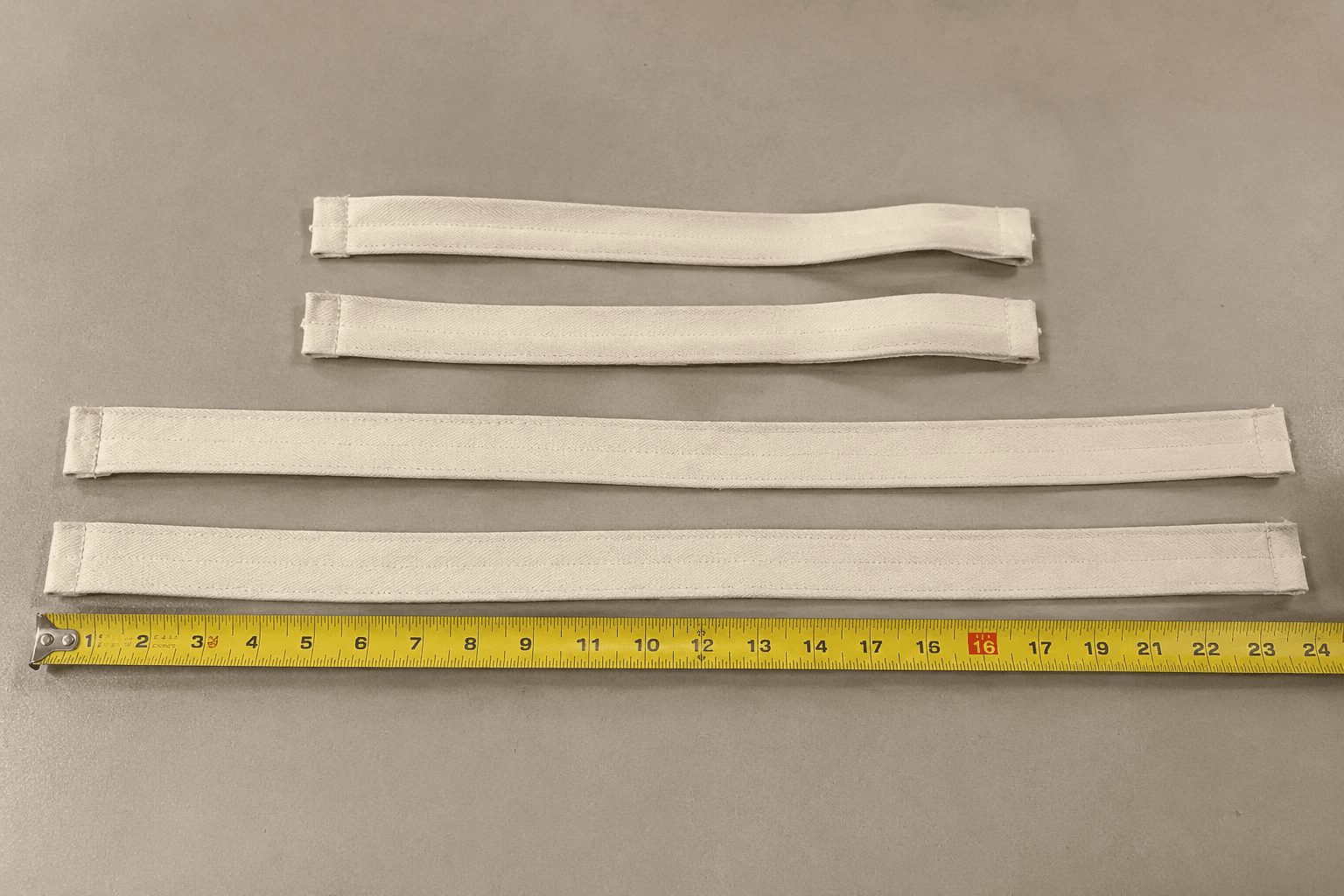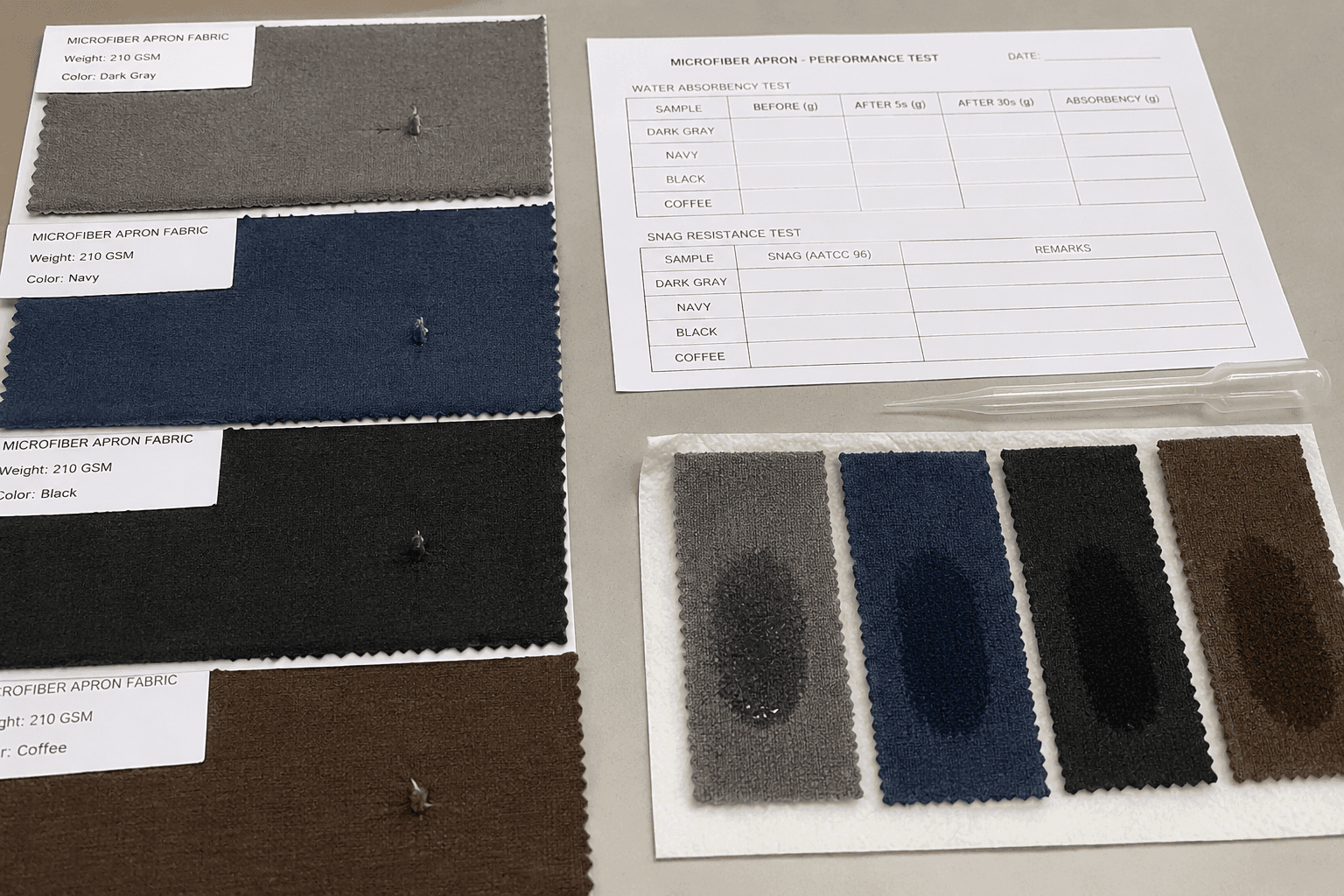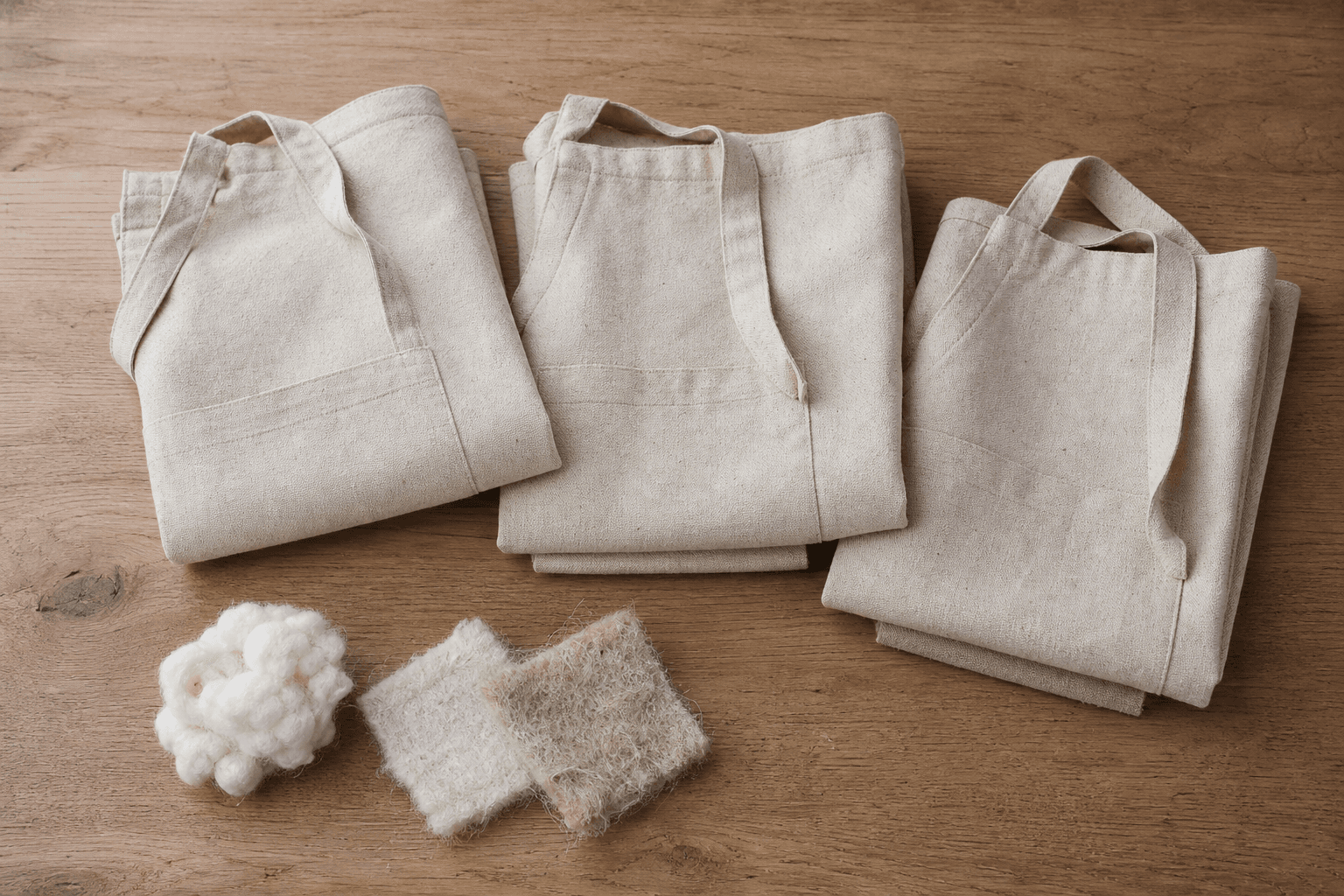
Bulk apron sourcing often starts with loose terms such as oil resistant, stain proof, or easy clean. Those phrases are too vague for development or bulk approval. A workable grease resistant apron fabric must be matched to the actual exposure: butter and cream in bakery production, fryer oil on a quick-service line, animal fat in butcher work, or repeated wipe-downs in seafood and central-kitchen prep. It also has to survive the real wash routine, whether that means home laundering at 40 C, commercial washing at 60 C three times per week, or alkaline industrial laundry with 20 to 30 minute cycles.
In apron manufacturing, grease resistance usually comes from three routes. The first is a fluorine-free finish applied to a woven base such as 65/35 poly-cotton twill, cotton drill, or polyester twill. The second is a tighter weave with higher cover and heavier construction, usually 240-320 GSM, that delays strike-through without becoming a true barrier. The third is a coated or laminated surface, commonly PU, PVC, TPU, or acrylic, that blocks oil more aggressively but changes drape, heat build-up, branding options, and seam construction.
For B2B apron buyers, the right choice is the construction that meets the required protection level at the target FOB, MOQ, and ex-factory lead time. The sections below stay on apron-specific buying points: realistic GSM and oz ranges, common minimums, wash-cycle retention, AQL expectations, sewing implications, and the approval points that should be locked before bulk production.
- Fluorine-free finished woven aprons are usually the right fit for light to medium splash exposure in cafe, bakery, deli, and service programs; they improve release and short-term repellency but do not create a full grease barrier.
- Dense woven apron fabrics in the 240-320 GSM range often deliver the best cost-to-performance balance for buyers who want a textile hand feel, better grease delay than standard 200-220 GSM twills, and lower FOB than coated programs.
- Coated apron surfaces provide the strongest immediate oil blocking for fryer, butcher, seafood, sauce, and heavy prep use, but they usually reduce breathability, limit embroidery, and require closer control of seams and reinforcement points.
- Ask suppliers to quote performance after 20, 30, or 50 wash cycles, not only day-one repellency; many finishes weaken sharply after commercial laundering.
- MOQ usually rises when custom dyeing, specialty finishing, custom coating color, or third-party test paperwork is added; a practical working range is 800-1,500 pcs per colorway.
- Use AQL 2.5 for major defects and AQL 4.0 for minor defects on bulk apron inspection unless the program specifies tighter control, because seam leakage, coating voids, shade variation, and broken bartacks affect field performance directly.
1. Define grease resistance by apron use zone, wash routine, and approval standard
In apron sourcing, grease resistance is not one property. Buyers should separate three questions before asking for a quotation. First, does oil bead on the face at first contact. Second, how long does the apron delay penetration through the base fabric and seam area. Third, after repeated washing, how much staining remains visible on the face. A sample that passes a simple cold oil-drop demo can still fail in production when exposed to hot fryer oil, protein-heavy sauces, butter, or repeated wiping across the same front panel.
A bakery bib apron, a fryer-line bib apron, and a butcher apron should not share the same material brief. Bakery staff handling butter, chocolate, cream, and syrup often need delayed penetration plus acceptable appearance after 20 home washes at 40 C or 15 commercial washes at 60 C. Fryer-line staff need low strike-through during a 6 to 8 hour shift and fast wipe-clean performance between tasks. Butcher and seafood teams often need stronger front-body protection, fewer dirt-trap details, and no lower pockets. These are different apron products, even if each is described internally as grease resistant.
The approval standard should be written into the RFQ and the tech pack. For a woven apron, the buyer may accept moderate face staining if there is no strike-through to the inside after a defined exposure test. For a coated apron, the buyer may prioritize zero penetration, wipe-clean recovery, and seam integrity after laundering. Without that written standard, price comparisons become unreliable because mills and factories will quote different performance levels under the same label.
- State whether the requirement is surface repellency, penetration delay, or post-wash stain release.
- Name the contamination source in the apron brief: fryer oil, butter, animal fat, marinade, sauce, or mixed kitchen grease.
- Define the wash method clearly: home wash at 40 C, commercial wash at 60 C, or industrial alkaline laundry with cycle length.
- Set the inspection baseline in advance, such as AQL 2.5 major and AQL 4.0 minor, with seam leakage, coating pinholes, shade variation, skipped stitches, and broken bartacks listed as key defects.
2. Fluorine-free finished grease resistant apron fabric for bakery, cafe, and deli programs
Fluorine-free finishing is now a common route when buyers want a more presentable textile apron with moderate grease control. In commercial apron production, the finish is typically applied by pad-dry-cure to a woven base. The most common bases are 65/35 poly-cotton twill at 210-240 GSM, 100% polyester twill at 180-220 GSM, and cotton twill or drill at 230-280 GSM, equivalent to roughly 5.3-8.3 oz. For a standard bib apron around 75 x 85 cm with neck strap, waist ties, and one pocket, the finish surcharge is often $0.12-0.35 per piece at 2,000 pcs.
The main advantage is that the apron still behaves like a uniform textile. Sewing remains straightforward, the hand feel stays relatively soft, and decoration can usually include embroidery, screen print, or heat transfer with fewer restrictions than coated fabrics. That makes this route commercially useful for branded bakery aprons, cafe aprons, deli aprons, coffee roastery aprons, and front-of-house service aprons where logo visibility and appearance matter almost as much as splash control.
The limitation is retention under washing. In many factory programs, face repellency falls noticeably after 10-20 home washes or 5-12 commercial laundry cycles, depending on cure quality, detergent strength, and wash temperature. Dark shades such as black, navy, espresso, and charcoal usually remain visually acceptable longer because shadow staining is less obvious. Lighter shades such as khaki, stone, natural, and light grey show grease marks earlier. For fryer or butcher exposure, buyers should treat this route as stain management rather than barrier protection.
- Typical MOQ for custom dyed, fluorine-free finished aprons: 1,000-1,500 pcs per color; some factories can accept 500-800 pcs on stock black or navy bases.
- Typical added lead time for fluorine-free finishing: 7-12 days beyond standard dyeing and sewing.
- Typical FOB for a basic bib apron in this category: $1.80-2.90 per piece at 2,000 pcs, depending on size, pockets, hardware, logo method, and packing.
- Best fit: bakery aprons, cafe aprons, deli aprons, service aprons, and light-prep aprons where softer hand feel and branded presentation are required.
3. Dense twill and canvas at 240-320 GSM: the most practical value option
A tighter weave is often the most economical upgrade when a buyer wants better grease control without moving into coated construction. In apron sourcing, this usually means high-cover twill, drill, duck, or canvas in the 240-320 GSM range, or about 7.1-9.4 oz. Compared with a basic 200-220 GSM twill, these denser constructions leave less open space between yarns, so grease penetrates more slowly and staff have more time to wipe the apron face before the mark sets deeply into the body cloth.
For everyday professional apron programs, dense 65/35 poly-cotton in the 260-300 GSM range is often the safest commercial choice. Polyester helps reduce visible oil retention and shortens drying time after laundering, while cotton keeps the handle closer to an apparel fabric rather than a slick utility surface. Dense 100% cotton canvas can work well for premium chef aprons and customer-facing food concepts, but it usually shows darker oil marks faster than a polyester-rich blend unless the shade is dark or a light stain-release finish is added.
From a cost standpoint, this is usually the strongest value tier. Moving from a standard 210-220 GSM twill to a dense 280-300 GSM twill or canvas often adds only $0.20-0.55 per apron at 2,000 pcs, including extra material and slightly higher sewing handling. The trade-off is wearer load. A heavy bib apron with metal hardware, double pockets, contrast straps, and 300 GSM fabric can feel noticeably heavier over a full 8 hour shift. That is less of an issue for waist aprons, but it matters for bib styles worn continuously in service or prep.
- Dense poly-cotton at 260-300 GSM is usually the first material to test when buyers want an apron that still looks and feels like a textile uniform.
- Dense cotton-rich canvas fits premium presentation aprons, but buyers should expect more visible oil marking unless they choose black, navy, dark olive, or charcoal.
- For bib aprons, request wearer trials for at least one full 6-8 hour shift before locking a 300 GSM plus construction.
- A practical FOB range for dense-woven bib aprons is $2.10-3.40 per piece at 2,000 pcs, depending on fabric weight, pocket layout, trims, and decoration.
4. Coated grease resistant apron fabric for fryer, butcher, seafood, and heavy prep lines
When an apron must handle repeated direct contact with grease, coated construction is usually the most credible route. Common apron materials include PU-coated polyester, PVC-coated polyester, TPU-laminated woven bases, and acrylic-coated fabrics. Typical total weights start around 170-200 GSM for lighter coated polyester and move up to 320-380 GSM for heavier-duty processing aprons. For fryer stations, butcher counters, seafood cutting, sauce filling, and wash-down prep areas, this category of grease resistant apron fabric provides the strongest day-one barrier and the fastest wipe-clean recovery.
Each coating family creates a different wearing profile. PU-coated polyester usually offers a softer handle and better flexibility than PVC, making it easier to use in all-day bib aprons. PVC-coated styles are often durable and cost-efficient for harsh splash zones, but they generally feel stiffer and warmer. TPU laminations usually improve flexibility and low-temperature handling, which matters in chilled seafood and meat rooms. Acrylic-coated woven bases retain more textile character, but in grease blocking they usually sit between a finished woven fabric and a full barrier coating.
The trade-offs are practical and immediate. Coated aprons breathe less, decoration choices narrow, and seam engineering matters more. Embroidery through the front body creates needle holes that can compromise the barrier. Large heat-transfer logos may also stiffen the chest area or fail after repeated wash and flex. For heavy-use styles, buyers often shift branding to woven labels, neck labels, top-edge patches, or non-critical zones. Seams may need reinforcement, binding changes, or taped treatment in exposed areas if the garment is expected to withstand repeated washing and aggressive wiping.
- Typical MOQ: 800-1,200 pcs per color for stock-based coated apron programs; 1,500 pcs or more for custom coating color or specialized laminated fabric.
- Typical ex-factory lead time: 35-55 days after approval, with coating-mill queue often adding 7-15 days compared with standard woven aprons.
- Typical FOB: $2.20-3.80 per piece for simple PU-coated bib aprons at moderate volume; $4.50-6.50 or more for thicker processing aprons with reinforced seams, binding, and custom trim.
- Best fit: butcher aprons, fryer aprons, seafood prep aprons, meat-processing aprons, and heavy splash aprons for central kitchens.
5. Wash retention, seam construction, and branding limits before bulk approval
For apron buying, wash retention is the point that separates a promising sample from a reliable production item. A fluorine-free finished woven apron may repel oil well on day one yet lose much of that effect after 15 washes. A coated apron may block grease effectively but show cracking, edge curl, delamination, or seam stress after repeated laundering if the construction is unstable. Buyers should therefore approve against cycle count. A practical standard might be acceptable function after 20 home washes at 40 C, after 30 commercial washes at 60 C, or after 10 industrial alkaline cycles, depending on the end use.
Seam construction deserves specific review because leakage and failure often start at the stitch line before the center panel fails. On woven aprons, common risk points are neck strap attachment, bartacks at pocket corners, and stress points where heavy hardware pulls against the body cloth. On coated aprons, needle perforation, seam puckering, edge curl, and cracking around fold lines are more important. For high-grease styles, a buyer should examine the apron inside and outside after wash testing, not only the outer face during first sample review.
Branding method can also determine material choice. Dense woven aprons and fluorine-free finished aprons generally accept embroidery, transfer, and print more easily. Coated aprons are less forgiving. Some buyers initially request a barrier apron, then move back to dense woven fabric because the brand requires chest embroidery, soft drape, or a premium front-of-house appearance. That is a valid trade-off, but it needs to be made deliberately and priced against the true use environment.
- Approve apron performance against defined wash cycles, not only against first-sample oil-drop demonstrations.
- Inspect seam zones after laundering for leakage, puckering, cracking, edge curl, and broken bartacks.
- Confirm the final logo method before fabric booking, especially for chest embroidery, heat transfer, or large front print areas.
- Review the inside face of the apron after testing; strike-through can occur even when the outer face still looks acceptable.
6. MOQ, lead-time, and RFQ benchmarks for professional apron sourcing
Apron quotations become more accurate when buyers treat fabric processing as the main cost driver. Sewing a basic bib apron is rarely the most variable cost. The larger differences usually come from GSM, finish or coating route, custom color, testing scope, and branding method. On common China OEM apron programs, stock-color woven aprons may start from 500-800 pcs, but once the buyer adds custom Pantone dyeing, fluorine-free finish validation, custom coating color, or third-party paperwork, the practical MOQ usually rises to 1,000-1,500 pcs per colorway.
Lead time should be quoted as a path, not a single number. For a new woven apron program, a realistic schedule is 5-7 days for proto or fit confirmation, 4-7 days for lab dips, 10-18 days for dyeing and finishing, and 18-25 days for sewing, inspection, and packing. That places many first orders in the 30-45 day ex-factory range after approvals. For coated or laminated aprons, another 7-15 days is common because the coating mill queue, material handling, and inspection process are slower. Once fabric and trims are stabilized, repeat orders on standard materials can often ship in 25-35 days.
The best RFQs are operational and specific. A buyer who requests a 65/35 poly-cotton bib apron at 260 GSM, black, fluorine-free finish, one chest pocket, one waist pocket, and a target FOB of $2.40-2.80 will receive usable proposals faster than a buyer who asks only for the best grease-resistant apron. The same applies to coated programs. If the buyer names exposure level, wash method, acceptable branding limits, and lead-time requirement, the factory can quote the correct apron construction instead of guessing across several fabric routes.
- State the use case directly: presentation service, light prep, fryer station, butcher counter, seafood room, or heavy processing line.
- Include target GSM or oz, color standard, logo method, carton standard, and expected wash frequency in the RFQ.
- Ask for quantity breaks at 1,000 pcs, 2,000 pcs, and 5,000 pcs so the effect of mill minimums and processing setup is visible.
- Keep a signed control sample and approved bulk swatch on both buyer and factory side to stabilize repeat orders and shade consistency.