For kitchen chains, central commissaries, meat and seafood plants, bakery operations, and ready-meal factories, an apron is not only a uniform item. It is a barrier between the worker, the product, cleaning chemicals, water, oil, and production surfaces. A food safe apron must therefore be specified with more detail than a standard hospitality apron, especially when the apron may touch unpacked food, trays, cutting tables, or wet processing zones.
In OEM apron sourcing, the main risk is not usually whether the apron looks correct in the sample room. The risk is whether the approved material, coating, printing, trims, and packaging can be repeated in bulk production with stable compliance evidence. Buyers often ask for “FDA compliant apron” or “food grade apron,” but the factory still needs the exact contact scenario: direct or incidental contact, dry or wet food, short or repeated exposure, ambient or hot processing, and whether the apron will be laundered, wiped, or disposed of.
This article explains how Linwa Apron Manufacturing approaches food contact apron development from a supplier-side view: material choices, construction details, compliance documents, testing, MOQ, lead time, and cost trade-offs for bulk custom apron orders from China.
- A food safe apron starts with the end-use map, including direct contact, wet processing, cleaning chemicals, and laundering frequency.
- PU, PVC, TPU, PE, and coated polyester each behave differently for oil resistance, cold flexibility, migration risk, and unit cost.
- FDA apron compliance is document-based and test-scope-specific, not a blanket statement that covers all colors, prints, and trims.
- Logo printing can change compliance status when inks, heat transfer films, or label materials sit in possible food-contact zones.
- Bulk production control matters as much as sample approval, especially for coating thickness, seam type, strap attachment, and batch traceability.
- Realistic lead times are usually 25-45 days after approval, depending on material sourcing, third-party testing, and order volume.
Defining a food safe apron before material selection
A food safe apron is not one single product type. In sourcing terms, it is an apron specification matched to a defined food environment and supported by suitable material declarations or test reports. A butcher shop using a wipe-clean waterproof apron has different requirements from a bakery packing dry bread, and both are different from a seafood plant where saltwater, low temperature, blood, and strong detergents are present every shift.
The first step is to classify the contact type. If the apron may directly touch unpacked food, such as fish fillets, meat cuts, dough, vegetables, or ready-to-eat ingredients, the buyer should treat it as a food contact apron and request suitable food-contact documentation for the outer surface. If the apron is worn only as worker protection and does not normally touch food, the requirement may be more about hygiene, cleaning durability, color control, and absence of unsafe restricted substances. The distinction affects testing cost, material options, and lead time.
Factories also need to understand cleaning practice. Some aprons are rinsed and sanitized several times per day; others go into industrial laundry at 60-90 degrees C; disposable PE aprons may be used for one shift or one task. A material that passes a migration test can still fail in the factory if it stiffens in cold rooms, cracks after chlorine exposure, or delaminates after repeated washing.
- Buyers should state whether contact is direct, incidental, or no expected food contact.
- Buyers should confirm whether the apron touches dry, aqueous, acidic, alcoholic, or fatty foods.
- Buyers should specify cleaning by wipe-down, rinse, industrial laundry, or disposal after use.
- Buyers should define the expected service life, such as 1 day, 30 washes, 100 washes, or 6 months.
- Buyers should identify the market destination, because US, EU, UK, and local rules can require different documentation.
Material choices for food contact apron orders
For bulk apron programs, material choice is usually the largest driver of compliance risk, performance, and unit price. Common food contact apron options include PE film, PVC-coated polyester, PU-coated polyester, TPU film laminate, rubberized fabrics, and heavy cotton or poly-cotton for dry, non-wet kitchen use. Each option has a place, but none should be selected only by feel or appearance.
PE disposable aprons are cost-efficient for high-turnover processing, cleaning crews, and visitor use. Typical thickness ranges from 16-40 microns, with 20-25 microns used for light duty and 30-40 microns for better tear resistance. They are generally packed 100 pcs/bag or on rolls and can be made with embossed texture. However, they are not durable, cannot carry complex sewing details, and are usually ordered in high MOQ, often 50,000-200,000 pcs depending on color and size.
PVC-coated polyester is common for waterproof industrial aprons because it is durable, economical, and easy to weld or sew. Typical weights run from 250-500 GSM, with 300-350 GSM suitable for many kitchen wash-down tasks and 450-500 GSM used for fish, meat, and heavy wet processing. The buyer must confirm plasticizer compliance and food-contact suitability if contact is possible. PU and TPU options cost more but often provide better softness, cold flexibility, and a cleaner compliance profile for certain applications. TPU film laminate is frequently chosen for premium hygienic apron programs where flexibility, low odor, and higher specification control are important.
- PE disposable apron: usually 16-40 microns, low cost, high MOQ, limited durability.
- PVC-coated polyester: usually 250-500 GSM, strong waterproof performance, plasticizer control required.
- PU-coated polyester: usually 180-350 GSM, softer hand feel, better comfort, moderate to high cost.
- TPU laminate: usually 150-300 GSM, flexible and low odor, higher material price and longer sourcing time.
- Poly-cotton kitchen apron: usually 180-280 GSM, suitable for dry food service, not a waterproof processing barrier.
What fda apron compliance actually covers
The phrase fda apron compliance is often used loosely in purchase requests. From a manufacturing perspective, it must be tied to a material, a surface, a color, a construction, and a food-contact condition. For the US market, buyers commonly refer to FDA requirements for food-contact materials under 21 CFR, depending on polymer type and intended use. For Europe, buyers may need Regulation EC 1935/2004, EU 10/2011 for plastic materials, and related migration testing. A report for one fabric, one coating, or one color should not automatically be treated as covering every future apron variation.
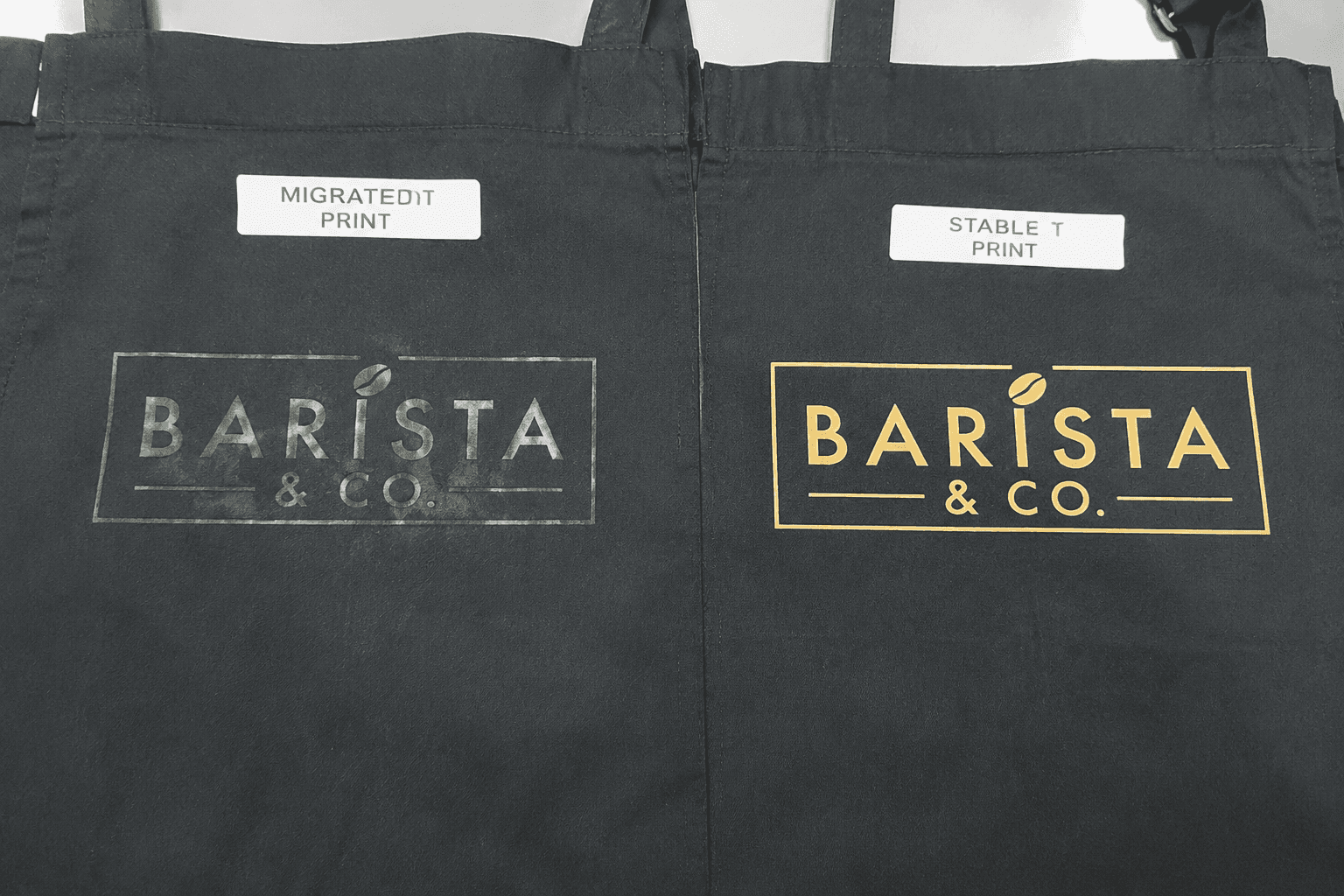
A practical example is a white TPU apron with no print versus the same apron with a large chest logo in black transfer film. If the logo is placed where food contact is possible, the ink or transfer film can become part of the food-contact surface. A third-party report for the base TPU does not necessarily cover the logo. The same issue applies to contrast binding, printed care labels, metal eyelets, coated webbing, and colored films.
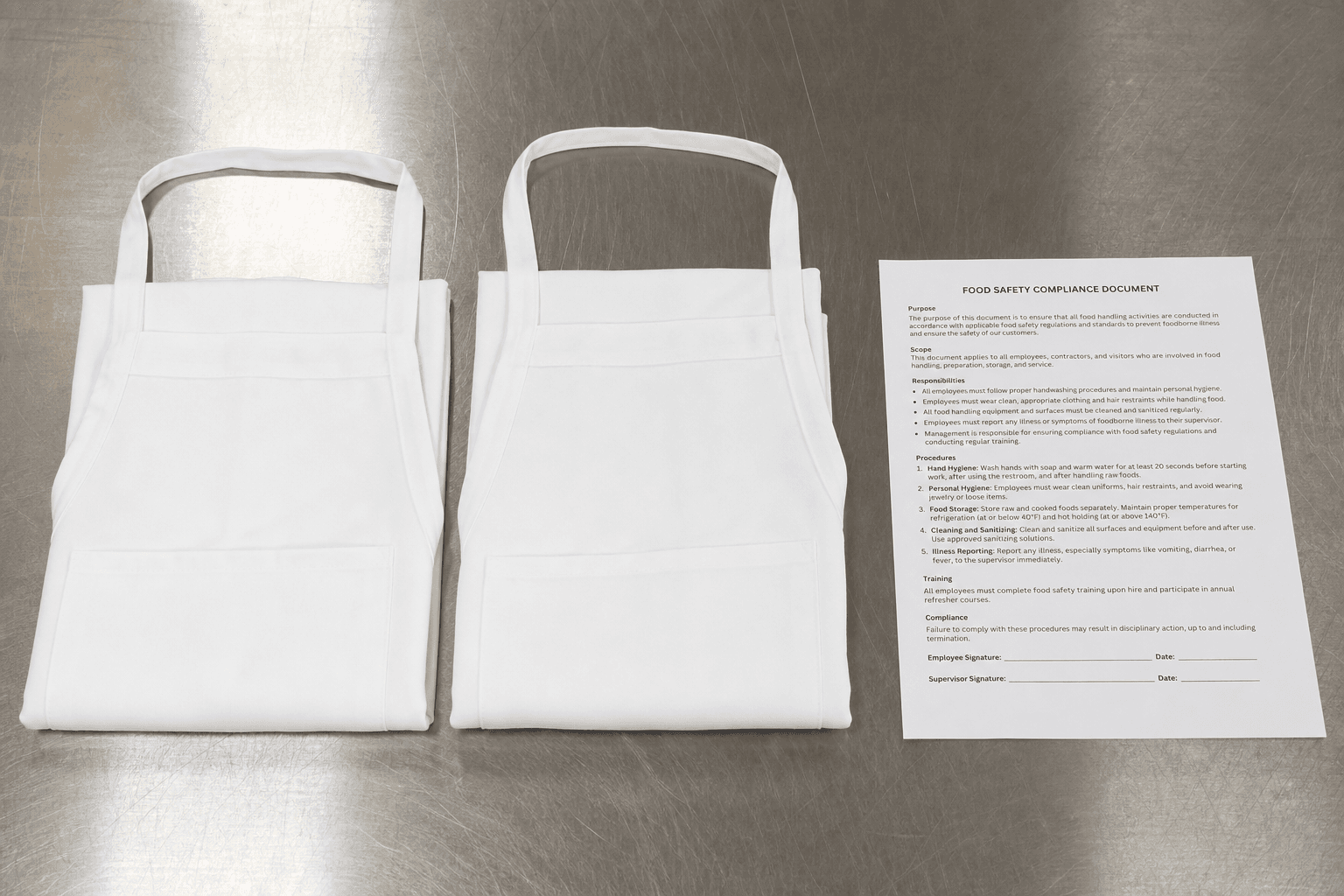
For sourcing managers, the key is to request documents that match the order. A supplier can provide material composition, supplier declaration, test report, safety data information where applicable, and production batch traceability. The buyer should check report date, sample description, color, test standard, simulants, conditions, and issuing laboratory. Reports older than 2-3 years may still be useful for screening, but many brand compliance teams request current reports or new testing for high-risk programs.
- A compliance report should identify the exact material and surface used in production.
- The report should match the buyer’s target market, such as US FDA or EU food contact.
- The test conditions should reflect real use, including fatty, aqueous, acidic, or dry contact where relevant.
- Colored coatings, printed logos, binding, labels, and trims should be checked if they may enter contact zones.
- For large programs, buyers should request batch traceability from material lot to finished carton.
Designing a hygienic apron for cleanability
A hygienic apron is not only about the fabric surface. Construction details decide how easily the apron can be cleaned and how quickly it fails in use. In food processing, unnecessary seams, open pockets, absorbent tapes, rough stitching, and decorative trims can hold moisture or residue. For restaurants and commercial kitchens, the requirements may be less severe, but apron design should still support daily cleaning without creating weak points.
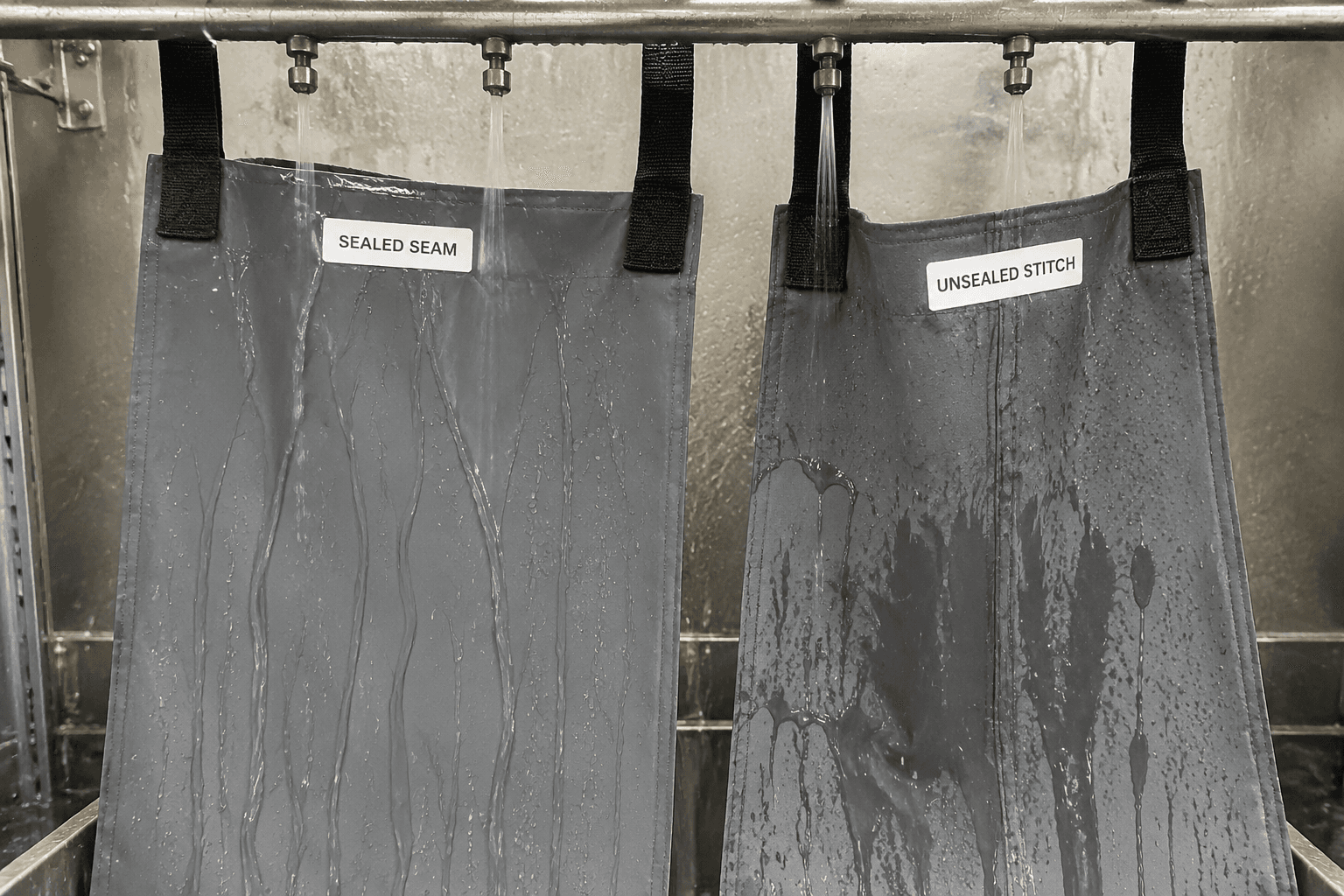
For waterproof aprons, factories commonly use stitched seams, high-frequency welded seams, heat-sealed edges, or ultrasonic bonding depending on the material. PVC can often be high-frequency welded, which provides strong water resistance when done correctly. TPU and PE may use heat sealing or ultrasonic methods. PU-coated fabrics are often sewn, but seam sealing may be needed for higher waterproof performance. The best choice depends on coating chemistry, thickness, order quantity, and the buyer’s cleaning protocol.
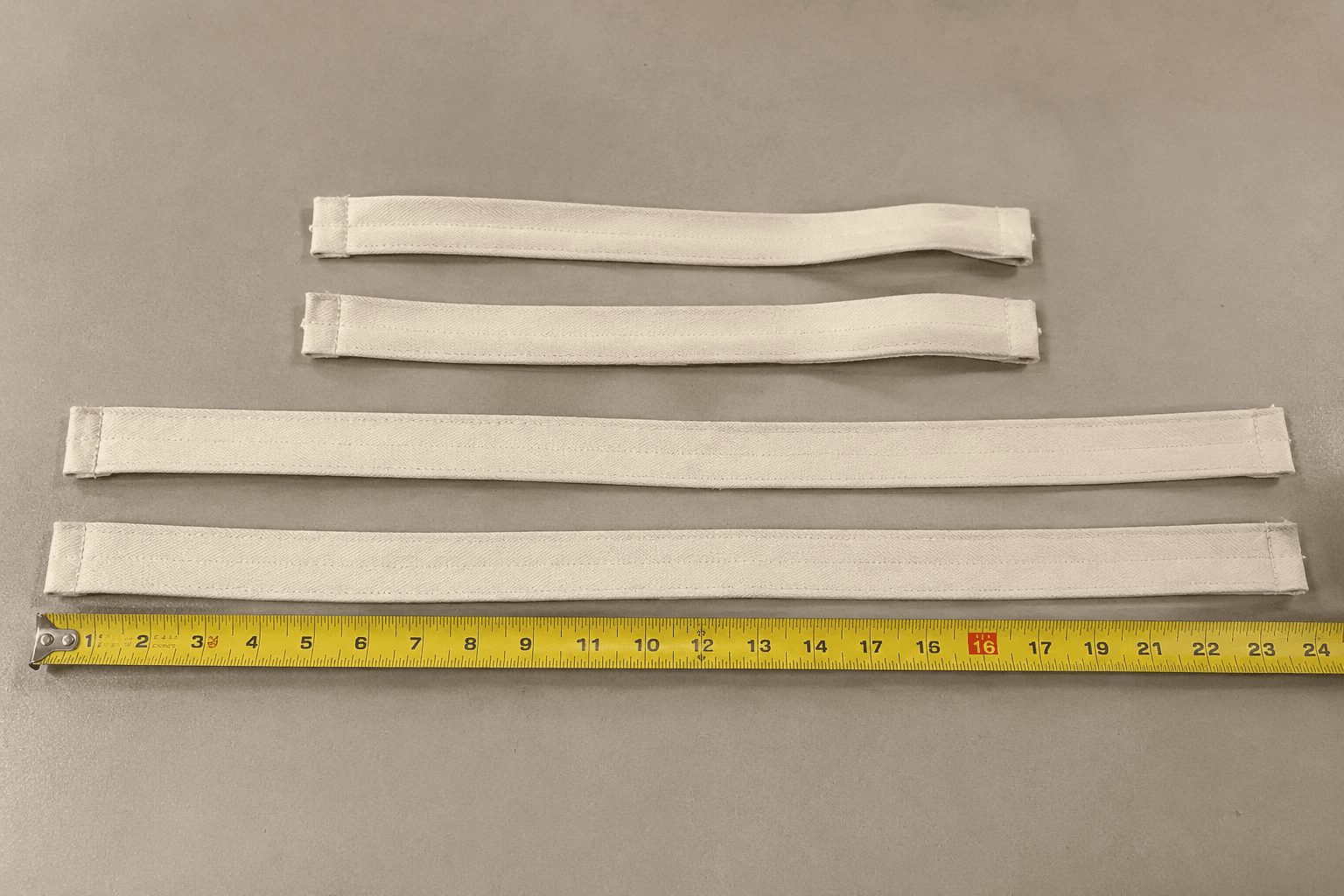
Straps deserve special attention. Cotton webbing is comfortable but absorbs water and soil, so it is not ideal for wet food processing. Polyester webbing dries faster and is more stable. Coated straps can improve wipe-clean performance but may feel stiffer. Adjustable neck buckles make sizing easier for mixed workforces, but buckle material must tolerate cleaning chemicals and cold rooms. Metal eyelets should be avoided in some processing areas because they may corrode or create foreign-body concerns if damaged.
- For wet processing, use smooth surfaces and avoid open pockets unless the buyer has a clear operational need.
- For high wash-down areas, consider welded or sealed edges instead of exposed woven binding.
- For worker comfort, specify neck strap width around 20-30 mm and waist tie width around 15-25 mm.
- For industrial laundering, confirm shrinkage, coating adhesion, and strap colorfastness after the target wash count.
- For color-coded hygiene zones, keep colors consistent by approving lab dips or material swatches before bulk cutting.
Logo, color, and packaging risks in a food safe apron program
Branding is normal in custom apron orders, but for a food safe apron it should be placed with care. Screen print, heat transfer, silicone print, woven label, rubber patch, and embroidery all behave differently. Embroidery is durable on textile aprons but creates needle holes and thread texture, so it is not usually preferred on waterproof food processing aprons. Heat transfer can look clean, but the film must be checked for adhesion after wash-down and for food-contact suitability if placed in a risk area.
Color also has practical implications. White and light blue are common in food plants because contamination is visible and zone control is easier. Dark colors hide stains but can make residue harder to detect. For meat, seafood, and dairy environments, buyers often use white, blue, or yellow aprons by department. For commercial kitchens, black, navy, grey, and striped textile aprons are common, but these are usually hospitality garments rather than direct food-contact barriers.
Packaging should not be ignored. If aprons are entering a clean production site, individual polybags may be requested to reduce handling contamination, but they add cost and plastic waste. Bulk pack is cheaper and common for laundries or back-of-house distribution. For PE disposable aprons, roll packing or dispenser bags can improve line efficiency. Carton strength matters for export: a wet-processing apron at 350-500 GSM is heavy, and weak cartons can crush or split during ocean shipment.
- Keep logos above the chest or outside likely food-contact zones when possible.
- Confirm ink or transfer film test data if branding may touch food or processing surfaces.
- Use color-coded apron sets only after approving physical swatches under the buyer’s site lighting.
- Choose individual packing for cleaner handling, or bulk packing when laundries will process the aprons before use.
- For heavy coated aprons, plan carton gross weight around 15-22 kg to balance freight efficiency and handling safety.
Bulk sourcing numbers: MOQ, sampling, lead time, and cost
The commercial side of a food grade apron project depends on material availability and the amount of compliance work required. For stock coated materials in standard colors, a realistic MOQ may start around 1,000-3,000 pcs for sewn reusable aprons. For custom coating, custom color TPU, special embossed PE, or exclusive food-contact tested material, MOQ may rise to 5,000-20,000 pcs for reusable aprons and 50,000 pcs or more for disposable PE aprons.
Sampling normally takes 5-10 days when material is in stock and the design is simple. If a new material, new color, welded construction trial, or third-party lab test is needed, sample and validation time can extend to 12-25 days. Bulk lead time after final approval is typically 25-45 days for reusable aprons, and 20-35 days for PE disposable aprons, assuming packaging artwork and compliance documents are approved on time. Peak season, coating mill schedules, and Chinese holidays can add 7-15 days.
Indicative FOB China pricing varies widely. A basic PE disposable apron can be below USD 0.03-0.08 per pc at high volume, depending on thickness and packing. A standard PVC-coated polyester waterproof apron may fall around USD 1.20-3.20 per pc for 1,000-5,000 pcs, depending on GSM, size, welding, straps, and logo. PU or TPU hygienic aprons may run around USD 2.50-6.50 per pc, and more for heavy-duty reinforced designs or small quantities. These are planning ranges, not fixed quotations, because resin price, coating width, waste rate, testing, and packaging all move the final cost.
- Reusable coated apron MOQ is commonly 1,000-3,000 pcs when standard material is available.
- Custom material or color programs often require 5,000-20,000 pcs to support coating mill MOQ.
- Disposable PE apron MOQ is commonly 50,000-200,000 pcs, especially for custom color or packing.
- Pre-production testing can add 7-15 working days depending on laboratory schedule.
- Reusable food apron bulk production is usually 25-45 days after sample, artwork, and material approval.
Factory quality control for food contact apron production
A compliant sample is only useful if bulk production repeats it. For food contact apron manufacturing, Linwa’s control points normally start at incoming material inspection: roll width, GSM or film thickness, coating appearance, odor, color, defects, and supplier lot reference. For coated fabrics, GSM tolerance is commonly controlled within +/-5% when the mill process is stable. For film aprons, thickness tolerance must be checked because small micron reductions can noticeably weaken tear resistance.
During cutting and sewing or welding, the factory checks size tolerance, strap pull strength, seam integrity, surface contamination, print position, and packaging accuracy. A typical reusable apron size tolerance may be +/-1 cm to +/-1.5 cm depending on design and material behavior. Strap attachment is a common failure point, so reinforced stitching, bar tacks, welded patches, or larger bonding areas may be needed for heavy aprons. For wet processing aprons, water leakage at seams should be checked during development and spot-checked in production where applicable.
Final inspection should be based on an agreed AQL level, usually AQL 2.5 for major defects and 4.0 for minor defects unless the buyer specifies a stricter level. Major defects include wrong material, wrong size beyond tolerance, failed strap strength, open seams, poor welding, strong odor, incorrect logo, contaminated surface, or wrong packing. Minor defects may include small cosmetic marks outside the contact area, slight thread ends, or acceptable shade variation within the approved tolerance.
Buyer checklist for specifying a food safe apron
The most efficient projects begin with a written specification that covers end use, compliance market, material, construction, branding, packing, and inspection. Without this, the supplier may quote a visually similar apron that cannot pass the buyer’s internal compliance review or cannot survive the actual production environment. A clear technical brief reduces re-sampling, shortens approval time, and makes price comparisons more meaningful.
For a new food safe apron program, the buyer should send the factory the target size range, annual volume, order split, color plan, contact scenario, cleaning method, and required documentation. If the buyer already has a failed product, photos of failure points are useful: cracked coating, broken straps, delamination, staining, odor, shrinkage, or seam leakage. If the buyer has a current apron that works well, a physical reference sample is often the fastest way to align on hand feel, stiffness, length, and durability.
The final purchase order should lock the approved material code, color, weight or thickness, construction drawing, logo method, packaging, test requirement, inspection standard, and shipment terms. For ongoing programs, it is better to keep a golden sample and material swatch at both buyer and factory side. When reorders are placed months later, these references help control shade, coating hand feel, and trim consistency.
- Specify the product as a food safe apron, food contact apron, or hygiene workwear apron according to real use.
- State the target market and required compliance documents before price negotiation.
- Confirm material weight, such as 300 GSM PVC-coated polyester or 250 GSM TPU laminate, instead of using only material names.
- Provide a drawing with apron length, width, neck strap, waist tie, pocket position, and tolerance.
- Approve a pre-production sample before bulk cutting, especially when food-contact testing or custom branding is involved.
- Keep one sealed approval sample for comparison during inspection and reorder production.