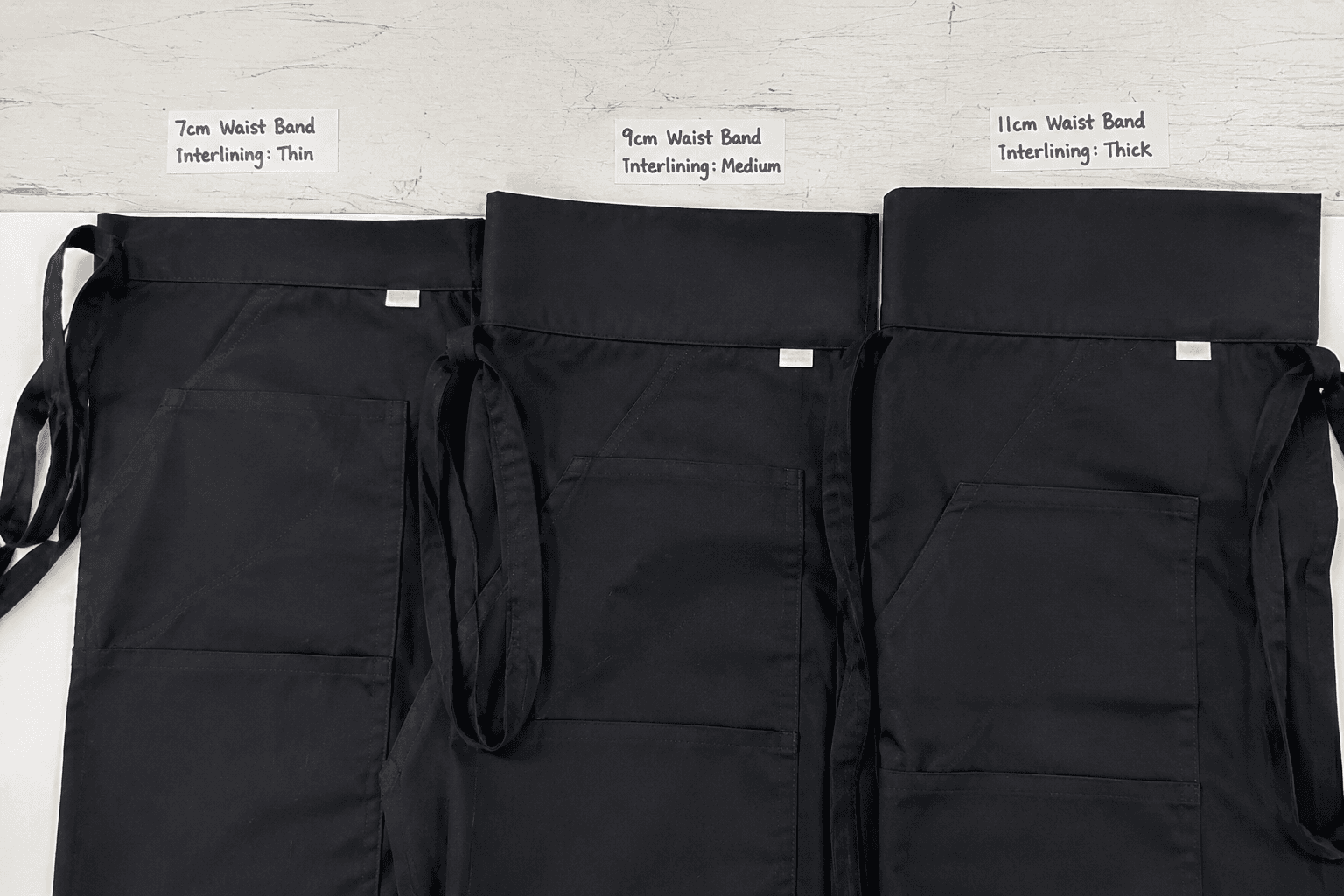
For B2B apron buyers, waistband construction changes cost, defect risk, and wash performance, not just appearance. In fold over waistband waist aprons, the waistband wraps over the apron body’s top raw edge and closes it inside the band, creating a cleaner interior than a basic attached waistband with a visible inside seam.
That cleaner finish matters on waist aprons used in restaurants, hotels, bars, bakeries, cafés, food retail, and uniform programs. A 210-240 GSM polycotton twill usually folds and topstitches with lower risk than a 280-310 GSM cotton canvas, while heavier fabrics improve handfeel but increase bulk at tie joins and raise the chance of puckering or skipped stitches along the top edge.
For sourcing teams, the commercial question is straightforward: when does the cleaner finish justify the extra fabric, labor, and QC? This article explains how fold over waistband waist aprons are built, where cost moves, which defects buyers should expect, and how to specify the construction clearly enough for consistent apron quotations and repeatable bulk production.
- Fold-over waistbands usually add 0.4-1.2 sewing minutes per waist apron; on 280-310 GSM canvas with self-fabric ties, the increase can reach 1.3-1.5 minutes.
- Typical FOB uplift is US$0.07-0.16 per piece on simple 210-240 GSM polycotton waist aprons at 3,000-5,000 pcs, and US$0.16-0.28 per piece on 260-310 GSM twill or canvas styles with tighter appearance standards.
- This construction delivers the best return on customer-facing hospitality and retail waist aprons where inside finish, top-edge straightness, and repeated laundering affect perceived quality and replacement rates.
- Buyers should lock finished waistband height, cut width, topstitch distance, tie method, stitch density, and seam encapsulation before sample approval and final costing.
- Bulk inspection should check waistband width consistency, tie symmetry, seam capture, and wash stability to at least AQL 2.5 major / 4.0 minor.
How fold over waistband waist aprons are built and why the process is less forgiving
A basic economy waist apron often uses an attached waistband that joins the apron body to the band, then leaves the inner seam allowance partly visible or only lightly covered. In fold over waistband waist aprons, the waistband is cut wider so it can wrap over the body’s top edge, trap the raw seam allowance inside, and close with one or two visible topstitch lines. The finish is neater, but the real change for an apron factory is tighter process control.
The sewing sequence is also more sensitive to variation. For a standard 80 x 45 cm waist apron with 70-75 cm ties on each side, the factory normally cuts the waistband strip, prepares the ties or self-fabric extensions, pre-presses the fold, inserts the apron body into the band, then topstitches the full length while controlling edge distance and inner seam capture. A 2 mm shift at one side can pull the whole top edge off line, especially on dark solid waist aprons where top-edge straightness is easy to see during packing and store handling.
Fabric weight changes how difficult the job becomes. A 205-220 GSM polycotton plain weave folds easily but can feel too soft if the buyer wants a 4.0 cm finished band without fusible support. A 235-270 GSM twill is often the most production-efficient range for hospitality waist aprons because it balances body, stitch control, and operator speed. A 290-310 GSM canvas looks more substantial, but the thicker layers increase needle resistance and make tie transitions harder to sew flat.
This is why B2B buyers should not copy one waistband specification across every apron fabric. The same 3.5 cm finished band that runs smoothly on 235 GSM twill may produce roping, thickness marks, or extra operator handling time on 300 GSM canvas. Good apron sourcing starts with matching waistband construction to fabric behavior rather than assuming the same drawing will quote and sew the same way across all materials.
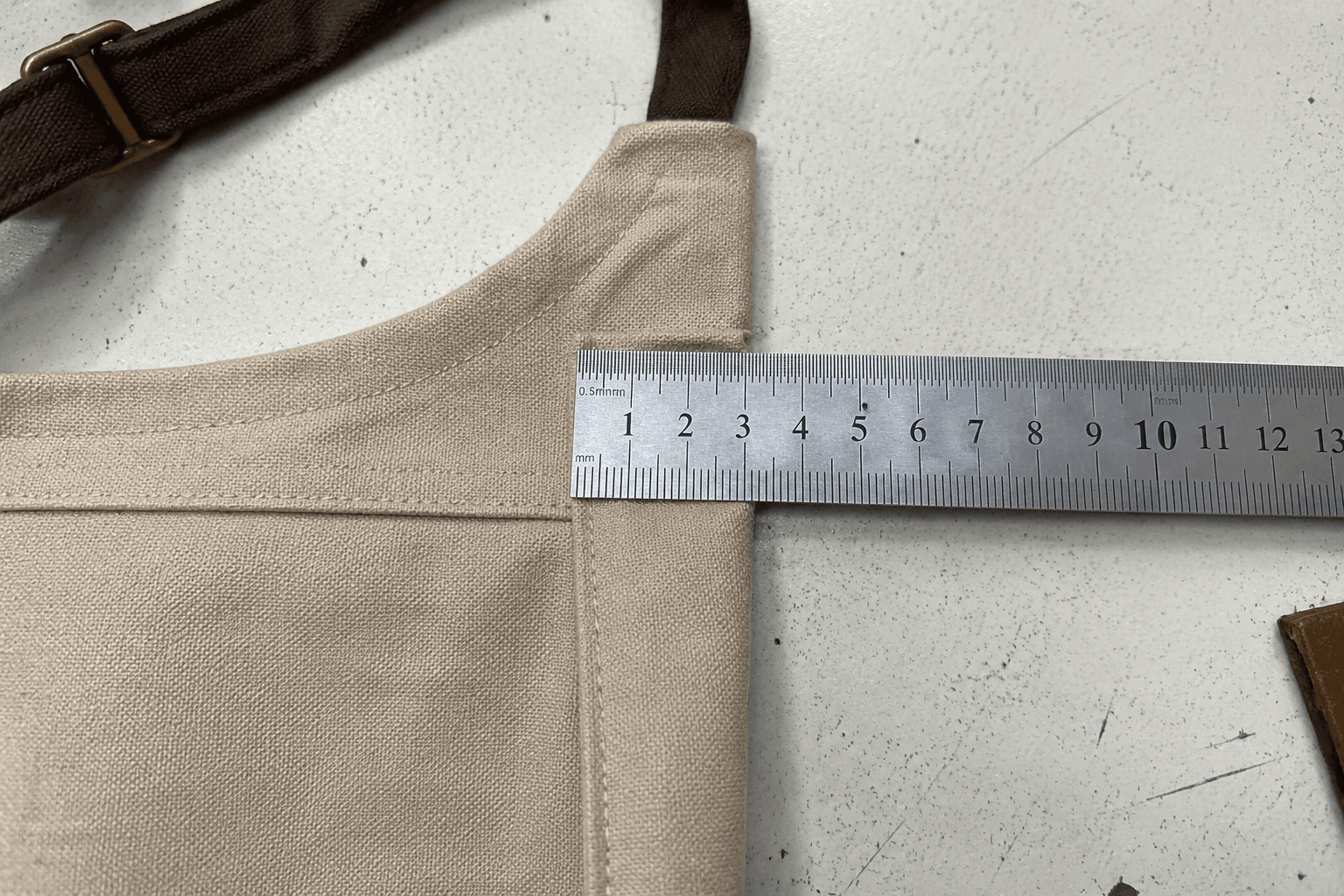
- Common finished waistband heights are 2.5 cm, 3.0 cm, 3.5 cm, and 4.0 cm.
- Typical cut waistband widths are 7.0-9.5 cm, depending on seam allowance and fold depth.
- Visible topstitch is usually set at 2 mm or 3 mm from the edge with 8-10 SPI.
- Extra labor versus a basic attached waistband is commonly 0.4-1.2 minutes per apron.
Where fold over waistband waist aprons make commercial sense for B2B buyers
Professional buyers choose this construction for specific apron programs, not for decoration. The first reason is presentation. On black, navy, charcoal, olive, and dark brown waist aprons, the inside waistband is visible during issuing, folding, laundering return, and retail inspection. A visible inner seam can make an otherwise acceptable apron look entry-level, while a fully enclosed top edge supports a cleaner, more uniform standard.
The second reason is comfort during long wear. Staff in restaurants, bars, bakeries, and hotel service operations often tie aprons tightly for 8-12 hour shifts. Enclosing the inner seam allowance reduces ridge contact against shirts or trousers. The difference is modest, but on 235-260 GSM twill waist aprons it is noticeable enough to support better wearer acceptance in uniform programs where staff complaints can drive early replacements or spec changes.
The third reason is product positioning. A hotel group ordering 2,000-4,000 waist aprons across core colors, or a kitchen retail brand buying 1,000-2,500 units for a gift line, is paying for repeatable finish quality as much as fabric. In those programs, a clean waistband reinforces the same quality signal as even pocket placement, straight hems, secure bartacks, and consistent shade control.
The construction is much harder to justify on low-cost event aprons, campaign giveaways, or short-life promotional programs where the target FOB may be only US$2.20-2.80 depending on fabric, print, and pocket count. In those cases, the buyer often gets better return by keeping a basic waistband and allocating cost to faster delivery, stronger print coverage, or slightly heavier shell fabric.
- Best fit: restaurants, hotels, bars, bakeries, cafés, specialty food retail, and branded gift programs.
- Typical order volume where the upgrade becomes practical: 800-5,000 pcs per style-color.
- Common fabrics for this construction: 210-240 GSM polycotton twill, 240-280 GSM cotton twill, and 280-310 GSM cotton canvas.
- Weak fit: price-driven promotional waist aprons with very short service life.
Cost impact on waist aprons: fabric usage, labor minutes, MOQ and lead-time days
The cost effect should be separated into four parts: fabric consumption, labor, quality control, and production planning. Fabric usage rises because the waistband must be cut wider to wrap over the apron body. On an 80 x 45 cm waist apron, the extra cloth per piece is modest, but it becomes meaningful across a 3,000-piece run. If shell fabric costs US$1.85-2.20 per meter for 210-230 GSM polycotton twill, the incremental material cost may add only a few cents. If the fabric costs US$3.40-4.80 per meter for reactive-dyed cotton canvas or yarn-dyed twill, the same construction has a more visible effect on apron costing.
Labor is usually the bigger driver. A basic waistband allows faster joining with lower appearance control. A fold-over version needs cleaner preparation, more accurate feeding, and stricter topstitch consistency because both outside appearance and inner seam capture become inspection points. On a simple one-pocket waist apron in 220-240 GSM twill, many China apron factories quote an additional 0.4-0.7 minutes. Add self-fabric ties, two patch pockets, contrast thread, and 280+ GSM canvas, and the increase is more often 0.9-1.2 minutes, with some programs reaching 1.3-1.5 minutes when buyers require a 2 mm topstitch and very flat finish.
FOB uplift should be budgeted realistically. At 3,000-5,000 pcs, a simple hospitality waist apron in 220-240 GSM polycotton twill usually rises by US$0.07-0.16 per piece when upgraded from a basic band to a hidden-seam fold-over band. On 260-310 GSM cotton twill or canvas with longer ties, stricter tolerances, and more demanding appearance standards, the increase is usually US$0.16-0.28 per piece. Below 800 pcs, unit cost often rises further because setup time, operator training, and inline checking are spread across fewer aprons.
MOQ and lead time also shift. Many suppliers will accept 500 pcs per style-color for standard waist aprons, but the more workable MOQ for stable premium execution is usually 800-1,000 pcs, especially when custom dyeing, woven labels, or retail packaging are included. Sample lead time is commonly 7-10 days after fabric, color, and construction approval. Bulk production is usually 25-35 days with stock fabric and 35-45 days when the order needs custom dyeing, printing, garment wash, or branded trims.
- Indicative FOB uplift at 3,000-5,000 pcs: US$0.07-0.16 on simple twill waist aprons.
- Indicative FOB uplift on heavier or more detailed waist aprons: US$0.16-0.28 per piece.
- Practical MOQ for cleaner execution: 800-1,000 pcs per style-color.
- Typical sample lead time: 7-10 days; typical bulk lead time: 25-45 days.
Apron specification points buyers should lock before RFQ, sample approval and PO release
Many apron sourcing problems start with vague terms such as 'folded waistband' or 'hidden seam band' in the tech pack. Those descriptions are not precise enough for costing or production. Different factories can interpret fold depth, finished height, topstitch distance, tie construction, and seam allowance differently, which creates quotation gaps and unreliable samples. Buyers need to specify this construction with the same precision used for apron body size, pocket dimensions, and fabric GSM.
The first item to lock is finished waistband height. A 2.5 cm finished band gives a lighter, more casual waist apron. A 3.5 cm or 4.0 cm band looks more structured and is common in hospitality styles, but it also makes width variation easier to spot. The second item is cut width and inner seam allowance. If these numbers are not fixed, a factory may reduce the inner bite to save time or fabric, which increases the risk of seam exposure after washing.
The third item is stitch appearance. A 2 mm topstitch line usually looks sharper than a 3 mm line, but it also raises rejection risk on heavier or looser-woven fabrics. The fourth item is tie method. Self-fabric waistband extensions reduce one join but create more difficult thickness transitions. Separately joined ties can be easier to turn and prepare, but they add a join seam that must be controlled for strength and symmetry.
Buyers should also state whether light fusible support is allowed inside the waistband on softer fabrics below roughly 220 GSM. That decision affects handfeel, wash behavior, and top-edge stability. Finally, the PO and pre-production sample comments should confirm seam encapsulation, stitch density, bartack placement, and tolerance rules so the apron factory is quoting and producing the same standard.
- State finished waistband height with tolerance, for example 3.0 cm ± 0.2 cm.
- Define cut waistband width and inner seam allowance in the tech pack.
- Set topstitch position, for example 2 mm from edge, with 8-10 SPI.
- Confirm tie construction: self-fabric extension or separately joined tie.
- Specify whether light fusible support is allowed on softer apron fabrics.
- Write seam encapsulation and wash expectations into the PO and PP sample comments.
QC risks on hidden-seam waist aprons: width variation, seam exposure, puckering and wash failure
The most common defect on this construction is uneven waistband width. It usually appears when the inner fold is not held consistently before topstitching or when the operator pulls the apron through thick points near the ties. On dark solid waist aprons, a left-to-right difference of only 2 mm is often visible during flat inspection. On striped or yarn-dyed apron fabrics, poor fold control is even more obvious because the lines do not sit level across the waistband.
The second problem is incomplete seam capture. If the inner fold is too shallow, or if the stitch bite sits too close to the outer edge, the waistband may pass visual inspection at packing but begin to open after repeated laundering. This matters on hospitality waist aprons expected to survive 20-30 commercial wash cycles. If the internal seam allowance starts showing after 10-15 cycles, the apron is likely to generate claims or early replacement pressure.
The third issue is distortion at thick points. On waist aprons made in 280-310 GSM canvas with pockets, bartacks, and self-fabric ties, multiple layers can meet near the upper side seam area. If needle size, thread tension, or feed control is wrong, the result can be puckering, roping, skipped stitches, or a twisted tie angle. Those defects often look minor at first glance but become clear when the apron is tied on body or folded for retail display.
QC should be measurable, not visual-only. Bulk inspections on apron programs commonly follow AQL 2.5 major / 4.0 minor. Waistbands should be checked flat, measured at left, center, and right positions, bent lightly to verify seam capture, and reviewed again after wash testing when the apron is intended for repeated commercial use. On tighter hospitality programs, some buyers also request inline inspection after the first 100-200 pcs to catch width drift before full bulk output.
- Measure waistband width at left, center, and right on each sampled apron.
- Compare left and right tie lengths, tie drop angle, and bartack position.
- Check seam capture by bending the band lightly along the full top edge.
- Run wash tests for programs targeting 20-30 cycles or more.
- Inspect bulk orders to at least AQL 2.5 major / 4.0 minor.
When the upgrade is justified and how to brief the apron factory for repeatable results
The upgrade is usually justified when the waist apron is customer-facing, laundered repeatedly, or positioned as a higher-value branded item. A restaurant chain buying 2,500 black 245 GSM twill waist aprons for front-of-house staff can often justify an extra US$0.10-0.14 per piece if the cleaner waistband improves uniform presentation across daily service and lowers rejection at receipt. A retail apron program selling 300 GSM canvas waist aprons at a mid-premium shelf price can justify US$0.18-0.25 extra when shoppers are likely to inspect the inside finish by hand.
It is less justified when the apron is driven mainly by lowest first cost. For one-time events, temporary campaigns, or mass giveaway programs, buyers usually get better value by keeping a basic waistband and spending the budget on print quality, fabric weight, or delivery speed. Hidden seams matter most when the apron will be worn often, folded often, and judged at close range by staff, managers, or retail customers.
The factory brief should therefore be exact. The RFQ and PO should state apron body size, finished waistband height, cut width, topstitch distance, tie length, fabric GSM, pocket layout, bartack positions, target wash performance, and inspection standard. Buyers should request a PP sample only after final fabric, thread, label, and construction details are fixed, then inspect both the outside appearance and the inside seam capture before approving bulk production.
That discipline turns fold over waistband waist aprons from a vague premium request into a controlled sourcing choice. For professional B2B apron buyers, the construction is worth the money when the product needs a cleaner interior finish, steadier presentation over repeated laundering, and a specification detailed enough for the factory to quote, sew, and inspect consistently.
- Best value case: front-of-house hospitality aprons, bar aprons, bakery service aprons, and retail gift programs.
- Weak value case: low-price event aprons, giveaways, and ultra-tight FOB projects.
- Request a PP sample only after fabric, thread, label, and construction are fixed.
- Allow extra production days for heavy canvas, yarn-dyed fabrics, or contrast topstitch programs.