A fishmonger apron is not a standard restaurant apron with a different print. It has to handle constant splash, wet hands, chilled rooms, fish oils, repeated wash cycles, and the kind of contamination that quickly exposes weak seams, poor coatings, and bad trim choices. For sourcing managers, the real job is to match the material system to the work pattern, not just pick a heavy fabric.
In seafood processing, display, trimming, and market prep, the apron often becomes a disposable interface between the worker and a wet, odor-heavy environment. A good seafood apron must resist soak-through, clean quickly, and stay comfortable enough that staff keep wearing it correctly. If the pattern is too stiff, too hot, or too hard to sanitize, compliance drops and buyers end up replacing product too early.
When sourcing a waterproof fish apron or fish market apron from China, the trade-off is usually between barrier performance, comfort, washability, and unit price. The right spec can hold up for 6-18 months in active use; the wrong one can fail in 30-60 wash cycles or start holding odor after a few weeks. The details below are the ones that affect bulk orders, inspection outcomes, and long-term buyer satisfaction.
- Barrier performance comes first: for wet work, the apron body should stop splash and soak-through before you optimize for appearance or hand feel.
- Material choice drives odor control: smooth, low-porosity surfaces clean faster and retain less fish smell than brushed cotton or open weave fabrics.
- Seams matter as much as fabric: binding, edge finishing, and strap attachment points often fail before the shell fabric does.
- Unit price should be judged against wash life: a $2.20 apron that lasts 150 cycles is better value than a $1.40 apron that fails after 40 cycles.
- Bulk specs need testable thresholds: request GSM, coating thickness, tear strength, and colorfastness in the tech pack instead of relying on generic terms.
- MOQ and lead time depend on construction: simple stock-material styles can ship in 20-30 days, while custom-coated seafood apron programs usually need 35-50 days.
What makes a fishmonger apron different from other work aprons
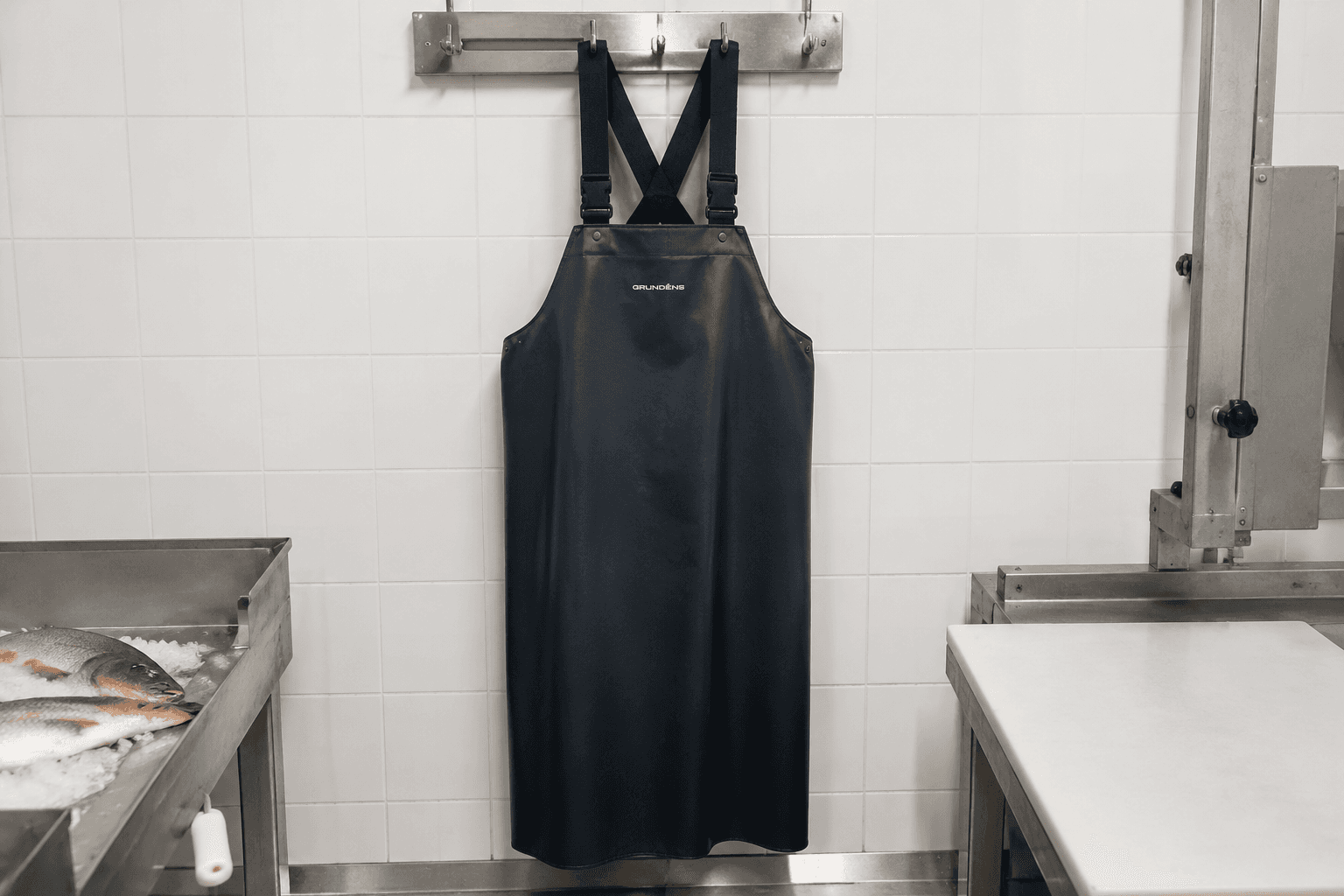
A fishmonger apron sits in a narrower use case than a general kitchen apron. The operator is dealing with wet tables, ice, scales, slurry, knife rinsing, and often cold-chain conditions. That means the garment has to resist not only water, but also low-temperature rigidity and odor absorption. In practice, a seafood apron should be specified like a light industrial barrier garment, not like hospitality wear.
The most common mistake is choosing a cotton or cotton-poly twill because it looks professional in photos. A 240-280 GSM twill may be fine for dry service, but it absorbs fish water and locks in odor. For fish counters, filleting lines, and wet prep stations, a buyer should start with either a coated textile, a laminated fabric, or a tightly woven base with a durable water-resistant finish. The apron should protect the clothing underneath without creating a sweat trap that workers refuse to wear.
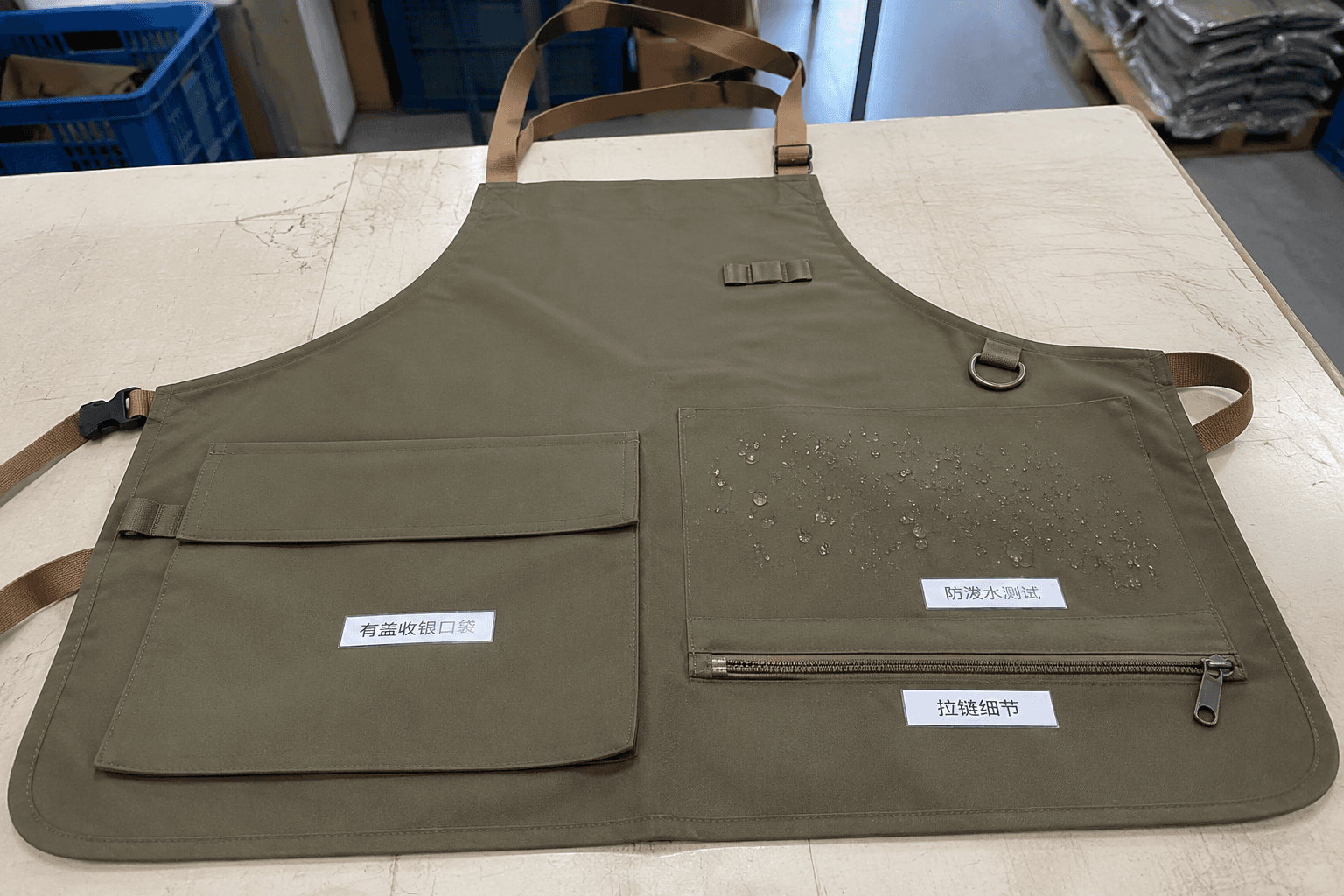
In field use, the difference shows up fast. A good fish market apron sheds rinse water, wipes clean in seconds, and can be sanitized with standard detergent without losing its shape. A weak spec stains at the hem, leaks through the abdomen after repeated movement, and starts smelling even after washing because the fabric structure holds organic residue.
- Use barrier fabrics for direct wet contact areas, especially the front torso and lower panel.
- Keep the garment length aligned with the task: chest-to-knee coverage works for trimming and packing, while shorter bib styles may suit display tasks.
- Specify cleanable surface finishes, because odor management starts with how easily residue can be removed.
- Avoid over-decorated styles; embroidery and thick prints can trap moisture and slow cleaning.
Material options for a seafood apron program
For bulk sourcing, there are four material routes that cover most fishmonger apron programs. The first is PVC-coated polyester, usually on a 150-300D base with coating thickness around 0.18-0.35 mm. This is the most common waterproof fish apron option because it offers strong splash resistance, low cost, and predictable cleaning. It is suitable for fish cleaning, market prep, and wet delivery work, but it can feel stiff in colder rooms if the coating is too heavy.
The second route is TPU or PU laminated fabric. TPU generally gives better flexibility and less plastic smell than basic PVC, while PU laminates can offer a softer hand and slightly better drape. These materials are usually higher in cost, but they are easier to wear for full shifts. In bulk, a TPU seafood apron may land around $2.60-$4.80/pc ex-works depending on fabric weight, pattern complexity, and trim. PVC versions often sit lower, commonly $1.40-$3.20/pc for standard factory programs.
The third route is heavy cotton canvas or cotton-poly twill with a DWR finish. This is only suitable when the apron is exposed to splash rather than continuous soaking. A 280-380 GSM fabric, or roughly 8-11 oz, can work for light wet work food apron use if the buyer accepts more maintenance and lower barrier performance. The fourth route is rubberized or coated technical cloth, used when the buyer wants very high water resistance and chemical tolerance, but these styles can be heavier and less comfortable in long shifts.
- PVC-coated polyester: lowest cost, strong splash resistance, easy wipe-down, moderate stiffness.
- TPU/PU laminated fabric: better flexibility, lower odor retention, usually higher cost.
- Cotton twill or canvas with DWR: better breathability, but weaker against repeated wet exposure.
- Rubberized or specialty coated cloth: suitable for severe wet work, but weight and comfort must be tested carefully.
Waterproof fish apron construction that actually survives use
Fabric is only half the story. A waterproof fish apron fails when seams, bindings, and strap anchors let water in or tear under repetitive pull. If the apron is meant for direct wet work, ask whether the factory uses sewn seams only, double stitching with binding, or seam sealing. For true splash resistance, seam tape or welded construction is more reliable than simple stitching because stitch holes create leakage points.
The neckline and waist system need attention too. A cross-back strap spreads weight better than a simple neck loop, especially on longer bib styles. For workers who move between cold rooms and wet tables, a neck loop can become uncomfortable within 2-3 hours and lead to incorrect wear. Cross-back systems usually cost more, but they improve wear compliance and reduce strain. For a fish market apron, that can matter more than a small difference in piece price.
Hardware selection is another practical issue. Metal grommets, snaps, and D-rings must resist corrosion in salty environments. Stainless steel or plated hardware should be specified, and the buyer should ask for salt-spray or corrosion resistance data if the site is near the coast. Plastic hardware can work, but it needs impact testing because cold-room handling makes brittle parts fail faster.
Cut shape should also support drainage and movement. A straight hem with no shaping may be easier to produce, but a slightly rounded lower edge can reduce snagging and improve walking comfort. Pockets are usually a poor choice on a heavy-wet apron because they collect water and residue. If pockets are needed for tools, they should be slotted, shallow, and easy to invert during washing.
- Request seam construction details in the tech pack: single stitch, double stitch, binding, or sealed seam.
- Specify corrosion-resistant hardware for salt and brine exposure.
- Prefer cross-back straps for shifts longer than 4-6 hours.
- Avoid deep front pockets unless the use case is clearly dry enough to keep them clean.
Odor-managing seafood apron specs for cleaning and hygiene
Odor management is not about adding fragrance or relying on an antimicrobial claim alone. In seafood work, odor builds up when protein residue, oils, and moisture stay trapped in the fabric structure. A smooth, low-absorption shell is the first line of defense. That is why a waterproof fish apron usually outperforms a brushed textile for smell retention, even if the brushed option feels more comfortable at first.
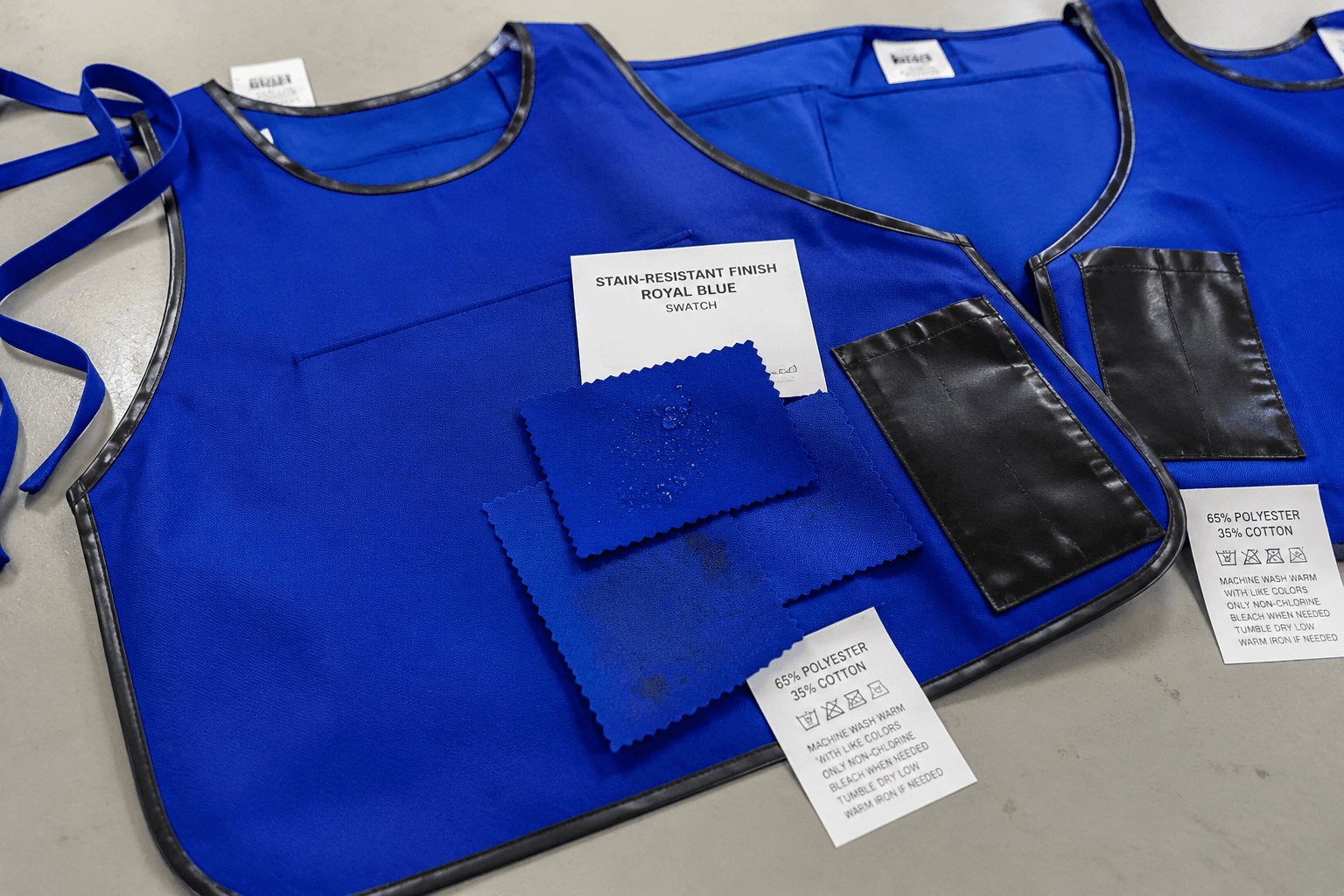
For buyers, the key question is how the apron behaves after repeated cleaning. A good supplier should tell you whether the product can handle standard detergent, warm water, and sanitizing agents without cracking, delaminating, or losing color. For coated aprons, ask for wash-cycle guidance, not just a general statement that the product is washable. In many factory programs, a well-made seafood apron can survive 50-100 industrial wash cycles; premium constructions can go higher if the chemistry is controlled. If the apron is expected to be wiped down daily and machine-washed weekly, the spec should be written around that actual use pattern.
Antimicrobial finishes can help, but they should be treated as secondary. They do not replace washing, and they do not stop odor if the surface itself traps residue. In sourcing terms, the better investment is usually a cleaner surface, tighter seam finishing, and more forgiving wash instructions. If a buyer needs a wet work food apron for a shared staff pool, color coding by shift or department also helps prevent cross-use and makes replacement control easier.
- Ask for wash-test data at a realistic temperature, such as 40 C or 60 C depending on the material.
- Treat antimicrobial claims as supplementary, not as a substitute for cleanable construction.
- Choose light colors only if the operation can manage faster visual inspection and replacement.
- Specify odor control through surface behavior, not perfume or fragrance treatment.
Sizing, trims, and work features for a fish market apron
Sizing in seafood programs should reflect motion, not fashion. A fishmonger apron needs enough coverage to protect the torso and upper legs during leaning, rinsing, and box handling. For adult staff, bib lengths around 90-110 cm are common, with widths sized to prevent gaps at the sides when the worker bends forward. If the apron is too narrow, splash reaches the underlayer; if it is too wide, the garment catches on tubs, hooks, or carts.
Trim choices should be driven by cleaning and durability. Polyester webbing is common, but if it is used near wet zones it should be dense and colorfast. Ties should be long enough for multiple waist sizes, usually 90-120 cm per side for wrap styles. If the apron uses adjustable neck hardware, the adjustment points must be easy to clean and not create pressure points. A fish market apron with complicated hardware can be technically good and operationally bad if staff need to remove it quickly during sanitation.
For branding, keep decoration minimal. Screen print can work on dry bib zones, but thick logos or heavy embroidery on wet surfaces often become dirt traps. If the buyer needs private-label identification, a small woven label or heat-transfer mark in a dry area is usually cleaner. In many supplier programs, this preserves the industrial look while keeping the apron easy to sanitize.
- Typical adult bib lengths: 90-110 cm, adjusted by work height and protection requirement.
- Common fabric weights: 280-380 GSM for heavy cotton styles, or coated bases with 150-300D backing.
- Use long waist ties and simple hardware that can be cleaned without disassembly.
- Keep branding small and place it away from the front splash zone.
How to source fishmonger apron programs from China
When buying from China, the sourcing process should start with a clear use profile. Is the apron for wet fish handling, retail display, filleting, seafood processing, or warehouse transfer? Those are different conditions, and the quote should reflect the exposure level. For a standard fishmonger apron made from stock PVC-coated fabric with basic trims, a common MOQ is 500-1,000 pcs per color or style. If the buyer wants custom color matching, special strap systems, or imported hardware, MOQ can move higher or the unit price can rise by 10-25%.
Lead time depends on whether the factory is using stock material or a custom order. For stock fabric and standard trim, 20-30 days after sample approval is a realistic window. For custom lamination, custom color coating, or special anti-odor treatment, 35-50 days is more typical. During peak export periods, add 7-10 days for material procurement and line queueing. Buyers planning seasonal seafood promotions should lock specs early, because a late sample round often costs more than the actual product difference.
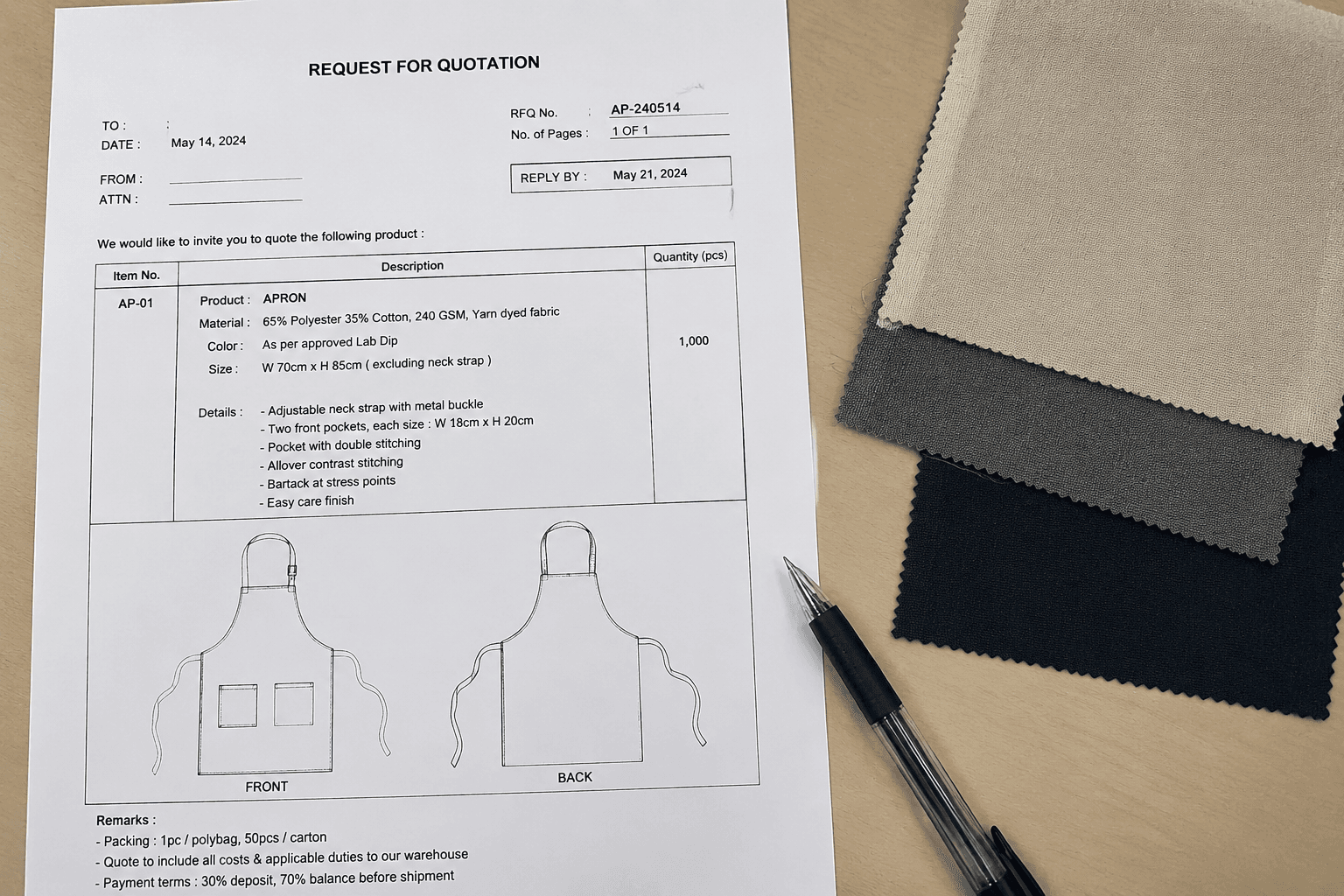
Quality control should focus on measurable failure points. For a waterproof fish apron, ask for water resistance or hydrostatic data if available, seam strength, colorfastness, hardware corrosion checks, and wash performance after defined cycles. If the apron is meant for a seafood apron program with repeated industrial laundering, include a post-wash acceptance standard for shrinkage, delamination, and odor retention. In price terms, do not compare only the quoted unit cost. Compare it against expected service life, replacement rate, and the labor cost of cleaning or rework.
A practical buying approach is to request three tiers of sample: a low-cost construction, a target production spec, and a higher-performance version. That lets the buyer test comfort, barrier behavior, and odor retention before placing a full PO. In our experience, the better decision is usually not the cheapest apron, but the one that stays functional through the actual cleaning rhythm of the site.
- Ask for a detailed tech pack with fabric composition, coating thickness, strap type, hardware material, and wash instructions.
- Budget MOQ at 500-1,000 pcs for standard styles, higher for custom coatings or special trims.
- Plan 20-30 days for stock-material production and 35-50 days for custom-material programs.
- Use sample rounds to compare comfort, splash protection, and wash durability before confirming bulk.