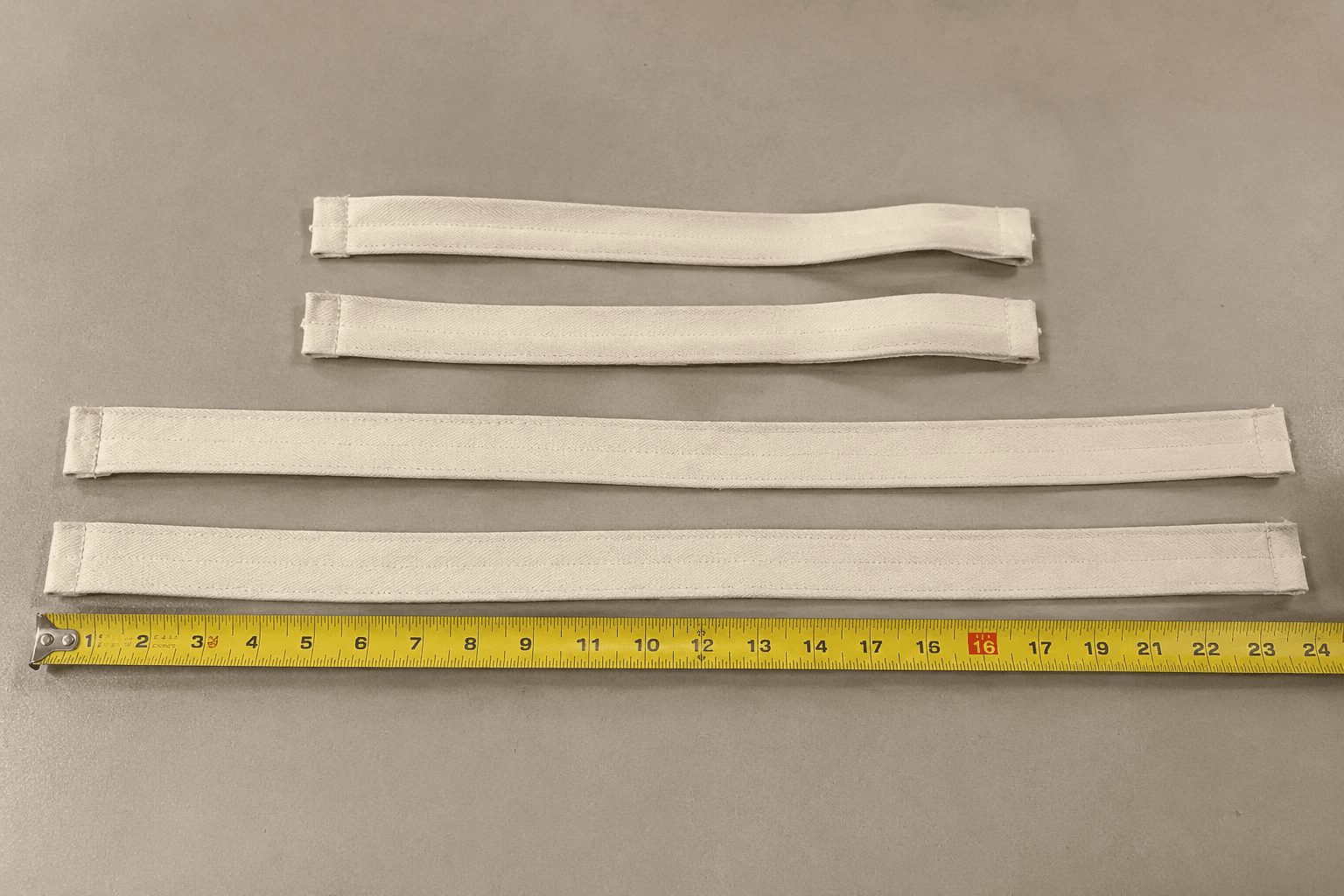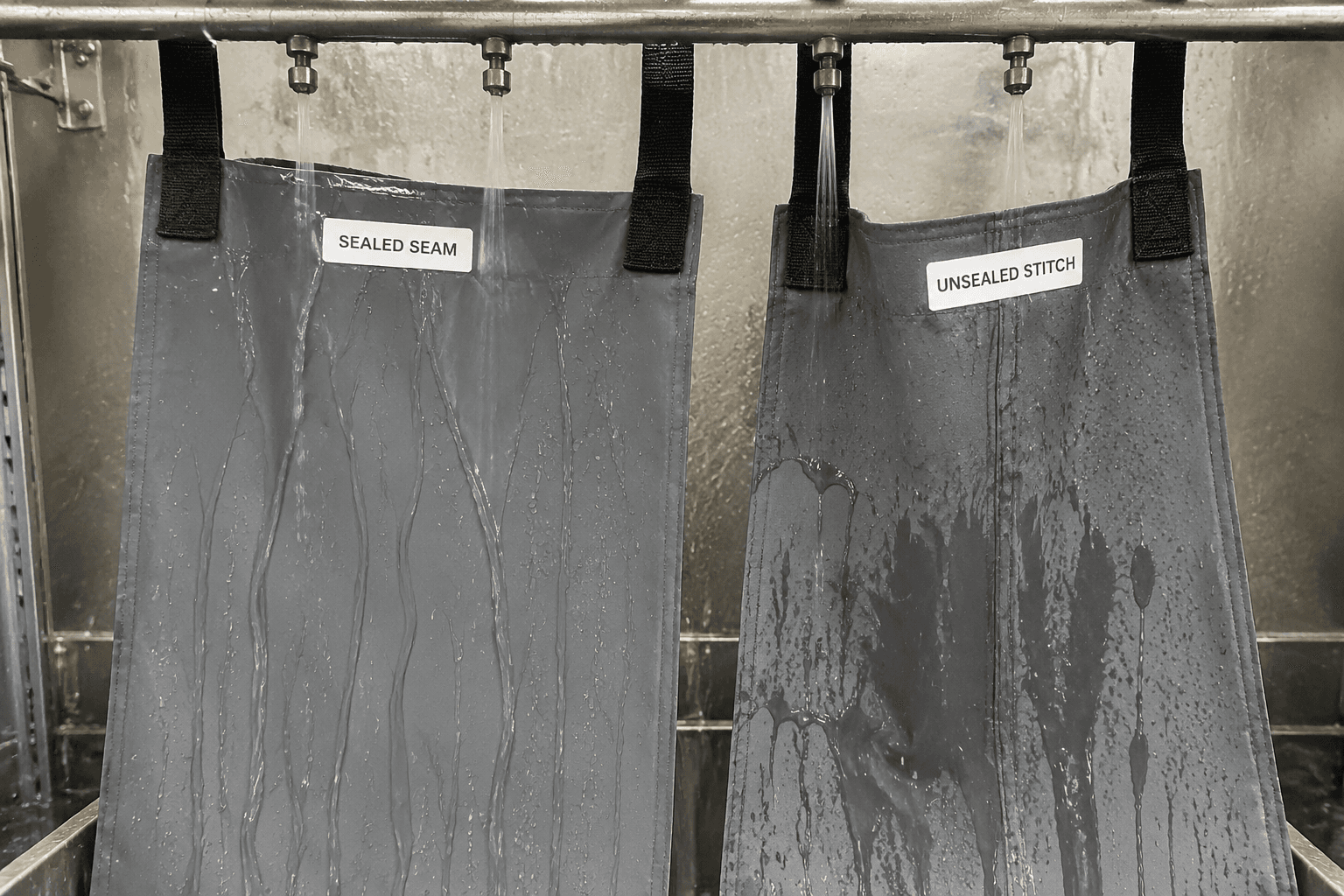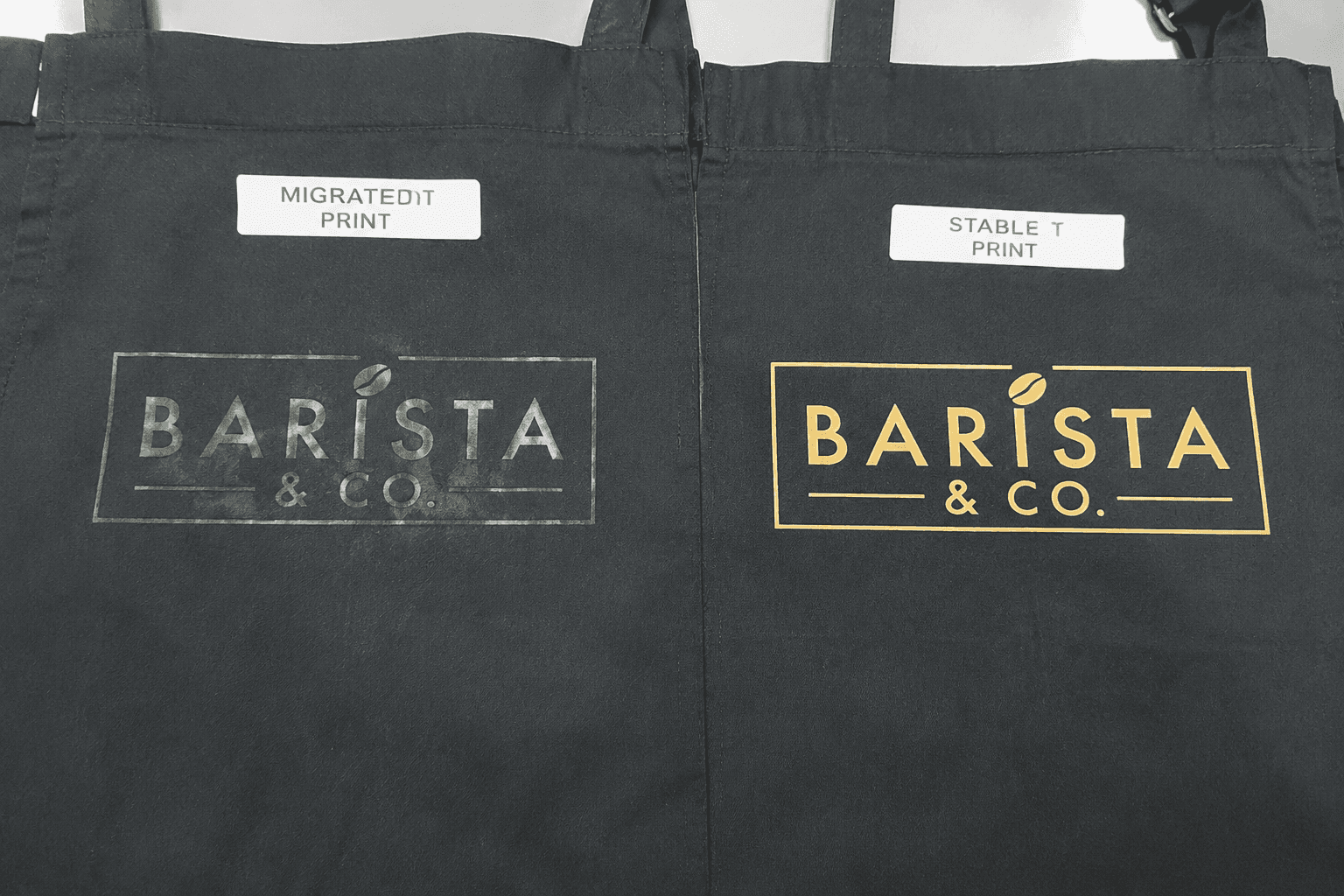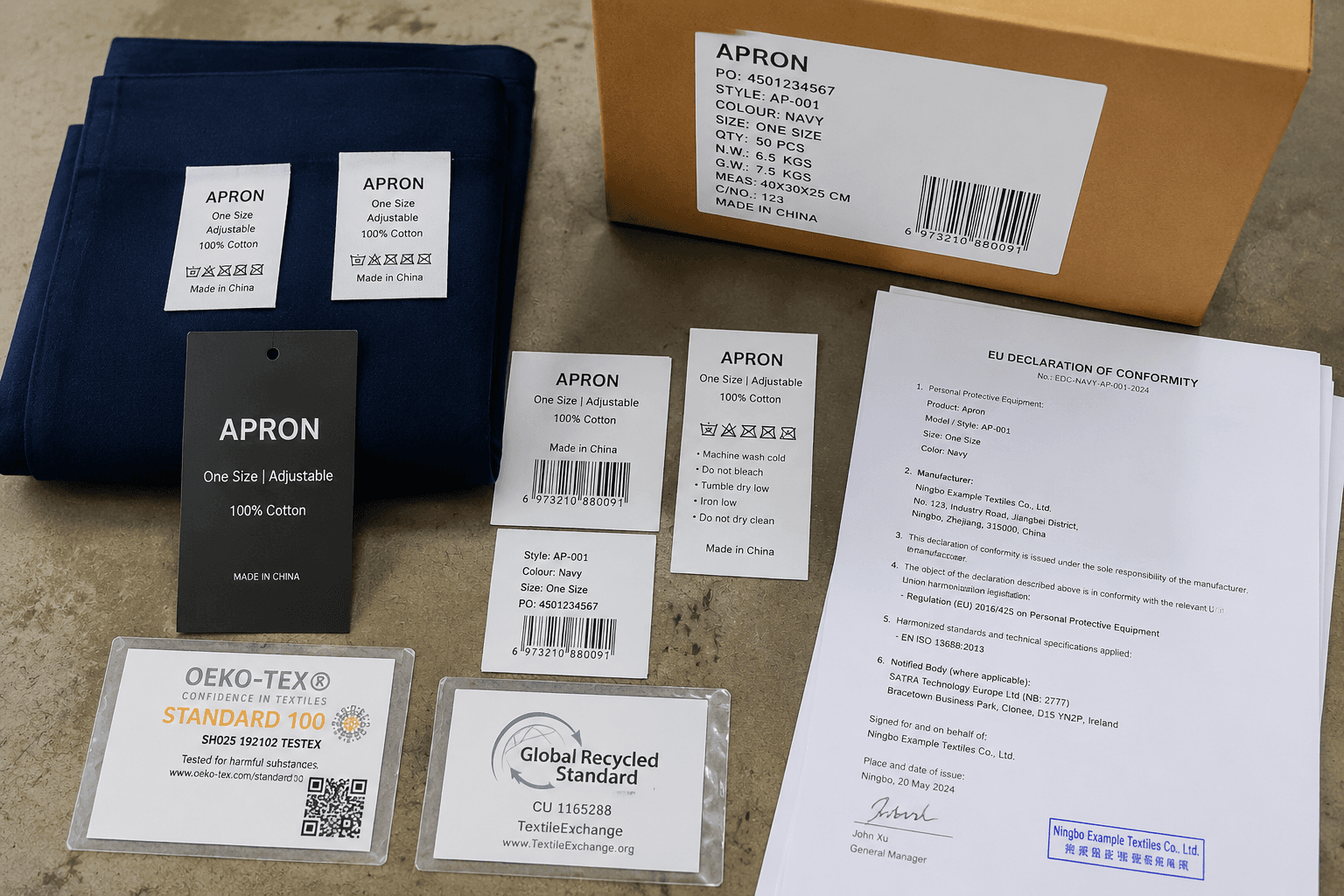
For EU-bound retail programs, gpsr aprons are now a sourcing control point that should be settled before PP sample approval. A buyer placing private-label aprons needs to know who the EU responsible person is, which factory records support the product safety file, and how each shipment can be traced to material lots, trim batches, decoration runs, sewing dates, carton numbers, and packing lists.
The documentation load should follow the apron design. A plain 200 GSM cotton twill bib apron with no metal hardware may need a compact file. A 10 oz canvas cross-back apron with antique brass sliders, PU patch, screen print, woven brand label, insert card, and retail polybag needs broader component evidence and a more detailed risk review. A children's craft apron needs closer checks on tie length, detachable parts, packaging warnings, and chemical evidence.
For buyers sourcing from China, the right timing is before bulk fabric and trims are booked. BOM confirmation, care label proof, responsible person wording, packaging proof, test planning, and carton marking should move together. If records are built during development, a standard adult apron file usually adds 5 to 10 calendar days. If records are rebuilt after packing, relabeling, retesting, or supplier declaration chasing can delay shipment or sales release by 7 to 21 days.
- gpsr aprons should have a product safety file before shipment, with style-level documents separated from lot-level production records
- The EU responsible person must be confirmed before care labels, inserts, carton marks, barcodes, and marketplace product data are finalized
- Effective apron traceability links style code, color, BOM version, fabric lot, trim lot, decoration batch, sewing date, carton range, and shipment record
- Common weak points are metal adjusters, PU or PVC patches, coatings, inks, recycled packaging claims, long ties, and missing supplier declarations
- A basic adult apron file can usually be prepared in 5 to 10 calendar days; multi-trim, coated, gift-pack, or children's apron programs often need 10 to 15 days
- For private-label apron orders, MOQ, customization level, and component complexity affect compliance cost more than the apron category itself
What gpsr aprons require before PO release
EU GPSR readiness for retail aprons: traceability, responsible person and product files starts with controlled product identity. In sourcing terms, gpsr aprons require a clear link between the retail SKU, the EU economic operator, and the factory records proving what was made. This is not one universal certificate. It is a document set for each SKU or style family: approved specification, BOM, material composition, labeling proof, packaging proof, risk review, relevant test evidence, production records, final inspection report, and shipment traceability.
File depth should match construction. A 180 GSM poly-cotton waist apron with two pockets and no decoration is low complexity. A 240 GSM cotton canvas chef apron with D-rings, screen print, woven neck label, and belly-band packaging has more control points. A children's apron, even at 500 pcs, needs additional review because the intended user changes the risk profile. The category name is less important than fabric weight, hardware, decoration, packaging, and user age.
The commercial risk is timing. A normal 3,000 to 8,000 pc private-label apron order often needs 30 to 45 days for bulk production after deposit, material approval, and PP sample release. If the compliance file starts during development, document collection can run beside fabric booking and trim purchasing. If it starts at final inspection, a missing trim declaration, wrong responsible person address, or care label correction can collide with the vessel date.
- Confirm importer, seller, and EU responsible person before PO release
- Freeze the BOM covering fabric, straps, thread, labels, hardware, decoration, packaging, and inserts
- Use one style code structure across specifications, production records, carton marks, and shipping documents
- Decide the test plan and supplier declarations before bulk materials are cut
GPSR aprons traceability from fabric roll to carton
A workable traceability system for gpsr aprons is lot-based and disciplined. It does not require expensive software, but it must connect the main materials and production events. At minimum, buyers should expect records for shell fabric, lining if used, webbing or neck straps, waist ties, buckles, D-rings, woven labels, care labels, decoration batch, packaging, production date, carton range, and shipment reference. If a retailer asks a question six months later, the buyer should be able to identify the affected lot and cartons without searching chat records.
A practical factory structure is style code + color code + BOM version + bulk lot number. Fabric rolls are received under a mill lot or invoice reference, then checked for width, shade, defects, and weight, such as 200 GSM twill, 240 GSM canvas, or 12 oz heavy canvas. Cutting issues should carry a batch card. Sewing output should be linked to line number and date. Decoration should be recorded by print order, ink system, heat transfer film, or embroidery batch. Finished cartons should show PO number, carton number, quantity, style, color, and destination reference.
This level of detail speeds response. If a complaint concerns a sharp burr on a metal slider, the factory can identify which trim lot was used and whether other shipments share it. If a fiber composition question arises, the mill lot and incoming inspection record can be checked against the care label. With a complete file, a first response can often be prepared within 24 to 48 hours. Without it, teams may spend a week reconstructing the shipment and still fail to prove which component entered which carton range.
- Fabric record: supplier, composition, width, GSM or oz weight, color, mill lot, inspection result, and cutting issue date
- Trim record: webbing, buckles, D-rings, snaps, rivets, adjusters, woven labels, care labels, thread, and batch references
- Decoration record: screen print, heat transfer, embroidery, wash, coating, ink or film type, approval date, and production batch
- Shipment record: PO number, carton range, ex-factory date, final inspection report, packing list, and container loading record
Responsible person details for EU apron labels
For China-made aprons sold in the EU, the factory usually supports documentation but is not normally the EU responsible person. That role generally sits with the EU importer, the brand owner's EU entity, an authorized representative, or another economic operator established in the EU. The name and address must be agreed before label and packaging artwork are approved, not after the goods are packed.
For private-label aprons, responsible person information may appear on the product, packaging, accompanying document, or related retail data depending on the buyer's distribution route. From the factory side, the key requirement is exact wording. Small differences between a care label, insert card, carton mark, and marketplace listing create avoidable review questions. If details change after label production, simple sticker correction may cost about $0.03 to $0.06 per pc. Replacing sewn labels, reprinting inserts, or opening cartons can push correction cost to $0.08 to $0.18 per pc plus 3 to 6 working days.
The responsibility split should be written into the order file. The factory can hold specifications, BOM records, declarations, inspection data, photos, and shipment documents. The buyer or EU operator should control legal claims, language requirements, responsible person appointment, retailer submission, and authority response. Both sides need access to the same current file version. A technically acceptable apron can still be delayed if nobody can confirm who answers a market surveillance request within 24 to 72 hours.
- Confirm the EU responsible person before care label, insert, carton, barcode, and retail data approval
- Use the same legal name and address across product data, packaging, internal files, and retailer submissions
- Define whether the factory, importer, or brand stores the master file and lot records
- Avoid temporary distributor details unless current and future stock are covered by a clear transition plan
Product safety file content for apron buyers
A product safety file for aprons should be compact enough to maintain and complete enough to answer basic questions. The simplest structure is one style-level folder plus one lot-level folder for each production run. The style folder holds stable product information. The lot folder proves what was actually produced, inspected, packed, and shipped. This separation prevents a common failure: the approved specification is clean, but the bulk lot used a different buckle, label, print method, or packaging component.
At style level, include the approved specification sheet, technical drawing, measurement table, tolerances, BOM, fabric composition, target weight, color standards, artwork files, care label proof, packaging specification, and risk assessment. For aprons, the risk review should address the real design. Long waist ties can create entanglement concerns. Metal hardware needs checks for burrs, corrosion, and relevant heavy metal or nickel evidence. Coated fabrics and PU patches need composition clarity. Retail polybags may need suffocation warnings or thickness checks depending on the market and retailer policy.
At lot level, include the fabric mill lot reference, trim batch records, decoration batch details, in-line inspection notes, needle control or metal control records where used, final random inspection report, photos of final labels and packaging, packing list, carton marks, and shipment reference. Many buyers use AQL 2.5 for major defects and AQL 4.0 for minor defects on standard apron inspections, with critical defects set at zero acceptance. The file should state the applied sampling plan, inspection date, lot size, defect count, and result.
- Specification: finished measurements, tolerances, fabric composition, construction details, and target weight such as 200 GSM twill or 10 oz canvas
- BOM: shell fabric, pocket fabric, straps, thread, labels, backing, interlining, hardware finish, print ink, packaging, and inserts
- Risk review: tie length, detachable parts, sharp edges, coatings, chemical concerns, age grading, and packaging warnings
- Evidence: test reports, supplier declarations, label proof, packaging proof, final inspection report, photos, packing list, and shipment record
Where retail apron compliance usually fails
Most retail apron compliance gaps come from secondary components, not the main fabric. Cotton, poly-cotton, and linen-look woven fabrics are usually manageable when fiber composition, restricted substance controls, and care labeling are correct. Problems appear when retail features are added late: imitation leather patches, antique-finish hardware, pigment prints, puff prints, water-repellent coatings, detachable towel loops, recycled packaging claims, kraft sleeves, individual barcode stickers, and gift boxes.
Each added feature affects cost and timing. A basic adult bib apron in 180 to 220 GSM cotton twill with one patch pocket, standard care label, and bulk polybag may sit around $1.80 to $3.20 FOB per pc at 3,000 pcs, depending on fabric market, color, and decoration. Add adjustable metal hardware, two woven labels, logo print, insert card, belly band, and retail carton packing, and the same apron may move to $2.60 to $4.80 per pc. Compliance work rises because more suppliers, materials, and claims must be supported.
Testing time should be planned realistically. A limited fabric or print test often takes 4 to 7 working days after samples reach the lab. Broader chemical or multi-component packages can take 7 to 12 working days. Label reprint or insert correction may add 3 to 6 days. Replacing undocumented hardware after review can add 10 to 20 days if a new supplier, new sample approval, and new bulk trim production are required. These delays are usually avoidable when component screening is done before PP approval.
- Metal adjusters and D-rings: check burrs, plating quality, corrosion risk, supplier declaration, and consistency across lots
- PU, PVC, coatings, and patches: confirm composition, surface finish, restricted substance evidence, and care behavior
- Prints and transfers: record ink or film type, curing method, wash durability, colorfastness, and final artwork approval
- Packaging: include inserts, polybags, belly bands, stickers, cartons, recycled claims, warnings, and barcode data in the file
Factory, importer and lab responsibility split
Apron projects run better when responsibility is assigned line by line. The factory should normally own the manufacturing specification, BOM accuracy, material receiving records, production traceability, in-process quality checks, final inspection coordination, and collection of upstream supplier declarations. The buyer or importer should own the sales market, product claims, age grading decision, language requirements, retail packaging content, EU responsible person appointment, and final compliance release. The lab provides test evidence; it does not manage the product file for either side.
This split matters in pricing. For straightforward apron styles, document compilation may be absorbed into normal order handling when MOQ is sensible and materials are standard. For low-volume customized orders, the workload can be disproportionate. A 500 pc trial order with special hardware, unique print, custom insert, and private-label packaging may require nearly the same file work as a 5,000 pc repeat order. Buyers should expect either a higher unit price, a document handling charge, or a simplified specification.
Use three control gates. At development approval, confirm the intended user, materials, risk points, claims, and likely test matrix. At pre-production, verify that approved fabric, trims, labels, and responsible person details match the file. At pre-shipment, check finished goods photos, carton marks, AQL findings, packing list, and lot traceability. This prevents a common sourcing failure: the apron is commercially acceptable, but the supporting file describes an earlier sample or a different packaging version.
- Development gate: lock intended user, claims, BOM, decoration method, packaging format, and missing declarations
- Pre-production gate: approve PP sample, care label, responsible person details, trim lots, and test plan
- Pre-shipment gate: confirm final photos, AQL result, carton marks, packing list, lot records, and file completeness
Implementation plan for gpsr aprons from China
For existing ranges, start with a style-family gap review. Group adult bib aprons, waist aprons, cross-back aprons, utility aprons, coated aprons, and children's aprons separately. Then check each group against a file checklist: specification, BOM, fabric data, trim data, artwork, care label, packaging, responsible person details, test reports, declarations, final inspection records, and shipment traceability. Many buyers already hold 60 to 80 percent of the needed information, but it is often scattered across merchandising, quality, logistics, and factory teams.
For new gpsr aprons, build the file as the product is created. During sampling, record fabric weight and construction, such as 150 GSM chambray, 210 GSM twill, 240 GSM canvas, or 12 oz heavy canvas. Confirm whether straps are self-fabric, cotton webbing, polyester webbing, or faux leather. Record hardware finish, print method, embroidery backing, wash process, and packaging components. During PP sample approval, freeze care label text, responsible person wording, barcode placement, carton mark layout, and final BOM version.
Plan time and cost openly. Standard adult apron launches usually need a 5 to 10 calendar day compliance buffer if documents and supplier data are available. Aprons with multiple trims, coatings, specialty prints, gift packaging, or children's sizing should carry a 10 to 15 day buffer. Practical OEM MOQs are often 500 to 1,000 pcs per color for standard fabrics and 2,000 to 3,000 pcs per color for custom dyed fabric or exclusive trim. Compliance work does not disappear at low MOQ, so small private-label runs should avoid unnecessary components.
GPSR readiness does not require buyers to abandon established China apron sourcing, but it does require earlier decisions and cleaner records. When design, BOM, responsible person details, safety file, and lot traceability are managed together, EU retail programs can stay on a predictable 30 to 45 day bulk timeline. When these items are treated as after-shipment paperwork, even a simple apron can become a slow and expensive launch problem.