For buyers sourcing aprons for food processing, sanitation, industrial laundry, maintenance, cleaning, and light splash tasks, labeling is a compliance control, not a packing detail. Industrial apron labeling requirements affect customs files, distributor receipt, user safety information, traceability, and the factory’s ability to ship without rework.
Many apron programs still lock fabric, coating, dimensions, and FOB target first, then review labels after PPS or after trim booking. That sequence is expensive. A bib apron in 210 GSM poly-cotton twill, a 320 GSM cotton canvas workshop apron, and a 480 GSM PVC-coated processing apron may share a similar shape, but they do not share the same care method, limitations, or user information needs.
For a professional OEM workflow, the labeling architecture should be frozen before bulk cutting. That means confirming what data stays on the apron, what moves to the leaflet, which language versions are required, how lot traceability will be printed, and who signs off legal wording. In a standard custom apron order, artwork approval typically needs 2 to 4 working days, custom label production 7 to 12 days, leaflet printing 8 to 14 days, and a late wording change can delay shipment by 3 to 10 days.
- Approve industrial apron labeling requirements before bulk cutting, trim PO release, and PPS sign-off.
- Separate functions clearly: the sewn label identifies the apron; the leaflet carries intended use, cleaning, storage, inspection, limitations, and replacement guidance.
- Normal custom labeling for aprons adds about $0.03 to $0.18 per piece at OEM scale, while post-production relabeling commonly costs $0.25 to $0.80 per piece plus 3 to 10 extra days.
- If an apron references waterproofing, splash resistance, heat, cut, or chemical-related performance, the wording must match the actual tested or specified scope.
- Add label version, leaflet version, barcode, and carton mark checks to inline and final inspection at AQL 2.5 major and AQL 4.0 minor.
Why industrial apron labeling requirements should be frozen before trim release
EN ISO 13688 sets the general framework for protective clothing marking and information, but in apron sourcing the operational issue appears much earlier. Labels affect trim MOQ, artwork approval, sewing method, packaging format, final inspection, and shipment timing. For aprons, this matters because the usable label area is often smaller than on jackets or coveralls, while the end-use conditions can be harsher.
A buyer ordering 5,000 bib aprons in 210 GSM poly-cotton twill for janitorial work may need only a woven brand label and a printed care label. A buyer ordering 3,000 workshop aprons in 320 GSM cotton canvas may need a size tab and multilingual leaflet. A buyer ordering 8,000 fish-processing aprons in 480 to 520 GSM PVC-coated polyester may need compact on-garment identification plus a separate instruction sheet because the apron is frequently rinsed, wiped, and folded wet. These are different trim structures with different costs and lead times.
The cost impact is not theoretical. At normal OEM volumes, a simple label set usually adds $0.03 to $0.08 per apron. A fuller set with size tab, folded label, polybag sticker, and multilingual leaflet is more commonly $0.10 to $0.18 per apron, and can rise to $0.22 to $0.28 when the order is below 2,000 pieces or split across many language versions. Custom woven label MOQ is often 3,000 to 5,000 pieces per design, while printed satin labels can be practical from 1,000 pieces.
The timing impact is just as important. Artwork review normally takes 2 to 4 working days. Custom labels then need 7 to 12 days, and booklet-style inserts or folded leaflets usually need 8 to 14 days. If label text remains open after bulk cutting, the factory either holds sewing for missing trims or finishes aprons into temporary stock awaiting inserts. Both options increase handling, mispacking risk, and shipment delay.
- Freeze apron label text and placement before PPS approval.
- Budget $0.03 to $0.18 per piece for normal custom labeling.
- Allow 7 to 12 days for labels and 8 to 14 days for leaflets.
- Define who owns legal wording before issuing bulk trim POs.
What must stay on the apron under EN ISO 13688 labeling practice
For professional apron programs, the on-garment marking should be legible, durable, and tied to the exact SKU supplied. In most B2B orders, buyers should expect the manufacturer or responsible operator identification, a style or article code, a size designation where relevant, and the care or maintenance reference required for the market. If the apron carries protective positioning beyond basic identification, any standard references or performance statements must remain consistent with the technical file and user instructions.
Apron construction limits how much information can be sewn in. On textile bib aprons, the common solution is one main neck label plus one secondary care label at the side seam or back waist seam. On coated aprons made from PVC, TPU, PU-coated, or nitrile-based materials in the 300 to 600 GSM range, buyers often use a smaller sewn, welded, or printed identifier because excessive stitched labels can create local stiffness, cleaning inconvenience, or avoidable needle-hole concentration.
A common sourcing mistake is trying to print six languages of warnings onto one narrow satin label. That usually produces poor readability, difficult sewing, and frequent end-user complaints. For a 10,000-piece EU apron order, a cleaner structure is concise apron identification plus a separate leaflet carrying intended use, storage, washing or wipe-down method, limitations, inspection criteria, and replacement guidance. This keeps the apron practical while preserving the required information.
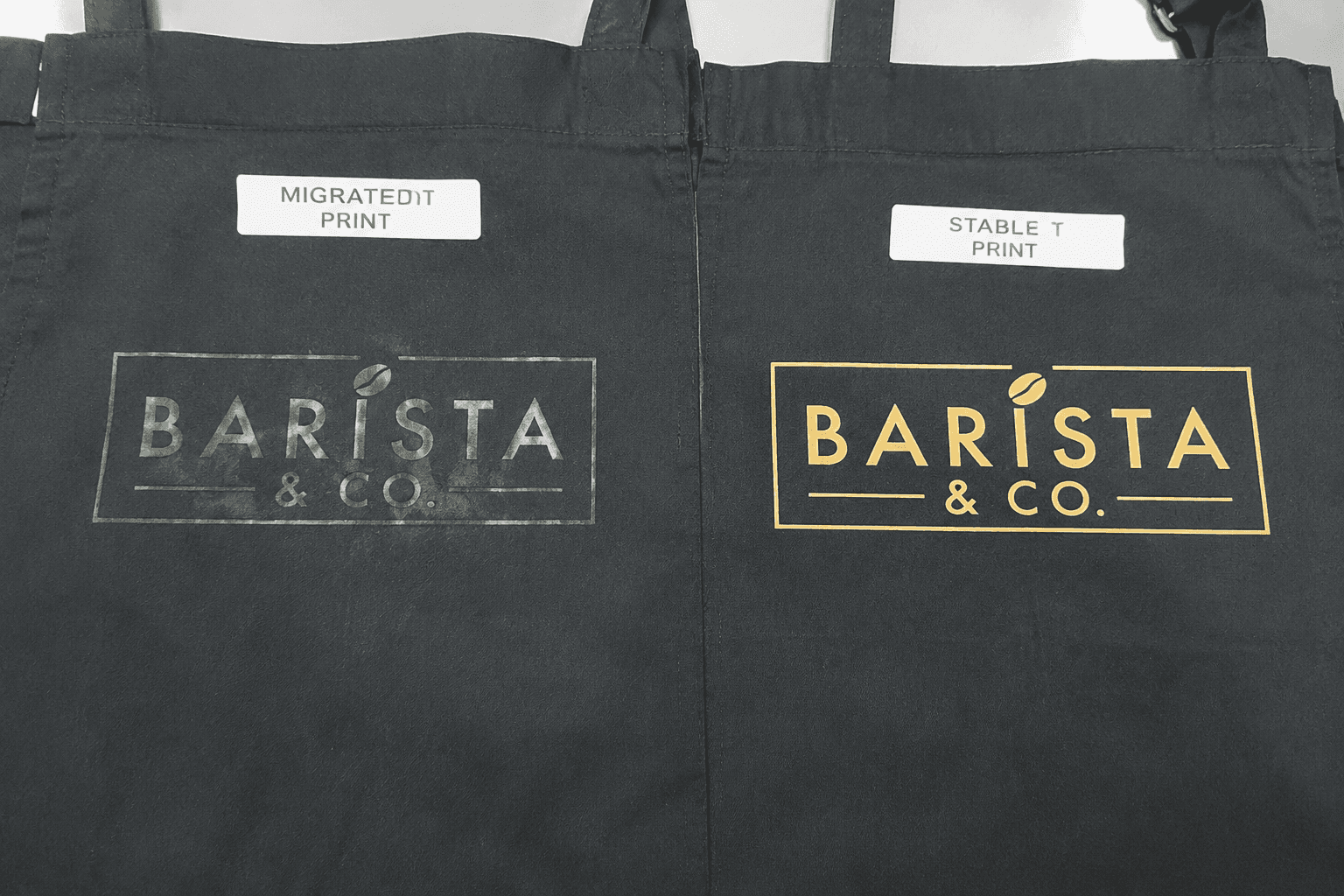
Durability must be checked under the actual care regime. If a label becomes unreadable after 10 industrial wash cycles at 60°C, after repeated chlorine wipe-downs, or after abrasion against a stainless worktable, it has failed in service even if it looked acceptable at final packing. For aprons, durability is part of usability, not an optional cosmetic detail.
- Keep one style code aligned with the PO, BOM, test file, and carton mark.
- Use concise on-apron information and move long warnings into the leaflet.
- Choose placement that does not interfere with cleaning or coated material performance.
- Verify label legibility after the real wash or wipe process.
Industrial apron labeling requirements and user instructions are not the same control
One of the costliest mistakes in apron sourcing is treating the sewn label and the user instruction sheet as interchangeable. They are not. The sewn label identifies the apron and links it to the approved SKU. The leaflet explains how the apron should be used, cleaned, stored, inspected, and replaced. For aprons used around detergents, oils, diluted chemicals, food residue, blood, or aggressive sanitation routines, that distinction is essential because the practical limits of use are normally explained in the user information, not on a small neck label.
Removing the leaflet rarely creates meaningful savings. On a 5,000-piece apron order, deleting a printed insert may save only $0.02 to $0.06 per piece, or roughly $100 to $300 total. If the shipment later needs destination-side relabeling, repacking, and revised documents, the typical rework cost is $0.25 to $0.80 per piece, or $1,250 to $4,000 before warehouse labor, delay penalties, and internal sourcing time. For a B2B apron buyer, deleting the leaflet to save a few cents is usually false economy.
Instruction depth should match the apron application. A 220 GSM poly-cotton maintenance apron may need concise guidance covering intended use, standard washing, dry storage, and replacement when torn, seam-broken, or permanently contaminated. A 500 GSM PVC-coated sanitation apron normally needs more detail, including rinse procedure, wipe-down chemicals, maximum service temperature, coating inspection, and clear rejection criteria for cracks, pinholes, delamination, or damaged tie points. If the buyer wants to mention splash resistance or waterproof construction, the wording should match the actual tested or specified capability rather than sales language.
The cleanest factory control is to assign one leaflet version code to each apron SKU and destination market, then carry that code through the BOM, packing spec, inline checklist, and carton records. This prevents a common repeat-order error: the correct apron packed with an outdated insert or the wrong language set.
- Use the sewn label for identity and the leaflet for use, care, limits, and replacement.
- Do not remove the leaflet to save $0.02 to $0.06 per apron.
- Assign one leaflet version code per SKU and destination market.
- Review language sets again on every repeat order before print release.
How fabric, GSM, and cleaning method change industrial apron labeling requirements
Material selection changes the correct labeling method. In OEM production, textile aprons commonly use 180 to 240 GSM poly-cotton twill for cleaning or service use, and 260 to 340 GSM cotton canvas for workshop or retail craft use. Waterproof industrial aprons more often use PVC-coated polyester, TPU laminate, PU-coated fabric, or nitrile-based materials in the 350 to 600 GSM range, depending on flexibility, barrier performance, and washdown conditions. These constructions do not respond the same way to stitching, printing, washing, sanitizing, or folding.
On woven textile aprons, a woven neck label plus printed satin care label is usually cost-efficient and durable if the apron is home-laundered or industrially washed under normal conditions. On thick coated aprons, multiple stitched labels can create stiffness, needle penetration points, or hygiene-cleaning inconvenience. In those cases, buyers often approve a smaller label footprint, smoother placement, or an alternative identification method where construction permits. The aim is durable readability without compromising apron function.
Cleaning method is where many label systems fail. If the apron will be industrially laundered at 60°C or 75°C, the print method and substrate must tolerate repeated cycles. If it will be sanitized with chlorine-based cleaners, quaternary disinfectants, or alcohol wipes, the ink and surface need resistance to fading, smearing, and edge lift. A low-cost label that survives one showroom sample is not good enough for a professional apron program running weekly wash cycles.
For repeat SKUs above 3,000 pieces, it is good practice to add a simple label durability check during PPS: either a 5-cycle wash test for textile aprons or a 5-cycle wipe-down test for coated aprons. This small step costs very little and catches weak substrates before bulk packing. It is especially useful when the supplier changes ink, label stock, or subcontract trim source between orders.
- Match the label substrate to the apron’s actual cleaning regime.
- Review stitched labels carefully on coated aprons to avoid unnecessary perforation.
- Run a 5-cycle wash or wipe legibility test during PPS on repeat styles.
- Use placement that remains readable after folding, wearing, and sanitation.
The approval errors that trigger relabeling, claims, and warehouse holds
The first recurring problem is mismatched product identity. The apron label may show one style number, the leaflet another, the carton a shortened factory code, and the test report a development reference. When a distributor rejects a lot or a buyer needs to isolate a complaint batch, that mismatch slows traceability. A better structure is one commercial style code, one optional internal article code only if necessary, and one standard lot format such as YYMM plus PO sequence or line code.
The second problem is overstated protective language. Buyers sometimes want to mention chemical protection, cut resistance, or heat resistance because the apron gives some practical splash or abrasion benefit. If the apron was not specified and validated for that performance, the label and instructions should not imply it. A waterproof PVC apron for washdown work can be described accurately through intended use, cleaning method, and limitations without suggesting broad chemical resistance that has not been verified.
The third problem is late language expansion. A salesman sample approved in English only may later need French, German, Italian, Spanish, and Dutch after fabric booking. That often forces a redesign from a simple printed label into a folded booklet label or multilingual insert, changing MOQ, approval time, and packing format. On a normal 30 to 40 day apron production cycle, this type of change can add 4 to 9 days and increase trim cost by $0.03 to $0.09 per piece.
The fourth problem is weak inspection discipline. Many factories inspect stitching, dimensions, coating defects, and carton quantity carefully, but do not check label version, leaflet version, barcode, lot format, or carton mark against the approved file. For aprons shipping to distributor DCs or retailer-managed warehouses, those documentation mismatches can trigger goods-receipt holds even when sewing quality passes AQL 2.5 major and AQL 4.0 minor.
- Keep style code, lot code, leaflet code, and carton mark aligned across all documents.
- Avoid unsupported wording for heat, cut, chemical, or similar protective claims.
- Freeze all language versions before ordering bulk labels and inserts.
- Add label and leaflet version checks to inline and final AQL inspection.
A practical OEM workflow for EN ISO 13688 apron labeling and shipment control
The most reliable apron sourcing programs treat labeling as a gated workflow rather than a finishing detail. Before bulk trim release, the buyer should approve five linked items for each SKU: apron artwork, label artwork, user instruction text, packaging mark, and claim scope. Once those items are frozen, the factory can place trim orders, confirm pack ratio, prepare carton marks, and brief QC. This reduces the risk of unfinished aprons, wrong inserts, mixed-market packing, and shipping holds.
For a standard custom apron order from an OEM factory, a realistic schedule is 2 to 4 days for comment consolidation after sample review, 3 to 5 days for revised artwork and buyer confirmation, 7 to 12 days for custom labels and printed trims, 15 to 30 days for bulk production depending on material and order size, and 2 to 3 days for final inspection and booking. MOQ often starts around 1,000 pieces for simple textile aprons and 2,000 to 3,000 pieces for coated aprons with specialized trims, though exact minimums still depend on fabric stock, color matching, and trim count.
For repeat business, a label matrix by SKU is one of the most effective controls. That matrix should record apron type, style code, fabric composition, coating type, GSM, color, size range, destination market, label version, leaflet version, carton mark version, and revision date. Buyers placing 20,000 to 100,000 aprons per year across multiple SKUs usually save several approval days per order by maintaining this matrix instead of rebuilding each trim set from zero.
Before shipment, labels should be checked physically during final random inspection, not only in office files. Inspectors should compare the sewn label, size mark, polybag sticker, leaflet, inner carton if used, and master carton mark against the approved BOM and packaging file. On flat-packed waterproof aprons, they should also confirm that labels remain readable after folding, do not stick to coated surfaces, and do not transfer ink onto the apron body.
This control is inexpensive insurance. On industrial apron FOB programs ranging roughly from $2.20 to $6.80 per piece depending on fabric, coating, and trim complexity, a few extra inspection hours cost far less than destination-side relabeling, warehouse quarantine, or distributor chargebacks caused by incorrect apron documentation.
- Approve apron art, label art, leaflet text, packaging mark, and claim scope together.
- Use a SKU label matrix to control repeat orders and market variations.
- Inspect sewn labels, inserts, polybags, and cartons against one approved version set.
- Plan 7 to 12 days for trims and 15 to 30 days for bulk apron production.