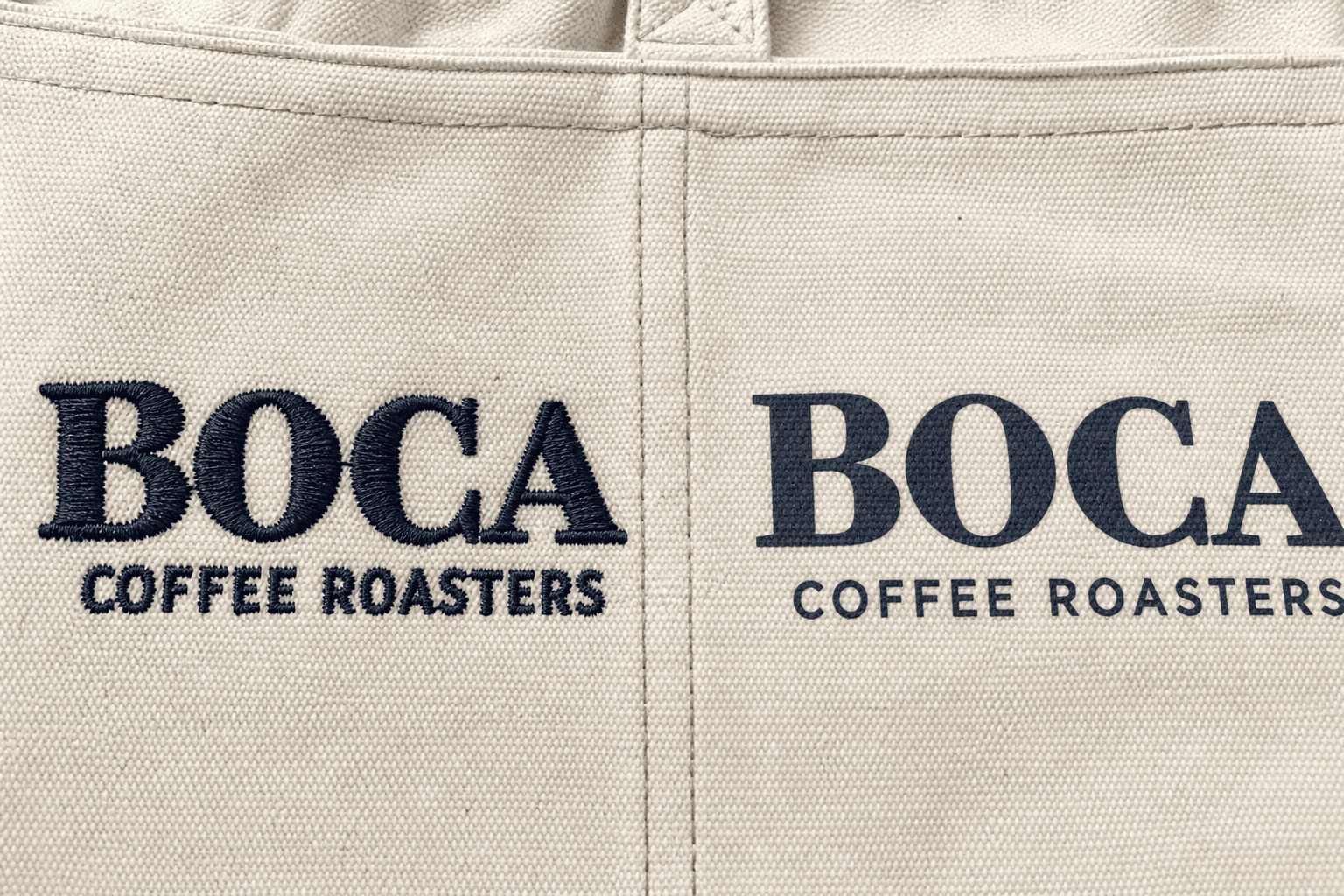
For bulk apron programs, the choice between embroidery and screen print affects more than logo appearance. It changes fabric selection, pocket construction, sampling time, packing method, inspection criteria and final landed cost. Buyers comparing apron embroidery vs screen print should look at the full production route, not only the decoration quote.
In our Zhejiang apron factory, we see embroidery used most often for hospitality, cafe, barista, salon and premium retail aprons where the logo must look structured and durable. Screen print is more common for promotional aprons, event aprons, staff uniforms with large artwork, seasonal designs and price-sensitive programs. Both methods can be correct, but they fit different order sizes, fabrics and brand standards.
This article explains the sourcing trade-offs behind apron embroidery, apron screen print and combined decoration. The numbers below reflect typical China OEM apron production using cotton canvas, poly-cotton twill, denim, TC fabric and polyester, with normal commercial tolerances.
- Embroidery usually costs more per logo, but it gives a premium raised finish and strong wash durability on midweight and heavyweight aprons.
- Screen print is more economical for large artwork, especially when the design uses one to three solid colors and the order exceeds 500-1,000 pcs.
- MOQ is driven by fabric, apron construction and logo process together, not by decoration alone.
- Embroidery is better for small chest logos, name marks and long-term uniform programs, while screen print is better for large front graphics and promotional campaigns.
- Artwork complexity, stitch count, color count and print size can change the decoration cost more than buyers often expect.
- The lowest-risk sourcing route is to confirm fabric GSM, logo size, placement and wash standard before finalizing the apron branding method.
Apron embroidery vs screen print: the basic production difference
Embroidery decorates the apron by stitching thread directly into the fabric. For aprons, this normally requires a digitized logo file, thread color matching, backing material and machine time calculated by stitch count. A small left-chest logo may be 4,000-8,000 stitches, while a dense restaurant emblem or badge can reach 12,000-20,000 stitches. The higher the stitch count, the higher the unit cost and the longer the machine time.
Screen print applies ink onto the apron surface through mesh screens. Each color normally needs one screen, and each print position needs set-up. For simple apron screen print work, a one-color logo on the bib or lower pocket is efficient. A three-color graphic across the apron body is still manageable, but registration, ink curing and fabric absorption must be controlled. On dark fabric, an underbase layer may be needed, which increases cost and hand feel.
The practical difference for sourcing managers is that embroidery price is mainly driven by stitch count and machine time, while screen print price is mainly driven by color count, print size, set-up and order quantity. A 70 mm embroidered logo and a 250 mm printed logo cannot be compared only by visual size; they use completely different cost structures.
- For a 60-80 mm chest logo, embroidery often gives a cleaner premium result than print.
- For a 200-300 mm center-front design, screen print is usually more cost-efficient than embroidery.
- For fine gradients, photographic artwork or very small text, neither standard embroidery nor basic screen print may be ideal without artwork adjustment.
- For repeat corporate uniform orders, the original embroidery tape or print screens can reduce future set-up cost if the design remains unchanged.
Cost structure: what changes the $/pc quote
For custom apron branding, decoration cost should be separated from apron sewing cost in the quotation. A basic poly-cotton bib apron may cost around US$1.20-2.20/pc FOB before decoration depending on fabric weight, pocket structure and quantity. A heavier 10 oz cotton canvas apron may be US$3.20-5.80/pc before decoration. The branding process then adds its own cost layer.
For embroidery, a small logo may add roughly US$0.25-0.60/pc at 1,000 pcs if the stitch count is moderate. A larger dense logo can add US$0.80-1.80/pc or more. One-time digitizing charges are often US$15-50 per logo depending on complexity, although some factories absorb this into the order when the volume is sufficient. Buyers should ask the supplier to quote based on stitch count, not only logo dimensions.
For screen print, a one-color one-position logo may add around US$0.12-0.35/pc at 1,000 pcs, excluding screen charges. Screen set-up may be US$15-35 per color per position. At 300 pcs, the same print can feel expensive because the screen cost is spread over fewer aprons. At 3,000-5,000 pcs, screen print becomes very efficient, especially for simple solid artwork.
- A 1-color 100 x 80 mm apron screen print at 1,000 pcs may add about US$0.12-0.25/pc plus screen cost.
- A 3-color 220 x 260 mm print may add about US$0.35-0.80/pc depending on ink, underbase and registration difficulty.
- A 6,000-stitch apron embroidery logo may add about US$0.25-0.45/pc at bulk quantity.
- A 15,000-stitch embroidery logo may add about US$0.75-1.40/pc and can slow output if several placements are required.
- Metal eyelets, leather patches, contrast straps and special pockets often affect total cost more than a simple one-color print.
MOQ and lead time for apron embroidery vs screen print
MOQ is not fixed only by the decoration method. It depends on fabric availability, dyeing requirements, webbing color, hardware, packing, and whether the apron is a stock style or a fully customized pattern. For stock fabric and a standard bib apron, many China apron factories can accept 300-500 pcs for embroidery or screen print. For custom dyed fabric, yarn-dyed stripes, special denim wash or custom hardware, practical MOQ may be 1,000-3,000 pcs.
Embroidery is often more flexible at low quantity because there is no screen for each color. Once the embroidery file is digitized, a factory can run 100-300 pcs for sampling, pilot orders or executive uniform sets, provided the base apron fabric is available. However, embroidery still needs line balancing. If an apron has three embroidered positions, output can be slower than sewing, and the decoration may become the bottleneck.
Screen print has stronger economies of scale. For 100-200 pcs, screen charges and color matching time can make the unit cost unattractive. For 1,000 pcs and above, especially with a one-color or two-color logo, print output is fast. A typical timeline is 2-4 days for artwork confirmation and screen making, 1-2 days for strike-off approval, then 3-7 days for bulk printing depending on quantity and curing capacity.
For normal OEM apron orders, buyers should plan 7-10 days for pre-production sample development and approval, then 20-35 days for bulk production after deposit and final artwork approval. Orders using available greige or stock fabric can be faster. Orders requiring fabric dyeing, lab dips, embroidery strike-offs, print strike-offs, carton marks and third-party inspection should be scheduled closer to 35-50 days.
- Stock apron style with one embroidered logo: typical MOQ 300-500 pcs, bulk lead time 15-25 days after sample approval.
- Custom apron with stock fabric and one screen print: typical MOQ 500-1,000 pcs, bulk lead time 20-30 days.
- Custom dyed canvas apron with embroidery: typical MOQ 1,000-2,000 pcs, bulk lead time 35-45 days.
- Large multi-color print on dark apron fabric: allow extra 3-7 days for strike-off, underbase testing and curing checks.
Durability after washing, abrasion and daily apron use
Durability must be judged against the real use of the apron. A cafe apron washed twice per week for one year faces different stress from a promotional apron used for one trade show. For long-term uniform programs, embroidery normally performs better in repeated laundering because the thread is physically stitched into the fabric. With good polyester embroidery thread, colorfastness is stable and the logo can remain readable after 30-50 domestic wash cycles, assuming the fabric itself is suitable.
Screen print durability depends on ink type, fabric surface, curing temperature and wash method. A properly cured plastisol or pigment print on cotton or poly-cotton can survive regular washing, but cracking, fading and edge wear are possible if the ink layer is too thick, the fabric shrinks heavily or the washing temperature is high. Aprons used in kitchens also face oil, detergent, abrasion from counters and frequent folding around pockets.
The fabric matters. Embroidery on a 180 GSM plain polyester apron may pucker because the base fabric is too light. Screen print on a rough 12 oz canvas may lose sharpness because the surface is textured. A 240-280 GSM TC twill or 280-350 GSM cotton canvas often gives a good balance for logo apron programs, but the right answer depends on the logo and use case.
Buyers should define wash requirements in the purchase order. A vague instruction such as 'durable logo' is difficult to inspect. It is better to specify 30 degrees C or 40 degrees C wash, tumble drying or line drying, colorfastness grade, acceptable shrinkage and whether the logo must pass rubbing or tape tests. For institutional laundries, the supplier should be told early because industrial wash can be much harsher than home laundering.
- Choose embroidery for staff aprons expected to stay in use for 6-18 months.
- Choose screen print for event aprons, campaign aprons and large visual designs where lower unit cost is important.
- Avoid dense embroidery on very light fabric below about 180-200 GSM unless testing confirms no puckering.
- Avoid thick print layers across pocket openings or high-fold areas because cracking risk increases.
- Request a wash-tested pre-production sample when the apron is part of a repeat uniform program.
Fabric, placement and construction limits for apron embroidery
Apron embroidery looks simple on a specification sheet, but placement and construction decide whether production is smooth. The embroidery frame needs flat access to the area being stitched. A logo placed too close to the neck strap seam, pocket edge, eyelet or curved bib top may be difficult to hoop. For this reason, embroidery is usually added before final sewing when the logo sits on a panel, or after sewing when the area remains flat and accessible.
Common embroidery placements include the center bib, left chest, pocket corner and lower side panel. For bib aprons, a 60-90 mm wide logo is usually safe. A 100-120 mm logo may still work if the artwork is not too dense. Large embroidery across the full apron front is rarely economical and may feel stiff against the wearer, especially on canvas or denim.
Fabric stability is important. Cotton canvas, denim, twill and heavier poly-cotton hold stitches better than thin plain-weave polyester. If the apron uses stretch fabric, washed denim, slub cotton or uneven texture, the logo may need extra backing and adjusted stitch density. Too many stitches can pull the fabric and create a wavy bib. Too few stitches can make the logo look weak.
Small text is another common problem. As a practical factory rule, embroidered letters below 4-5 mm height become difficult to read, especially on textured apron fabrics. Fine taglines, QR codes, thin outlines and gradients should be simplified before digitizing. Buyers should provide vector artwork, Pantone references and a clear maximum logo size so the embroidery technician can build a realistic file.
- Best apron fabrics for embroidery include 240-320 GSM TC twill, 280-420 GSM cotton canvas and medium denim.
- High-risk embroidery fabrics include thin polyester, loosely woven cotton, heavily washed denim and very stretchy blends.
- Keep embroidered text at least 4-5 mm high for better readability.
- Keep embroidery away from thick seam intersections, metal hardware and pocket edges unless the factory confirms hooping clearance.
- Approve a physical embroidery strike-off on the actual apron fabric, not only a digital mock-up.
Artwork, color and hand feel in apron screen print
Screen print is strong when the artwork is bold, flat and clear. Many apron buyers use it for center-front logos, slogans, promotional graphics, large restaurant marks and event designs. A one-color white print on black TC fabric or a black print on natural canvas is a classic low-risk option. The print is easy to read from distance and does not add much weight to the garment.
The main limitations are fine detail, color registration and fabric surface. If the logo has four or more colors, thin outlines and small reversed text, screen print can still be done, but each color adds set-up and alignment risk. On textured canvas, edges may not be as sharp as on a T-shirt fabric. On dark aprons, an underbase may be required so the top color stays bright, but that also increases thickness and cost.
Hand feel matters for aprons because the print often sits on the front panel where the wearer bends, folds, ties and leans against counters. A thick print can feel plasticky and may crack over time. Water-based or pigment printing can create a softer hand, especially on cotton, but color brightness and wash performance must be tested. Plastisol can give strong opacity but needs proper curing and may feel heavier.
For food service aprons, placement should avoid areas that receive heavy abrasion, such as the lower front where trays, counters or tools rub constantly. If the apron has a large center pocket, printing before pocket attachment can give a clean full design, but printing over a sewn pocket is more limited. The production sequence must be confirmed before sampling.
- Use one to three solid colors when cost and consistency are priorities.
- Avoid small reversed text below about 2 mm line thickness on textured apron fabric.
- Add an underbase on dark fabric when bright logo colors must match closely.
- Confirm whether the print is plastisol, water-based, pigment or discharge before approving the order.
- Specify whether the logo should sit on the bib panel, lower panel, pocket or strap because each position has different printing access.
Inspection standards and buyer approval points
Most logo apron disputes come from approval gaps, not from the basic decoration method. A buyer may approve a digital mock-up, but the factory is producing on 280 GSM canvas with seam allowances, pocket folds and real thread or ink behavior. Digital renderings are useful for layout, but they cannot confirm hand feel, stitch tension, print opacity or wash performance.
For embroidery, the approval package should include digitized artwork, thread color references, logo size in millimeters, placement distance from top edge or side seam, and a physical strike-off. For example, a buyer may specify a 75 mm wide logo centered 95 mm below the top bib edge, using Madeira or domestic polyester thread matched to Pantone 186C as closely as available. The factory should also show the reverse side if backing appearance matters.
For screen print, approval should include print size, color count, Pantone references, ink type, print position, acceptable registration tolerance and curing confirmation. A normal commercial tolerance for placement may be plus or minus 5-10 mm depending on apron style and order volume. For premium retail aprons, tighter control may be requested, but it should be stated before quotation because it may slow production and increase inspection time.
During final inspection, the logo should be checked under consistent lighting. Inspectors should compare bulk pieces against the approved pre-production sample, not against a phone photo. Common defects include embroidery puckering, loose threads, wrong thread color, missing stitches, print pinholes, ink smears, poor opacity, off-center placement and color bleeding after washing. For large orders, AQL inspection should include both sewing defects and decoration defects.
- Approve fabric lab dip or stock fabric cutting before logo strike-off when color contrast is important.
- Measure logo placement from fixed garment points, not from a visual estimate.
- Keep one signed pre-production sample at the factory and one with the buyer or agent.
- Include decoration defects in the inspection checklist, not only garment sewing defects.
- For repeat orders, keep approved thread codes, screen files, digitizing files and placement specs in the supplier file.
How to choose the right method for a logo apron program
The best decision starts with the business use of the apron. If the apron is a permanent staff uniform for a cafe chain, hotel, bakery, bar, salon or workshop, embroidery is often worth the higher cost because it gives a stable, premium logo and handles regular washing well. If the apron is for a launch event, supermarket promotion, giveaway, cooking class or seasonal campaign, screen print usually gives better value because the graphic can be larger and the unit cost lower.
Order quantity also guides the decision. Below 300 pcs, embroidery may be simpler if the base apron is available and the logo is small. From 500-1,000 pcs, both methods are practical, and the artwork should decide. Above 2,000 pcs, screen print becomes very competitive for large designs, while embroidery remains suitable for compact brand marks. For mixed staff levels, some buyers use screen print for general staff aprons and embroidery for supervisor or premium-service aprons.
Brand positioning should be considered, but it should not override technical reality. A luxury-looking logo loses value if it puckers on thin fabric. A low-cost print is not economical if it cracks after five washes and the buyer must replace uniforms early. The correct embroidery vs print decision is the one that matches fabric GSM, logo size, wash expectation, MOQ and target FOB price.
For many apron programs, a hybrid solution works well: a small embroidered brand logo on the bib and a printed campaign message on the lower panel or back side. This raises the decoration cost, but it can separate permanent branding from seasonal messaging. The factory must review the production sequence carefully so embroidery, printing, pocket sewing and pressing do not damage each other.
- Choose apron embroidery when the logo is small, the fabric is stable and the apron will be washed repeatedly.
- Choose apron screen print when the graphic is large, the quantity is high and the design uses limited solid colors.
- Use woven labels or leather patches when the logo has very small detail and neither embroidery nor print gives the desired look.
- Ask for separate quotes for apron cost, logo cost, set-up cost, sample cost and packing cost to compare options clearly.
- Before confirming bulk production, approve one complete sample with final fabric, final logo method, final placement and final packaging.