For commercial apron programs, apron binding is not a cosmetic afterthought. It changes fray control, abrasion resistance, laundering behavior, sewing minutes and visual balance across the whole style. A design that looks simple on a sketch can become difficult in production when a 240 GSM poly-cotton twill shell, rounded bib curve, double patch pocket and 32 mm tape all need to feed through one binder without twisting, tunneling or leaving raw edge exposed.
Buyers usually specify binding for three practical reasons: to protect exposed edges, to create a sharp contrast frame, or to add brand color without the extra setup cost of print or embroidery. To buy it correctly, the tech pack needs more than a trim swatch. It should confirm tape composition, open width, target finished reveal, shrinkage compatibility, curve performance, join placement and whether the construction can still run efficiently at 1,000, 5,000 or 20,000 pcs.
In apron sourcing, binding adds both trim cost and labor cost. A stock 25 mm cotton herringbone tape on a 10 oz canvas bib apron is usually straightforward. A custom-dyed 38 mm polyester tape on a 300 GSM recycled canvas style can reduce line speed, increase in-line checks and add 7 to 12 days before trim is bulk-ready. Buyers should evaluate apron binding together with MOQ, laundering requirements, approved tolerances and agreed AQL before issuing the purchase order.
- Specify apron binding by application area, tape composition, open width and finished visible width; tape width alone is not enough for bulk control.
- For most adult professional aprons, a finished visible binding width of 10 mm to 14 mm gives the best balance of edge coverage, proportion and sewing stability.
- Cotton and 65/35 poly-cotton tapes usually sew more reliably than slick polyester tape on bib curves, lower corners and pocket mouths.
- Full-edge binding commonly adds 0.8 to 2.5 SMV and about $0.12 to $0.45 per piece FOB, depending on apron size, fabric weight, total edge length and seam bulk.
- Stock trim colors can support apron MOQ from 500 to 1,000 pcs with bulk lead times around 25 to 35 days; custom-dyed tape often starts at 2,000 to 3,000 pcs per color and adds roughly 7 to 12 days.
- Because binding defects are highly visible, buyers should lock AQL, visible-width tolerance and tape-join rules before bulk cutting and PPS approval.
What apron binding changes in apron production and sourcing
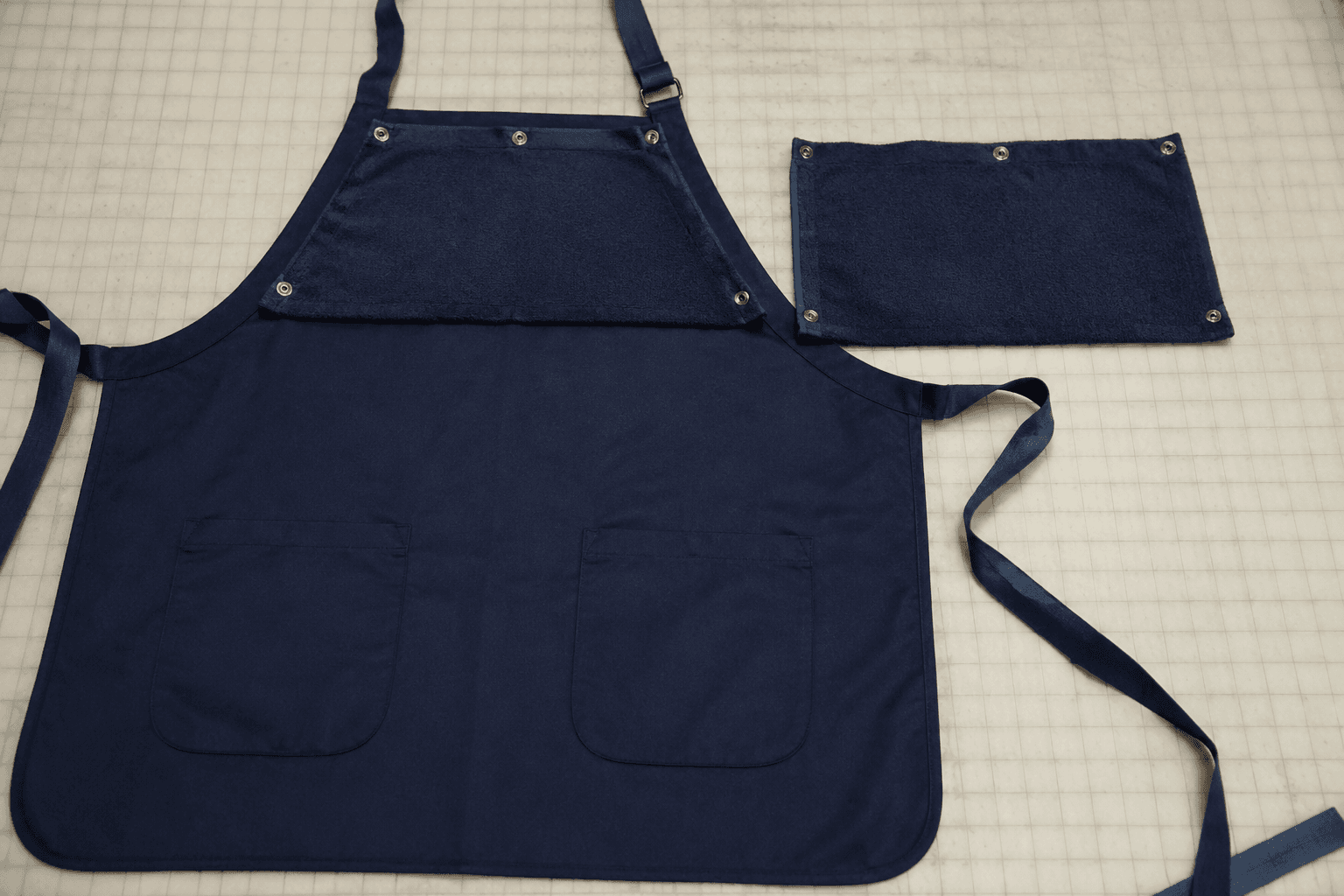
In apron manufacturing, apron binding is a folded tape or strip sewn over a raw edge to protect the shell fabric and create a controlled border. On bib aprons, buyers most often use it around the outer body edge, top bib curve, pocket mouth, side slit and towel-loop opening. On waist aprons, full perimeter binding is less common because long straight hems are usually faster and cheaper to sew as turned hems.
Binding adds the most value where the edge stays exposed to rubbing, repeated handling and frequent washing. Typical applications include 8 oz to 12 oz cotton canvas café aprons, 210 to 270 GSM poly-cotton hospitality aprons and denim service aprons with contrast trim. In these categories, binding can reduce visible fray, improve abrasion resistance at exposed edges and give a cleaner presentation for uniform and retail programs.
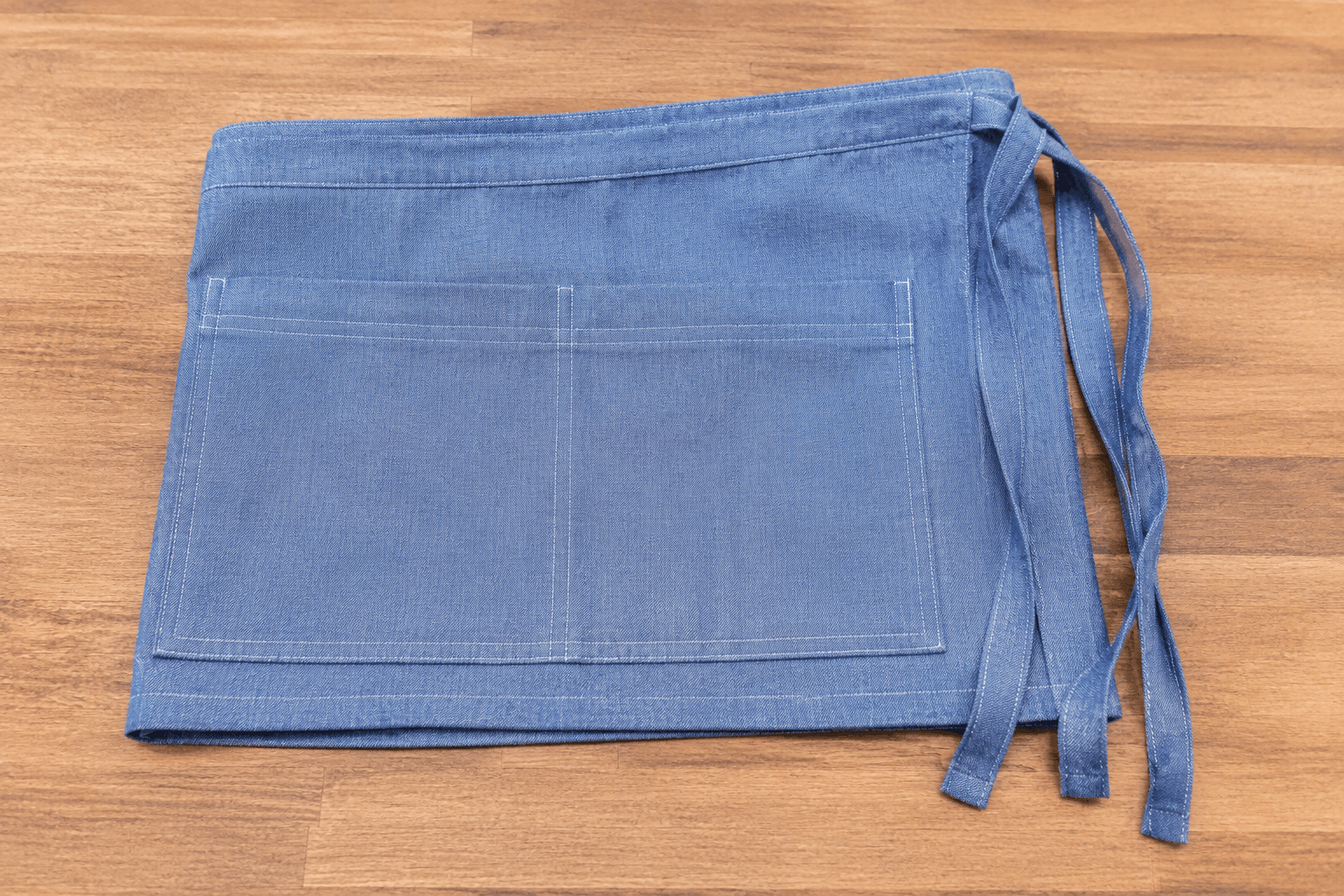
It is not automatically the strongest or lowest-cost finish in every location. On a long flat bottom edge, a 20 mm turned hem with double-needle topstitching is often more wash-stable and usually cheaper than a bound edge. Binding earns its cost on curved edges, high-visibility borders and styles where the edge color is part of brand identity. Buyers should decide at concept stage whether binding is functional, decorative or both, because that choice affects FOB, trim planning, sample approval and production capacity.
- Full perimeter binding gives the clearest framed look but adds the most sewing minutes.
- Pocket-mouth binding adds contrast color at lower cost than binding the entire apron edge.
- On fabrics above 260 GSM or about 10 oz, corner bulk becomes a primary sewing constraint.
- For orders above 3,000 pcs, straight bottom hems are usually more economical than bound bottom edges.
Apron binding materials: realistic choices by fabric weight and wash use
The most common binding materials for custom aprons are cotton herringbone tape, cotton twill tape, 65/35 poly-cotton tape, polyester tape and self-fabric binding cut from the shell cloth. Each option behaves differently in folding, shrinkage, colorfastness and feeding through the binder. For most OEM apron orders, cotton and poly-cotton tapes are easier to control because they hold crease better and slip less than many polyester constructions.
Cotton herringbone tape is widely used on premium canvas aprons in 8 oz, 10 oz and 12 oz weights. Standard open widths are usually 25 mm, 32 mm and 38 mm, producing a visible finished width of roughly 10 mm to 14 mm depending on folder setup and seam thickness. It gives a matte workwear look and handles moderate curves better than stiffer synthetic trims. Its main risk is shrinkage. If the apron body is garment-washed or enzyme-washed and the tape is not pre-tested, the bound edge can rope or pucker after one to three wash cycles.
Poly-cotton tape is often the most practical choice for hospitality and foodservice buyers. It usually offers better dimensional stability than 100% cotton, a softer hand than many polyester tapes and competitive pricing at volume. Common stock shades such as black, navy, natural, beige, bottle green and red are often available without custom dyeing. Polyester tape can deliver brighter shades, stronger lightfastness and lower moisture pickup, but it is more slippery under the binder and less forgiving on tight curves or thick seam intersections.
Self-fabric binding gives the closest shade match because the trim comes from the same cloth lot as the apron body. It works best on lighter shell fabrics around 180 to 240 GSM. Once the shell moves into 300 to 340 GSM canvas, self-binding usually creates more cutting waste, more corner bulk and slower handling at the sewing line. It may look clean on a salesman sample but become the least efficient option in bulk.
- Cotton herringbone tape suits matte canvas and workwear-style aprons.
- 65/35 poly-cotton tape gives the best balance of sewability, wash stability and cost for many uniform programs.
- Polyester tape supports brighter contrast shades but increases slip risk on curves and corners.
- Self-fabric binding matches shade exactly but usually reduces efficiency on heavy aprons.
- Stock tape colors may support trim MOQ of 500 to 1,000 pcs, while custom-dyed tape often starts at 2,000 to 3,000 pcs per color and width.
How to set apron binding width: finished reveal, apron size and border proportion
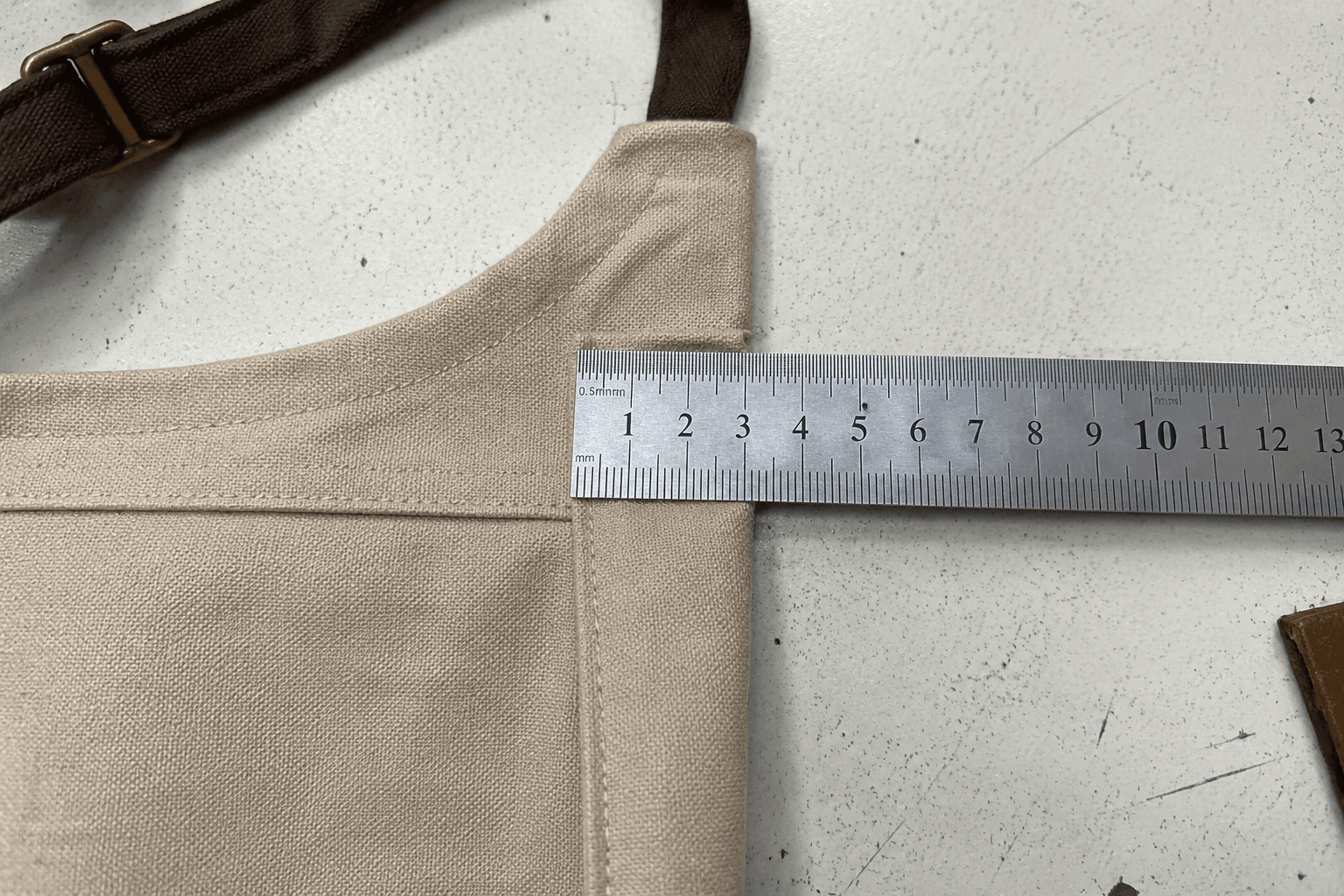
A common sourcing mistake is approving tape by open width only. In production, the more useful control point is the finished visible reveal after folding, stitching and pressing. A 25 mm tape may finish at about 10 mm to 12 mm visible width, while a 32 mm tape may finish closer to 12 mm to 14 mm. The result depends on folder size, stitch placement, seam capture and shell thickness. If the buyer wants a specific border effect, the tech pack should state the target visible width, not only the trim mill width.
On adult bib aprons around 70 x 85 cm to 75 x 90 cm, the most practical visible width is usually 10 mm to 14 mm. Below 8 mm, coverage tolerance becomes tight and raw-edge exposure risk rises, especially at bib curves and lower corners. Above 16 mm, the border can dominate the apron face unless the product is intentionally heavy-duty or fashion-led. Wider tape also increases trim consumption per unit, which matters once the order volume reaches 10,000 pcs or more.
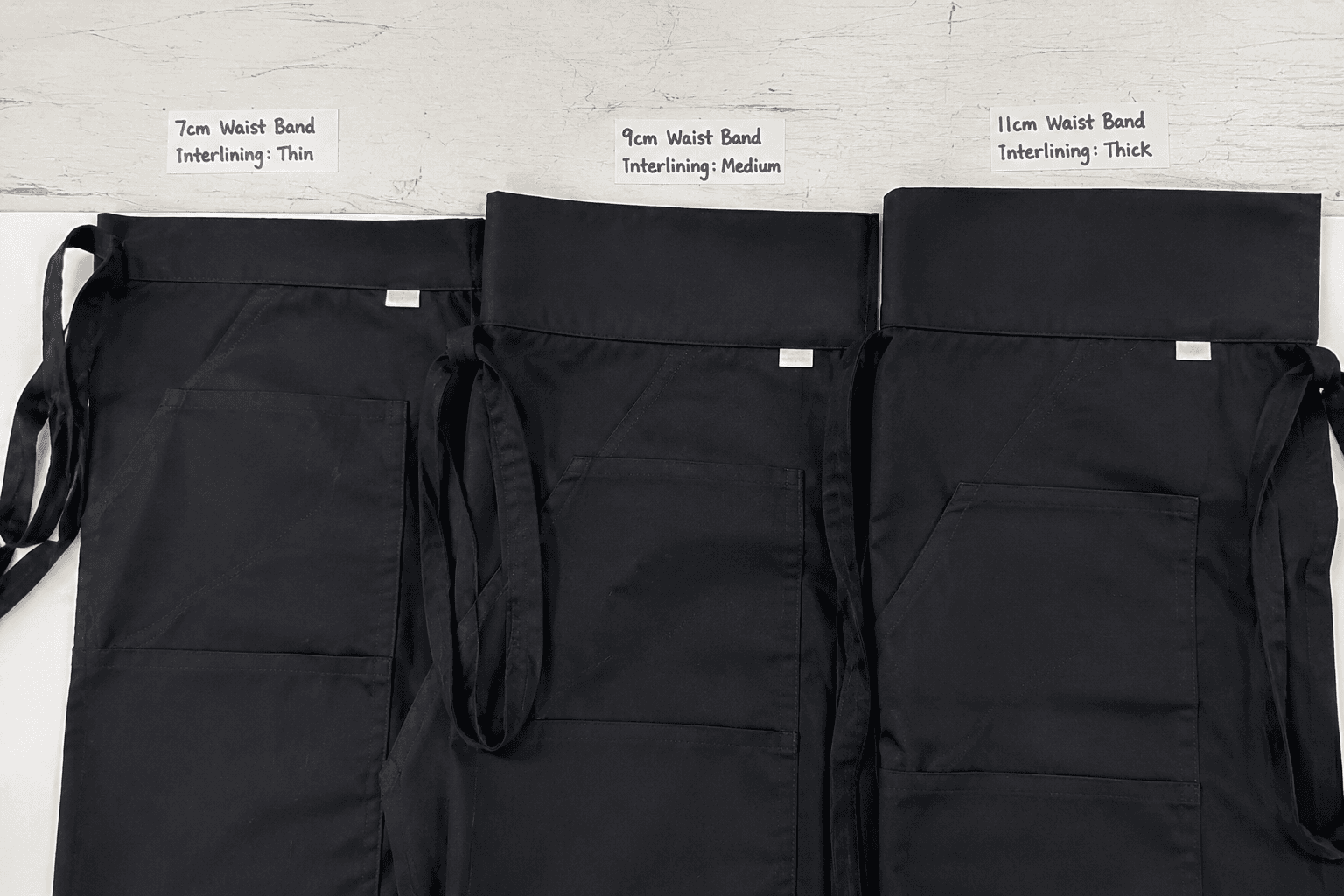
Fabric weight and seam build-up matter as much as appearance. A 190 GSM poly-cotton shell with a single patch pocket can accept a narrower binding cleanly. A 300 GSM canvas apron with divided pockets, towel loop, bartacks and strap insertions usually cannot. In these zones, a narrow tape may fail to cover raw edges, while an over-wide tape may tunnel if binder tension is not adjusted correctly. The right width is the one that covers securely, turns consistently and still looks proportional after washing.
Width should also match product positioning. A 10 mm reveal usually fits hospitality aprons that need a tidy, uniform look. A 12 mm to 14 mm reveal suits 10 oz to 12 oz canvas barista aprons where the trim is part of the selling image. Once the visible width reaches 16 mm or more, buyers should cost it as a deliberate design feature, not as a standard finishing detail.
- 10 mm to 12 mm visible width is the most common range for standard adult bib aprons.
- 12 mm to 14 mm visible width is usually better for heavier canvas and stronger contrast framing.
- Children’s aprons often scale down to 8 mm to 10 mm visible width.
- A wider reveal can add $0.02 to $0.06 per piece on high-volume runs because of higher tape consumption.
Where apron binding fails first: curves, corners and pocket-mouth bulk
Most bulk binding defects do not begin on long straight seams. They show first at rounded bib tops, inside curves, lower corners and pocket mouths where the tape crosses multiple layers. These are the points where a contrast edge can pleat, twist, ripple or show uneven reveal if the tape structure is wrong for the shape or the stack-up is too thick for the selected width.
For curved areas, softer constructions and bias binding usually perform better than stiff straight-grain tape. Bias binding can stretch and compress slightly as it turns around the curve, helping it lie flatter. The trade-off is higher trim consumption, more movement in washing and a slightly higher risk of distortion if pressing is inconsistent. Straight-grain herringbone tape is more stable on long flat edges and often gives a cleaner topstitch line, but it does not naturally wrap a tight curve without careful easing and skilled handling.
Pocket openings need separate technical review because seam thickness changes quickly. A single-layer pocket mouth on a 210 GSM poly-cotton apron is usually simple. A divided tool pocket on a 12 oz canvas apron with bartacks, rivets or reinforcement patches is not. When binding crosses those bulk points, skipped stitches, needle deflection, asymmetric coverage and raw-edge exposure become more likely. In practice, the factory may recommend trimming seam allowance, increasing tape width by one size or revising the pocket build before bulk approval.
This is why PPS review should include close-up inspection, not just a front photo of the full apron. Buyers should check the bib curve, bottom corner and pocket mouth after sewing, pressing and at least one wash cycle if the style is intended for repeated commercial laundering.
- Bias-cut binding usually performs best on rounded bib tops and curved openings.
- Straight-grain tape is usually better on long flat side edges and bottom runs.
- Pocket-mouth binding should be tested with the exact divider, bartack and reinforcement layout.
- Corners with more than three fabric layers often need seam trimming or a wider binding specification.
Apron binding cost, SMV and QC standards on bulk custom orders
For B2B sourcing teams, binding is not just a trim surcharge. It changes SMV, operator skill requirement, in-line checking frequency and repair risk. A basic bib apron with turned hems can usually run on a stable line with moderate operator skill. Add full-edge contrast binding, a bound pocket mouth and bound strap details, and the style usually shifts to slower operations with more experienced operators and more inspection points.
In practical FOB costing, full-edge apron binding on a standard adult bib apron usually adds about 0.8 to 2.5 SMV. The exact increase depends on total bound length, number of corners, shell stiffness, tape behavior and whether the pocket opening is also bound. On many commercial programs, this adds roughly $0.12 to $0.45 per piece FOB. A repeat order of 10,000 pcs using stock black 25 mm herringbone tape may stay near the low end, while an 800 pc order using custom-dyed 38 mm tape on heavy canvas can exceed that range because of trim surcharge and lower line efficiency.
Quality control becomes tighter because binding defects are visible at first glance. Uneven reveal, exposed raw edge, twisting at corners, poorly placed tape joins, skipped stitches and post-press puckering all affect sellable appearance. For many uniform orders, AQL 2.5 major and 4.0 minor remains standard. For retail-facing aprons with high-contrast tape, buyers often require stricter front-edge appearance control even when the formal AQL level does not change.
Internal waste should also be part of cost discussion. Because the trim frames the apron, one visible defect can force repair or replacement of the full unit. Factories therefore build in trim overage, more in-line audits and sometimes extra final inspection time when quoting contrast-bound styles. That is normal and should be clarified before PO confirmation.
- Full-edge binding usually adds more cost through labor than through tape consumption alone.
- Typical FOB increase is about $0.12 to $0.45 per piece on standard apron programs.
- AQL 2.5 major and 4.0 minor is common, but retail aprons often need tighter visual agreement on the front edge.
- Common visible defects include uneven reveal, twisted corners, exposed raw edge, skipped stitches and poor tape joins.
MOQ, lead time and color control for contrast-bound apron programs
A contrast-bound apron program is simplest when the buyer accepts stock tape colors and standard widths. Black, natural, navy, grey, beige and selected reds are commonly available in cotton or poly-cotton tape. In many factories, that supports apron MOQ of 500 to 1,000 pcs per style-color, provided the shell fabric is also standard and decoration is limited. After PPS approval and deposit, bulk lead time can often remain within 25 to 35 days.
Lead time gets longer when the brand requires Pantone-matched tape, unusual widths, recycled certification or a custom weave. Custom dyeing usually adds 7 to 12 days for lab dips, approval and bulk trim production. Trim suppliers often set MOQ at 2,000 to 3,000 pcs per custom color for common constructions, and the minimum can rise if the width is non-standard or the tape needs a special finish. On smaller programs, buyers may need to accept a stock shade, pay a low-MOQ surcharge or consolidate several apron styles under one trim color plan.
Color approval should not be based on tape cards alone. Cotton tape against sulfur-dyed denim can read differently from polyester tape against reactive-dyed canvas, especially under restaurant, hotel or retail lighting. If the apron includes matching straps, ties, thread and pocket binding, all components should be reviewed together under the same light source. Otherwise, the trim can pass lab dip approval and still show visible shade break in finished production.
Repeat-order planning is equally important. If the first order uses custom-dyed tape, buyers should confirm whether repeats must come from the same trim mill, whether the approved standard is a physical hanger and what shade tolerance remains acceptable after six to twelve months. This prevents disputes when the next shell fabric lot is slightly different from the original order.
- Stock-color tape supports faster development and lower MOQ on many apron styles.
- Custom-dyed tape usually adds 7 to 12 days before bulk trim is ready.
- Common custom trim MOQ is 2,000 to 3,000 pcs per color, with higher minimums for unusual widths.
- Approve tape, shell fabric, straps and sewing thread together to avoid shade mismatch in production.
How buyers should specify apron binding in the tech pack
Most binding disputes start with incomplete specification. The tech pack should state whether the finish is edge binding, self-fabric binding, bound facing or decorative top-applied tape, because different factories may interpret the same sketch differently. It should also show exactly where the binding starts and stops, whether joins are allowed on visible front edges and which side must hold the cleaner reveal if minor variation occurs.
Buyers should specify tape composition, open width, target visible finished width, color standard, stitch type, SPI, thread color, shrinkage requirement and wash expectation. If the binding passes over heavy patch pockets, towel loops, bartacks, rivets or strap insertions, those intersections should be marked on the sewing diagram. Many bulk problems occur because the tape is approved visually, but the seam sequence and fabric stack-up are never reviewed together.
For development, a reliable apron supplier should provide a PPS with close-up photos or a physical review of the bib curve, lower corner and pocket mouth. If the apron is intended for foodservice, workshop or commercial laundry use, a wash test should be completed before final approval. Adding two to four days at PPS stage is usually faster than reworking a bulk order after puckering, corner distortion or post-wash roping appears.
A practical OEM standard is to approve the apron binding package as a complete construction system rather than as an isolated trim item. That means approving the tape, binder setup, stitch appearance, washed result and tolerance together. This approach produces more repeatable bulk performance than approving only color and nominal width.
- State both open tape width and finished visible width in the tech pack.
- Mark high-bulk points, start-stop locations and any restricted areas for tape joins.
- Specify stitch type, SPI, thread color, shrinkage requirement and wash standard.
- Request PPS close-ups for bib curves, lower corners and bound pocket mouths.
- Define acceptable visible-width tolerance and inspection rules before bulk cutting.