Apron logo printing is rarely a simple choice between price and appearance. A 200 pc coffee shop reorder, a 5,000 pc restaurant chain launch, and a 30,000 pc retail program may all use the same apron pattern, but the correct print method can be different. For sourcing managers, the decision should be based on fabric surface, logo size, color count, wash requirement, packaging standard, and repeat-order control.
In our Zhejiang apron factory, the three most common options are DTF, DTG, and screen print. dtf apron printing has grown quickly because it handles full-color artwork, low to medium MOQs, and mixed logo batches well. DTG apron printing can produce soft photographic results on suitable cotton fabrics, while screen print apron orders remain the most economical and durable option for larger runs with stable spot colors.
This comparison is written from a production and sourcing point of view. The goal is not to declare one method best, but to show where each method fits when you are ordering custom aprons in bulk from China and need predictable cost, lead time, and quality before issuing a purchase order.
- DTF is usually strongest for 100-2,000 pc apron programs with full-color logos, small batch variation, or frequent artwork changes.
- Screen print is normally the lowest unit cost above 1,000-3,000 pcs when the design uses limited colors and repeat placement.
- DTG works best on smoother cotton or cotton-rich aprons, but it is less suitable for coarse canvas, dark polyester, and rough twill surfaces.
- Fabric GSM and texture affect print results as much as artwork file quality, especially on 220-320 GSM canvas and poly-cotton twill.
- Wash testing should match the buyer's channel, because a cafe uniform apron and a retail gift apron do not face the same laundry conditions.
- The cheapest quotation is not always the lowest landed cost if reprints, slower packing, color drift, or logo cracking create shipment risk.
How dtf apron printing works in bulk apron production
DTF means direct-to-film. The artwork is printed onto a PET transfer film using CMYK and white ink, covered with hot-melt adhesive powder, cured, and then heat pressed onto the apron panel. For apron production, the logo is normally applied after fabric cutting and panel preparation but before final packing. Depending on the apron structure, we may print before sewing or after sewing. A flat bib panel can usually be printed after sewing, while a pocket area, split-leg design, or curved panel may need printing before assembly to keep pressure even.
The main advantage of dtf apron printing is flexibility. A buyer can run a 300 pc order with 5 logo variants, each in full color, without paying separate screen charges for every color and every design. For coffee chains, corporate events, cooking schools, and boutique hospitality brands, this is useful because logo versions often change by store, department, or campaign. A typical minimum for DTF on aprons can start around 100 pcs per design when combined with apron production, though the most stable unit price usually begins around 300-500 pcs.
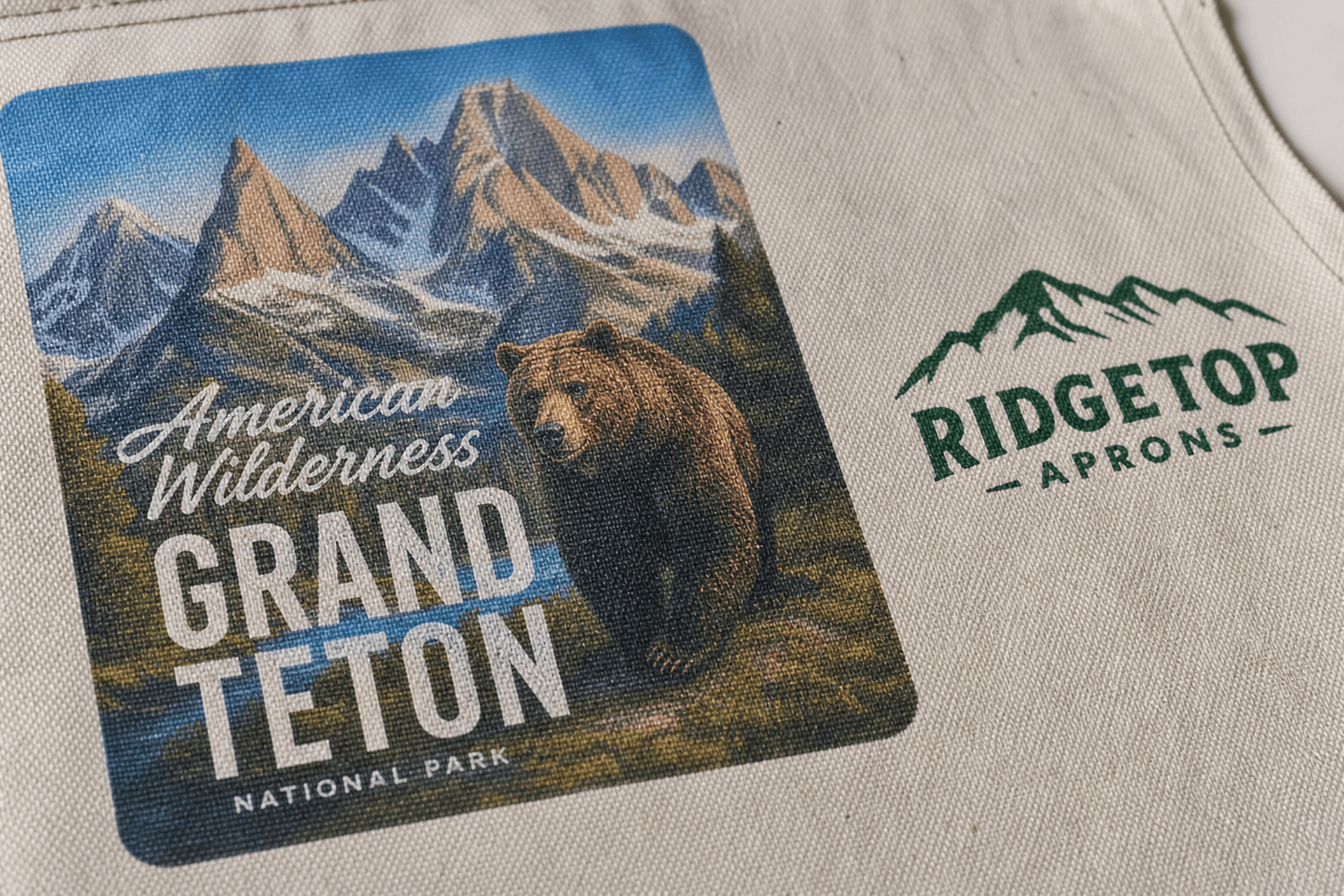
DTF has a slightly raised hand feel because the film and adhesive sit on top of the fabric. On a 240 GSM poly-cotton twill apron, the result is clean and dense. On a 320 GSM cotton canvas apron, it can still look sharp, but the print edge and surface feel are more visible. For buyers who need a soft vintage retail effect, DTF may feel too solid. For buyers who need sharp logos, small text, gradients, or full-color apron print on short runs, it is often the most practical option.
- Typical MOQ for combined apron plus DTF orders is 100-300 pcs per artwork, depending on apron fabric stock and logo size.
- Common logo size is 8-12 cm wide for chest logos and 18-28 cm wide for large front logos.
- Normal heat press settings are around 150-165°C for 10-15 seconds, adjusted by fabric composition and film type.
- Sampling usually needs 3-5 working days after artwork confirmation, while bulk logo application normally adds 2-5 days to apron sewing lead time.
DTG apron printing: soft result, stricter fabric limits
DTG apron printing means direct-to-garment printing. Ink is printed directly into the fabric surface, often after pretreatment, and then cured. It can produce a softer hand feel than DTF because there is no separate transfer film layer. For photographic designs, watercolor-style artwork, or large full-color graphics, DTG can look natural on the right base fabric.
The limitation is fabric suitability. DTG performs best on cotton or cotton-rich fabrics with a smooth and absorbent surface. A 180-220 GSM cotton twill apron or a fine plain-weave cotton apron can accept DTG better than a heavy, uneven 16 oz canvas. Polyester content also matters. On a 65/35 poly-cotton twill, color strength and wash result may be acceptable after testing, but on high-polyester aprons the result can be weaker or less consistent. Dark fabric DTG requires white ink underbase, which increases cost, curing time, and risk of pretreatment marks.
For apron sourcing, DTG is usually selected when the buyer values a softer print hand and the order uses fabric we already know will print well. It is less commonly our first recommendation for industrial kitchen uniforms, barista aprons with heavy laundering, or rough canvas work aprons. DTG is also slower than screen print for large-volume repeat orders. A factory may print 200-500 DTG aprons per day depending on artwork size and equipment, while screen print can be much faster after setup.
- Best fabric base is usually 100% cotton or cotton-rich twill in approximately 180-260 GSM with a smooth surface.
- Dark fabric DTG costs more than light fabric DTG because white ink and pretreatment are required.
- Large print areas can feel softer than DTF, but curing control is critical to avoid poor wash resistance.
- DTG is better for detailed full-color graphics than for low-cost, high-volume one-color uniform branding.
Screen print apron orders: best for volume and repeat color control
Screen printing remains the main method for many large apron logo printing programs. Each color is separated onto a screen, ink is pushed through the mesh, and the design is cured. For a one-color white logo on a black restaurant apron, a screen print apron is often more economical and more durable than DTF or DTG once the quantity is high enough. The setup cost is higher, but the running cost per piece drops quickly.
For apron orders above 1,000 pcs, screen print is normally the first method we calculate if the design uses 1-4 spot colors. For 5,000 pcs or more, the cost difference can be significant. As a working example, a 10 cm one-color chest logo may add approximately USD 0.15-0.35 per apron after setup on a 3,000 pc order, depending on ink type and factory loading. The same design by DTF may add USD 0.35-0.80 per apron. For a large 25 cm full-front print, both methods cost more, but screen printing still becomes attractive when the artwork is not photographic.
Screen print also gives strong wash performance when the ink system is matched to the fabric. Plastisol can give bright, durable prints on many cotton and blended fabrics, but it has a heavier feel. Water-based ink can feel softer on cotton, but it may lose brightness on dark or blended fabrics unless handled carefully. Discharge printing can be very soft on suitable dyed cotton, but it is not universal and is rarely the safest choice for mixed apron fabric programs.
- Best order range is usually 1,000 pcs and above for 1-4 color logos with stable artwork.
- Screen setup may cost around USD 20-60 per color per size, depending on local supplier and design complexity.
- Ink choices include plastisol, water-based, silicone, and specialty inks, each with different hand feel and wash behavior.
- Pantone control is stronger than DTF for spot-color brand logos, provided the buyer approves a strike-off before bulk production.
- Screen printing is less efficient for many small artwork variations because each version needs setup and registration.
dtf apron printing vs screen print for cost and MOQ
The cost crossover between DTF and screen print depends on logo size, color count, fabric, and number of artwork versions. Many buyers ask for one single rule, but a better approach is to compare landed risk. DTF has low setup cost and higher running cost. Screen printing has higher setup cost and lower running cost. This means DTF is efficient for small and mixed orders, while screen print becomes more efficient when the same artwork repeats over a large quantity.
For example, assume a 240 GSM black poly-cotton bib apron with one chest logo. At 300 pcs, DTF may be more attractive because there is no multi-screen setup, especially if the logo has gradients or 6 colors. At 2,000 pcs with a simple one-color logo, screen print will normally reduce the unit cost. At 10,000 pcs, screen print is almost always the better commercial choice unless the artwork is highly detailed, personalized, or changing by store.
Buyers should also consider packing flow. DTF transfers can be prepared in batches and applied to multiple logo versions with good flexibility, but heat pressing is piece-by-piece. Screen print requires setup and drying space, but once running, output is fast. If the apron order includes individual polybags, barcode stickers, size labels, and carton sorting by logo version, the decoration method affects production planning. A small DTF order with 12 logo versions may need more sorting control than a large screen print order with one logo.
- For 100-500 pcs with full-color artwork, DTF is usually the most practical quotation path.
- For 500-1,500 pcs, compare both DTF and screen print if the logo uses 1-3 colors.
- For 2,000 pcs and above with one stable logo, screen print often gives a lower unit cost.
- For 10 or more logo versions in one PO, DTF can reduce setup complexity even when the total quantity is above 1,000 pcs.
- For reorder programs, screen print can become more competitive after screens, formulas, and approved strike-offs are already established.
Fabric, GSM, and apron construction change the print decision
An apron is not a flat T-shirt. Bib seams, pockets, straps, waist ties, rivets, towel loops, split fronts, and hardware can limit print placement. A logo that looks simple on a tech pack may be difficult to heat press after sewing if the pocket seam is close to the print area. For screen printing, bulky seams can cause uneven ink deposit. For DTG, an uneven panel can affect platen loading and print registration.
Fabric GSM also changes the result. A lightweight 160-180 GSM promotional apron may show a clean logo with DTF, but the fabric can wrinkle under heat if press settings are too aggressive. A 240 GSM poly-cotton twill apron is usually stable and economical for uniform programs. A 280-320 GSM cotton canvas apron gives a premium workwear look, but the surface texture can reduce fine detail in DTG and make DTF feel more raised. Denim aprons, especially 10-12 oz washed denim, need extra testing because wash treatments and indigo dye can affect both color and adhesion.
For sourcing managers, it is important to confirm print placement together with the apron construction drawing. A 9 cm chest logo placed 6 cm below the neck seam may work well on a standard bib apron. A 24 cm center-front logo may conflict with a kangaroo pocket or divided tool pocket. If printing before sewing, we need additional registration allowance during stitching. If printing after sewing, we need a flat enough area for pressure and curing.
- 160-200 GSM promotional fabrics are cost-efficient but need heat control to avoid shine marks or distortion.
- 220-260 GSM poly-cotton twill is the most stable base for many restaurant and cafe apron logo programs.
- 280-340 GSM canvas gives a strong apron body but requires testing for fine lines, small letters, and large solid prints.
- Denim, waxed canvas, coated fabrics, and water-repellent finishes should always be tested before bulk logo approval.
- Logo placement should avoid thick seams, metal eyelets, rivets, pocket corners, and strap attachment points.
Wash performance and quality control for apron logo printing
Aprons are washed harder than many promotional garments. Restaurant and bakery aprons may face oil, detergent, hot water, tumble drying, and industrial laundry cycles. A retail cooking apron may only be washed at home a few times. Because the end use is different, the wash standard should be agreed before bulk production. A buyer asking for 30 home washes at 40°C is setting a different requirement from a hotel group asking for 50 commercial laundry cycles.
For DTF, the main quality risks are edge lifting, cracking, poor stretch recovery, dye migration, and heat press marks. Good film and powder are important, but process control matters just as much. Pressure, temperature, dwell time, peel timing, and second pressing all affect result. For screen print, common risks include under-curing, ink cracking, color variation, poor registration, and hand feel that is heavier than approved. For DTG, the main risks are pretreatment marks, weak color after washing, and inconsistent results on uneven fabric.
A practical apron QC process should include pre-production sample approval, bulk first-piece approval, in-line inspection, and final AQL inspection. For logo printing, we normally check placement tolerance, color, adhesion, surface defects, and packing separation by artwork. A reasonable placement tolerance for a chest logo is often +/-5 mm, while a large front print may allow +/-8 mm depending on construction. Buyers with strict retail packaging should specify whether logo orientation and barcode-label matching are checked at piece level.
- Ask for a printed fabric swatch or pre-production sample before approving bulk, especially for dark aprons and large logos.
- Confirm wash target, such as 10, 20, 30, or 50 cycles, and specify home laundry or commercial laundry conditions.
- Check print placement tolerance in millimeters, not only by visual approval.
- For dark fabrics, request a test for dye migration if the logo uses white, cream, yellow, or light gray.
- For DTF, bend and stretch the print after curing to check cracking before shipment.
Artwork preparation for full color apron print programs
Artwork preparation can save several days in sampling. For screen print, vector files are preferred because colors must be separated and trapping may be needed. Pantone references should be provided for brand colors, but the buyer should understand that a Pantone color on coated paper will not look identical on black cotton twill or natural canvas. For DTF and DTG, high-resolution raster artwork can work, but transparent backgrounds, small text, and thin lines must be checked carefully.
For a full color apron print, DTF is often easier than screen print because gradients, shadows, and multiple colors do not require separate screens. However, very small details still have limits. Text below 4-5 mm high may lose clarity after heat pressing and washing, especially on textured canvas. Thin lines below 0.3 mm can break or fill in. A large photographic logo on a bib apron may look impressive in a digital mockup, but on a real apron it must follow the fabric drape and may be partly hidden when the wearer bends or ties the waist.
Buyers should send artwork at the same time as the apron spec sheet. The best package includes AI, PDF, or PSD files, Pantone references, logo size in centimeters, placement from fixed seams, and the intended fabric color. If only a JPG is available, we can still review it, but sampling may take longer and color matching will be less exact. For repeat orders, keeping one approved print standard with date, fabric lot, ink method, and wash result is more useful than relying only on the previous PO number.
- Preferred files are AI, EPS, PDF, PSD, or 300 dpi PNG at actual print size.
- For screen print apron orders, provide Pantone references and confirm whether the print should be plastisol, water-based, or another ink type.
- For DTF apron orders, check whether the artwork needs a white border, transparent background, or full-bleed edge.
- Avoid placing critical text across pockets, seams, or waist fold areas.
- Keep one approved physical standard sample for every repeat program, not only a digital mockup.
How to choose the right method before issuing the PO
The best decoration method is the one that fits the order structure. If the buyer needs 300 pcs of natural cotton aprons for a bakery opening, each with a detailed full-color logo, DTF is likely the fastest and most economical route. If the buyer needs 8,000 black bib aprons for a restaurant chain with a one-color chest logo, screen print will normally be the better cost and production choice. If the buyer wants a soft photographic illustration on a smooth cotton apron for a retail gift line, DTG may be worth testing.
Before placing a PO, a sourcing manager should ask the factory to quote the apron and print as one production package. Separating garment cost from logo cost is useful for comparison, but the real delivery risk sits in the combined workflow: fabric cutting, sewing, printing, inspection, packing, and carton marking. A print method that saves USD 0.10 per piece may not be a saving if it adds seven days to delivery or increases rework on a tight launch schedule.
For most custom apron buyers, we recommend approving one physical sample for appearance and one wash-tested sample for performance before bulk. For urgent orders, a digital mockup can help confirm placement, but it should not replace print testing on the actual fabric. The most stable programs are those where the buyer locks fabric, GSM, logo size, placement, print method, packaging, and wash standard before deposit. That gives the factory a clear production route and gives the buyer a more reliable shipment.
- Choose DTF when the order is low to medium volume, full color, multi-version, or artwork changes often.
- Choose DTG when the fabric is smooth cotton, the buyer wants a soft hand feel, and the artwork benefits from direct ink printing.
- Choose screen print when the order volume is high, artwork is stable, and brand colors must repeat consistently.
- Request a side-by-side cost comparison when quantity is between 500 and 2,000 pcs and artwork has limited colors.
- Lock the approved sample, wash standard, and packing method before bulk cutting whenever delivery timing is strict.