Casino and gaming floor aprons: security pockets, dark colors and frequent laundering
On a gaming floor, an apron is not casual servicewear. Cocktail servers, bar teams, food runners and VIP lounge attendants work under cameras, in low-light interiors and through 8-12 hour shifts. That environment changes the sourcing brief for casino aprons: the garment must look disciplined, carry only approved tools and keep a clean front profile after repeated washing.
Compared with standard restaurant aprons, casino programs usually need darker colorways, flatter pockets and tighter construction tolerances. Black, charcoal, deep navy and espresso conceal splash marks, but they also expose fading, crocking, edge abrasion and lot-to-lot shade mismatch. A pocket that looks acceptable in casual dining can bulge under gaming-floor lighting and create unnecessary concealment concerns.
For OEM sourcing, buyers should convert operational needs into measurable specifications before sampling. Define GSM or oz, fiber content, pocket depth, pocket opening width, bartack positions, shrinkage allowance, colorfastness targets, trim type, replenishment MOQ and inspection level. Those details determine whether a 5,000-20,000 pc program sits near US$3.20/pc or US$8.50/pc, and whether repeat orders remain visually consistent.
- 210-230 GSM, about 6.2-6.8 oz, 65/35 poly-cotton twill is the most practical baseline for casino service use because it balances drape, pocket support and wash durability.
- Casino aprons should use controlled divided pockets, bartacked stress points and limited visible storage volume instead of oversized patch pockets.
- For black and charcoal programs, specify wash-tested dye performance, target shrinkage under 3% for poly-cotton and retained shade standards for every repeat PO.
- Realistic OEM MOQ is usually 500-1,000 pcs per color for stock fabric, rising to 1,500-3,000 pcs for custom dye lots, branded trims, embroidery or special packaging.
- Typical production lead time is 25-40 days after lab dip, PP sample and deposit approval, with a 7-15 day buffer before major holidays or peak uniform seasons.
- Bulk ex-factory pricing commonly falls between US$3.20-US$8.50/pc, driven by fabric weight, pocket complexity, reinforcement, branding and packing method.
- For inspection, use AQL 2.5 for major defects and AQL 4.0 for minor defects, with sealed samples retained for replenishment control.
Why casino aprons need stricter uniform control
The sourcing logic starts with where the apron is worn. Gaming-floor staff are visible to guests, supervisors and surveillance cameras, so the apron must keep a clean profile while the wearer bends, turns, reaches, carries trays and moves between service stations. This favors controlled pocketing, stable ties, low-bulk trims and fabric that does not twist or curl after laundering.
The failures are usually small but highly visible. A tie that narrows after 20 washes, a pocket corner without bartack reinforcement or a black fabric that shifts toward grey can make a uniform program look poorly controlled. Buyers should evaluate appearance after use, not only the first delivery sample on a table.
Role mapping is essential. A cocktail server may need a pen slot, order-pad division and one narrow utility compartment. A VIP lounge attendant may need only a discreet flat pocket. A cash-adjacent service role may justify one hidden zip pocket, but not broad external storage. One shared apron can reduce SKU count, but only if the pocket layout stays slim on every wearer.
- Typical shift length is 8-12 hours, so tie width, waistband feel and fabric stiffness directly affect wear compliance.
- Check development samples after 20, 30 and 50 wash cycles before approving a large replenishment program.
- Control dark shade continuity across repeat orders, especially for black, charcoal and deep navy.
- Prioritize a flat silhouette over maximum storage because pocket bulge is highly visible under venue lighting.
Fabric specification for casino aprons: 190-250 GSM range
Fabric is the largest performance variable. For casino aprons, the workable range is normally 190-250 GSM, or about 5.6-7.4 oz depending on weave and fiber blend. Below 190 GSM, pockets may print through the front panel and the apron can wrinkle quickly. Above 250 GSM, the garment can feel warm during long shifts and may dry more slowly in commercial laundry.
For most volume orders, 65/35 poly-cotton twill at 210-230 GSM is the safest starting point. It gives better shrinkage control than 100% cotton, holds shape through repeated washing and has enough body for divided pockets without feeling stiff. A 190-205 GSM twill can reduce cost by about US$0.20-US$0.45/pc, but buyers usually lose structure. A heavier 230-250 GSM twill or canvas can improve drape and durability, but often adds US$0.50-US$1.20/pc.
Cotton-rich options can work for premium venues that want a softer hand feel, but they require stricter dye and shrinkage testing. On black or charcoal, high-cotton fabrics are more likely to show fading, wrinkling and edge abrasion unless the mill uses the correct dye system and the pattern allows for shrinkage. For 2-4 washes per week and a target service life of 6-12 months, poly-cotton usually produces the lower replacement rate.
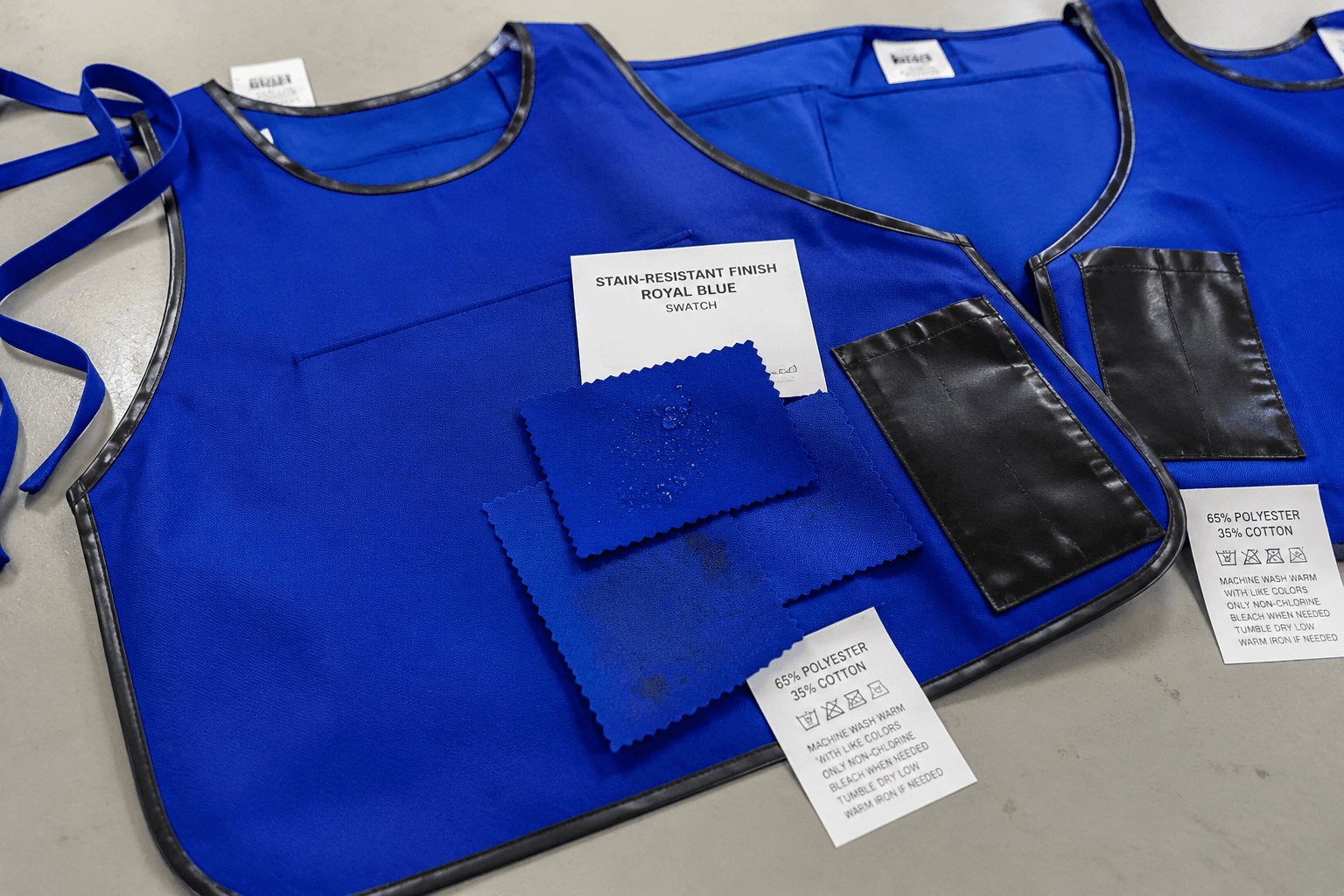
Finishes such as stain release or light water repellency can help beverage teams, but they are not a substitute for the right base cloth. These finishes often add US$0.20-US$0.60/pc and may weaken after repeated laundering. For 50 wash cycles or more, a stable dark twill with tested colorfastness is normally the stronger purchase.
- 190-205 GSM twill: lower cost and lighter hand, but weaker pocket support and less structured drape.
- 210-230 GSM poly-cotton twill: the common casino apron baseline for structure, comfort and wash life.
- 230-250 GSM heavy twill or canvas: stronger silhouette, higher cost and warmer wear.
- Target shrinkage: under 3% for poly-cotton and under 5% for cotton-rich fabric after standard wash testing.
Secure pocket engineering for casino aprons
When buyers request secure pockets, the first instinct is often to add zippers. In casino aprons, true control starts with capacity. Oversized pockets invite overfilling, distort the apron front and create avoidable concealment concerns. A better layout uses narrow compartments, internal divisions and reinforcement anchored close to the body.
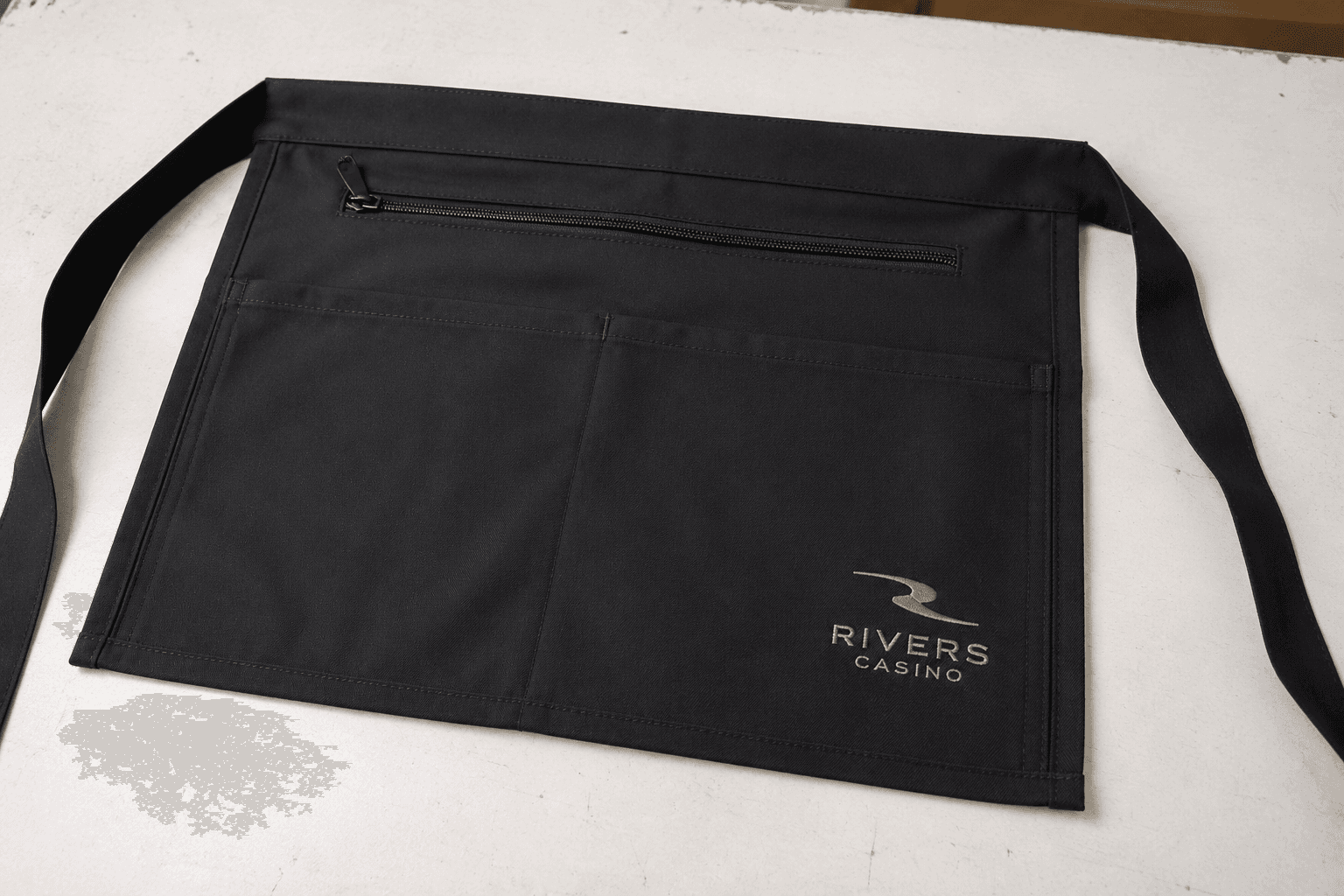
A standard hospitality waist apron may use an open pocket depth of 18-20 cm. In casino use, 16-18 cm often works better, with pocket openings around 12-16 cm depending on role and apron width. Internal stitched channels can separate pens, pads and service tools without adding multiple visible exterior pockets. This keeps the garment flatter and reduces pocket swing during movement.
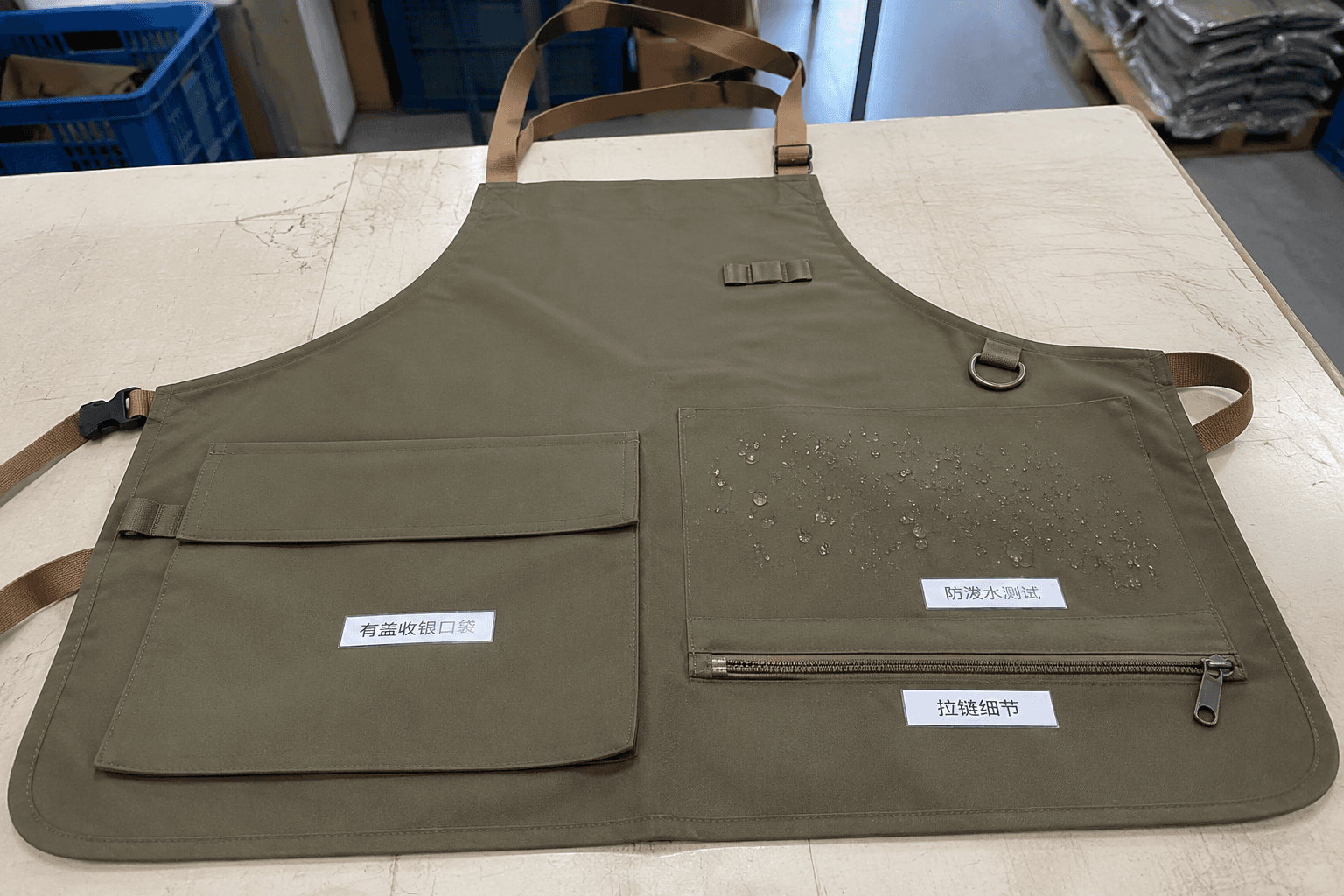
If a secured compartment is required, a hidden inside pocket with a nylon coil zipper is the most practical factory option. Nylon zippers are lighter, quieter and better suited to repeated laundering than metal hardware. A concealed zip pocket typically adds US$0.25-US$0.70/pc and 1-2 minutes of sewing labor per unit. That cost can be justified for VIP lounge or controlled-service roles, but it should not become a default feature for every staff group.
Reinforcement should be specified, not assumed. The first failures on high-use aprons are usually upper pocket corners, zipper ends and tie joins. Bartacks or triangle reinforcement at these points cost little during development and prevent expensive failures in bulk. Buyers should also define thread color, stitch density and whether reinforcement should be visible or tone-on-tone.
- Use internal partitions for pens, order pads or POS tools instead of adding extra front patch pockets.
- Keep visible pocket openings near 12-16 cm where function allows.
- Specify bartacks at upper pocket corners, tie joins and zipper ends.
- Use nylon coil zippers for hidden compartments that will face frequent laundering.
- Avoid bellows or gusset pockets unless the role has a documented need for bulk storage.
Dark casino aprons: black, charcoal and navy wash control
Dark color is one of the most common casino apron requests and one of the easiest to under-specify. Buyers may approve a rich black showroom sample, then see fading, red cast, green cast or edge abrasion after 15-20 industrial washes. These issues rarely come from sewing alone; they come from dye system, fiber blend, rubbing performance and wash compatibility.
The sourcing conversation should include the real laundry process. If garments are washed at 40-60°C with standard detergent and moderate tumble drying, a 65/35 poly-cotton twill with compatible dye performance is usually sufficient. If the laundry uses stronger chemicals, higher heat or bleach-adjacent processing, the mill must confirm that the selected dark shade can hold appearance for the intended service life.
Repeat-order shade control matters as much as first-order color. Black from one production lot can differ noticeably from black in a later replenishment when viewed under warm, mixed or low casino lighting. Buyers should approve lab dips, retain swatches, seal PP samples and record fabric lot references. If one order is split across more than one mill, shade matching should be approved before cutting.
Branding should stay restrained on dark aprons. Small embroidery on the pocket or upper panel is common and usually durable, while dense embroidery can pucker lighter fabric after repeated washing. A small logo typically adds US$0.20-US$0.80/pc depending on stitch count and backing. Tone-on-tone embroidery or low-contrast branding is usually more appropriate than large printed graphics for gaming-floor use.
- Request testing for colorfastness to washing, crocking and appearance retention before bulk approval.
- Confirm wash temperature, detergent type, drying method and expected washes per week.
- Retain approved color swatches and sealed samples for every repeat order.
- Limit dense embroidery on lighter-weight dark aprons because puckering becomes more visible after laundering.
OEM cost, MOQ and lead time for casino aprons
Price is highly sensitive to specification detail. Fabric often represents 35-50% of ex-factory cost, while sewing labor rises with every added partition, hidden pocket, reinforcement point, embroidery placement or special packing step. Because aprons look simple, unrealistic low quotes usually mean the supplier has reduced GSM, simplified pocket construction, weakened reinforcement or quoted against a lower dye standard.
For a basic waist apron in stock 210 GSM dark poly-cotton twill with one divided front pocket and standard ties, a realistic FOB China price at 3,000 pcs is often US$3.20-US$4.20/pc. A mid-level style with 220-230 GSM twill, extra bartacks, custom woven labels and small embroidery may land near US$4.50-US$6.20/pc. A specialized version with heavier cloth, hidden zip pocket, premium packaging or lower-volume development commonly falls into the US$5.50-US$8.50/pc range.
MOQ depends mainly on whether the buyer accepts stock fabric and standard trims. For stocked black, charcoal or navy twill, many factories can support 500-1,000 pcs per color per style. Custom dyeing, exclusive trims, multiple coordinated styles or branded packaging usually move MOQ to 1,500-3,000 pcs. Below those levels, buyers should expect a higher unit cost or reduced customization.
Lead time is manageable when approvals are disciplined. A common schedule is 3-7 days for lab dips, 7-14 days for first samples, 5-7 days for PP revisions and 15-25 days for cutting, sewing, final inspection and packing after approval. Most casino apron programs therefore need 25-40 days after deposit and final confirmation. Before major China holidays or peak uniform months, add a 7-15 day buffer.
- US$3.20-US$4.20/pc: stock dark twill, standard waist apron and simple divided pocket.
- US$4.50-US$6.20/pc: higher GSM, extra reinforcement, custom labels and small embroidery.
- US$5.50-US$8.50/pc: hidden secure pocket, heavier cloth, premium packing or lower-volume custom run.
- 500-1,000 pcs/color: common MOQ for stock fabric programs.
- 1,500-3,000 pcs: common MOQ for custom dye, branded trim or multi-style programs.
Quality control: tolerances, AQL and sealed samples
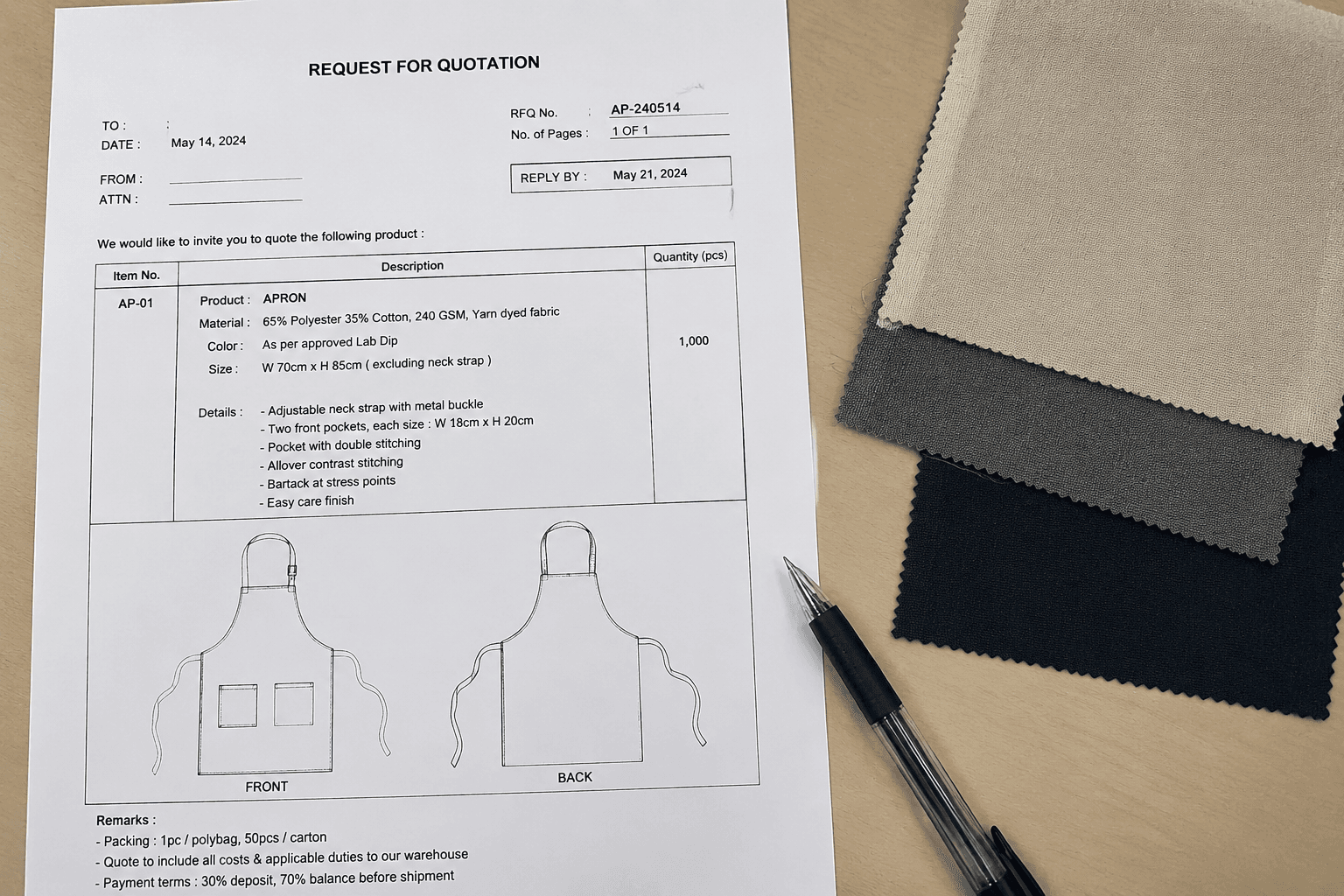
The most common apron quality problems are inconsistencies that weaken the uniform program: tie lengths drifting by 2 cm, uneven pocket placement, missing bartacks or visible shade variation between panels. Buyers prevent these issues with a precise tech pack and approval file. For casino aprons, the file should include finished measurements, tolerance table, pocket position from hem and side seam, tie width and length, fabric weight tolerance, approved thread color, reinforcement points and laundering expectations.
Finished measurement tolerance is often set at +/-1 cm for body dimensions and +/-1.5 cm for tie length. Fabric weight tolerance is commonly +/-5%. These numbers matter because drape, pocket behavior and wearer comfort change quickly when the body panel or ties are cut inconsistently. Pocket placement should be dimensioned in centimeters, not left to visual judgment.
Pre-production approval should include wear testing and wash testing. Staff should load the apron with intended tools, walk, bend, serve and sit as they would on shift. The sample should then be washed under planned conditions and rechecked for twist, edge curling, pocket gape, puckering, zipper function and shade loss. A wash-tested PP sample is more useful than a perfect unwashed table sample.
For final inspection, many buyers use AQL 2.5 for major defects and AQL 4.0 for minor defects. Major defects include wrong shade, missing bartacks, defective zipper installation, severe skew, broken stitching, out-of-tolerance measurement and pocket misplacement. Minor defects include loose threads, small pressing marks and slight logo position variance within tolerance. Buyer and supplier should both retain sealed samples so second and third orders do not drift from the launch standard.
- Set main body tolerance around +/-1 cm and tie tolerance around +/-1.5 cm.
- Control fabric weight within +/-5% to protect drape and pocket performance.
- Use AQL 2.5 major / 4.0 minor as a practical inspection baseline.
- Require both fit approval and wash-tested PP approval before mass production.
- Keep sealed samples with both buyer and supplier for replenishment matching.
Sourcing brief for repeat-order casino aprons
The fastest way to improve development is to replace reference photos with operating facts. A useful casino apron brief should state wearer role, shift length, tools carried, pocket count, visible pocket profile, laundry frequency, target service life, venue lighting, branding method and reorder expectations. With this information, a factory can judge whether 200 GSM twill is sufficient, whether 220-230 GSM is safer and whether a hidden compartment is justified.
Buyers should also decide whether the apron is a stand-alone item or part of a coordinated uniform package. If it sits over fitted shirts or tailored vests, excessive fabric weight may look heavy. If it supports high-frequency beverage service, too-light cloth may look casual and wear out early. The objective is usually not the lightest or heaviest product, but a stable middle specification that keeps shape after long shifts and repeated laundering.
For most professional gaming-floor programs, a dependable baseline is a waist apron in 210-230 GSM dark 65/35 poly-cotton twill, with one controlled divided pocket, bartack reinforcement at all stress points, ties proportioned for 8-12 hour wear and wash-tested black or charcoal shade performance. From there, add only the features the operation truly needs. This keeps sampling focused, controls cost and makes replenishment easier to manage.
- State expected washes per week and target service life, such as 6, 9 or 12 months.
- Define exactly what the wearer will carry so pocket size and partitions can be engineered correctly.
- Request one fit sample and one wash-tested PP sample before bulk approval.
- Agree on reorder MOQ, shade continuity method and retained standards at the first PO stage.
- If several staff roles will share one style, test the apron on each role before confirming bulk production.