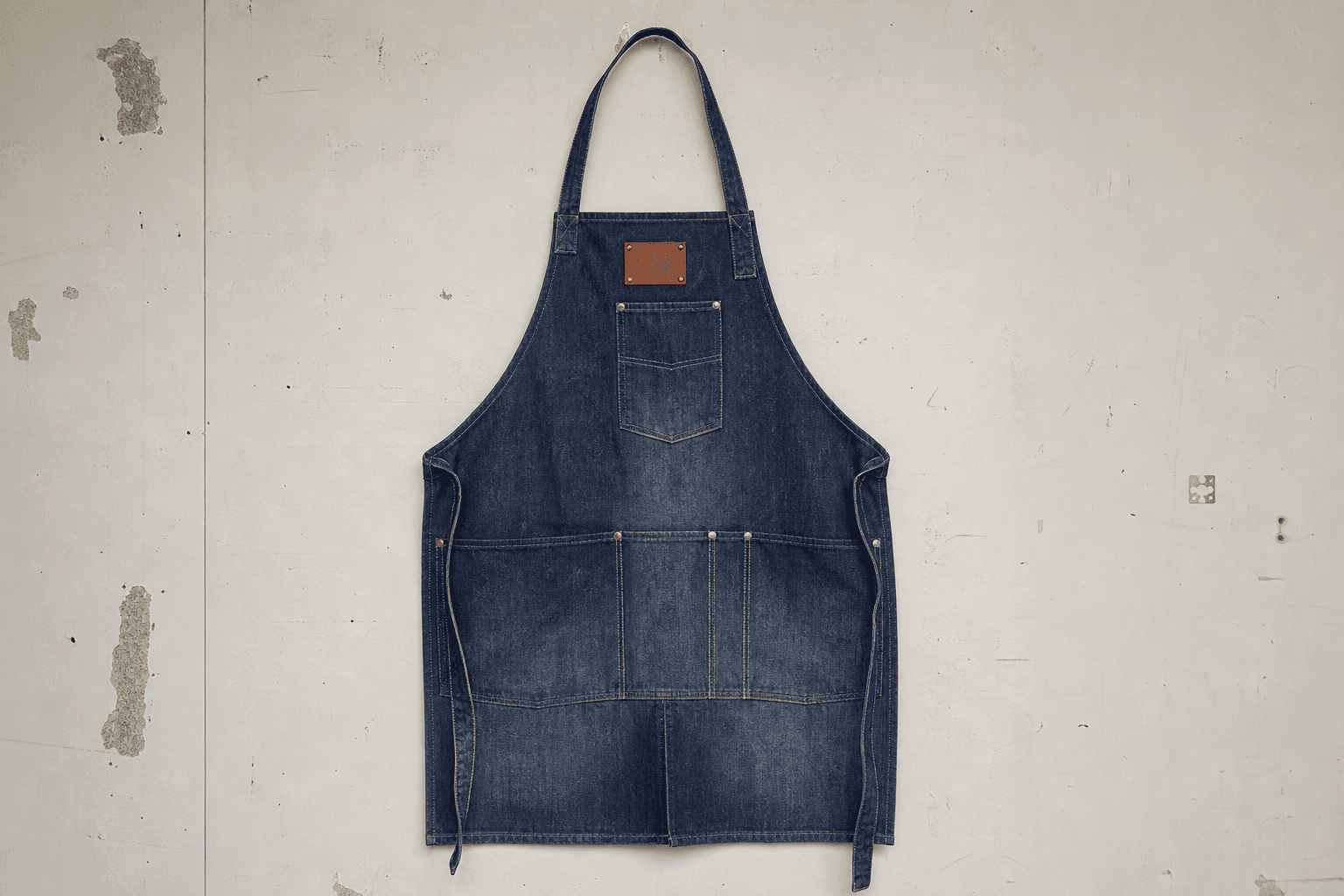
A denim apron is not sourced in the same way as a basic canvas apron. The buyer is not only choosing a fabric weight and pocket layout; they are also deciding how the garment will age, bleed, shrink, soften and present the brand after repeated washing. For coffee chains, barber shops, chef uniforms, workshop retail and heritage lifestyle brands, these details affect both the first inspection and the customer experience six months later.
From a factory side, the most common problems in denim apron development are predictable: over-specifying heavy fabric that becomes uncomfortable, requesting selvedge details without understanding fabric width and wastage, approving dark indigo without setting colorfastness standards, or skipping shrinkage testing before bulk cutting. These are manageable issues, but they need to be handled before quotation and sampling, not after 3,000 pieces are already sewn.
This article explains how we evaluate denim apron fabric for OEM production in Zhejiang, including selvedge construction, GSM and ounce weight, raw denim behavior, indigo fastness, washing options, MOQ, costing and quality control points that sourcing managers should confirm before placing a bulk order.
- A practical denim apron for hospitality usually sits between 280-380 GSM, while workshop and heritage retail styles often use 400-520 GSM.
- A selvedge denim apron is not automatically higher quality, but it requires narrower fabric planning, higher cutting waste and clearer placement rules.
- Dark indigo apron fabric should be tested for dry rubbing, wet rubbing and washing fastness before bulk approval, especially for hospitality uniforms.
- Raw denim apron production needs shrinkage planning because unwashed denim can move 3-8% depending on yarn, weave and finishing.
- Factory MOQ is normally driven by fabric dyeing and weaving minimums, not sewing capacity; custom denim often starts from 500-1,000 pcs per color.
- The lowest unit cost is rarely the best denim apron cost if it ignores staining risk, broken needle rate, seam bulk or post-wash measurement loss.
Why a denim apron specification needs more detail than canvas
Canvas apron sourcing is usually controlled by fiber composition, GSM, color, pocket layout and logo method. A denim apron has more moving parts. The fabric may be rope dyed, piece dyed, sulfur topped, enzyme washed, stone washed, sanforized or left raw. Each choice changes color behavior, shrinkage, handfeel and sewing risk. The apron may look simple on a tech pack, but the bulk result depends heavily on fabric finishing.
For B2B orders, the first question is not whether denim is strong. Most denim apron fabrics are strong enough for normal use. The better question is whether the chosen denim matches the working environment. A barista wearing an apron for eight hours has different requirements from a furniture workshop, a craft brewery, a barber shop or a premium gift set. Fabric that photographs well at 14 oz may be too stiff for daily hospitality use, while 8 oz denim may lack the structure expected in a heritage apron fabric.
We normally ask buyers to define three points before sampling: how stiff the apron should feel on day one, whether the garment may bleed color onto light clothing, and whether the final look should be clean, worn-in or raw. These answers guide the fabric selection more accurately than requesting only 'heavy denim' or 'premium denim'.
- Hospitality denim aprons usually need softer handfeel, lower color transfer and adjustable neck or cross-back straps for long shifts.
- Workshop denim aprons can accept heavier fabric, reinforced stress points and more rigid structure if mobility is not restricted.
- Retail heritage aprons often need visible texture, contrast stitching, leather trims or selvedge placement, but these details increase QC complexity.
- Gift and promotional denim aprons should avoid unstable indigo if the end user is not trained to wash dark denim separately.
Denim apron weight: GSM, ounces and real wearing comfort
Denim weight is usually discussed in ounces per square yard, while many China fabric mills quote in GSM. The conversion is approximate: 10 oz denim is around 339 GSM, 12 oz is around 407 GSM, and 14 oz is around 475 GSM. For aprons, the ounce number alone does not tell the full story. A tightly woven 10 oz fabric can feel firmer than a loose 12 oz fabric, and a washed 13 oz apron may feel easier to wear than an unwashed 11 oz apron.
For most commercial denim apron programs, we see four useful weight bands. Light denim at 220-280 GSM is suitable for promotional, casual kitchen or low-cost retail use, but it may not hold shape well in large bib apron panels. Medium denim at 280-380 GSM is the most balanced choice for coffee, restaurant and general staff uniforms. Heavy denim at 400-520 GSM works for heritage retail, barber shops and workshop use. Very heavy denim above 540 GSM can be impressive, but it requires careful pattern engineering and is rarely comfortable for all-day hospitality wear.
Sourcing managers should also consider sewing cost. Heavy denim needs stronger needles, slower sewing speed and sometimes different seam construction at pocket corners, strap junctions and waist tie attachments. On a basic cotton apron line, one operator may sew a certain operation quickly with standard lockstitch settings. With 14 oz denim plus folded seams, the same operation can cause skipped stitches, needle breakage or bulky corners unless the line is adjusted. This adds time and may add $0.20-$0.60 per piece depending on construction.
- 220-280 GSM is suitable for low-cost promotional denim aprons, but not ideal for a structured premium bib shape.
- 280-380 GSM is the safest commercial range for restaurant, cafe and service uniform orders.
- 400-520 GSM gives a stronger heritage look but increases sewing difficulty, unit weight and freight cost.
- Above 540 GSM should be sampled on the real pattern before price confirmation because seam bulk can change the sewing method.
Selvedge denim apron sourcing: appearance, wastage and MOQ
A selvedge denim apron is usually requested for visual and positioning reasons. Buyers want the clean self-finished edge, often with a red, white or custom ID line, visible along a pocket opening, side edge, tool loop or towel holder. This can look excellent when the apron is designed around the fabric width. It is also one of the easiest areas to misunderstand during costing.
Standard denim fabric is often supplied in wider widths, commonly around 57-60 inches usable width. Selvedge denim is often narrower, for example 28-32 inches, depending on the loom and mill. Narrower width changes marker efficiency. If the apron panel is wide, the pattern may not fit efficiently or may force the selvedge edge into only one side of the garment. When a buyer asks for selvedge on both sides, the fabric and pattern must be planned together from the beginning.
MOQ is also different. A standard stock denim may be available from 300-500 meters if the mill has greige or finished stock. Custom selvedge with specific weight, shade and ID color may require 800-1,500 meters or more, depending on the mill. For apron production, this often means the realistic MOQ is 500-1,000 pcs per color for a simple bib apron, and higher if the pattern has low fabric efficiency or requires shade sorting.
- Selvedge placement should be marked on the pattern, not only described in the comments section of a tech pack.
- Buyers should confirm whether the selvedge line is decorative, functional or mandatory on every piece.
- Custom selvedge ID color may increase fabric lead time by 10-20 days compared with stock denim.
- Narrow fabric can increase cutting waste by 8-18% compared with standard-width denim, depending on apron size.
- If the apron uses selvedge only on pockets or loops, cost can be controlled better than using it on the full body edge.
Indigo apron fastness: what to test before bulk approval
Indigo is part of the appeal of a denim apron, but it is also the main risk. Dark indigo can transfer onto white shirts, light upholstery, leather goods, pale countertops or staff uniforms. This is especially important for cafes, hotels, salons and retail staff who work close to customers. A beautiful dark indigo apron that fails wet rubbing fastness can create complaints quickly.
For bulk orders, we recommend setting test expectations before sample approval. Common tests include colorfastness to dry rubbing, wet rubbing and washing. A dark raw denim may only achieve moderate wet rubbing results because loose surface dye is part of the raw denim character. A washed indigo apron can usually achieve better stability, but the shade will be lighter and the surface will look less crisp. The buyer must decide which outcome is more important.
In practical sourcing terms, dry rubbing fastness of grade 3-4 is normally acceptable for many dark denim apron orders, while wet rubbing may be grade 2-3 on raw or very dark indigo. If the apron will be worn over white clothing, used in hospitality, or sold without denim care instructions, we usually push for improved wet rub performance or a pre-wash process. The extra washing cost may be $0.25-$0.80 per piece depending on wash type, order quantity and local washing plant charges, but it can reduce after-sales risk.
- Dry rubbing fastness should be checked because aprons move against shirts, counters and hands during service.
- Wet rubbing fastness matters when staff work in kitchens, bars, salons or cleaning environments.
- Washing fastness should be tested on the actual approved bulk fabric, not only on a mill reference swatch.
- Dark indigo should be packed carefully because color transfer can occur if damp cartons sit in hot storage.
- Care labels should state separate washing for dark indigo products if the apron is raw or minimally washed.
Raw denim apron versus washed denim apron
A raw denim apron gives a crisp, dark, structured appearance. It is attractive for heritage brands, chef collaborations, craft retail and limited collections. The fabric can develop wear marks over time, especially at the waist fold, pocket edges and strap contact points. For the right brand, this aging is the reason to choose raw denim. For a uniform program, it may be a problem because every worker's apron will fade differently.
The main technical issue with a raw denim apron is shrinkage. Even sanforized denim can shrink after home washing. Non-sanforized or loosely finished denim can shrink much more. In apron production, shrinkage affects bib length, waist width, pocket placement and strap balance. If a buyer approves an unwashed sample and then the end user washes it hot, the apron may become shorter by 2-5 cm depending on size and fabric behavior. This is not a sewing defect; it is a fabric and finishing decision.
Washed denim aprons are more predictable. Enzyme wash can soften the handfeel and reduce surface dye. Stone wash gives a more worn appearance but may damage trims or increase shade variation. Rinse wash is a moderate option when the buyer wants some shrinkage control without a heavy faded look. For most B2B hospitality orders, a rinse or light enzyme wash is safer than fully raw denim.
- Raw denim is best for brands that accept fading, crocking risk and user-specific aging.
- Rinse wash is suitable when the buyer wants dark color but better shrinkage control.
- Enzyme wash improves softness and reduces stiffness, often adding 3-7 days to production flow.
- Stone wash should be tested with metal hardware, leather patches and printed labels before approval.
- Garment washing can change measurements, so final specs should be based on after-wash dimensions.
Construction details that matter on a denim apron
Denim apron durability is not only about fabric weight. Many failures occur at stress points: pocket corners, waist tie insertion, neck strap adjustment, tool loops and side seams. If the fabric is heavy, weak construction becomes more visible because the user expects a long service life. If the fabric is raw and stiff, stress is concentrated at folded points until the garment softens.
For medium and heavy denim, we usually recommend bar tacks at pocket corners and strap attachment points. Reinforced stitching may use contrast thread for heritage appearance, but thread quality must match the stress level. A thick decorative thread can look strong but perform poorly if the machine tension is not correct. For commercial washing programs, polyester core-spun thread is usually more stable than cotton thread, especially where colorfastness and tensile strength matter.
Hardware also needs attention. Antique brass eyelets, grommets, rivets and buckles are common on heritage apron fabric styles, but they can create issues in washing, metal detection, airport shipment checks and nickel compliance depending on destination market. Leather trims look premium but complicate garment washing and may bleed or stiffen. For bulk hospitality orders, cotton webbing or denim self-fabric straps are often more practical than leather unless the buyer is prepared for higher MOQ, extra testing and stricter packing control.
- Use bar tacks at high-stress pocket corners, waist ties, strap anchors and tool loops.
- Confirm pocket opening size with real tools such as order pads, thermometers, pens, bottle openers or kitchen towels.
- Avoid excessive seam layers where heavy denim folds over webbing, because needle breakage can slow bulk sewing.
- Test leather patches and trims before garment wash, especially on dark indigo fabric.
- Specify thread color and stitch density clearly because contrast stitching makes irregular sewing more visible.
Cost, MOQ and lead time for custom denim apron orders
A realistic denim apron quotation depends on fabric source, weight, washing, trims, logo method and packing. For a simple medium-weight denim bib apron using stock fabric, a factory may quote around $3.20-$5.80 per piece at 1,000 pcs, depending on construction and trim level. A heavier selvedge denim apron with custom hardware, garment wash, leather patch and reinforced pockets may move into the $7.50-$13.00 per piece range or higher. These are not fixed market prices, but they show how quickly the specification changes the cost base.
MOQ is mainly controlled by fabric. If stock denim is acceptable, 300-500 pcs per color may be possible, although unit cost will be higher. If the buyer needs custom indigo shade, custom weight, custom selvedge ID or special finishing, 500-1,000 pcs per color is more realistic. For yarn-dyed or mill-developed denim, the fabric MOQ can be the limiting factor, sometimes 1,000-2,000 meters before cutting efficiency is considered.
Lead time should also include fabric and wash time. A stock denim apron sample may take 5-10 days if trims are available. Custom fabric lab dip or strike-off may need 7-15 days. Bulk fabric production can take 18-30 days, sewing 10-18 days, garment washing 3-7 days, and final inspection plus packing 2-4 days. For a normal OEM denim apron order, 35-55 days after sample and deposit is a practical planning range. If custom selvedge or special wash development is involved, allow 50-75 days.
- Stock medium denim with simple construction can support lower MOQ and faster sampling.
- Custom indigo shade normally requires lab dip approval and can add 7-15 days before bulk fabric starts.
- Garment washing adds cost, lead time and measurement control work, but reduces shrinkage and crocking risk.
- Selvedge fabric can raise material cost and cutting waste even if the sewing operation is simple.
- Small orders below 300 pcs are possible only when fabric, trims and logo methods are kept close to stock options.
Quality control checklist for bulk denim apron production
A good denim apron approval process should include more than one beautiful sales sample. Before bulk cutting, the factory and buyer should confirm fabric shade, weight tolerance, shrinkage, fastness, after-wash measurements, logo placement and construction details. A 5 cm pocket shift may not matter on a promotional apron, but it matters on a professional apron where tools must sit correctly.
Shade control is especially important for indigo apron production. Denim can show roll-to-roll shade variation, side-center-side variation and wash batch variation. For uniform programs, we recommend keeping cutting lots separated and using shade bands during inspection. For fashion or heritage retail, slight variation may be acceptable, but it should be agreed in writing. The worst situation is when the factory treats variation as normal denim behavior while the buyer expects uniform shade like dyed canvas.
Final inspection should check both appearance and function. Aprons should be measured after any wash process, not before. Straps should be pulled to confirm attachment strength. Rivets and eyelets should be checked for sharp edges. Dark indigo pieces should be inspected under good light because stains, oil marks and chalk marks can hide in low lighting. Cartons should remain dry, and polybags should not trap moisture after washing because this can cause odor, mildew or color migration during transport.
- Confirm actual GSM or ounce weight with tolerance, commonly plus or minus 5%, before bulk cutting.
- Measure shrinkage after the approved wash process and update the production spec to after-wash dimensions.
- Check dry and wet rubbing fastness on bulk fabric, especially for dark indigo and raw denim apron orders.
- Separate shade lots during cutting, sewing and packing to avoid visible mismatch in the same shipment.
- Inspect stress points with pull testing or practical manual checks, not only visual inspection.
- Confirm carton dryness and packing ventilation after garment washing before export shipment.