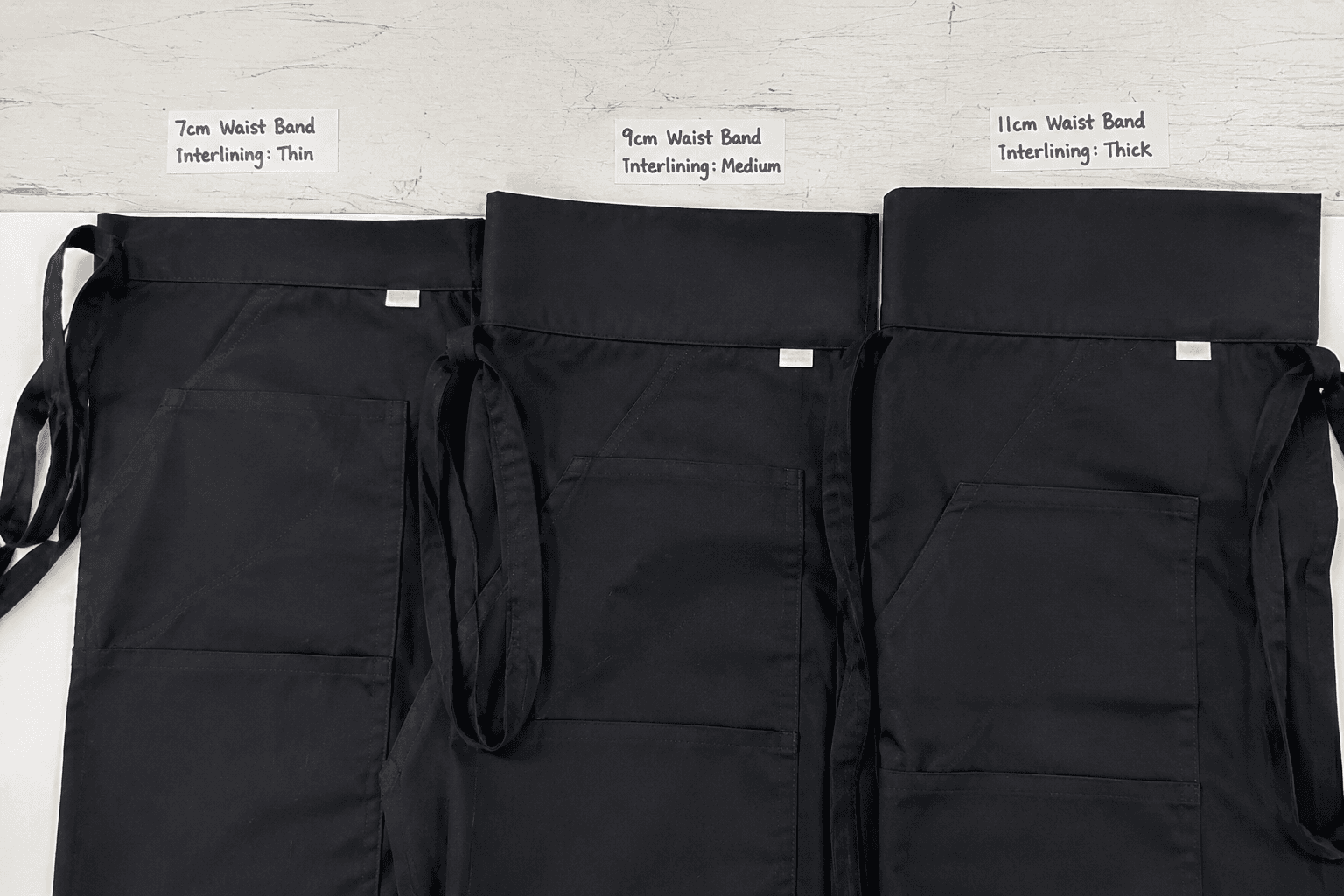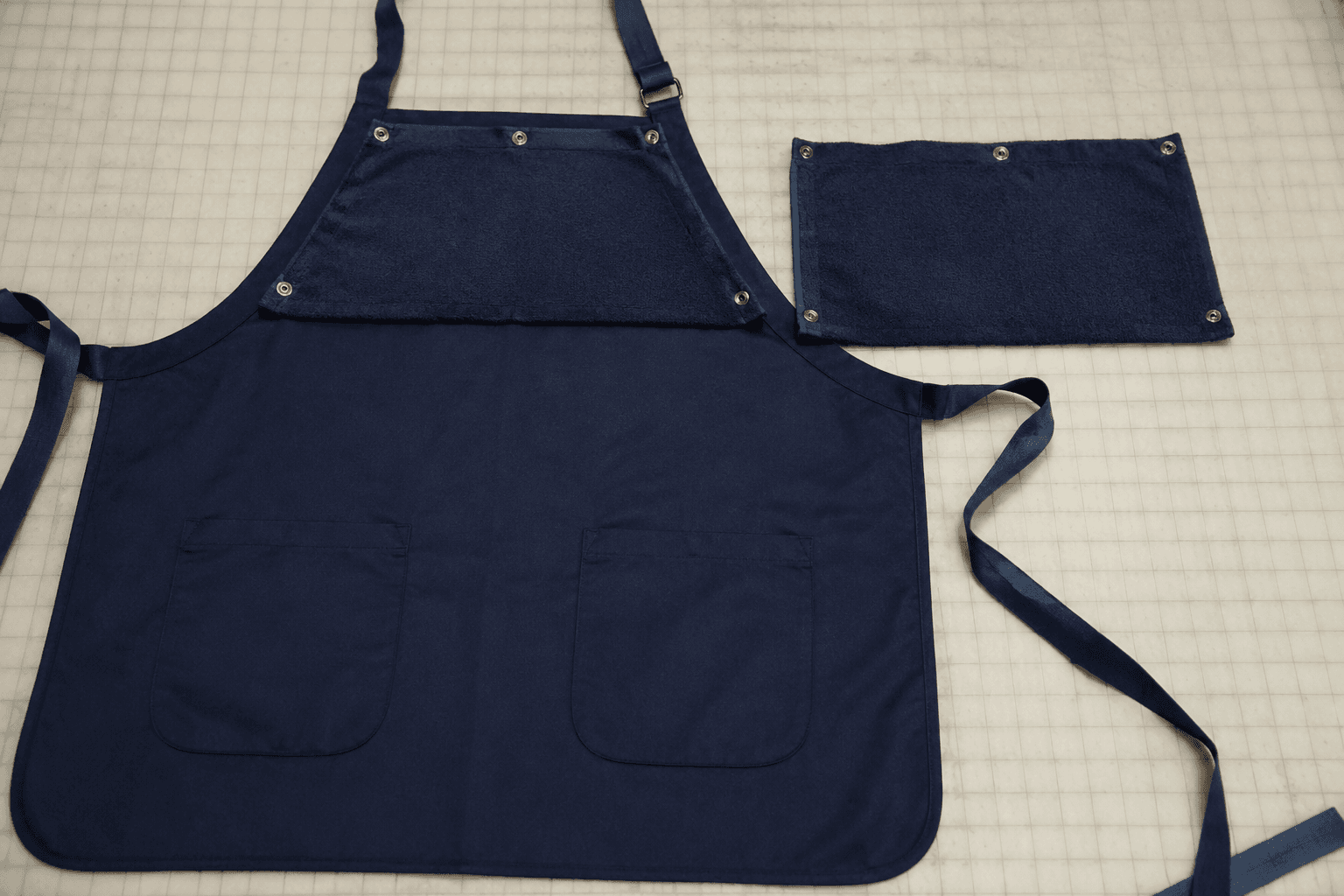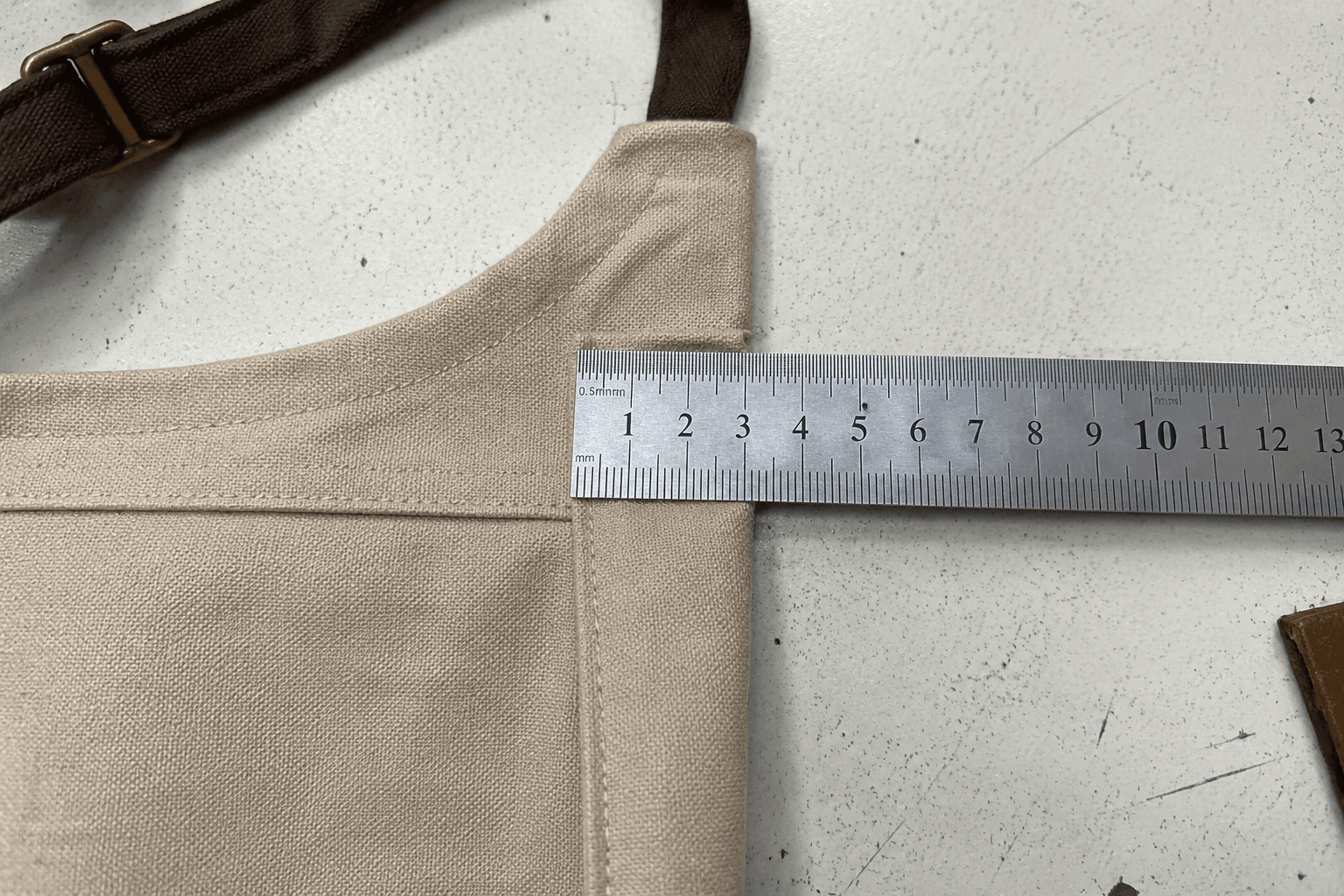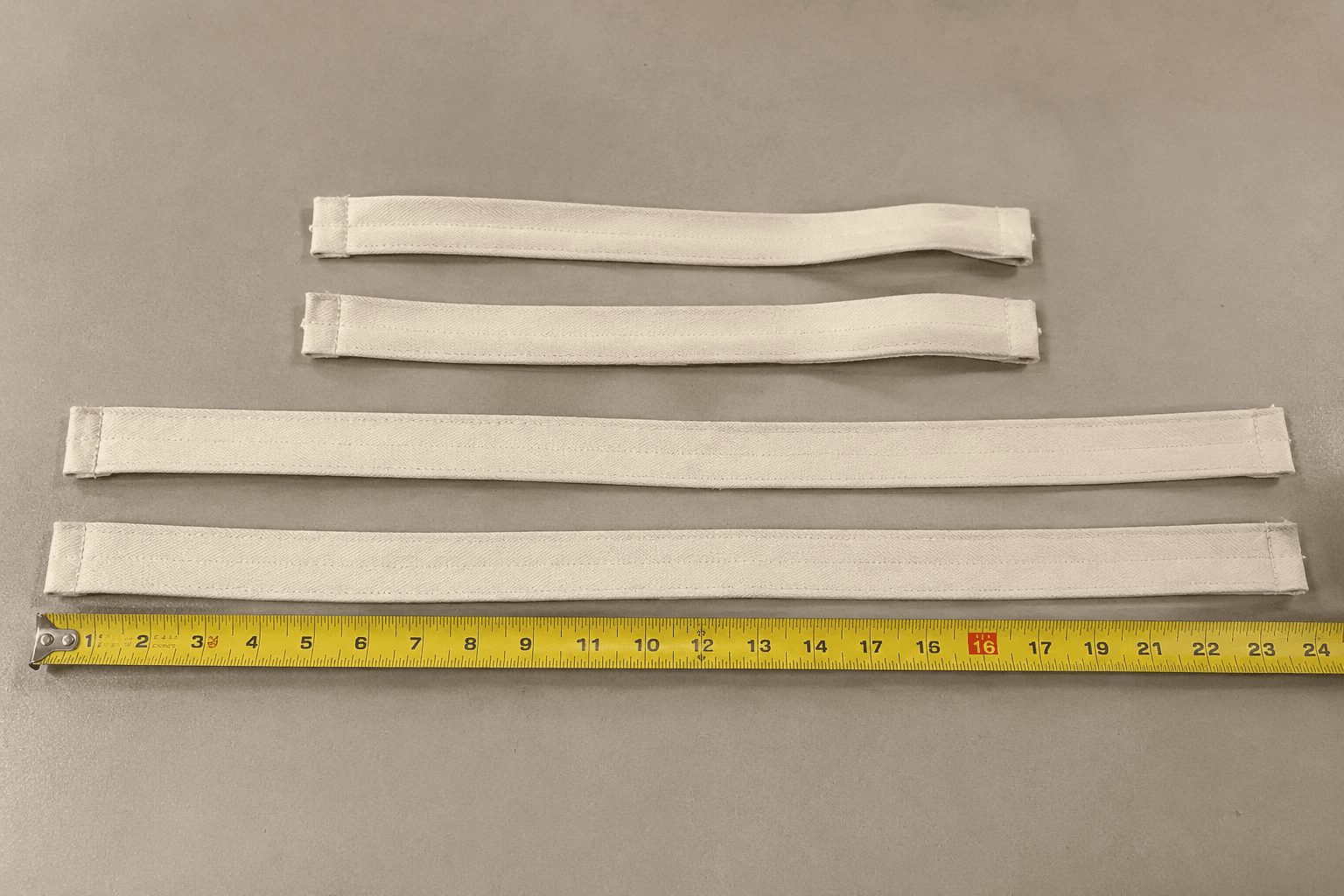
For bulk apron programs, sizing is often discussed as body width and body length, but the straps decide whether the apron is actually wearable. A bib apron with a correct panel can still sit too high on a tall chef, pull at the neck on a barista, or fail to tie securely on a larger-waist wearer. That is why custom apron strap length should be specified early, before sampling and before fabric consumption is calculated.
In factory development, we treat neck and waist straps as functional components, not decoration. Strap length affects fit coverage, sewing time, reinforcement method, hardware selection, carton volume, and sometimes metal detector or laundry requirements. A 10 cm change on each waist tie may look small on a tech pack, but across 10,000 pieces it can add hundreds of meters of tape or self-fabric, plus extra minutes in cutting and bundling.
This guide explains how to size necks and waists for professional apron orders, with practical dimensions, tolerances, and sourcing trade-offs for restaurants, hotels, bakeries, salons, workshops, and promotional uniforms.
- Apron strap length must be specified separately for neck strap, left waist tie, and right waist tie.
- Adjustable neck systems usually add USD 0.08-0.35 per piece, depending on hardware, webbing, and sewing method.
- Waist ties below 85 cm per side are risky for adult unisex aprons unless the apron is designed for a narrow size range.
- Longer straps increase fit range but also raise fabric consumption, tangling risk, and laundry wear.
- Sampling should include a fit trial on at least three wearer sizes, not only a flat measurement check.
Why custom apron strap length matters in bulk sourcing
In a retail sample, a strap problem may look minor because one model tries it on for a few minutes. In a chain restaurant, the same problem becomes operational. Staff members vary by height, shoulder slope, neck comfort preference, chest depth, and waist size. If the apron strap length is too short, the apron cannot be tied in front, cannot wrap around winter uniforms, or pulls the bib into the throat. If it is too long, ties hang near knees, get caught in drawers, and tangle during industrial washing.
For sourcing managers, the real issue is predictability. A standard adult bib apron body may be 70 x 85 cm, 72 x 86 cm, or 75 x 90 cm, but strap standards vary widely between factories. One supplier may quote 60 cm neck loop and 90 cm waist ties. Another may use 55 cm neck plus slider hardware and 100 cm waist ties. Without a written strap specification, both suppliers can claim compliance while delivering a different fit experience.
From the factory side, we also need strap details to calculate cost accurately. Self-fabric straps use the same shell fabric and require folding, pressing, stitching, and turning or edge topstitching. Twill tape or cotton webbing can be faster, but has its own MOQ and color matching limits. For a 280 GSM cotton canvas apron, adding 20 cm to each waist tie can increase fabric usage by roughly 0.015-0.025 m per piece depending on strap width and marker efficiency. On a 20,000 piece order, that becomes a visible cost line.
- Specify strap dimensions in centimeters after washing, not only before washing, if the apron is garment washed or enzyme washed.
- Separate functional strap length from sewn-in allowance, because 2-3 cm may be consumed inside the seam or reinforcement fold.
- Confirm whether waist tie length is measured per side or total combined length, as this is a common quotation error.
- State whether the neck strap is fixed, adjustable, detachable, cross-back, or part of one continuous waist-and-neck system.
Standard apron strap length ranges by apron type
There is no single global standard, but factories use working ranges based on apron type and wearer profile. For adult bib aprons used in food service, a fixed neck loop commonly measures 55-65 cm finished length. An adjustable apron neck system may use a 45-55 cm neck strap plus a 20-30 cm adjustment tail, or a 70-80 cm total strap passing through a slider. For waist ties, 85-100 cm per side is common for general adult unisex use, while 105-115 cm per side is preferred when buyers want front tying for more wearers.
Short waist aprons usually need longer ties relative to the body because the tie is the primary fit point. A bistro waist apron with 45 cm body height may use 95-110 cm ties per side. A long server waist apron with wrap styling may require 110-130 cm per side, especially when the design expects the tie to return to the front. For children or junior cooking kits, neck straps may be 38-48 cm and waist ties 55-75 cm per side, but these should be graded by age, not guessed from adult proportions.
Industrial and workshop aprons introduce other limits. A heavy 12 oz canvas apron with leather straps may use a cross-back harness instead of a neck loop because neck pressure becomes uncomfortable after a full shift. A PVC or TPU-coated apron for dishwashing may need welded or bar-tacked synthetic straps, often 80-95 cm waist ties per side, because overly long coated straps become stiff and inconvenient.
- Adult bib apron, fixed neck: 55-65 cm neck loop and 85-100 cm waist ties per side.
- Adult bib apron, adjustable neck: 45-80 cm usable neck range and 90-110 cm waist ties per side.
- Front-tie restaurant apron: 105-115 cm waist ties per side for wider wearer coverage.
- Waist apron: 95-130 cm waist ties per side, depending on wrap style and body width.
- Junior apron: 38-48 cm neck loop and 55-75 cm waist ties per side, graded by age group.
How to size an adjustable apron neck for real users
The neck strap controls bib height. If the bib sits too low, the chest is not protected. If it sits too high, the top edge rubs the throat and looks untidy over uniforms. For most adult bib aprons, the top bib edge should sit around upper chest level, usually 18-25 cm below the base of the neck depending on apron style. A tall chef may need more drop, while a shorter cafe worker may need the bib raised.
For apron fit customization, we recommend testing neck adjustment on at least three fit models: one shorter wearer around 155-160 cm, one average wearer around 170-175 cm, and one taller wearer around 185-190 cm. The same apron body can fit all three only if the neck adjustment range is realistic. A finished adjustable range of about 18-25 cm is usually enough for general service aprons. For uniform programs across many locations, 25-30 cm is safer.
Hardware choice changes both function and cost. A metal slider and buckle gives a clean look and durable adjustment, but adds weight and may cost USD 0.12-0.35 per piece depending on material and plating. Plastic ladder locks are lighter and cheaper, often USD 0.04-0.12 per piece, but may not suit premium hospitality programs. Buttonhole adjustment is low cost and washable, but adjustment steps are fixed and sewing must be accurate. Ties at the neck are flexible but slower for staff and can look inconsistent.
- Use metal slider hardware for premium canvas, denim, and hospitality aprons where appearance and durability matter.
- Use plastic ladder locks for lightweight polyester-cotton uniforms where low cost and laundering practicality are priorities.
- Use buttonhole and button adjustment when metal is not acceptable for washing, food safety, or detector requirements.
- Use tie-neck construction only when the buyer accepts slower dressing and a more casual visual effect.
Choosing apron waist tie length for mixed-size teams
Waist ties are the main reason a technically correct apron fails in the field. A 90 cm tie per side may work for back tying on many wearers, but it may not allow front tying for larger waists or for staff wearing thicker shirts. If the body panel is 70 cm wide and each tie is 90 cm, the total horizontal coverage is 250 cm before knot allowance. After allowing 25-35 cm for knot and bow, the practical wrap range is much lower.
For adult unisex programs, we usually advise 95 cm per side as the minimum general-purpose waist tie length and 105 cm per side when front tying is requested. For inclusive sizing or North American hospitality programs, 110-115 cm per side is often more practical. Buyers should be cautious with 75-80 cm waist ties unless the apron is for a narrow wearer group, a short promotional event, or a children’s product.
Longer is not always better. At 120-130 cm per side, ties can hang too low on smaller wearers and may twist in commercial laundry. Very long self-fabric ties also add bulk at the side seams, especially in 10 oz or 12 oz canvas. If the wearer range is very broad, it may be better to create two size sets, such as Regular with 100 cm ties and Extended with 120 cm ties, instead of forcing one strap length onto everyone.
- Back-tie only adult apron: 85-95 cm per side can be acceptable for many standard uniforms.
- Back or front tie adult apron: 105-115 cm per side gives better coverage across mixed teams.
- Extended size apron: 120-130 cm per side may be needed, with extra control for laundry tangling.
- Heavy canvas apron: keep ties practical, because thick self-fabric straps become bulky when tied.
- Promotional light apron: 80-90 cm per side may be used when cost is more important than broad fit.
Material and construction choices for each custom apron strap
The strap material must match the apron body, washing method, and target price. Self-fabric straps give the best color continuity because they are cut from the same fabric as the apron shell. They are common for cotton twill, poly-cotton twill, canvas, denim, and linen-cotton aprons. A typical self-fabric finished strap width is 2.0-2.5 cm for neck straps and 2.5-3.0 cm for waist ties. Wider straps distribute pressure better, but consume more fabric and may feel bulky at the knot.
Twill tape is efficient for lower and mid-price apron programs. Polyester-cotton twill tape in 2.5 cm width can be stable, colorfast, and cheaper to sew than folded self-fabric. Cotton tape has a more natural hand feel but may shrink 3-6 percent if not pre-shrunk. Webbing is stronger and useful for tool aprons, barber aprons, and cross-back designs. However, stock webbing colors may not match custom-dyed shell fabrics, and dye-to-match webbing can require 1,000-3,000 meters MOQ per color.
Construction also matters. A strap inserted into a side seam with one lockstitch line is lower cost, but it is not suitable for heavy use. For restaurant and workshop aprons, we prefer a box stitch, X stitch, or bartack at stress points. Bartacks add time but reduce strap pull-out claims. On a 5,000 piece order, adding bartacks at four strap points may add USD 0.03-0.08 per piece depending on factory line setup, but it is usually cheaper than handling returns for failed ties.
- Self-fabric straps are best when exact body color matching and a premium look are required.
- Twill tape is efficient for price-sensitive programs and stable repeat production.
- Cotton webbing improves hand feel but needs shrinkage control before bulk cutting.
- Polyester webbing improves strength and drying speed but can look less natural on cotton aprons.
- Leather straps should be detachable if the apron will be machine washed.
Custom apron strap length, cost, and MOQ impact
Buyers sometimes ask why a small strap change affects price. The answer depends on material. If the strap is self-fabric, length changes affect fabric yield, cutting marker efficiency, sewing labor, and sometimes carton size. If the strap is tape or webbing, length changes affect purchased trim consumption. For a 2.5 cm twill tape strap costing USD 0.06-0.12 per meter, adding 30 cm total tape per apron may add USD 0.018-0.036 in material before wastage and handling. For 50,000 pieces, that is USD 900-1,800 before any labor impact.
Hardware creates a larger step change. A fixed neck apron may need only sewing thread and fabric. An adjustable apron neck with two metal pieces may add USD 0.15-0.40 per piece depending on finish, order quantity, and testing requirements. Nickel-free plating, antique brass finish, stainless steel, or branded metal parts can push the cost higher and extend lead time by 7-15 days if tooling or custom plating is required.
MOQ should be discussed by strap material and color. A factory may accept 300-500 pieces per color for standard fabric aprons using stock tape. But custom-dyed webbing, special metal hardware, or silicone-tipped drawcord style straps may require higher MOQ. For Zhejiang apron production, a practical custom apron order may be 500 pieces per style for simple construction, 1,000 pieces per color for custom tape, and 3,000 pieces or more when dedicated hardware color is developed.
Measurement tolerances, shrinkage, and quality control
Straps are narrow components, so small errors are visible in use. For most apron programs, a finished strap length tolerance of plus or minus 1.0 cm is reasonable for neck straps and plus or minus 1.5 cm for waist ties. For garment-washed aprons, tolerance may need to be plus or minus 2.0 cm because cotton shrinkage and washing variation are harder to control. The important point is to agree whether measurements are taken before wash, after wash, or after steam pressing.
Shrinkage testing should be done before bulk cutting when cotton, linen, denim, or cotton webbing is used. A cotton canvas body at 280-320 GSM may shrink 2-5 percent depending on finishing. Cotton tape can shrink differently from the body fabric, causing puckering or shorter-than-expected ties after washing. If the apron is intended for industrial laundry at 60-75 degrees Celsius, home-wash shrinkage data is not enough.
During production QC, straps should be checked flat, without stretching. Inspectors should measure from the seam exit point to the strap end for waist ties, and along the center line for fixed neck loops. For adjustable neck systems, QC should check both minimum and maximum usable positions. Pull testing is also useful: a waist tie attachment should withstand normal force without seam slippage. For heavy-duty aprons, buyers may request a 7-10 kg pull test at strap points.
- Neck strap tolerance: usually plus or minus 1.0 cm for non-washed aprons.
- Waist tie tolerance: usually plus or minus 1.5 cm for standard bulk production.
- Garment-washed strap tolerance: often plus or minus 2.0 cm after wash.
- Shrinkage testing: check shell fabric and strap material separately before production.
- Pull test: use higher requirements for tool, butcher, workshop, and laundry-intensive aprons.
How to brief a factory for apron fit customization
A good tech pack should remove guesswork. Instead of writing standard straps, state the exact custom apron strap length, finished width, material, attachment method, hardware, tolerance, and measurement point. Include wearer intent: back tie only, front tie preferred, adjustable neck required, cross-back comfort required, or extended size coverage. The more clearly the use case is stated, the easier it is for the factory to recommend a practical construction.
For sampling, one prototype is not enough when strap fit is a key selling point. We recommend one salesman sample for appearance, then a size trial sample after strap comments are updated. If the apron is for a national restaurant rollout, test on at least five staff profiles before approving bulk: shorter female wearer, average female wearer, average male wearer, tall male wearer, and larger-waist wearer. This process can add 5-7 days to development, but it reduces the chance of bulk complaints.
Lead time depends on complexity. A standard apron with stock fabric and stock tape may sample in 5-7 days and produce bulk in 25-35 days after approval. Custom-dyed fabric or webbing may require 10-15 days for lab dip and 35-50 days for bulk. Special hardware, leather straps, or multiple size grading can add another 7-20 days. For repeat orders, keeping an approved strap standard in the factory file is the simplest way to control fit and speed up reorders.
- Provide neck strap finished length, usable adjustment range, width, material, and hardware type.
- Provide apron waist tie length per side, not only total length.
- Confirm whether ties must reach the front on a target waist size, such as 100 cm or 115 cm.
- State washing method, because shrinkage changes final apron strap length.
- Approve a sealed pre-production sample before cutting bulk fabric and straps.