For custom apron orders, packaging is often treated as a late-stage detail, but it directly affects cost, lead time, inspection method, warehouse handling and the buyer's retail presentation. A bib apron packed flat in a clear OPP bag is a different project from the same apron folded around a paper belly band, packed with a printed hangtag, barcode sticker and inner carton assortment. The sewing specification may be identical, but the production flow and quality control checkpoints are not.
At factory level, apron packaging decisions are made together with fabric weight, apron size, pocket structure and shipment channel. A 7 oz cotton canvas apron can usually be folded thin enough for compact polybag packing, while a 12 oz denim apron with leather-look straps, metal hardware and reinforced pockets needs a larger bag, stronger carton and more time at the packing table. If the buyer requires retail-ready apron presentation, the packing standard should be confirmed at pre-production sample stage, not after bulk sewing is complete.
This guide explains the practical options we use for bulk apron packaging, including apron hangtag formats, apron polybag choices, carton planning, branded apron packaging and retail-ready requirements. The numbers below are typical for OEM apron production in Zhejiang and should be adjusted based on apron dimensions, fabric GSM, order quantity and destination compliance rules.
- Apron packaging should be locked before bulk cutting because fold size, barcode placement and carton dimensions can affect final packing speed.
- A basic apron polybag normally adds USD 0.03-0.08 per piece, while printed retail packaging can add USD 0.12-0.45 per piece depending on material and quantity.
- Hangtags are low-cost but require artwork control, especially when SKU codes, care content, country of origin and barcode data are included.
- Retail ready apron orders need extra inspection time because presentation defects, label errors and barcode scanning must be checked before shipment.
- Carton packing should be calculated by folded apron size, not by apron body size, because straps, pockets and hardware change actual volume.
- MOQ for branded apron packaging is often higher than the apron MOQ, so buyers should confirm packaging MOQ before approving final price.
Why apron packaging should be specified early
In apron sourcing, the packing method is part of the product specification. It is not only a shipping instruction. When a buyer sends a tech pack with fabric, size, logo and pocket details but leaves packaging as to be confirmed, the factory can quote only a base packing assumption. Usually this means one apron folded in one clear OPP polybag, 50 or 100 pieces per export carton, with a neutral shipping mark. If the final order later changes to printed polybags, hangtags, barcode labels or retail display packs, both cost and lead time may change.
The most common issue is fold size. A 70 x 85 cm bib apron in 220 GSM cotton twill may fold to about 24 x 28 cm without looking bulky. The same apron in 360 GSM canvas with cross-back straps may need a 28 x 32 cm bag to avoid pressure marks. If the buyer wants an apron hangtag visible through the bag, the fold must also expose the brand area or neck strap area correctly. These details sound small, but on a 10,000 piece order they determine packing table efficiency, carton cube and final presentation.
Early specification also prevents rework. If care labels, hangtags and polybag warnings are approved after bulk sewing, the finished aprons may sit in the warehouse for 5-10 days waiting for printed components. During peak months before summer hospitality orders or year-end promotional campaigns, packaging delays can be more serious than sewing delays because printing suppliers have their own queue.
- Confirm the target sales channel: wholesale, e-commerce, uniform program, promotional gift or retail shelf.
- Confirm whether each apron needs an individual SKU, barcode, size mark, color code or assortment label.
- Confirm the folding method at sample stage and photograph it for the production file.
- Confirm whether packaging must pass destination rules such as suffocation warnings, recycling marks or retailer carton labels.
- Confirm whether the quoted unit price includes all packing materials or only neutral export packing.
Basic apron polybag options and cost range
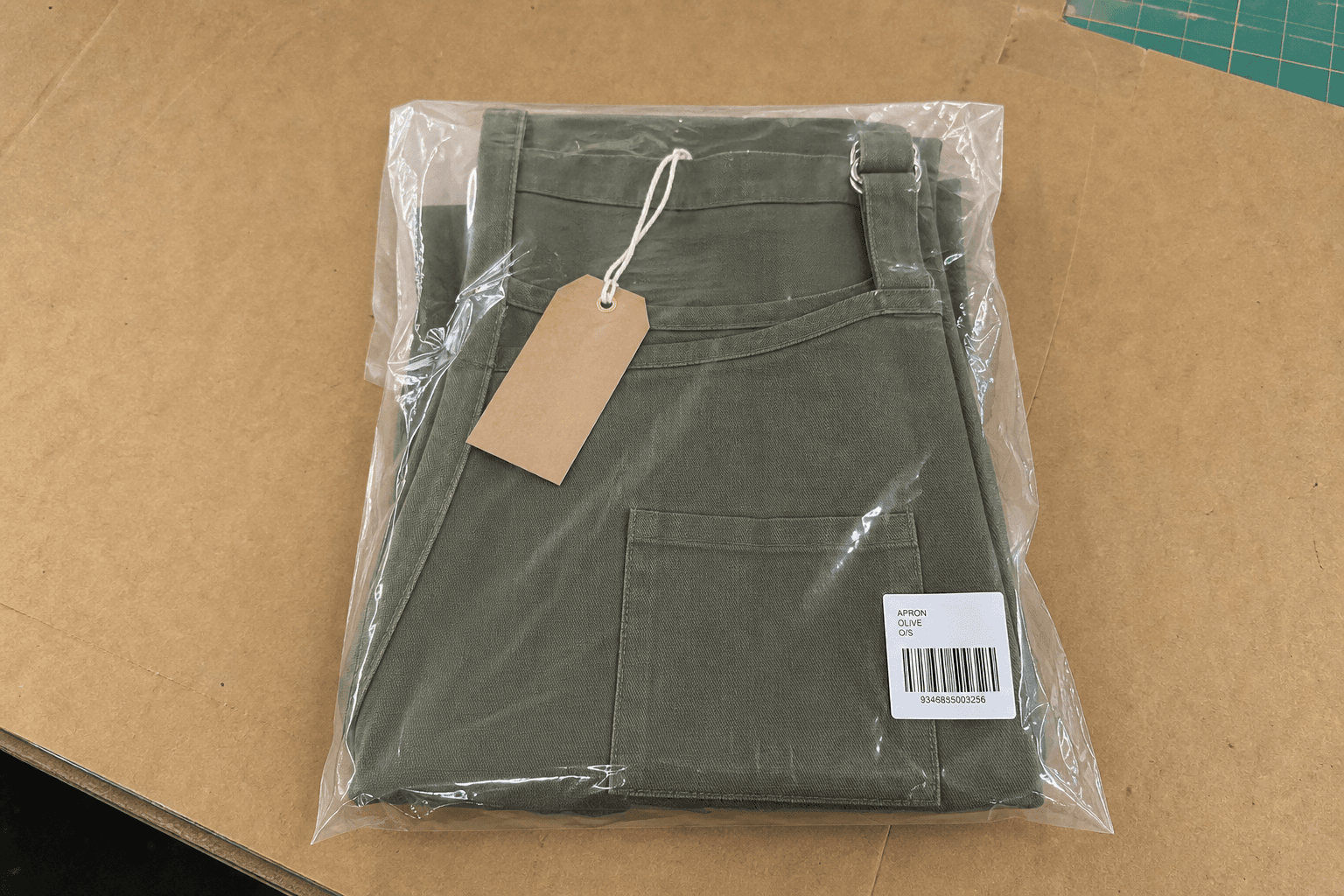
The apron polybag is the most common packing method for bulk custom aprons. For factory packing, the standard choice is a clear OPP bag or PE bag with adhesive closure. OPP is clearer and gives a cleaner retail look, while PE is softer and more flexible. For most cotton, poly-cotton and denim aprons, bag thickness is usually 30-50 microns. Heavier aprons or aprons with metal buckles may need 50-70 microns to reduce tearing during carton loading.
For a simple bib apron or waist apron, a plain clear polybag usually costs about USD 0.03-0.08 per piece at 3,000-10,000 pieces. A printed one-color warning statement or recycling mark may add USD 0.01-0.03 per piece depending on print area and quantity. Fully printed branded apron packaging can range from USD 0.08-0.20 per bag for common sizes, but the cost rises if the bag is oversized, uses matte material, has a zipper closure or needs small-batch printing.
The main trade-off is between cost, clarity and sustainability targets. Clear OPP gives the best product visibility and is widely used for promotional aprons, restaurant uniform aprons and kitchen textile programs. PE is easier to handle for thick canvas aprons. Recycled-content bags and biodegradable bags are available, but buyers should confirm actual certificates, shelf life and destination acceptance before specifying them. Some biodegradable bags become brittle after long storage, which is a risk for replenishment programs.
- Clear OPP adhesive bag: practical for most 160-280 GSM cotton or poly-cotton aprons.
- Clear PE adhesive bag: better for bulky aprons, denim aprons and styles with hardware.
- Printed warning bag: useful for US retail or e-commerce programs requiring suffocation text.
- Frosted bag: cleaner brand presentation but usually higher cost and lower product visibility.
- Zipper bag: reusable and premium in appearance, but slower to pack and usually unsuitable for lowest-cost promotional orders.
Apron hangtag choices for OEM orders
An apron hangtag is a small component, but it carries a high amount of buyer-facing information. For uniform programs, the hangtag may only show brand name, SKU and care instruction. For retail aprons, it may include fabric composition, features, barcode, country of origin, price field and retailer compliance text. The factory needs final artwork, size, paper weight, hole position, string type and attachment location before mass production.
Common hangtag sizes for aprons are 50 x 90 mm, 60 x 100 mm and 70 x 120 mm. Paper weight is often 300-400 GSM for a single card and 250-350 GSM for folded cards. Matte lamination gives a more restrained look and reduces fingerprints, while gloss lamination makes color stronger but can look less suitable for workwear and hospitality aprons. For natural cotton or linen-blend aprons, uncoated kraft paper is often used, usually 300-450 GSM, but color accuracy is lower than white card.
Attachment method matters. A hangtag tied to the neck strap is easy to see, but it may swing during packing and create uneven folds. A tag attached to a side seam or waist tie can be cleaner for flat packing. Plastic swift tags are low-cost and fast, but some buyers avoid them for sustainability reasons. Cotton string, jute cord or paper string improves the look but adds manual handling time. On a 20,000 piece order, even 6-8 extra seconds per piece becomes a real labor cost.
- Single hangtag with barcode: usually suitable for wholesale and e-commerce apron programs.
- Folded hangtag: useful when care information, brand story and feature callouts must fit without crowding.
- Kraft hangtag: common for canvas, denim, organic cotton and artisan-style aprons.
- String attachment: better appearance but slower than plastic fasteners.
- Barcode sticker on hangtag: flexible for multi-SKU orders, but the sticker material and scan quality must be checked.
Branded apron packaging for retail and e-commerce
Branded apron packaging can include printed polybags, paper belly bands, insert cards, header cards, kraft sleeves, gift boxes and custom carton labels. The right choice depends on how the apron is sold. A wholesale restaurant uniform buyer may only need a clear bag and SKU sticker because the apron goes directly to staff issue. A retail kitchenware brand may need a folded apron secured with a belly band so the logo, fabric texture and pocket shape remain visible. An online seller may prefer a compact branded bag that protects the apron during warehouse picking.
Paper belly bands are popular for retail ready apron programs because they are lower cost than boxes and allow the buyer to see fabric. A typical band might be 80-120 mm wide, printed on 250-350 GSM paper, wrapped around the folded apron and fixed with tape or locking tabs. For a 5,000 piece order, a simple printed belly band may add about USD 0.06-0.15 per piece, depending on paper, printing colors and labor. The risk is slipping during transport if the band is too loose or the fabric surface is smooth.
Gift boxes create a stronger presentation but increase cost, carton volume and damage risk if the board is too thin. For a midweight apron, a folding paper box may add USD 0.25-0.80 per piece at moderate quantity, sometimes more for rigid boxes. Boxes also require more storage space before packing. If the apron is 300-420 GSM canvas, the box must be tested with the actual folded sample; otherwise the lid may bulge, and the final retail display will look poor even if the sewing quality is good.
- Printed polybag is economical for high-volume promotional or e-commerce apron orders.
- Paper belly band gives a retail look while keeping fabric visible and carton volume moderate.
- Header card works for peg display but must match retailer hole and display height requirements.
- Insert card is useful when the apron is sold online and the buyer wants brand content inside the bag.
- Gift box suits premium aprons but requires drop testing and carton compression checks.
Retail ready apron requirements buyers often overlook
A retail ready apron is not simply an apron with nicer packaging. It must arrive at the buyer's warehouse or store in a condition that can be scanned, sorted and displayed without repacking. This means barcode readability, carton labeling, SKU separation, fold consistency and packaging cleanliness are all part of the quality standard. For multi-color apron programs, each color should have its own SKU code and packing mark. Mixed cartons are possible, but the assortment ratio must be written clearly, such as 10 black, 10 navy and 10 olive per carton.
Barcode control is one of the most common failure points. The barcode artwork should be generated from confirmed data, printed at sufficient size and tested with a scanner before bulk printing. If the barcode is placed on a curved fold, glossy surface or wrinkled polybag, scanning may fail even when the number is correct. For Amazon-style FNSKU labels or retailer-specific carton labels, the factory needs the label files and placement guide. Reprinting labels after carton sealing is slow and expensive.
Retail packaging also changes inspection. A normal apron inspection focuses on measurements, stitching, color, logo placement, fabric defects and packing quantity. A retail ready order adds checks for hangtag position, printed bag quality, barcode scan rate, carton label accuracy, fold shape and visible dust or thread inside the bag. Buyers should allow this in the inspection AQL plan. For example, on a 12,000 piece retail apron order, a third-party inspector may need additional time if every sampled unit requires barcode scanning and packaging review.
- Barcode should scan through the final packaging, not only on the loose printed label.
- Retail carton marks should match the purchase order, SKU, color, quantity and destination routing guide.
- Folded apron dimensions should fit the buyer's shelf, bin or e-commerce storage requirement.
- Hangtags and stickers should face the same direction across the carton for professional presentation.
- Inner cartons may be needed when a master carton contains multiple retail-ready packs.
MOQ, sampling and lead time for apron packaging
Packaging MOQ can be different from apron MOQ. A factory may accept 500-1,000 pieces for a simple custom apron style if fabric is available, but printed bags, woven labels, paper tags and custom boxes may have higher minimums. For printed hangtags, MOQ is often 1,000-3,000 pieces per design. For printed polybags, practical MOQ is often 3,000-5,000 pieces per size and artwork. For custom gift boxes, MOQ may be 1,000-3,000 pieces, but the unit cost at the low end can be high.
Sampling time also varies. A digital printed hangtag can be sampled in 3-5 days after artwork approval. A printed polybag sample may need 5-7 days. A custom paper box can need 7-12 days for blank structure sample and printed sample. If the buyer requests color matching to Pantone values, add time for proofing. Packaging sampling should run in parallel with apron sample development when possible. Waiting until the size set sample is approved before starting packaging can add one to two weeks to the calendar.
For bulk lead time, neutral packaging usually has little effect if materials are stocked. Printed packaging normally adds 5-15 days depending on supplier queue, approval speed and whether tooling is required. A realistic schedule for a 5,000 piece custom apron order with printed hangtag and clear warning polybag might be 3-5 days for artwork check, 5-7 days for packaging production, 20-30 days for apron sewing after deposit and fabric approval, and 2-4 days for final packing and inspection. During busy seasons, it is safer to confirm packaging components before fabric cutting is complete.
Carton planning and freight impact of apron packaging
Apron packaging affects freight because it changes carton size, carton weight and loading efficiency. For many cotton bib aprons, export cartons are planned at 50 pieces per carton for heavy styles or 100 pieces per carton for lighter styles. A 180 GSM promotional apron may fit 100 pieces in a carton around 55 x 35 x 35 cm. A 360 GSM canvas apron with cross-back straps may require 50 pieces in a carton around 60 x 40 x 40 cm. These are examples only; actual packing should be tested with folded samples.
Carton gross weight should remain manageable for warehouse handling. Many buyers prefer cartons under 15 kg, and some routing guides limit cartons to 18-20 kg. A 300 GSM apron with metal eyelets and long ties may weigh 280-380 g per piece before packaging. At 50 pieces, product weight alone can reach 14-19 kg before polybags and carton board. In that case, reducing carton quantity to 40 pieces may be better than creating a carton that is difficult to lift or more likely to burst.
Retail packaging can increase cubic volume faster than expected. A belly band may have little effect, but a header card, box or thick zipper pouch can reduce pieces per carton by 20-50 percent. For sea freight, this changes CBM and landed cost. For air shipment, both actual weight and volumetric weight matter. Buyers comparing two packaging options should ask the factory for estimated carton dimensions, gross weight and CBM per 1,000 pieces, not only the packaging unit price.
- Ask for a trial carton packing photo before bulk shipment, especially for new apron styles.
- Check gross weight per carton against the buyer's warehouse handling limits.
- Calculate CBM per 1,000 pieces when comparing polybag, belly band and box options.
- Use stronger 5-ply export cartons for heavy canvas, denim or waxed-look apron programs.
- Separate sharp metal hardware from carton edges by adjusting fold direction or adding inner protection.
Quality control points for apron packaging
Good apron packaging is consistent, clean and correct. During in-line and final inspection, the factory should check packaging materials before full packing starts. This includes confirming hangtag artwork, polybag size, printed warning text, sticker data, carton marks and packing ratio. One incorrect digit in a barcode or one wrong color name on a carton label can create receiving problems even when the aprons themselves are acceptable.
Packing workers also need a reference sample. For custom aprons, straps can be folded in several ways, and inconsistent strap placement makes the packed product look untidy. A sealed gold sample should show the approved fold, hangtag position, sticker position and bag closure direction. For retail ready apron orders, the packing line should compare output against this sample throughout the day. If the apron has embroidery or screen printing, the fold should avoid pressing hard creases across the logo area.
Buyers can reduce risk by providing complete packaging files in editable and print-ready formats. The factory should still check whether the file size, bleed, barcode, color mode and language match production requirements, but final content responsibility usually remains with the buyer. For repeat orders, packaging files should be controlled by version number. This is important when care instructions, importer address, compliance wording or SKU codes change between seasons.
- Verify packaging material dimensions against the folded bulk apron, not only against the sample apron.
- Check barcode readability after the apron is packed and sealed.
- Inspect hangtag position, string attachment and sticker placement for consistency.
- Confirm carton quantity and assortment ratio before cartons are sealed.
- Keep one approved packed sample at the line and one in the QC file for shipment comparison.
- Record packaging defects separately from sewing defects so the cause can be corrected quickly.