Buying printmaking studio aprons for professional use becomes easier when the brief is built around workflow instead of retail styling. Relief printing, screen printing, monotype and etching create different front-body contact, tool load and wash frequency. A teaching studio using mostly water-based ink for 6 to 8 hours per week can often accept 280 to 320 GSM fabric, while a commercial workshop running 5 days a week usually needs 340 to 410 GSM with stronger pocket reinforcement and tighter shrinkage control.
For B2B buyers, the key decisions should be numerical: fabric composition, GSM and oz weight, finished width and length, pocket dimensions, strap construction, wash expectation, shrinkage limit, FOB target, MOQ, AQL and bulk lead time. Buyers also need to separate ink resistance from solvent splash risk. A dense canvas apron can slow visible strike-through from light splash if it is wiped quickly, but it is not a chemical-barrier garment unless the material and testing support that claim.
The safest sourcing method is to write the apron spec from actual studio use. Define which inks are used, what cleanup liquids are present, how long splash remains before wipe-off, which tools go in pockets, how often aprons are washed, and what replacement cycle the program can afford. That gives procurement, QC and the factory a practical standard for repeat orders instead of a sample-only approval that fails in bulk.
- For daily-use printmaking studio aprons, 340 to 410 GSM or about 10 oz to 12 oz is the most reliable commercial range for shape retention, front coverage and pocket stability.
- For classroom and lower-frequency use, 240 to 300 GSM or about 7 oz to 9 oz is workable; mixed school and studio programs usually fit 300 to 340 GSM.
- Typical OEM MOQ is 300 to 500 pcs per color with stock fabric, rising to 800 to 1,200 pcs for custom dye, special finish or non-standard trim.
- Sampling usually takes 7 to 10 days for a basic style and 12 to 18 days for revised pocket engineering or finish changes. Bulk production is commonly 30 to 45 days after approval, or 45 to 60 days in peak season.
- Many professional apron buyers use AQL 2.5 major and AQL 4.0 minor for measurements, sewing, print placement and appearance.
- A simple chest pocket plus one or two reinforced lower pockets is usually more functional and often $0.18 to $0.45/pc cheaper than complex multi-division utility layouts.
Why printmaking studio aprons need a different specification than general craft aprons
General craft aprons are often designed for occasional wear, light splash and visual merchandising. Professional printmaking studio aprons are a work layer exposed to repeated hand wipe-off, brayer contact, table-edge abrasion, damp cloth transfer and frequent laundering. In B2B sourcing, that changes the priority from decorative styling to coverage, seam durability, pocket stability and predictable wash performance.
A useful buying method is to divide apron exposure into three zones. The upper chest receives splash when users lean over screens, blocks or plates. The mid-body receives repeated smear transfer from hands, rags and tools. The upper thigh area takes abrasion from benches and press-side movement. This is why a bib apron with full torso coverage usually outperforms waist styles in school labs, shared studios and professional workshops.
Construction should stay simple. Metal rivets, deep pocket dividers, folded channels and ornamental trim add cleaning problems without improving service life. For bulk orders, cleaner sewing with bartacks at stress points usually performs better after 30 to 50 wash cycles than fashion-led aprons with more parts and more contamination traps.
- Recommended finished width for adult one-size issue: 70 to 75 cm
- Recommended finished length: 84 to 90 cm for chest-to-thigh coverage
- Bib width under 24 cm often leaves the upper chest exposed during forward lean
- Use 20/3 or equivalent heavy-duty sewing thread at straps and pockets
- For programs below 1,000 pcs, one-size production usually reduces MOQ pressure and replenishment complexity
Fabric weight and composition ranges for printmaking studio aprons
Fabric weight should be fixed early because it affects protection, drape, carton weight, FOB cost and sample expectations. For entry classroom use, 240 to 300 GSM or 7 oz to 9 oz is acceptable when aprons are worn 2 to 3 days per week, carry light tools and see mostly water-based ink. For mixed-use lab programs, 300 to 340 GSM offers a stronger balance of cost and service life. For daily workshop wear, 340 to 410 GSM or about 10 oz to 12 oz is the safer commercial range because it resists distortion, supports reinforced pockets and masks strike-through better.
Material choice should follow the buyer's channel and price ceiling. 100% cotton canvas remains common for museum shops, art brands and premium studio issue because it has a natural hand and prints well. Its trade-offs are higher absorbency, slower drying and greater shrinkage risk. A 65/35 poly-cotton canvas or twill at 260 to 320 GSM usually dries faster, shrinks less and can lower FOB by about $0.20 to $0.45/pc on a 1,000-piece order compared with similar-weight cotton canvas.
Weight tolerance should be written into the purchase order. A standard commercial control is +/-5% on approved fabric weight. Without that limit, a bulk run can arrive visibly softer or lighter than the approved sample, which often leads to complaints about pocket sag, reduced coverage and poorer stain masking.
- 240 to 300 GSM: art classes, workshop kits, low-frequency issue
- 300 to 340 GSM: mixed school and studio use, moderate laundering
- 340 to 410 GSM: daily studio issue, heavier tool load, premium private label
- Typical FOB for stock-fabric bib aprons: $2.30 to $3.60/pc
- Typical FOB for 10 oz to 12 oz custom canvas aprons with reinforced pockets: $4.20 to $6.80/pc
Ink resistance claims and solvent splash limits for printmaking studio aprons
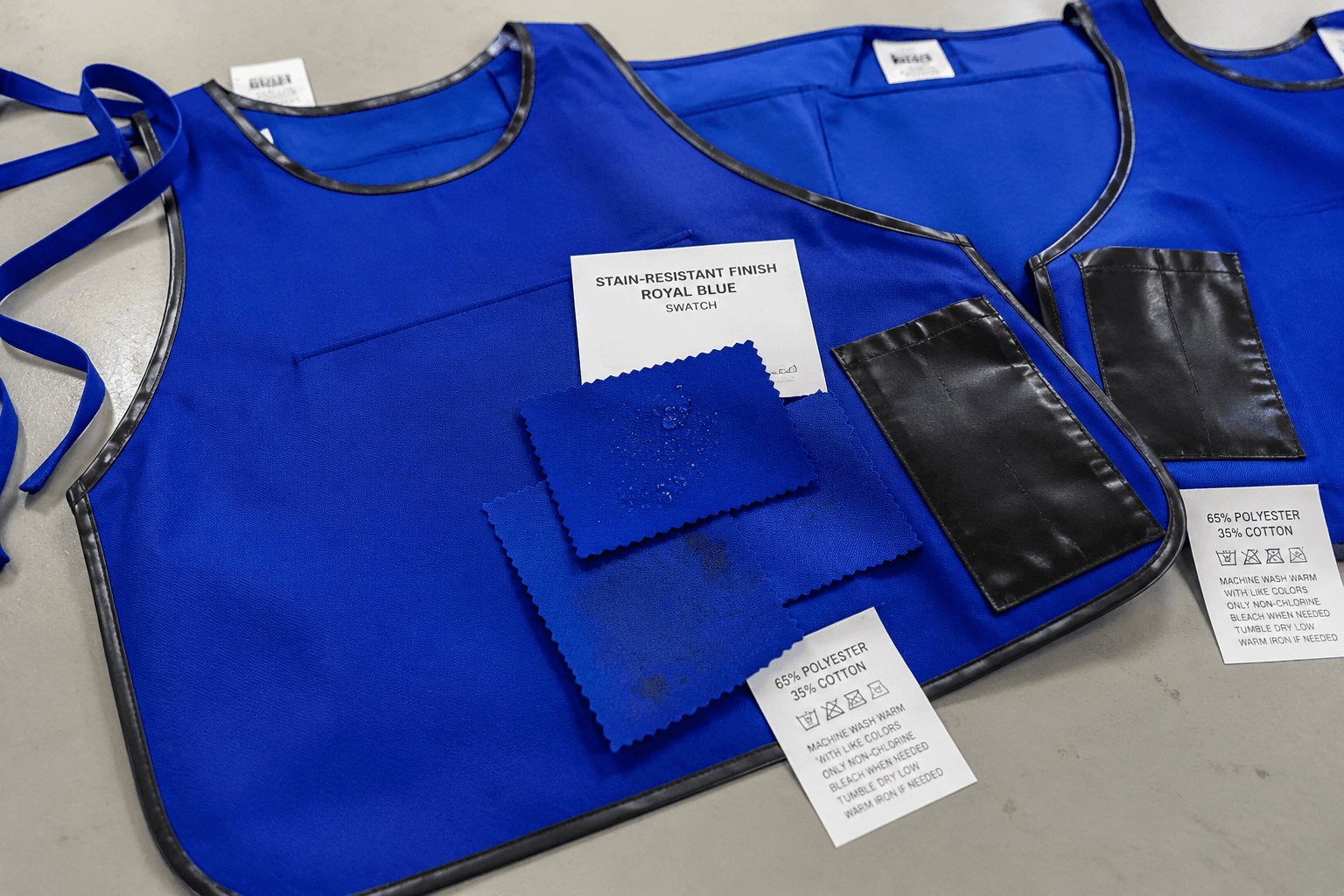
This is where many sourcing briefs become inaccurate. Buyers often request a solvent-resistant apron when the real need is a durable canvas apron that reduces visible staining and handles incidental splash during cleanup. Standard cotton or poly-cotton canvas, even at 12 oz, should not be sold as chemical-proof or solvent-safe PPE unless the material and testing justify that language. For apron programs, the safer claim is that the apron helps reduce staining and manages light, short-duration splash during normal studio use.
In practical use, heavier fabric delays penetration better than lighter fabric. A 370 GSM canvas apron can buy more wipe-off time than a 250 GSM base when exposed to small droplets of water-based ink or diluted wash water. If splash is wiped away within 30 to 60 seconds, the chance of immediate strike-through is lower. That is useful performance, but it is still not a chemical barrier for sustained contact with mineral spirits, alcohol-based cleaners or plate wash.
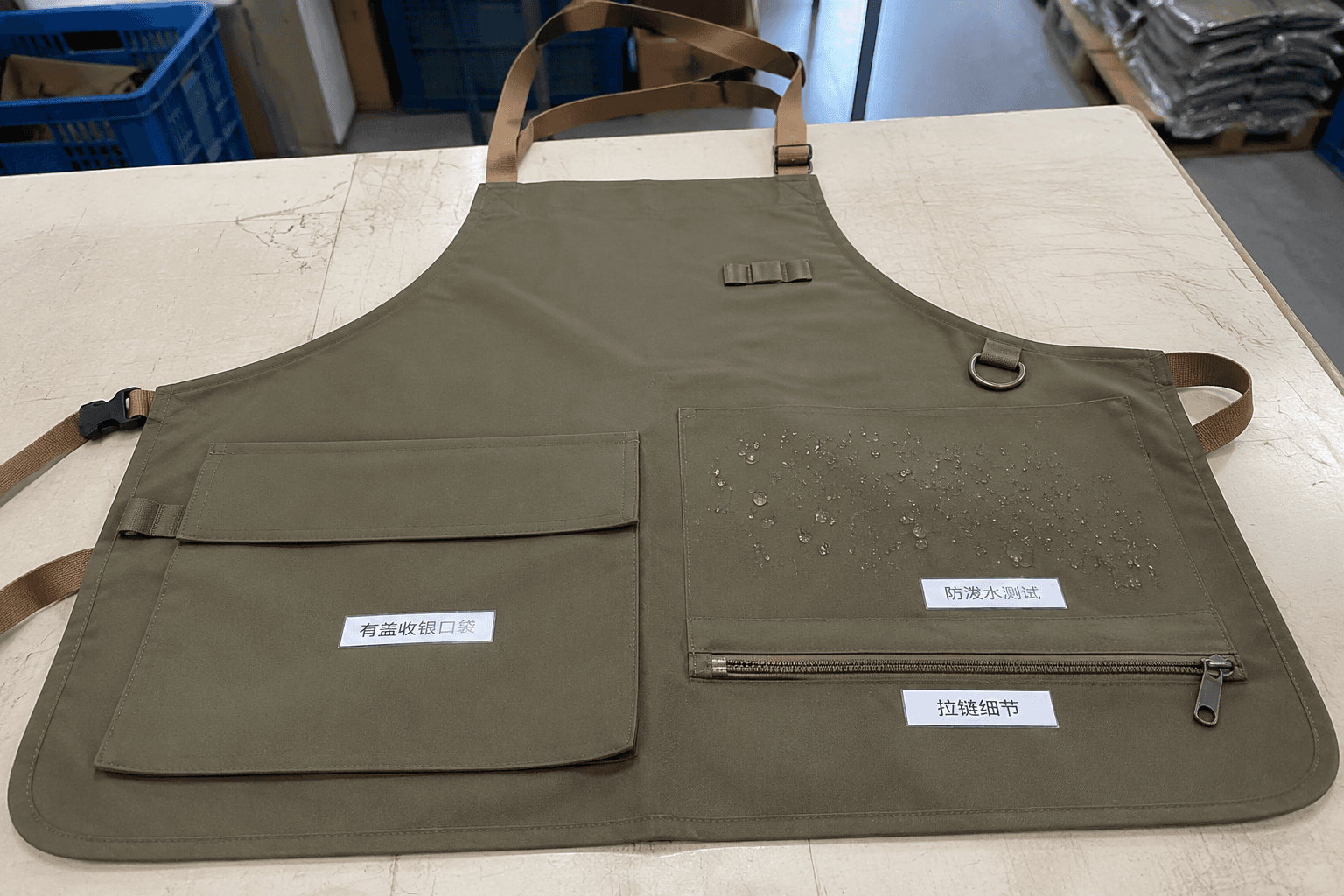
Finish language needs control as well. A light C0 water-repellent finish can help rinse water and some water-based stains bead briefly on the surface, but retention drops after laundering. Buyers should set checkpoints after 5, 10 and 20 home-wash cycles. If the studio uses solvent-heavy cleanup every day, the apron brief should explicitly state that the garment is an outer work layer used alongside site PPE rules, not in place of them.
- Confirm whether the studio uses water-based, oil-based or mixed-media inks
- List actual cleanup agents such as soap and water, citrus cleaner, alcohol-based cleaner or mineral spirits
- Approve claim wording as stain reduction or light splash reduction, not solvent proof
- Set finish-retention review points at 5, 10 and 20 washes
- For solvent-heavy environments, align the apron specification with internal safety policy before bulk approval
Pocket placement for brayers, knives, pencils and wiping cloths
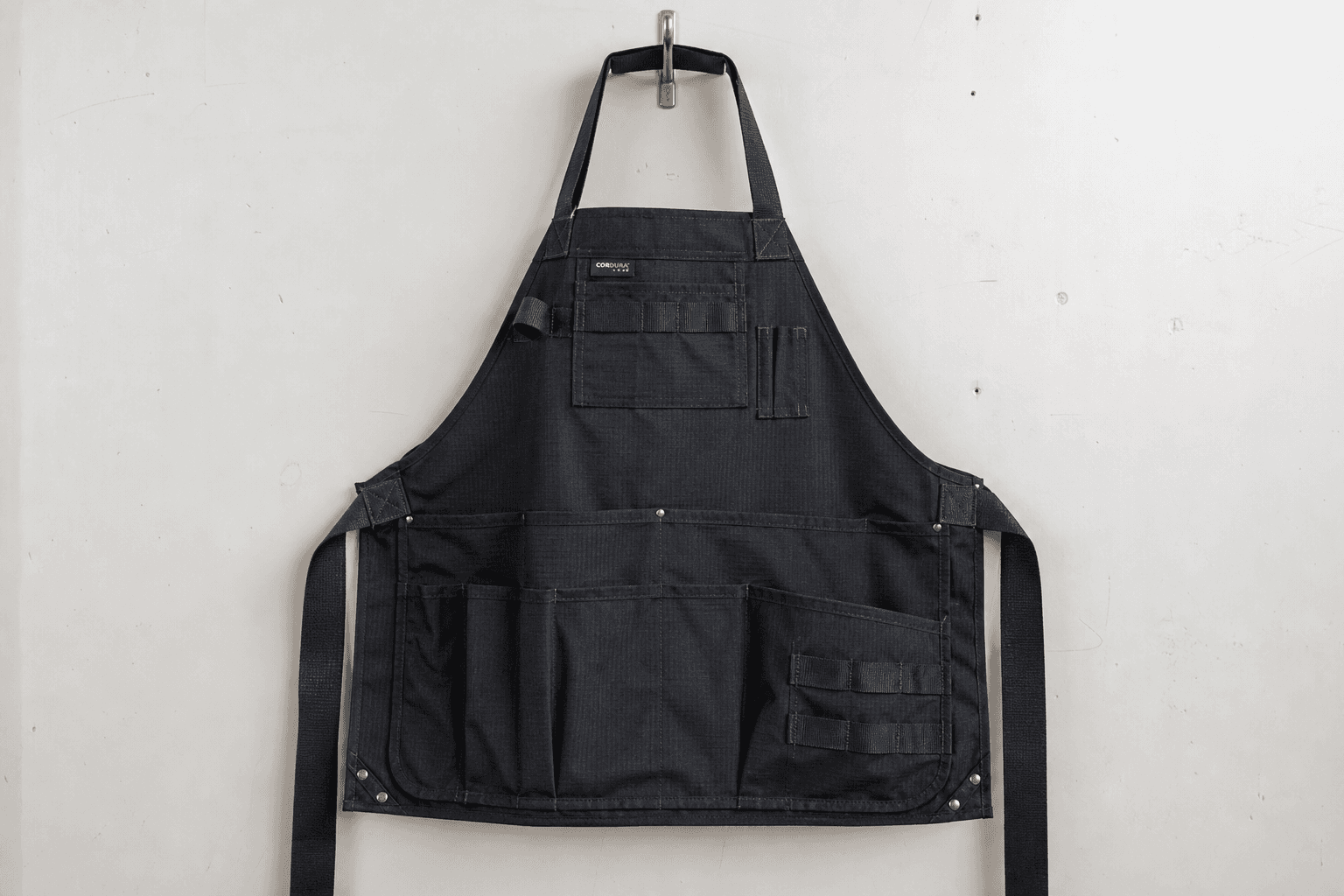
Pocket layout affects utility, contamination control and sewing cost more than many buyers expect. In a print shop, users bend forward, move close to benches and carry damp cloths or narrow tools that can distort soft pockets. Pockets set too low hit the thigh and collect residue. Pockets that are too deep trap rags, dried ink and debris that wash poorly. Complex utility maps often look efficient on a drawing but underperform in studio use.
For most professional programs, one narrow chest pocket and one or two reinforced lower patch pockets are enough. The chest pocket is best for pencils, markers, folded notes or a small ruler. Lower pockets can carry a narrow brayer, scraper, palette knife or folded wiping cloth, but they should not be oversized. A practical lower pocket opening often sits 18 to 22 cm above the hem so the pocket stays usable without slapping the thigh during movement.
Every added compartment raises sewing minutes and defect risk. On a 500-piece order, changing from a basic two-pocket apron to a five-compartment layout commonly adds $0.18 to $0.45/pc depending on topstitching, bartacks and divider count. If a buyer wants dedicated tool slots, the tech pack should include actual tool dimensions; otherwise the extra labor usually adds cost without improving field performance.
- Chest pocket width: 12 to 14 cm
- Chest pocket depth: 14 to 16 cm
- Lower pocket opening height from bottom hem: 18 to 22 cm
- Add bartacks at all pocket corners for metal scraper or mini-brayer use
- Avoid full-width kangaroo pockets in ink-heavy studios because they trap residue and wash poorly
Wash durability, color choice and shrinkage control in bulk apron programs
Wash performance should be specified as service appearance after repeated laundering, not complete stain removal. Ink, wiping marks and contact staining will build up over time in any real studio. The purchasing question is whether the apron remains presentable and dimensionally stable after 20, 30 or 50 washes, depending on the issue model. For shared studio stock, appearance retention usually matters more than perfect stain release.
Dark shades are the lowest-risk commercial choice. Black, charcoal, navy and deep olive hide residual staining better than natural cotton, stone or pale gray, and they support simple white or light-color logo printing. Buyers should still test crocking, especially if the aprons will be worn over light uniforms or sold into workshop settings where users often wear white T-shirts.
Shrinkage limits should be written into the order and inspection plan. For cotton canvas aprons, many OEM buyers accept 3% to 5% dimensional change after standard home laundering. If the target is below 3%, the supplier may need sanforized or prewashed fabric, which can add roughly $0.12 to $0.35/pc and extend fabric preparation by 3 to 7 days. That is a reasonable upgrade if approved before bulk fabric booking.
- Common low-risk colors: black, charcoal, navy, deep olive
- Typical shrinkage target for cotton canvas: within 3% to 5%
- Check colorfastness after 3 home washes and one higher-temperature wash if required by market
- Review dry crocking, wet crocking and logo contrast on dark shades
MOQ, lead times, AQL and cost drivers for OEM printmaking studio aprons
A standard OEM quote usually assumes stock fabric color, standard sewing thread, simple labels and uncomplicated construction. Under those conditions, MOQ is commonly 300 to 500 pcs per color. If the buyer needs custom-dyed fabric, a special finish, woven branding, embroidery relocation, size grading or non-standard strap hardware, MOQ often moves to 800 to 1,200 pcs. That increase usually comes from mill minimums and line setup efficiency rather than sewing alone.
Sample timing should match engineering complexity. A basic sample in stock canvas usually takes 7 to 10 days. If the style includes a new pocket map, custom PMS color, special finish or multiple decoration methods, 12 to 18 days is more realistic. Bulk production is typically 30 to 45 days after final approval and deposit in normal season, extending to 45 to 60 days for back-to-school and Q4 shipment windows.
Quality control should be fixed before production. For custom apron orders, many professional buyers use AQL 2.5 major and AQL 4.0 minor. The inspection plan should cover body measurements, strap attachment strength, pocket symmetry, stitch security, print or label placement, pre-pack appearance, barcode accuracy and carton count. On heavier canvas styles, carton planning also matters because a 12 oz apron can raise shipping weight quickly and reduce pieces per carton.
- Standard MOQ with stock-dyed fabric: 300 to 500 pcs/color
- MOQ with custom dye, finish or special trim: 800 to 1,200 pcs
- Sample lead time: 7 to 10 days standard, 12 to 18 days revised engineering
- Bulk lead time: 30 to 45 days normal, 45 to 60 days peak season
- Common inspection standard: AQL 2.5 major / 4.0 minor
- Review carton quantity early on heavier 10 oz to 12 oz apron programs
Tech pack items that reduce claims and rework on professional apron orders
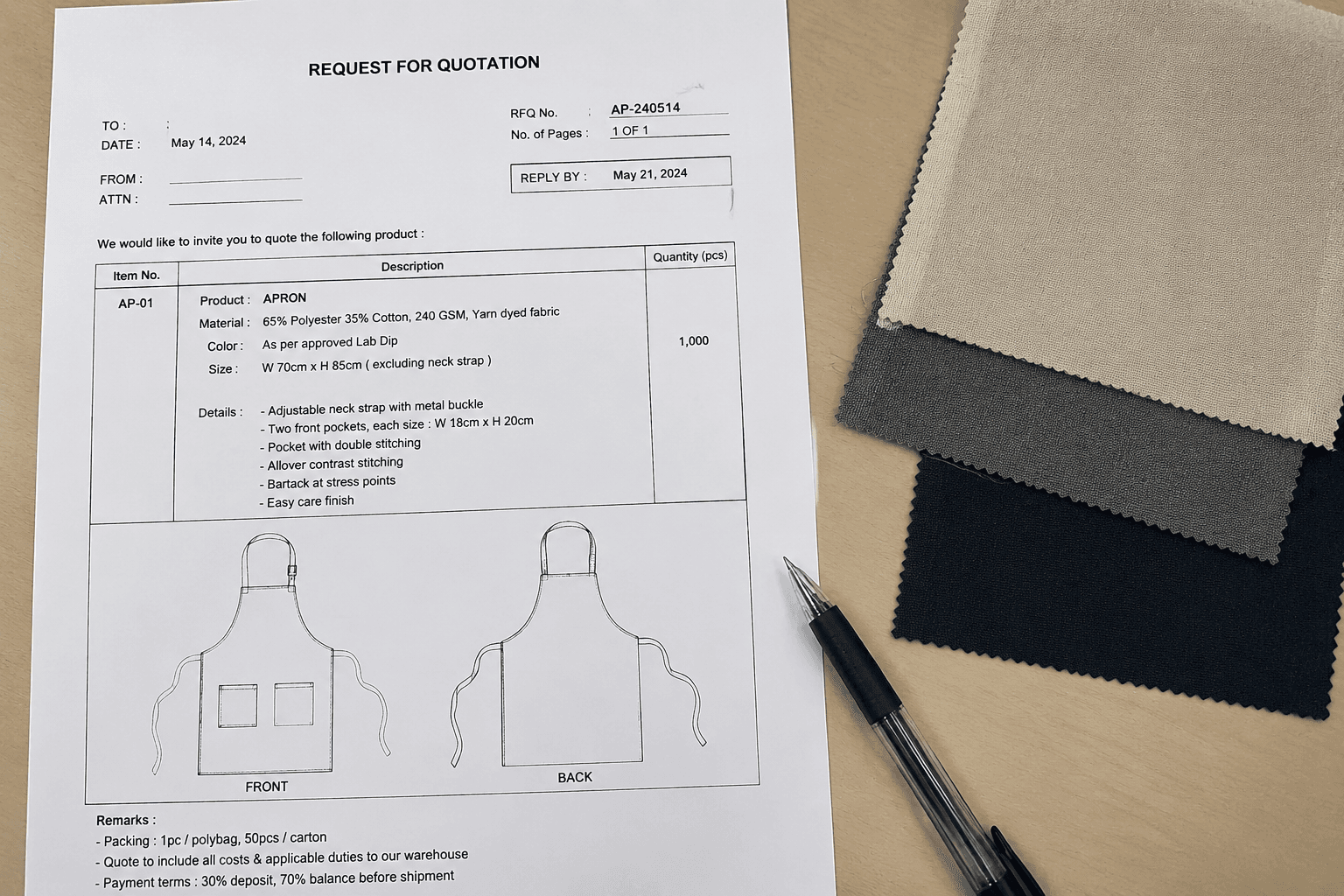
The strongest result comes from a tech pack written for use, not just appearance. For printmaking studio aprons, the document should define fabric content, exact GSM or oz, color standard, finished dimensions, neck and waist construction, pocket map, reinforcement points, decoration method, wash expectation, shrinkage tolerance and approved claim language for splash or staining. If those items stay vague, the first sample may still pass while the bulk run fails on size consistency, pocket function or finish retention.
The issue model also needs to be documented. A school district buying 2,000 pcs for shared use usually needs lower FOB, simpler one-size fitting and easy replenishment. A private-label art brand buying 600 pcs may accept a higher FOB for 370 to 410 GSM cotton canvas, cleaner seams and branded woven labels. The correct specification depends on the reorder cycle, target margin and service environment, not the reference photo.
Before bulk starts, buyers should approve the fabric swatch, color standard, artwork strike-off, measurement chart, pre-production sample and any wear-test notes. That front-end discipline can add several days, but it usually prevents far more delay later by reducing claims, remake costs and disagreements over what the approved apron was meant to do.
- Fabric example: 100% cotton canvas, 370 GSM, dyed black
- Measurement tolerance example: +/-1 cm on key body dimensions
- Pocket map with exact width, depth and bartack locations
- Decoration method: screen print, embroidery or woven label
- Shrinkage requirement and wash-care instruction
- Approved wording for stain reduction and light solvent splash limitation
- Packing details including fold method, polybag requirement, carton quantity and carton marks