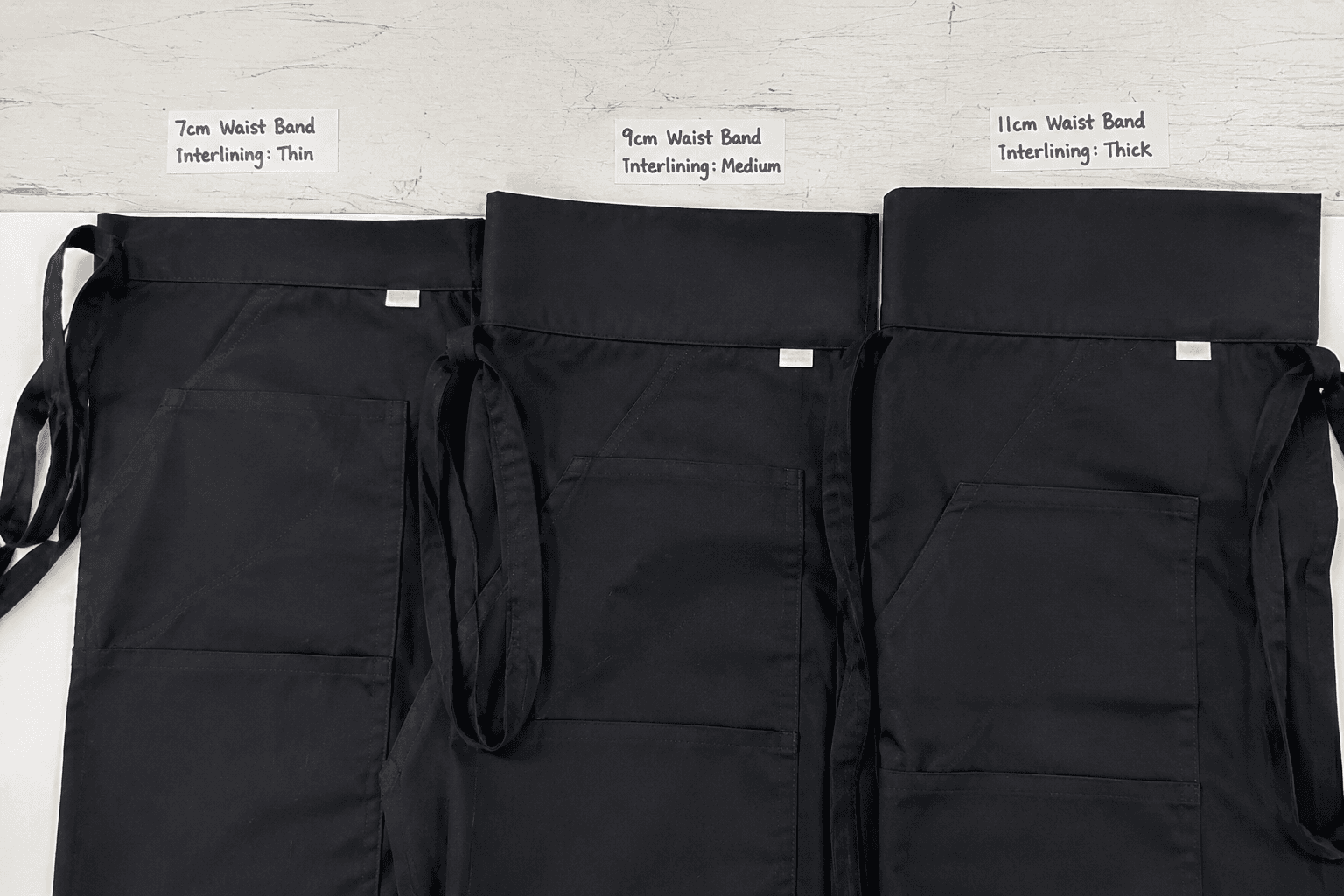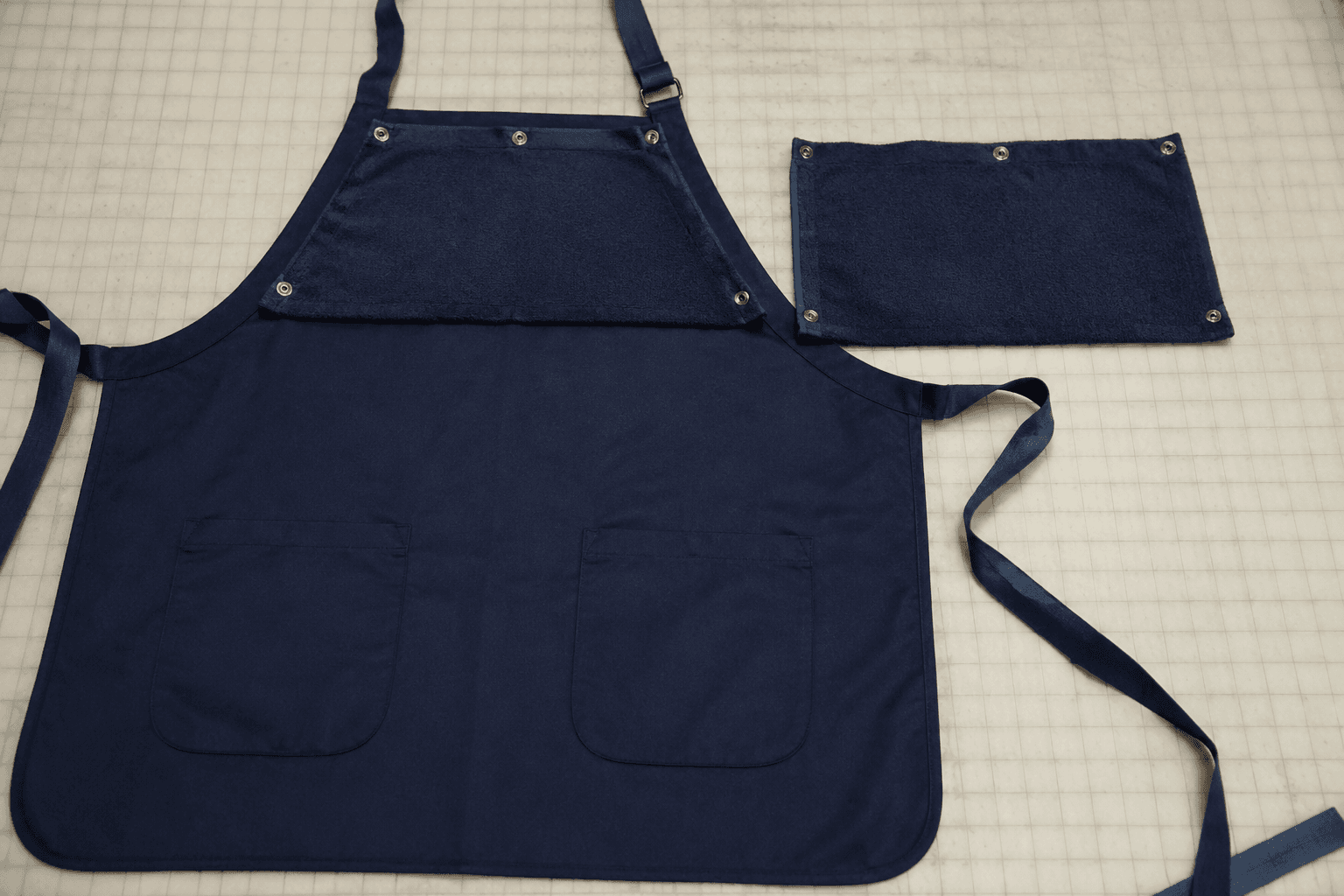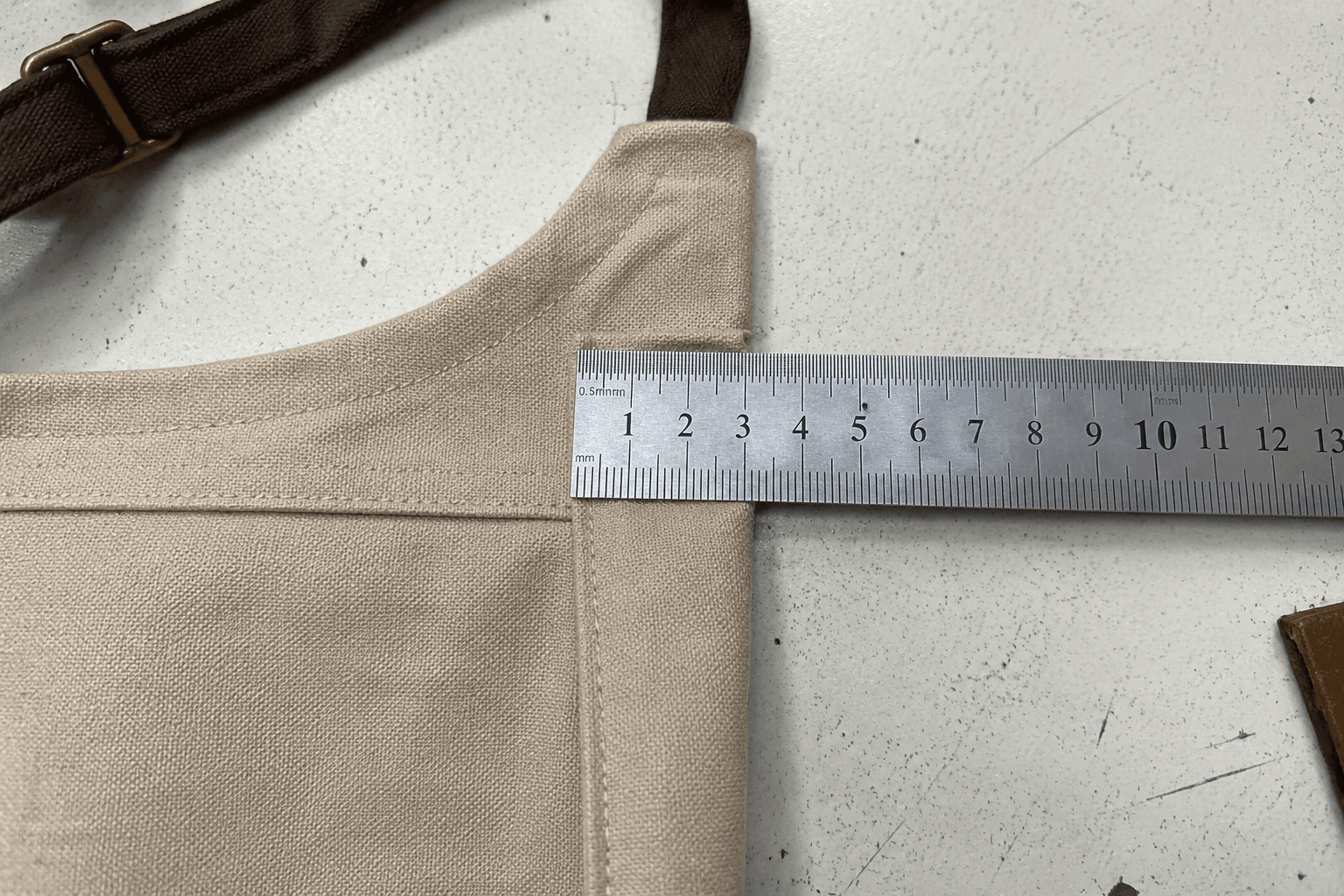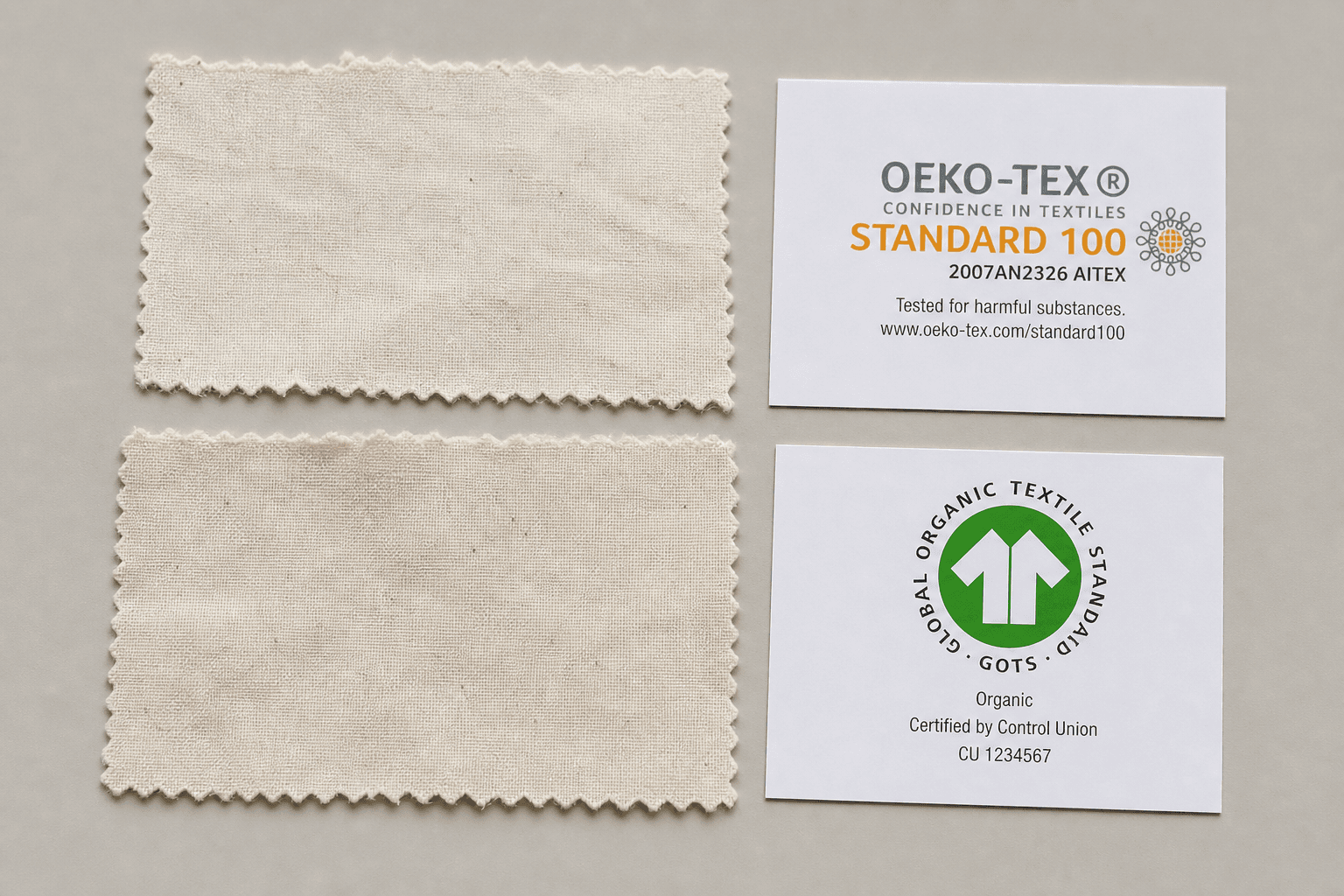
For bulk apron sourcing, contrast topstitching on aprons should be treated as a technical construction item, not a styling comment added after the salesman sample. A white stitch on black 340 GSM cotton canvas behaves very differently from a tobacco stitch on 260 GSM cotton drill or a black stitch on 200 GSM poly-cotton twill. Thread Tex size, needle range, SPI, seam allowance, fold build, presser-foot pressure and wash finishing all affect seam flatness, operator speed, rework rate and final FOB cost.
Professional buyers should assess visible stitching with the same discipline they use for fabric weight, pocket load, strap strength and shrinkage. Contrast seams can frame bib edges, sharpen pocket outlines and create a recognizable workwear signature without adding embroidery, heat transfer or woven badges. The same feature also exposes sewing variation that tonal thread would hide: 1.0 to 2.0 mm edge drift, uneven stitch density, skipped stitches, seam waviness, enlarged needle holes and post-wash puckering.
The most reliable custom apron programs define contrast topstitching on aprons in measurable terms before PPS approval: fabric weight in GSM or oz, thread supplier code, Tex size, needle size, SPI target, edge distance in millimeters, wash test, seam appearance tolerance and defect grading at final audit. Those numbers reduce sample loops, make PP comments actionable and help repeat orders match across fabric lots and production seasons.
- Match thread size to apron fabric weight and seam role: Tex 27 to 40 usually suits 170 to 220 GSM twill, Tex 40 to 60 fits 230 to 300 GSM drill or denim, and Tex 60 to 80 needs stitch trials on 340 to 400 GSM canvas.
- High contrast makes minor sewing defects obvious: ecru thread on black canvas or red thread on natural drill turns 1.0 mm edge drift and light seam ripple into visible audit issues.
- Separate decorative seams from structural seams: pocket framing, bib edges and outer-body topstitching do not always need the same thread setup as tie insertions, strap anchors and bar-tack transitions.
- Cost impact is driven mainly by labor: visible contrast stitching usually adds $0.03 to $0.08 per piece on simple twill aprons and $0.08 to $0.20 on heavier canvas bib aprons.
- Wash approval matters on canvas and denim aprons: pre-shrunk fabric helps, but curved pockets, folded bib edges, double rows and washed seam transitions remain the highest-risk zones.
- Use a sealed stitch panel for reorders: approved thread shade, Tex size, SPI, edge distance and post-wash seam appearance are more reliable than artwork or rendering notes.
Why contrast topstitching on aprons needs a numeric sewing specification
Buyers usually add visible topstitching to custom aprons for three commercial reasons: to create a workwear look, to improve product readability in catalog images, or to build a recognizable private-label signature without extra decoration. All three are valid, but each raises the visible quality threshold on the sewing line. Tonal black thread on a black apron can hide minor feed variation; ecru thread on the same apron will not.
This matters most on bib aprons with broad front panels, patch pockets, center seams, towel loops and multiple reinforcement points. On a 260 GSM cotton drill apron, a 1.5 mm shift in edge distance may pass visually when thread is tonal. On a black 12 oz canvas apron sewn with ecru Tex 60, the same shift often reads as a reject at final audit. Long vertical seams, pocket mouths and bib edges are especially sensitive because the eye tracks the stitch path before it reads the full apron shape.
From the factory side, contrast stitching should be costed and planned as a construction feature. A standard waist apron in 200 to 220 GSM poly-cotton twill may run at normal line speed. Add visible pocket framing, bib-edge topstitching, double rows and contrast reinforcement boxes, and sewing minutes usually rise by 8% to 15%. On 10 oz to 12 oz canvas bib aprons with webbing or self-fabric straps, the increase commonly reaches 18% to 25% if the buyer expects tight seam appearance control and extra sorting before packing.
The practical sourcing rule is simple: approve the feature by measurable standards, not by a visual comment such as make stitching stand out. A usable apron tech pack should state thread Tex size, needle range, seam type, SPI, edge distance, seam-waviness tolerance, wash requirement and inspection level. Without those numbers, the salesman sample may look acceptable while bulk production drifts in appearance.
- Set edge distance in millimeters, such as 2.5 mm or 3.0 mm, rather than using vague notes like keep even.
- Use a stated inspection baseline; AQL 2.5 major and AQL 4.0 minor remains common for custom apron orders.
- Treat visible contrast stitching as its own PPS checkpoint on dark aprons with light thread.
- Expect lower operator output when bib edges, pocket mouths and strap anchors all require contrast precision.
Thread size by GSM, oz and seam function for contrast topstitching on aprons
The most common sourcing mistake is choosing contrast thread only by how bold it looks in a sales sample. In production, thread size has to fit both apron fabric weight and seam function. If the thread is too fine, the visual effect weakens after washing and looks less defined in product photography. If it is too heavy, the apron can develop larger needle holes, stiff seam ridges and visible puckering around folds and corners.
For lighter hospitality, café and promotional aprons in 170 to 210 GSM cotton twill or poly-cotton, Tex 27 to Tex 40 is usually the safest decorative range. It gives enough visual contrast for pocket outlines and bib edges without overloading the seam. For midweight 230 to 280 GSM drill, brushed twill or denim, Tex 40 to Tex 60 is more typical. For premium workwear aprons in 10 oz to 14 oz canvas or dense denim, Tex 60 to Tex 80 can work when the buyer wants a heritage look and accepts slower sewing plus stricter approval control.
Needle size and SPI must move with thread size. A line using Tex 30 may sew cleanly with NM 90, while Tex 60 often needs NM 100 or NM 110, and Tex 80 may require NM 120 depending on seam bulk and fabric finish. Larger needles create larger holes, which can be acceptable on 370 GSM canvas but too harsh on a 190 GSM twill apron body. Stitch density matters just as much. On heavy visible thread, 6 to 8 SPI often lies cleaner on canvas than 10 to 12 SPI, which can over-compress the seam and cause seam draw.
Seam role matters as much as base fabric. Apron body-edge stitching and pocket framing are mainly visual. Waist-tie insertions, neck-strap anchors and pocket corners are structural. Many factories therefore use a stable construction seam for strength and a separate visible topstitch for appearance, or they pair a heavier needle thread with a lighter bobbin to improve sewability. Buyers should define where the contrast thread must be visible and where internal support thread may differ.
- 170 to 210 GSM twill: Tex 27 to 40 is usually enough for clean visible contrast.
- 230 to 280 GSM drill or denim: Tex 40 to 60 balances brand visibility and seam control.
- 340 to 400 GSM canvas: Tex 60 to 80 should be trialed with needle size, SPI and fold build before approval.
- Specify decorative seams and load-bearing seams separately in the apron tech pack.
Puckering risk on canvas and denim aprons after sewing and wash
Contrast topstitching on aprons makes puckering easier to see because the eye follows the thread line before it reads the panel shape. The fabric may only draw slightly, but a high-contrast seam can turn a minor distortion into a visible quality claim. On custom aprons, puckering usually comes from a combination of five causes: excessive thread tension, thread that is too heavy for the fabric, unstable finishing, mismatched shrinkage between fabric and thread, or SPI that is too dense for the seam build.
The highest-risk apron materials are rigid cotton canvas, recycled cotton canvas blends with uneven density, sulfur-dyed dark canvas, washed denim and lower-stability open-end twills. A black 12 oz canvas apron with ecru topstitching will show seam wave much faster than a natural canvas apron sewn with brown thread, even when the underlying distortion is similar. Curved patch pockets, rounded lower corners, split-pocket dividers, folded bib edges and side seams near tie insertion are the most common failure zones.
Seam geometry often decides whether the apron passes post-wash inspection. A topstitch placed too close to the folded edge can tunnel after washing. A heavy thread sewn at 10 to 12 SPI on stiff 340 GSM canvas may look sharp off the machine yet ripple after garment wash or tumble finishing. The same seam sewn at 6 to 8 SPI with lower tension and correct presser-foot pressure usually lies flatter while keeping strong contrast. On washed denim or enzyme-finished canvas aprons, approval is incomplete until the actual washed sample is measured and reviewed.
Good factories reduce puckering through process control rather than trial-and-error. That means allowing fabric relaxation for 12 to 24 hours before cutting, preferring sanforized or pre-shrunk apron fabric where possible, using suitable thread lubrication for heavy sewing, controlling presser-foot pressure, matching needle point to fabric construction and testing seams on bulk fabric before PP approval. For orders above 3,000 pieces, a pre-production sample cut from the actual bulk lot is far more reliable than an early prototype made from development yardage.
- Highest-risk zones include curved pockets, folded bib edges, side seams near tie insertion and bar-tack transitions.
- Heavy contrast thread on rigid canvas usually performs better at 6 to 8 SPI than at 10 to 12 SPI.
- Review seam appearance after wash on denim or washed canvas aprons, not only before finishing.
- Define in advance whether seam puckering is graded as a major or minor defect.
Where contrast topstitching on aprons improves brand visibility most efficiently
For professional apron buyers, visible stitching delivers the best return when it improves recognition without creating unnecessary sewing risk or overbuilt cost. A clean ecru seam on indigo denim, tobacco thread on olive canvas or black thread on natural drill can make a private-label apron look more deliberate and more premium without adding embroidery, print or badges. In hospitality supply, kitchenwear and retail workwear, that visual framing helps the apron read clearly from roughly 1 to 3 meters and also performs well in catalog and ecommerce photography.
The strongest return usually comes from placing contrast thread only where the eye naturally lands. On most aprons, those zones are the top bib edge, pocket mouth, pocket divisions, center seam if present, strap-anchor reinforcement and sometimes the upper body side edges. A Tex 40 or Tex 60 line in those locations normally gives better visual yield than running the same thread across hidden inner seams. Online buyers never inspect the inside of an apron, but they notice pocket framing and bib shape immediately.
Consistency across reorders matters as much as the first run. If visible stitching becomes part of the apron's brand identity, the buyer should lock the thread supplier code, Tex size, SPI and approval panel in the technical file. A request for natural thread is too loose for repeat orders. One supplier's natural can read creamy ecru; another may read yellow-beige. On black, navy or charcoal aprons, that shade shift is obvious. The same applies to stitch spacing: a reorder sewn at 8 SPI can look materially different from one sewn at 6 SPI even if thread color matches.
For mature B2B programs, contrast stitching is often controlled like a trim item. It receives a dedicated sealed reference because the apron may carry minimal logo decoration elsewhere. That discipline helps preserve shelf recognition and reduces disagreement when a buying team changes or production moves to another approved line.
- Focus contrast stitching on 3 to 5 visible seam zones instead of every seam on the apron.
- Lock thread shade by supplier code and keep a sealed stitch panel for each approved apron colorway.
- Use the strongest visual emphasis on pocket mouths and bib edges when catalog readability is important.
FOB cost, MOQ and lead-time effects for custom aprons with visible stitching
Thread consumption is rarely the main cost driver in apron production. The increase comes mainly from extra seam passes, slower corner handling, machine adjustment, more inline checking and stricter final sorting. On a simple waist apron in 240 GSM cotton twill with one patch pocket, tonal sewing may price around $2.20 to $3.10 per piece FOB at 1,500 to 3,000 pieces, depending on fabric source, trims, packaging and port terms. Adding clean contrast topstitching around the body edge and pocket divisions usually raises cost by about $0.03 to $0.08 per piece.
On a heavier bib apron in 10 oz to 12 oz canvas with two or three front pockets, contrast double rows, towel loop attachment and reinforced strap anchors, the increase is more often $0.08 to $0.20 per piece. If the buyer requests Tex 60 or Tex 80 thread on dark fabric with a tight visual tolerance, added labor and sorting can push the increment toward the upper end of that range. If the style also includes rivets, faux-leather trims or garment washing, the factory may quote another increase because the sewing sequence becomes less forgiving and PP correction risk rises.
MOQ is usually driven by fabric and trims rather than stitching alone. A standard apron program in stock twill may run at 500 to 1,000 pieces per color. A custom-dyed canvas apron often needs 1,000 to 3,000 pieces per color to stay commercially efficient. Contrast stitching changes MOQ mainly when the buyer requests a custom-dyed thread shade or specialty bonded thread that the factory does not stock. In that case, the thread mill's minimum dye lot can make small runs uneconomical.
Lead time usually shifts by days rather than weeks, but it still needs to be planned. A repeat apron order in approved stock twill with standard thread may ship ex-factory in 25 to 35 days. A new development with visible contrast seams, thread approval, sewn strike-offs and PPS review is more likely to require 35 to 50 days. If the apron is garment washed, made in heavy canvas or revised after puckering in sampling, buyers should reserve another 7 to 10 days before production lock.
- Simple twill aprons: visible contrast stitching often adds $0.03 to $0.08 per piece.
- Heavy canvas bib aprons: added cost is more often $0.08 to $0.20 per piece.
- Stock thread colors reduce MOQ risk compared with custom-dyed thread shades.
- Allow 35 to 50 days ex-factory for new custom apron developments with stitch approval and PPS review.
Sampling, PPS approval and AQL controls for repeatable apron orders
The cleanest bulk result comes from approving visible stitching in stages. First confirm bulk apron fabric weight, shade and finish. Then approve thread shade against that exact fabric rather than against a paper card alone. Next, request sewn strike-offs for each seam type used in the style: straight body-edge topstitching, curved pocket corners, pocket divisions, bib folds, strap anchors and any double-needle rows. That process is more dependable than trying to approve all visual and construction points from one salesman sample.
For canvas or denim aprons that will be washed, buyers should review samples after finishing, pressing and final measurement. A seam that looks flat before wash can rope after enzyme wash, distort after tumble finishing or open slightly after pressing. Tolerance wording should be numeric. Instead of telling the factory to keep neat, specify edge-stitch deviation such as ±1.0 mm on key visible seams and a maximum of 2.0 mm wandering on longer outer edges where fabric movement is harder to control. Also define whether skipped stitches, severe puckering and shade mismatch count as major or minor defects.
A sealed reference panel is one of the simplest controls for repeat apron orders. A stitched panel measuring about 20 cm by 20 cm can show the approved bulk fabric, thread shade, Tex size, SPI, edge distance and wash result. When a reorder starts six or nine months later with a new fabric lot, that panel gives both buyer and factory a concrete target. It also reduces disagreement during inline and final inspection because the standard is physical rather than interpretive.
Inspection planning should reflect how central visible stitching is to the sale. When contrast topstitching is a headline feature, final audit teams often put extra weight on seam appearance even when the order still follows AQL 2.5 major and AQL 4.0 minor. On black, navy or charcoal aprons with light thread, some buyers require 100% visual sorting of the most exposed panels before packing. That extra labor is usually cheaper than handling a bulk claim for inconsistent seam appearance.
- Request sewn strike-offs for straight seams, curved pockets, strap anchors and double rows used on the apron.
- Approve washed seam appearance on denim or canvas aprons before PP or PPS signoff.
- Keep one sealed stitch panel per approved fabric-and-thread combination for reorders.
- Use AQL 2.5 major and AQL 4.0 minor as a baseline, then classify seam waviness and puckering by defect level.
When heavier visible thread is commercially justified on professional aprons
Heavier visible thread adds value when the apron category, base fabric and selling price support it. Premium workwear aprons, open-kitchen restaurant uniforms, branded barista programs, hardware-store collaborations and denim capsule lines are typical cases. In those segments, Tex 60 or Tex 80 thread, wider edge distance and defined reinforcement details can strengthen the perception of durability and justify a moderate FOB increase if sewing quality is controlled.
It is much less useful on lightweight café aprons, event aprons and entry-price promotional programs where softness, low defect rate and cost discipline matter more than stitch drama. On a 180 GSM poly-cotton bib apron, oversized thread often creates a stiff seam and harsher needle holes without enough visual return. A better commercial choice is usually Tex 30 or Tex 40 contrast stitching limited to the pocket opening, upper bib edge and one pocket divider. That keeps the apron clean while protecting line efficiency and final pass rate.
The sourcing decision should always return to end use. If the apron must withstand frequent commercial laundry, seam stability should take priority over aggressive decorative effect. If it is mainly a branded uniform or merchandise style with lighter wear, the buyer can push visual contrast more confidently. In either case, a clear instruction such as Tex 60 on pocket mouth and bib edge only, Tex 40 elsewhere, 7 SPI, 3.0 mm edge distance, post-wash approval required gives the factory a real production target. A note such as use thicker contrast stitching does not.
For repeat B2B buying, that level of precision protects margin, shortens development and helps the same apron style look consistent from one season to the next, even when fabric lots or operator teams change.
- Specify heavier thread only when apron fabric density and selling position justify a stronger workwear look.
- Limit bold contrast to the highest-visibility zones when target FOB is tight.
- Tie thread size, SPI and edge distance to end use, especially for aprons facing frequent commercial washing.