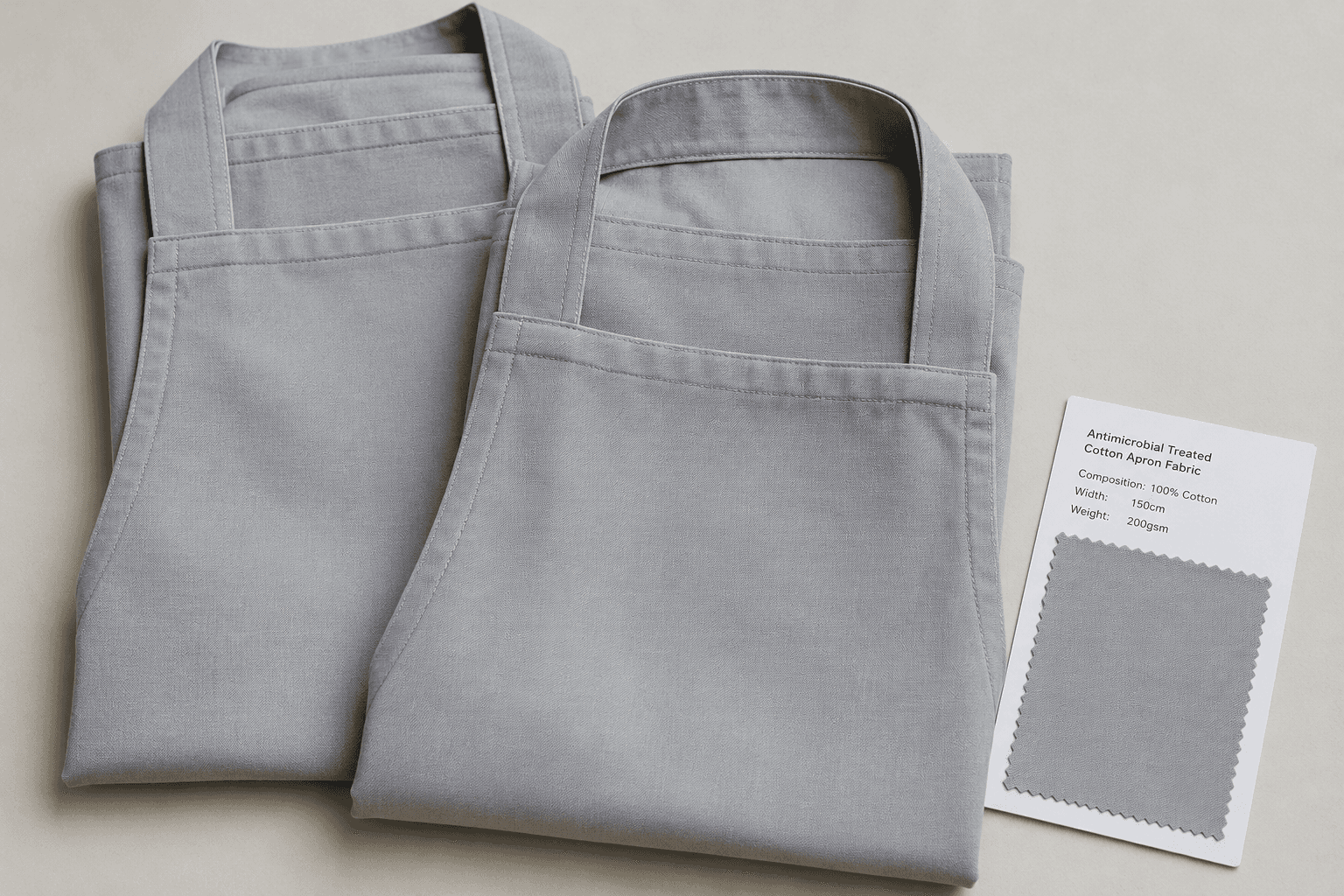
Most apron fabric issues appear after decoration, packing, and laundering rather than during cutting or inline sewing inspection. A bib apron can pass measurement checks and seam inspection, then show fuzzy logo edges, light surface frosting, or a chalky-looking front panel after only 15 to 25 wash cycles. For hospitality, culinary, retail, and promotional apron programs, that is where compact spun apron fabric becomes commercially relevant.
Compared with standard ring-spun yarn, compact spinning condenses the fiber strand before twist insertion, leaving fewer loose fiber ends on the yarn surface. On aprons, that lower hairiness usually improves three visible outcomes: cleaner embroidery on chest panels, sharper print edges on pocket and bib logos, and better wash appearance on dark front panels. The gain is appearance control and consistency, not a promise that the apron becomes dramatically stronger.
For sourcing teams, the decision is practical. They need to know which apron weights justify the upgrade, what premium is realistic, how MOQ and lead time may change, and how to lock the specification so repeat orders stay visually consistent. The sections below stay strictly focused on apron buying, apron decoration, and apron factory sourcing decisions.
- Compact spun apron fabric usually gives cleaner embroidery because fewer loose fibers rise through satin borders, fill stitches, and small lettering.
- The best commercial range is typically 220 to 320 GSM, or about 6.5 to 9.4 oz/yd², especially for dark bib aprons and branded waist aprons.
- A realistic premium is often $0.10 to $0.38 per apron at volumes of 1,000 to 5,000 pieces, depending on fabric usage, blend, color, and stock support.
- For black, navy, charcoal, burgundy, and forest aprons, compact-spun cotton and poly-cotton usually keep a cleaner face through 20 to 50 wash cycles than comparable standard ring-spun cloth.
- Buyers should specify fiber content, GSM tolerance, yarn system, finish, decoration method, wash test, shade standard, and AQL together rather than asking for 'premium apron fabric'.
- The strongest use case is a branded apron program where logo clarity, front-of-house appearance, and reorder stability are worth more than the lowest first cost.
Where compact spun apron fabric adds measurable value
Aprons concentrate visual risk in a small number of high-exposure zones. On a bib apron, the chest panel carries the logo and sits directly under customer-facing light. On a waist apron, the pocket face, pocket mouth, and lower front panel take repeated rubbing from hands, towels, counters, and wash abrasion. When the fabric surface is hairy, those areas start to look older faster even if the apron still passes seam strength and measurement standards.
That is why compact spun apron fabric matters most in professional apron programs where appearance affects brand perception. Restaurant groups, hotel uniform buyers, café chains, bakery operators, gourmet retailers, culinary schools, and private-label apron brands all need aprons that still look presentable after decoration, packing, display, and repeated service use. In these channels, a cleaner fabric face reduces the chance that the apron looks worn after 10 to 20 washes even when the garment is structurally sound.
The difference is most visible on dark shades. Black, navy, charcoal, forest, and burgundy aprons show frosting quickly because loose surface fibers catch light and create a dusty look. A standard ring-spun twill can pass shrinkage and tensile tests but still lose showroom appearance after 12 to 18 domestic washes or 8 to 15 light commercial washes. Compact spinning does not replace good dyeing or finishing, but it usually delays that early-aging effect on the bib front, pocket edge, and lower body panel.
- Best fit: branded bib aprons, premium waist aprons, open-kitchen chef aprons, and retail apron lines with visible decoration.
- Lower payoff: event aprons, low-cost giveaway aprons, and back-of-house utility aprons with no logo exposure.
- Highest-risk colors: black, navy, charcoal, burgundy, and forest show hairiness and frosting sooner than ecru, sand, or khaki.
- Highest-risk zones: bib center, pocket face, pocket mouth, lower front body, and strap-contact areas.
How compact spun apron fabric improves embroidery and logo print clarity
Embroidery quality on aprons depends on digitizing, thread quality, stabilizer, and machine settings, but the fabric face still sets the baseline. On a hairy surface, loose fibers rise through satin edges, soften crest outlines, and reduce the readability of small text. The problem is especially noticeable when white, beige, or metallic thread is stitched onto black or navy bib aprons. In real sourcing work, cleaner embroidery is one of the most consistent reasons buyers upgrade to compact spun apron fabric.
The improvement is easiest to see on 240 to 310 GSM cotton canvas and cotton-rich twill used for chest-logo bib aprons. Logos in the 6,000 to 18,000 stitch range usually show cleaner borders and less haloing than the same logo on a comparable standard ring-spun base fabric. Small text below about 4 mm cap height is still risky on coarse apron cloth, but a lower-hairiness face gives the design a better chance of reading cleanly if the file is properly digitized.
Printed apron programs also benefit, although less dramatically than embroidery. Screen prints, heat transfers, and woven patch applications usually show a neater perimeter and hold a cleaner look after washing when applied to a smoother, less hairy apron surface. For buyers, the commercial value is lower variation between approved sample and bulk output, plus fewer complaints after 10, 20, and 30 wash cycles.
Compact spinning is not a substitute for decoration discipline. A dense logo can still pucker a light apron body, and poor digitizing can still make a good cloth look weak. Buyers should treat compact-spun yarn as a fabric-level risk reduction tool rather than a cure for avoidable embroidery mistakes.
- For logo widths under 70 mm, compact-spun surfaces usually help small lettering remain more legible.
- Common bib-apron embroidery uses 75/11 or 80/12 needles with backing matched to fabric weight.
- Ask for a washed logo sample after 5 cycles or 10 cycles, not only an unwashed strike-off.
- Compare standard and compact-spun apron fabrics side by side under direct light before approving dark-color bulk production.
Best apron weights, blends, and constructions for compact-spun sourcing
Not every apron fabric gains equally from compact spinning. In practice, the strongest return usually sits in the 220 to 320 GSM range, equivalent to roughly 6.5 to 9.4 oz/yd². Below that band, many promotional aprons are bought primarily on price, and the appearance gain may not justify the premium. Above about 340 GSM, workshop and heavy craft aprons can still benefit, but the buyer is already paying for a premium platform and should verify that the visual improvement is worth the extra cost and longer fabric planning.
For hospitality sourcing, 230 to 270 GSM is common for 65/35 poly-cotton twill, while 250 to 300 GSM is common for 100% cotton canvas bib aprons. Twill offers easier drape, lower stiffness, and faster daily wear comfort. Canvas offers a firmer body, stronger premium positioning, and a more substantial hand for branded retail or chef apron programs.
Construction should follow the use case and laundry route. Canvas suits premium aprons where structure and visual texture are part of the selling point. Twill suits uniform aprons where comfort, movement, and steady repeat laundering matter more. In either case, buyers should specify the finished weight with a clear tolerance such as ±5% and call out compact spun apron fabric directly so the mill cannot substitute a standard ring-spun base on a reorder.
- 180 to 220 GSM / 5.3 to 6.5 oz/yd²: lighter service aprons; use compact spinning only for logo-sensitive programs.
- 220 to 280 GSM / 6.5 to 8.3 oz/yd²: strongest value range for café, restaurant, and hotel bib aprons.
- 280 to 320 GSM / 8.3 to 9.4 oz/yd²: premium range for chef aprons, retail apron collections, and gifting lines.
- 100% cotton: natural hand and stronger premium story, but usually higher shrinkage exposure.
- 65/35 poly-cotton: better shape retention, easier care, and faster drying in repeat-use uniform systems.
Wash appearance benchmarks on dark aprons after 10, 20, and 50 cycles
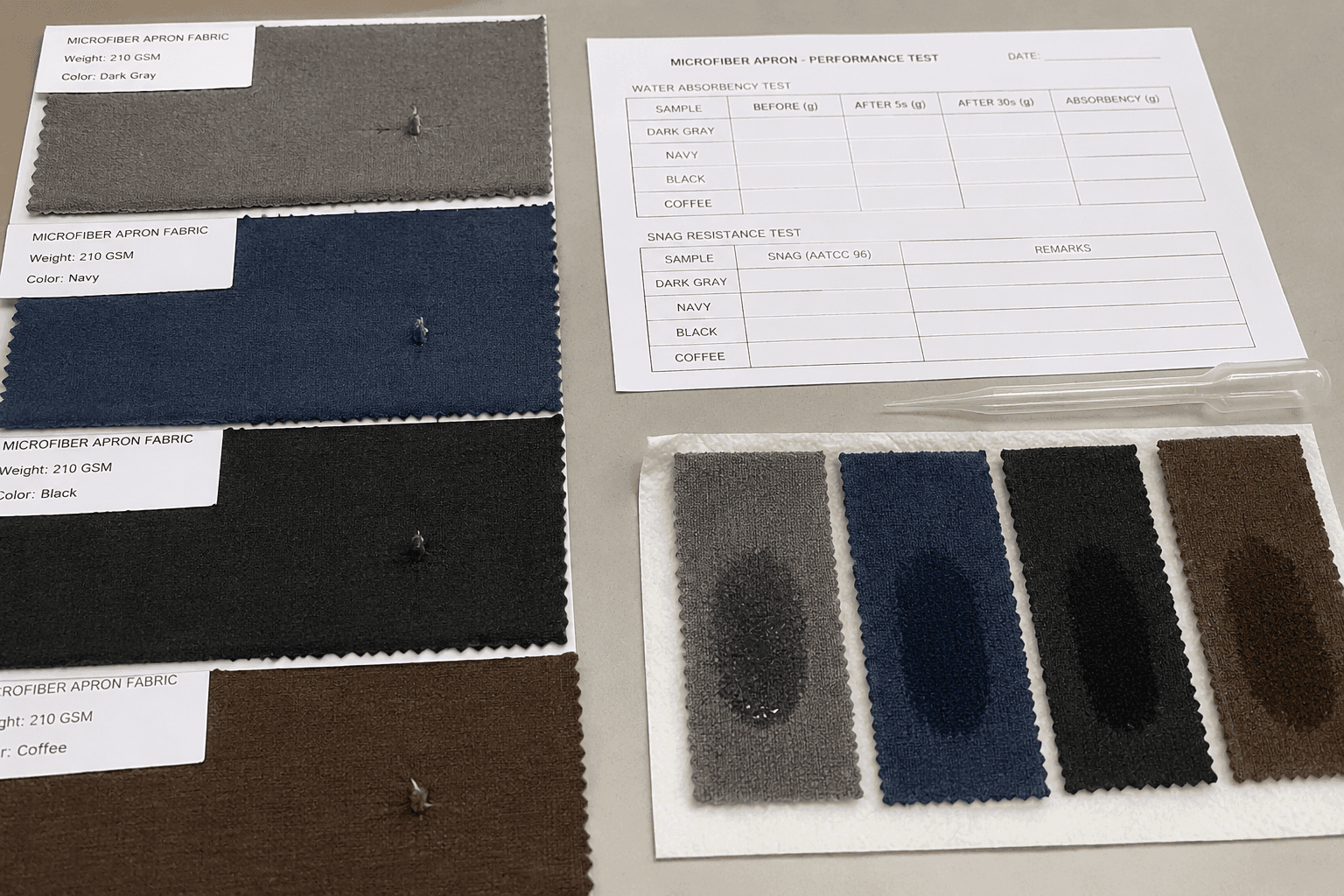
For apron buyers, wash appearance is often more important than break strength because many replacement decisions are visual. A fabric can leave the factory looking clean and still appear old after repeated laundering, tumble drying, and front-panel abrasion. With compact-spun yarn, the advantage is usually a slower rate of surface disturbance. Fewer loose fibers project from the yarn body, so dark apron panels show less frosting, less linty reflection, and less fuzz build-up around decorated areas.
In practical comparisons, the difference often becomes visible after about 10 washes at 40°C to 60°C using standard detergent loads. By 20 cycles, standard ring-spun black or navy aprons often show more whitening on the bib center, pocket edge, and lower front body where friction is highest. By 50 cycles, the visual gap can be large enough to determine whether the apron remains acceptable for front-of-house wear or gets moved to kitchen-only use. For hotel, café, and restaurant uniform buyers, that distinction directly affects replacement frequency and annual spend.
Finishing still matters. Singeing, enzyme finishing, preshrink control, dye penetration, and softener chemistry can strengthen or weaken the benefit of compact spinning. A poorly finished compact-spun apron can still underperform. Buyers should therefore approve the apron against the intended care method and review washed standards rather than relying only on the yarn description on a quotation sheet.
- Use one wash protocol: same detergent, same water temperature, same load size, and same drying route.
- For hospitality programs, review appearance after 20 cycles; for premium retail aprons, also review after 50 cycles.
- Inspect bib center, pocket mouth, lower front body, tie-contact area, and decorated panels for frosting and fuzz.
- Record shrinkage, skew, and shade shift alongside appearance so the sourcing decision is not based on surface look alone.
Cost, MOQ, lead time, and AQL for compact-spun apron orders
The premium for compact-spun apron cloth is real but usually manageable within a professional uniform or retail apron budget. Mills often quote the fabric at about $0.18 to $0.55 per meter above a comparable standard ring-spun base, depending on cotton price, blend ratio, dye route, and whether the construction is stock-supported. On a finished apron, that often translates to about $0.10 to $0.22 extra for a waist apron and $0.14 to $0.38 extra for a bib apron using roughly 0.8 to 1.3 meters of shell fabric.
MOQ is usually driven by fabric availability rather than sewing capacity. If black, white, natural, or navy compact-spun cloth is mill-stocked, workable MOQ can start around 500 to 800 pieces per color per style. If the buyer needs a custom shade, exclusive blend, or special finish, MOQ more often moves to 1,200 to 3,000 pieces or a fabric minimum of 1,500 to 3,000 meters per color. Buyers below that level should expect a surcharge, narrower color options, or slower replenishment.
Lead time needs realistic planning. With stock fabric, sample development commonly takes 7 to 10 days, and bulk production usually takes 25 to 35 days after sample approval and deposit. A new weaving and dyeing program often adds 18 to 30 days, putting the full cycle closer to 45 to 65 days. During peak uniform seasons or before major holidays, adding a 7 to 12 day buffer is prudent.
For final inspection, a common benchmark is AQL 2.5 major / 4.0 minor. On compact-spun apron orders, buyers should require extra review of the bib front, pocket face, and decorated area because that is where the value of the fabric upgrade is most visible and where customer complaints are most likely to start.
- Typical added cost: $0.10 to $0.38 per finished apron on medium-volume custom orders.
- Stock-color MOQ: often 500 to 800 pieces per color per style when the fabric is available.
- Custom-color MOQ: commonly 1,200 to 3,000 pieces or 1,500 to 3,000 meters per color.
- Sample timing: about 7 to 10 days with stock cloth, or 12 to 18 days when new dye approval is needed.
- Bulk timing: about 25 to 35 days with stock fabric, or 45 to 65 days with fresh fabric development.
When to specify compact-spun fabric for aprons and when to skip it
The best use case is a branded apron that must keep a clean face through repeated wear, laundering, photography, and customer interaction. That includes café and barista aprons, hotel and restaurant uniforms, chef bib aprons in open kitchens, premium salon or grooming aprons, and private-label culinary apron collections. In these categories, buyers are paying for presentation as well as protection, so an extra $0.15 to $0.30 per unit can be justified by cleaner logos, fewer appearance complaints, and slower visual aging.
The weaker use case is a budget apron with low branding sensitivity and a short service life. One-event promotional aprons, low-price giveaway aprons, and hidden back-of-house utility styles often do not recover the premium. If the apron is light colored, undecorated, and replaced quickly, the difference after washing may not be commercially meaningful enough to justify higher MOQ or a longer sourcing window.
Many buyers get the best result by splitting their range instead of upgrading every SKU. Premium bib aprons can use compact-spun shell fabric, while entry-price aprons stay on standard ring-spun twill. In tighter target-cost programs, the better solution is often to reserve the cleaner fabric for the most visible apron platforms rather than over-engineering the entire assortment.
- Specify it first for front-of-house, retail, e-commerce, gifting, and logo-heavy apron programs.
- Skip it for low-cost utility aprons where visual life and decoration sharpness are not core buying priorities.
- Use it selectively on premium apron lines if the cost target does not support a full-range upgrade.
- Pair the fabric upgrade with reinforced pockets, bartacks, and controlled shrinkage targets for a balanced specification.
How to write a reorder-safe compact spun apron fabric specification
The most common sourcing mistake is asking for 'better canvas' or 'premium twill' without fixing measurable parameters. That leaves room for variation in yarn count, blend ratio, fabric density, finish, and even the actual yarn system between one order and the next. The first apron run may look acceptable, but the reorder can feel flatter, hairier, or less stable after washing. For apron programs that repeat every quarter, season, or annual contract cycle, the specification must be explicit enough that the mill, apron factory, and QC team are all working to the same target.
A practical apron spec should include fiber content, weave, finished width, target GSM with tolerance, approved shade standard, shrinkage limit, colorfastness requirement, and a direct requirement for compact spun apron fabric. If the style carries embroidery or print, the buyer should also define logo placement, artwork size, stitch-count range or print method, backing requirement, and the rule that approval depends on a washed sample. For hospitality apron orders, the care route should be stated clearly, such as 40°C domestic wash for 20 cycles or 60°C commercial simulation for 20 and 50 cycles.
Quality control should cover both fabric and finished aprons. A practical method is to seal one approved unwashed swatch and one approved washed swatch from the production lot, then use them as reorder references. Final inspection should review not only measurements and sewing defects but also surface appearance on the bib front, pocket face, and decorated area. Combined with an agreed inspection plan such as AQL 2.5 major / 4.0 minor, that gives both buyer and supplier a workable basis for approving bulk, handling claims, and keeping repeat orders visually consistent.
- State weight precisely, for example 270 GSM ±5%, not only 'medium-weight canvas'.
- State composition precisely, such as 100% cotton or 65/35 poly-cotton.
- State decoration controls: logo size, stitch range, placement, backing, and washed-sample approval requirement.
- Approve both unwashed and washed standards for dark-color aprons before bulk release.
- Keep one sealed bulk swatch from each production lot for future reorder comparison.