Chef apron sourcing for hotels and restaurant groups is not only a question of choosing a canvas bib apron and adding a logo. The apron has to survive hot kitchens, repeated industrial laundry, sauce and oil exposure, staff turnover, and multiple property rollouts where the same uniform must look consistent for 12 to 24 months. A small decision on fabric weight, pocket placement, strap material, or dye method can change the landed cost, service life, and reorder reliability.
For bulk chef aprons, buyers usually balance three targets: a professional front-of-house or open-kitchen appearance, a garment that holds shape after 50 to 100 wash cycles, and a unit cost that fits chain-wide deployment. In our Zhejiang apron factory, most hotel chef apron and hospitality apron programs fall between 300 and 5,000 pieces per style, with common production lead times of 25 to 40 days after pre-production sample approval.
This article explains the sourcing details that matter when working with a restaurant apron supplier in China: fabric selection, apron pattern, logo process, MOQ planning, testing, packing, and cost drivers. The focus is practical specification control, because clear specs reduce sampling rounds and prevent expensive surprises after bulk production.
- Fabric weight should match the kitchen role, with 200-240 GSM for light service aprons and 280-360 GSM for heavier chef aprons.
- Industrial laundry changes the specification, so shrinkage, colorfastness, and reinforcement should be confirmed before bulk production.
- MOQ depends on fabric, color, and logo process, not only on the apron factory's sewing capacity.
- Embroidery is durable for hotel chef apron branding, while screen print and heat transfer need careful testing against wash temperature.
- A realistic China bulk apron timeline is 35-55 days including fabric sourcing, sampling, production, inspection, and export packing.
- Good tech packs reduce unit cost risk because pocket size, strap width, bartack position, and tolerance affect production efficiency.
Chef apron sourcing starts with the operating environment
A chef apron used in a luxury hotel open kitchen has different requirements from an apron used in a quick-service restaurant, bakery, catering kitchen, or back-of-house prep area. Before discussing fabric swatches, the buyer should define where the apron will be worn, how often it is washed, who launders it, and whether the garment is part of a visible brand uniform. These details decide whether the apron should prioritize durability, stain resistance, brand presentation, or low replacement cost.
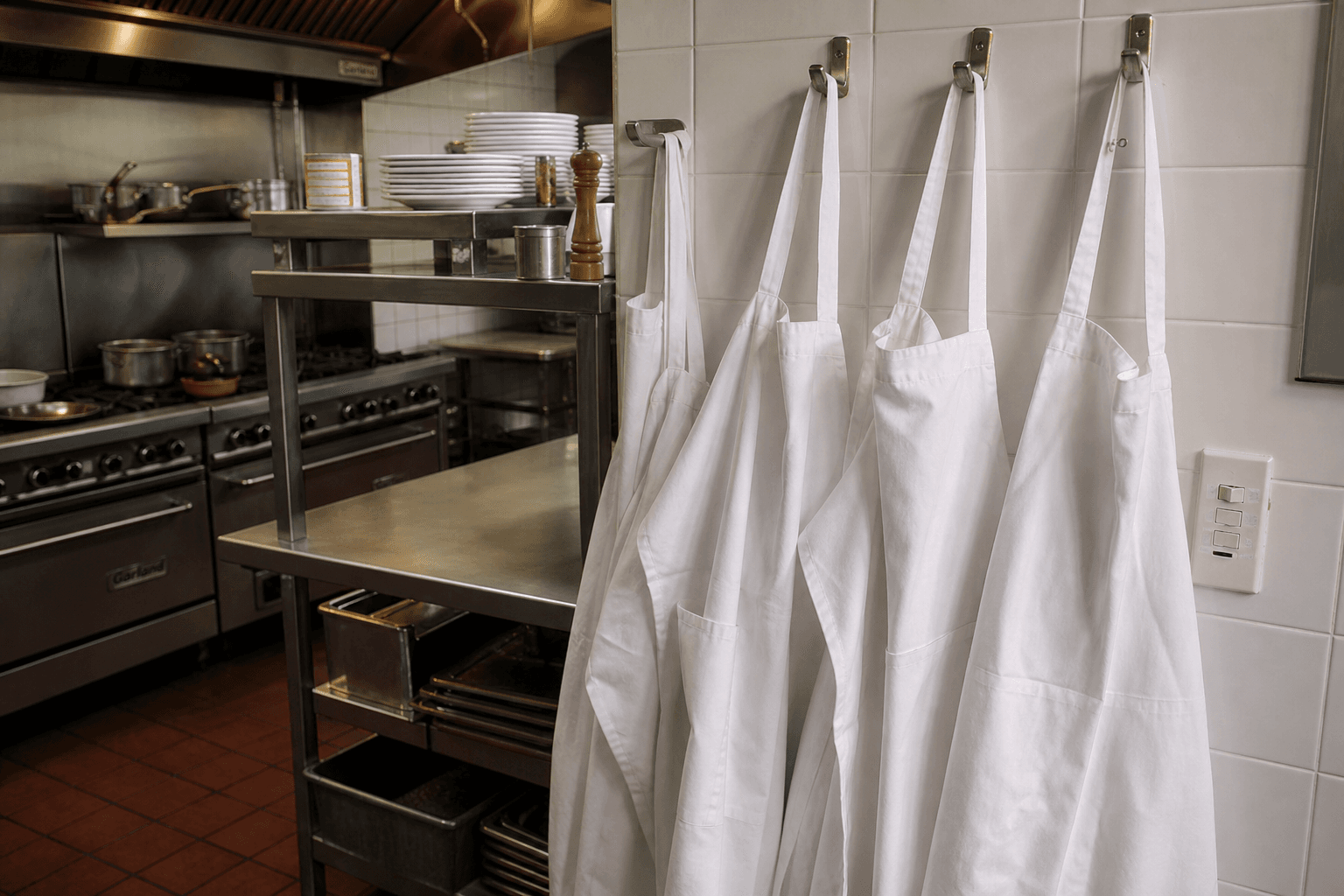
For hotel groups, a hotel chef apron often needs a cleaner silhouette, better hand feel, and stable color across reorders. For restaurant chains, the specification may be more focused on wash resistance, easy size grading, and fast replenishment. A hospitality apron for open kitchens or service counters may also need a more refined drape than a standard back-of-house chef apron, because guests see the garment at close distance.
In early chef apron sourcing discussions, we normally ask for expected wash cycles, laundry temperature, logo size, target unit cost, order quantity by color, and whether the buyer needs the same design for different staff roles. Without these inputs, a supplier may quote a technically possible apron that does not match the real kitchen workflow.
- For heavy back-of-house use, specify stronger fabric, reinforced pockets, and wider waist ties.
- For open-kitchen hotel use, prioritize color consistency, clean topstitching, and logo alignment.
- For chain restaurant rollout, confirm reorder fabric availability and carton labeling requirements.
- For catering and event teams, consider lighter weight fabric to reduce heat discomfort during long shifts.
Choosing fabric weight, weave, and fiber content for chef aprons
Fabric is the largest cost and performance variable in most bulk chef aprons. Common chef apron fabrics include cotton twill, poly-cotton twill, canvas, denim, and sometimes treated fabrics with water-repellent or stain-release finishing. For commercial kitchen use, the practical weight range is usually 200-360 GSM. Below 200 GSM, the apron may feel too light for kitchen work and may not hang well. Above 360 GSM, the apron becomes stronger but hotter, slower to dry, and more expensive to ship.
Cotton twill at 240-300 GSM gives a natural feel and good appearance, but it can shrink 3-5% if not pre-shrunk or controlled by finishing. Poly-cotton twill, often 65/35 or 80/20 polyester/cotton, has better crease recovery, lower shrinkage, and more stable color, which is why many restaurant groups choose it for repeated washing. Cotton canvas at 300-360 GSM is durable and has a premium hand, but it can be stiff in the first few washes and the cost is higher. Denim chef aprons, commonly 8-12 oz, are popular for casual dining and steakhouse concepts, but indigo colorfastness must be checked carefully.
A buyer should not select fabric by GSM alone. A 260 GSM compact twill can feel stronger than a loosely woven 300 GSM fabric. Yarn count, weave density, finishing, and dye quality all affect performance. For example, a 240 GSM poly-cotton twill may be a better restaurant apron supplier recommendation than a 300 GSM low-density cotton canvas if the apron will be laundered three times per week.
- 200-240 GSM poly-cotton twill is suitable for light kitchen, bakery, and service apron use.
- 250-300 GSM cotton or poly-cotton twill is a balanced range for most chef apron programs.
- 300-360 GSM canvas is suitable for premium hotel chef apron styles and heavy-duty kitchen use.
- 8-12 oz denim is suitable for casual restaurant concepts, but requires colorfastness and crocking checks.
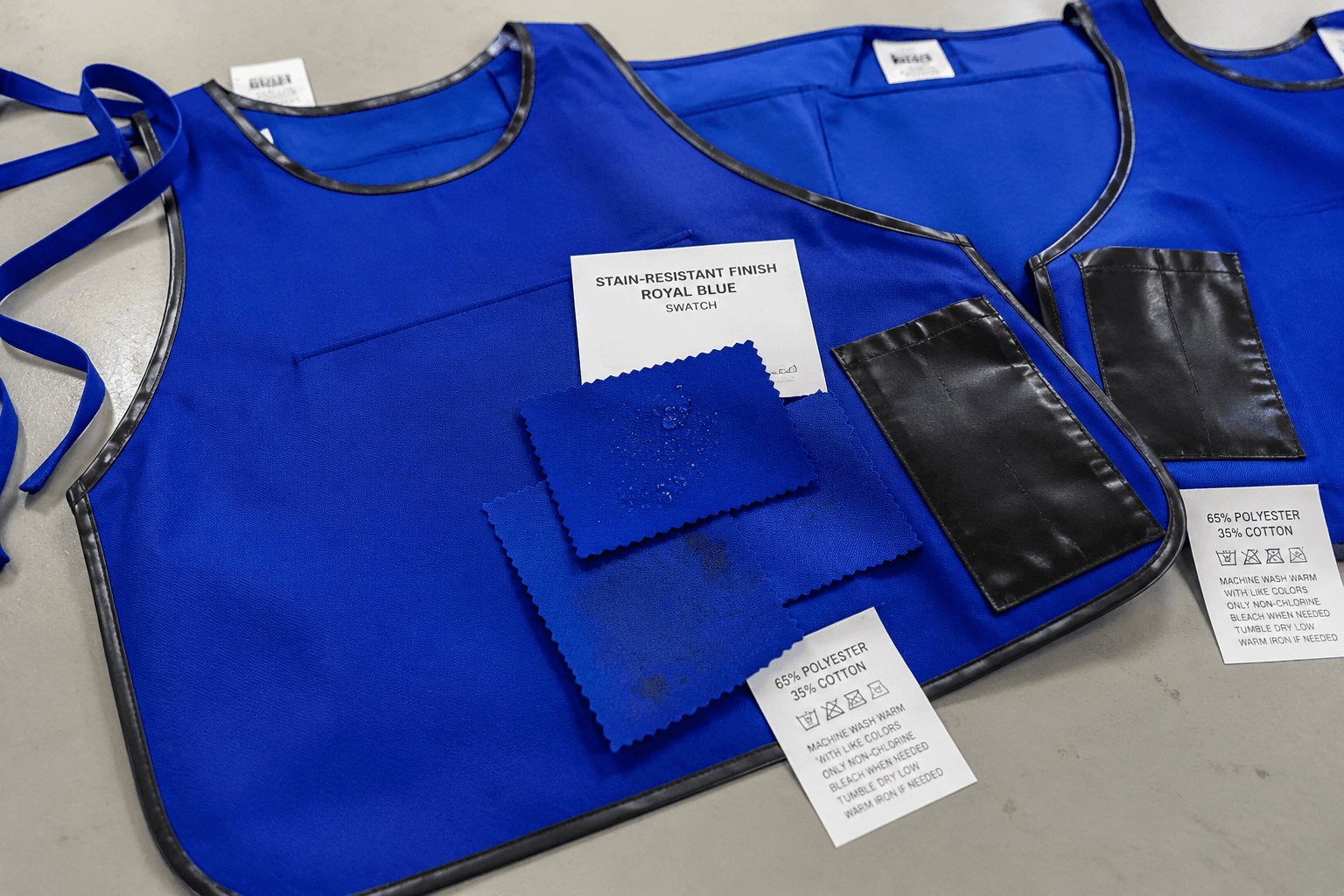
- Water-repellent finishing may add about US$0.15-US$0.45 per piece depending on fabric and order volume.
Apron pattern decisions that affect comfort and production cost
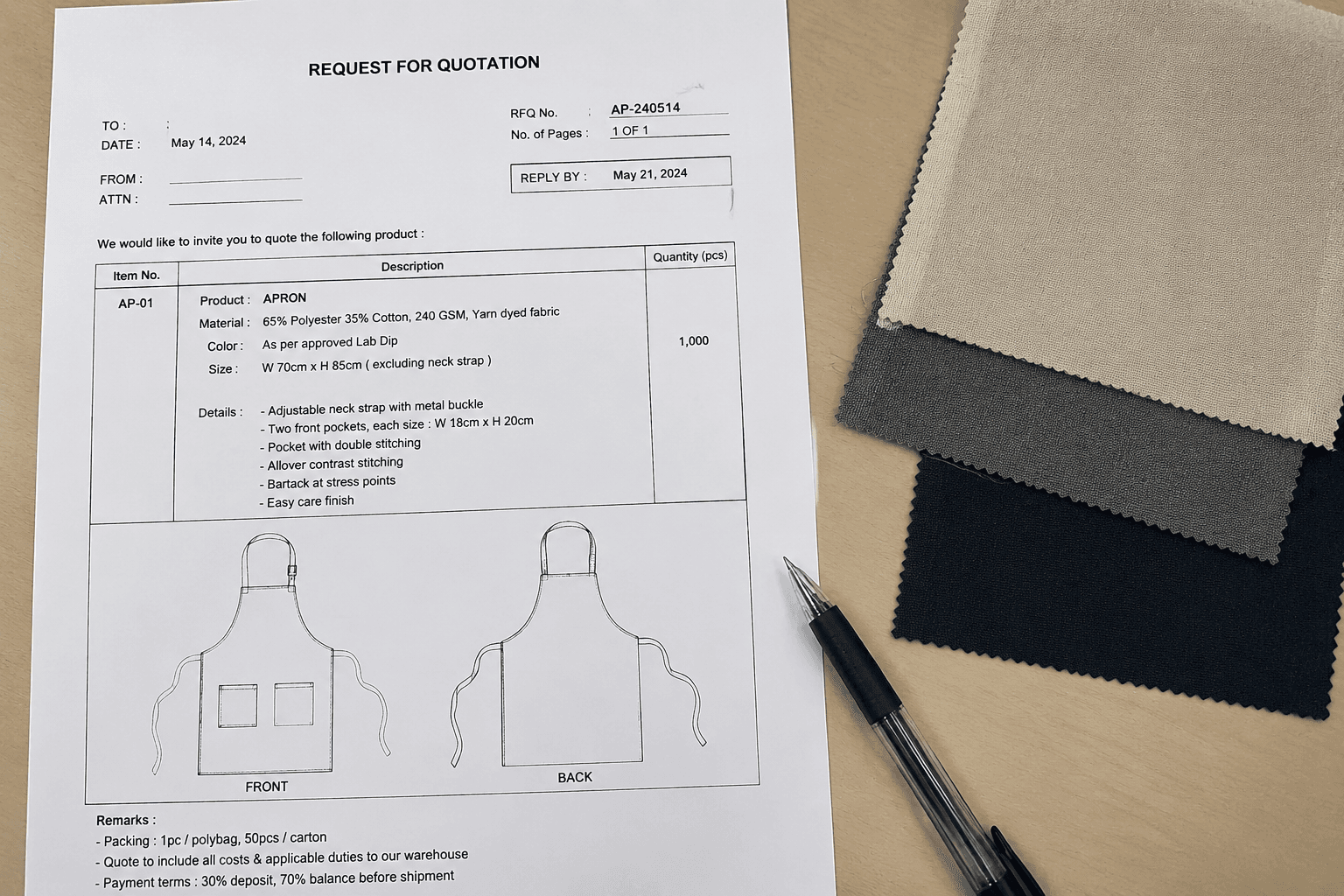
The pattern of a chef apron looks simple, but small construction choices create real cost and comfort differences. A standard bib apron may measure around 70 x 85 cm, while larger hotel chef apron styles may be 75 x 90 cm or longer for better coverage. Waist aprons can range from 45 x 70 cm for short service use to 80 x 90 cm for bistro and kitchen use. For bulk orders, the buyer should confirm body length, bib width, bottom width, strap length, pocket dimensions, and finished tolerance.
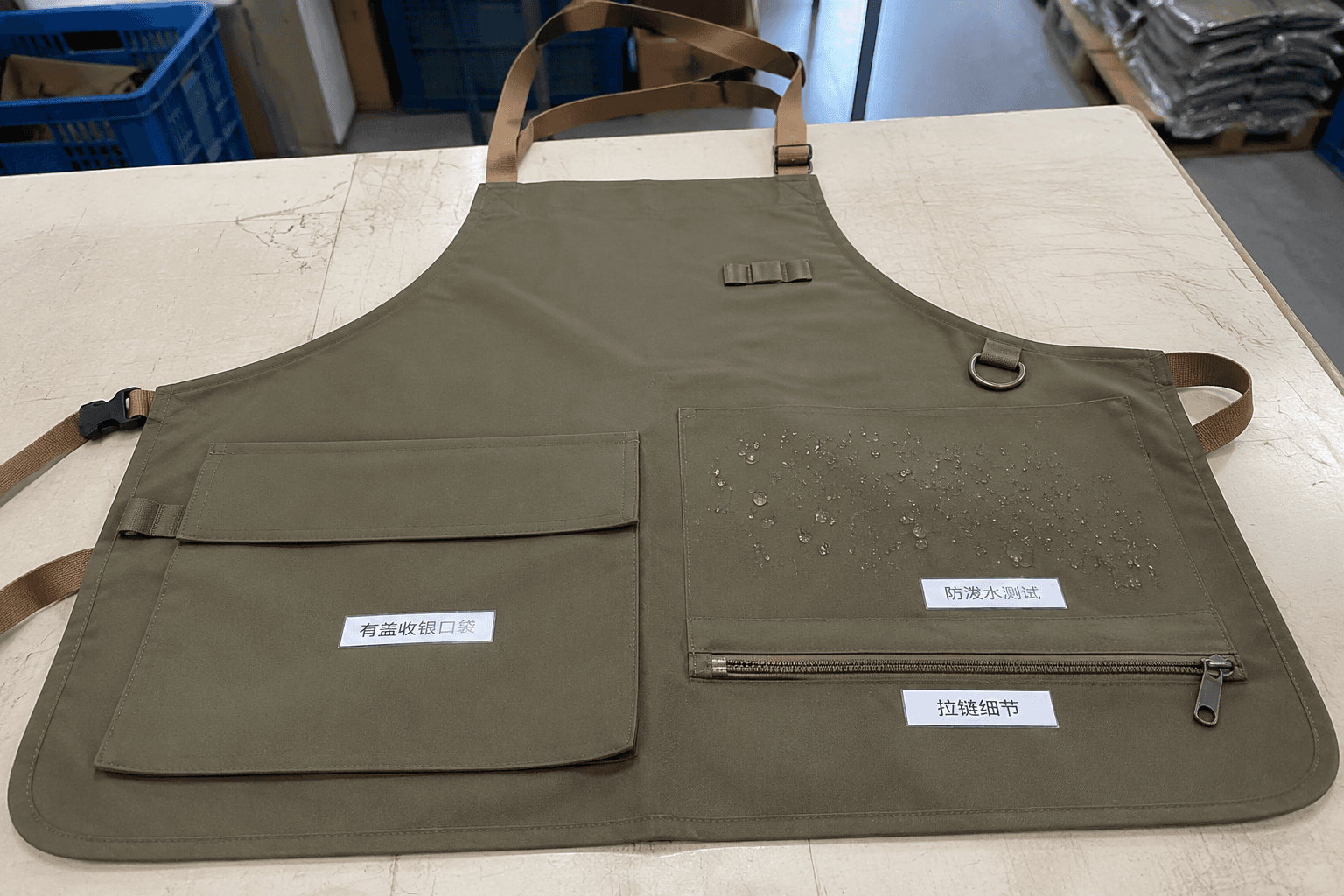
Neck straps are a frequent source of user complaints. A fixed neck loop is simple and low-cost, but it does not fit all staff well. An adjustable metal buckle adds durability and a more professional look, usually adding about US$0.08-US$0.18 per piece depending on hardware quality and strap construction. Tie-through or cross-back straps reduce neck pressure during long shifts, but they use more fabric or tape and require more sewing time. For kitchens where chefs wear aprons for 8-10 hours, cross-back designs can improve comfort, but they may add US$0.30-US$0.80 per piece.
Pocket design should be practical rather than decorative. A chest pen pocket, thermometer slot, divided waist pocket, or towel loop may be useful, but every pocket adds cutting, folding, alignment, and bartacking time. If a hotel group needs a clean executive chef look, fewer visible pockets may be better. If a restaurant chain needs utility, reinforced divided pockets are worth the small cost increase because pocket tearing is one of the most common failure points.
- Use 1-1.5 cm finished tolerance for most apron body dimensions and tighter tolerance for logo placement.
- Add bartacks at pocket corners, waist tie insertion points, and towel loops for industrial kitchen use.
- Specify strap width, usually 2.5-3.8 cm, because narrow straps can twist and feel uncomfortable.
- Confirm whether metal hardware must be nickel-free, rust-resistant, or suitable for industrial laundry.
- Avoid unnecessary pocket complexity if the target price is below US$2.50 per piece.
Branding methods for hotel chef apron and restaurant uniform programs
Logo application should be selected according to wash method, brand standard, and fabric surface. Embroidery is the most common choice for hotel chef apron programs because it looks professional and performs well through repeated washing. A small left-chest embroidery logo of 5-8 cm width may cost around US$0.15-US$0.45 per piece depending on stitch count and thread colors. Larger embroidery can become heavy and may distort thinner fabrics, so we usually recommend testing on the exact bulk fabric before approval.
Screen printing is cost-effective for simple one- or two-color logos on larger quantities, especially when the order is above 500 pieces per design. It can be suitable for casual restaurant aprons, but ink quality and curing must match laundry conditions. Heat transfer gives sharp detail and is useful for multi-color artwork, but it should be tested against high-temperature washing and tumble drying. For premium hospitality apron projects, woven labels, leather patches, or riveted logo tabs may create a stronger brand impression, but they add both material cost and compliance questions.
The buyer should provide vector artwork, Pantone references, exact logo position, and size in centimeters. For chain rollouts, we recommend approving a physical logo sample, not only a digital mockup. A 1 cm position shift may not look serious on a screen, but it is visible when 200 chefs stand in the same open-kitchen environment.
- Embroidery is durable and suitable for premium hotel and chef apron branding.
- Screen print is economical for simple artwork and medium to large volume orders.
- Heat transfer supports detailed logos but needs wash and peeling tests before bulk approval.
- Woven labels work well for subtle brand identification on side seams, pockets, or waistbands.
- Leather or PU patches should be checked for wash compatibility, color bleeding, and cracking.
Chef apron sourcing cost structure and MOQ planning
A realistic chef apron quotation is built from fabric, trims, cutting, sewing, logo application, finishing, packing, inspection, and export handling. For a basic 240 GSM poly-cotton bib apron with one pocket and simple packing, factory pricing may start around US$1.80-US$2.60 per piece at 1,000 pieces, depending on fabric market price and color. A 300 GSM cotton canvas chef apron with adjustable buckle, reinforced pockets, and embroidery may fall around US$3.20-US$5.80 per piece. More complex cross-back denim or waxed-look aprons can move above US$6.00-US$9.00 per piece.
MOQ is often misunderstood. Sewing MOQ may be low, but fabric dyeing MOQ is the real constraint for custom colors. If the buyer selects stock black, white, navy, grey, or natural canvas, MOQ can sometimes be 200-500 pieces per color. For custom Pantone dyeing, fabric mills may require 800-1,500 meters per color, which can translate into about 1,000-2,500 aprons depending on width and pattern efficiency. For small hotel groups needing 300 pieces, choosing stock fabric colors can save both time and cost.
Buyers should also consider reorder economics. A first order of 500 pieces may be possible, but if the group needs only 80 replacement aprons six months later, the supplier may not be able to reproduce the exact fabric dye lot at a low MOQ. For multi-property hospitality apron programs, it is often better to produce a 5-10% spare quantity during the first bulk run and hold consistent trims and labels for future production.
- Basic poly-cotton chef apron: approximately US$1.80-US$2.60 per piece at 1,000 pieces.
- Mid-range cotton twill or canvas apron: approximately US$2.80-US$4.80 per piece depending on GSM and trims.
- Premium denim, cross-back, or heavy canvas apron: approximately US$5.00-US$9.00 per piece depending on construction.
- Stock color MOQ may be 200-500 pieces per color, while custom dyeing often requires 1,000 pieces or more.
- Embroidery, metal hardware, special washing, and individual polybag packing can each shift the final unit price.
Sampling, fit approval, and bulk production timeline
For custom chef aprons, a normal development timeline includes tech pack review, fabric confirmation, sample making, sample shipment, buyer comments, pre-production sample approval, bulk cutting, sewing, finishing, inspection, and shipment booking. A simple sample can often be made in 5-7 days if stock fabric is available. If custom dyed fabric or special trims are required, sample development may take 10-18 days. International sample delivery usually adds 3-7 days depending on courier service and destination.
After approval, bulk production for 500-3,000 pieces commonly takes 20-35 days. Larger programs, multiple colors, or complex logo applications may require 35-45 days. Export packing, inspection, and vessel or air booking add more time. For hotel opening projects, buyers should not work backward only from the grand opening date; uniforms usually need to arrive 2-3 weeks before training, staff fitting, and property distribution.
The most efficient sampling process uses one fit sample and one pre-production sample. The fit sample confirms dimensions, pockets, strap system, and general appearance. The pre-production sample confirms the actual bulk fabric, trims, logo, label, thread color, and packing method. Bulk production should start only after the pre-production sample is approved in writing, especially for hotel chef apron projects where brand presentation is important.
- Tech pack and quotation review usually takes 1-3 working days when details are complete.
- Stock fabric sample making usually takes 5-7 days before courier shipment.
- Custom fabric or special trim sampling usually takes 10-18 days before courier shipment.
- Bulk production usually takes 20-35 days for standard orders after sample approval.
- A full China sourcing timeline is often 35-55 days before sea shipment departure.
Quality control points for bulk chef aprons
Bulk chef aprons should be inspected against measurable standards, not only against a reference photo. The most important checkpoints are finished measurements, fabric defects, color consistency, logo position, seam strength, pocket reinforcement, strap attachment, loose threads, stains, and packing accuracy. For hotel groups and restaurant chains, the inspection should also confirm carton marks by property, size, color, or department if distribution is part of the order.
Fabric testing depends on the buyer's market and use case. Common tests include dimensional stability to washing, colorfastness to washing, colorfastness to rubbing, pilling, seam slippage, and azo-free dye compliance. For Europe, REACH-related substance control may be required. For the US market, buyers may request CPSIA only if the product is for children, but adult chef aprons normally focus more on fiber content labeling, care labeling, and general chemical safety requirements. If the apron is treated with water-repellent finishing, the buyer should clarify whether fluorine-free chemistry is required.
A practical acceptance quality limit for apron orders is often AQL 2.5 for major defects and AQL 4.0 for minor defects, though some hotel brands set tighter standards. Major defects include wrong logo, serious stains, incorrect size, broken strap, open seam, or shade mismatch beyond approved tolerance. Minor defects include small loose threads, slight uneven stitching, or minor packing wrinkles. The inspection checklist should be shared before production so the supplier can build the same criteria into inline QC.
- Check finished apron length, bib width, bottom width, strap length, and pocket placement against the approved sample.
- Test shrinkage after washing if the apron will enter industrial laundry or high-temperature drying.
- Inspect bartacks at stress points because strap failure and pocket tearing are common field complaints.
- Confirm logo size, color, and position with a ruler, not by visual judgment only.
- Verify carton quantity, polybag labeling, care labels, and property allocation before shipment.
Working with a restaurant apron supplier for repeat programs
A restaurant apron supplier should be evaluated not only by first-order price, but also by repeatability. Chain buyers need the same black twill, the same embroidery thread, the same strap width, and the same packing format six or twelve months later. To make that possible, the supplier should keep a production file with fabric article number, GSM, composition, color standard, approved trims, logo file, thread color, measurement chart, packing photos, and inspection criteria.
For restaurant groups with multiple concepts, it is useful to standardize the hidden parts of the apron program while changing visible details. For example, the same 260 GSM poly-cotton base fabric, same waist tie length, same care label, and same carton format can be used across several restaurant apron styles, while pocket shape, logo, color, or strap detail changes by concept. This reduces sourcing risk and improves production efficiency.
Forecasting also matters. If a buyer can provide quarterly demand, the factory can reserve greige fabric or maintain stock trims, reducing lead time for repeat bulk chef aprons. For urgent replenishment, stock fabric programs can sometimes ship in 15-25 days after logo approval, but custom dyed fabrics usually cannot. The strongest supplier-buyer relationships in chef apron sourcing are built around accurate specifications, realistic timelines, and early communication before peak season.
- Ask the supplier to maintain a production file for every approved chef apron style.
- Use fabric article numbers and Pantone or lab dip approvals instead of color names only.
- Plan replacement stock at 5-10% of initial order quantity for hotel and restaurant rollouts.
- Standardize trims and labels across concepts when possible to reduce MOQ pressure.
- Share forecast quantities early if repeat orders must ship within 20-30 days.