For buyers sourcing a catering apron in bulk, the main question is not only style. The apron has to look consistent on a large team, survive commercial washing, accept branding quickly, and ship on a firm event date. A small weakness in fabric shrinkage, pocket placement, or logo method becomes visible when 1,000 staff are dressed the same way.
In our Zhejiang apron factory, catering orders usually sit between fashion and utility. The buyer wants a clean front-of-house appearance, but the garment is still exposed to grease, sauces, repeated laundering, and fast staff turnover. For this reason, we evaluate every bulk catering aprons order by fabric weight, color fastness, construction, logo process, carton packing, and realistic lead time.
This article explains the practical sourcing decisions behind catering aprons for restaurants, hotels, banquets, festivals, and outsourced event staff. It focuses on what affects cost, durability, MOQ, sample timing, and branding speed before a purchase order is placed.
- 190-240 GSM poly-cotton is usually the most balanced fabric range for a catering apron used in high-turnover service.
- Screen print is fastest for large single-color logos, while embroidery is stronger for premium waiter apron programs.
- Bulk catering aprons need pre-production approval for logo size, pocket position, strap length, and carton labeling before cutting.
- Lead time is normally 18-35 days after sample approval, depending on fabric stock, logo process, and order volume.
- MOQ can start from 300-500 pcs for stock fabric colors, but custom dyed fabric usually needs 1,000-3,000 pcs per color.
- Durability depends on construction details such as bartacks, thread quality, shrinkage control, and color fastness, not only GSM.
What makes a catering apron different from a retail apron
A retail apron may be selected for appearance first, but a catering apron is selected for repeated use across many employees, often under time pressure. Catering teams may include full-time staff, temporary staff, agency workers, and event crews who need one consistent uniform item that fits many body types. This is why adjustable neck straps, long waist ties, simple sizing, and stable colors matter more than fashion details.
Most catering buyers order aprons for banquet service, buffet lines, hotel breakfast teams, pop-up kitchens, conference catering, outdoor food events, and restaurant chains. In these settings, one apron may be worn for a full shift, then laundered in bulk. If the fabric wrinkles heavily, shrinks unevenly, or fades after 10-15 washes, the whole uniform set begins to look tired before the buyer has recovered the cost.
Compared with a light promotional apron, a professional hospitality bib apron needs stronger seams, practical coverage, and better color control. For a front-of-house waiter apron, hand feel and drape are important, but the buyer should still confirm tensile strength, wash shrinkage, and logo fastness. The best specification is usually the one that looks clean at service distance and remains stable after commercial laundry.
- A catering apron should fit a wide staff size range without creating excess adjustment work on site.
- The apron should keep its color and shape through repeated washing, especially in black, navy, grey, burgundy, and bottle green.
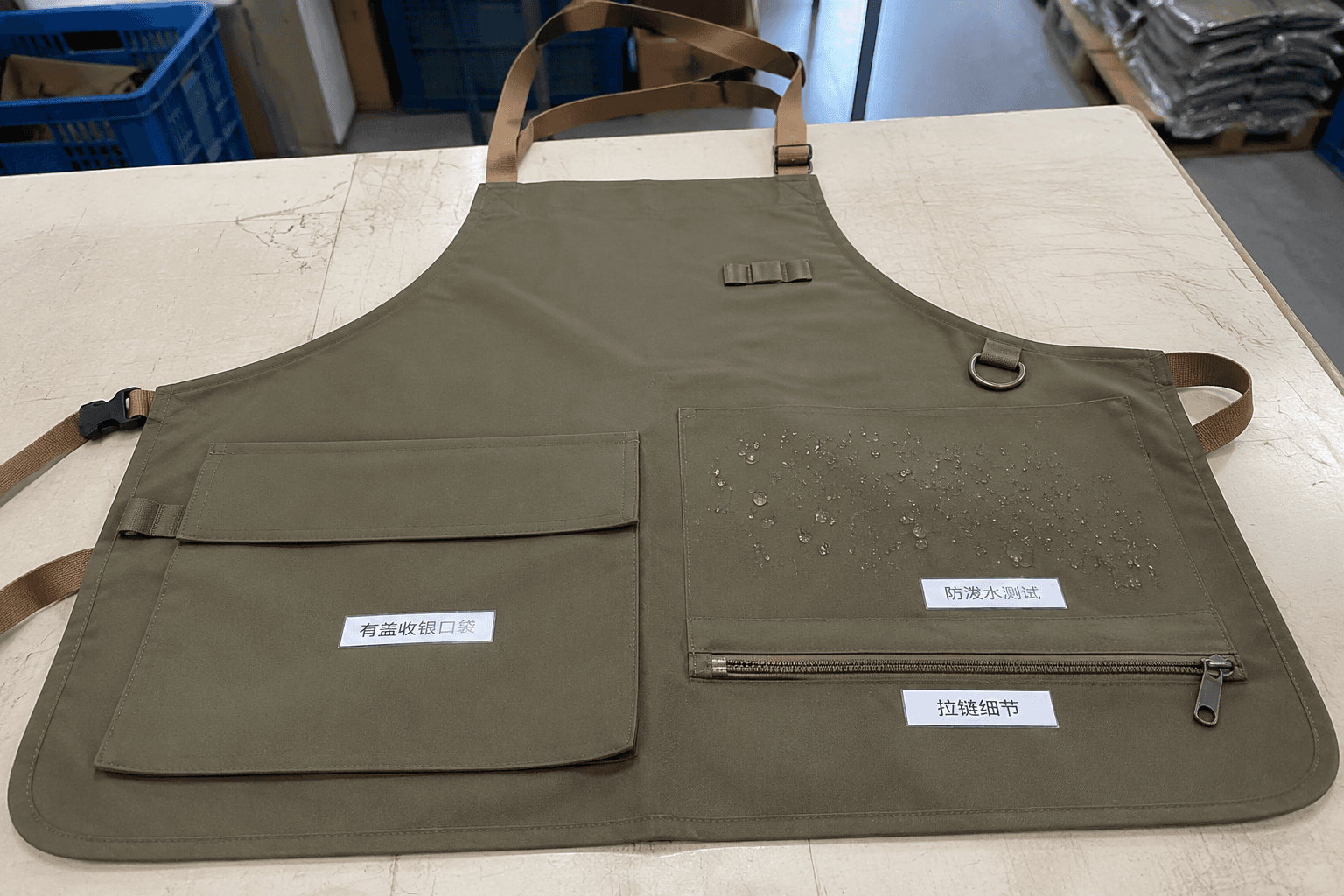
- Pocket layout should match the service role, such as pen slots for waiters or large lower pockets for buffet staff.
- Branding should remain readable after washing and should not crack, peel, or distort at the chest or pocket area.
Choosing fabric for a durable catering apron
Fabric selection is the main cost and durability driver in a catering apron program. The most common base fabrics are poly-cotton twill, 100% cotton twill or canvas, polyester twill, and denim. For general catering use, 190-240 GSM poly-cotton twill is often the most practical choice because it balances price, crease recovery, color stability, and wash performance. A 65/35 polyester-cotton blend at around 210 GSM is widely used for restaurants and hotel service because it dries faster than cotton and holds shape better after repeated laundering.
For heavier kitchen-adjacent service, such as barbecue catering or event kitchens, buyers may choose 260-320 GSM cotton canvas or poly-cotton canvas. This gives a more substantial feel and better abrasion resistance, but it increases unit cost and carton weight. A 300 GSM cotton apron can look premium, but it may shrink 3-5% if not properly pre-shrunk, and it may require ironing after washing. For high-volume event staff apron orders, that extra maintenance cost can be more important than the fabric price difference.
Denim, herringbone, and yarn-dyed fabrics are common for premium hospitality programs. They create a stronger brand look, especially for cafes, breweries, and casual dining chains. However, buyers should request color fastness data, especially for dark indigo denim. If a dark apron rubs onto white shirts or light table linen, the complaint cost is much higher than the saving from selecting a cheaper fabric.
- 170-190 GSM fabric is suitable for low-cost promotional or short-event catering use, but it may feel light for daily service.
- 190-240 GSM poly-cotton twill is a strong middle range for bulk catering aprons used in restaurants, hotels, and events.
- 260-320 GSM canvas gives better body and abrasion resistance, but increases freight weight and drying time.
- 8-10 oz denim is common for premium hospitality bib apron projects, but dark shades need careful rubbing fastness checks.
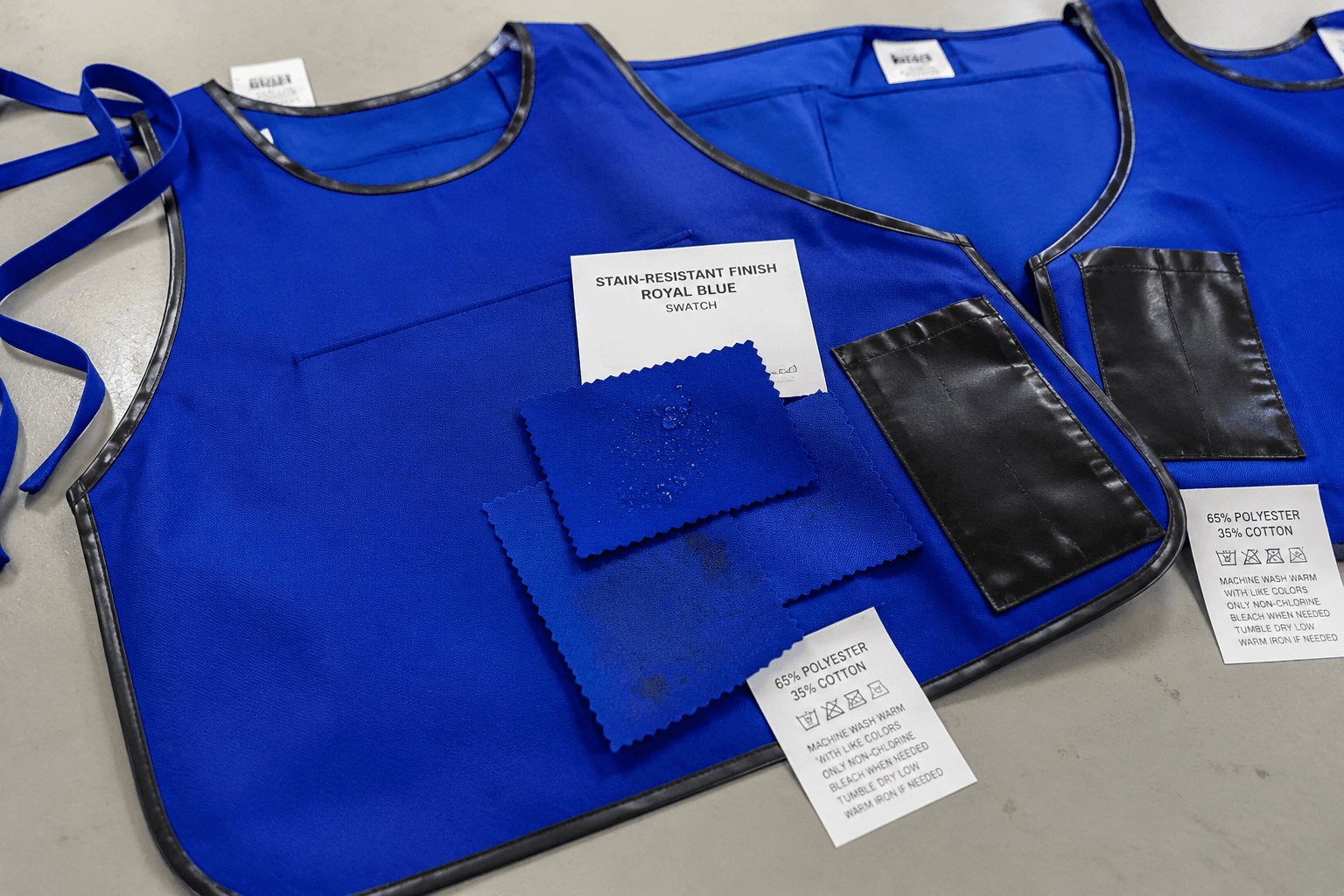
- Water-repellent finishing can add about USD 0.15-0.40 per piece depending on fabric and order quantity, but it may reduce breathability.
Construction details that control wash life
Many apron failures are not caused by the main fabric. They come from weak stitching, poor bartacks, loose pocket corners, or neck straps that twist after washing. For a catering apron, the factory should reinforce stress points before the buyer asks, especially at waist tie joins, pocket openings, neck strap attachment points, and split corners on bistro aprons.
For bulk catering aprons, we normally recommend 8-10 stitches per inch for woven twill and canvas, with polyester core-spun thread for better strength. Pocket corners should be bartacked or triangle reinforced. Waist ties should be long enough for different staff sizes, commonly 90-100 cm each side for bib aprons and 80-90 cm each side for waist aprons. If the catering team needs aprons tied at the front, the tie length should be tested on a real wearer before approval.
Neck construction is also important. A fixed neck loop is cheaper and faster to produce, but it does not fit all staff comfortably. A metal slider or plastic buckle adds cost, usually about USD 0.08-0.20 per piece depending on component quality, but improves fit across a mixed workforce. For higher-end waiter apron orders, a fabric neck strap with metal eyelets or antique brass hardware can improve appearance, but the buyer should confirm whether the hardware is nickel-free and rust-resistant.
- Bartacks should be used at pocket corners, waist tie joins, and strap attachment points.
- Pocket depth should usually be 16-20 cm for pens, order pads, phones, or small service tools.
- Adjustable neck straps reduce size complaints in mixed staff teams and temporary event staffing.
- Polyester thread is preferred for commercial laundry because it keeps strength better than cotton thread.
- A tolerance of +/-1 cm on main dimensions is realistic for bulk production, while tighter tolerance may slow inspection.
Branding a catering apron quickly without reducing quality
Fast branding is often the reason a buyer contacts a China apron factory instead of a local decorator. The event date is fixed, the logo must be visible, and the buyer may need 500-5,000 pcs within a short window. The correct branding method depends on logo size, fabric type, color count, wash requirements, and budget per piece.
Screen printing is the fastest and most economical option for large quantities, especially for one-color or two-color logos on cotton or poly-cotton fabric. For example, a one-color chest print on 1,000 pcs may add about USD 0.12-0.25 per piece, with 3-5 days for logo setup and printing after artwork approval. Heat transfer works well for multi-color logos and smaller MOQs, but low-grade transfer can crack after repeated washing. For catering apron use, buyers should specify wash-resistant transfer and confirm test results at 40 degrees C or 60 degrees C if the laundry process is hotter.
Embroidery is slower and more expensive, but it gives a strong premium appearance for hotel, restaurant, and waiter apron programs. A small chest embroidery of 5,000-8,000 stitches may add about USD 0.35-0.80 per piece depending on thread colors and quantity. For larger logos, embroidery can become heavy, stiff, and uncomfortable on bib aprons. Woven labels, faux leather patches, and rubber badges are also possible, but each has different MOQ and wash limits.
- Screen print is best for simple logos, large quantities, and short lead times.
- Embroidery is best for premium hospitality bib apron styles where texture and durability matter.
- Heat transfer is useful for multi-color event logos, but the buyer should confirm washing temperature and peel resistance.
- Woven labels are clean and consistent for brand programs, usually with label MOQ around 1,000-3,000 pcs.
- Leather-look patches need careful testing because real leather and some PU patches can deform in industrial washing.
Cost structure for bulk catering aprons
Apron pricing is sensitive to fabric width, GSM, style complexity, logo method, packing, and order quantity. A simple poly-cotton bib catering apron in 200-220 GSM stock black fabric, with one front pocket and no logo, may sit around USD 1.60-2.40 per piece at 1,000 pcs, depending on material market and factory loading. Adding a one-color screen print may bring it to about USD 1.80-2.70 per piece. A heavier canvas or denim apron with adjustable neck strap, metal hardware, multiple pockets, and embroidery may range from USD 3.50-7.50 per piece or more.
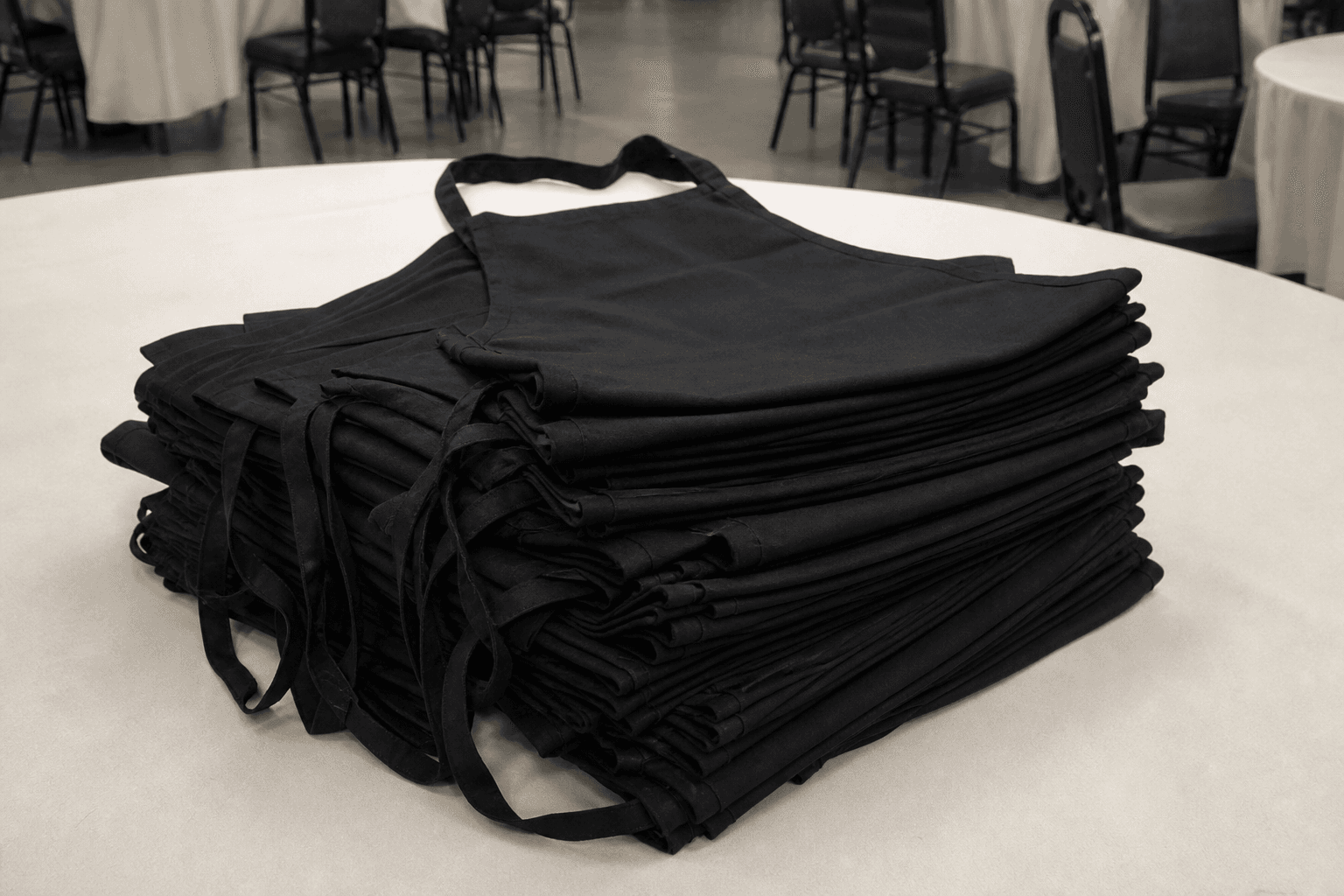
Buyers should separate the quotation into base apron cost, logo cost, label or hangtag cost, packing cost, and freight basis. This prevents confusion when a sample looks correct but the final PO includes extra barcode stickers, individual polybags, carton marks, or retail packaging. For a pure catering supply order, bulk pack in cartons can save USD 0.05-0.15 per piece compared with individual polybag packing. For a distributor or brand buyer, individual packing may be necessary for warehouse handling.
MOQ depends mainly on fabric availability. If the buyer accepts stock colors such as black, white, navy, grey, red, or burgundy, MOQ can often be 300-500 pcs per style. For custom dyed fabric, MOQ is normally 1,000-3,000 pcs per color because dyeing mills have minimum batch requirements. For special yarn-dyed stripes or custom woven fabric, MOQ may be higher, and development time can add 10-20 days before apron production starts.
- A basic 200-220 GSM stock poly-cotton bib apron can often be quoted from about USD 1.60-2.40 per piece at 1,000 pcs before freight.
- One-color screen printing commonly adds about USD 0.12-0.25 per piece at medium to large quantity.
- Small embroidery commonly adds about USD 0.35-0.80 per piece depending on stitch count and quantity.
- Individual polybag packing can add about USD 0.03-0.08 per piece, while barcode or carton label work may add more.
- Custom fabric color usually needs higher MOQ and longer lead time than stock black, white, navy, grey, or burgundy.
Lead times and approval steps for event deadlines
Catering apron orders are often linked to opening dates, trade shows, stadium events, holiday banquets, or seasonal campaigns. The buyer should build the schedule backward from the required delivery date, including artwork approval, sample making, fabric booking, production, inspection, inland transport, export customs, and international freight. A common mistake is to count only sewing days and ignore logo sampling or packing approval.
For stock fabric and a standard apron pattern, a sample can usually be made in 3-7 days. If embroidery or print is included, add 2-4 days for logo setup and strike-off. Bulk production for 500-2,000 pcs is commonly 18-25 days after sample and deposit approval. For 5,000-10,000 pcs, 25-35 days is more realistic, especially if fabric needs dyeing or if several logo versions are required.
When delivery is urgent, the factory can sometimes shorten the schedule by using available fabric, reducing pocket complexity, selecting screen print instead of embroidery, or approving digital layout before physical logo sampling. However, the buyer should not skip size approval, fabric confirmation, or logo placement approval. A fast order still needs one controlled pre-production standard so the inspection team knows what to measure.
- Allow 3-7 days for a standard sample using stock fabric.
- Allow 2-4 additional days for logo strike-off or embroidery sample approval.
- Allow 18-25 days for 500-2,000 pcs after approval when fabric is in stock.
- Allow 25-35 days for 5,000-10,000 pcs or more complex branding programs.
- Add 10-20 days if custom dyed fabric or special woven fabric must be developed.
Inspection points for bulk catering aprons before shipment
A catering apron inspection should focus on the problems that affect use in the field. Appearance matters, but the inspector should also check measurements, pocket position, strap length, logo placement, stitch strength, stains, color consistency, and packing accuracy. For a branded event staff apron order, a small logo position error can be very visible in team photos, so placement tolerance should be agreed before production.
For bulk orders, AQL inspection is common, but the buyer should define the critical points clearly. Major defects include wrong fabric color, incorrect logo, broken stitching, oil stains, obvious shade variation, missing pockets, wrong label, and packed quantity shortage. Minor defects may include small loose threads or slight measurement variation within approved tolerance. In our factory practice, we also check carton weight and carton dimensions because apron orders can become heavy quickly, especially with 260-320 GSM fabric.
Wash testing is useful when the apron will be used for a long-term uniform program. A practical test is 3-5 wash cycles at the buyer's expected laundry temperature, followed by measurement of shrinkage, logo condition, seam twisting, and color change. For black or dark navy catering aprons, rubbing fastness should be checked on both dry and wet fabric. This is especially important when aprons are worn over white shirts.
- Check finished width, length, waist tie length, neck strap length, and pocket placement against the approved sample.
- Check logo size, color, position, and wash resistance before final packing.
- Check pocket corners, bartacks, seams, and strap joins for skipped stitches or weak reinforcement.
- Check dark fabrics for dry and wet rubbing fastness, especially when worn with light shirts.
- Check carton marks, quantity per carton, barcode labels, and packing method against the purchase order.
Specifying the right catering apron for your channel
Different sales channels need different apron specifications. A hotel group may prefer a refined hospitality bib apron with embroidery, adjustable neck strap, and stable black poly-cotton fabric. A festival caterer may need a lower-cost event staff apron with fast screen printing and bulk carton packing. A restaurant distributor may need several colors, individual polybags, and barcode labels for warehouse picking. The correct specification starts with the use case, not with the lowest unit price.
For foodservice distributors, repeatability is often more valuable than a small first-order saving. If a buyer plans to reorder every season, it is better to lock fabric composition, GSM, color reference, thread color, pattern dimensions, logo file, and packing standard from the first PO. This makes the second and third orders faster and reduces shade or fit variation. For chain restaurants, we recommend keeping one approved counter sample at the buyer side and one sealed production sample at the factory side.
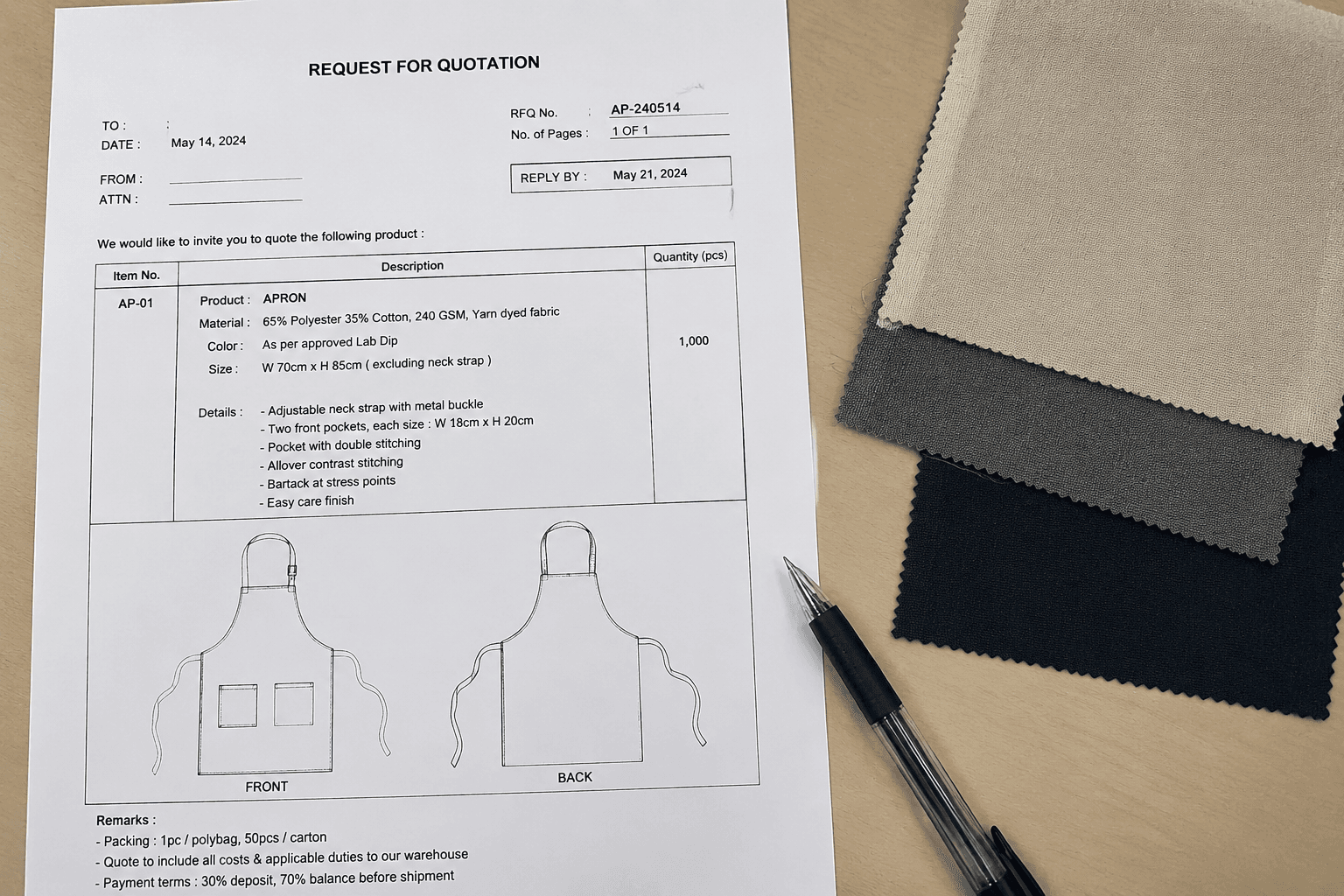
A clear tech pack for a catering apron does not need to be complicated, but it should be complete. It should include apron type, finished size, fabric composition, GSM or oz weight, color standard, pocket details, strap construction, logo artwork, logo size, logo position, label requirements, packing method, carton marks, and inspection standard. With these details confirmed early, the factory can quote accurately and produce without avoidable back-and-forth during the critical lead-time window.
- For hotels and premium restaurants, specify embroidery, adjustable neck strap, and stable mid-to-heavy fabric.
- For festivals and short-term events, specify stock fabric colors, screen print, and efficient bulk packing.
- For distributors, specify barcode labels, carton quantity, color assortment, and repeat-order fabric standards.
- For restaurant chains, keep sealed approval samples to control shade, fit, and logo position across reorders.
- For laundry-heavy use, prioritize poly-cotton stability, reinforced construction, and tested logo durability over decorative details.