For buyers sourcing car detailing aprons, the standard is stricter than for workshop, barber, or hospitality aprons because the garment works within direct contact distance of painted panels, gloss-black trim, chrome, glass, leather, and interior plastics. In daily use, an apron may brush a fender while a technician leans across the hood, slide against a door sill during interior work, or rub a center console when reaching into a footwell. The product therefore has two jobs at once: protect the wearer from short-contact splash and contamination while presenting no hard, abrasive, or grit-holding point that can mark a vehicle.
Many failed sourcing programs start with the wrong benchmark. A 10 to 12 oz cotton canvas apron with metal rings may look premium and survive rough handling, yet it often performs poorly in detailing because it absorbs liquid, dries slowly, gains weight during the shift, and introduces scratch risk through exposed hardware, stiff seams, and heavy swinging pockets. In this category, buyers usually get better field performance from a smooth woven synthetic shell, zero exposed metal, low-bulk seam construction, and a strap system that shifts load away from the neck.
For most OEM orders, the strongest commercial baseline is a 210 to 240 GSM polyester or polyester-rich woven shell with a DWR face, light PU backing, acetal or POM trim, and a finished body length of 78 to 85 cm for mixed detailing work. Buyers who lock these points early, together with pocket load limits, wash expectations, defect standards, and bulk lead-time days, get faster samples, cleaner quotations, and more repeatable reorders.
- Car detailing aprons should have no exposed metal on the front, sides, strap path, or hidden substitute trim used in production.
- A 210 to 240 GSM polyester shell with DWR face and light PU backing is a practical baseline for mobility, quick drying, and 5 to 30 minute splash exposure.
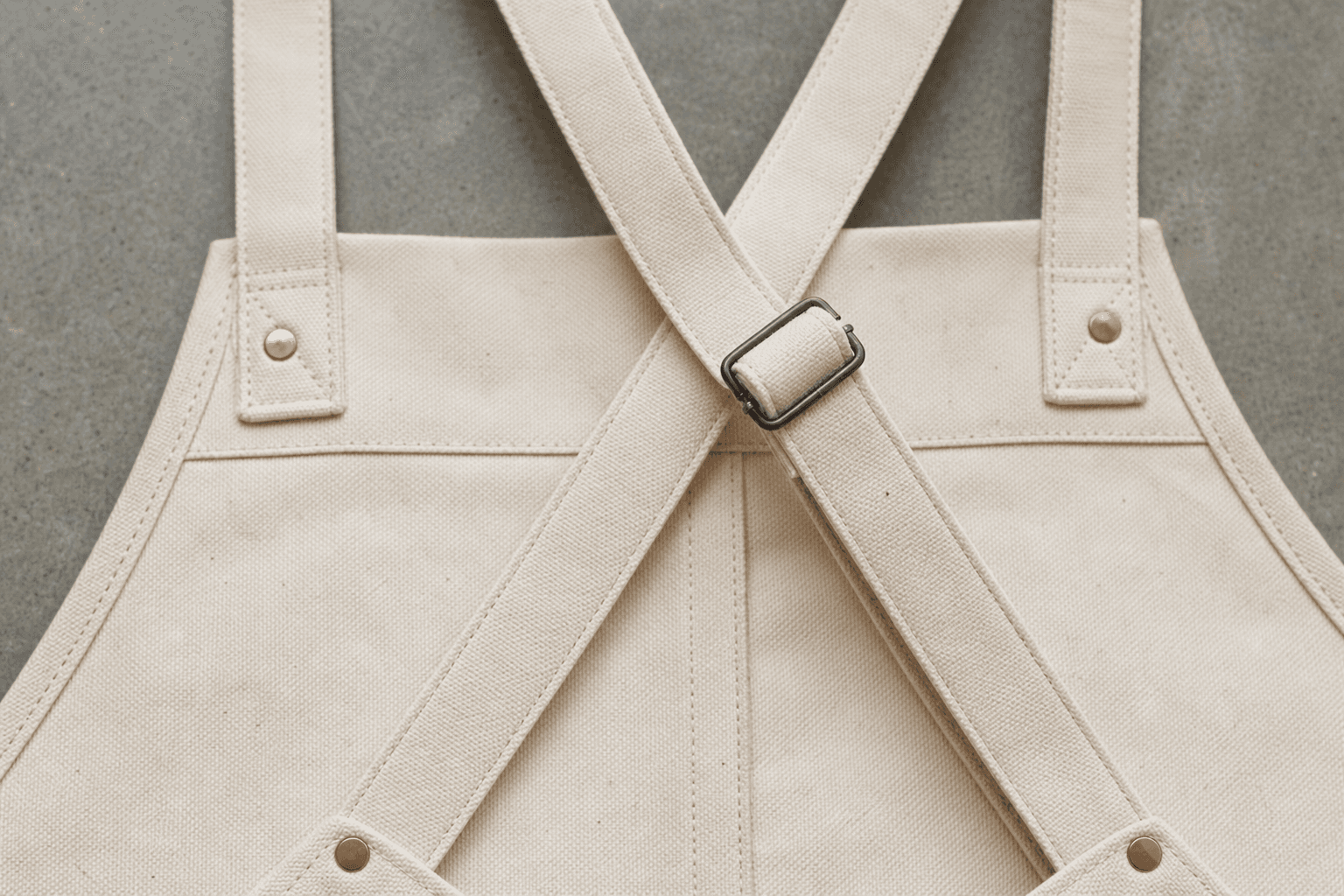
- Cross-back or waist-supported straps are usually safer than neck-hung styles once carried front load exceeds about 0.8 kg.
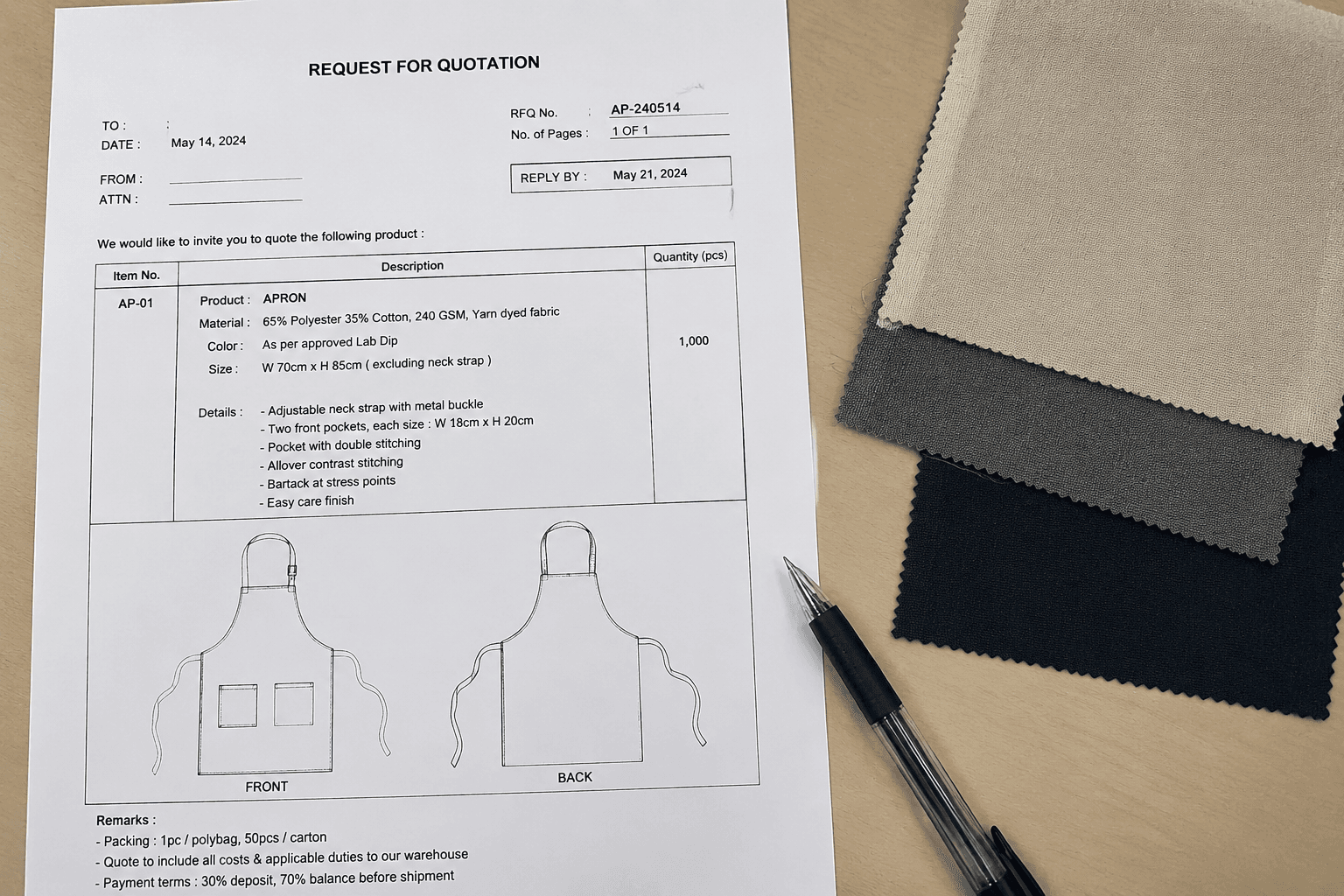
- RFQs should define actual chemicals, body length, webbing width, pocket dimensions, wash-cycle target, AQL level, MOQ, sample days, and bulk lead-time days.
- Typical FOB pricing is about US$3.40 to US$5.60 per piece at 500 to 1,000 pcs for standard builds and about US$6.20 to US$9.80 for more technical custom builds.
Why car detailing aprons require a tighter B2B spec than general workshop aprons
A generic utility apron rarely transfers well into professional detailing because the service environment is different. The apron does not only face water, dust, polish, or cleaner residue; it also works within direct contact range of clear coat, piano-black trim, PPF edges, dashboards, touchscreens, and leather bolsters. That changes the sourcing priority from simple durability to controlled surface contact. Fabric smoothness, trim hardness, seam bulk, pocket swing, and even logo method become first-order specifications rather than minor styling details.
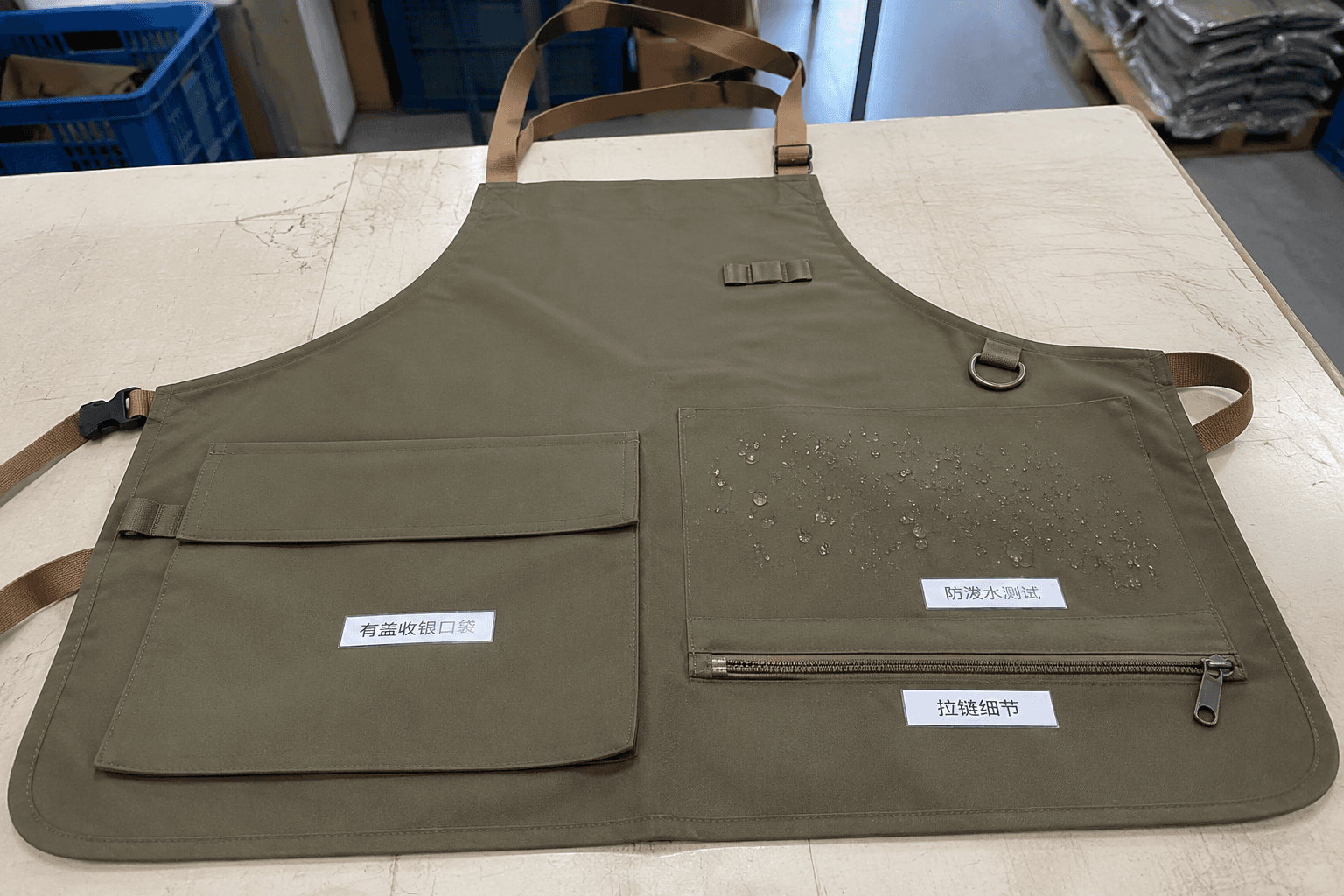
In factory claim analysis, the failure point is often not the base fabric. More common causes are metal D-rings, rivets, zipper teeth, stiff binding, sharp bartack tails, hard embroidery backing, and front pockets that flare outward when loaded with towels or bottles. A sample may look clean on a hanger but still fail once the wearer bends over a fender, twists into a footwell, or kneels at a rocker panel. That is why approval should happen in motion, not only on a tabletop.
Buyers should also use the right performance language. In most detailing bays, the commercial need is not a heavy waterproof PPE apron. The real target is short-contact splash resistance, easy wipe-clean behavior, low water absorption, fast drying between jobs, and low abrasion against vehicle surfaces across an 8 to 10 hour shift. Thick PVC and heavy TPU can block liquid, but they usually add drag, heat buildup, noise, and stiffness that work against close vehicle handling.
- Define the service mix at RFQ stage: exterior detailing, interior detailing, wash-bay work, ceramic coating, or mixed service.
- Approve samples during bending, kneeling, bottle reach, and towel handling instead of flat inspection only.
- Treat scratch safety, grit release, seam softness, and pocket stability as equal to splash resistance.
- Replace vague terms such as durable or waterproof with measurable specs such as 225 GSM, 80 cm body length, 32 mm webbing, and no metal parts.
Scratch-safe hardware specs for car detailing aprons
Hardware is the fastest hard-fail point for car detailing aprons. The safest commercial rule is no exposed metal on the front, sides, strap path, or adjustment points, and many premium buyers now ban metal anywhere on the garment, including eyelets, snaps, zipper parts, logo plates, and hidden substitutions during replenishment. Practical trim options are acetal buckles, POM adjusters, nylon sliders, bartack-secured webbing loops, and hidden reinforcement tape that does not create a hard contact point.
Non-metal trim still needs durability control. Low-grade plastic adjusters can crack after repeated flexing, cold storage, or contact with alkaline cleaners and panel prep sprays. For lighter single-pocket aprons, 25 mm webbing is often enough, but 32 mm webbing performs better when the apron carries multiple microfiber towels, applicator pads, or a 500 ml trigger bottle. Buyers should ask the factory to verify strap-joint strength, adjuster hold, and smooth adjustment after repeated use rather than assuming all plastic hardware performs equally.
Branding should pass the same scratch-safety review as hardware. Dense embroidery can leave a hard reverse patch, thick thread ridge, or backing edge that prints through the shell. Rubber badges, molded patches, and metal logo plates carry even more risk. For detailing use, a one-color or two-color heat transfer, screen print, or a small woven label placed at the upper chest edge is usually the safer sourcing choice because it keeps the contact face flatter and quieter against paint and trim.
- Preferred trim set: acetal or POM adjusters, nylon webbing, hidden reinforcement tape, no rivets, no metal eyelets.
- Recommended webbing width: 25 mm for lighter builds and 32 mm for larger aprons or higher pocket loads.
- Avoid chest zippers, front snaps, metal clips, hard rubber badges, and decorative button hardware.
- Request function checks after low-temperature storage if the target market includes winter detailing operations.
Fabric and weight specs for car detailing aprons: 210 to 240 GSM as the commercial baseline
Fabric selection determines drape, dry time, wipe-clean behavior, heat retention, and wash stability. For most professional car detailing aprons, the practical shell range is 180 to 260 GSM woven polyester or polyester-rich fabric. At 180 to 200 GSM, the apron feels lighter and cooler, but pockets can collapse when carrying damp towels and the front panel may flutter during movement. At 210 to 240 GSM, buyers usually get the best balance of structure, mobility, abrasion life, and stable pocket behavior. Above 260 GSM, many builds become too stiff for close-contact vehicle work unless the fabric hand is unusually soft.
Cotton canvas remains popular in presentations, but it is not the best default for detailing bays. A typical 10 oz cotton canvas is about 339 GSM, and a 12 oz canvas is about 407 GSM. At those weights, the apron can absorb shampoo, APC residue, and polishing compound quickly, hold moisture longer, and feel heavier by the second half of the shift. A more dependable OEM baseline is 210D or 300D polyester oxford, or a polyester twill around 200 to 230 GSM, finished with a DWR face and light PU backing. That construction supports water beading, lowers soak-through during short exposure, and keeps the surface smoother than many natural-fiber alternatives.
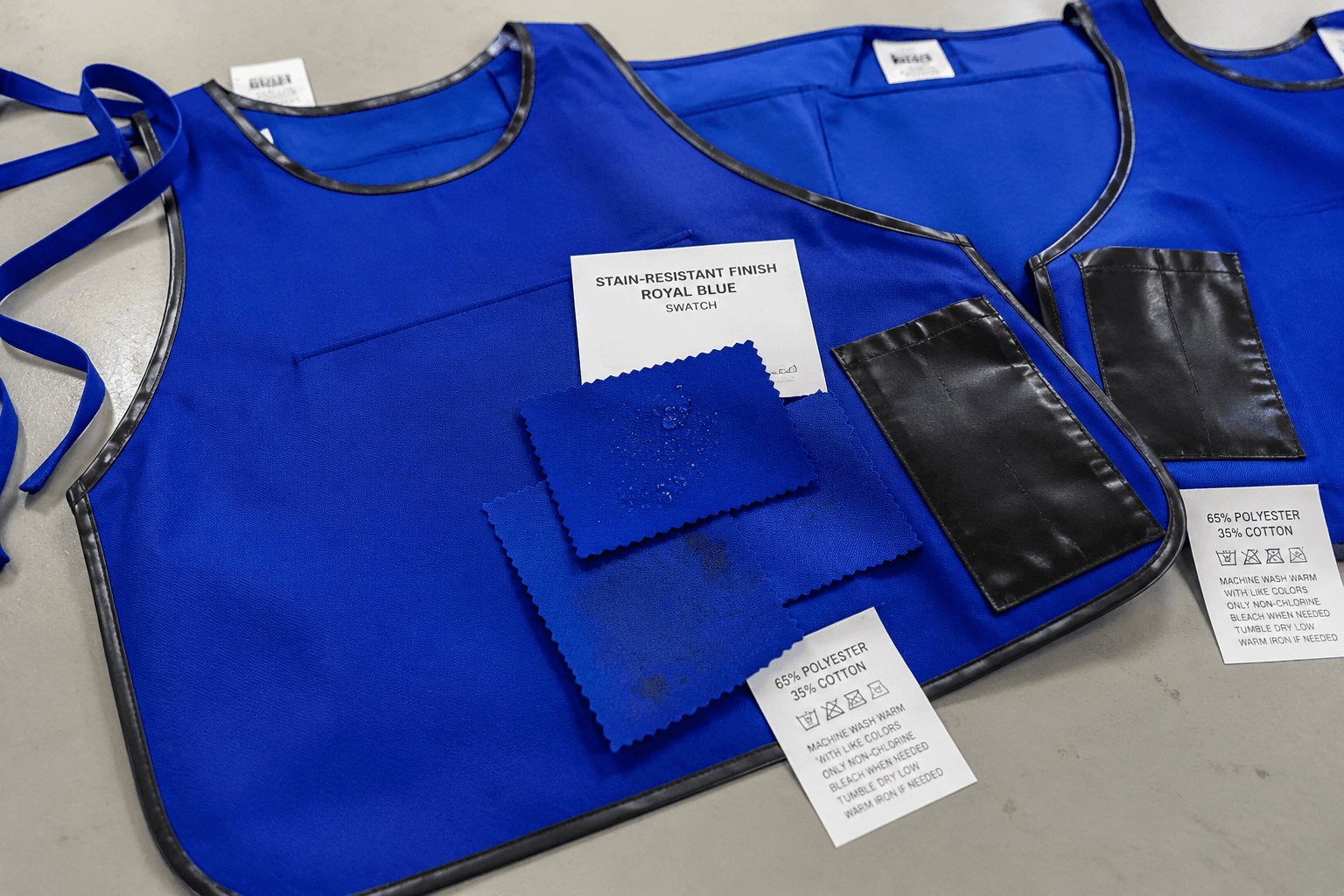
Buyers should separate launch-day repellency from long-term wash performance. A shell that beads water when new may lose much of that effect after repeated laundering if the finish is weak. In practical terms, suppliers should compare candidate fabrics after 10, 20, and 30 wash cycles for beading retention, seam distortion, coating stability, colorfastness, and handfeel. Weekly laundering means a 30-wash review covers roughly seven months of service, which gives a more realistic picture than a sample card alone.
- Working shell range: 180 to 260 GSM woven polyester or polyester-rich fabric.
- Commercial sweet spot: 210 to 240 GSM for mixed detailing work and stable pocket behavior.
- Common base constructions: 210D polyester oxford, 300D polyester oxford, or 200 to 230 GSM polyester twill with DWR face and light PU backing.
- Request wash checks after 10, 20, and 30 cycles for beading retention, seam puckering, color shift, and coating integrity.
Chemical splash resistance buyers should specify instead of asking for a 'chemical-resistant' apron
The term chemical-resistant is too broad to support a clean quotation. In detailing shops, aprons are usually exposed to atomized products, wet towel transfer, glove contact, and drips from trigger bottles rather than full immersion. The realistic B2B requirement is controlled 5 to 30 minute splash resistance with easy wipe-clean performance and no obvious tackiness, staining, or coating damage afterward. If the RFQ only says chemical-resistant, one supplier may quote a light DWR polyester while another prices a heavy industrial coated apron, making cost and performance comparisons meaningless.
A stronger brief lists the actual product families used in the bay. Typical examples include pH-neutral shampoo, APC, alkaline wheel cleaner, glass cleaner, iron remover, tar remover, IPA panel prep spray, interior cleaner, and tire dressing. Buyers should also define where exposure happens most often: chest panel, lower front panel, pocket opening, or strap edge. Five minutes of mist on the chest is a very different challenge from 30 minutes of liquid held in a folded pocket seam, and those differences affect shell choice, thread type, print method, and whether the back coating may soften over time.
Sample approval should follow a repeatable process. Apply each key product, leave it for 5, 15, and 30 minutes, wipe clean, air dry, and inspect the fabric, seams, print, labels, and backing. Polyester thread is generally the safer default than cotton thread because it handles moisture and cleaner exposure better. If the apron uses a heat transfer logo or printed care mark, those elements should be included in the same test because logo failure often appears before shell failure.
- Define the actual chemical set in the RFQ instead of relying on one broad claim.
- Set sample exposure intervals such as 5, 15, and 30 minutes for each key chemical.
- Check for staining, odor retention, tackiness, delamination, seam puckering, and logo damage after wipe-off.
- Specify polyester sewing thread and confirm that labels and branding survive the same cleaner exposure.
Pocket layout, load limits, and mobility specs for full-shift detailing work
Pocket design should support movement, not just storage. Detailers lean over hoods, rotate around doors, kneel at lower panels, and reach into footwells throughout the shift. Large loose kangaroo pockets are therefore risky in many programs because they trap grit, hold moisture, and swing outward toward paintwork when loaded. Segmented pockets with controlled depth are usually safer because contents stay flatter, cleaner, and more stable against the body. This also helps operators separate clean microfiber from damp or contaminated towels.
Pocket load should be written in measurable terms. A filled 500 ml trigger bottle commonly adds about 0.55 to 0.65 kg, and two bottles plus damp towels can push the front load above 1.2 kg. Once carried load rises beyond about 0.8 kg, neck-hung aprons often become uncomfortable during an 8 hour shift and are more likely to rotate forward while bending. For that reason, many OEM buyers prefer cross-back or waist-supported systems, reinforced pocket bases, and bottle sleeves anchored into side seams rather than only topstitched onto the front panel. Some detailing brands go further and ban bottle carry entirely, reserving the apron for towels, applicators, brushes, and inspection lights.
Length and hem shape matter as much as pockets. A finished body length of 75 to 85 cm suits most mixed detailing work because it covers the torso and upper thigh without interfering with kneeling. For wetter wash-bay operations, some users prefer 85 to 95 cm for more splash coverage, but the lower section still needs flex during crouching. Side vents or a center split can improve reach, provided the opening stays controlled and does not fold outward into contact with paint.
- Separate clean microfiber storage from damp or contaminated towel zones.
- Use cross-back or waist-supported straps when front load exceeds about 0.8 kg.
- Typical body length: 75 to 85 cm for mixed detailing and 85 to 95 cm for wash-bay use.
- Prefer segmented pockets, reinforced bases, and side-seam bottle sleeves over one large front pouch.
MOQ, target FOB cost, AQL, and lead-time days for custom detailing apron programs
For B2B buyers, unit cost is driven less by apron shape than by trim restrictions, coating choice, decoration method, and packaging. A standard custom build using stock black 220 GSM polyester fabric, stock black webbing, acetal hardware, one or two segmented pockets, and a one-color heat-transfer logo typically prices around US$3.40 to US$5.60 FOB per piece at 500 to 1,000 pcs. A more technical program with cross-back straps, bottle sleeves, upgraded coating, extra reinforcement, multiple print positions, or retail-ready individual packaging more often lands around US$6.20 to US$9.80 FOB. Small GSM changes usually have less cost impact than custom-dyed fabric, molded branded hardware, or complex packing requirements.
MOQ depends on how much of the build can run on stocked materials. If the buyer accepts stock black, charcoal, or dark gray shell fabric with standard black trim, MOQ often starts at 300 to 500 pcs per color. Once the program moves to custom-dyed fabric, contrast webbing, molded branded buckles, or several decoration placements, the practical MOQ often rises to 800 to 1,000 pcs or more. Buyers can reduce sampling waste by narrowing the concept early rather than requesting multiple fabrics, several pocket maps, and two strap systems in one round.
Lead time should be broken into development and bulk production instead of offered as one vague promise. A sample from an existing pattern often needs 5 to 7 days. A custom sample with new materials or revised pocket architecture usually needs 10 to 15 days. After approval, fabric preparation can require 15 to 25 days, while cutting, sewing, finishing, inline inspection, and packing typically add another 20 to 30 days depending on quantity and season. For most customized programs, 35 to 60 days from approved sample to shipment is realistic. A practical QC baseline is AQL 2.5 for major defects and AQL 4.0 for minor defects, with checkpoints on no-metal compliance, pocket dimensions, strap attachment, logo position, shade consistency, and carton assortment.
- Indicative MOQ: 300 to 500 pcs for stock-material logo programs and 800 to 1,000+ pcs for deeper customization.
- Indicative FOB price: US$3.40 to US$5.60 for standard builds and US$6.20 to US$9.80 for more technical builds.
- Sample lead time: 5 to 7 days from an existing pattern and 10 to 15 days for custom development.
- Bulk lead time: commonly 35 to 60 days after sample approval with AQL 2.5 major and AQL 4.0 minor.
Pre-production approval points to lock before placing the bulk order
The final approval stage should reduce field risk, not just confirm appearance. Strong buyers seal one pre-production sample and run it through real detailing use: load the pockets, bend over painted panels, kneel into interior access positions, expose the shell to the actual cleaner set, wash it, dry it, and recheck whether the trim remains flexible, quiet, and non-marking. This process catches problems that material claims and tabletop inspection often miss, especially on black paint and gloss trim where hard points show up quickly.
From the factory side, repeatable output depends on freezing measurable specifications before the purchase order is issued. The approved standard should include fabric code, GSM tolerance, coating type, color standard, webbing width, hardware material, finished body length, pocket dimensions, logo method, carton ratio, and production tolerances. If scratch safety is non-negotiable, the PO should state clearly that no metal component is allowed anywhere on the garment, including hidden reinforcement, zipper elements, eyelets, substitute trim, or replenishment material changes.
A reliable apron program is specific enough to quote, inspect, and repeat without drift. Instead of asking for a light, durable, premium, waterproof apron, define the actual build: 225 GSM polyester oxford, DWR face, light PU backing, 80 cm finished length, 32 mm cross-back straps, two microfiber pockets, one accessory sleeve, acetal adjusters, and approval after 20 wash cycles. Those details let the factory plan correctly, let QC teams inspect consistently, and let buyers reorder with less risk of unwanted change.
- Approve one sealed pre-production sample through wear, spray, wipe, wash, and recheck testing.
- Freeze measurable specs such as GSM tolerance, finished body length, webbing width, pocket depth, logo location, and pack ratio.
- Write the no-metal rule directly into the PO if the apron may contact painted, gloss, or chrome surfaces.
- Keep one retained golden sample for repeat-order comparison and incoming QC reference.