For B2B buyers sourcing laminated canvas aprons, the key decision is not whether a supplier can bond waterproof film to canvas. It is whether the finished apron can bend, hang, sew, and wear properly after lamination, pocket construction, bartacking, and daily wipe-downs.
Lamination changes the entire apron package. It affects drape, fold memory, stitch-hole visibility, shrinkage control, sewing speed, carton density, and wearer comfort. In most hospitality and light wet-work programs, a 10 to 12 oz canvas, roughly 285 to 340 GSM, laminated with 0.05 to 0.08 mm TPU or soft PU gives the best balance. Once the build moves to 12.5 to 14 oz canvas, roughly 360 to 410 GSM, with 0.10 to 0.15 mm PVC, the apron usually suits heavier splash zones where barrier performance matters more than all-day comfort.
The safest sourcing brief treats laminated canvas aprons as a system: base cloth, fiber blend, film chemistry, film thickness tolerance, pattern engineering, strap layout, MOQ, AQL standard, and realistic production days. Buyers who specify only “waterproof canvas apron” often receive the stiffest defendable construction, not the most wearable apron for reorder business.
- Film thickness usually adds more rigidity than canvas weight alone; reducing film from 0.12 mm to 0.07 mm often improves flexibility more than reducing canvas from 340 GSM to 300 GSM.
- 285 to 340 GSM is the most reliable range for wearable laminated canvas aprons used in café, kitchen prep, floristry, and grooming programs.
- TPU and soft PU usually outperform standard PVC in comfort for 8- to 10-hour apron wear, especially at the bib and waist fold zones.
- Seam stacking can add 15% to 25% perceived stiffness; deep hems, double pockets, bartacks, and reinforced waist joins quickly create hard spots.
- MOQ usually starts with laminated fabric, not sewing capacity; custom laminated cloth often requires 500 to 1,000 meters per color, while finished apron MOQ commonly starts at 300 to 800 pieces per style.
- Bulk approval should include material and garment checkpoints; review laminated swatches, a sewn pre-production sample, and written inspection terms such as AQL 2.5 major and AQL 4.0 minor before mass production.
Why laminated canvas aprons become rigid after bonding and sewing
Most stiffness complaints come from cumulative apron-spec choices rather than one obvious mistake. A canvas that feels acceptable before conversion can become board-like after full-width film bonding, pocket reinforcement, double-turn hems, bartacks, and waist-strap joins are added. The worst zones are usually the bib, lower skirt, and patch-pocket area because those parts combine the highest layer count with the most repeated bending during wear.
A common sourcing failure starts when the buyer asks for “waterproof” performance without defining target hand feel, acceptable bend radius, shift length, or task exposure. The lamination mill then protects against claims by choosing thicker film or a heavier adhesive spread. That may pass a simple bench splash check, but it often creates an apron that pushes outward while walking, presses into the neck after 2 to 3 hours, and keeps hard fold lines after uncartoning.
A practical comparison shows the trade-off. A 12 oz, 340 GSM cotton canvas with 0.15 mm PVC usually feels much harder than a 10.5 oz, 300 GSM 65/35 poly-cotton canvas with 0.08 mm TPU, even if both survive the same short splash exposure. In apron use, the difference comes from fold recovery, seam compressibility, stitch-hole stability, and how the laminated panel behaves after cutting and sewing rather than how it feels as a flat roll.
- Canvas above 380 GSM should be reviewed carefully before approval for standard bib aprons.
- PVC above 0.10 mm often creates a visible jump in board feel, especially on bib panels and pockets.
- Full-face lamination is usually stiffer than lighter transfer or backside systems intended for splash resistance.
- Pocket bags, deep hems, bartacks, and reinforced waist seams can add more stiffness than the lamination itself.
Base cloth specifications that keep laminated canvas aprons wearable
Base fabric sets the comfort ceiling for the finished apron. Commercial apron programs can technically run from 8 oz to 14 oz canvas, about 230 to 410 GSM, but the most reliable range for wearable laminated canvas aprons is 10 to 12 oz, or about 285 to 340 GSM. Below that range, long bibs and large pockets may collapse or twist. Above it, the cloth-and-film package often resists bending too much for café, prep kitchen, bar, and front-of-house use.
Fiber content matters almost as much as weight. A 100% cotton canvas gives a more natural hand and richer surface texture, but the uncoated side absorbs more moisture and needs tighter shrinkage control. Many factories pre-shrink cotton-rich canvas before lamination and target residual shrinkage below 3% after care testing if washing is required. A 65/35 or 80/20 poly-cotton canvas usually gives better width stability, lower shrink risk, and cleaner cutting repeatability. At 1,000 to 3,000 units, that blend can reduce FOB by roughly $0.20 to $0.45 per apron compared with a similar-weight pure cotton base.
Buyers should request more than nominal GSM. Weave density, roll width tolerance, lamination tension, and post-lamination relaxation all affect apron yield and appearance. Loose construction can show film telegraphing, bubbling, or uneven tension after heat bonding. For efficient cutting, width tolerance within plus or minus 1.5 cm per roll is easier to control than lots that drift across the marker. A practical factory standard is to laminate first, then let the fabric relax for 24 hours before spreading and cutting.
- 230 to 260 GSM suits lighter promotional or front-counter aprons, but limits pocket load and long-term durability.
- 285 to 340 GSM is the strongest all-round range for café, kitchen prep, florist, grooming, and retail food aprons.
- 360 to 410 GSM fits butcher, dishwash, seafood, and heavier splash apron categories where comfort is secondary.
- Poly-cotton canvas usually gives lower shrinkage, cleaner bulk repeatability, and a lower piece price than 100% cotton at the same target weight.
Film selection for laminated canvas aprons: TPU, soft PU, or PVC
Film choice should start with the wearer’s task, cleanup method, and hours on body, not with the lowest raw-material cost. For professional apron programs, TPU and soft PU usually deliver the best balance of barrier performance and flexibility. Standard PVC remains common because it is available in many markets and costs less, but it is also the option most likely to harden the hand when paired with midweight or heavy canvas.
The cost difference is real but usually manageable at apron level. On a basic bib apron, soft PVC lamination often adds about $0.35 to $0.70 per piece depending on thickness, order size, and whether the fabric is stock or custom. TPU commonly adds about $0.70 to $1.40 per piece, while soft PU or transfer-coated systems often land between those ranges. For many uniform buyers, the extra spend is justified if it reduces wearer complaints, returns, and slow reorders.
Thickness tolerance matters as much as material type. A nominal 0.08 mm film with poor control across the roll can produce one apron panel that feels acceptable and another that feels noticeably harder. Buyers should request target thickness, tolerance, gloss level, odor expectation, and fold-crack review in the approval sheet. For hospitality and culinary programs, it is reasonable to ask for crease-whitening checks after repeated bending and visual consistency across swatches before bulk sign-off.
- PVC is usually the lowest-cost route, but also the firmest hand in most laminated apron constructions.
- TPU usually gives better flexibility, cleaner fold recovery, and lower crack risk at corners and fold lines.
- Soft PU or transfer-coated systems work well when wipe-clean performance matters more than heavy waterproof build.
- For wearable aprons, many factories keep film thickness within 0.05 to 0.10 mm before considering heavier barrier packages.
Pattern engineering that stops laminated canvas aprons from feeling overbuilt
Even a well-developed laminated fabric can fail once it is converted into an apron with too many stacked layers. Aprons bend constantly at the chest, waist, hip, and thigh, so pattern engineering directly affects comfort. To preserve movement, factories often simplify pocket facings, reduce seam overlap at waist joins, limit decorative overlays, and use binding only where it lowers bulk rather than adding it.
Strap construction is one of the most overlooked sourcing points. If the body panel is laminated and the straps use the same stiff composite, the apron often pulls awkwardly across the neck and shoulders. A more commercial build keeps protection on the body while switching to softer canvas straps, cotton webbing, or polyester webbing. Cross-back layouts are especially useful when the laminated bib exceeds about 330 GSM total composite weight because they spread load better during 8- to 10-hour shifts.
Trim selection should be costed against comfort and reorder risk. Double-layer utility pockets, rivets, towel loops, D-rings, carabiner tabs, and leather-look trim can improve a sales sample, but together they can turn a balanced apron into an overbuilt garment that staff avoid wearing. In most uniform programs, one or two functional features are enough if the real target is repeat purchase rather than showroom impact.
- Use cross-back or wide neck layouts when the laminated bib exceeds about 330 GSM total composite weight.
- Limit double-layer pockets unless the apron must carry tools, shears, bottles, or metal accessories.
- Choose narrow hems or binding where deep double-turn hems would create a hard edge.
- Pair laminated body panels with softer straps or webbing to reduce neck fatigue and improve movement.
Sampling, AQL, and process controls before bulk laminated apron production
The lamination process determines whether the finished apron feels controlled or brittle. Bonding temperature, pressure, dwell time, and adhesive add-on all affect hand feel. Too much heat can tighten cotton-rich canvas and flatten its surface. Too much pressure can create a plastic-plate effect that looks smooth on a table but performs poorly in motion. These problems are expensive to correct after cutting, so staged approval is essential before bulk lamination begins.
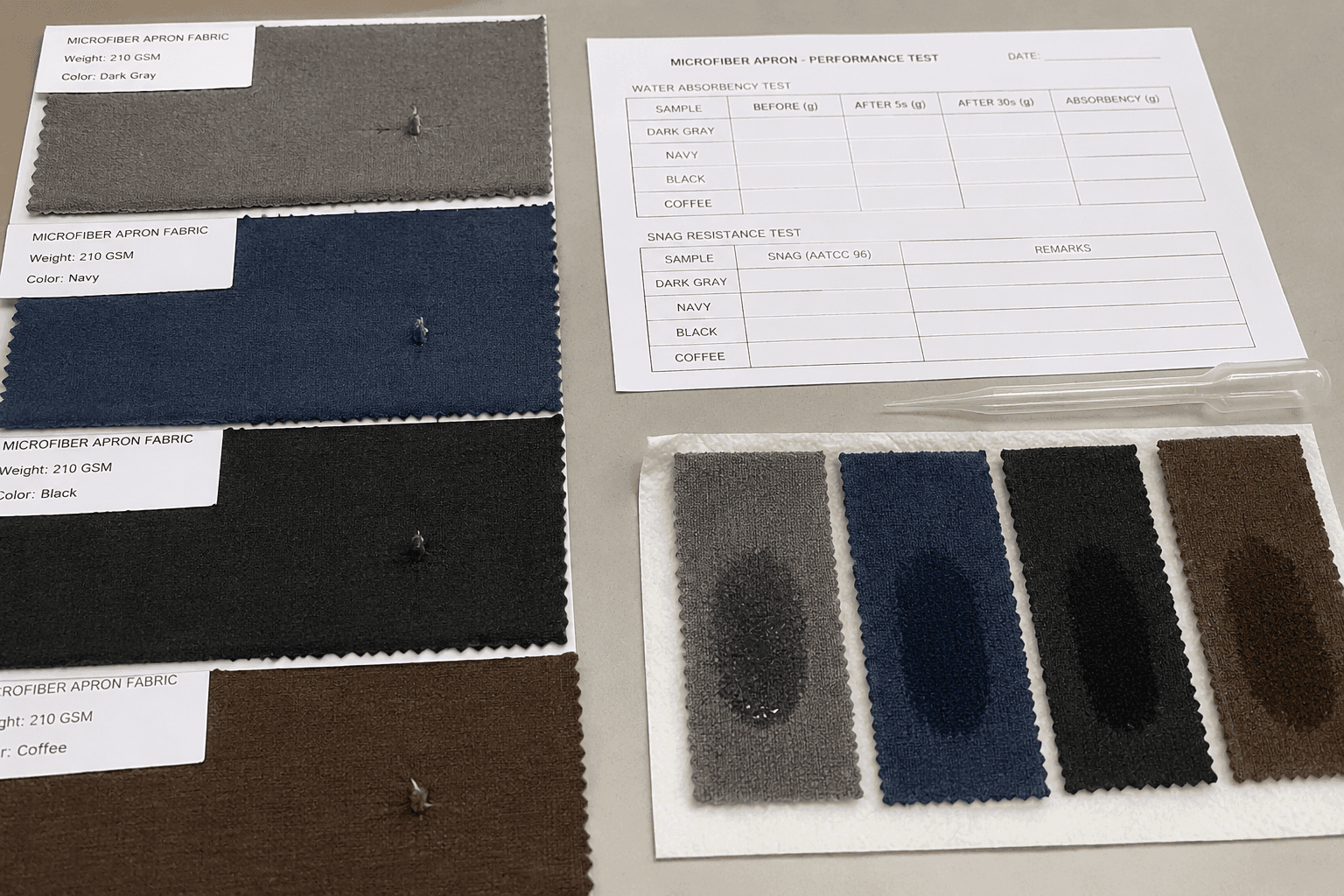
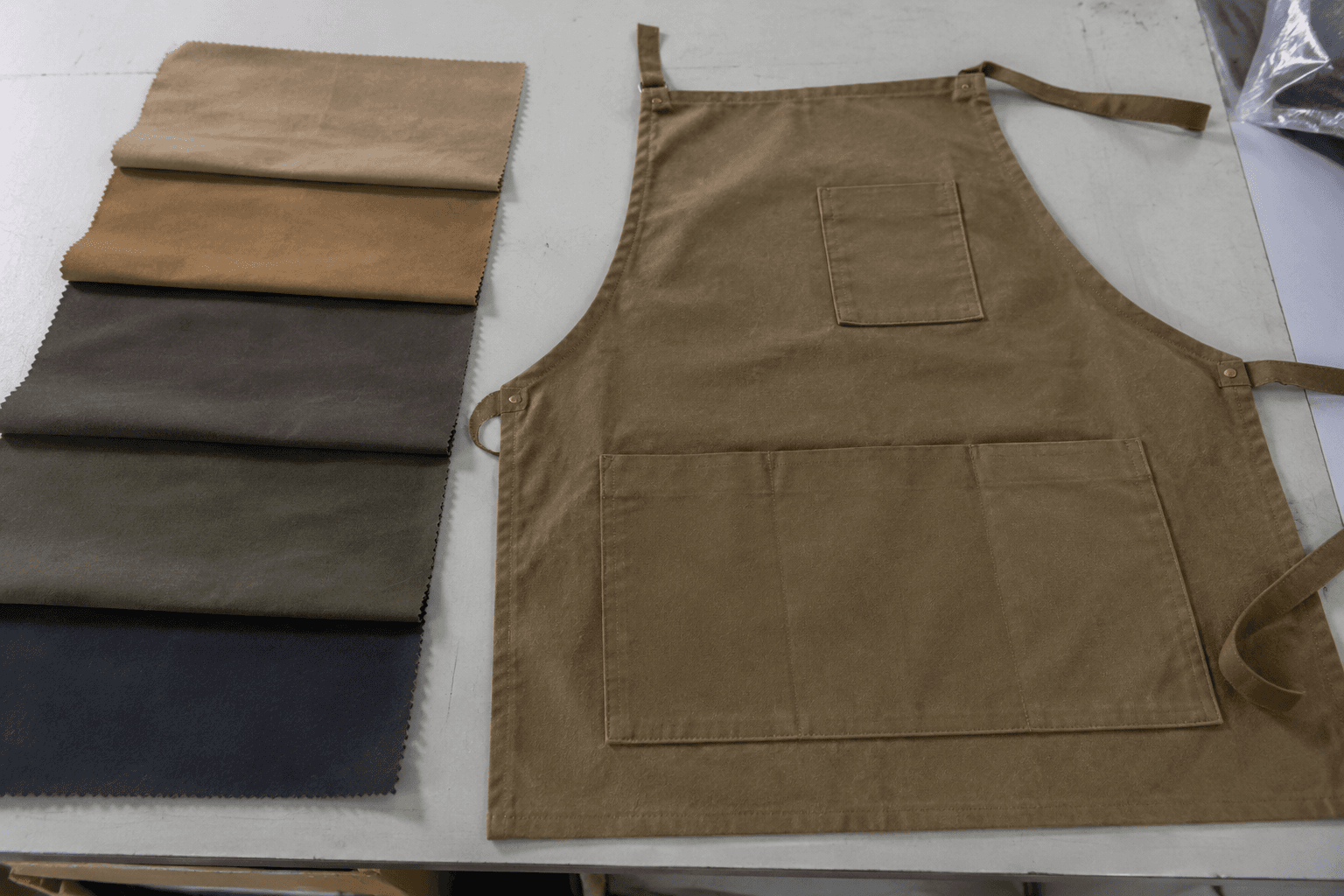
A useful development path is to compare at least three apron-ready options side by side. For example, a buyer may review 300 GSM canvas with 0.07 mm TPU, 320 GSM canvas with 0.08 mm TPU, and 340 GSM canvas with 0.08 mm soft PVC. That comparison reveals not only barrier differences but also fold recovery, stitch-hole appearance, edge waviness, and sewing behavior around pocket corners and bartacks. The swatch that feels best by hand is not always the one that sews cleanest, which is why both a proto and a pre-production sample are worth the extra 7 to 12 development days.
Quality control terms should be written into the purchase order. For most professional apron programs, AQL 2.5 major and AQL 4.0 minor is a workable baseline. Major defects typically include delamination, stitch-hole tearing, panel distortion, broken bartacks, or strong chemical odor. Minor defects typically include light surface scratching, gloss variation, uneven topstitching, or mild crease whitening. Standard bulk lead time for stock laminated colors is often 25 to 35 days after final sample approval. If the order includes custom film color, embossing, special retail packing, or cold-flex testing, 35 to 50 days is more realistic.
- Approve laminated swatches first, then approve a sewn pre-production sample with final pockets, straps, and trims.
- Request at least three hand-feel options instead of approving one lamination package blind.
- Set an inspection baseline such as AQL 2.5 major and AQL 4.0 minor with written apron defect definitions.
- Allow about 24 hours of post-lamination fabric relaxation before cutting when dimensional stability matters.
MOQ, FOB, and lead-time benchmarks for B2B laminated apron sourcing
Buyers should budget laminated apron programs differently from standard canvas styles because the process adds film sourcing, lamination, fabric relaxation, slower sewing through bulk zones, and tighter inspection. For a simple custom bib apron in 285 to 320 GSM laminated canvas with basic straps and one pocket, a common FOB range is about $3.80 to $6.50 per piece at 1,000 to 3,000 units. A utility-heavy style with multiple pockets, metal hardware, branded trims, and retail packing often moves to $6.50 to $11.00 per piece. Trial runs below 500 pieces usually carry a higher cost because laminated fabric utilization is less efficient.
MOQ is usually driven by fabric conversion rather than sewing capacity. In-stock laminated canvas can support smaller test orders, but color and hand-feel options are limited. For custom lamination, fabric MOQ commonly starts at 500 to 1,000 meters per color, while finished apron MOQ often starts around 300 to 800 pieces per style. If the buyer wants a custom Pantone tone, embossed surface, matte finish, or specific low-temperature flex requirement, the practical MOQ may rise because the lamination line needs a more economical run length.
Lead time should include development loops, not only cut-and-sew days. A realistic schedule is 5 to 7 days for hand-feel submissions, 7 to 10 days for sample sewing after fabric arrival, 3 to 5 days for revision comments, and 25 to 35 days for standard bulk production after final approval. Where custom lamination and extra testing are involved, the total cycle often reaches 40 to 60 days. Buyers who need speed usually save the most time by choosing stock black, navy, olive, or dark brown laminated bases and limiting custom hardware.
- Simple laminated bib aprons often land at $3.80 to $6.50 FOB per piece at moderate volume.
- Utility styles with extra pockets and hardware often reach $6.50 to $11.00 FOB per piece.
- Custom laminated fabric MOQ commonly starts at 500 to 1,000 meters per color even when garment MOQ appears lower.
- A full custom apron program usually needs 40 to 60 days from material development to bulk completion.
Matching laminated apron construction to light-duty and heavy-splash work
Not every department needs the same apron build. In café, bakery, barista, deli, and front-counter food service, buyers often over-specify waterproofness and then face comfort complaints from staff. A 285 to 310 GSM base with a soft 0.05 to 0.07 mm TPU or PU layer is usually enough for splash control, stain wipe-off, and a clean presentation. That construction keeps the apron closer to the body and reduces spring-out at the lower skirt.
For higher-exposure environments such as dishwash, seafood prep, butcher stations, floristry, and pet grooming, a stronger barrier can be justified. Even then, the apron still has to perform through a full shift. A practical heavier-duty build may use a 340 to 380 GSM base with 0.08 to 0.10 mm TPU or soft PVC, simplified pockets, and softer straps to offset added rigidity. In most cases, going beyond that build should be reserved for specialized wet-work aprons where mobility is a secondary requirement.
The strongest sourcing strategy is to split light-duty and heavy-duty apron programs instead of forcing one universal style across every workstation. Final approval should come from wear trials, folded aging, and a sewn sample with final trims. If the apron still folds cleanly, hangs straight after 48 hours on a hanger, and does not spring outward after repeated handling, the construction is usually within a safe commercial range for repeat orders.
- Use lighter laminated builds for café, bakery, barista, deli, and customer-facing prep aprons.
- Use stronger barrier builds for dishwash, butcher, seafood, floristry, and grooming aprons.
- Judge the sewn apron after folding, hanging, and wear trials rather than from flat swatches alone.
- Split light-duty and heavy-duty programs when departments face different splash levels, cleaning routines, and shift lengths.