Buyers sourcing cannabis retail aprons are usually solving three operating issues at once: odor retention after repeated laundering, secure storage for keys and handheld tools, and branding that passes internal compliance review without debate. In this category, fabric weight, pocket engineering and wash performance affect replacement cost more than trend styling. An apron that photographs well at sampling but twists, fades or sags after 10 commercial washes becomes a recurring expense across every store.
The common mistake is to brief dispensary aprons like café uniforms. Cannabis retail staff often work 8-10 hour indoor shifts, move between customer consultation, POS, cash handling and stock tasks, and spend long periods around aromatic product. That puts more stress on fabric recovery, seam stability and pocket construction than a light hospitality program. Buyers should lock fabric composition, finished dimensions, wash conditions, pocket layout, logo coordinates, packaging and inspection standards before approving the PP sample.
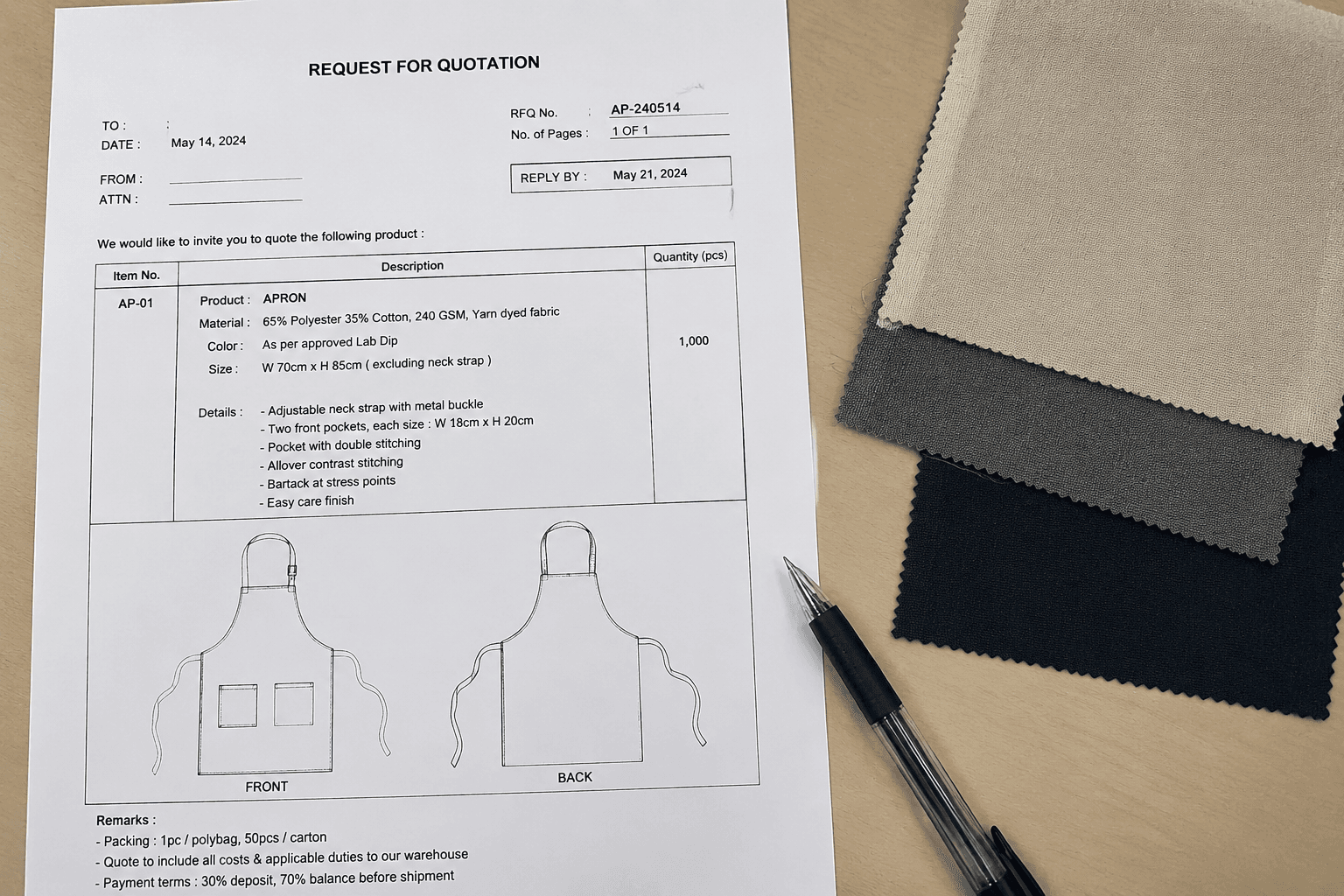
For most professional OEM programs, the commercial target is simple: cannabis retail aprons that survive 30-50 wash cycles, hold shrinkage below 3%, support keys or scanners without pocket distortion, and reorder six months later in the same shade and fit. In current China sourcing terms, that usually means 300 pcs/style/color for stock materials, 500-800 pcs for custom trims or dyeing, FOB pricing around $3.60-$8.40/pc, proto sampling in 7-12 days, and bulk production in 25-40 days after PP approval and deposit.
- 240-270 GSM poly-cotton twill is the safest baseline for daily-use cannabis retail aprons; 8.5-10 oz cotton canvas suits premium programs if pre-shrink and colorfastness are approved.
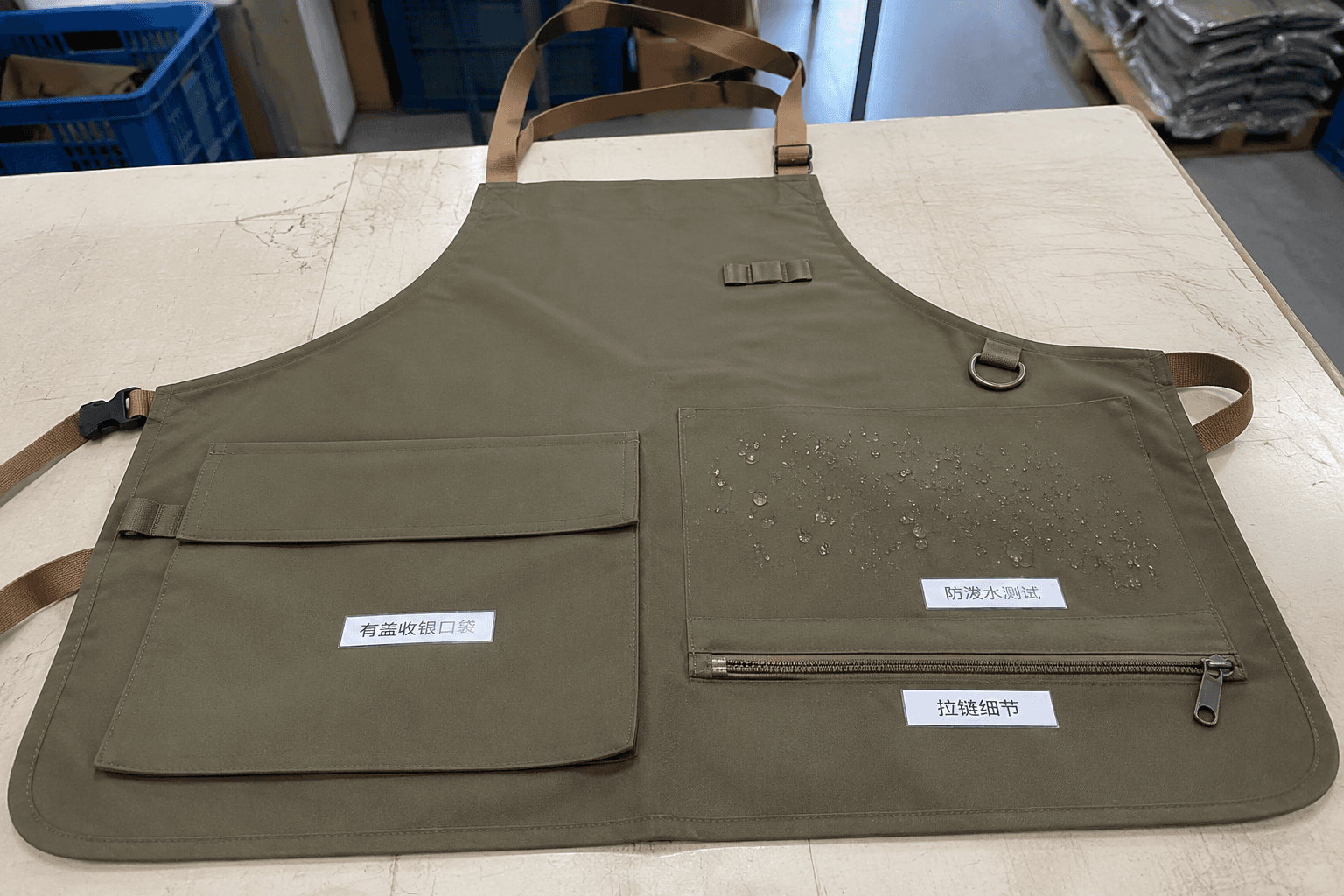
- A functional pocket spec usually means 1 zippered or snap-closed pocket plus 2-3 segmented open pockets, with bartacks at pocket corners and reinforcement at the pocket base.
- Laundering should be approved against real store conditions: test at 40°C, 50°C and 60°C, review after 5, 10 and 20 cycles, and hold shrinkage to under 3%.
- Compliance-friendly branding is typically a 6-9 cm embroidered chest logo on a dark neutral body color, with no slogans or oversized graphics.
- Standard OEM MOQ starts around 300 pcs with stock fabric; custom dyeing, special hardware or mixed branding methods usually push MOQ to 500-800 pcs.
- POs should state AQL 2.5 major / 4.0 minor, finished measurements, logo coordinates, packaging method and carton counts to reduce inspection disputes.
Why cannabis retail aprons need a stricter sourcing brief than café aprons
Cannabis retail aprons are not simple promotional garments. In a dispensary, staff may greet customers, handle packaged product, scan SKUs, open secured doors, carry keys and return to the sales floor within the same shift. That makes the apron part of the operating kit. If the fabric is too light, the body wrinkles, the hem curls and loaded pockets pull the front panel out of shape within weeks. If decorative trims are chosen over durable construction, failures show up fast in wash and wear.
Odor exposure is also different from a standard café environment. Lightweight fashion fabrics in the 160-180 GSM range often absorb airborne odor more quickly, lose structure sooner and show edge distortion after repeated washing. A more reliable sourcing range is 240-270 GSM poly-cotton twill or 8.5-10 oz compact cotton canvas. These weights give cleaner drape, better pocket support and more stable shrinkage control while still remaining comfortable during 8-10 hour indoor shifts.
Style should follow task, not mood board preference. Waist aprons can suit cashier-only roles, but mixed-use floor staff usually perform better in bib aprons because the load is spread across neck and waist ties and there is room for an upper secure pocket. To keep reorders consistent, the first tech pack should lock bib width, finished length, strap width, bartack points, hardware finish and logo coordinates. A small undocumented change, such as a 2 cm shift in length or pocket height, can make staff-issued uniforms inconsistent across locations.
- Use 240-270 GSM twill when cost control and reorder consistency matter most.
- Use 8.5-10 oz canvas for a premium look only after pre-shrink approval.
- Choose bib aprons for staff carrying scanners, radios, keys or access cards.
- Freeze finished dimensions early; even 2-3 cm variation affects comfort and pocket reach.
Fabric specifications for cannabis retail aprons: GSM, oz weight and service-life math
Fabric selection determines whether an apron lasts a full retail season or becomes a 90-day replacement problem. Most buyers compare three practical bases: 100% cotton canvas, 65/35 poly-cotton twill and polyester-richer blends such as 80/20. Cotton canvas gives a natural hand and a premium workwear look, but it usually absorbs more moisture and odor and can shrink 3-5% unless it is pre-shrunk and properly compacted. Poly-cotton twill dries faster, keeps shape better and is easier to reorder at stable cost.
For daily dispensary use, the safest middle ground is usually 240-270 GSM twill. Below 220 GSM, bib aprons often lose body too quickly once pockets carry pens, phones or keys. Above 300 GSM, the apron may feel bulky under constant indoor wear and discourage all-day use. Dense twill and compact canvas also tend to release odor more effectively in repeated wash-and-dry cycles than soft, open constructions that trap detergent residue and body oils.
The commercial difference is easy to quantify. A basic bib apron in 220-240 GSM poly-cotton twill with one embroidery logo and standard self-fabric straps often lands at $3.60-$4.90/pc FOB at 500 pcs. A heavier 10 oz canvas apron with contrast stitching, upgraded webbing straps and reinforced multi-pocket layout often moves to $6.30-$8.40/pc FOB. Buyers should compare those prices against replacement interval. An apron lasting 9-12 months in rotation usually costs less per wear than a cheaper style replaced after 12-16 weeks.
- 220-240 GSM twill: entry-level chain option for simple briefs.
- 240-270 GSM twill: best balance of structure, comfort and laundering stability.
- 280-300 GSM twill: suitable for heavier bib styles with more pocket load.
- 8.5-10 oz canvas: premium appearance, but require shrinkage and colorfastness approval.
- Target post-wash shrinkage at under 3% in both length and width.
Secure pockets on cannabis retail aprons: dimensions, closures and reinforcement points
Pocket design is where many apron programs fail in live retail use. Two oversized open patch pockets may look clean in development photos, but they perform poorly once staff bend, reach or move quickly between the counter and stockroom. Keys shift, pens tilt sideways, handheld devices drag the panel down and loose items collect lint. Professional cannabis retail aprons work better when pockets are divided by function: one closed compartment for sensitive items and separate open sections for tools used constantly during the shift.
For most buyers, a secure-pocket brief means at least one zippered, snap-flap or hook-and-loop pocket. The most reliable layout is a zippered chest or upper-waist pocket for keys, access cards or a cash sleeve, paired with segmented lower pockets for pens, gloves, notepads or a small scanner. In weekly wash programs, a #5 nylon coil zipper is usually safer than a #3 if the pocket carries keys or devices. Metal zippers can look premium, but they add weight and can mark fabric or deform in lower-grade wash conditions.
Construction detail matters as much as closure choice. Pocket corners should be bartacked, pocket bases reinforced and opening widths matched to the actual device. A pen slot at roughly 3-3.5 cm width is useful; a phone pocket typically needs at least 9 cm width and enough depth to prevent bounce while walking. Scanner sleeves often need 8-10 cm width depending on the hardware. Buyers should test the PP sample with real store tools, not paper mockups, before approving bulk cutting.
- Include 1 secure pocket for keys, access cards or cash sleeves.
- Add 2-3 segmented open pockets instead of one large lower cavity.
- Require bartacks at pocket corners, tie joins and high-stress seams.
- Approve pocket width and depth against actual phones or scanners.
- Avoid oversized open pockets where concealment risk or shrink distortion matters.
Odor-control laundering standards for cannabis retail aprons before bulk approval
Odor control is not solved by generic claims such as 'anti-odor' or 'easy care.' In uniform use, odor retention usually comes from aromatic exposure, body oils, detergent build-up and incomplete drying. Buyers should define the real care process before development begins. If aprons are washed in-house, confirm water temperature, detergent type, cycle length and drying method. If a commercial laundry handles the program, ask for its normal chemistry and finishing conditions because industrial wash formulas are often harsher than sample assumptions.
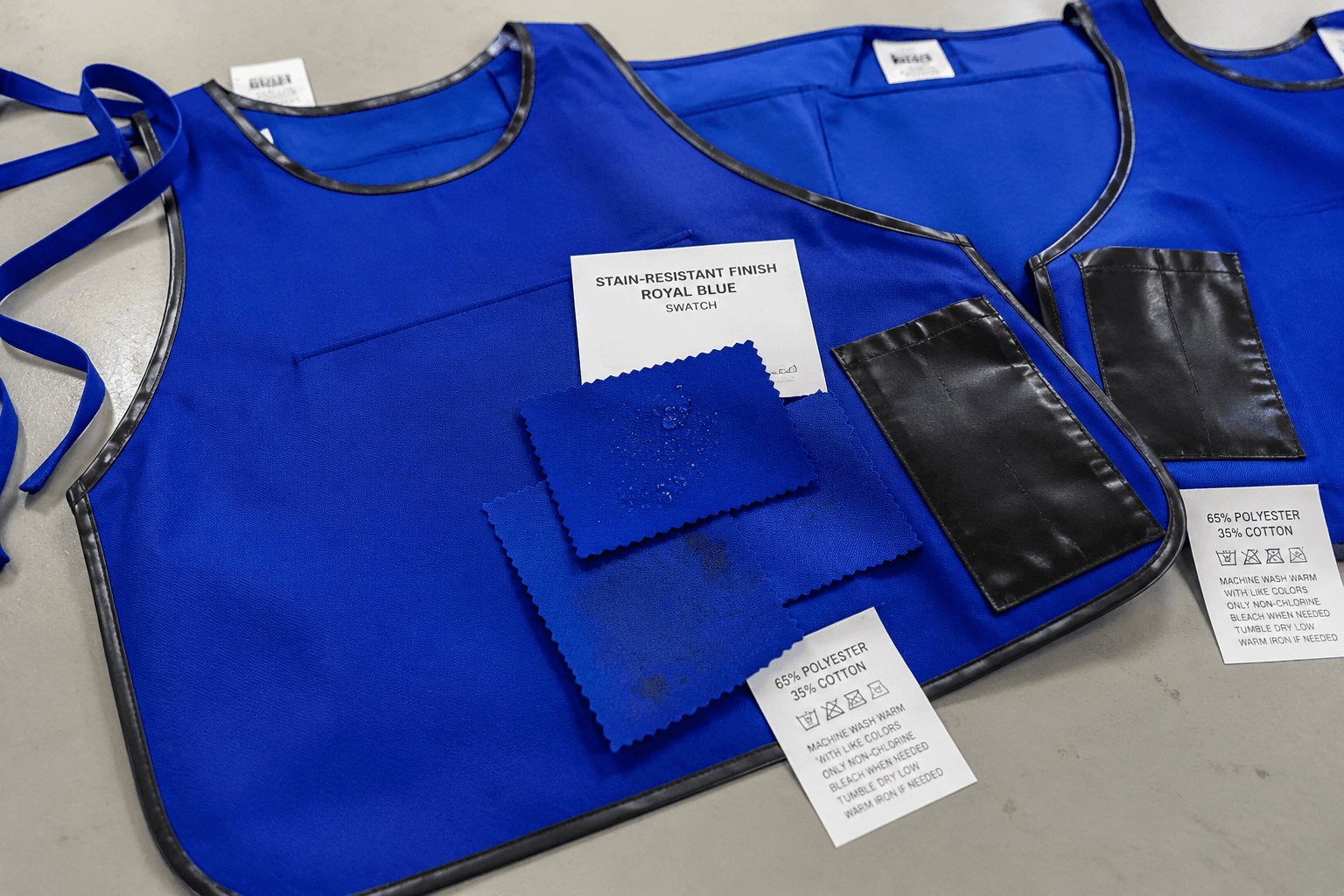
A practical approval protocol for cannabis retail aprons is to test at 30°C, 40°C and 60°C according to intended use, then review shrinkage, seam puckering, color change, torque, hand feel and residual odor after 5, 10 and 20 cycles. For most dispensary programs, the target should be under 3% shrinkage, no visible seam distortion at stress points and no major shade drift outside the approved standard. If the body color is black, charcoal or dark green, also check for lint visibility, detergent streaking and uneven fade.
Trim choices directly affect wash performance. Faux leather tabs, decorative rivets, thick folded pocket edges and low-grade printed labels often trap residue or dry slowly. Very deep black fabrics can also show detergent film faster if rinsing is inconsistent. Many buyers achieve better store-level results with charcoal, deep olive, brown-black or dark taupe because those shades hide lint and wash residue while still presenting a disciplined retail uniform.
- Define actual wash conditions before sampling, including temperature, detergent, cycle and drying method.
- Test at 5, 10 and 20 cycles rather than approving after one wash.
- Reject trims that cannot survive the same laundering process as the apron body.
- Target under 3% shrinkage and stable seams after repeated washing.
- Review body color for lint, detergent film and fade visibility, not aesthetics alone.
Compliance-friendly branding on cannabis retail aprons: logo size, placement and decoration method
Branding should be controlled as tightly as fabric and fit. The goal is clear store identification without slogans, novelty graphics or oversized decoration that creates avoidable internal review. In most regulated retail settings, the safest approach for cannabis retail aprons is restrained branding: one small chest logo, low-contrast accent colors and no text referring to potency, effects or consumption. This keeps the garment professional and easier to approve across operations, merchandising and compliance teams.
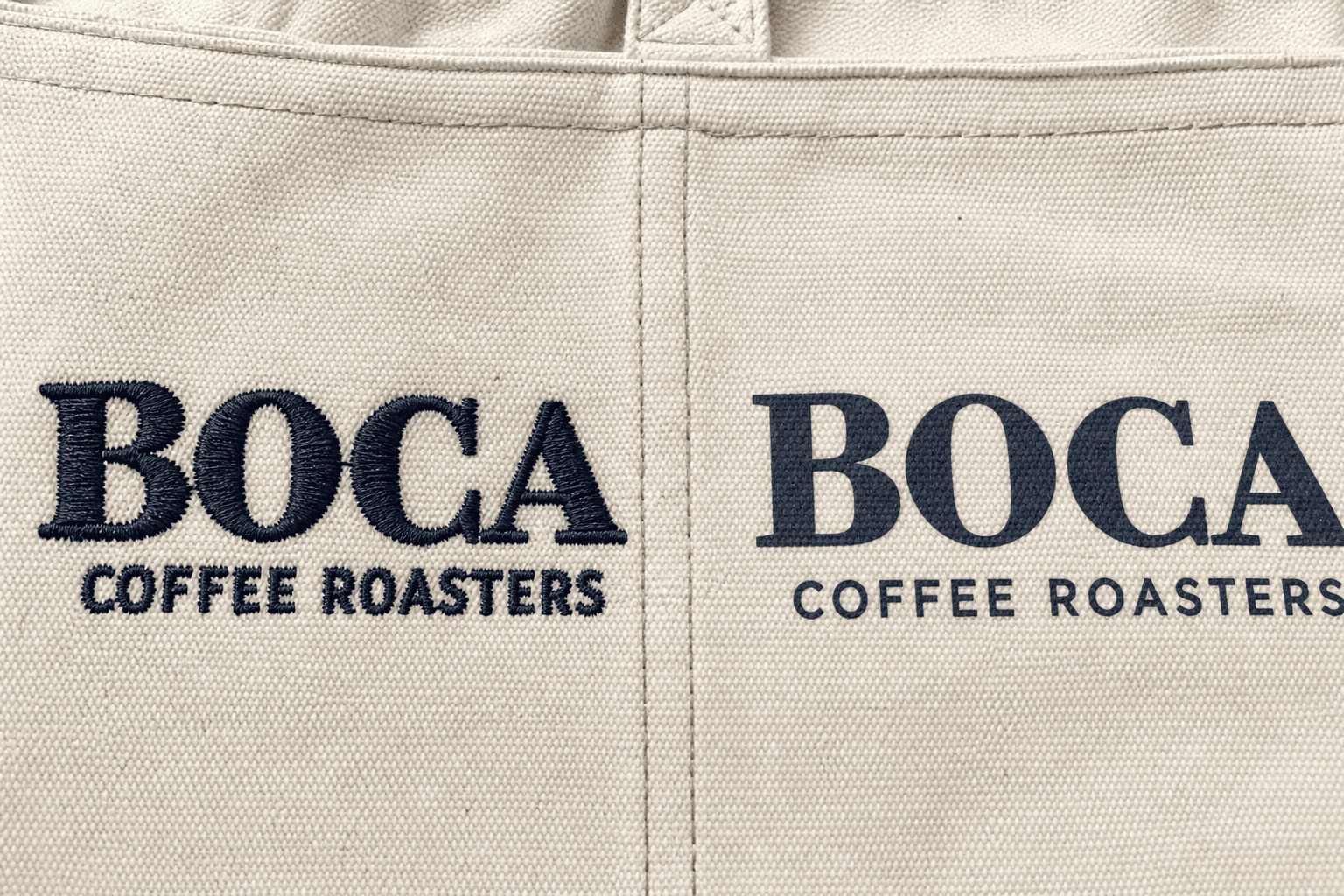
Embroidery is usually the best default because it tolerates repeated laundering better than most print methods and gives a more stable in-store appearance. A standard chest logo is typically 6-9 cm wide, positioned from a fixed top-edge measurement and center line. Screen print can lower cost on large runs, but cracking, ink hand feel and wash durability must be tested on the actual fabric weight. Heat transfer works for short runs or highly detailed logos, but it is generally less durable for aprons washed weekly at 40°C or above.
Retail groups with multiple store banners can simplify sourcing by keeping one core apron body and changing only labels, embroidery thread color or a small patch. That reduces MOQ pressure, shortens development time and avoids maintaining separate patterns for each sub-brand. It also makes staggered reorder planning easier when store openings are phased over 60-180 days rather than launched all at once.
- Keep logo width at 6-9 cm for most adult bib aprons.
- Use embroidery when wash durability matters more than minimum setup cost.
- Avoid slogans, oversized graphics and novelty leaf artwork.
- Fix logo coordinates in the tech pack to protect reorder consistency.
- Use label or patch changes to support multiple banners on one apron base.
MOQ, AQL and lead-time planning for sourcing cannabis retail aprons from China
Commercial terms become easier to manage when the apron specification is disciplined from the start. For stock fabric, standard trims and one logo method, many OEM factories can start at 300 pcs/style/color. Once the brief includes custom-dyed fabric, branded hardware, mixed decoration methods, special packaging or garment washing, MOQ commonly rises to 500-800 pcs. Buyers should treat every material or trim change as both a cost variable and a schedule variable.
Lead time usually breaks into three stages. Proto development often takes 7-12 days. A revision sample for fit, fabric or branding corrections usually adds 5-7 days. After PP approval and deposit, bulk production generally requires 25-40 days for standard apron programs. Custom-dyed canvas, branded trims, peak-season congestion or split-size packing can add another 5-10 days. If the PO includes final inspection before balance payment, leave at least 2-3 days for booking, reporting and any necessary corrective action.
Inspection language should be written directly into the PO, not handled later by email. For aprons, a practical standard is AQL 2.5 for major defects and 4.0 for minor defects. Major defects include wrong logo placement, broken zippers, missing bartacks, severe shade variation and measurements outside tolerance. Minor defects include loose threads, small sewing irregularities and limited measurement drift within the agreed tolerance. Apron programs look simple, but inconsistency becomes highly visible when a retail chain issues dozens or hundreds of units at the same time.
- Standard MOQ: 300 pcs/style/color with stock fabric and standard trims.
- Custom dyeing, special hardware or mixed branding: usually 500-800 pcs.
- Proto sample: 7-12 days; revision sample: 5-7 days.
- Bulk production: 25-40 days after PP approval and deposit.
- Recommended inspection: AQL 2.5 major / 4.0 minor.
- Typical FOB range: $3.60-$8.40/pc depending on fabric, pockets and branding.
Buyer checklist for a repeatable cannabis retail apron program
The strongest apron programs are the easiest to reproduce. Start by defining the real role of the garment: cashier apron, floor advisor apron, inventory support apron or one style for mixed-use teams. That decision shapes fabric weight, pocket security, bib height and branding scale. In many dispensary programs, a midweight bib apron with one secure pocket and restrained branding delivers better operating value than a more decorative style with multiple trims and more failure points.
Before issuing the PO, review the physical sample and the paperwork together. Measure the apron before and after washing, verify logo placement against approved artwork, inspect bartacks and seam consistency, and confirm that closures still operate smoothly after repeated handling. Packaging should also be finalized early. If stores require aprons packed by location, by employee issue set or with barcode labels, that must be specified before bulk production rather than sorted after arrival.
For repeat orders, record every approved detail: fabric composition, GSM or ounce weight, color standard, thread color, strap width, pocket dimensions, closure type, label content, carton quantity and inspection method. Once those points are documented in one master spec, reorders move faster, defect risk drops and price discussion stays focused on real variables instead of rebuilding the apron every season.
- Confirm fabric composition, GSM/oz, color standard and shrinkage target before PO release.
- Approve pocket count, dimensions, closure type and bartack locations from the PP sample.
- State measurement tolerances and inspection terms, including AQL 2.5 / 4.0, in purchase documents.
- Lock packaging by unit, employee set or store allocation before bulk starts.
- Maintain one master spec sheet for cost, lead-time and reorder control.