A butcher apron is not a standard promotional apron with heavier fabric. In meat cutting, deboning, trimming, packing and washdown areas, the apron has to manage blood, fat, cold water, knife contact, repeated sanitation and long shifts. For bulk buyers, the sourcing decision is usually a balance between protection level, worker comfort, cleaning method, compliance documentation and landed cost.
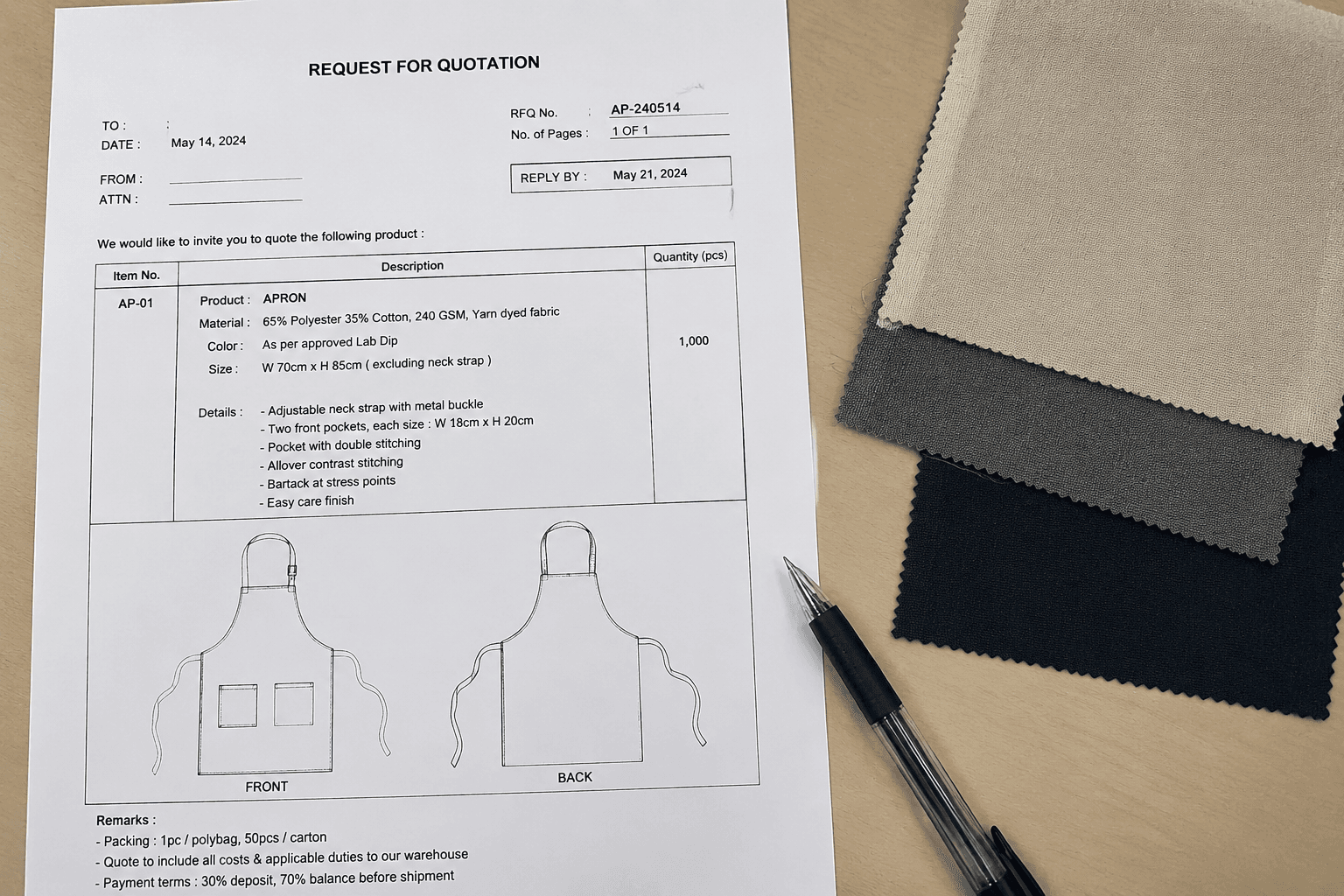
From a factory point of view, most problems start when the buyer specifies only a style photo and target price. For butcher and meat-processing use, the more useful specification is built around material weight, coating type, waterproof performance, strap system, finished size, reinforcement points, color control, packaging method and inspection standard. These details directly affect unit cost, MOQ, sampling days and the reject rate during production.
This article explains how to source a butcher apron from China for professional food industry use, including PVC, TPU, PU-coated fabric, rubberized fabric, waxed canvas and blended constructions. The numbers below reflect normal OEM production ranges for custom apron orders, not retail replacement purchases.
- PVC and TPU are the main waterproof options when a meat processing apron must resist blood, fat and washdown water.
- Fabric weight alone is not enough; coating thickness, backing strength and seam construction decide the real service life.
- A heavy duty butcher apron usually needs reinforced stress points, especially at neck straps, waist ties and pocket corners.
- MOQ is normally 500-1,000 pcs per color for custom color, size and logo production, with lower quantities possible at higher unit cost.
- Sampling usually takes 5-10 days, while bulk production normally needs 25-40 days after sample approval and deposit.
- Food-contact and chemical compliance should be confirmed before sampling if the apron will be used in regulated processing plants.
What makes a butcher apron different from a standard work apron
A butcher apron is used in a wet, cold and high-soil environment. It is exposed to blood, animal fat, meat juice, water spray, detergent, sanitizer and sometimes abrasion from cutting tables or metal racks. A normal cotton or polyester apron can absorb liquid, become heavy during the shift and stain permanently. For meat-processing plants, that is usually unacceptable because the apron must be cleaned frequently and must not carry odor or residue into the next work area.
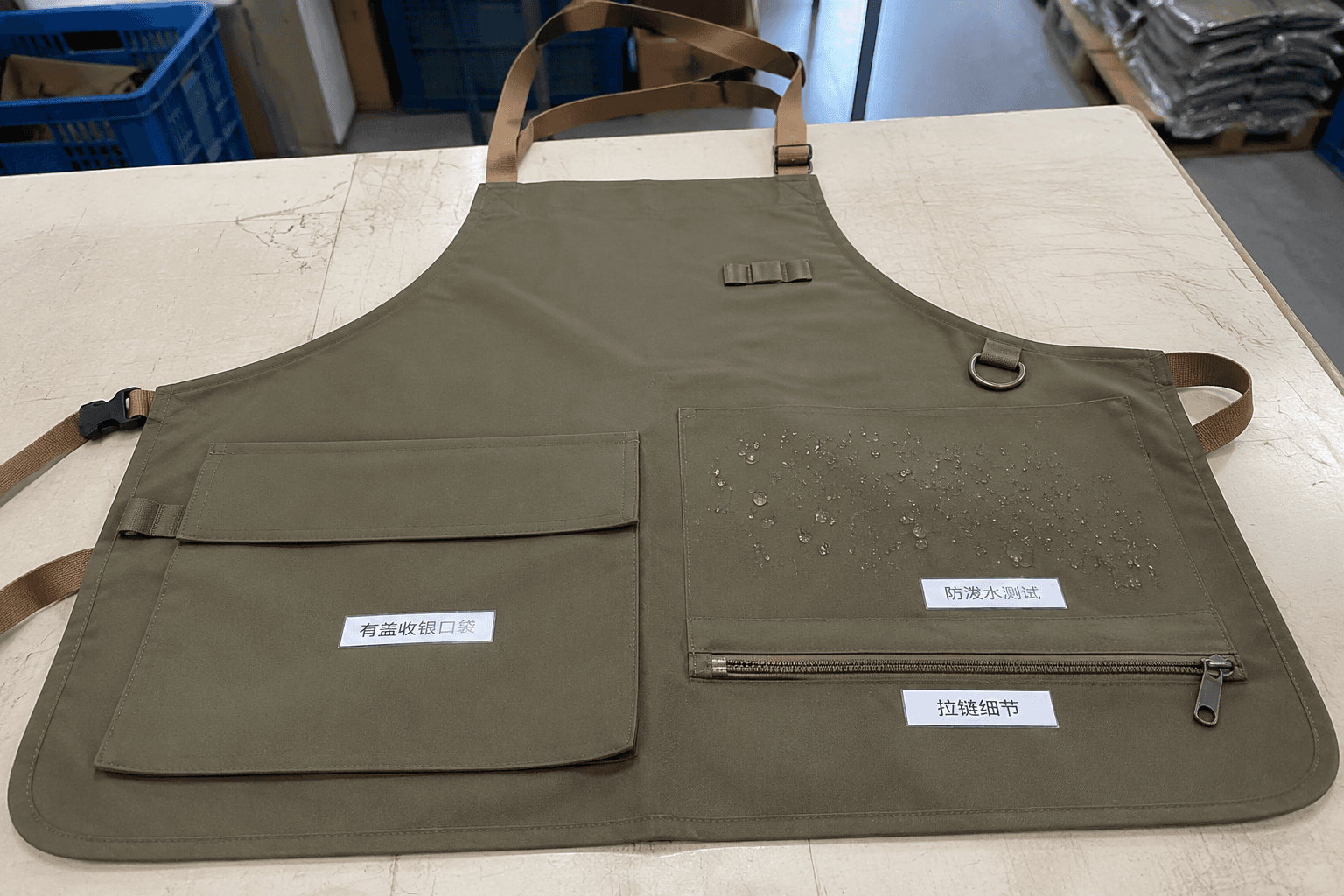
The functional specification is also different. A retail chef apron may focus on appearance, pockets and brand presentation. A food industry apron for butchery needs liquid resistance, coverage, quick cleaning and a strap system that does not fail under pulling. In many plants, pocket design is reduced or removed because pockets can collect residue. If pockets are required for tools, they should be positioned away from the main splash zone and reinforced with bar tacks.
A practical buyer specification should define the working area. Slaughterhouse trimming, retail butcher counter work, chilled meat packing and seafood processing do not require the same apron. A waterproof butcher apron for washdown work may use 0.30-0.45 mm PVC, while a retail butcher shop may choose 10-12 oz cotton canvas with a water-repellent finish for a more traditional appearance. Both are called butcher aprons, but the production methods and cost structure are different.
- For wet cutting rooms, specify waterproof coating, sealed or reinforced seams and easy-clean surface.
- For retail butcher counters, specify stain resistance, professional appearance and comfortable wear over long shifts.
- For packing and trimming lines, specify lightweight waterproof material and consistent sizing for uniform issue.
- For heavy deboning work, specify thicker material, stronger neck hardware and reinforced tie points.
Main material choices for a butcher apron
Material selection controls most of the cost and performance. In OEM production, the common options are PVC-coated polyester, TPU-coated polyester, PU-coated fabric, rubberized fabric, cotton canvas, poly-cotton twill and waxed canvas. Each option solves a different problem. A low-cost waterproof apron for meat packing may use PVC-coated polyester at 300-450 GSM. A more flexible and cold-resistant meat processing apron may use TPU-coated polyester at 250-380 GSM. A heritage retail butcher apron may use 12 oz or 16 oz cotton canvas, but this is not suitable for constant washdown unless treated and maintained carefully.
PVC is the most common material for a waterproof butcher apron because it is cost-effective, weldable, printable in limited ways and easy to wipe clean. Typical thickness is 0.20-0.50 mm. For light meat packing, 0.20-0.25 mm may be enough. For cutting rooms and more frequent sanitation, 0.30-0.40 mm is a safer starting point. Above 0.45 mm, durability improves, but the apron becomes stiffer and less comfortable, especially in cold rooms.
TPU is usually higher cost but offers better flexibility, softer hand feel and better low-temperature performance. It is often selected when workers complain that PVC becomes too stiff or cracks too early. TPU also supports some compliance requirements better, depending on the exact formulation. For buyers selling into premium foodservice or regulated processing channels, TPU can be worth the extra $0.60-$1.50 per piece compared with a basic PVC apron.
- PVC-coated polyester: common range 300-650 GSM, strong waterproof performance, competitive price, suitable for washdown.
- TPU-coated polyester: common range 250-500 GSM, softer and more flexible, better cold-room comfort, higher cost.
- PU-coated fabric: lighter and more breathable than PVC, moderate water resistance, less suitable for heavy blood and fat exposure.
- Cotton canvas: common range 10-16 oz, durable dry-use appearance, absorbs liquid unless treated.
- Waxed canvas: good retail look and moderate water shedding, not ideal for industrial sanitation cycles.
- Poly-cotton twill: common range 190-280 GSM, economical for front-of-house or light retail use, not a true waterproof solution.
How to specify a waterproof butcher apron for meat processing
For a waterproof butcher apron, the key specification is not simply the base fabric weight. The buyer should specify base yarn, coating material, coating thickness, finished GSM, color, surface texture and seam method. A 420 GSM PVC-coated polyester with stable backing can perform better than a heavier but poorly bonded coating. When factories compare quotations, small material differences can create a $0.30-$0.80 per piece gap, so the technical sheet must be clear.
In meat processing, the apron surface should resist liquid penetration and allow fast cleaning. A smooth surface is easier to wipe but can show scratches. A light matte or embossed surface can hide wear but may hold residue if the texture is too deep. For most industrial buyers, we recommend a smooth or fine-texture PVC or TPU surface in white, blue, navy or black. White and light blue make contamination easier to see, while black hides stains but may not meet some plant color-control practices.
Seams deserve attention. For very wet applications, heat welding is preferred where the material supports it. Sewing creates needle holes, so stitched seams should be placed outside the main splash zone or combined with binding and reinforcement. Many apron failures occur at the top bib corners and waist tie points, not in the main panel. Adding a reinforcement patch or larger weld area can add only $0.05-$0.15 per piece but can extend useful life significantly.
- Specify coating thickness in mm, not only GSM, when comparing PVC or TPU apron quotes.
- Use heat-welded construction where waterproof integrity is more important than tailoring detail.
- Request reinforced bib corners and waist tie points for any heavy duty butcher apron.
- Avoid deep-texture surfaces if the apron must be washed quickly between shifts.
- Confirm cold-room flexibility if the apron will be used below 5 degrees Celsius.
Sizing, coverage and strap systems
Apron sizing should match the job and the workforce. Common butcher apron sizes include 70 x 100 cm, 80 x 110 cm, 90 x 115 cm and 90 x 120 cm. For US and European buyers, a frequent size is about 35 x 45 inches or 36 x 48 inches. A longer apron gives better leg coverage but can restrict walking or create a trip risk if it is too long for shorter workers. For production-line issue, many buyers choose one standard size plus one larger size instead of too many SKUs.
Width is important in meat processing because workers turn, bend and reach. A narrow apron may cover the front when standing straight but expose the sides during cutting or packing. For high-splash work, 85-95 cm width is common. For retail butcher counters, 70-80 cm width may be enough and looks cleaner. Some buyers request split-leg aprons for mobility, especially in slaughterhouse or fish processing environments. Split-leg construction increases sewing or welding complexity and usually adds $0.20-$0.60 per piece.
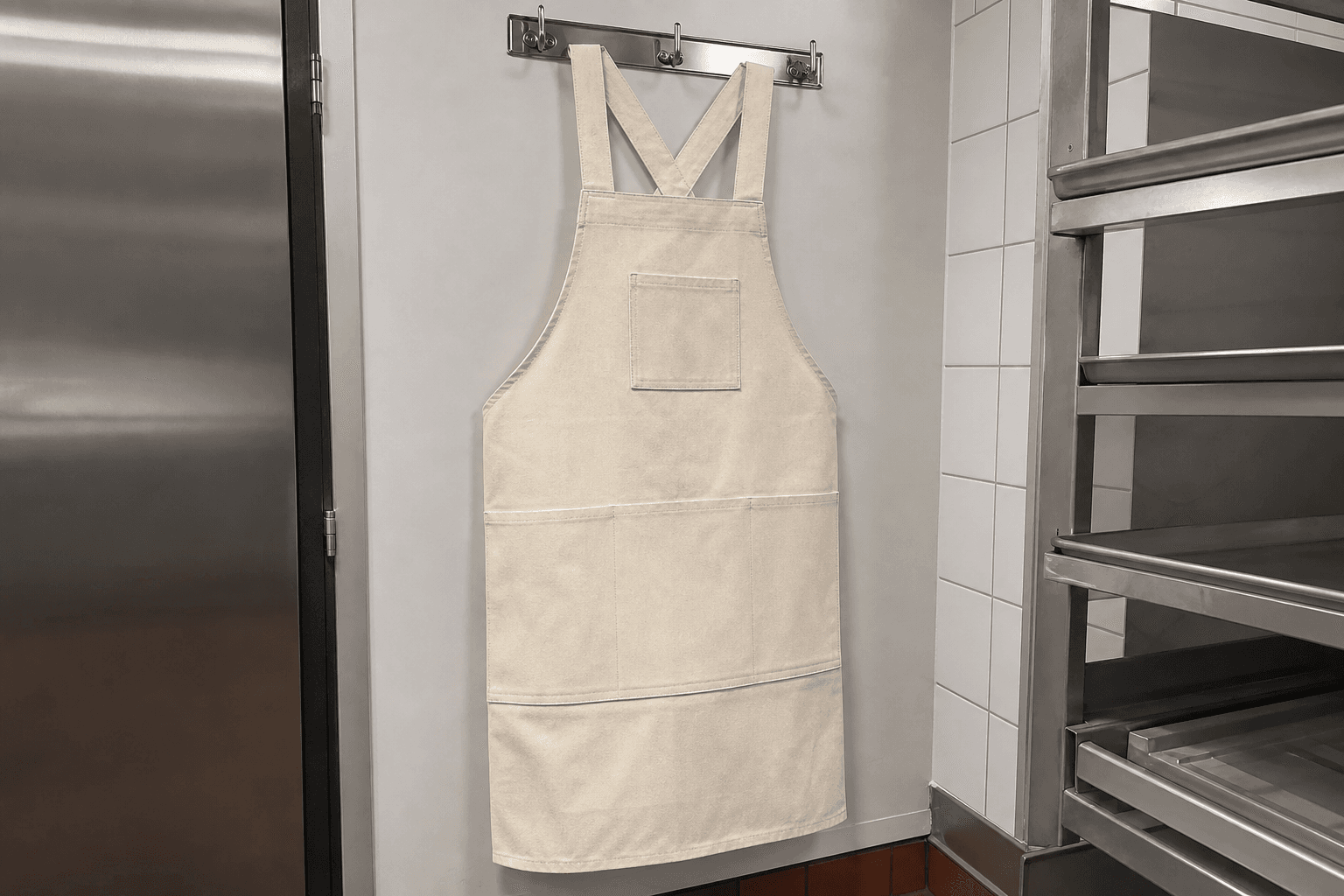
The strap system affects worker comfort and replacement cost. A simple neck loop is economical but can load the neck during long shifts, especially with heavy PVC. Cross-back straps distribute weight better and are preferred for heavy duty butcher apron programs. Adjustable buckles improve fit but add hardware cost and potential corrosion risk if the wrong metal is used. Plastic hardware is light and corrosion-resistant, while stainless steel hardware is stronger but more expensive.
- Standard bib apron sizes often range from 70 x 100 cm to 90 x 120 cm.
- Cross-back straps are recommended for aprons above roughly 500 GSM or for shifts over 6 hours.
- Polyester webbing of 2.0-2.5 cm width is common for ties; 3.0-3.8 cm improves comfort.
- Stainless steel, acetal or POM hardware should be considered for wet food-processing environments.
- Tie length should be confirmed on body size charts, not estimated only from a product photo.
Branding, color control and practical customization
Custom branding on a butcher apron is possible, but the technique depends on material. Screen printing works well on many PVC and PU surfaces if the ink system is matched to the coating. Heat transfer can work on some fabrics but may fail on high-plasticizer PVC or textured waterproof surfaces. Embroidery is usually not recommended for fully waterproof aprons because it creates needle holes and traps residue. For canvas retail butcher aprons, embroidery is common and gives a durable brand appearance.
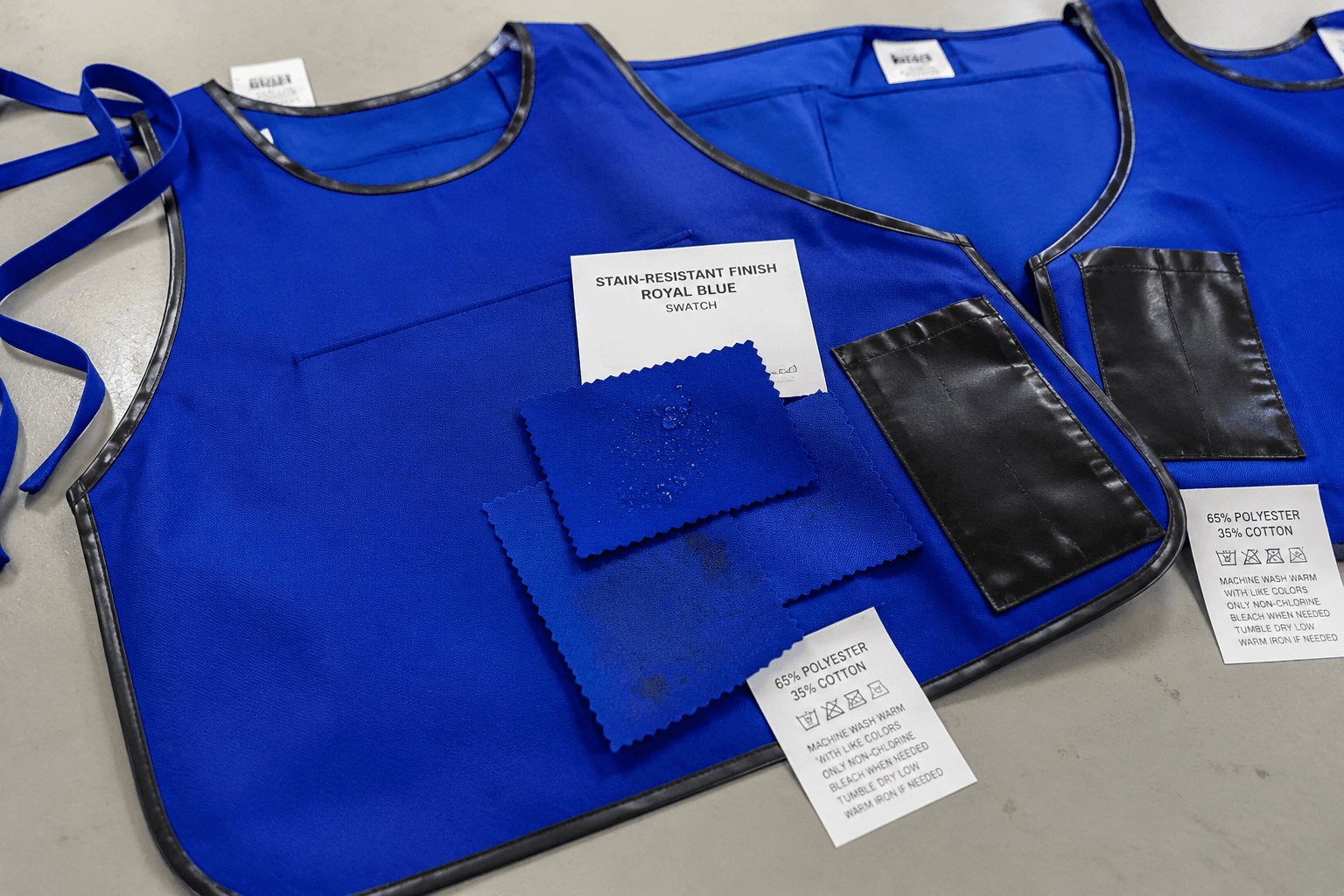
For food industry apron programs, color control is often more important than decoration. Plants may use different apron colors to separate raw meat, cooked product, packing, sanitation or visitor areas. In that case, the factory should match Pantone or physical color standards, but buyers should understand that coated fabric colors normally have wider tolerance than dyed woven fabric. For PVC and TPU, a practical color tolerance should be approved with a lab dip or material swatch before bulk cutting.
Logo size should be realistic. A large front logo on a waterproof apron may be scratched during daily use and can make cleaning more difficult if the ink layer is raised. For industrial use, many buyers choose a small chest logo, department text, size mark or internal laundry code. For retail butcher shops, a larger logo is acceptable, especially on canvas or twill. The brand decision should follow the cleaning method, not only the visual design.
- Use screen printing for many PVC, PU and TPU apron surfaces after ink adhesion testing.
- Use embroidery mainly on canvas, twill or other non-waterproof retail butcher apron styles.
- Use heat transfer only after confirming coating compatibility and washing performance.
- Request lab dips or physical swatches for color-coded food plant programs.
- Keep logos away from heavy abrasion zones when aprons will be used at cutting tables.
Compliance, testing and inspection points
Compliance requirements vary by market and by how the apron is used. If the apron may contact food directly, buyers should confirm food-contact requirements before sampling. For the EU, this may include Regulation EC 1935/2004 and relevant plastic material requirements depending on construction. For the US, buyers may ask about FDA food-contact suitability for certain materials, although the exact obligation depends on use case. For general workwear, REACH, RoHS, phthalate limits or Prop 65 may be requested by brand buyers and distributors.
Testing should be targeted. For a meat processing apron, useful tests include coating adhesion, colorfastness, low-temperature flexibility, tensile strength, tear strength, waterproofness and resistance to cleaning chemicals. Not every order needs a full test package. For repeat industrial supply, a practical approach is to test the approved material once, keep a retained swatch, and verify bulk production against that standard using GSM, thickness, color, surface and pull tests.
Inline and final inspection should focus on defects that affect function. Pinholes, coating scratches, weak welds, misaligned straps, poor bar tacks and contaminated packing matter more than small cosmetic issues on the reverse side. For AQL inspection, many buyers use general inspection level II with AQL 2.5 for major defects and 4.0 for minor defects, but critical defects such as open seams, sharp hardware, severe coating delamination or wrong material should be rejected at stricter limits.
- Confirm food-contact or chemical compliance before approving material, especially for PVC and TPU.
- Check finished GSM and thickness against the approved sample during bulk inspection.
- Test strap pull strength at bib corners and waist points because these are common failure areas.
- Inspect for pinholes by visual light check or water test when waterproof performance is critical.
- Keep approved pre-production samples and material swatches for repeat-order comparison.
MOQ, costing and lead-time for custom butcher apron orders
MOQ depends on material availability, color, logo method and size range. For a stock PVC material with standard colors, a factory may accept 300-500 pcs per style, especially without complicated branding. For custom color coated fabric, MOQ is often 1,000-3,000 meters of material, which may translate to 1,500-4,000 aprons depending on size. For canvas and twill, MOQ may be lower if the fabric color is available from the market. For fully custom TPU, buyers should expect higher MOQ and longer material lead time.
Typical OEM pricing for a basic PVC waterproof butcher apron may range from $1.80-$3.50 per piece FOB China for 1,000-3,000 pcs, depending on thickness, size and straps. A heavier PVC apron with reinforced corners, cross-back straps and better hardware may range from $3.20-$5.80. TPU-coated apron programs often start around $4.50 and can exceed $8.00 if the material, hardware and compliance package are demanding. Canvas butcher aprons can range from $3.50-$9.00 depending on fabric weight, pockets, embroidery and washing finish.
Lead time should be planned around sampling, material booking and inspection. A normal custom sample takes 5-10 days if material is available. If a custom color coating is needed, swatching and material production can add 10-20 days before apron sewing starts. Bulk production commonly needs 25-40 days after deposit and sample approval for 1,000-10,000 pcs. Peak season, complex packaging, third-party testing or late artwork changes can add another 7-15 days.
- Stock-material MOQ is commonly 300-500 pcs per style, subject to factory scheduling.
- Custom color coated-material MOQ often starts from 1,000-3,000 meters.
- Basic PVC waterproof apron pricing commonly falls around $1.80-$3.50 per pc FOB at bulk quantities.
- Reinforced heavy duty butcher apron pricing commonly falls around $3.20-$5.80 per pc FOB.
- TPU apron programs often cost $4.50-$8.00+ per pc FOB depending on specification.
- Normal production timing is 5-10 days for sampling and 25-40 days for bulk after approval.
Building a reliable butcher apron specification sheet
A clear specification sheet reduces quotation errors and production disputes. At minimum, it should include apron type, finished size, material construction, GSM or thickness, color reference, strap material, hardware type, seam method, reinforcement details, logo method, packaging, labeling and compliance requirements. Photos are useful, but they should support the written specification rather than replace it.
For a meat processing apron, the buyer should also state the expected cleaning method. Wipe-clean, hose rinse, mild detergent wash, industrial laundry and chemical sanitation place different stress on the material. A PVC apron that performs well under wipe-clean use may not survive repeated high-temperature laundry. A canvas butcher apron may look excellent in retail service but may shrink, fade or absorb fat if treated like waterproof plant gear. The factory needs this information before recommending material.
The best sourcing result usually comes from approving a physical pre-production sample and using it as the control standard. For repeat programs, retain one approved sample at the buyer office and one at the factory. When the next order is placed, compare thickness, hand feel, color, strap strength and logo adhesion against the retained sample. This is more reliable than relying only on a past purchase order description.
- State the intended work area, such as cutting room, packing line, retail counter or washdown zone.
- Define material by coating type, backing, thickness, GSM and surface finish.
- Confirm finished dimensions with tolerance, usually +/-1 cm for simple apron panels.
- Specify strap layout, strap width, tie length, buckle material and reinforcement method.
- State whether the apron must be waterproof, water-repellent, stain-resistant or washable.
- Approve packaging details, including polybag type, carton quantity, size marks and barcode labels.