For sourcing teams buying brushed canvas aprons from China, the key question is not whether the sales sample feels soft on day one. The commercial question is whether softness, color depth and face appearance still meet spec after cutting, sewing, logo application, washing, export packing, shipment and repeated wear across a 90-day, 180-day or 365-day replacement cycle. In apron programs, a peached hand can raise perceived value and wearer comfort, but every finishing step also changes abrasion behavior, seam appearance, shade depth and claim risk.
A brushed or peached face is created by lightly sanding or emerizing the canvas so a fine nap rises above the weave. In apron production, that treatment is often paired with enzyme wash, garment wash or pigment wash to create a broken-in look. Buyers should write these as separate variables on the spec sheet, because base yarn quality, weave density, finished GSM, brushing depth and wash chemistry each affect the final apron differently. A 285 GSM reactive-dyed bib apron with light brushing does not age like a 300 GSM pigment-washed apron with a heavier peached face, even when both look similar at sample stage.
The safest sourcing result comes from defining softness retention and wear numerically before bulk approval. For professional apron buying, that usually means a target GSM with tolerance, shrinkage after wash, acceptable shade variation, seam puckering standard, logo clarity after laundering, trim friction points, fold pattern and final inspection level. Without those controls, a premium development sample can turn into bulk aprons with early fuzzing, flattened pocket edges, pressure marks, lot-to-lot shade variation or inconsistent handle after only 8-12 weeks of store use.
- Brushed canvas aprons for café, hospitality and retail programs usually perform best at 270-310 GSM, or about 8.0-9.1 oz/yd² finished weight.
- The softest salesman sample is rarely the safest bulk standard; moderate brushing usually gives cleaner face retention after 10-20 washes than aggressive peaching.
- A light enzyme wash can improve handfeel, but stronger formulas raise the risk of color loss, nap disruption, seam edge whitening and lot-to-lot variation.
- Realistic MOQ is often 300-500 pieces per color for standard fabrics, but 800-1,200 pieces per color for custom wash tuning, dark shades or special shade approval.
- Bulk approval should include a washed PP sample, appearance checks at 5 and 10 washes, and shipment inspection at AQL 2.5 major and AQL 4.0 minor.
How brushed canvas aprons differ from standard canvas in bulk production
Standard apron canvas has a flatter face and firmer hand because the surface fibers stay compact after weaving and dyeing. Brushed canvas aprons go through mechanical finishing that lifts a fine nap on the face, giving a softer, warmer first touch. That benefit is easy to appreciate on a sample table, but in production it also creates a controlled wear layer. The same raised fibers that improve first-touch softness are also the first part of the apron to show rubbing, flattening and shade shift.
For B2B buyers, the practical trade-off is not simple strength versus weakness. It is surface sensitivity versus visual life. A 280-300 GSM cotton canvas apron can still deliver good seam integrity, stable straps and adequate body coverage through daily use, yet look older sooner than unbrushed canvas because the peached face reacts faster to friction. This matters most on black, navy, charcoal and olive aprons, where pressure marks and localized whitening are more visible under café lighting, retail spotlights or front-of-house uniform checks.
That distinction matters when internal teams report 'softness loss.' In many cases, the fabric body still meets use requirements, but the face has flattened around pocket openings, fold lines, neck hardware or abdomen contact zones. Buyers should therefore separate appearance standards from structural standards. If those two are merged into one vague quality requirement, the supplier and buyer often judge the same apron differently after laundry testing or field wear.
In apron sourcing, this is why moderate brushing is often the safer bulk route. The difference between a development sample that wins approval and a repeat style that survives six reorders usually comes down to how much face change the buyer is willing to accept after 5, 10 and 20 wash cycles.
- Commercial weight range for most apron programs: 260, 280, 300 or 320 GSM.
- Best balance for daily hospitality wear: 280-300 GSM, about 8.3-8.9 oz/yd².
- Common early wear zones: pocket mouth, waist fold, abdomen contact area and neck slider point.
- Dark reactive shades show nap disturbance earlier than ecru, stone, sand and khaki.
How to write a workable fabric spec for brushed canvas aprons
When a buyer requests peached fabric, the factory needs more than the words 'soft canvas.' A usable apron specification should state fiber content, weave, yarn count if known, finished GSM, brushed side, dye method, wash process, finished width and target shrinkage after washing. In apron sourcing, the gap between a stable bulk result and an unstable one usually comes from missing details in the fabric brief, not from the brushing machine alone.
For most professional bib aprons and waist aprons, a finished fabric in the 270-340 GSM range, roughly 8.0-10.0 oz/yd² depending on weave density and moisture regain, gives enough body for clean sewing, pocket support and stable logo application. Below 230-240 GSM, the brushed face may feel pleasant in a sample room but the apron often loses shape around top edges, towel loops and patch pockets. Above 350 GSM, the apron becomes heavier to sew, slower to wash, harder to dry and less comfortable for long shifts, while the added softness rarely justifies the extra FOB cost.
Buyers should also state whether brushing happens before dyeing or after dyeing, and whether the final hand comes from brushing alone or from brushing plus enzyme wash. These routes produce different color depth and nap stability. If the apron includes embroidery, screen print or heat transfer, the sample stage should test logo clarity on the actual peached face, because stitch sink-in and print edge blur increase once surface fibers are raised.
A practical OEM spec sheet should include measurable tolerances. Finished GSM is commonly set at plus or minus 5 percent, finished width at plus or minus 3 percent, and garment shrinkage after one wash at 30-40°C at 3-5 percent for cotton canvas. If the buyer wants tighter control on a chain uniform program, measurement tolerance after wash should be written directly into the PP approval form rather than discussed later during inspection.
- Specify finished GSM tolerance: +/-5%.
- Specify finished width tolerance: +/-3%.
- Request a sample set: greige-to-finish swatch, sewn proto, washed sample and logo strike-off.
- If metal hardware is used, check rubbing at D-rings, sliders, rivet backs and buckle backs.
Softness retention benchmarks at 5, 10 and 20 washes
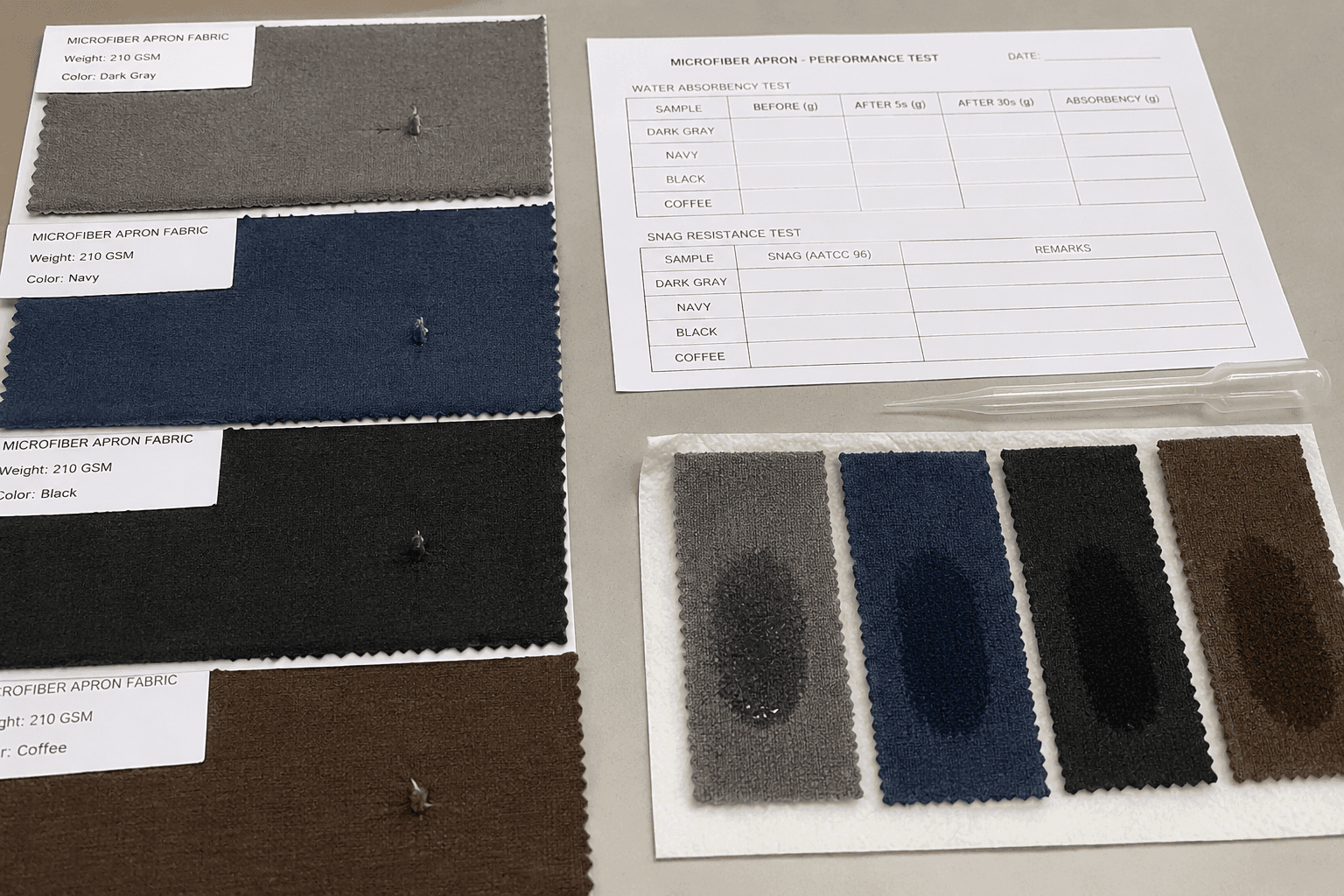
Softness retention in brushed canvas is not linear. The biggest handfeel change usually appears between wash 1 and wash 5, when loose surface fiber settles and the nap begins to level. A well-controlled 280-300 GSM cotton apron normally becomes a little drier in hand but still comfortable, with better drape than loom-state canvas. An over-brushed or over-washed apron behaves differently: it starts exceptionally soft, then drops quickly into visible fuzzing, flatter handle and uneven color response.
For B2B review, wash-stage checkpoints are more useful than a single after-wash comment. After 5 home-laundry-equivalent washes at 30-40°C with mild detergent, a good brushed canvas apron should still retain most of its soft hand, with only light flattening on fold lines and pocket corners. After 10 washes, moderate change is normal: the peached layer looks less even, body-contact zones smooth out and dark shades may lighten slightly at exposed areas. After 20 washes, the apron should still be serviceable and presentable, but it should not be sold internally as if day-one softness will remain unchanged.
This is why end-use cycle matters. A merchandise apron sold in a café shop can tolerate more evolving character than a uniform apron used 5 or 6 days per week. If a chain expects a 180-day wear cycle, the sample should be judged against that timeline, not against launch-day touch. For a 90-day promotional program, buyers may accept more visible face change in exchange for a softer hand and lower FOB.
To reduce disputes, buyers should define what counts as acceptable change at each wash stage. That usually includes shade change within the approved limit, no severe pilling at pocket edges, no obvious seam puckering after laundering and no logo cracking or excessive stitch sink-in. Without these checkpoints, softness becomes a subjective argument instead of a sourcing standard.
- Typical shrinkage target after wash: 3-5% for 100% cotton canvas aprons.
- Set appearance reviews at 5 washes and 10 washes before bulk approval.
- Compare at least 2 brushing levels on the same base fabric for uniform programs.
- Align testing with a 90-day, 180-day or 365-day replacement cycle.
Wash chemistry, FOB impact and lead-time risk for brushed canvas aprons
Many buyers pair brushing with enzyme wash because the combination can remove harshness and give medium-weight canvas a more relaxed feel. Used moderately, enzyme treatment can reduce scratchiness and clean loose surface fiber without relying only on stronger mechanical abrasion. Used too aggressively, it removes too much fiber from an already peached face, which speeds up color fade, nap disruption and edge wear around seams, pockets and strap anchors.
This matters directly in cost planning and delivery schedules. In OEM apron manufacturing, a standard dyed canvas apron with no garment wash may run on a cut-make-pack lead time of about 25-30 days after deposit, lab dip approval and trim confirmation. Add enzyme wash, shade review and shrinkage control, and the practical lead time often moves to 35-40 days. Add stronger vintage effects such as pigment wash, stone wash or multi-stage washing, and total production can extend to 40-50 days because the factory must allow for wash approval, sorting, re-inspection and possible recutting if shade variation exceeds tolerance.
FOB cost changes in visible ways as well. For a basic bib apron ordered at 1,000-3,000 pieces, a light enzyme wash often adds about US$0.25-US$0.60 per piece. More complex washed effects can add US$0.80-US$1.50 per piece, depending on fabric weight, order size, wash-house pricing, rework rate and required shade sorting. On low-MOQ orders, these costs are harder to absorb because setup time and rejection risk are spread across fewer units.
Buyers working under tight color standards should be especially careful. Washed finishes usually need earlier lab approval and a wider discussion of acceptable shade tolerance than flat-dyed aprons. If close Pantone matching matters for chain branding, the safer route is usually moderate brushing with limited wash chemistry rather than an aggressive vintage effect.
- Use enzyme wash to refine handfeel, not to hide weak yarn quality.
- Standard MOQ for stable custom wash programs: 800-1,200 pieces per color.
- Typical lead time: 25-30 days basic, 35-40 days with enzyme wash, 40-50 days with complex effects.
- Typical wash upcharge: US$0.25-US$0.60 light enzyme, US$0.80-US$1.50 complex effects.
Where brushed canvas aprons show surface wear first
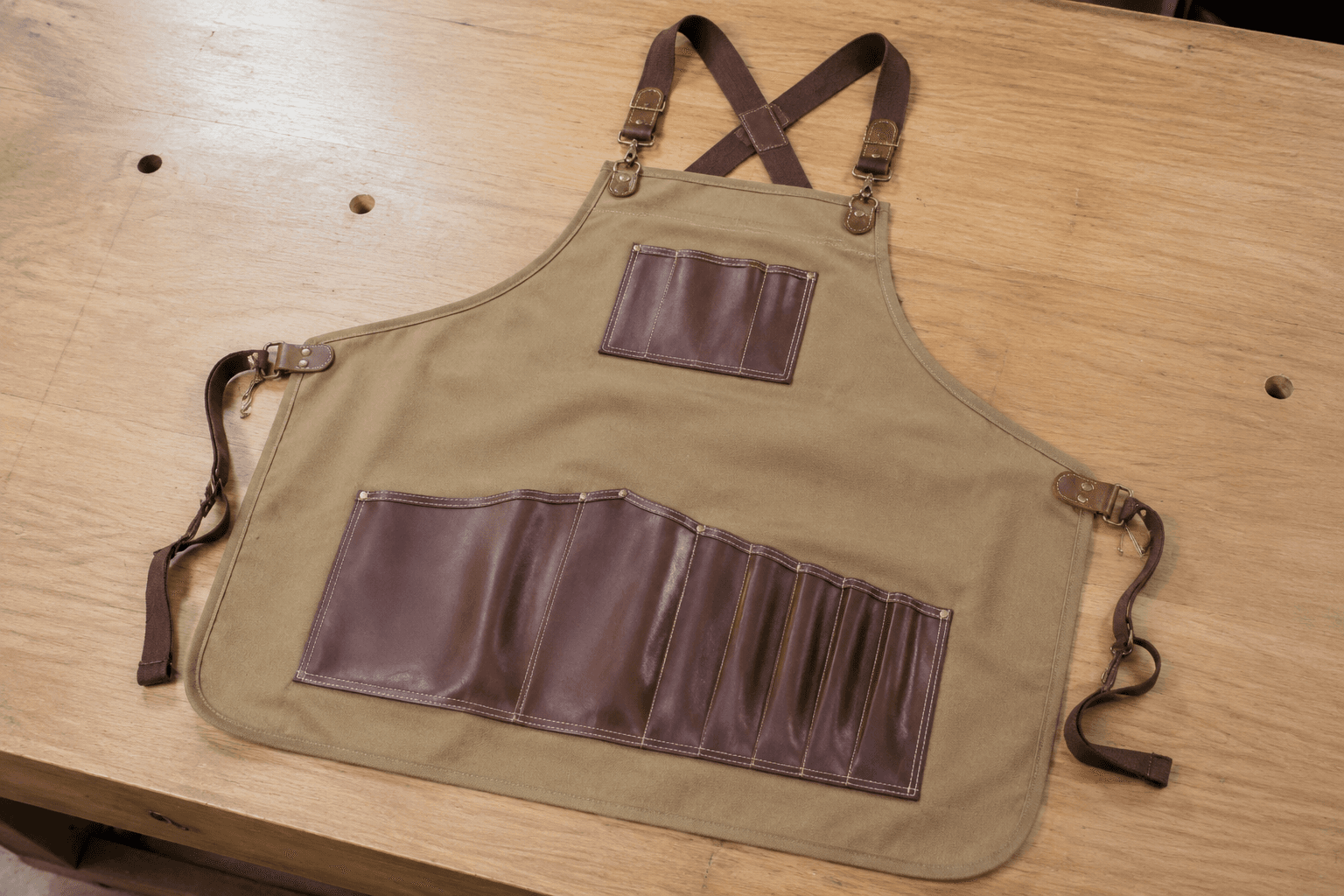
B2B buyers should inspect wear at apron-specific friction points rather than looking only at the center front panel. On brushed canvas aprons, the first visible change usually appears at pocket openings, side folds, lower abdomen contact zones, neck-strap adjusters, towel loops and hardware contact points. In café use, baristas often abrade the abdomen area by leaning into counters. In kitchen prep, table edges and repetitive wiping create localized scuffing. In retail programs, tightly folded export packing can leave pressure lines that recover slowly on dark peached fabrics.
Because the brushed face changes direction and density under pressure, the apron can look older before it is mechanically weak. That is why complaints may arrive after 8-12 weeks of heavy use even when seam strength and bartacks still pass internal checks. The issue is usually appearance retention, not construction failure. Better yarn quality helps here: cleaner spinning and longer staple cotton usually produce a more even peached face, so wear appears more uniform and less random across the apron front.
Factories can reduce complaint rates by managing both design and handling. Hardware backs should be smooth, metal edges controlled, fold packs tested on dark colors, and care instructions matched to the real finish. If visual longevity is the priority, reducing brushing depth is usually more effective than simply increasing fabric weight. A 320 GSM apron with an aggressive peached face can still show whitening and flattening sooner than a 280 GSM apron with moderate brushing.
This point matters for commercial alignment. If the end customer expects a broken-in, vintage look, moderate face evolution may be acceptable. If the apron is part of a branded uniform image across 20, 50 or 200 stores, buyers should prioritize cleaner surface retention over maximum day-one softness.
- Check wear zones under daylight and warm indoor light.
- Ask for packed-and-recovered samples if cartons will be tightly compressed.
- Inspect friction near rivets, sliders, bartacks and pocket top corners during PP review.
- Track first-complaint timing by use case: retail, café, kitchen or workshop.
Buying by end use, MOQ, FOB target and inspection standard
The right brushed apron spec depends on wear intensity, brand position and target FOB. For entry-level uniform programs targeting roughly US$3.20-US$5.00 FOB for a basic bib apron, the safest route is usually 240-270 GSM cotton canvas with light brushing or a mild softening wash. This gives a softer hand than raw canvas while protecting reorder stability and keeping MOQ manageable at around 300-500 pieces per color for standard construction.
For mid-range branded programs in the US$5.50-US$8.50 FOB range, a 280-320 GSM peached canvas with stronger trim control, wash-tested approval and better packing management usually creates a better value proposition. If the buyer adds contrast webbing, custom metal trims, embroidery or special wash effects, MOQ often needs to move closer to 800-1,200 pieces per color to keep shade sorting, trim procurement and wash-house setup commercially efficient.
Higher-end apron programs can justify these details, but every added variable increases development time and repeat-order risk. A premium finish only has value if it can be reordered within acceptable consistency on the next purchase order. For that reason, many professional buyers approve one standard fabric-and-wash route for chain replenishment, then reserve more experimental finishes for limited campaigns or retail capsules.
Quality terms should be explicit. For most export apron orders, AQL 2.5 for major defects and AQL 4.0 for minor defects is a practical shipment standard, with special attention to shade variation, logo placement, seam puckering, hardware marks, face damage and measurement tolerance after wash. For high-usage uniform programs, a pilot of 20-50 pieces can be worth an extra 5-7 days because it reveals wash behavior, fold marks and trim friction before full cutting begins.
- Entry level: US$3.20-US$5.00 FOB, 240-270 GSM, light brushing.
- Mid range: US$5.50-US$8.50 FOB, 280-320 GSM, controlled peached finish.
- Standard MOQ: 300-500 pieces per color; custom wash MOQ: 800-1,200 pieces per color.
- Inspection baseline: AQL 2.5 major, AQL 4.0 minor, with wash-tested appearance review.
Bulk approval checklist before production starts
The most reliable way to source brushed canvas aprons is to replace subjective wording with measurable approval points. Terms such as 'premium handfeel,' 'soft vintage look' or 'better quality' do not control production. A usable approval sheet should record finished GSM, shade standard, wash route, shrinkage result, finished garment measurements after wash, seam appearance, logo clarity, trim friction points, packing fold pattern and acceptable face change after laundering.
Before bulk cutting, buyers should approve at least one pre-production sample made in actual bulk fabric with real trims, final logo method and final wash process. For dark colors or custom washed programs, that sample should be reviewed both fresh after wash and again after packing recovery, because compressed export folding can temporarily flatten the face and create visible pressure lines. If the order is image-sensitive or above 1,000 pieces per color, keeping a retained hanger swatch and a wash-tested sealed sample on both buyer and factory side helps reduce disputes on repeat orders.
A practical approval routine also saves time later in the schedule. If the factory knows the approved fold direction, the accepted shade range and the tolerance for pocket-edge flattening before cutting starts, fewer disagreements appear at final inspection. In most apron programs, one extra day spent tightening the PP standard saves far more than one day lost to rework, sorting or claim handling after shipment.
The two most common sourcing mistakes are approving on day-one handfeel alone and comparing an unpacked showroom sample with a bulk shipment that has been folded and compressed for 20-35 days in transit and storage. A brushed canvas apron is often the right choice for professional buyers, but only when acceptable wear is defined against the real service life of the apron program.
- Approve 1 washed PP sample and 1 unwashed control from the same bulk fabric.
- Record body width, body length and strap length after wash, not only before wash.
- Keep factory reference samples for each repeat color and wash route.
- Include packing method, fold direction and carton compression note in approval records.