For restaurant groups, hotel dining operators, and contract uniform buyers, apron selection for front-of-house service is narrower than it looks. Bistro service aprons need to present cleanly in guest view while staying light enough for repeated bending, tray carrying, cash handling, and fast table turns across 6-10 hour shifts. In sourcing terms, that usually points to a shorter waist apron in a midweight woven fabric rather than a long protective style built for kitchen coverage.
The core variables are fabric weight, finished length, pocket load, waistband stability, and wash route. These choices interact. A fabric that feels premium in the sample room can become hot and slow after 3 hours on a dense floor. A long apron may look formal on a hanger but drag on chair backs and table edges during service. A pocket layout that is too deep or too layered will twist once loaded with a pen, terminal, and wine key.
For China OEM production, the practical goal is consistency across repeat orders. That means setting measurable standards before bulk cutting: 190-220 GSM fabric, finished length tolerance of +/-1 cm, tie length, stitch density, shrinkage limits after 3 wash-and-dry cycles, and inspection at AQL 2.5 major / 4.0 minor. This article focuses on how B2B buyers can source bistro service aprons that hold their look, move well on the floor, and land in an acceptable FOB cost band.
- 200-210 GSM is the safest all-round fabric range for most bistro and brasserie waist aprons, especially in 65/35 poly-cotton twill.
- A finished length of 55-65 cm gives the best balance of coverage, stride clearance, and chair contact control for front-of-house staff.
- Pocket capacity should be built around actual service tools; for most programs, 18-22 cm pocket depth and limited layering outperform oversized utility layouts.
- Typical China OEM MOQ is 300-500 pcs per color/style on stock-supported fabric and 800-1,200 pcs on custom-dyed or trim-heavy builds.
- Standard FOB for a basic midweight waist apron is commonly $2.30-$3.60/pc, with cotton-rich fabric and upgraded branding moving closer to $3.90-$5.80/pc.
- A usable approval package should lock GSM tolerance, finished dimensions, shrinkage result, logo position, pocket placement, and AQL standard before production starts.
Why bistro service aprons need a different front-of-house specification
Bistro service aprons follow a different wear pattern from chef bib aprons or long kitchen waist aprons. Front-of-house staff turn through narrow chair gaps, carry plates at hip level, bend toward table height, and cover high step counts during a single service. In that setting, excess fabric weight and length create friction faster than they add useful value.
One common buying mistake is equating heavier cloth with better durability. Fabrics at 280-320 GSM can feel expensive in hand, but on the dining-room floor they usually add heat retention, slower drying, and unnecessary swing weight. At the other extreme, fabrics under 170 GSM often lose shape, print pocket contents through the front panel, and show seam grin after repeated laundry cycles. For most B2B buyers, the commercial sweet spot is not the heaviest apron. It is the apron staff will keep wearing correctly through repeated shifts.
Short front-of-house aprons also reveal workmanship more quickly than larger garments. Uneven pocket placement, top-edge waviness, waistband roll, and twisted hems are visible at guest distance. That matters for chain restaurants and hotel groups because inconsistency across a service team reads as weak uniform control, even when the garment is technically wearable.
- Typical dining-room waist apron length is 55-65 cm; many chef-oriented waist styles run 75-90 cm.
- Fabrics above 280 GSM usually increase fatigue and drying time without extending practical front-of-house service life.
- Fabrics below 170 GSM often show pocket collapse and reduced opacity under restaurant lighting.
- Visible sewing defects on guest-facing aprons push faster replacement decisions than similar issues on back-of-house garments.
Best midweight fabrics for bistro service aprons: 190-220 GSM by wash route
For repeat uniform programs, the most reliable fabric category is midweight woven twill. In current OEM sourcing, the strongest defaults are 65/35 poly-cotton twill at 200-210 GSM, 80/20 poly-cotton twill at 190-205 GSM, and 100% cotton canvas or twill at 220-230 GSM for brands that want a more natural surface. These constructions support clean topstitching, stable pocket attachment, and enough body to prevent the front panel from collapsing after washing.
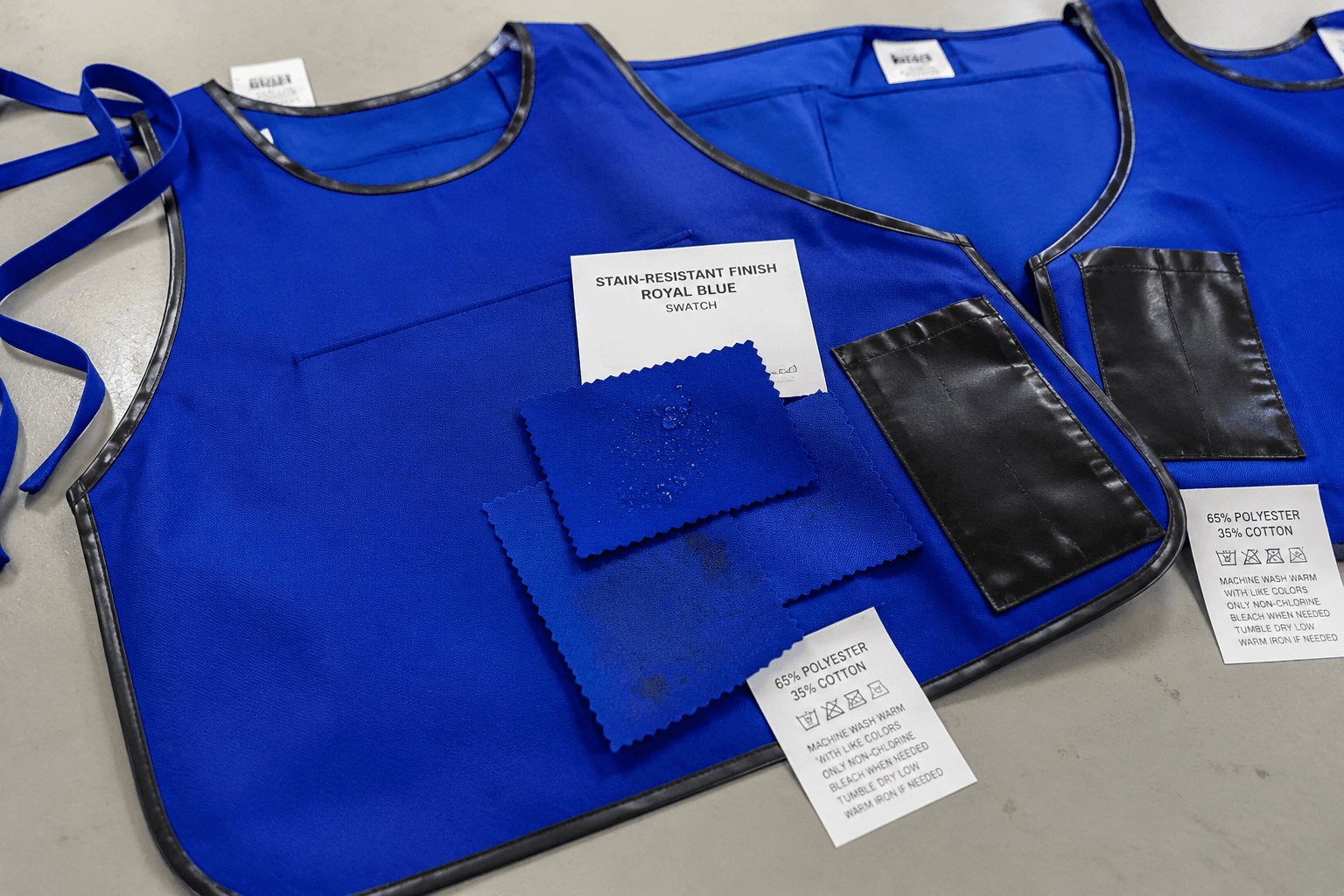
Laundry method should drive the fabric decision. If the operator uses commercial washing with tumble drying, poly-cotton twill is usually the best control fabric because it dries faster and holds size more predictably. A well-finished 65/35 twill commonly lands at 2-3% total shrinkage after 3 wash-and-dry cycles. A comparable 100% cotton fabric may move to 4-6%, depending on sanforization, dye route, and dryer heat. On a 60 cm apron, that difference is visible enough to change the line of the uniform.
Cotton-rich builds still fit specific concepts. Wine bars, artisan bakery counters, and heritage brasseries often accept a higher care burden in exchange for a softer hand and a less synthetic face. The trade-off is straightforward: higher fabric cost, slower drying, and more dimensional movement lot to lot. In many factory quotations, moving from stock-supported 200 GSM poly-cotton twill to 225 GSM cotton canvas adds around $0.40-$0.85/pc FOB at volumes of 500-1,000 pcs, before embroidery or labels are added.
- 190-200 GSM: lighter and cooler, suitable for simple pocket layouts and warmer service environments.
- 200-210 GSM: best all-round range for bulk bistro service aprons with stable drape and cost control.
- 220-230 GSM: fuller hand and stronger visual body, but hotter in wear and higher in cost.
- 65/35 poly-cotton twill: strongest option for shrinkage control, drying speed, and replenishment consistency.
- 100% cotton fabric: better natural look, but more wash movement and higher replacement risk if the laundry route is aggressive.
Bistro service aprons at 55-65 cm: shorter lengths for faster floor movement
Length is one of the fastest specification levers in front-of-house apron buying. When a waist apron drops too close to the knee, it interferes with stride, stair use, chair backs, and table corners. For most restaurant and hotel dining environments, the best working range is 55-65 cm finished length. That gives enough coverage to look polished without adding drag during service.
Shorter cuts often work better in faster formats. In compact bistros, bakery counters, and wine bars where staff pivot constantly, 50-55 cm can feel cleaner and quicker. In hotel all-day dining or more formal brasserie service, 60-65 cm usually gives the right presentation. Once length pushes past 70 cm, the apron often needs readjustment through the shift and shows more repeated contact with chairs, stool edges, and POS corners.
Finished length should not be reviewed in isolation. Waistband width, top width, side taper, and hem balance all affect how the apron hangs on real bodies. A properly tapered 62 cm apron with a stable 3.5 cm waistband will usually perform better than a generic 70 cm block in the same fabric. Approval wear tests should therefore be done with loaded pockets and active movement, not only on a hanger or mannequin.
- 50-55 cm: best for tight floor plans and high-frequency turning.
- 55-65 cm: strongest standard range for most brasserie and bistro service programs.
- 65-70 cm: usable in more formal settings if the fabric stays near 220 GSM and pocket load is light.
- Finished-length tolerance should generally be held to +/-1 cm in bulk inspection.
- Wear testing should include bending, stair use, seated contact, and loaded-pocket walking for at least 30-45 minutes.
Pocket engineering for service tools, not decorative bulk
Pocket layout is where many apron samples become weaker in production. Buyers often request extra compartments in the name of utility, but every added layer changes drape, front weight, and wash behavior. In actual table service, most staff carry only a pen, small order pad, handheld terminal, wine key, and sometimes a cloth. A pocket system built for more than that usually adds swing and visible distortion without increasing speed.
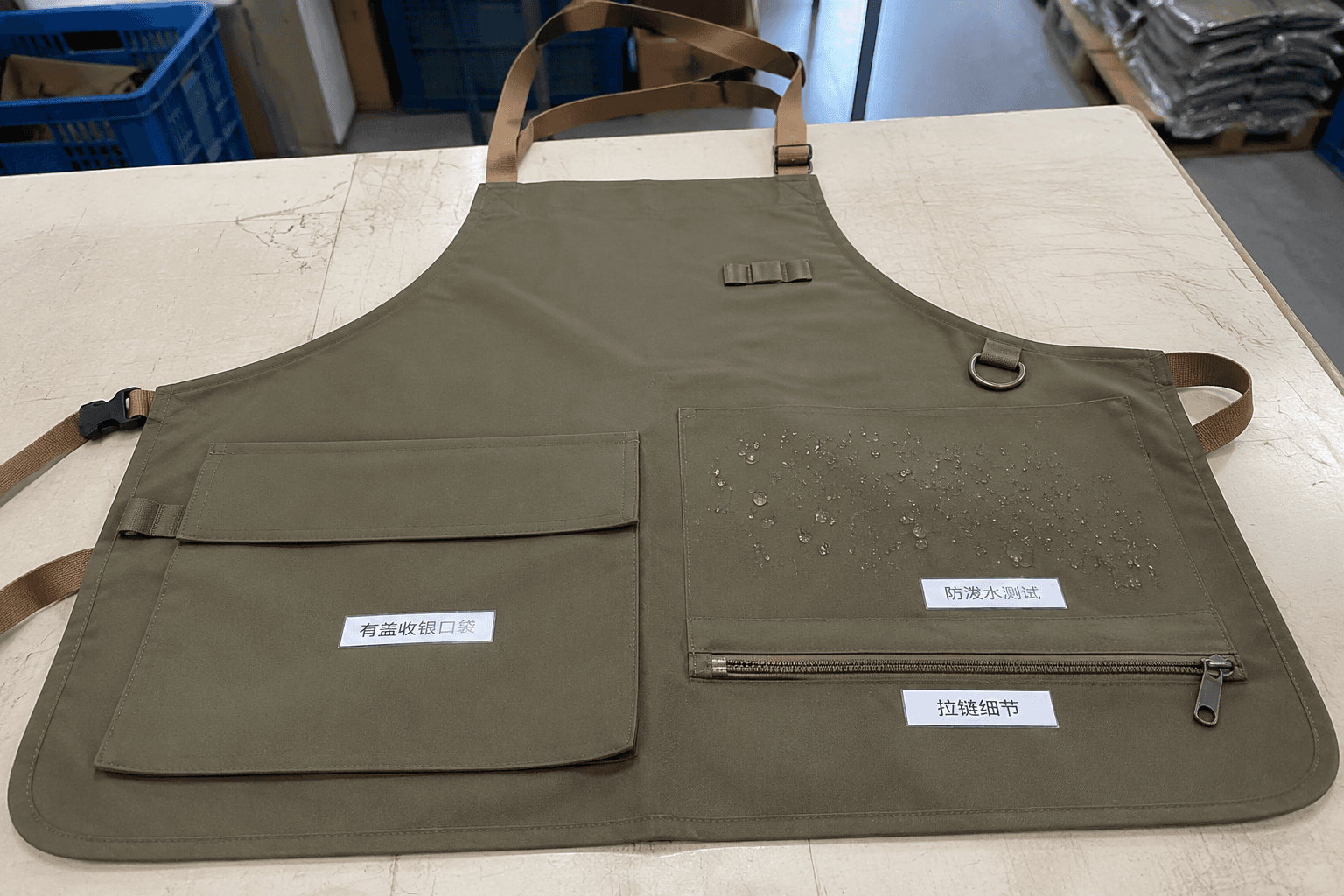
For most waist-apron programs, one divided center pocket or two moderate front pockets are enough. Pocket depth of 18-22 cm usually fits service tools without pulling the apron downward. If a dedicated device pocket is required, it should hold the terminal upright and close to the body. If it sits too low or too wide, the device prints through the panel, knocks against the thigh, and twists the apron after repeated movement.
Pocket durability is driven by construction details. Pocket corners should be bartacked or triangle reinforced when devices are inserted and removed 50-100 times per shift. Stitch density around 9-11 SPI is a workable target for clean appearance and seam hold on midweight fabrics. Pocket-mouth waviness after 10 industrial washes is usually a sign of weak reinforcement, tension imbalance, or poor interlining choice at the waistband and top edge.
- Standard pocket depth for front-of-house waist aprons is typically 18-22 cm.
- Use bartacks or triangle reinforcement at pocket corners for terminals, wine tools, or cash handling.
- Avoid triple-layer utility pockets unless the operator has a documented tool requirement.
- Run a loaded wear trial for at least 1 mock shift or 4 hours.
- Compare pocket shape before wash and after 3 wash cycles to catch sagging early.
MOQ, FOB cost, and lead times for professional apron sourcing
For China OEM buying, MOQ is driven mainly by fabric route, dyeing method, trim count, and branding complexity. On stock-supported twill with one standard logo application, many factories can start at 300-500 pcs per color/style. Once the program moves into custom pantone dyeing, contrast panels, rivets, woven labels, or multiple branding methods, practical MOQ often rises to 800-1,200 pcs. Buyers should confirm whether the MOQ is per color, per style, or per total order, because factories do not always quote that point consistently.
FOB cost bands are relatively predictable when the build is controlled. A plain waist apron in 200-210 GSM poly-cotton twill with standard pockets and no complex trims commonly lands around $2.30-$3.60/pc FOB at commercial volume. A cotton-rich apron with embroidery, custom labels, reinforced pocketing, and upgraded trims usually moves to $3.90-$5.80/pc FOB. Smaller orders under 300 pcs or developments requiring special dye lots can add $0.30-$0.90/pc because fabric and setup costs spread across fewer units.
Lead times should be aligned with the development route from the start. Fit or counter samples on stock fabric often take 7-12 days. Development using custom dyeing or special trim sourcing more often takes 15-20 days. Bulk production is commonly 25-30 days for standard programs after approval and deposit, and 35-40 days for more complex builds. Around peak factory periods, buyers should allow an additional 5-7 days for cutting-line scheduling and final packing.
- Standard MOQ: 300-500 pcs per color/style on stock-supported fabric.
- Custom MOQ: 800-1,200 pcs when custom dyeing, multiple trims, or special branding are involved.
- Typical FOB: $2.30-$3.60/pc for standard midweight poly-cotton waist aprons.
- Upgraded FOB: $3.90-$5.80/pc for cotton-rich fabric, embroidery, and added trim detail.
- Sample lead time: 7-12 days on stock fabric, 15-20 days with custom development.
- Bulk lead time: 25-30 days standard, 35-40 days for more complex orders.
Approval standards that keep repeat orders consistent
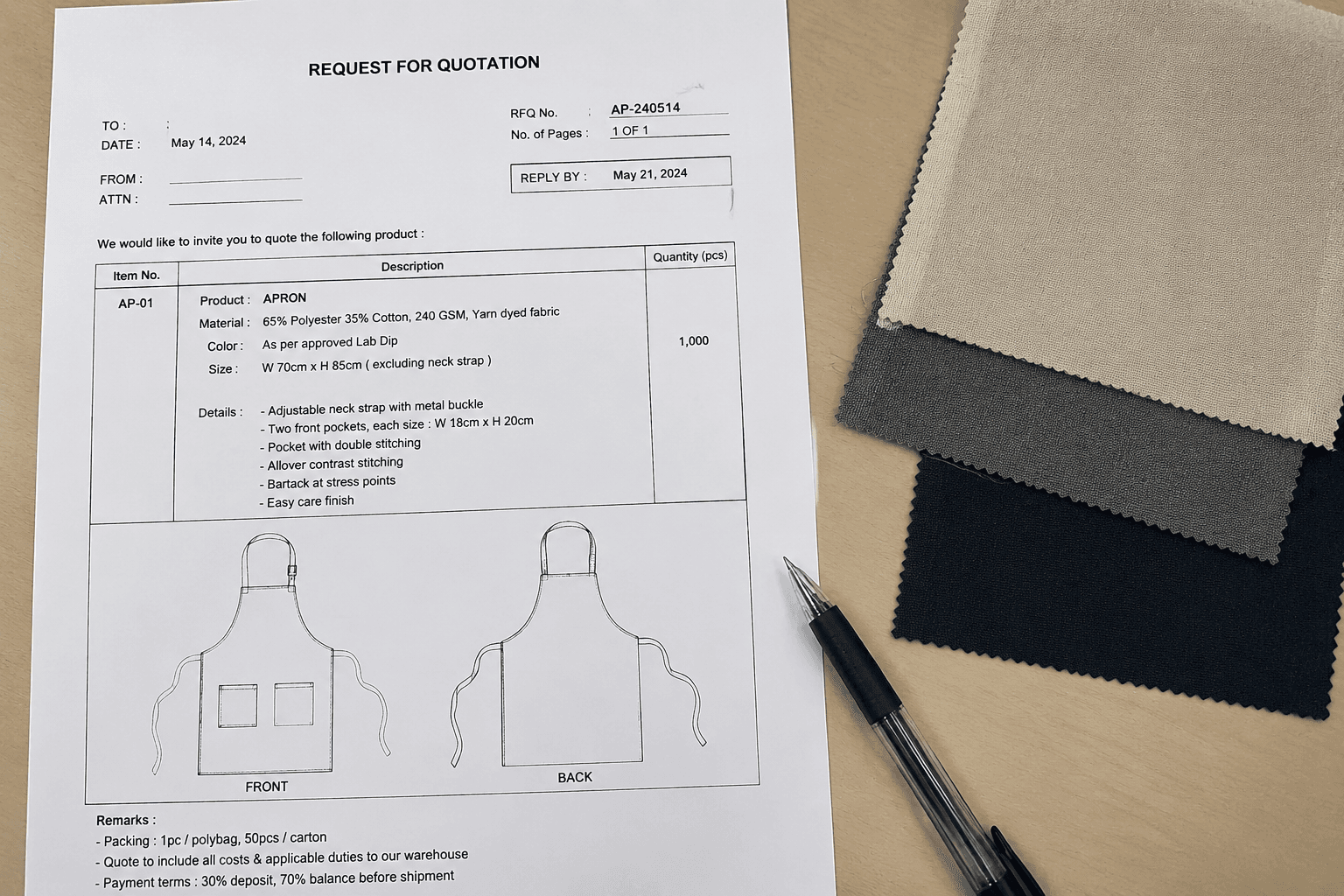
The strongest purchase orders remove interpretation before bulk cutting begins. For apron programs, the approval file should define fabric composition, GSM target, color standard, finished length and width, tie length, pocket placement, logo size and method, care label language, carton pack ratio, and inspection level. A photo-approved sample alone is not enough, especially for short guest-facing aprons where small proportion changes are easy to see.
Wash testing should mirror the real care route. At minimum, buyers should compare pre-wash and post-wash measurements after 3 full wash-and-dry cycles, checking shrinkage, skew, seam puckering, color change, crocking, and logo performance. On a front-of-house waist apron, even 1.5-2 cm of length loss can change how the uniform line reads across a service team. That is why sample approval should include both measurement review and wear review on at least 2 body types.
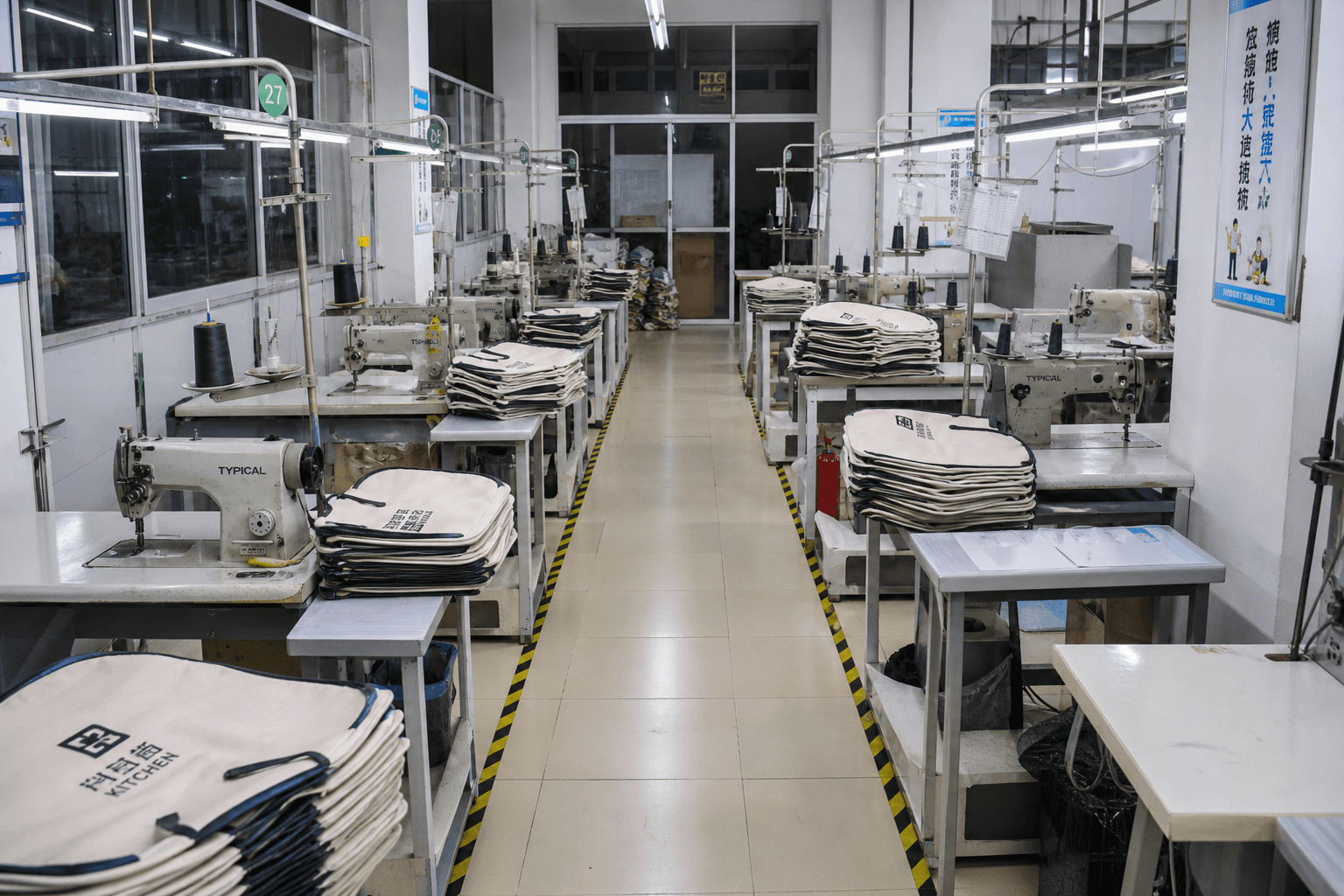
Inspection standards should be fixed before shipment. For most professional apron orders, a workable baseline is AQL 2.5 for major defects, AQL 4.0 for minor defects, and 0 critical defects. Finished dimensions are often controlled to +/-1 cm on length and width, while fabric weight tolerance is usually +/-5% if mill testing supports it. These are small controls, but they are what prevent quality drift between lots and reduce claims after delivery.
- Approve a written spec sheet before bulk cutting, not only a fit sample or photo.
- Test at least 3 wash-and-dry cycles using the intended laundry method.
- Set inspection at AQL 2.5 major / 4.0 minor / 0 critical unless the program requires tighter control.
- Hold finished dimensions at about +/-1 cm and fabric weight at +/-5%.
- Check logo position, waistband roll, pocket balance, and hem twist on a worn sample before shipment release.