A barista apron is a working garment, not only a brand surface. In a cafe, it is exposed to espresso grounds, milk splashes, syrup, steam, detergent, counter abrasion and repeated tying at the waist. For sourcing managers, the key question is not whether the apron looks good in a product photo, but whether it keeps its shape, color and stitching after 50 to 100 wash cycles in daily service.
For cafe chains, roasters, bakery cafes and hospitality groups, apron development usually sits between uniform procurement and brand merchandising. The buyer needs a consistent cafe apron that fits different body types, accepts logo decoration, meets a target landed cost and can be repeated season after season. The factory needs clear technical direction on fabric weight, strap construction, pocket layout, hardware, wash standard, packaging and inspection level.
This article explains how we evaluate a custom cafe apron from the supplier side: fabric selection, pattern fit, reinforcement, decoration method, costing and order planning. The examples reflect common bulk production ranges in Zhejiang and nearby textile clusters, where MOQ, dye lot control and sewing efficiency strongly affect both price and delivery.
- Fabric weight between 240 and 340 GSM covers most daily-use cafe aprons, depending on desired drape and wash durability.
- Cross-back straps reduce neck pressure, but they add sewing time, hardware cost and size-management complexity.
- Reinforced pocket corners and bar-tacked stress points are more important than decorative details for long-term cafe use.
- Embroidery suits premium cotton and canvas aprons, while screen print or heat transfer is usually more cost-efficient for larger logo areas.
- Lead time for custom barista apron orders is usually 25 to 45 days after sample approval, depending on fabric status and decoration workload.
- A realistic MOQ starts around 300 to 500 pieces per color for stock fabric, and 800 to 1,500 pieces per color for custom dyeing.
What a barista apron must handle in daily cafe service
A barista apron works in a narrower but more demanding environment than many general hospitality aprons. The front panel is constantly in contact with counters, portafilters, grinder edges, steam wands, pitchers, cleaning cloths and POS areas. The upper chest may receive small splashes of milk and coffee oil, while the lower front collects water marks, grounds and flour if the cafe also sells bakery items. A coffee shop apron that looks clean at opening time can look tired by the third shift if fabric, color and pocket placement are not chosen carefully.
The durability requirement is also different from a promotional apron. A giveaway apron may only be worn occasionally, but a cafe uniform apron may be used 4 to 6 days per week. If each unit is washed twice per week, a three-month trial already represents around 25 wash cycles. For chain operations, we normally recommend testing a barista apron to at least 50 home-laundry cycles or 30 commercial-laundry cycles before locking a multi-store rollout. The failure points are predictable: neck strap elongation, pocket corner tearing, waist tie fraying, color loss at fold lines, logo cracking and metal hardware discoloration.
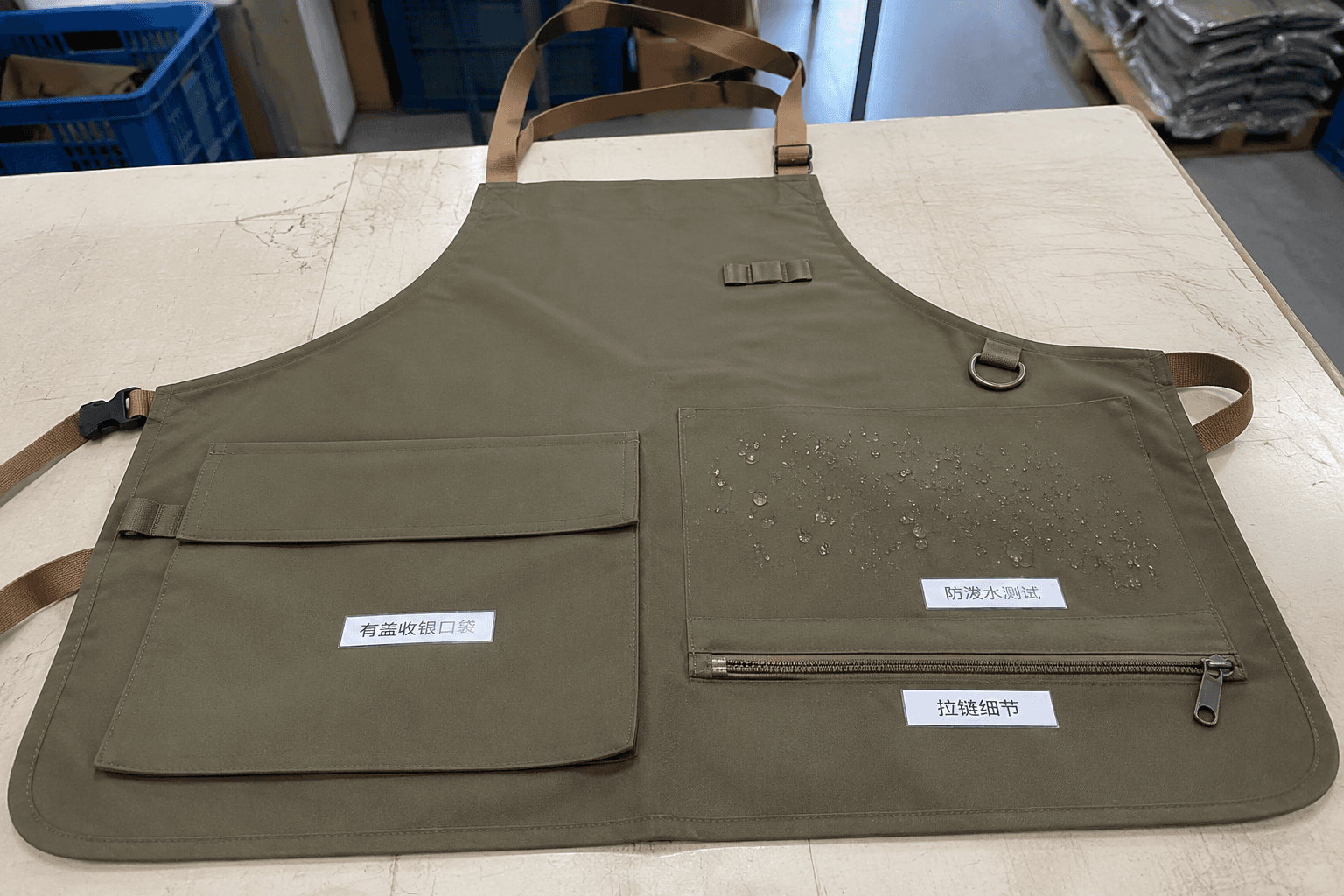
Buyers should also consider how the apron supports actual work. A deep central pocket may look practical, but if it catches tamper handles or bulges when carrying a phone, it becomes inconvenient. A narrow pen pocket is useful for supervisors, but too many segmented pockets slow sewing and make the front panel stiff. The best cafe apron is usually simple, stable and repeatable: enough pocket capacity, no unnecessary bulk and reinforcement at every point where the worker pulls, bends or stores tools.
- A daily-use barista apron should tolerate coffee oil, milk spots, water marks and repeated detergent exposure.
- The main stress points are pocket corners, waist-tie insertion points, neck or shoulder strap joins and lower hem edges.
- Cafe brands should test appearance after washing, not only fabric strength before washing.
- Apron design should avoid pocket layouts that interfere with counters, grinders, tampers or seated movement.
Barista apron fabric choices: canvas, twill, denim and blends
Fabric is the largest driver of both performance and cost. For a standard barista apron, we usually see four practical directions: cotton canvas, cotton twill, denim and poly-cotton blends. Each has a different feel, shrinkage profile and decoration behavior. A buyer asking for a “heavy premium apron” may receive samples from 280 GSM to 420 GSM, but not every heavy fabric is suitable for cafe work. If the fabric is too stiff, workers feel restricted when bending or reaching. If it is too light, pockets sag and the apron loses its professional look after washing.
Cotton canvas in the 280 to 340 GSM range is a common choice for specialty coffee brands. It gives a structured appearance, supports embroidery well and feels authentic for craft-oriented cafe environments. The trade-off is shrinkage and color management. Reactive dyed cotton canvas can be controlled, but dark shades such as black, navy, forest green and coffee brown may show fading after repeated washing. Pre-shrunk or enzyme-washed canvas improves hand feel and reduces shrinkage, but it adds roughly USD 0.20 to 0.60 per piece depending on weight, wash type and quantity.
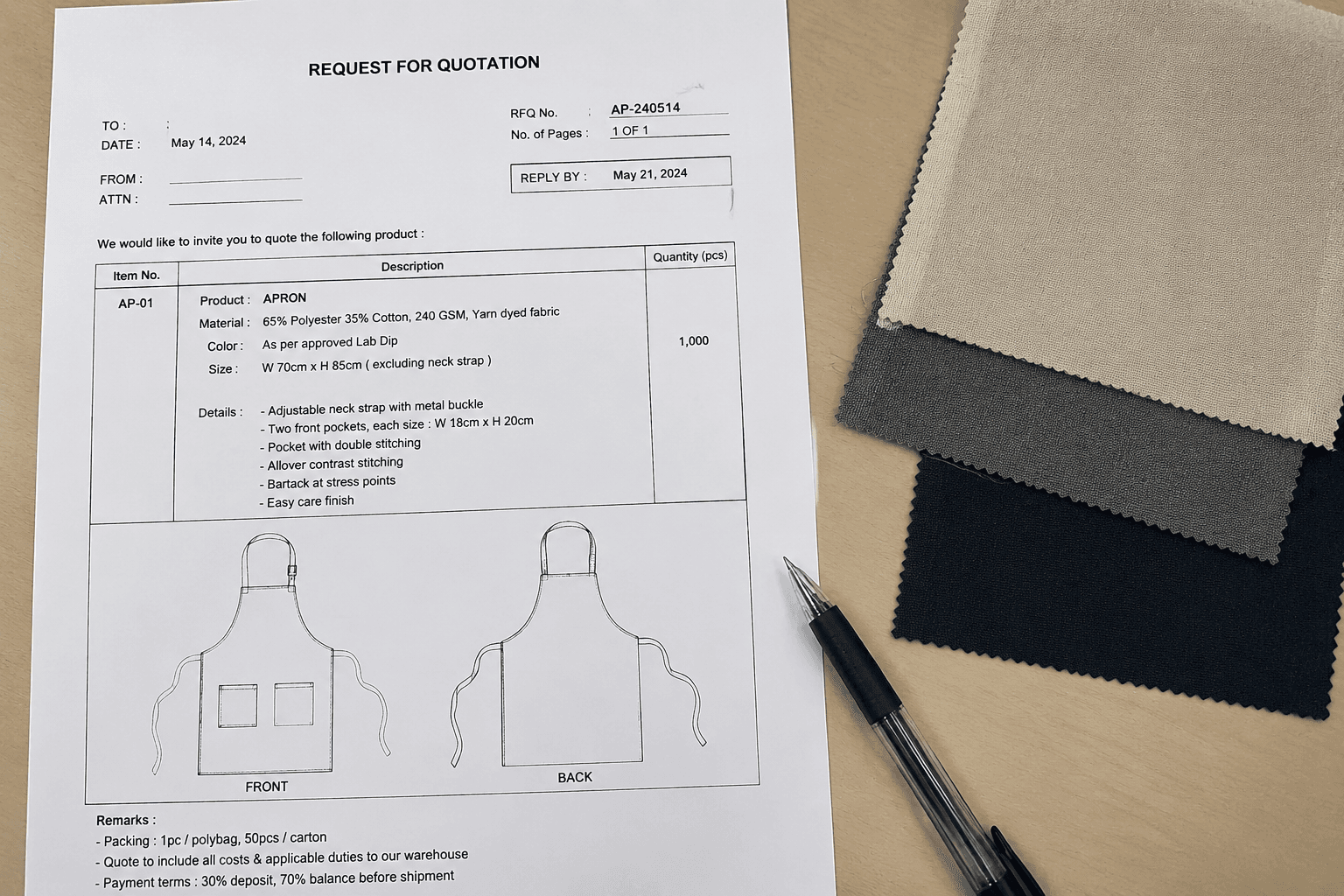
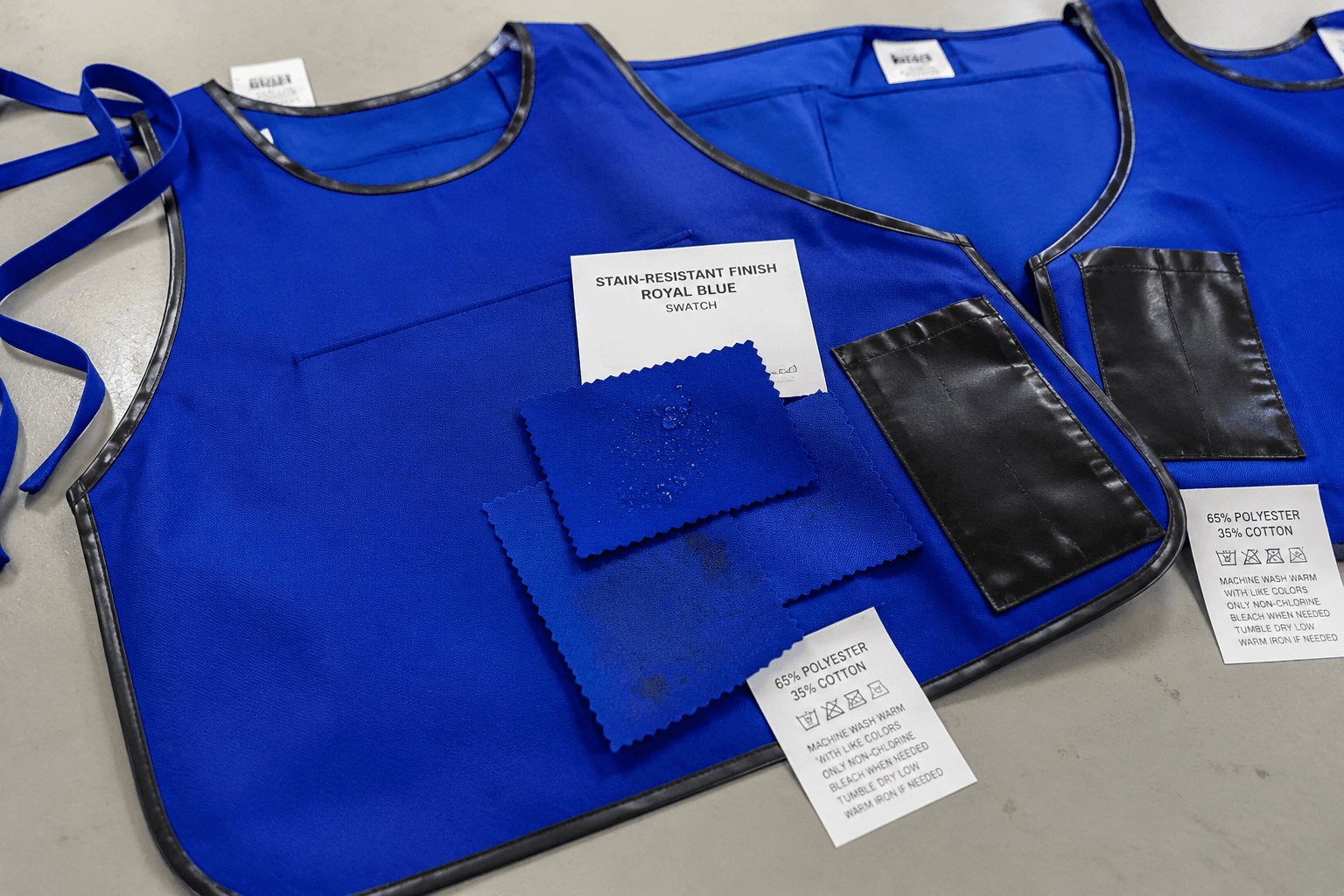
Cotton twill between 240 and 300 GSM is more flexible and often better for larger cafe chains that need comfort and cost control. Twill drapes better than canvas and is easier to sew at high speed. Poly-cotton twill, for example 65/35 polyester-cotton at 240 to 260 GSM, improves colorfastness and drying speed, which matters for commercial laundry. However, it has a less natural hand feel and may not match the brand image of a roastery or artisan bakery. Denim, usually 8 oz to 11 oz, creates a strong workwear look, but indigo bleeding must be controlled carefully. For denim cafe apron programs, buyers should approve both dry crocking and wet crocking test results before bulk cutting.
- 240 to 260 GSM poly-cotton twill is practical for cost-sensitive chain uniforms and frequent washing.
- 280 to 340 GSM cotton canvas gives a premium look and better pocket stability, but requires tighter shrinkage control.
- 8 oz to 11 oz denim works for workwear styling, but indigo color transfer must be tested before approval.
- Washed canvas or washed denim improves softness, while adding cost and several days to production lead time.
- Dark colors should be checked for fading, edge whitening and shade variation between fabric rolls.
Fit and pattern decisions for a custom cafe apron
Fit is often underestimated because aprons are not sized like jackets or shirts. In bulk sourcing, the buyer may want one universal size to simplify inventory. That can work, but only when the pattern is balanced for both shorter and taller staff. A typical adult bib apron for cafes is 70 to 80 cm wide and 80 to 90 cm long. For many Asian and European cafe programs, 72 x 84 cm is a reliable starting point. For taller North American markets, 76 x 88 cm or 78 x 90 cm may provide better coverage. The width matters as much as the length: if the front panel is too narrow, the apron twists when the wearer moves quickly behind the bar.
Neck-loop aprons are simple and economical. They reduce components and are easy to adjust with a metal slider, snap tape or buttonholes. The downside is pressure on the neck, especially when the front has heavy canvas, metal hardware or loaded pockets. Cross-back straps distribute weight across the shoulders and are preferred by many specialty coffee teams. From a supplier perspective, cross-back construction adds pattern pieces, strap length control and more sewing operations. It can increase FOB cost by USD 0.30 to 1.20 per piece, depending on strap material, hardware and order volume.
For a custom cafe apron, strap length should be specified with real wearer data, not guessed from a reference photo. Waist ties are commonly 85 to 100 cm each side for standard adult aprons. Cross-back shoulder straps may range from 120 to 160 cm depending on whether they pass through grommets, tie at the waist or connect with clips. If the brand uses a unisex uniform policy, we normally suggest one main size plus a shorter option when the total order exceeds 1,000 pieces. The second size adds inventory handling, but it improves staff comfort and reduces alterations.
- A standard cafe bib apron often starts at 72 x 84 cm, while taller markets may need 76 x 88 cm or larger.
- Neck-loop construction is lower cost and easier to pack, but it may become uncomfortable with heavy fabric.
- Cross-back straps improve comfort for long shifts, while increasing component cost and sewing time.
- Waist ties should be long enough for front or back tying without creating excessive loose ends.
- A two-size apron program is worth considering when the order is above 1,000 pieces and staff height range is wide.
Durability details that separate a good barista apron from a weak one
Durability is decided in small construction details. A fabric may be strong, but if the pocket corner is single-stitched with no bar tack, the apron will fail early. In cafe use, staff often place phones, order pads, markers, bottle openers, small cloths or keys in the pocket. Every time the wearer bends or leans against a counter, the pocket mouth is pulled outward. For bulk orders, pocket corners should be bar-tacked or reinforced with triangular stitching. This is a low-cost operation compared with replacing failed aprons after shipment.
Thread choice also matters. For most cotton, canvas and twill aprons, 40/2 polyester thread is common and stable. For heavier canvas or denim, 20/2 or 30/3 thread may be used for stronger visible topstitching. Stitch density normally sits around 8 to 10 stitches per inch for durable apron seams. Too few stitches look rough and reduce seam strength; too many can perforate the fabric and slow production. Edge finishing should be consistent, especially after washing. Clean binding or double-fold hems are common. Overlock-only edges are usually not suitable for a premium barista apron unless they are hidden inside a seam.
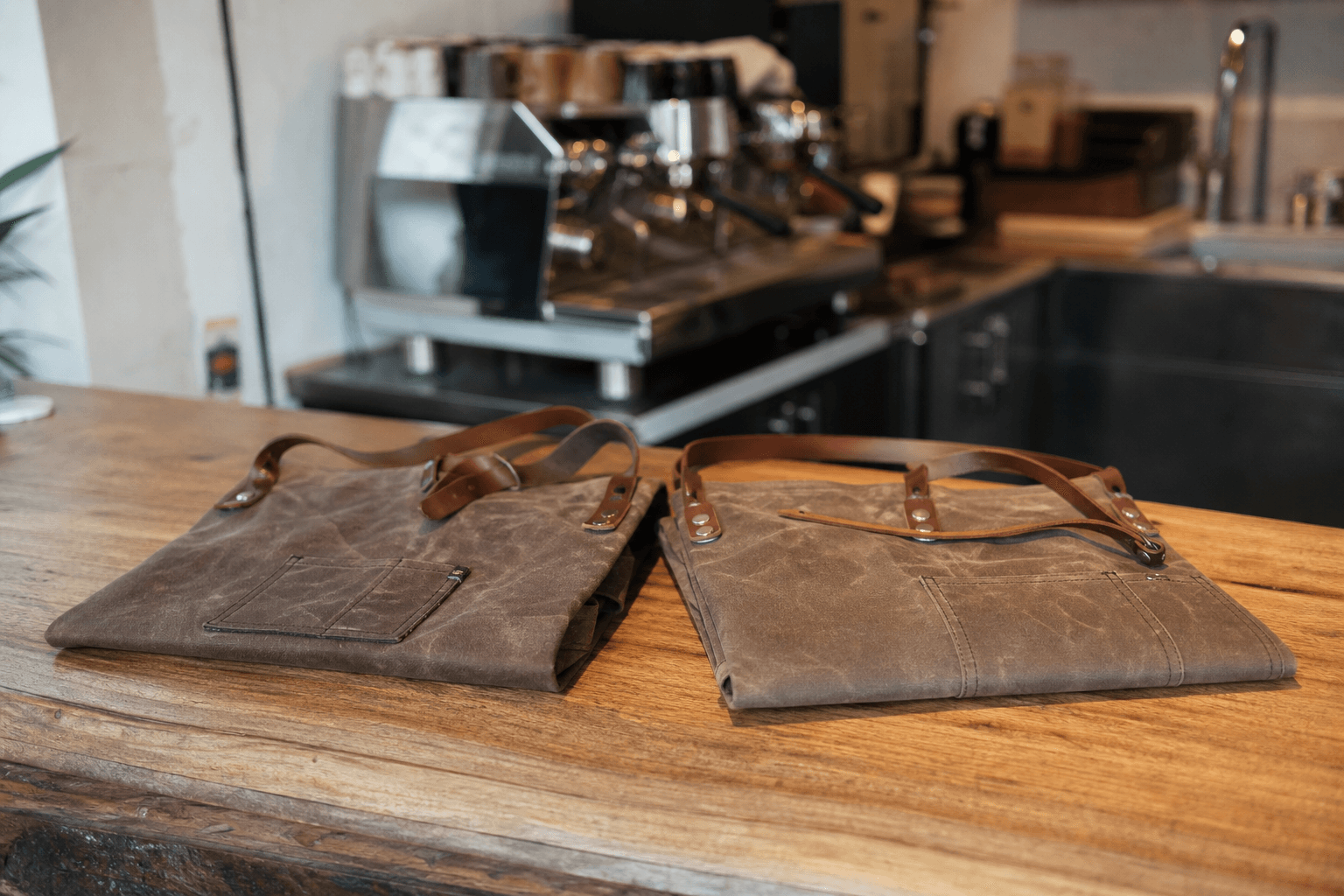
Hardware should be selected according to laundry conditions. Antique brass or gunmetal accessories look good on coffee shop apron designs, but plating quality varies widely. Low-grade D-rings, sliders and snap hooks may rust, discolor or stain the fabric after washing. Stainless steel is more stable but more expensive and less warm in appearance. For brands that require metal-free garments, adjustable fabric straps with buttonholes or plastic hardware can be used, but the look is different. If the apron will be commercially laundered, the buyer should confirm washing temperature, drying method and chemical exposure before approving metal hardware.
- Pocket corners should use bar tacks, triangle reinforcement or dense backstitching for daily cafe use.
- Stress points at strap joins should be reinforced because workers pull them every time they put on the apron.
- A durable apron usually uses 8 to 10 stitches per inch, adjusted by fabric thickness and thread size.
- Metal hardware should be checked for rust, plating loss and fabric staining after wash testing.
- Visible topstitching should be evaluated for both appearance and seam strength, especially on denim and canvas.
Logo decoration and branding for cafe apron programs
Branding on a barista apron must survive washing and still look controlled at store level. The most common decoration methods are embroidery, screen printing, heat transfer, woven labels, leather patches and rubber patches. Each has a different cost structure and minimum. Embroidery is preferred for premium cafe uniforms because it looks permanent and handles washing well. It is best for logos up to about 8 to 12 cm wide, depending on stitch count and fabric. A dense 8,000-stitch logo may cost USD 0.25 to 0.60 per piece in bulk, while a larger 18,000-stitch chest design can cost much more and may stiffen the bib area.
Screen printing is economical for larger flat graphics and high quantities. It works well on cotton twill and canvas, but ink selection must match the fabric and wash requirement. A one-color chest print may add USD 0.08 to 0.20 per piece at volume, while multi-color prints require screens, registration control and higher setup cost. Heat transfer is useful for small runs, complex logos or variable store names, but poor-quality transfers may crack after repeated washing or feel plastic on heavy cotton. For a custom cafe apron that will be washed frequently, we recommend testing the exact decoration on the exact bulk fabric, not on a substitute swatch.
Placement needs operational thinking. A logo centered too low on the bib may be hidden when the wearer bends or when the apron wrinkles. A logo too close to the pocket may be distorted by pocket contents. For most cafe apron programs, a left chest embroidery, centered upper-bib embroidery or small woven label near the pocket gives a clean result. Leather patches are popular for heritage styling, but genuine leather does not tolerate washing well unless specially treated. PU leather patches are more consistent and lower cost, but the buyer should approve the hand feel and edge finish.
- Embroidery is durable and premium, but large stitch counts can make the bib area stiff.
- Screen print is cost-efficient for simple graphics, especially above 500 to 1,000 pieces.
- Heat transfer is flexible for complex artwork, but wash testing is essential for cafe uniforms.
- Woven labels are stable, repeatable and useful when the brand wants understated identification.
- Leather or PU patches should be tested for curling, color bleeding and edge cracking after washing.
MOQ, costing and lead time from a barista apron supplier
A professional barista apron supplier calculates price from fabric, cutting efficiency, sewing minutes, decoration, hardware, washing, packaging and inspection requirements. For a basic 240 GSM poly-cotton twill cafe apron with one pocket and simple neck strap, FOB China pricing may fall around USD 2.20 to 3.80 per piece at 1,000 pieces, depending on details. A 300 GSM cotton canvas apron with cross-back straps, metal hardware, embroidery and reinforced pockets may range from USD 5.00 to 9.50 per piece. Washed denim, leather patches, custom hardware and individual retail packaging can push the cost higher.
MOQ depends mainly on fabric availability. If the buyer selects stock fabric in black, navy, beige, grey or standard denim, many factories can accept 300 to 500 pieces per color, although the unit price will be higher. For custom dyed cotton canvas or twill, fabric mills usually require 800 to 1,500 meters per color, which often translates to 800 to 1,500 aprons depending on width and pattern efficiency. For yarn-dyed stripes or special weaves, the MOQ may be higher. Buyers sometimes request 200 pieces across five colors; that is possible only with stock fabric, simplified trims and a premium price.
Lead time should be planned from sample approval, not from first inquiry. A typical development timeline is 3 to 7 days for initial pattern and material discussion, 5 to 10 days for proto sample, 3 to 7 days for buyer review, then 25 to 45 days for bulk production after approval and deposit. Custom dyeing, garment washing, lab testing or complex decoration can extend the schedule to 50 or 60 days. For seasonal cafe openings, we suggest approving fabric and fit at least 70 to 90 days before the required in-store date, leaving time for freight and any corrective action after pre-shipment inspection.
- Stock-fabric MOQ is commonly 300 to 500 pieces per color, with better pricing above 1,000 pieces.
- Custom dyed fabric usually requires 800 to 1,500 pieces per color equivalent, depending on fabric width and marker efficiency.
- Simple twill cafe aprons may price around USD 2.20 to 3.80 FOB at volume, while premium canvas styles may reach USD 5.00 to 9.50.
- Bulk lead time is usually 25 to 45 days after sample approval, excluding long buyer review cycles.
- Garment washing, lab testing and custom hardware can add 7 to 15 days to the schedule.
Quality control before shipping a coffee shop apron order
Inspection for a coffee shop apron order should cover more than general appearance. The inspector should measure length, width, pocket size, strap length and logo placement against the approved sample and size specification. A tolerance of plus or minus 1 cm is common for main apron dimensions, while logo placement may need a tighter tolerance, such as plus or minus 0.5 cm, especially for chest embroidery. If the apron includes cross-back straps, the inspection should confirm that left and right straps are equal, properly attached and not twisted inside hardware.
Fabric and color checks are important because apron panels are large and shade variation is visible. Bulk fabric rolls should be checked before cutting, especially for dark cotton canvas, denim and garment-washed items. For multi-store brands, inconsistent shade between batches can create a poor uniform standard. Colorfastness to washing, rubbing and perspiration should be confirmed according to the buyer’s market requirement. Common internal targets are grade 3-4 or above for washing colorfastness and dry rubbing, with wet rubbing carefully reviewed for dark denim and black cotton.
Packaging should match how the buyer distributes uniforms. For warehouse distribution, one apron per polybag with size, color and SKU sticker is common. For direct-to-store rollout, carton assortment by location may be requested, but it requires accurate packing lists and more handling time. Standard export cartons often hold 50 to 100 aprons depending on fabric weight and folding method. Heavy canvas cross-back aprons may reduce carton quantity and increase freight volume. Before shipment, the buyer should approve folded size, bag warning text if required, carton marks and barcode format.
- Final inspection should measure apron body size, strap length, pocket position and logo placement against the approved sample.
- Shade control should be checked by roll and by finished garment, especially for dark cotton and denim fabrics.
- Wash, rubbing and shrinkage results should be reviewed before large chain rollout, not after store complaints.
- Packing method should reflect warehouse distribution, store allocation and barcode requirements.
- Carton quantity should be confirmed early because heavy apron styles increase freight volume and handling cost.
How buyers can brief a factory for a custom barista apron
A clear brief saves sample rounds. Instead of sending only a photo, buyers should provide the intended use, target market, expected washing method, preferred fabric hand feel, color reference, logo artwork, approximate order quantity and target price range. A factory can then advise whether the desired result is realistic. For example, a buyer asking for 350 GSM washed cotton canvas, cross-back straps, antique brass hardware, embroidery and individual retail box at USD 3.50 FOB will need either a design adjustment or a higher budget. Early cost alignment avoids slow sampling of an apron that cannot meet the commercial target.
Reference samples are useful, but they should be treated as direction, not as a complete specification. Two aprons may look similar in photos but use different fabric weight, dye method, thread, pocket reinforcement and strap construction. For repeatable OEM production, the final tech pack should include finished measurements, fabric composition and GSM, color standard, stitching details, logo size and placement, hardware finish, packaging method, testing requirements and acceptable tolerance. Once the buyer approves a pre-production sample, the factory should keep one sealed sample for production reference and send one to the buyer.
For cafe brands planning long-term replenishment, it is worth standardizing a core apron platform. Keep the same pattern, fabric quality and construction, then adjust color, logo or small trim details by campaign. This improves pricing, reduces sample time and makes future orders more predictable. A stable barista apron program also helps the supplier reserve fabric, control shade continuity and reduce training time on the sewing line. The result is not only a better apron, but a smoother procurement cycle with fewer surprises.
- A useful factory brief should include quantity, target price, fabric preference, washing method, logo artwork and required delivery date.
- The tech pack should specify GSM, composition, finished measurements, pocket layout, stitch details, hardware and packaging.
- The pre-production sample should be sealed and used as the production standard for cutting, sewing and inspection.
- Long-term cafe programs benefit from one stable apron platform with controlled seasonal changes.
- Buyers should discuss replenishment needs early so the supplier can manage fabric continuity and shade risk.