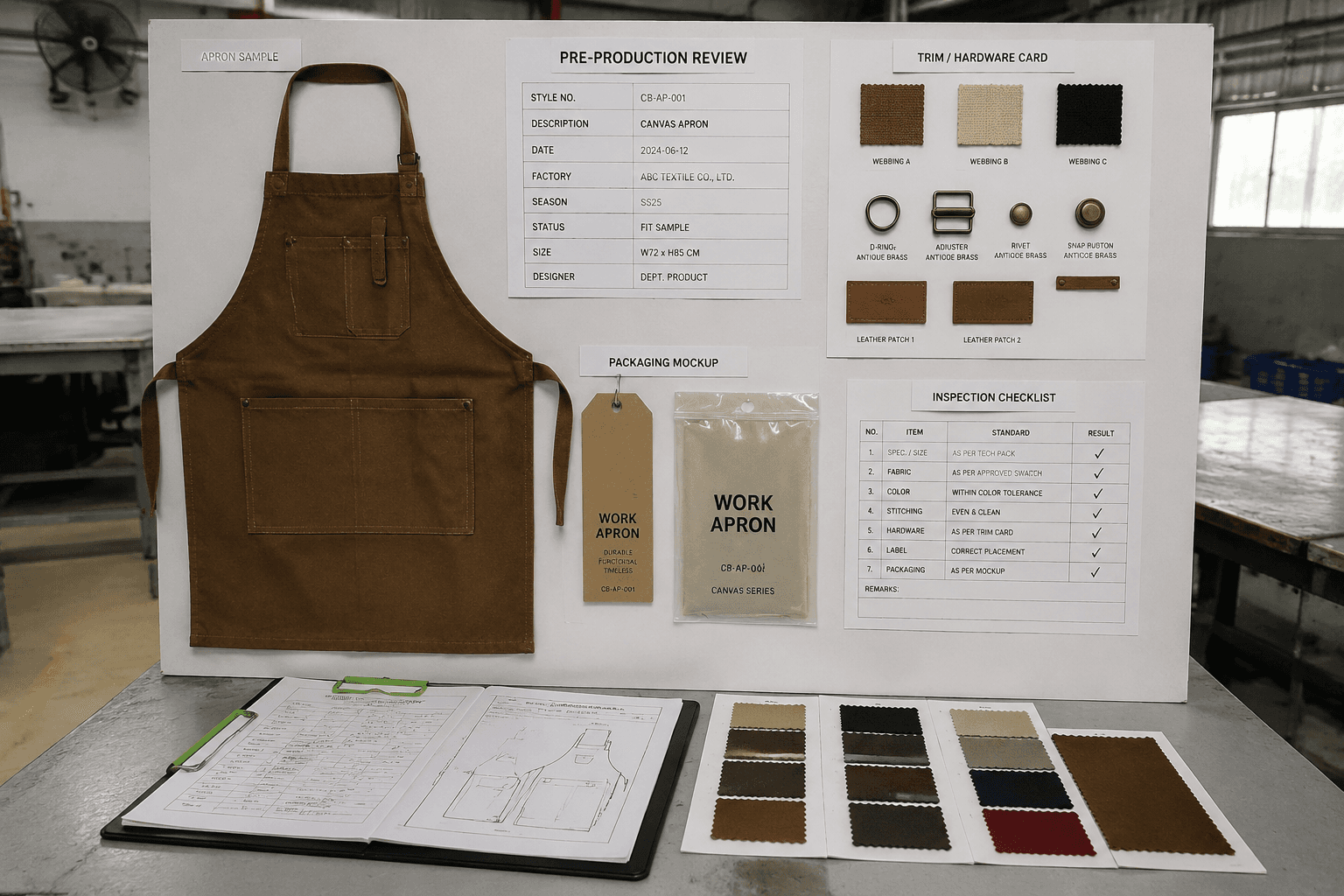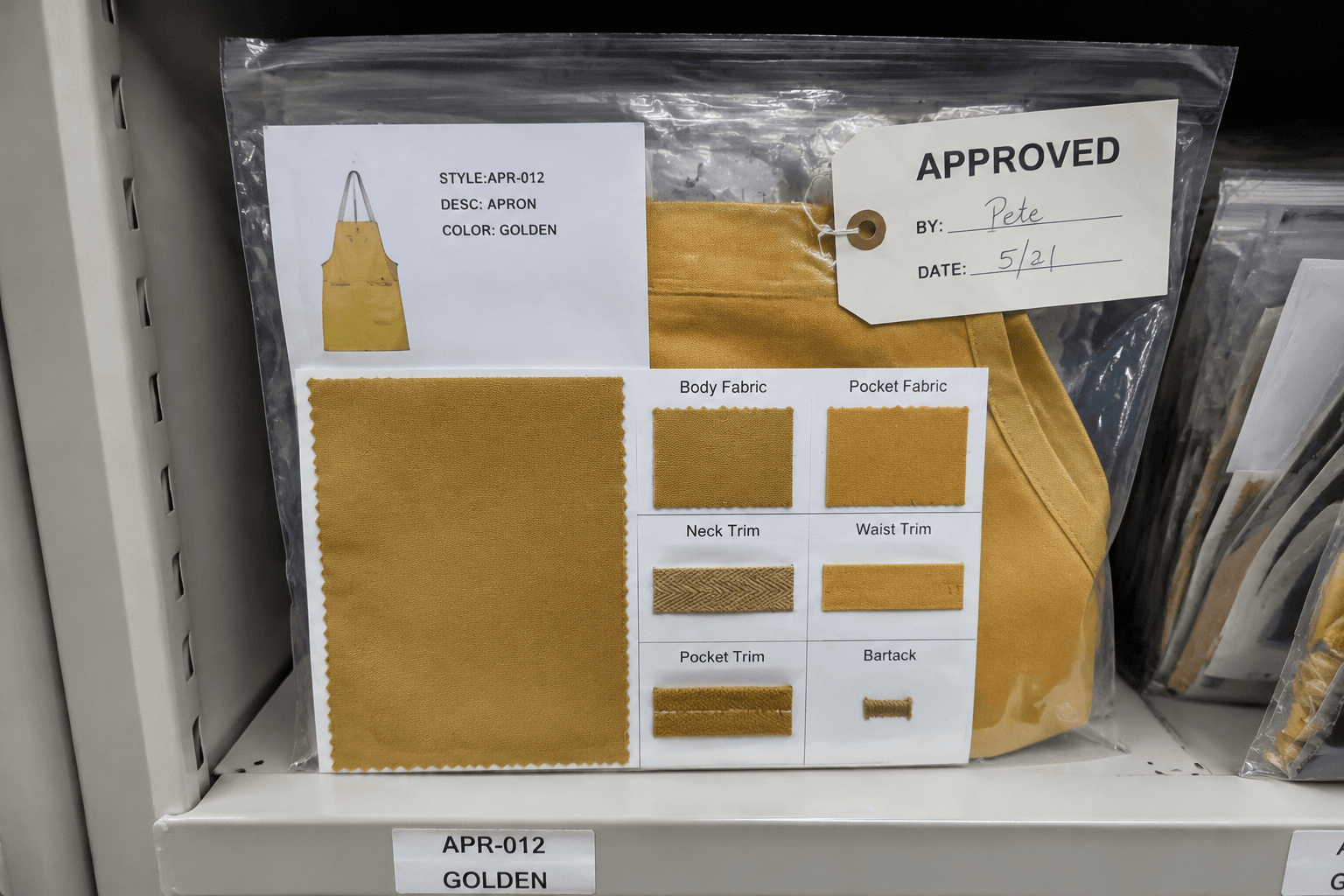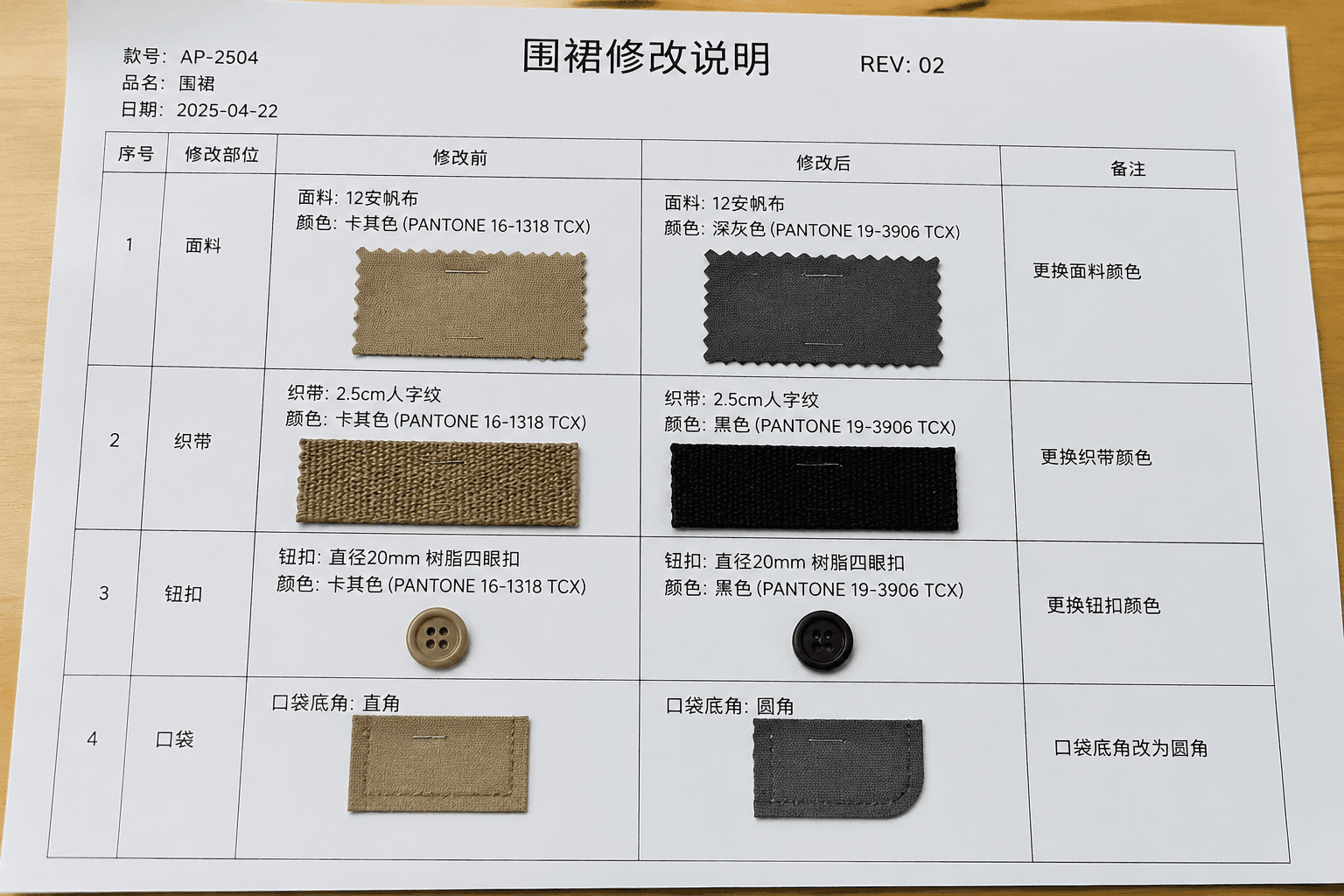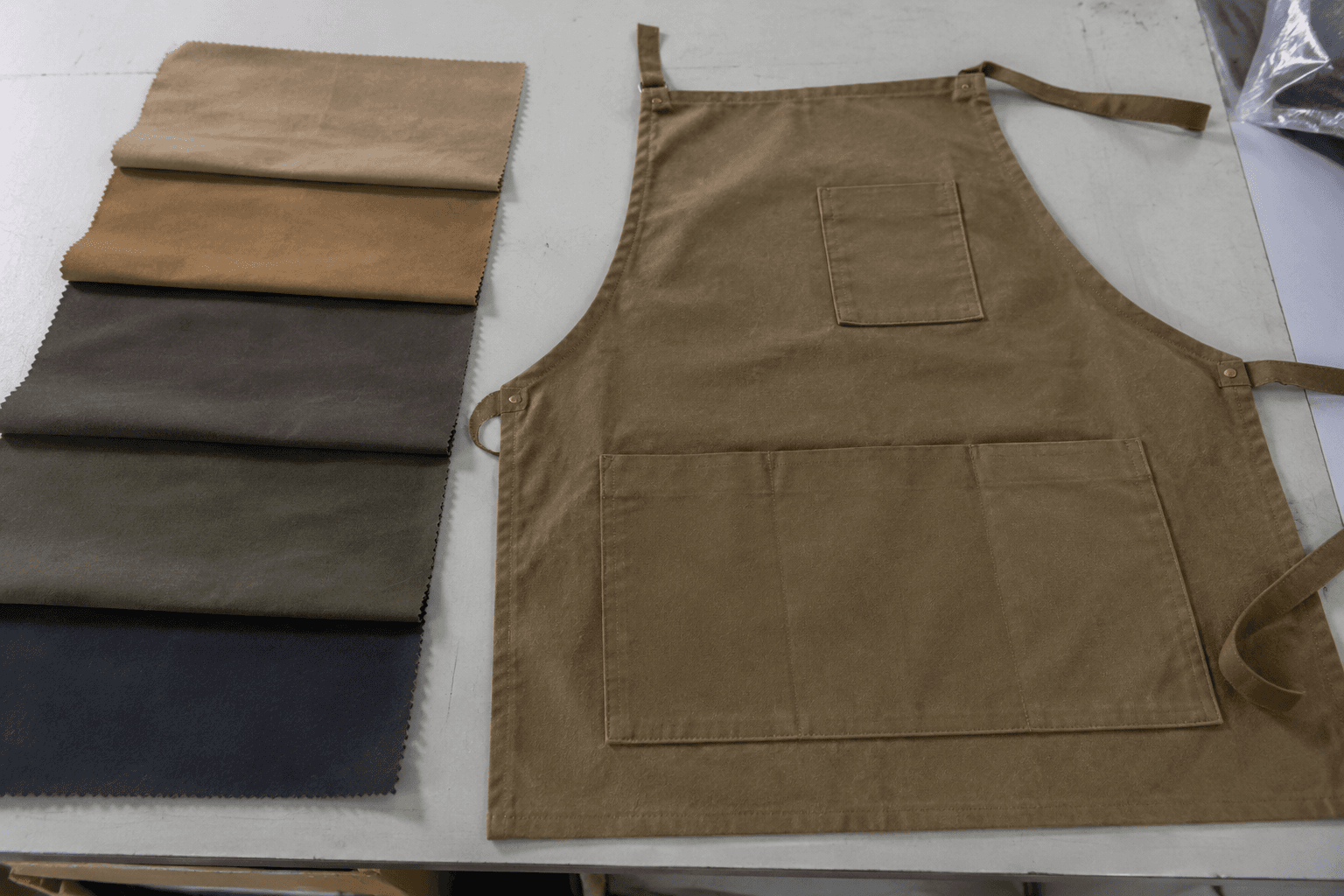
For professional buyers, the core challenge in apron moq multiple lengths is not whether a factory can sew 70 cm, 80 cm, and 90 cm versions. It is whether those lengths can be grouped into one apron program with stable material usage, efficient cutting, and a realistic MOQ per variant. Once every length starts carrying its own pocket shape, strap spec, label set, or packing method, the supplier stops treating the order as one family and starts costing it as several small runs.
In practical factory terms, the fabric delta between adjacent apron lengths is usually modest. On 150 cm to 160 cm wide fabric, moving from a 75 cm bib apron to an 85 cm bib apron often adds about 0.05 to 0.11 meter per piece after seam allowance, hem turn, and marker yield are confirmed. At typical bulk pricing for 240 GSM cotton twill or 8 oz poly-cotton twill, that can mean roughly $0.09 to $0.24 per piece in extra cloth value. The larger swing usually comes from secondary costs: an additional marker, more bundle sorting, more WIP tracking, and slower final packing.
That is why the most reliable sourcing strategy is to standardize the hidden factory variables first and let only the visible body length change. A workable apron program uses one approved fabric, one trim bill, one logo position logic, one carton method, and one inspection rule, then grades length in a controlled way. With that structure, buyers can discuss MOQ, lead time, and FOB pricing with real numbers instead of broad assumptions.
- Keep fabric common across all lengths so the factory can cut from one dyed lot, hold one shrinkage standard, and run one marker family.
- Use one trim bill wherever possible including the same strap width, hardware finish, label pack, thread color, and packing method.
- Separate cloth cost from handling cost because a 10 cm length increase may add only cents in material but much more in sorting and setup if volumes are low.
- Protect MOQ by holding each length above a usable threshold; in many apron factories, 150 to 200 pieces per length is the minimum level before pricing becomes stable.
- Ask for size-by-size costing with fabric meters, trim usage, make-up, decoration, packing, and waste assumptions shown separately.
- Fix quality and lead-time assumptions early such as AQL 2.5 major / 4.0 minor and 25 to 35 days for stock materials, so the quote reflects real bulk conditions.
Why <em>apron moq multiple lengths</em> often rises faster than the fabric cost
Buyers often assume that adding lengths mainly changes fabric consumption. In apron manufacturing, that is only partly true. A 75 cm, 85 cm, and 95 cm bib apron may share the same 72 cm body width, 2.5 cm neck strap, and 90 cm waist ties, yet the factory still has to manage three bundle identities, three cut counts, and three final packing ratios. Those extra controls add labor even when the style is visually simple.
For 240 GSM cotton twill, 8 oz poly-cotton twill, or 10 oz canvas, the material difference between adjacent lengths is usually limited. After marker planning, a 10 cm increase often adds 0.06 to 0.12 meter per piece. At fabric prices of about $1.90 to $3.20 per meter depending on blend and finish, that adds around $0.11 to $0.30 per apron. By contrast, the operational premium from a fragmented order can add another $0.18 to $0.55 per piece through extra marker setup, line balancing, in-line sorting, and carton verification.
MOQ pressure appears when the total order is split too thinly. A factory that is comfortable quoting 400 pieces for one apron length may ask for 600 to 900 pieces total when the same program is split across three lengths, especially if no length exceeds 150 pieces. Below that threshold, waste allowance tends to rise from about 3% to 5% up to 5% to 7%, because the cutting room and packing line lose efficiency.
This is why buyers should view length variation as a production-control issue, not just a pattern issue. If the body fabric, trims, logo location, and hem construction remain identical, the order can still behave like one efficient program. If each length carries unique details, the supplier will cost it closer to a bespoke run.
- A 10 cm length increase often adds only $0.11 to $0.30 in fabric.
- Low per-length volume can add $0.18 to $0.55 in handling cost.
- Many factories want at least 150 to 200 pieces per length for stable pricing.
- Orders under 500 pieces total usually face more MOQ pressure when split across three lengths.
- Printed, washed, or heavily branded aprons need a higher waste and rework allowance than plain solid twill styles.
Standardize fabric and trim first to keep <em>apron moq multiple lengths</em> workable
The fastest way to lose pricing discipline is to let every apron length carry its own supporting materials. When buyers standardize the body fabric and trim bill first, the factory can treat the order as one sourcing package: one greige or dyed lot, one strap tape, one hardware finish, one thread ticket, and one label set. That improves purchasing leverage and reduces the chance of small-lot surcharges.
In a typical foodservice or café program, the common platform might be 240 GSM cotton twill, 65/35 poly-cotton twill at 245 GSM, or 10 oz cotton canvas, all cut in one color lot. The trim package might stay fixed at 2.5 cm herringbone neck tape, 2.5 cm self-fabric waist ties, one antique-brass slider, one main label, one care label, and one polybag format. The lengths change from 70 cm to 80 cm to 90 cm, but the trim architecture does not. That is the point where a mixed-length apron range remains commercially sensible.
Shared trims also protect lead time. If a buyer adds a second buckle finish, a different strap width, or a different label insertion for only one length, the supplier may need to source a separate MOQ from its trim vendor. In practice, that can add 7 to 12 days for hardware and 5 to 10 days for custom labels or printed bags, especially when the alternate item is not in stock.
The same discipline applies to branding and packaging. One barcode position, one fold method, and one carton spec are far easier to control than three variations. On the packing line, these details matter because mixed-SKU orders already demand more verification than a single-length apron order.
- Use one fabric quality and one approved shade across all lengths.
- Keep strap width common, usually 2.0 cm for lighter service aprons or 2.5 cm for standard bib aprons.
- Lock one hardware finish such as nickel, matte black, or antique brass for the full run.
- Hold labels, barcode placement, fold method, and polybag format unchanged across variants.
- Challenge any request for length-specific trim unless it solves a real end-use requirement.
Costing mixed apron lengths with factory-level detail
A credible quotation for mixed apron lengths should show where the cost moves by length and where it should stay fixed. The cleanest format is one base FOB price for the common style plus a defined add-on or deduction by length. That gives the buyer visibility into whether the supplier is charging for real fabric use or quietly building in broad risk premiums.
As an example, consider a bib apron in 240 GSM cotton twill with one front pocket, adjustable neck strap, and self-fabric ties. At 500 pieces in one color, a 75 cm length might quote at about $2.20 to $2.90 FOB depending on fabric origin, trim quality, and packaging. Moving to 85 cm may add around $0.12 to $0.24 if the pocket, ties, and strap package remain unchanged. Moving again to 95 cm may add another $0.10 to $0.22. But if the longer version also increases pocket depth, tie length, or embroidery position complexity, the premium can climb to $0.28 to $0.48 per piece.
Buyers should ask for fabric consumption in meters per length, trim usage per piece, make-up cost, decoration cost, packing cost, and waste percentage. For simple solid-color aprons, a 3% to 5% waste assumption is usually defendable. For reactive prints, washed canvas, enzyme finishes, or placement embroidery, 5% to 8% is more realistic. Without that breakdown, a low quote can hide the fact that the supplier has averaged all sizes together and will later recover margin through surcharges or reduced quality.
The same logic applies to MOQ. A supplier may advertise 300 pieces MOQ for aprons, but that often means 300 pieces for one style in one color with one size profile. Once the order becomes a mixed-length program, buyers should confirm whether MOQ is combined across lengths or whether each length must clear a separate threshold. That distinction materially affects true landed cost.
- Request per-length fabric usage in meters, not one averaged number.
- Separate body, trims, sewing, decoration, packing, and inspection in the quote.
- Check whether MOQ is total-program MOQ or per-length MOQ.
- Use 3% to 5% waste for stable solids and 5% to 8% for washed or printed fabrics.
- Treat a quote without length-by-length assumptions as incomplete for B2B procurement.
Plan production so multiple apron lengths still run like one family
Factories keep pricing workable when they can run multiple apron lengths through one stable sewing route. That means the order should share the same hem sequence, pocket attachment order, bar-tack positions, topstitch gauge, and pressing standard. Three bib apron lengths usually qualify. A bib apron, waist apron, and cross-back apron usually do not, even if the fabric is the same, because the operations differ too much.
In practical scheduling, stock fabric and standard trims can often support a 25 to 35 day lead time after sample approval and deposit. If the buyer requires custom dyeing, yarn-dyed stripes, all-over print, or special hardware, 35 to 50 days is a safer planning window. Small mixed-length runs near the MOQ floor tend to move toward the longer end because line supervisors must stop more often to confirm bundle identity, carton ratio, and label accuracy.
A good master specification limits variation to body length, bib drop, or finished apron drop while holding other measurements steady where possible. Keeping body width constant, preserving one pocket placement grid, and fixing one logo coordinate can save more money than negotiating a few cents off the fabric rate. Those controls also reduce pre-production confusion, which is where many mixed-SKU apron orders start losing time.
From a sourcing standpoint, the question is not how many lengths the brand wants. The better question is how many sewing or packing decisions change from one length to the next. If the answer is more than body drop and finished measurement, the order may already be drifting away from an efficient production family.
- Use one sewing route for all lengths whenever possible.
- Expect 25 to 35 days with stock materials and 35 to 50 days with custom materials.
- Keep body width and pocket layout stable unless the end use requires otherwise.
- Confirm carton ratios before cutting starts to avoid packing delays.
- Avoid mixing structurally different apron types into one MOQ discussion.
Use pattern, cutting, and QC controls that support repeat apron sourcing
The cutting room has a major influence on whether a mixed-length apron order remains economical. When body width stays fixed and only length changes, marker efficiency is usually easier to protect. On a 150 cm to 160 cm fabric width, many suppliers can maintain acceptable marker yield across a 70 cm to 90 cm bib apron range with only a modest efficiency drop. If width changes as well, marker loss can jump by 2% to 6%, which is significant on heavy 280 GSM twill or 10 oz to 12 oz canvas.
Pocket and logo placement should be standardized with the same discipline. If the embroidery or print location shifts by length, the sample team may need separate strike-offs, revised machine coordinates, or extra approval photos. Each step adds time and increases the chance of packing or inspection errors. For a buyer focused on repeatability, those small technical changes are rarely worth the added complexity unless the end market clearly demands them.
Quality control should be defined at the same time as pattern control. For most commercial apron programs, an AQL of 2.5 for major defects and 4.0 for minor defects is a realistic starting point. That standard is easier to maintain when the factory uses one approved measurement chart with controlled length increments, one shrinkage allowance after wash testing, and one packing checklist across all variants.
Repeat business improves when the first order is structured as a replenishment program rather than a one-off negotiation. Many buyers lock one base length and one or two adjacent lengths, then provide an annual forecast of 1,000 to 3,000 pieces so the supplier can plan fabric and trim reservations. That approach reduces price drift on reorders and lowers the risk that one small length variant will fall below an economic MOQ later.
- Keep body width fixed to protect marker efficiency across multiple lengths.
- Standardize pocket and logo coordinates unless market requirements prevent it.
- Approve shrinkage results before finalizing graded finished lengths.
- Use AQL 2.5 major / 4.0 minor as a practical baseline for bulk apron inspection.
- Support reorders with a 1,000 to 3,000 piece annual forecast when possible.
Set reorder rules before the first PO so the program stays commercially usable
A mixed-length apron range is only valuable if it can be repeated without rebuilding the whole cost structure. Buyers should therefore define the commercial rules before the first production order: approved fabric quality, approved trim set, allowed length range, carton ratio, inspection level, and reorder MOQ. Without those controls, the second order often turns into a fresh development cycle with different costs and longer lead time.
A practical replenishment model might use 80 cm as the core length, then 70 cm and 90 cm as controlled adjacent options. If the split is, for example, 500/250/250 in a 1,000 piece order, the supplier can usually manage one fabric lot, one cutting plan family, and one packing standard. If the split becomes 120/130/750 or rotates unpredictably from PO to PO, the shorter lengths may start attracting higher unit prices because their individual run sizes no longer justify efficient cutting and packing.
Buyers should also align warehouse demand with factory carton planning. If one customer group consistently buys the 90 cm version faster, that should be visible in the reorder forecast rather than corrected after stock imbalance appears. Good apron sourcing is not only about FOB cost at shipment; it is about making sure each length is purchased often enough to remain economically viable in future runs.
The most stable apron program is the one that the factory can repeat with minimal new engineering. When fabric, trims, QC rules, and packing logic stay fixed, the apron moq multiple lengths conversation becomes predictable. That is where buyers gain the best leverage: not by pushing every length to the lowest possible first-order quantity, but by structuring the assortment so the factory can quote it as a disciplined, repeatable bulk program.
- Define approved fabric, trims, QC, and carton rules before the first PO.
- Keep adjacent lengths within a forecasted replenishment ratio rather than ordering random small lots.
- Review sell-through by length so future POs stay above economic run size.
- Confirm reorder MOQ by length as well as total-program MOQ.
- Treat repeatability as part of cost control, not only as a supply-chain convenience.