Hotel groups and facility-management buyers often write briefs for supervisor aprons too loosely, then approve samples that are simply smaller room attendant aprons. The result is predictable: pockets sit too low, loaded fronts pull down, radios bounce while walking, and supervisors take the apron off during long inspection rounds. Housekeeping supervisor aprons are not reduced cleaning aprons. They are light-utility uniform pieces built for room-release checks, key control, floor walks, guest-area movement, and fast note-taking across 8- to 10-hour shifts.
The specification gap is measurable. A room attendant apron commonly uses 240 to 300 GSM fabric, larger lower pockets, and heavier reinforcement because it may carry cloths, liners, spray bottles, or amenity stock. Supervisor and inspector aprons usually perform better at 180 to 240 GSM with 3 to 5 storage positions, lower garment weight, and fewer overlapping seam areas. In OEM production, that can reduce fabric consumption by 0.08 to 0.18 meters per piece, trim sewing time by about 6 to 14 minutes per dozen, and lower FOB cost by roughly $0.20 to $0.70 per piece, depending on trim count and order volume.
For B2B buyers, the key sourcing question is not whether the apron looks neater than attendant styles. The real question is whether it carries the correct tools cleanly through repeated shifts, survives 40 to 60 commercial wash cycles, and can be reordered without shade drift, pattern inconsistency, or fit complaints. The strongest RFQs define carried items, target GSM, pocket dimensions, radio position, laundry method, AQL level, carton limits, and replenishment timing before sampling starts.
- Housekeeping supervisor aprons generally perform best at 180 to 240 GSM, with 200 to 220 GSM the safest range for most hotel and facility-management programs.
- A practical layout usually means 3 to 5 storage positions: one phone or note pocket, one radio location, 2 to 3 pen slots, and one key loop or short webbing tab.
- Removing oversized lower pockets, heavy facings, and unnecessary hardware can cut fabric use by 0.08 to 0.18 meters per piece and reduce FOB by about $0.20 to $0.70 per piece.
- For commercial laundry, set shrinkage below 3%, colorfastness to washing at grade 4 minimum, and bartack reinforcement at all stressed pocket corners and tie or strap joints.
- Typical China OEM benchmarks are MOQ 300 to 500 pieces for stock-fabric styles, 1,000 or more for custom color, sample lead times of 5 to 14 days, and bulk lead times of 25 to 40 days after approvals.
Why housekeeping supervisor aprons need a different load plan than room attendant aprons
Supervisors and inspectors move through a property with a different load profile from room attendants, so the apron pattern has to start there. A room attendant may carry cloths, guest supplies, refill stock, liners, and spray bottles. A supervisor usually carries a smartphone or hotel handset, a radio, a key set or master cards, 2 to 3 pens, folded inspection notes, and sometimes light gloves. Reusing an attendant pattern for this role creates excess depth, excess swing, and unnecessary weight on the center front.
The better sourcing approach is to classify housekeeping supervisor aprons as light-utility aprons. In practical terms, that means one medium phone or document pocket, one stable radio position, one divided pen section, and one key attachment point instead of two oversized lower patch pockets. If the apron drags forward when the wearer bends to inspect a vanity edge, reaches into a wardrobe, or opens several guestroom doors in sequence, the layout is already overbuilt.
This distinction also matters in manufacturing. Fewer large pocket panels mean fewer seam intersections, less topstitching congestion, and less needle heating through thick overlap zones. On an order of 3,000 pieces, simplifying a supervisor layout in the same fabric and color can recover roughly 2 to 4 factory days compared with a room-attendant-style apron loaded with extra pocketing and reinforcement.
- Typical carried items: smartphone, radio, master key set or key cards, 2 to 3 pens, folded notes, disposable gloves.
- Practical storage count: 3 to 5 functional positions.
- Typical finished weight target: about 180 to 260 g per piece for supervisor styles, versus 240 to 360 g for heavier attendant aprons.
- Most common wearer-trial complaints: deep sagging pockets, front pull, poor radio placement, and ties that loosen during long walks.
Fabric specifications for housekeeping supervisor aprons: 180 to 240 GSM with real cost targets
Fabric weight is the first control point because it affects comfort, pocket stability, laundry life, and total garment cost. For supervisor use, the workable range is usually 180 to 240 GSM. Below 170 GSM, pocket mouths tend to collapse, the garment twists more easily after wash, and shape retention drops once a radio or large phone is added. Above 240 GSM, the apron starts to behave like attendant workwear unless the pattern is stripped back very aggressively.
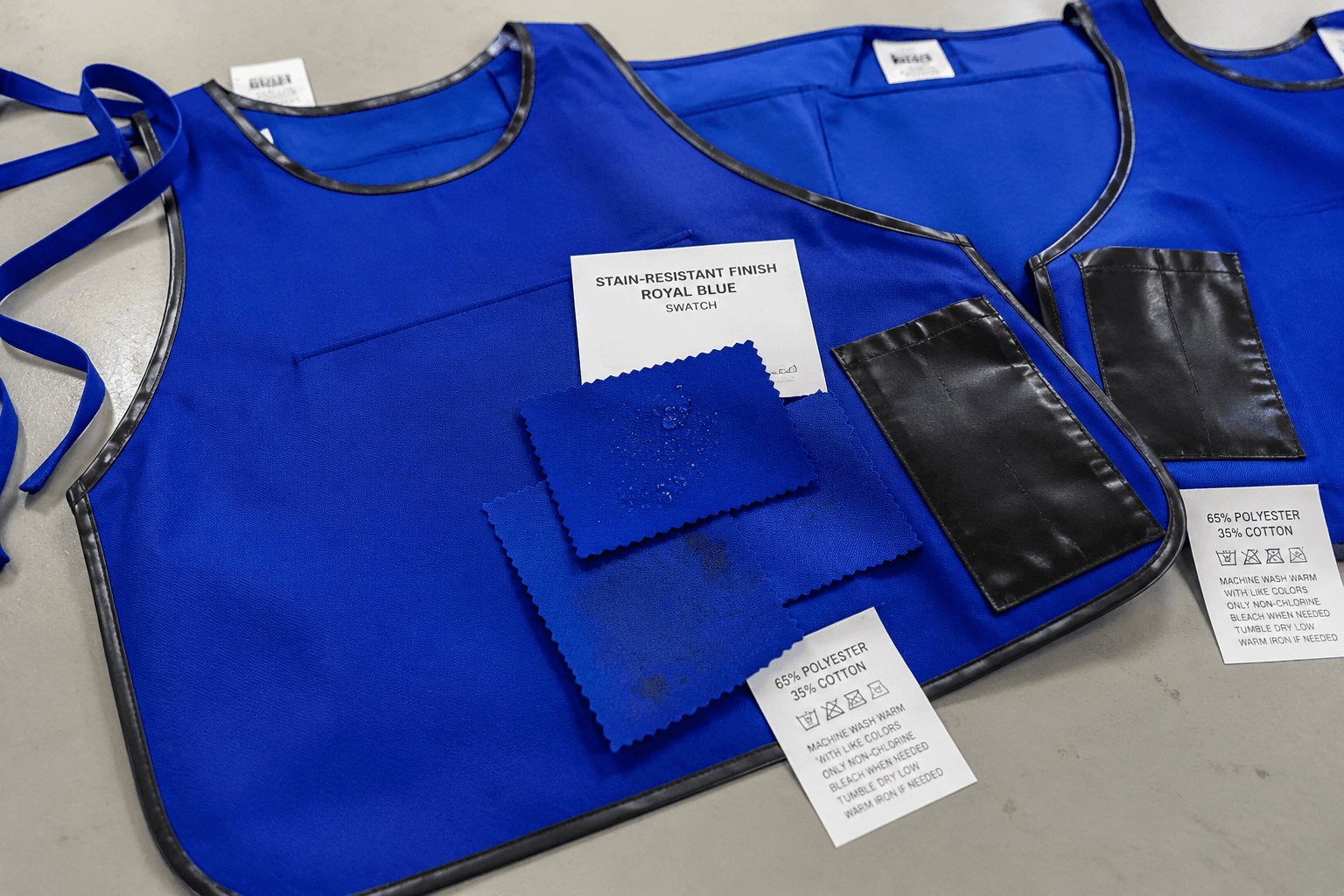
For most hotel chains, 200 to 220 GSM is the safest middle band. It gives enough body for stable openings and acceptable commercial-laundry performance while staying cooler than heavy twills. Standard 65/35 poly-cotton twill remains the most practical shell because it balances price, wrinkle control, and color retention. An 80/20 poly-cotton blend can offer a softer hand but usually adds cost and may need closer shrinkage control. Plain weave works for low-cost waist aprons, but twill normally holds pocket shape better after repeated laundering.
Buyers should benchmark price against the full build, not GSM alone. At around 3,000 pieces, a simple waist apron in 200 GSM twill with three functional pockets and stock fabric color can often land at about $1.55 to $1.95 FOB China. A bib apron in 210 to 220 GSM with cross-back straps, divided pockets, a woven brand label, and a webbing radio tab more commonly sits at $2.40 to $3.20 FOB at the same quantity. Embroidery, custom dyeing, branded polybags, individual size stickers, carton marking rules, or third-party lab testing will raise that number.
- 180 to 200 GSM: suitable for warm climates, low-load inspection rounds, and lighter waist styles.
- 200 to 220 GSM: best all-round range for hotel groups balancing comfort and durability.
- 220 to 240 GSM: suitable when the apron must support a radio, heavier key set, or more structured pocket openings.
- Preferred shells: 65/35 poly-cotton twill, 80/20 poly-cotton twill, and plain weave only for budget waist programs.
- Recommended shrinkage target after washing: under 3% in both warp and weft.
Pocket dimensions and tool placement that work on inspection rounds
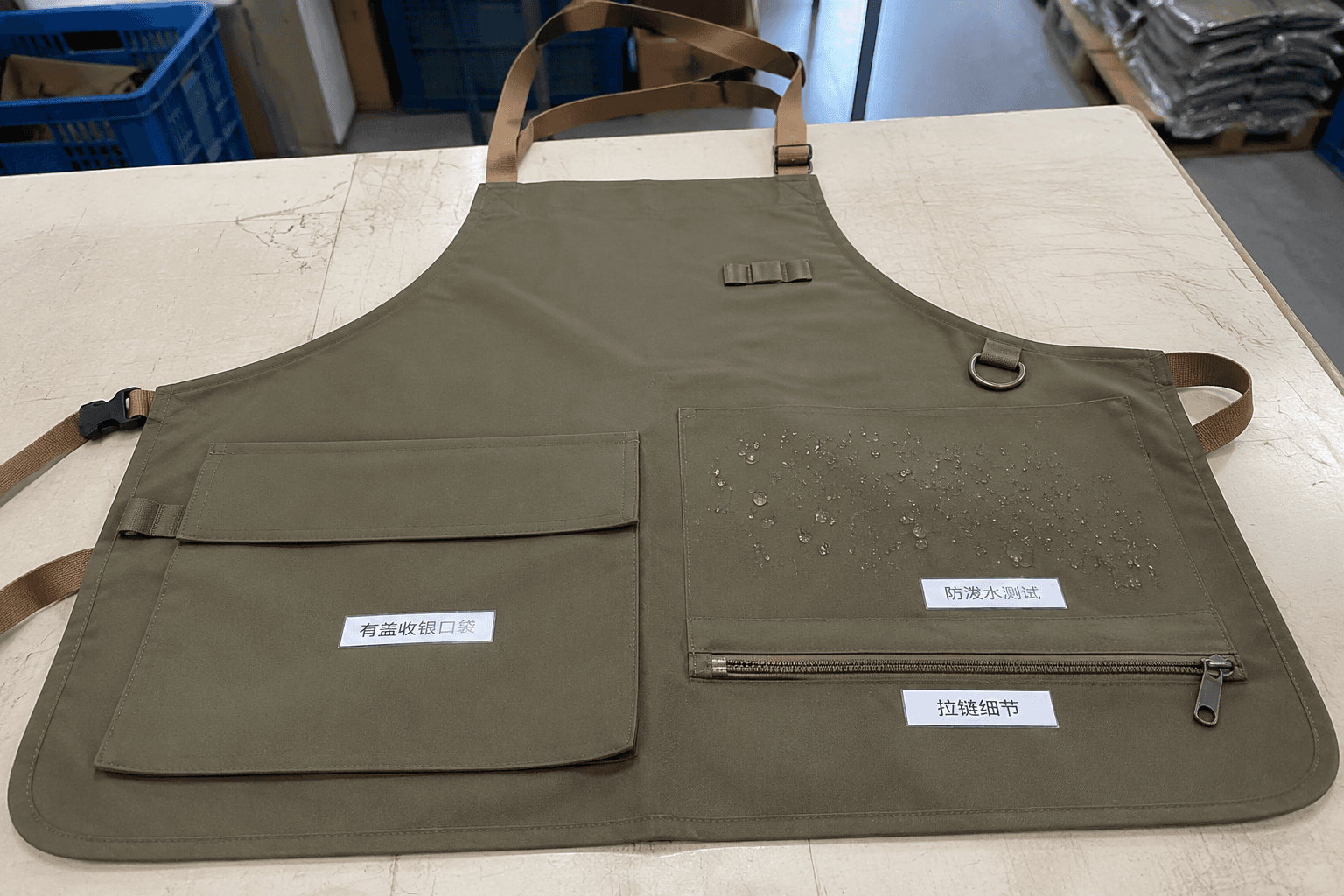
Pocket planning should begin with actual carried-item measurements, not a generic request for more utility. Supervisors need one-handed access to a phone, radio, pens, keys, and room-check notes without stacking everything into one cavity. This is where many samples fail. The factory adds deep front pockets because they look useful on paper, but once loaded the apron becomes front-heavy, swings while walking, and bunches at the waist.
A workable specification uses real dimensions. Pen slots at 1.5 to 2.0 cm finished width will usually secure standard ballpoints and slim markers. A phone pocket opening of 9.0 to 10.5 cm generally fits most company-issued smartphones with slim protective cases. Main utility pocket depth of 16 to 19 cm is enough for folded inspection sheets or gloves without creating the long sag associated with attendant aprons. If a radio is used every shift, a reinforced side sleeve, upper side tab, or 2.5 cm webbing loop usually performs better than dropping it into a front patch pocket.
Position matters as much as size. Heavy items on the center front interfere with bending and create visible pull lines. Chest pockets are acceptable for pens, slim cards, or a folded checklist, but they are a poor position for heavier phones because bounce increases during walking. Many buyers get better wearer feedback from a waist or hip arrangement with one higher divided pocket line. A hidden key loop or 6 to 8 cm external webbing tab is typically faster, quieter, and more secure than placing keys into a deep open pocket.
- Bartack all pocket corners, radio tabs, and tie or strap join points.
- Keep bulky items away from center front to improve bending comfort and garment balance.
- Test samples with actual hotel devices, not paper dimensions only.
- Avoid lower cargo pockets deeper than 20 cm unless supervisors also handle amenity replenishment.
- Set pocket placement tolerance at plus or minus 0.5 cm on approved production specs.
Waist or bib housekeeping supervisor aprons: selection rules by climate, load, and guest visibility
The waist-versus-bib decision should be based on work routine, not appearance alone. Waist aprons are lighter, cooler, and faster to issue at shift start, so they are often the better choice for floor supervisors who already wear branded shirts and only need organized accessory carry. Bib aprons distribute load more evenly when a radio, phone, keys, and notes are all carried at once, but they can feel excessive for inspection-led roles where the carry load is light and movement is constant.
In warm or humid properties, a waist apron in 180 to 210 GSM usually drives better wear compliance because staff are less likely to remove it mid-shift. In luxury hotels, serviced residences, and premium facility-management contracts, a bib apron at 200 to 220 GSM can create a cleaner uniform line in corridors and public areas, especially when supervisors spend time in front of guests. Neither format is automatically better. The correct choice depends on carried weight, ambient temperature, and the visual hierarchy of the uniform program.
For multi-property procurement, the practical method is to standardize one shell fabric, one approved shade standard, and one branding method across the housekeeping department while splitting the pattern by role. That keeps replenishment simpler than managing unrelated SKUs, yet it avoids forcing supervisors into an overbuilt attendant style. In repeat-order programs, this two-layout approach usually reduces wearer complaints without adding major inventory complexity.
- Waist aprons typically use about 10% to 18% less fabric than comparable bib aprons.
- Bib aprons are usually the better choice when a radio, phone, and key set are carried daily.
- Waist styles are easier for locker storage, faster to issue, and usually cheaper to replace.
- Shared fabric across role-specific patterns helps maintain shade continuity on repeat orders.
Laundry performance and QC standards buyers should write into the PO
Supervisor aprons do not need the same heavy build as cleaning-support gear, but they still need to survive commercial laundering without losing shape or function. The most common failures are pocket-edge fray, tie or strap seam breakage, twisted side seams after tumble drying, and shade loss on black, navy, or charcoal programs. These problems usually come from weak reinforcement, poor seam balance, unstable finishing, or mismatch between shell fabric and laundry process, not from GSM alone.
A well-made 210 GSM poly-cotton apron with balanced seam construction and correct bartack placement will often outlast a poorly made 260 GSM apron. Buyers should ask for test data tied to the exact approved shell fabric, thread count, and trim set rather than a generic report from a similar style. For hotel and facility-management tenders, pre-bulk checks should include shrinkage, colorfastness to washing, seam slippage, and pilling. If the laundry uses chlorine, peroxide, tunnel finishing, or high-heat tumble drying, that needs to be declared before fabric booking.
Quality standards should appear in the purchase order and approval record, not in side emails. AQL 2.5 for major defects and AQL 4.0 for minor defects is a common benchmark for professional apron programs. Stitch density should stay consistent at pocket tops, side joins, tie joins, and strap joins. If embroidery, woven labels, contrast bartacks, or custom bindings are used, define placement tolerance in millimeters and agree shade tolerance against the approved standard. It is much cheaper to settle those points before PP approval than after goods are needed for a hotel opening or seasonal rollout.
- Target wash-life benchmark: 40 to 60 commercial wash cycles for standard hotel use.
- Recommended QC benchmark: AQL 2.5 major, AQL 4.0 minor.
- Set colorfastness to washing at minimum grade 4 for core dark shades where achievable.
- Use practical trims such as webbing loops and reinforced fabric tabs instead of decorative metal in industrial laundry environments.
- Define logo placement tolerance at plus or minus 3 mm and finished garment measurement tolerance at plus or minus 1 cm unless the style requires tighter control.
MOQ, sampling stages, and lead-time controls for OEM apron sourcing
MOQ depends mainly on fabric source, color strategy, and customization level. Many China factories can produce stock-fabric supervisor aprons from about 300 to 500 pieces per color for basic waist or bib styles. Once the buyer requests custom-dyed fabric, woven labels, embroidery, revised strap lengths, special packing, or mixed-size assortments, MOQ usually rises to 1,000 to 3,000 pieces per color or style. Costs improve when several properties standardize the same fabric, branding, and shade while varying only the pattern.
Sampling should be managed in stages with sign-off at each point. A practical sequence is tech pack review, proto sample, wearer-trial sample, and PP sample. For housekeeping supervisor aprons, the biggest delays usually come from unclear pocket widths, repeated logo-position changes, strap-length complaints, and disagreement over whether the radio should clip externally or sit in a pocket. Buyers who send actual device dimensions, shift-role notes, and laundry conditions often save one full sample round and 7 to 12 calendar days.
Bulk production usually runs 25 to 40 days after deposit, material confirmation, and PP approval. A simple stock-fabric waist apron may be ready in 20 to 25 days at moderate quantity. A customized bib apron with embroidery, woven labels, and custom-color shell often needs 30 to 45 days because dyeing and trim preparation extend the pre-cutting stage. At inquiry stage, buyers should already define target FOB, GSM, carried items, AQL standard, packing ratio, carton weight limit, and replacement tolerance. When those controls are added after pricing, quotation accuracy drops and sample revisions multiply.
- Sample lead time: 5 to 10 days for basic styles; 10 to 14 days for customized versions.
- Stock-fabric MOQ: typically 300 to 500 pieces per color.
- Custom-color MOQ: commonly 1,000 pieces or more, depending on mill minimums.
- Bulk lead time: usually 25 to 40 days after approvals are locked; 30 to 45 days for custom-color or trim-heavy styles.
- Best RFQ inputs: target GSM, apron type, carried items, logo method, laundry process, AQL, packing ratio, carton limit, and FOB target.
What buyers should include in an RFQ for housekeeping supervisor aprons
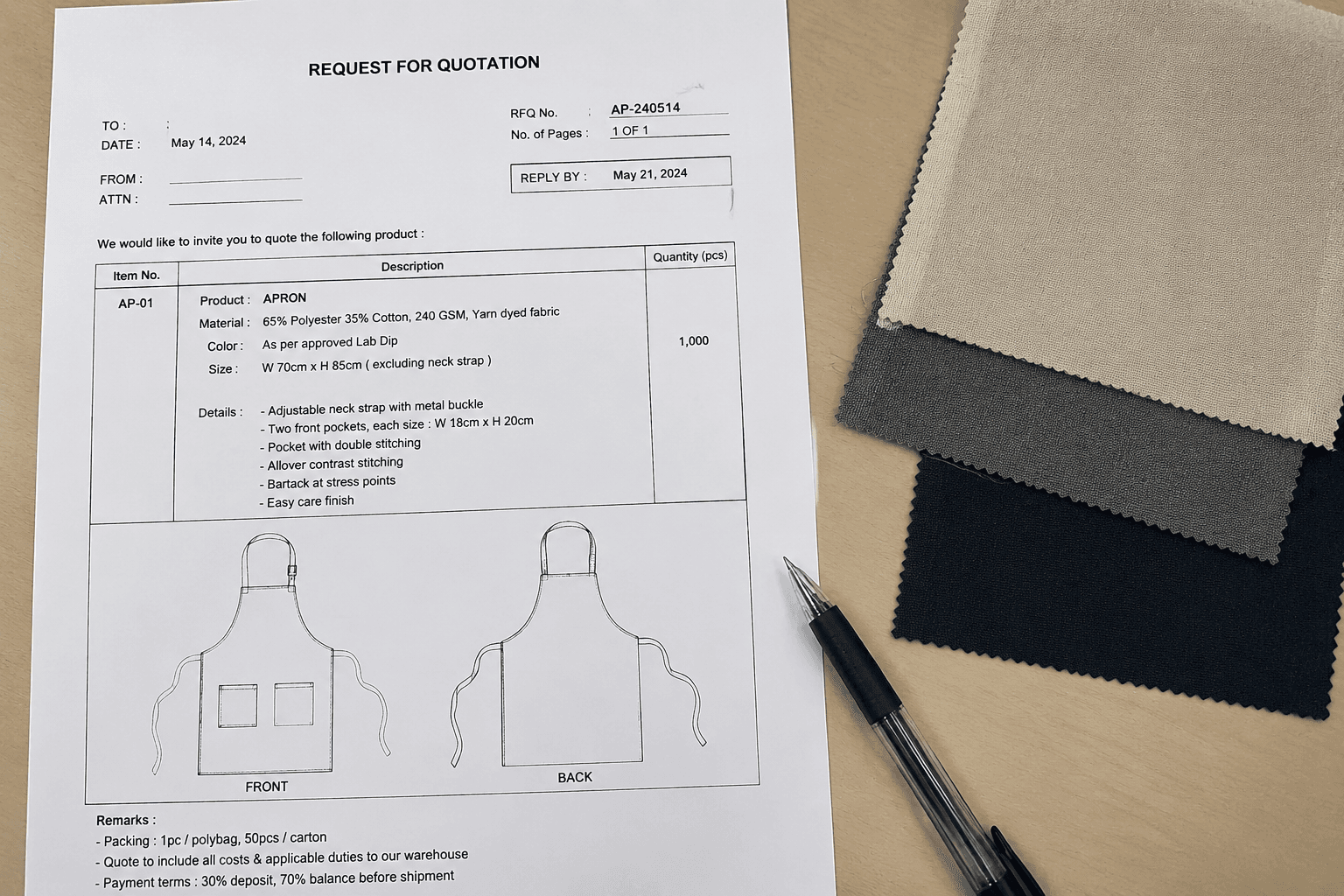
The strongest RFQs remove guesswork before sampling starts. Factories price faster and sample more accurately when the buyer states the role clearly: housekeeping supervisor, inspector, executive housekeeper support, or mixed-use floor management. That role definition drives whether the apron needs a radio tab, a note pocket, a key loop, or only basic pen storage. It also prevents the supplier from defaulting to a room attendant pocket map.
A useful RFQ should specify fabric weight, composition, color reference, apron type, exact storage needs, logo method, laundry conditions, QC standard, and target price band. If the buyer already knows that the property wants 200 to 220 GSM 65/35 twill, 4 storage positions, a 10 cm phone pocket, and a radio loop on the wearer's right side, sampling moves much faster than a brief asking for a practical supervisor apron. Buyers should also confirm whether the garment will be commercially laundered, line dried, or tumble dried, because those conditions affect shrinkage, thread choice, and reinforcement.
For replenishment programs, the RFQ should also cover continuity controls. That means approved shade standard, repeat-order tolerance, trim continuity, carton labeling, and whether partial replacements will be needed within 10 to 15 working days during high season or pre-opening periods. These points are routine in professional sourcing, but they are still missed often on apron programs because the unit price looks small. In practice, the low ticket value makes spec discipline more important, not less, because the product is easy to underdefine.
- State the job role clearly so the factory does not default to room attendant construction.
- Specify fabric composition and GSM, not just durable poly-cotton.
- List actual carried items and indicate left or right placement for radio and key attachment.
- Declare laundry method, QC standard, packing rules, and required replenishment speed.
- Include a target FOB range so trim choices stay aligned with budget from the start.