Dark kitchens and ghost kitchens buy aprons as consumable workwear, not front-of-house uniform pieces. In a delivery-led operation, aprons absorb fryer oil, soy sauce, chili paste, tomato base, flour dust and sanitizer splash, then go through repeated 40-75°C washing and mechanical extraction. In many sites, each apron is washed 4-7 times per week. That makes sourcing decisions less about appearance at receipt and more about wash survival, drying speed, stain camouflage and how quickly stock can be replenished when units fail or disappear.
For that reason, dark kitchen apron sourcing should be managed as a cost-per-wear program. A bib apron at $2.15 FOB that loses color, twists ties or shrinks out after 25-30 commercial washes is often more expensive than a $2.80 apron that holds shape and shade for 75 washes. The same logic applies to logistics: one emergency air shipment can add $0.80-$1.80 per apron equivalent and erase the saving from negotiating a few cents off the opening order.
The strongest B2B programs are standardized early. Buyers who lock a repeatable bib apron in black, charcoal or dark navy, specify 245-270 GSM poly-cotton twill, define laundry chemistry, set AQL levels and establish monthly call-off rules usually see fewer complaints and lower total handling cost. Buyers who keep changing styles, fabrics or trims often create longer lead times, higher MOQ and more inconsistent field performance.
- For dark kitchen apron sourcing, black, charcoal and dark navy usually outperform light colors because they mask oil and sauce better and look more consistent through repeated washing.
- A commercial sweet spot for professional bib aprons is typically 245-270 GSM in 65/35 or 80/20 poly-cotton twill, balancing dry time, seam stability, wearer comfort and repeat-order continuity.
- Construction drives life span as much as fabric. Tie attachment, bartacks, pocket layering, shrinkage control and trim selection directly affect field failure rate.
- Stock-supported core styles can often open at 500-1,000 pcs per color per style, while custom-dyed fabrics, branded hardware or multiple size splits usually push MOQ to 1,500-3,000 pcs.
- Indicative FOB pricing is commonly $2.10-$3.20 for basic twill bib aprons and $2.80-$4.20 for builds with webbing ties, adjusters or embroidery.
- Monthly or bi-monthly call-off planning can cut repeat lead time by about 5-10 days and reduce the need for air freight.
- A practical QC baseline is AQL 2.5 for major defects and 4.0 for minor defects, backed by wash shrinkage, seam strength, GSM and shade checks against the actual laundry route.
Start dark kitchen apron sourcing with the laundry route, not the mood board
In dark kitchens, apron performance is decided in laundry conditions before anyone judges appearance on the line. One shift can leave an apron with oil splash, sauce staining, flour dust, condensation marks from chilled prep and sanitizer residue from wipe-down routines. If the apron then goes through industrial washing at 60-75°C with alkali detergent and heavy extraction, weak construction fails quickly even when the pre-production sample looked acceptable.
That is why dark kitchen apron sourcing should begin with a written wash profile. Buyers should state whether aprons are washed in-house at 40-60°C, outsourced to a laundry at 60-75°C, line dried, tunnel finished or tumble dried. These details change what fabric blend, tie construction and trim package make sense. A supplier that is only told to make a 'durable kitchen apron' will fill in the blanks differently from a supplier that is told to hit 75 commercial wash cycles, under 3% shrinkage and no tie failures under the approved wash route.
For most delivery-only kitchens, lighter cotton-rich fabrics are a poor fit. A 180-210 GSM cotton apron can feel soft at first issue, but it absorbs grease more deeply, dries more slowly and tends to show earlier visual fatigue. In contrast, a 245-270 GSM poly-cotton twill gives a more stable workwear base for repeated laundering, especially when aprons need to return to service within the same day or next day.
A buyer should also define what counts as acceptable aging. Some operators can tolerate a gradual matte finish after 40 washes as long as the apron stays structurally sound. Others need stricter appearance retention because the production line is visible on social media or open kitchen footage. Those expectations affect fabric choice, shade selection and the true cost-per-wear target.
- Write the laundry route into the tech pack: in-house 40-60°C or industrial 60-75°C.
- Set a measurable wash-life target such as 50, 75 or 100 cycles.
- State shrinkage tolerance, commonly under 3% after the approved wash process.
- List the main soils by station, such as fryer oil, chili sauce, flour and sanitizer residue.
Choose fabric and shade for stain camouflage, drying speed and repeatability
The most reliable apron color for this channel is not always the deepest black on the hanger. True black hides oil, soy and red sauce well, but it can show flour dust, bleach spots and dried starch sharply. That is why many professional buyers settle on black, charcoal, dark graphite or dark navy after wash trials rather than by swatch alone. These shades usually provide a better balance between grease camouflage and powder-soil visibility.
Fabric structure matters almost as much as color. A 2/1 or 3/1 twill in the 245-270 GSM range generally hides abrasion and mixed kitchen staining better than a lighter plain weave. The face remains more even after repeated washing, and the handfeel stays closer to the opening standard across multiple production lots. Brushed finishes can feel softer in a showroom, but in active kitchen use they often hold lint, flour and dry batter, which makes the apron look tired earlier.
For fiber content, 65/35 poly-cotton twill is usually the safest commercial center. It gives acceptable comfort, stable sewing behavior and practical FOB pricing. An 80/20 blend can shorten drying time further and improve shape retention, which helps operations that cycle aprons aggressively through wash and reissue. Pure cotton generally underperforms for ghost kitchen use because it takes longer to dry, absorbs grease quickly and shows more shrinkage variation between lots.
Repeatability matters just as much as initial performance. Stock-supported black or navy twills are easier to replenish in 20-30 days on repeat orders because mills already run these shades in volume. A custom melange charcoal or special-dyed seasonal color may look distinctive, but it often extends production to 35-50 days and pushes MOQ from around 800-1,000 pcs to 1,500-3,000 pcs per color. For buyers managing multiple sites, that extra complexity rarely improves operational value.
- Commercial fabric range: 245-270 GSM twill for most bib apron programs.
- Preferred blends: 65/35 for balance, 80/20 when faster drying is a priority.
- Core shades: black, charcoal, dark graphite and dark navy.
- Approve colors only after wash trials for oil marks, red sauce shadowing, flour contrast and detergent residue.
Use lean construction to reduce failure points and speed laundering
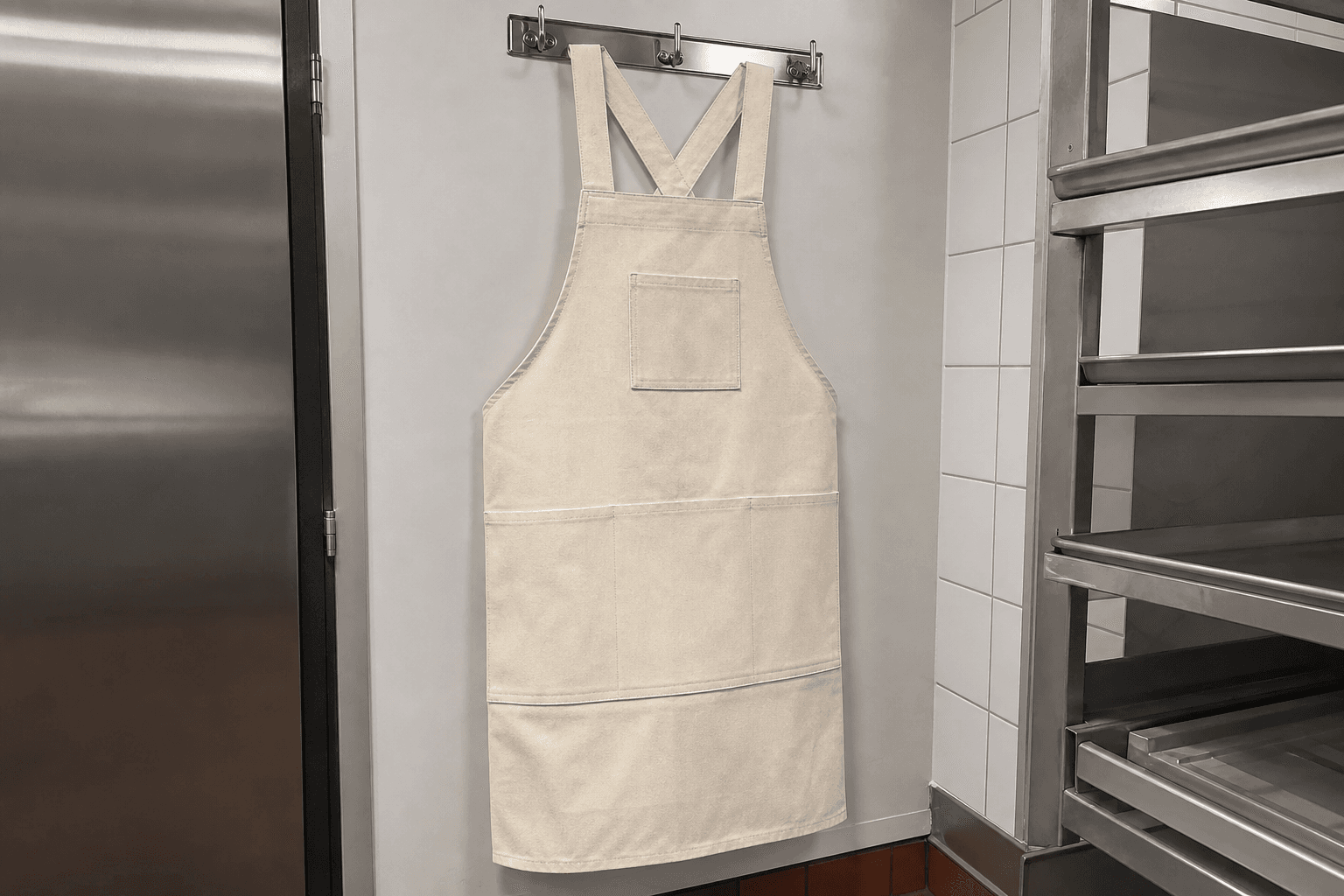
A dark kitchen apron should be built like repeat-use workwear, not embellished uniform fashion. The simplest commercial winner is usually a one-piece bib body with one practical patch pocket, limited overlapping layers and minimal decorative additions. Heavy embroidery backings, contrast panels, extra facings and oversized divided pockets add sewing minutes, trap water and increase the time each apron spends drying. In a high-turnover kitchen group, those details raise operating cost without improving utility.
Weight discipline is part of laundering efficiency. Some buyers request 300 GSM or heavier cloth because they assume more weight means longer life. In practice, that often creates a wet, slow-drying apron that is uncomfortable at hot stations and more expensive to process every wash. A bib apron in 250-270 GSM fabric usually lands around 220-290 grams depending on dimensions and pocket layout, which is enough substance for daily work without becoming a laundry penalty.
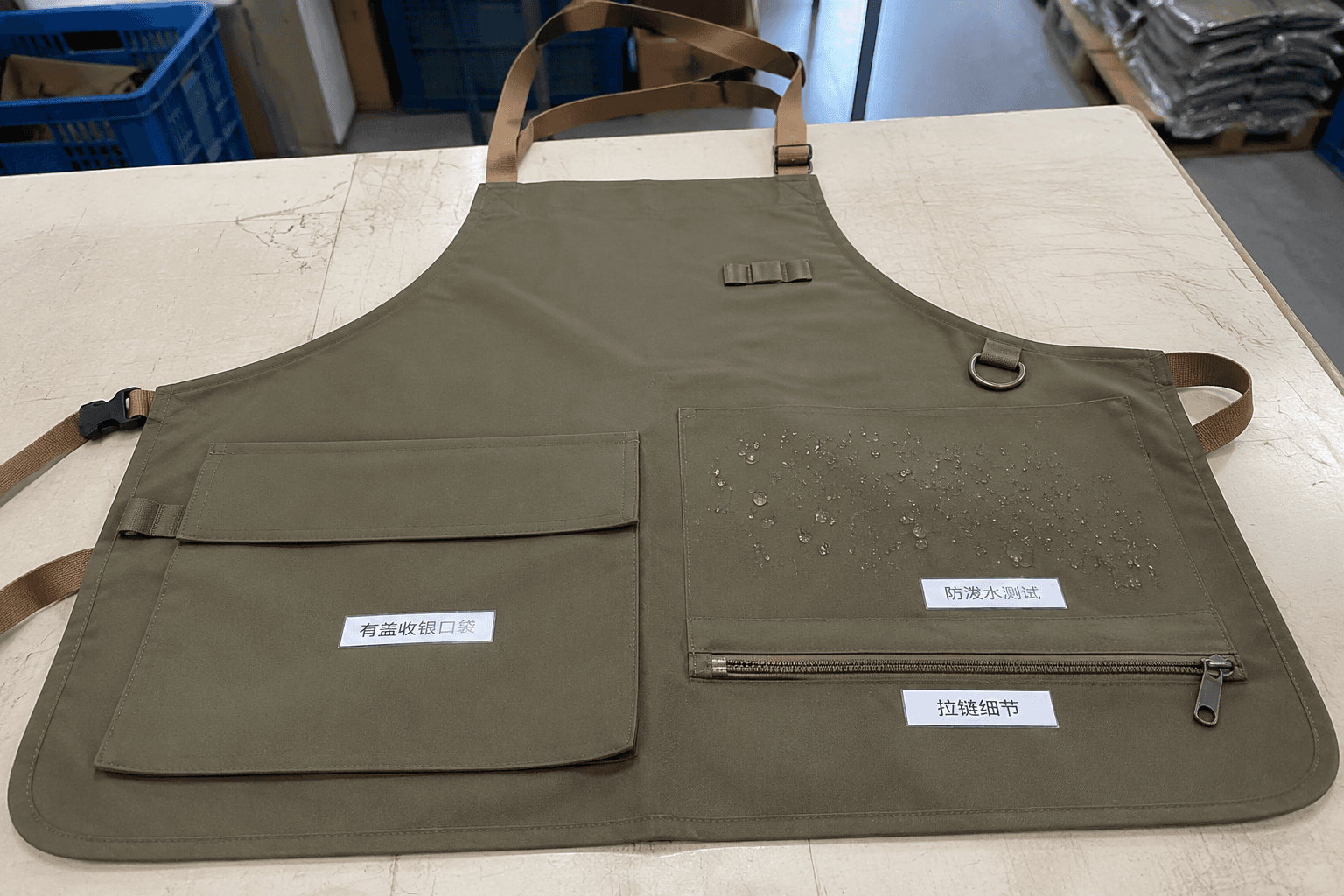
Tie construction deserves close review because it is one of the first field failure points. Self-fabric ties can match visually, but they are more likely to twist, rope or stress the seam under repeated extraction. Many factories get better long-run results with 1.5-2.5 cm webbing ties attached with bartack reinforcement. If adjustability is required, engineering-grade plastic sliders are often more suitable than metal components because they reduce rust risk and simplify washing, provided the slider passes pull testing and heat exposure under the actual laundry route.
Pocket design should also stay restrained. One medium patch pocket is enough for occasional order slips, pens or a thermometer. Large multi-compartment pockets hold debris, stay wet longer and become a common point of seam breakdown. In professional B2B sourcing, every extra layer should justify itself in wash time, utility and defect risk.
- Keep the body simple: one-piece bib layout with one practical patch pocket.
- Use bartacks at tie joins and pocket corners; 28-42 stitches is a common reinforcement range.
- Prefer webbing ties or tightly controlled self ties tested under extraction conditions.
- Reject trims that increase rust risk, snag risk or drying time.
Standardize SKU design before negotiating MOQ, FOB and lead times
Many buyers try to negotiate cost before they stabilize the apron specification. That usually weakens the result. In dark kitchen apron sourcing, the bigger saving often comes from SKU discipline: one approved body size, one oversize option if needed, one logo position, one pocket layout and one trim package. When the style is fixed, factories can quote against the same assumptions, and replenishment becomes faster and easier to compare across suppliers.
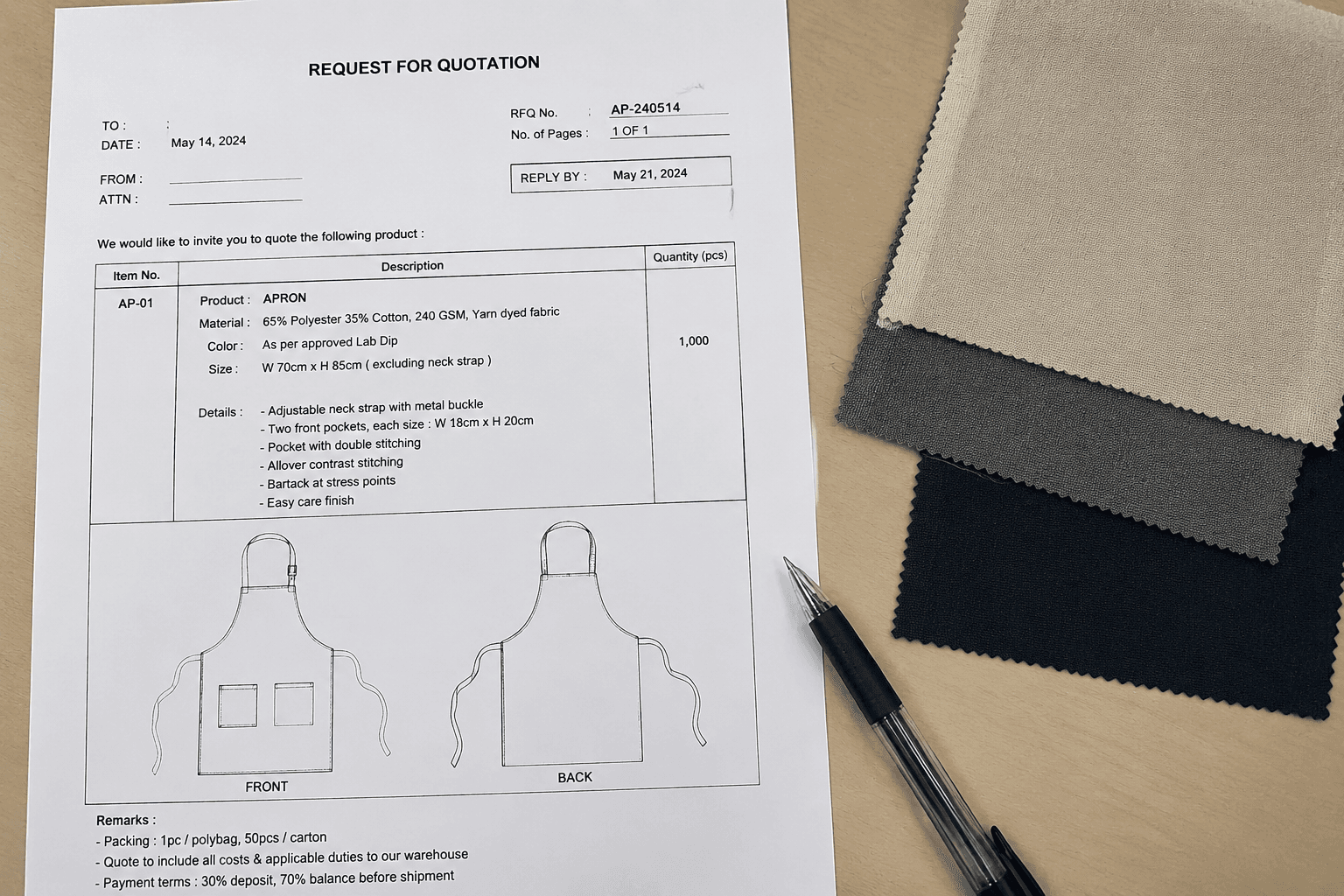
For most operators, one standard adult bib apron around 70 x 85 cm covers the bulk of use, with an oversized option around 75 x 95 cm for selected teams. Beyond that, frequent size splitting often creates unnecessary stock fragmentation. A micro-run of several lengths or widths may sound employee-friendly, but it increases carton complexity, slows repeat ordering and leaves leftover odd sizes that are hard to reallocate.
MOQ bands track closely to how standardized the bill of materials is. A stock-supported black or navy twill bib apron with standard trims can often open at 500-1,000 pcs per color per style. Add custom-dyed fabric, special labels, branded hardware, multiple size splits or unusual packaging, and MOQ commonly rises to 1,500-3,000 pcs. That increase reflects mill minimums, trim setup cost and the supplier's risk of holding materials that may not repeat.
FOB pricing should be reviewed line by line. In a typical East China program, a basic 245-260 GSM 65/35 poly-cotton twill bib apron with one patch pocket and simple ties commonly lands at $2.10-$3.20 FOB at 2,000-5,000 pcs. If the style includes webbing ties, adjusters, heavier reinforcement, embroidery or more complex labeling, pricing often moves to $2.80-$4.20 FOB. Quotes far below these ranges should trigger a check on actual GSM, stitch count, inspection scope and trim quality rather than immediate acceptance.
- Fix one core bib apron SKU and one oversize option before broad quoting.
- Expect MOQ around 500-1,000 pcs for stock-supported basics and 1,500-3,000 pcs for custom programs.
- Use $2.10-$3.20 FOB as a realistic basic range and $2.80-$4.20 for upgraded builds.
- Break quotations into fabric, sewing, trims, branding and packaging to compare suppliers properly.
Plan lead times, call-offs and safety stock around real apron attrition
Aprons in ghost kitchens leave circulation faster than many procurement teams expect. They are not only damaged; they are also over-stained, lost in laundry, taken by staff, mis-packed between sites or retired because ties fail before the body does. A replenishment model should therefore be based on issued units, wash frequency and discard rate, not rough annual spend. If a site has 60 staff, issues 3 aprons per person and experiences 8% combined loss and rejection per month, the operator should expect to replace about 14-15 units monthly before adding growth stock.
Repeat ordering works best when buyers shift from ad hoc purchasing to monthly or bi-monthly call-offs against a rolling forecast. Once one bill of materials is locked, a factory can reserve greige stock, pre-book dyeing for core black or navy and hold the right ties, labels and cartons for 1,000-2,000 pcs. In many programs this shortens repeat lead time by 5-10 days compared with one-off ordering and lowers the chance of emergency air freight.
Lead-time assumptions should remain realistic. A repeat order on an approved style with stock-supported fabric can often ship in 20-30 days under normal capacity. A first order with custom dyeing, logo adjustments, packaging changes and trim confirmation usually needs 35-50 days from final approval. Sample development follows the same pattern: 5-10 days for a salesman or fit sample using stock materials, and around 10-18 days when custom dyeing or trim sourcing is involved.
Safety stock should reflect volatility. Mature sites with stable staffing can often work with a 2-4 week buffer of average usage. New launches, seasonal peaks or multi-site rollouts are better protected with 4-6 weeks until real consumption data is established. The cost of that buffer is usually far lower than the cost of disrupted site opening or repeated air freight.
- Calculate monthly replacement demand from issued stock and measured discard rates.
- Use monthly or bi-monthly call-offs against one locked bill of materials.
- Plan repeat lead times at 20-30 days and new developments at 35-50 days.
- Hold 2-4 weeks of safety stock for stable sites and 4-6 weeks for new or scaling sites.
Set QC and discard rules that match professional dark kitchen apron sourcing
Quality control for aprons should focus on field failure points, not showroom neatness alone. A practical shipment baseline is AQL 2.5 for major defects and AQL 4.0 for minor defects, but those numbers only matter if the inspection checklist covers the right risks. For dark kitchen use, the key checks are fabric weight, dimension tolerance, stitch security, bartack placement, tie attachment strength, shade consistency and shrinkage after the approved wash route.
Inline inspection is especially valuable because the cost of correction is lower while sewing is still running. Inspectors should verify tie joins, pocket placement, seam slippage, hardware security and measurement control before the order reaches final packing. If these issues surface only during final random inspection, shipment dates are more likely to slip and rework becomes more expensive. For first bulk orders or fabric-lot changes, buyers should also ask for wash validation using the actual detergent and temperature route rather than relying only on generic mill reports.
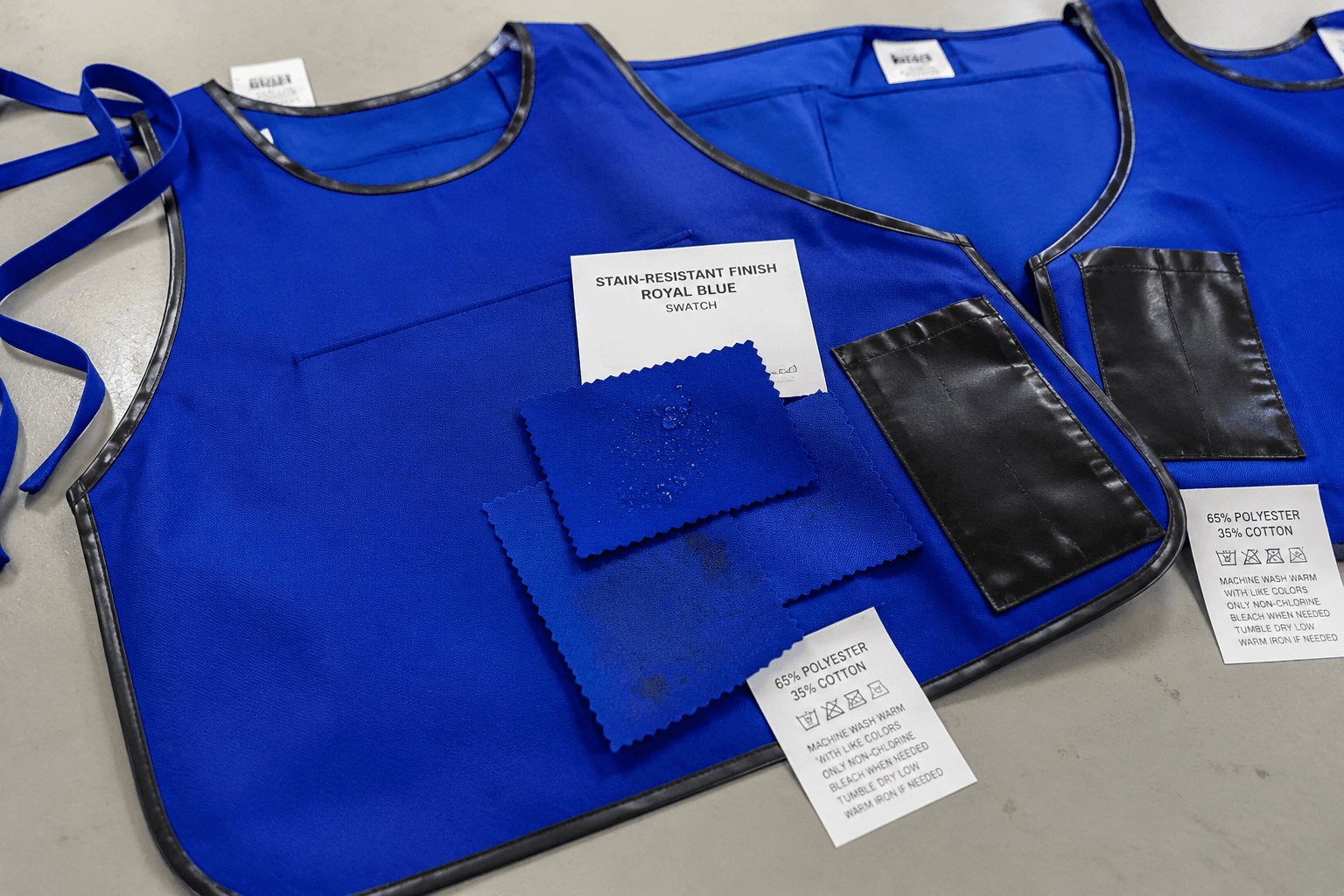
Shade continuity needs tighter control than many buyers expect. One black lot can lean brown while another leans blue, and when both lots mix in one kitchen group the difference is obvious. A retained swatch with a defined shade band helps future approvals stay objective. That is especially important in long-running replenishment programs where visual consistency matters even if the apron is a pure utility garment.
Discard rules should be formalized so site managers do not keep worn aprons in service too long. Practical retirement triggers include permanent oil shadowing beyond the approved reference, broken ties, seam failure, hardware breakage, shrinkage beyond tolerance and logos that are no longer legible. When these rules are fixed, buyers can compare suppliers by real field life rather than by opening price alone. That is the discipline that turns dark kitchen apron sourcing from tactical buying into controlled supply management.
- Use AQL 2.5 major and 4.0 minor as the starting shipment standard.
- Inspect GSM, dimensions, bartacks, tie joins, seam strength and shade continuity.
- Retain an approved shade swatch to control black, charcoal or navy lot variation.
- Write discard triggers into the program: staining, tie failure, seam failure, shrinkage and logo loss.