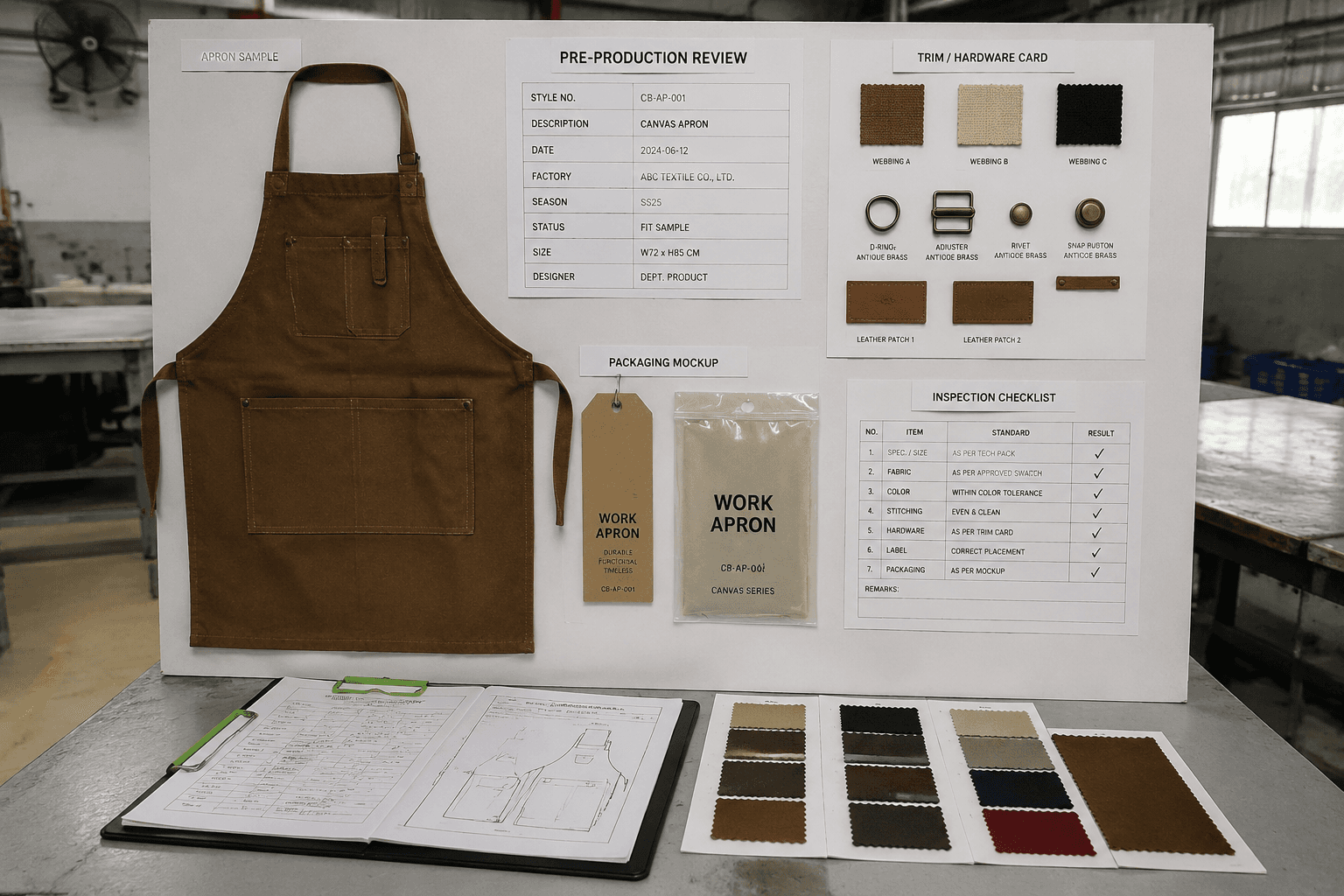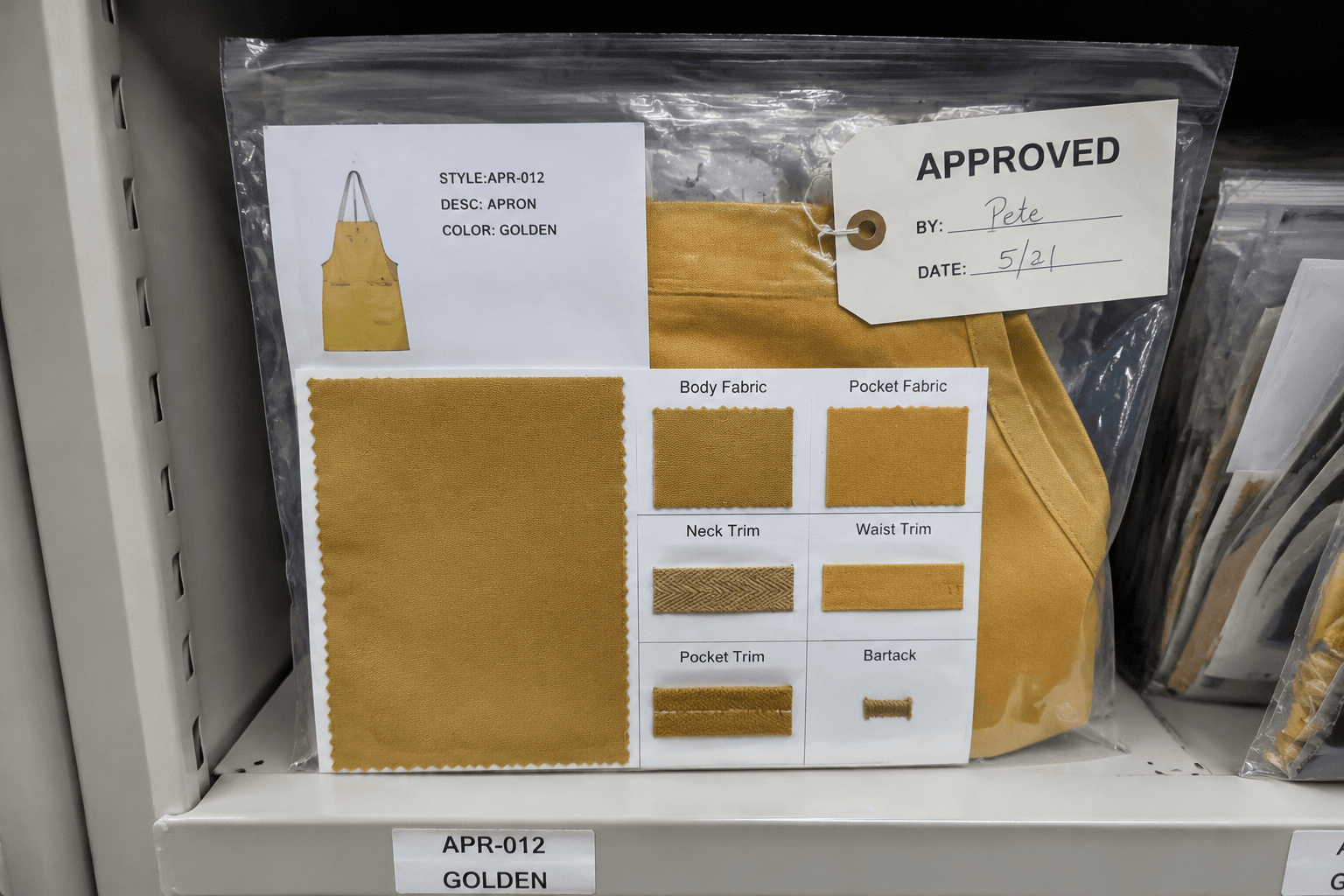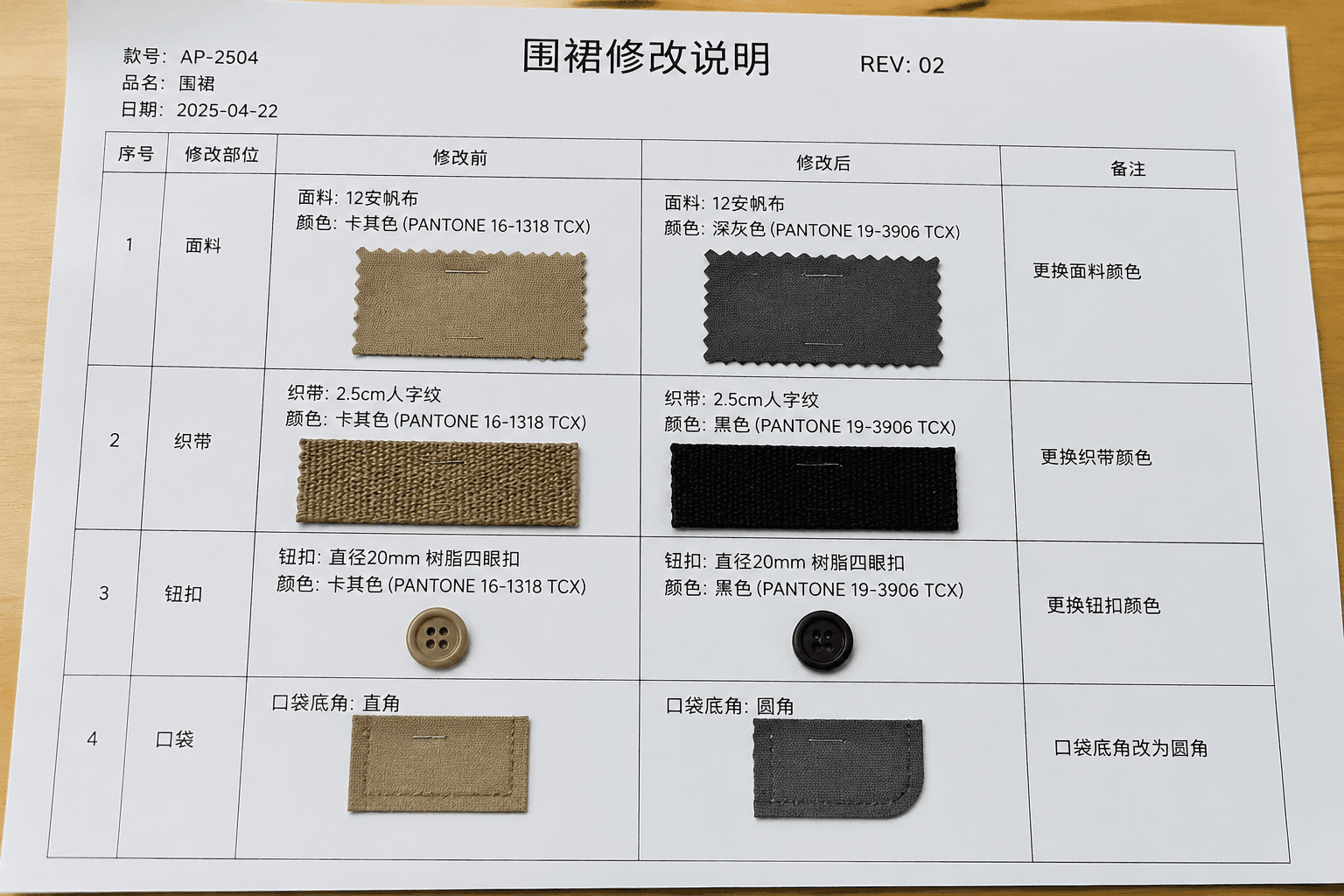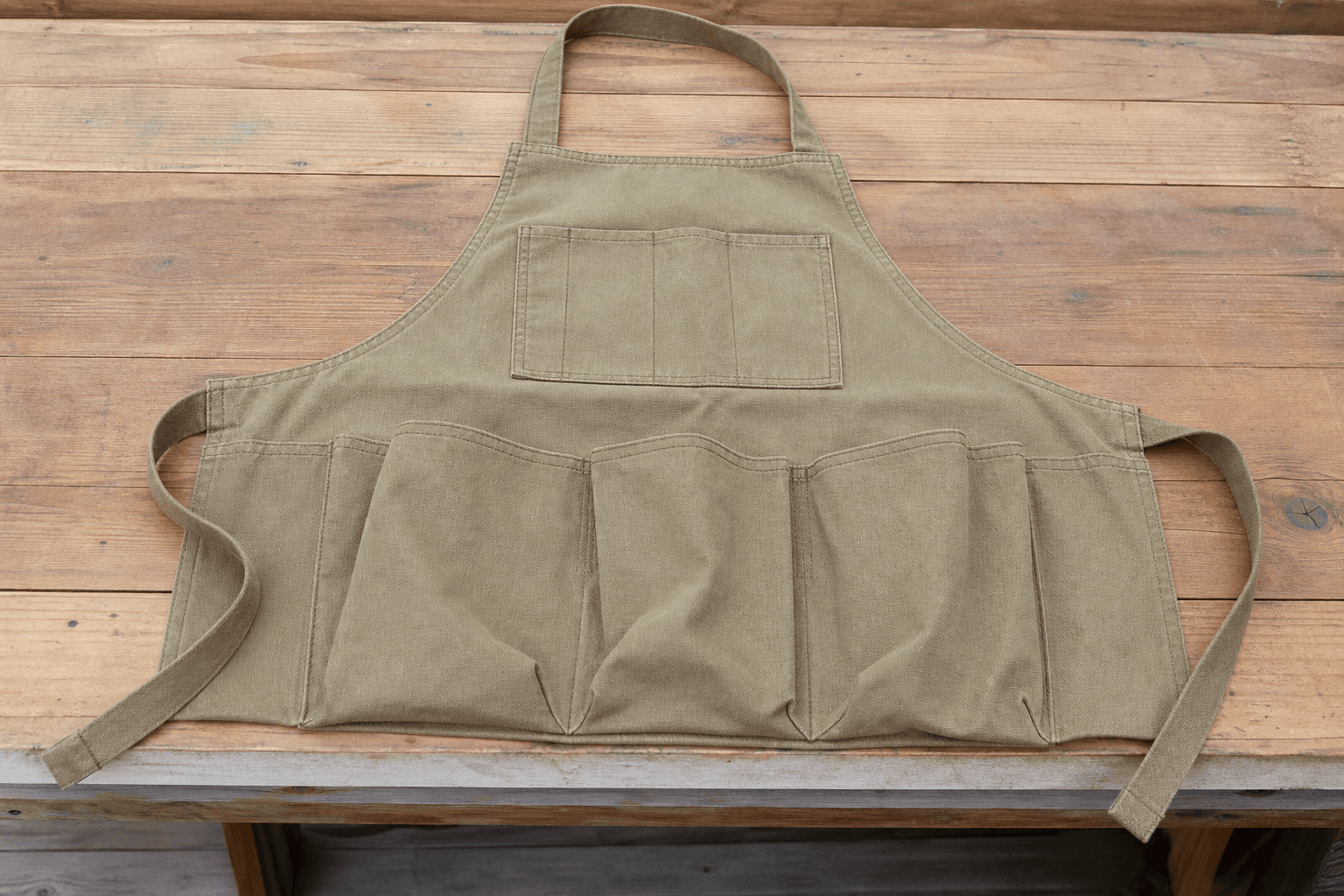
Many apron tech packs describe fabric, color, logo position, and pocket dimensions in detail, then reduce fit to a vague note such as "one size" or "standard width." In bulk sourcing, that shortcut causes avoidable fit claims. Apron coverage specifications are not a single flat-width number; they define how much of the front body and side hip remain covered when staff turn, bend, carry trays, or reach across a counter.
For an OEM factory, width changes affect more than the paper pattern. A finished-width increase of 4 cm can alter marker efficiency, fabric yield, tie placement, binding usage, carton density, and sometimes print placement. On orders of 1,500-5,000 pieces, that commonly shifts material and making cost by $0.08-$0.22 per piece on 200-280 GSM twill or canvas. If the style uses custom-dyed fabric or contrast binding, the impact can be higher. After PP sample approval, even a small coverage revision often adds 3-7 days; after cutting starts, corrections can add 15-25 days plus fabric loss and rework.
The sourcing decision is not simply whether a wider apron gives more protection. It does. The practical question is how much width creates useful side coverage rather than thigh bulk, tie twist, or restricted movement in service. This article turns apron coverage specifications into measurable buying language for professional buyers: width points, overlap targets, wearer bands, motion checks, MOQ effects, QA standards, and realistic lead-time consequences.
- Specify coverage as a measurement set; record top width, waist width, bottom sweep, tie length, and target side reach together.
- Test fit in motion; side gaps typically open by 4-8 cm during turning and forward reach, and can exceed 10 cm on stiff canvas aprons.
- Use body-size bands in centimeters; one-size programs are more reliable when limited to defined ranges such as 76-96 cm waist or 90-108 cm high hip.
- Write overlap targets into the tech pack; for wrap styles, define minimum side reach or overlap on a stated body circumference.
- Match fabric weight to the job; 190-220 GSM twill usually gives better movement, while 260-320 GSM canvas offers more structure but can bunch at the thigh.
- Freeze width and wrap decisions before PP approval; late changes often add 15-25 days and move ex-factory cost outside the original quote.
1. Why apron coverage specifications need their own tech-pack section
A size line such as 72 cm width x 86 cm length is not enough for apron sourcing. A straight-cut bib apron, an A-line bib apron, and a partial-wrap apron can share the same headline width while giving very different waist and side-hip protection. That is why apron coverage specifications should be a separate section in the tech pack, not a note buried under general dimensions.
A workable specification starts with three sourcing decisions. First, define the required coverage zone: center front only, front plus side hip, or partial back wrap. Second, define the intended wearer band in centimeters, not broad retail labels. Third, define the job movement: cashier standing, café service with frequent turning, kitchen prep with bending, salon work with cross-body reach, or housekeeping cart loading. Without those inputs, the factory can only guess whether the style needs a straight body, more sweep, shaped side seams, or added wrap extension.
In OEM production, common one-size bib aprons run 68-75 cm finished width at the waist and 82-90 cm finished length. Waist aprons typically run 80-95 cm finished width, while bistro styles may go to 100-110 cm when coverage is prioritized over minimal fabric use. On a 1,000-piece order in 210-240 GSM poly-cotton twill, increasing body width by 4 cm usually raises ex-factory price by about $0.06-$0.18 per piece. If the apron includes contrast edging, large pockets, or engineered logo placement, the added cost may reach $0.20-$0.28 per piece because yield and placement efficiency both change.
- State top width, waist width, and hem sweep as separate finished measurements.
- Define the coverage objective: front-only, side-hip protection, or partial wrap.
- Record the wearer size band in centimeters for waist and high hip.
- Note the actual work movement the apron must pass in use.
2. Measuring apron width, sweep, and overlap without factory-buyer disputes
Most width disputes start with different measuring methods, not poor sewing. One team measures across the chest line, another at the waist seam, and another across the bottom sweep. In wrap aprons, some buyers count the underlap panel inside total width while others count only the visible front panel. That can create a 5-10 cm interpretation gap even when the same sample is under discussion.
For bib aprons, the cleanest approach is to define at least three finished measurement points after pressing: top width, waist width, and hem sweep. For waist and bistro aprons, define top opening width and bottom sweep separately. If the style includes side tabs, wrap wings, underlap panels, or curved side extensions, list each part width on its own line and state clearly whether it is included in the total body-width figure. A photo-approved sample without a measurement table is one of the most common causes of preventable bulk claims.
Tolerance should match the order type. On a 3,000-5,000 piece promotional order, buyers may accept +/-1.0 cm on body width and +/-1.5 cm on tie length. On a repeat uniform program, tighter standards are common: +/-0.5 cm on key width points, +/-0.8 cm on bib width, and +/-1.0 cm on ties. For final inspection, AQL 2.5 for major defects and AQL 4.0 for minor defects is a practical baseline. If the apron is intended for industrial laundering, the measurement table should also state whether dimensions are checked before wash or after one wash cycle, with shrinkage limits such as less than 3% in width and less than 3% in length on finished twill.
- Use separate lines for top width, waist width, and bottom sweep.
- State whether ties, wrap panels, and tabs are included in total width.
- Set tolerances that match order risk and pair them with AQL 2.5/4.0.
- Specify whether dimensions are taken after pressing, before wash, or after wash.
3. Apron coverage specifications in motion: controlling side gaps and preserving movement
Flat measurements do not show how an apron performs at work. In wear tests, staff turn at the waist, bend to shelves, step sideways through tight aisles, and reach across worktops. These motions regularly open side gaps by 4-8 cm on narrow bib aprons, and by 8-10 cm on stiff canvas styles tied tightly at the back. Because of that, apron coverage specifications should include motion checks, not only table measurements.
The usual failure point appears when the apron is anchored firmly at the waist but cut too narrow through the lower body. As the torso rotates, the wearer moves inside the apron and the side waist or upper hip of the uniform becomes visible. Buyers often try to correct this with longer ties, but tie length does not create extra side coverage if the body panel itself is too narrow. Better corrections include adding 3-5 cm to lower sweep, shifting the side line into a mild A-line, or moving tie attachment 1.5-2.0 cm behind the side seam to improve wrap behavior.
Fabric weight changes the result. A 280-320 GSM cotton canvas or 10-12 oz duck apron can look substantial on a hanger but bunch at the thigh and lift during bending. A 200-220 GSM poly-cotton twill or 8-9 oz cotton twill usually drapes better at the same width, improving practical coverage in hospitality and food-service movement. For fast-service, café, and kitchen-prep roles, moderate width in a softer twill often performs better than maximum width in a rigid canvas because the apron stays closer to the body instead of springing outward.
During fit approval, the garment should be tested over the real uniform layer. A polo shirt, chef coat, or service shirt adds bulk that changes how ties sit and how side edges track around the hip. Testing on a thin T-shirt alone often overstates apparent coverage.
- Test at least three motions: forward reach, 45-degree turn, and bend to knee height.
- Record side exposure as a gap in centimeters, not a visual comment.
- Compare the same pattern in 200-220 GSM twill and 280-320 GSM canvas if coverage is borderline.
- Fit over the actual work uniform, not a lightweight base layer only.
4. Selecting one-size, extended-wrap, or graded sizing for inclusive apron programs
Many buyers prefer one-size aprons because they reduce SKU count and simplify replenishment. That approach works only when the wearer band is realistic. If one bib apron must fit a 74 cm waist and a 114 cm waist while still protecting the side hip, longer ties alone will not solve the issue. Body width, lower sweep, tie angle, and coverage target all have to be defined together.
In practice, three sourcing models are reliable. The first is one-size with front-focused coverage, best for lighter-duty roles and narrower wearer bands such as 76-94 cm waist. The second is one-size with extended wrap reach, used when the buyer insists on one SKU but wants more side coverage, usually suitable for about 80-104 cm waist depending on fabric drape and tie placement. The third is graded sizing, often split into S/M and L/XL or defined by body bands such as 76-92 cm and 93-110 cm waist. For presentation-sensitive uniform programs, graded sizing usually gives the best balance of coverage, proportion, and movement.
MOQ often decides what is commercially practical. At 300-500 pieces per color, one-size is usually the easiest structure. At 800-1,000 pieces per color, a two-size split becomes more workable if color count is controlled and size ratios are agreed before fabric booking. For a basic custom bib apron in 65/35 twill at 210-230 GSM, ex-factory pricing commonly falls around $2.40-$4.60 per piece at 1,000 pieces, depending on printing, pocket count, and neck adjustment. Adding a second size usually changes marker efficiency, cutting ratios, and packing complexity more than trim cost, but for repeat uniform programs the reduction in fit complaints often justifies the small increase.
- Use one-size for narrow wearer bands and moderate coverage expectations.
- Use extended-wrap one-size when one SKU is required but side exposure risk is higher.
- Use graded sizes when visual consistency and repeat orders matter most.
- Write wearer bands in centimeters for waist and high hip.
5. Writing overlap and wrap reach into apron coverage specifications
A strong coverage spec defines success in measurable terms. Instead of saying "full coverage" or "extra-long ties," state what the apron must achieve on a named body reference. For example: on a 96 cm waist form, each front edge must reach at least to the side seam of the wearer garment; or on a 102 cm high-hip form, the apron must maintain at least 5 cm side overlap when tied at the natural waist. This shifts the conversation from styling language to production control.
Buyers should also separate decorative wrap from protective wrap. Decorative wrap may need only a small extension for look. Protective wrap has to stay positioned through walking, bending, and repeated laundering. That usually requires wider side panels, reinforced tie joins, stable tie angle, and enough drape to keep the extension from springing open. If side pockets are included, panel width must also be checked against access; a wrap extension that improves coverage but moves the pocket too far behind the hip can reduce service use.
The same discipline should guide sample approval. A width measurement can pass while practical coverage still fails if the wrong body reference is used. The most effective process is to approve fit on two body references: one near the middle of the target wearer range and one near the upper end. Most OEM factories can turn a fit revision in 3-5 days. Once cutting starts, however, a request for more wrap can add 15-25 days because it may require recutting, extra fabric booking, or downgrading partly cut panels.
- Define overlap or wrap reach on a specific waist or high-hip circumference.
- State whether coverage is judged at the waist, high hip, or both.
- Approve the sample on two body references, not one standard form only.
- Include tie reinforcement and attachment position in the wrap spec.
6. Cost, MOQ, QA, and lead-time impact when coverage changes late
Coverage changes are cheapest in early development and most expensive after approvals. A revision of 2-3 cm per side can often be handled in one fit-sample correction with limited disruption. Larger changes, especially those that shift pocket position, alter tie angle, or convert a straight body into a partial-wrap shape, usually require a new consumption calculation, revised marker planning, and another fit review. At that point, cost, MOQ, and delivery begin moving together.
Lead-time impact depends on timing. Before trim booking and fabric reservation, a width correction may add only 2-4 days. After PP approval, the same change can interrupt marker planning and booked yield assumptions. If the order was placed close to exact consumption, an extra 4 cm of body width can create a fabric shortfall. On stock 210 GSM poly-cotton twill, the issue may be solved within a few days. On custom-dyed 280 GSM canvas, 10 oz slub twill, or yarn-dyed stripe, replenishment can add 10-20 days depending on mill capacity. Buyers should request an updated consumption sheet, carton ratio, and unit-cost confirmation whenever apron coverage specifications change after sample approval.
For a typical custom apron order from an eastern China OEM factory, a realistic timeline is 5-7 days for the first fit sample, 3-5 days for one revision, 2-4 days for PP sample confirmation, and 25-35 days for bulk production after approval. In peak season, multi-size assortments, embroidery, garment washing, or custom fabric can push bulk production to 40-50 days. Standard MOQ commonly starts around 300-500 pieces per color for simple cut-and-sew aprons, but hardware trims, embroidery, special finishing, or size splitting can raise the practical MOQ to 800 pieces or more per color. Clear width, sweep, and overlap decisions at tech-pack stage keep the order inside the original costing window and reduce avoidable QA failures.
- Freeze apron coverage specifications before PP approval whenever possible.
- Request revised consumption, carton count, and ex-factory pricing after width or wrap changes.
- Check whether size splitting changes MOQ by color, ratio, or total style quantity.
- Use inline and final inspection to confirm width compliance at AQL 2.5/4.0.