For custom aprons, print approval is not a PDF sign-off. A buyer is approving how ink, transfer film or discharge chemistry performs on a specific fabric weight, color, weave and finish after curing, sewing, pressing and washing. An apron print strike off gives sourcing teams physical evidence before bulk cutting or finished-apron printing locks in the risk.
Most apron print failures are small and preventable: a 150 mm chest logo that overwhelms a 260 mm bib, 3 mm lettering that fills in on 10 oz cotton canvas, white ink that looks grey on black twill without an underbase, or a pigment print that fades after five 40 C washes. These defects are inexpensive to correct at strike-off stage and costly after 3,000 finished aprons are packed.
This guide explains how professional buyers should review an apron print strike off for scale, placement, edge sharpness, color, opacity, wash change, MOQ, lead time, cost and AQL inspection when sourcing custom printed aprons from an OEM factory.
- Approve on bulk-matched fabric: edge sharpness and opacity differ between 190 GSM poly-cotton twill, 240 GSM cotton canvas and 320 GSM denim.
- Measure the print on the apron body, not only in the artwork file; bib width, pocket stitching, waist ties and taper change visual balance.
- Set realistic minimum detail rules: text below 4 mm and lines below 0.35 mm often need adjustment on textured apron fabrics.
- Define wash expectations before approval, especially for restaurant, hotel, bakery, salon and industrial laundry programs.
- Build correction time into the calendar: one strike-off revision usually adds 3-7 working days before bulk print starts.
What an apron print strike off must prove before bulk
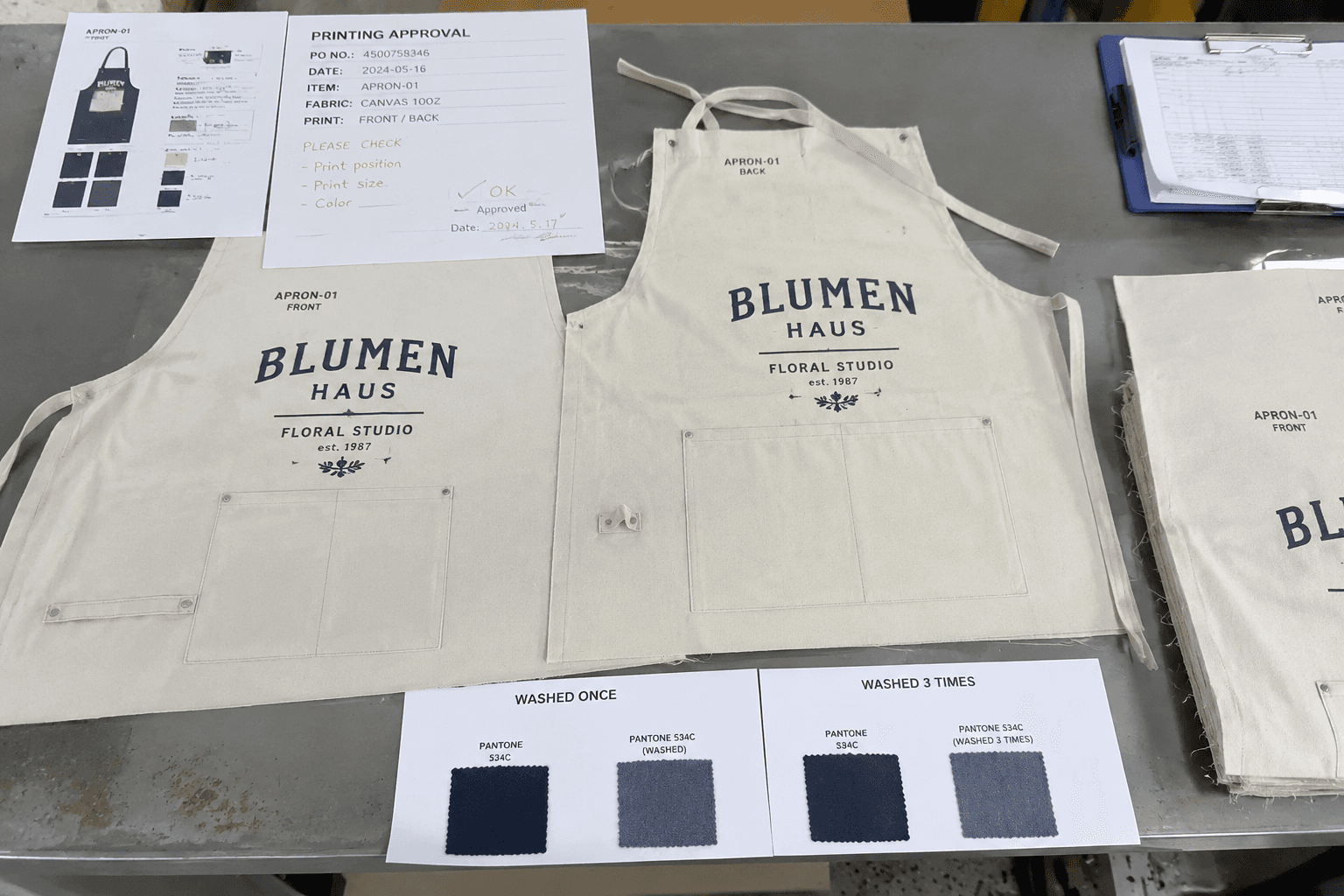
An apron print strike off is a physical print trial made on the approved bulk fabric or on fabric with the same composition, construction, finish and dye lot. For apron sourcing, it should prove five points before bulk: artwork size, placement, color and opacity, edge definition and wash performance. A digital mockup can confirm layout, but it cannot show how pigment sits on 240 GSM cotton canvas, how a transfer film edge feels on a bib panel, or whether white ink covers a black twill apron after curing.
The sample format should match the print risk. A 30 x 30 cm fabric panel may be enough for a one-color chest logo on stock twill. A full bib graphic, cross-pocket mark or repeat print should be checked on a half body or sewn pre-production apron. If the artwork crosses a pocket opening, bartack, waistband or tie attachment, approval on a flat swatch is incomplete because sewing changes the visual center and can distort the print edge.
The approval record should state fabric composition, GSM or oz, base color, print method, ink system, artwork version, print size, placement reference and wash result. Approving a 120 mm white logo on 240 GSM black cotton canvas does not approve the same result on 190 GSM polyester-cotton twill. Ink deposit, opacity, edge spread and hand feel will change, even when the artwork file is unchanged.
- 180-210 GSM poly-cotton twill usually gives smoother edges but lower ink absorption than cotton canvas.
- 240-280 GSM cotton twill or canvas gives stronger ink hold, with more yarn texture visible through large solid prints.
- 300-340 GSM denim or heavy canvas increases ink consumption and raises the risk of rough edges on fine lines.
- Water-repellent, PU-coated or waxed apron fabric needs an adhesion check before any bulk print approval.
Apron print strike off scale and placement checks
Aprons are worn products, not flat poster panels. A bib apron may have a chest width of 240-300 mm, waist width of 650-750 mm and body length of 800-900 mm. A 200 mm chest logo can look balanced on a wide chef apron but oversized on a slim barista apron with a tapered bib. Artwork scale must therefore be checked against the apron pattern and, for important programs, on an actual sewn body.
For chest logos, 80-120 mm width is common for understated hospitality branding, 120-160 mm for standard visibility and 160-200 mm only when the bib is wide and the logo is simple. For waist-apron pocket prints, 60-90 mm is practical because each pocket may be only 160-190 mm wide. If the apron has two or three pockets, the strike off should show stitching lines, bartacks and pocket openings so the buyer can judge clearance.
Placement should be measured from stable garment points. On bib aprons, use the top bib edge or center top edge, not a curved side edge. On waist aprons, use the top waistband edge and center front. A realistic tolerance for manual or semi-automatic screen printing is usually +/- 5 mm for small logos and +/- 8-10 mm for large front prints. Tighter tolerance may require a print jig, extra inspection time and a higher unit cost.
- Chest logo placement is commonly 90-130 mm below the top bib edge, depending on bib height and neck strap style.
- Pocket prints should keep at least 15 mm clearance from stitching to reduce distortion during sewing and pressing.
- Large front prints should be checked with waist ties and pockets visible because the worn apron changes the perceived center.
- Repeat patterns need a written alignment rule, such as center front, pocket edge or lower hem reference.
Apron print strike off edge sharpness and small text limits
Edge sharpness is a frequent source of B2B disputes in custom apron printing. Buyers often supply artwork with thin outlines, small serif text, distressed texture, registration marks or QR-style details. These elements may look clean on screen but close up on fabric because of yarn texture, ink viscosity, screen mesh, squeegee pressure, curing temperature and print sequence.
For screen printing on cotton or poly-cotton apron fabric, text below 4 mm high should be treated as a risk. On 240 GSM cotton canvas, a 0.25 mm line may thicken, break or disappear where the yarn surface is uneven. On 190 GSM poly-cotton twill, the same detail may print cleaner, but dark fabric may need a heavier underbase that changes the edge and hand feel. Heat transfer can hold small detail better, but the buyer must accept a film edge and possible lifting risk if the apron is washed aggressively.
Evaluate sharpness from two distances: close inspection at 20-30 cm and normal use distance at about 80 cm. Slight softness visible only under close inspection may be acceptable for a work apron. Filled letter counters, missing dots, bleeding edges or unreadable small text are not acceptable if the brand mark depends on those details. The correction may be artwork simplification, larger line weight, a different print method or moving legal text to a woven label.
- Use 0.35 mm or wider positive lines for screen print on medium-weight cotton twill whenever possible.
- Use 0.50 mm or wider reversed-out lines because ink spread can close the open space.
- Avoid critical text below 4 mm height on heavy canvas unless a physical strike off proves legibility.
- Approve metallic, puff, high-density and discharge effects separately because their edges behave differently from standard pigment print.
Color, opacity and hand feel for printed aprons
A Pantone reference is a target, not a guarantee that every apron fabric will match a coated paper book. For pigment printing on cotton aprons, a commercial tolerance around Delta E 2.0-3.5 is common, depending on fabric surface and color. On black, navy, bottle green, burgundy or charcoal aprons, white and light logos usually need an underbase. The underbase improves opacity but adds thickness and can soften fine edges.
For strict brand programs, the strike off should use final fabric color, final ink build and the same curing process planned for bulk. A red logo approved on natural 10 oz cotton canvas will not behave the same on charcoal 240 GSM twill. White ink on black aprons may need two passes, adding about USD 0.08-0.25 per piece for a small logo, depending on size, order quantity and MOQ. For a 300 x 450 mm full-front print, the added ink, setup and curing time can have a larger cost impact.
Buyers should also define viewing light. D65 daylight, TL84 store lighting and warm restaurant lighting can make the same print look different. For restaurant chains, hotel uniforms and retail staff aprons, approve under daylight plus one realistic use environment. Keep one signed strike off at the factory and one with the buyer for repeat orders.
- Give Pantone TCX or Pantone C references, but approve the physical strike-off color as the production standard.
- Confirm whether an underbase is used because it affects opacity, edge thickness, hand feel and cost.
- Do not switch fabric dye lot after approval unless a new color and adhesion check is accepted.
- For repeat orders, compare new bulk production against the signed strike off, not only against a digital photo.
Wash change testing before apron print strike off approval
Printed aprons are washed more often than promotional apparel, especially in cafes, bakeries, butcher shops, salons, workshops and hotel service. A fresh strike off may look correct before washing but crack, fade, bleed, pucker or lose edge clarity after repeated cleaning. For any apron expected to see daily use, bulk print approval should not rely only on an unwashed sample.
For light hospitality or retail aprons, a basic check is one wash at 40 C with mild detergent, followed by line dry or tumble dry low and visual inspection. For staff uniform programs, five washes at 40 C or 60 C gives a more realistic view. Industrial laundry requires a separate discussion because high-alkalinity detergent, peroxide, chlorine bleach, tunnel finishing and high-temperature drying can damage a standard pigment print. In those cases, embroidery, woven badges, discharge print or laundry-rated transfer film may be safer.
Wash results should be recorded separately for print fade, cracking, edge change, staining and fabric shrinkage. Cotton aprons may shrink 2%-5% depending on construction and pre-shrink treatment. A large front print can pucker if the base fabric moves more than the cured ink film. For a small chest logo, a printed fabric panel may be enough. For full-panel graphics or print over pockets, a washed sewn apron sample gives a more reliable approval.
- For cafe and restaurant apron orders, test at least one 40 C wash before bulk when the calendar allows.
- For reorderable uniform programs, test five washes and keep photos plus measured notes with the approval file.
- For industrial laundry, confirm detergent, temperature, drying method and expected wash cycles before choosing the print method.
- Record fabric shrinkage separately from print fade because both affect the finished apron appearance.
MOQ, cost and lead time for apron print strike offs
A custom printed apron sample requires artwork output, fabric matching, print setup, curing and sometimes sewing before review. For a simple one-color logo on available fabric, a first strike off usually takes 3-5 working days after artwork and Pantone confirmation. Multi-color registered screen print normally needs 5-8 working days. A printed and sewn pre-production apron often needs 7-12 working days if bulk fabric is in stock. Custom dyed fabric plus print approval can push the pre-bulk stage to 18-30 working days.
Cost depends on method and complexity. A basic screen strike off may cost USD 30-80 per color if a screen is opened for sampling. A sewn printed apron sample may cost USD 50-150 depending on fabric, trims and labor. For production, a one-color chest screen print on 1,000 aprons may add about USD 0.15-0.45 per piece. Multi-color logos, large placements, dark-fabric underbase or low quantities can increase this range.
Screen print is usually practical from 300-500 pieces per design and colorway. Transfer or digital methods may work from 100-300 pieces but at a higher unit cost. For a program with several outlet names or department marks, buyers should separate the apron base MOQ from the print MOQ. The factory may be able to cut 2,000 identical aprons and print 200-300 pieces per location if artwork handling and inspection are priced clearly.
- Simple one-color logo strike off: 3-5 working days on available fabric.
- Multi-color registered logo strike off: 5-8 working days after final vector artwork.
- Printed and sewn pre-production apron: 7-12 working days when bulk fabric and trims are in stock.
- One correction round usually adds 3-7 working days and may cost USD 30-100 for simple logo work.
- Custom dye plus print approval can require 18-30 working days before bulk sewing starts.
Bulk print inspection and AQL defect rules
Final approval should define inspection rules before the first bulk apron is printed. A common factory control is to check the first 20 printed pieces before continuing, then inspect every 50-100 pieces for placement, color coverage, obvious contamination and curing defects. For long runs, the factory should pull samples from the beginning, middle and end of the print batch because screen tension, ink viscosity and operator settings can drift.
For final shipment inspection, many apron buyers use ANSI/ASQ Z1.4 general inspection level II with AQL 2.5 for major defects and AQL 4.0 for minor defects. Critical defects should be zero tolerance. Print defects must be classified before production so the factory and buyer judge bulk pieces against the same standard. A wrong logo version, print outside tolerance, severe color mismatch or failed wash adhesion is not equivalent to a tiny ink speck on the reverse tie.
The signed approval file should be practical enough for production staff to use on the floor. It should include the approved strike off, artwork version, print dimensions, placement sketch, tolerance, fabric reference, wash-test status, approved color standard and AQL defect definitions. Without that file, disputes become subjective after goods are finished and cartons are sealed.
- Major defects: wrong artwork, wrong placement beyond tolerance, severe color mismatch, poor adhesion or cracking after the agreed wash test.
- Minor defects: slight yarn show-through, very small edge softness or tiny ink specks within the approved AQL limit.
- Critical defects: unsafe contamination, offensive or legally incorrect artwork, or a print method that makes the apron unusable for the intended workplace.
- Approval status should be marked as approved, approved with comments, pending wash test or rejected before bulk print starts.