For custom apron orders, quotation gaps usually come from missing product information rather than supplier unwillingness. A factory can estimate a basic bib apron from a photo, but the price may move by USD 0.20-0.80 per piece once the fabric weight, pocket construction, strap system, printing method and packing standard are confirmed.
A practical apron tech pack does not need to be complicated. It needs to answer the questions that affect fabric consumption, labor minutes, trims, testing and carton loading. When those details are clear, the supplier can return a quote with a realistic MOQ, sample lead time, bulk lead time and cost breakdown instead of adding a safety margin.
This article explains what a China apron factory needs in an apron tech pack, how to structure an apron spec sheet, and which details create the largest quote differences for bulk sourcing managers and product developers.
- Fabric weight, width and shrinkage allowance can change the quote more than the apron silhouette itself.
- An accurate apron measurement spec should include finished dimensions, tolerance and measuring method, not only a flat sketch.
- Pocket count, reinforcement points, bartacks and strap hardware should be specified before the factory calculates labor cost.
- Print and embroidery files must state placement, size, color standard and wash requirement to avoid re-quoting after sampling.
- Packing details such as individual polybag, insert card and carton limit can shift cost by USD 0.03-0.18 per piece.
Why an apron tech pack changes the quote quality
An apron is a simple product only when the buyer is looking at the front view. On the production floor, the factory sees fabric yield, cutting direction, pocket handling, strap preparation, edge finishing, washing, inspection and packing. A two-pocket barber apron in 320 GSM canvas with metal grommets is not quoted in the same way as a 180 GSM polyester promotional apron with screen print, even if both appear similar in a catalog image.
A good apron tech pack reduces assumptions. If the buyer sends only a reference photo and target quantity, the supplier must choose a default fabric, default size and default packing method. Those defaults may not match the buyer's retail position or compliance requirement. The first quote may look attractive, but it is not stable. Once the real apron spec sheet arrives, the unit price may change because the actual product uses heavier fabric, longer straps, contrast stitching or a more labor-intensive pocket.
For factory quoting, the most useful file is not a polished presentation. It is an apron production file with enough technical detail to calculate material usage and sewing minutes. When we quote from a complete file, we can usually return a firm FOB or EXW price within 1-2 working days for standard materials. When key information is missing, the quote cycle often extends to 4-7 days because the merchandiser must ask follow-up questions, check fabric stock and re-calculate after each revision.
- A photo helps confirm visual direction, but it cannot replace measured dimensions.
- A target price helps the factory suggest alternatives, but it is not enough for cost calculation.
- A previous sample helps, but it still needs a written apron measurement spec for repeat production.
- A tech pack should separate confirmed requirements from open options so the supplier can quote both accurately.
Core information every apron tech pack should include
The first page of an apron tech pack should identify the product and commercial context. This sounds basic, but many quote requests arrive with artwork and measurements but no order quantity, delivery market or packing expectation. A factory cannot price the same product properly for 300 pieces, 3,000 pieces and 30,000 pieces because fabric MOQ, printing setup cost and cutting efficiency are different.
For most custom apron orders from China, the practical MOQ depends on fabric availability and decoration method. If the buyer accepts stock-dyed cotton twill or stock polyester, MOQ may start around 300-500 pieces per color. For custom-dyed fabric, MOQ is commonly 1,000-3,000 meters per color, which may translate to 1,500-6,000 aprons depending on width and pattern efficiency. If the apron uses special yarn-dyed stripes, waxed canvas, PU coating or certified organic cotton, MOQ can be higher and lead time longer.
A clear opening page also helps the factory match the quote to the correct selling terms. EXW, FOB Ningbo, FOB Shanghai and DDP destination pricing are not interchangeable. If freight, duty or Amazon-style carton rules are expected, they must be stated before price comparison.
- Style name or style number, for example BA-2406 denim bib apron.
- Apron type, such as bib apron, waist apron, cross-back apron, cobbler apron or children’s apron.
- Target order quantity by color and size, not only total quantity.
- Delivery market and required compliance standard, such as EU REACH, CA Prop 65 or food-service use.
- Required price term, currency and destination port if applicable.
- Expected sample date and bulk delivery window, including any fixed launch date.
Fabric details that move the price most
Fabric is usually the largest cost driver in an apron. For basic promotional aprons, fabric may account for 35-50% of the FOB price. For heavy canvas, denim or washed cotton aprons, fabric can account for 45-65%. The apron tech pack should therefore state fabric composition, construction, weight and finish as precisely as possible.
GSM and oz are both useful, but they must be tied to a fabric type. A 240 GSM cotton twill, a 240 GSM plain canvas and a 240 GSM poly-cotton fabric do not sew or price the same way. For US buyers, 7 oz, 10 oz and 12 oz canvas descriptions are common; the supplier should convert and confirm GSM during fabric sourcing because mills may quote by square meter. For example, 10 oz canvas is roughly 339 GSM, but actual finished weight can vary after dyeing, enzyme wash or coating.
Fabric width affects consumption. A bib apron body measuring 70 cm wide by 85 cm long may be efficient on 150 cm fabric, but less efficient on 110 cm fabric if pockets and straps cannot be nested well. If the apron uses striped fabric, brushed fabric, directional denim or printed fabric with a clear top direction, cutting waste increases. A buyer who wants accurate quotes should avoid writing only 'cotton canvas, black' and should instead provide the target GSM, hand feel, color standard and acceptable alternatives.
- For budget restaurant aprons, common fabrics include 180-220 GSM polyester or 190-240 GSM poly-cotton twill.
- For cafe and retail uniforms, 240-280 GSM cotton twill or canvas gives better drape and durability.
- For workwear-style aprons, 300-380 GSM cotton canvas or denim is common but increases sewing difficulty and freight weight.
- For premium hospitality aprons, garment wash, enzyme wash or stone wash can add around USD 0.15-0.45 per piece depending on quantity and process.
- For water-resistant aprons, PU coating, wax finish or laminated backing should include performance targets, not only surface description.
Building an accurate apron measurement spec
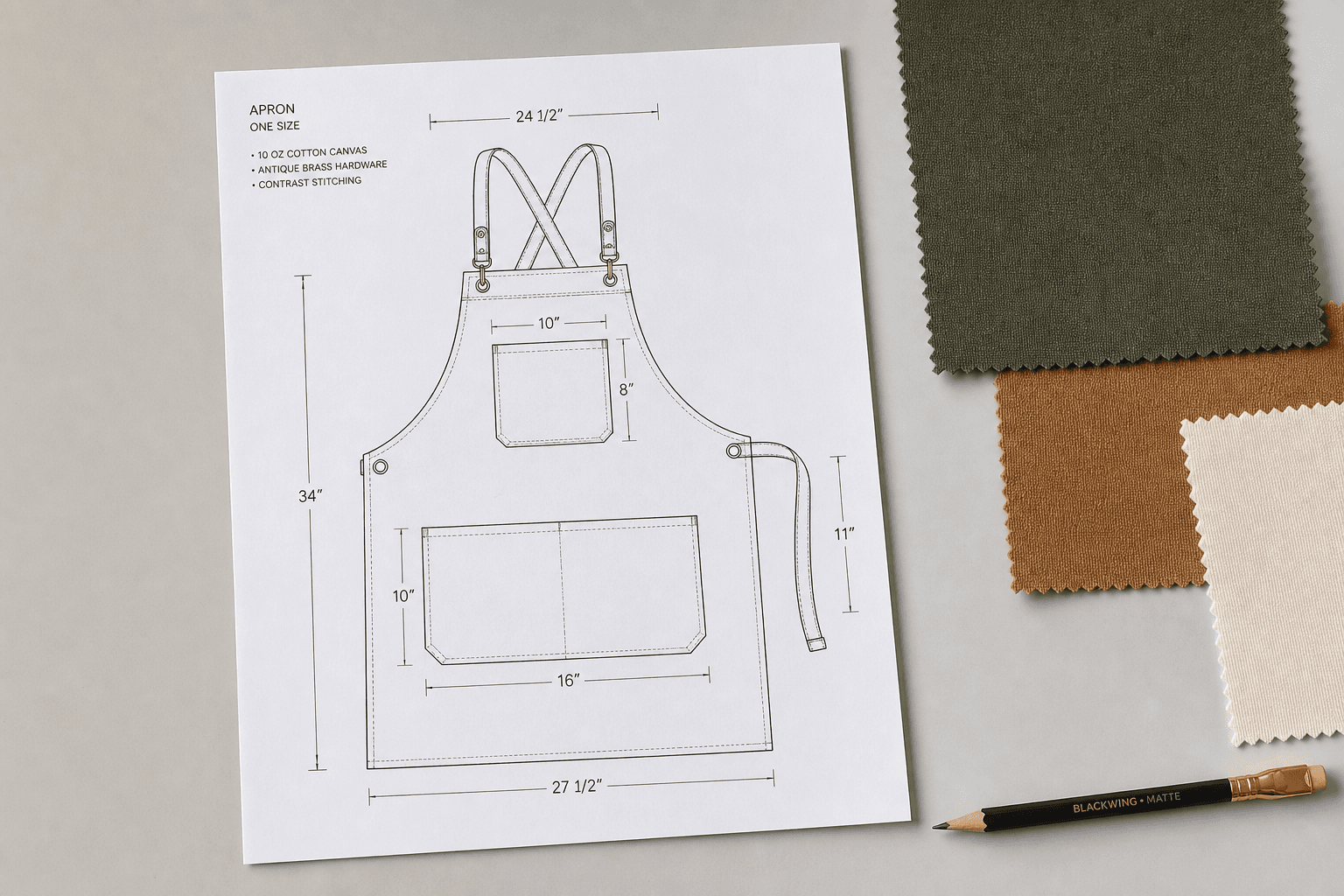
An apron measurement spec should show finished garment dimensions after sewing and after any washing process. The most common mistake is giving only one overall length and one width. That is not enough for a bib apron, because the chest width, waist width, bottom width, strap length, pocket position and hem depth all affect fit and production handling.
For factory use, each measurement point should have a code, description, target measurement and tolerance. Tolerance must be realistic for the fabric and construction. A basic polyester waist apron may hold +/-0.5 cm on most dimensions. A garment-washed 12 oz canvas apron may need +/-1.0 cm or more because shrinkage and hand finishing create variation. If the buyer applies retail inspection at AQL 2.5, the tolerance table must match the actual inspection standard. Otherwise good production may fail inspection because the tech pack was too tight for the chosen fabric.
The measuring method should also be clear. 'Length' can mean from top bib edge to bottom hem, from neck strap top to bottom hem, or from high point shoulder on a cross-back apron. 'Width' can mean top bib width, waist width or bottom sweep. If the supplier and buyer measure from different points, the sample comments become confusing and the pattern may be revised unnecessarily.
- Bib apron: total body length, top bib width, waist width, bottom width, neck strap length, waist tie length and pocket placement.
- Waist apron: center front length, waistband width, body width, tie length, pocket size and pocket distance from top edge.
- Cross-back apron: strap width, strap length, back crossing position, buttonhole spacing or buckle adjustment range.
- Children’s apron: age range, body length, safety requirement, neck opening and tie method.
- Tolerance: use +/-0.5 cm for stable small details, +/-1.0 cm for larger fabric panels, and wider tolerance when garment washing is required.
Construction details the factory must cost before sampling
Sewing cost depends less on the apron category and more on the number of operations. A plain bib apron with self-fabric ties may be quick to produce. Add a divided pocket, contrast binding, metal rivets, towel loop, adjustable neck buckle and reinforced stress points, and the sewing minutes rise quickly. The apron tech pack should describe each construction decision before the supplier quotes.
Edge finishing is one example. A single-fold hem is cheaper but may not be acceptable on heavier cotton if fraying risk is high. A double-fold hem is cleaner and stronger but consumes more fabric and sewing time. Bias binding gives a neat edge and can add contrast color, but it requires separate trim preparation and more accurate sewing. On heavy denim or canvas, thick corners may require slower sewing speed and stronger needles, which affects production efficiency.
Reinforcement is another area where buyers should be specific. A pocket corner can be secured by backstitch only, bartack, triangle stitch, rivet or a combination. For restaurant and bar aprons, bartacks at pocket corners and strap attachment points are common. For tool aprons, rivets may be useful but can increase metal detection requirements, packing protection and cost. The factory should know whether reinforcement is cosmetic, functional or required by the brand standard.
- Pocket construction: patch pocket, divided pocket, welt pocket, zipper pocket or hidden phone pocket.
- Strap system: fixed neck strap, adjustable metal buckle, D-ring, cross-back straps, detachable straps or elastic section.
- Seam type: lockstitch, overlock, flat-felled seam, bound edge or double-needle topstitch.
- Reinforcement: bartack count, rivet size, grommet position and thread strength.
- Labeling: woven label, printed neck label, care label, size label and brand patch.
- Thread: matching thread, contrast thread, heavy topstitch thread or fire-retardant thread if required.
Artwork, branding and decoration in the apron tech pack
Decoration can change both unit price and lead time. The apron tech pack should include artwork files, placement drawings and color references. A logo described as 'front center' is not enough. The factory needs width, height, distance from top edge, distance from center line, color standard and decoration method. If the apron has a pocket, the logo may sit above the pocket, on the pocket, or partly across a seam; each option has different risk.
For screen printing, the number of colors and print size drive setup cost. A one-color chest print on cotton may add around USD 0.08-0.20 per piece at 1,000 pieces, depending on size and ink type. A large multi-color print can add more. For embroidery, stitch count matters more than physical size. A small dense logo of 8,000 stitches may cost more than a larger simple wordmark of 4,000 stitches. For heat transfer, the buyer should confirm wash resistance, hand feel and whether the apron will be used near heat, steam or oil.
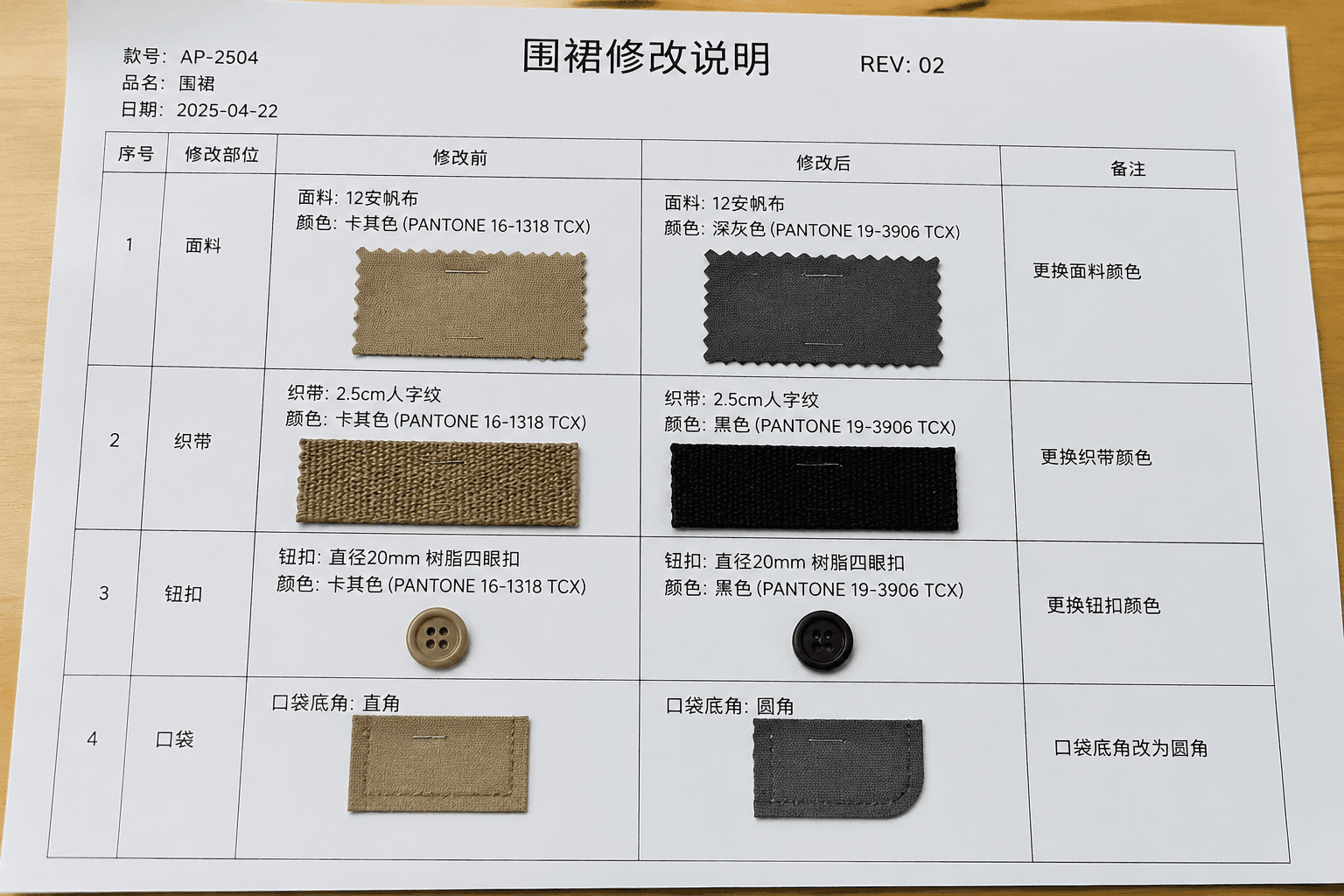
Color control should be practical. Pantone TCX is common for fabric, Pantone C or U for print ink, and thread cards for embroidery. The factory can match closely, but dark cotton canvas, denim wash and coated fabrics may not achieve the same brightness as artwork on a screen. If exact brand color is critical, allow time for lab dips, print strike-offs or embroidery swatches before bulk approval. A normal lab dip cycle is 5-7 days after fabric availability; revised dips add another 3-5 days.
- Provide vector artwork in AI, PDF or EPS for clean logo output.
- State decoration method or ask the factory to quote separate options if undecided.
- Give exact placement from measurable edges, not from a visual guess.
- Confirm whether the decoration must survive 30, 50 or 100 wash cycles.
- Specify whether brand labels require recycled polyester, cotton, leather patch or washable PU patch.
Packing, testing and compliance details in the apron production file
Packing is often left until the end, but it affects quote accuracy. A folded bulk pack costs less than an individual polybag with barcode sticker, size sticker, hangtag, tissue paper and carton drop-test requirement. For online retail or distributor shipments, packing may add meaningful cost and labor. The apron production file should state how the apron will be folded, what goes inside the bag, and whether cartons must meet a maximum weight or dimension.
For B2B uniform programs, buyers often request 50 pieces per carton or 100 pieces per carton. That may work for lightweight 180 GSM polyester aprons, but not for 12 oz canvas aprons with metal hardware. Heavy aprons may need 20-40 pieces per carton to keep gross weight under 15-18 kg. If carton size is restricted for warehouse handling, this should be quoted early because it can change carton count and freight cost.
Testing and compliance must be included before order confirmation. For aprons used in food service, the fabric and dyes may need to meet restricted substance requirements. For children’s aprons, drawstring safety and small parts risk must be reviewed. For flame or heat exposure, a normal cotton apron should not be presented as protective equipment unless certified. If a buyer needs OEKO-TEX, GRS, organic cotton, BSCI factory audit or specific chemical testing, the supplier must know before sourcing fabric, because certified material has different availability and cost.
- Packing method: bulk pack, individual polybag, paper band, retail box or hanger pack.
- Insert items: hangtag, UPC sticker, care card, size sticker, silica gel or inspection card.
- Carton requirement: pieces per carton, maximum gross weight, carton marks and pallet requirement.
- Testing: colorfastness to washing, rubbing, perspiration, dimensional stability and seam strength.
- Compliance: REACH, Prop 65, CPSIA for children’s aprons, food-contact limitation if applicable, and restricted substance list.
- Inspection: AQL level, critical defect list, measurement tolerance and approved sample reference.
A practical apron tech pack template for accurate quoting
A useful apron tech pack template should be simple enough for the buyer to maintain and detailed enough for the factory to quote without guessing. We recommend one PDF for human review plus editable files for artwork and measurement tables. For repeated orders, keep the style number and revision history clear. Many production errors come from old files being reused after a small change to pocket size, strap length or logo placement.
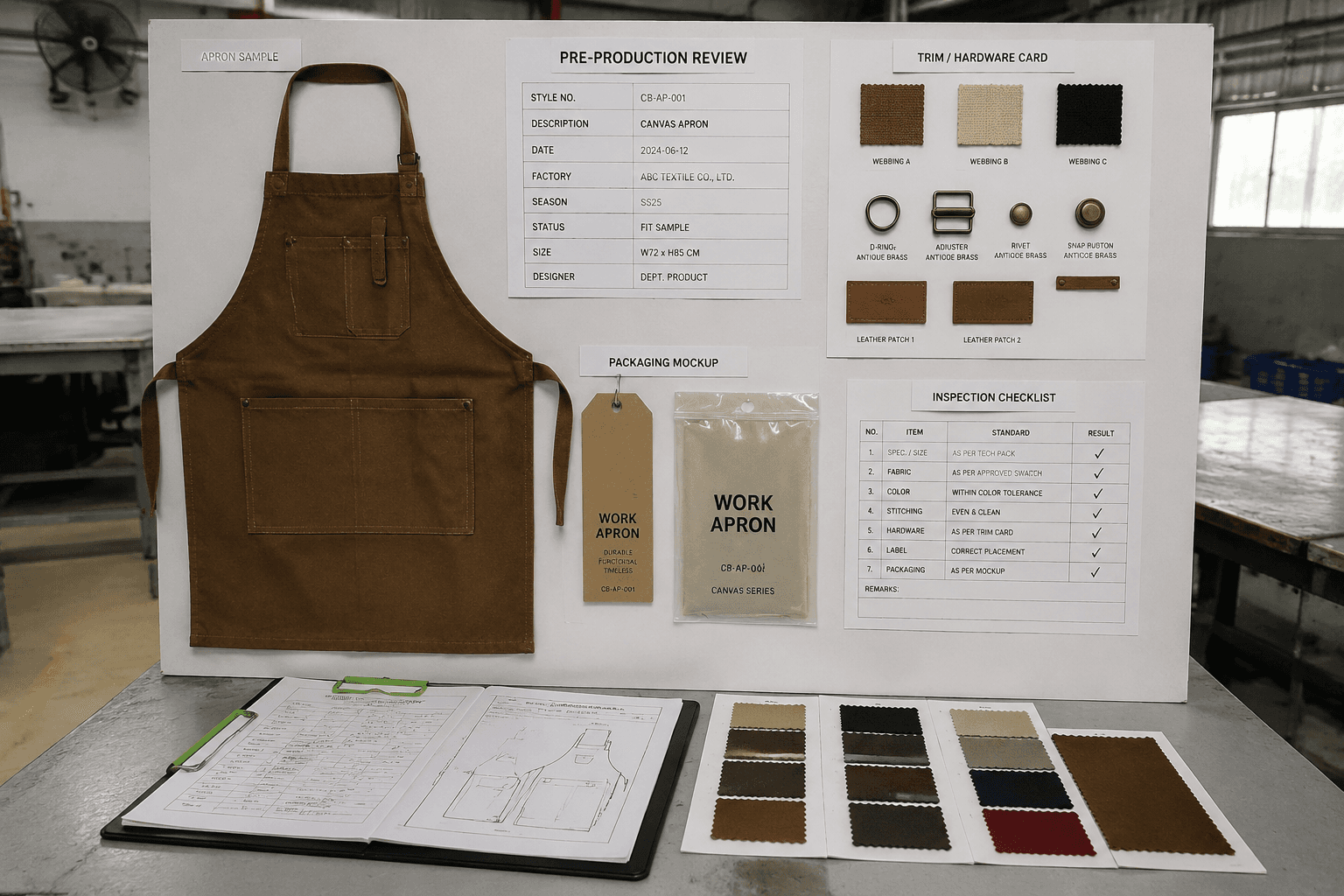
The best structure is page-based. Page one covers commercial and style overview. Page two shows front, back and detail sketches. Page three covers measurements. Page four covers fabric, trims and construction. Page five covers artwork and labeling. Page six covers packing, testing and inspection. For more complex apron programs with multiple colors or sizes, add a colorway table and size grading table. This keeps the apron spec sheet readable and prevents the supplier from missing cost-relevant details.
When sending the file to suppliers, separate confirmed requirements from options. For example, ask for Quote A using 240 GSM cotton twill and Quote B using 280 GSM cotton canvas, both with the same measurements and packing. This allows a clean comparison. If each supplier chooses its own fabric and construction, the lowest quote may simply be based on a lighter apron. A complete apron tech pack makes price comparison fair and speeds up sampling because the factory can build the first sample close to the intended production standard.
- Style overview: apron type, target market, quantity, colorways, size range and delivery terms.
- Measurement table: point of measure, target dimensions, tolerance and measuring diagram.
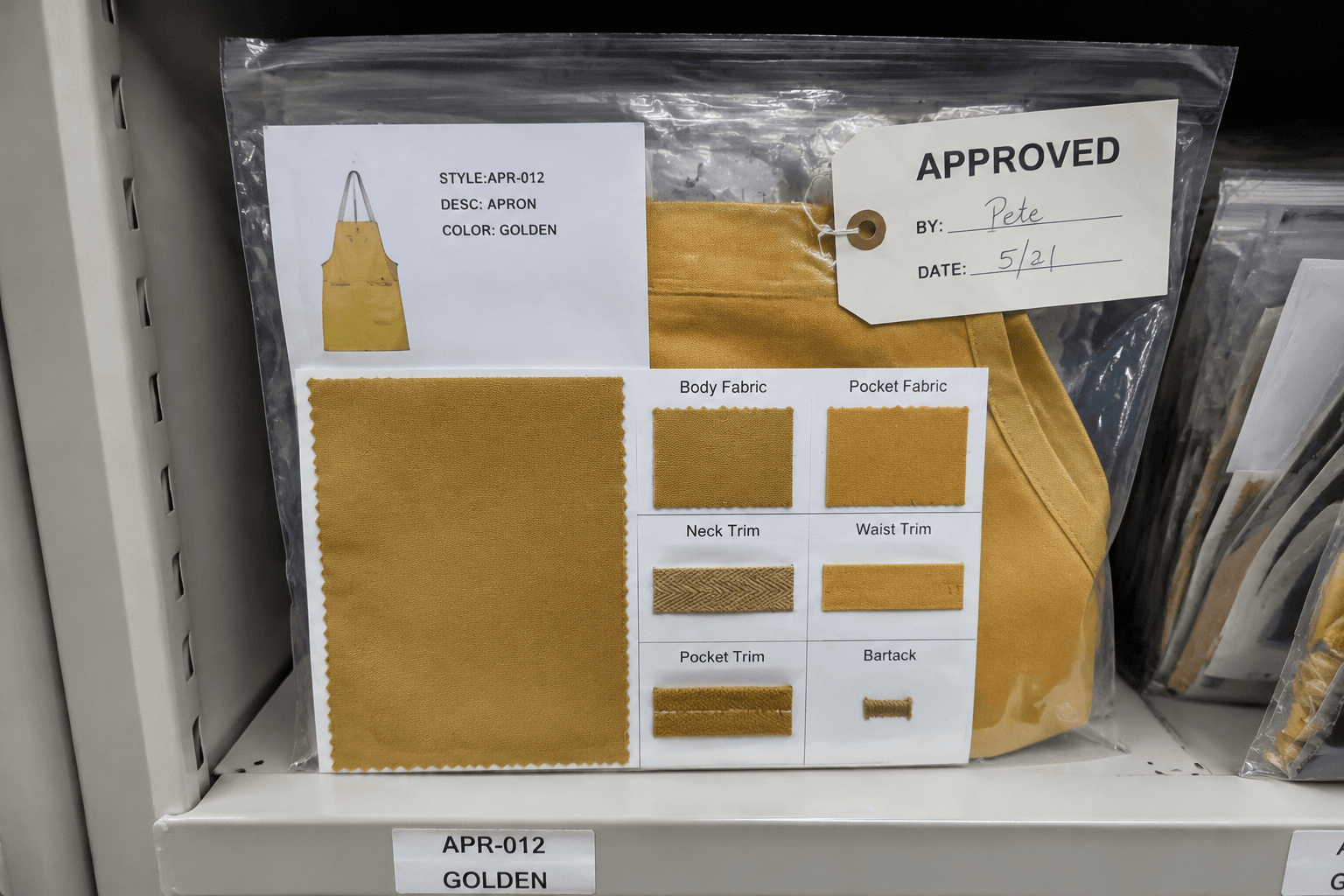
- Bill of materials: fabric, thread, trims, labels, hardware and packaging components.
- Construction sheet: seam types, pocket details, reinforcement, stitch color and finishing process.
- Artwork sheet: file name, method, size, placement, colors and approval requirement.
- Revision log: date, change description, person responsible and version number.