When you place a bulk apron order in China, the commercial risk is usually bigger than the sewing risk. A clean apron supplier contract defines what is being made, what can be shared, who owns the pattern, and how pricing changes when fabric cost, trim, or order volume shifts. Without that structure, even a simple canvas apron can become a dispute over color tolerance, logo placement, or whether the factory can reuse your pocket layout for another buyer.
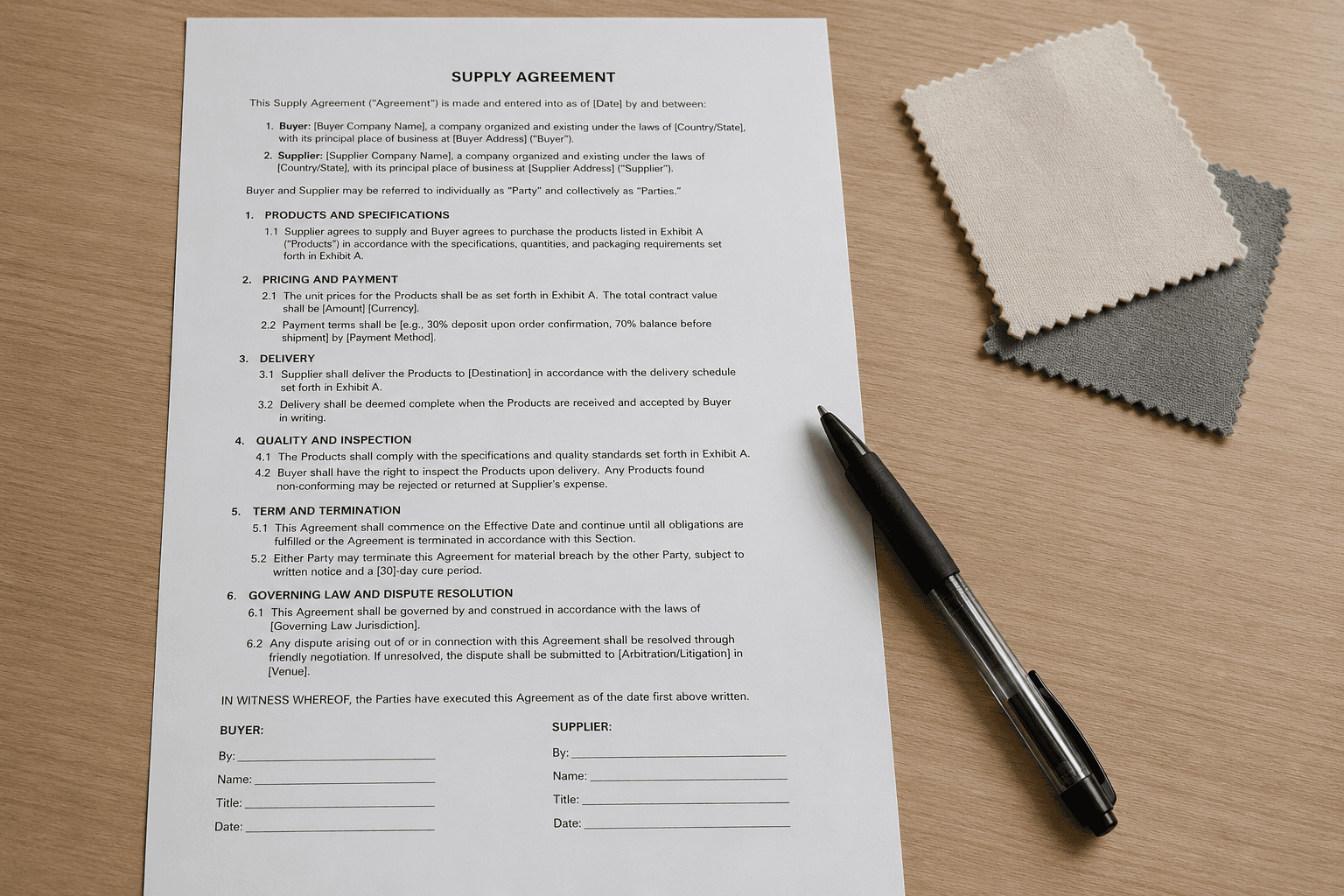
For sourcing managers and product developers, the goal is not legal theory. It is operational control. An apron manufacturing nda and a practical apron supply agreement should match how factories actually work: sample rounds, material substitution, stitch standards, packaging, inspection, and lead-time commitments measured in days, not vague promises. If the paper is weak, the factory will default to its own standard terms, and that usually favors speed and production convenience over your brand requirements.
The right contract does not need to be long, but it must be specific. It should cover fabric GSM or oz, color approval method, print or embroidery ownership, MOQ by color, re-order pricing, and the consequences of late material approval. For custom aprons, the contract is the control tower that protects your design, your margin, and your delivery window.
- Write the product spec into the apron supplier contract. Fabric composition, GSM or oz, size tolerance, stitching density, pocket count, strap construction, and packing method should all be attached as enforceable exhibits.
- Use an apron manufacturing nda for more than logos. Protect sketches, pocket layouts, label artwork, colorways, tech packs, and customer-specific features that a factory could reuse on a competing apron program.
- Define pricing logic before sampling ends. State the target FOB or EXW price, the MOQ, the overrun allowance, and the rule for fabric replacement or dye-lot changes so quote drift does not appear after approval.
- Link lead time to approval milestones. The apron supply agreement should start the production clock only after PPS approval, lab dip sign-off, and packaging confirmation are complete.
- Control ownership of tooling and patterns. If a custom waist apron uses unique pocket boards, strap jigs, or printed templates, the contract should state that these are customer-specific assets.
- Use factory contract terms that match real inspection practice. Set AQL level, defect categories, and rework responsibility so a rejected carton does not become a negotiation on the ship date.
Why an apron supplier contract matters in factory sourcing
Apron sourcing looks simple until the second order. The first PO is usually easy because everyone is aligned around a sample. The risk appears when the factory has to repeat the same apron at scale, across multiple colors, with different trim availability, and under a shipment deadline. A strong apron supplier contract prevents the factory from treating your order as a generic workwear style with minor branding changes.
For bulk buyers, the contract is not only about legal protection. It creates a single reference point for sales, merchandisers, QC, and production planning inside the factory. If the buyer says a 12 oz canvas bib apron with contrast webbing and copper rivets is approved, the factory must not later substitute a 280 GSM twill or shorten the neck strap by 2 cm because the original accessory ran short. In apron manufacturing, small substitutions can change fit, wash performance, and brand perception.
A good contract also reduces quotation games. Some suppliers quote low on a basic sample, then push fabric upgrades, extra bartacks, and package changes after approval. If the commercial terms are already defined, the buyer can compare suppliers fairly on the same basis. That matters when you are sourcing 5,000 to 50,000 pieces and even a $0.18 delta per piece changes the annual program cost.
- Fix the base style code, not just the product name.
- Attach a technical pack with measurements, construction, and pack method.
- State whether pricing is FOB Ningbo, FOB Shanghai, or EXW factory gate.
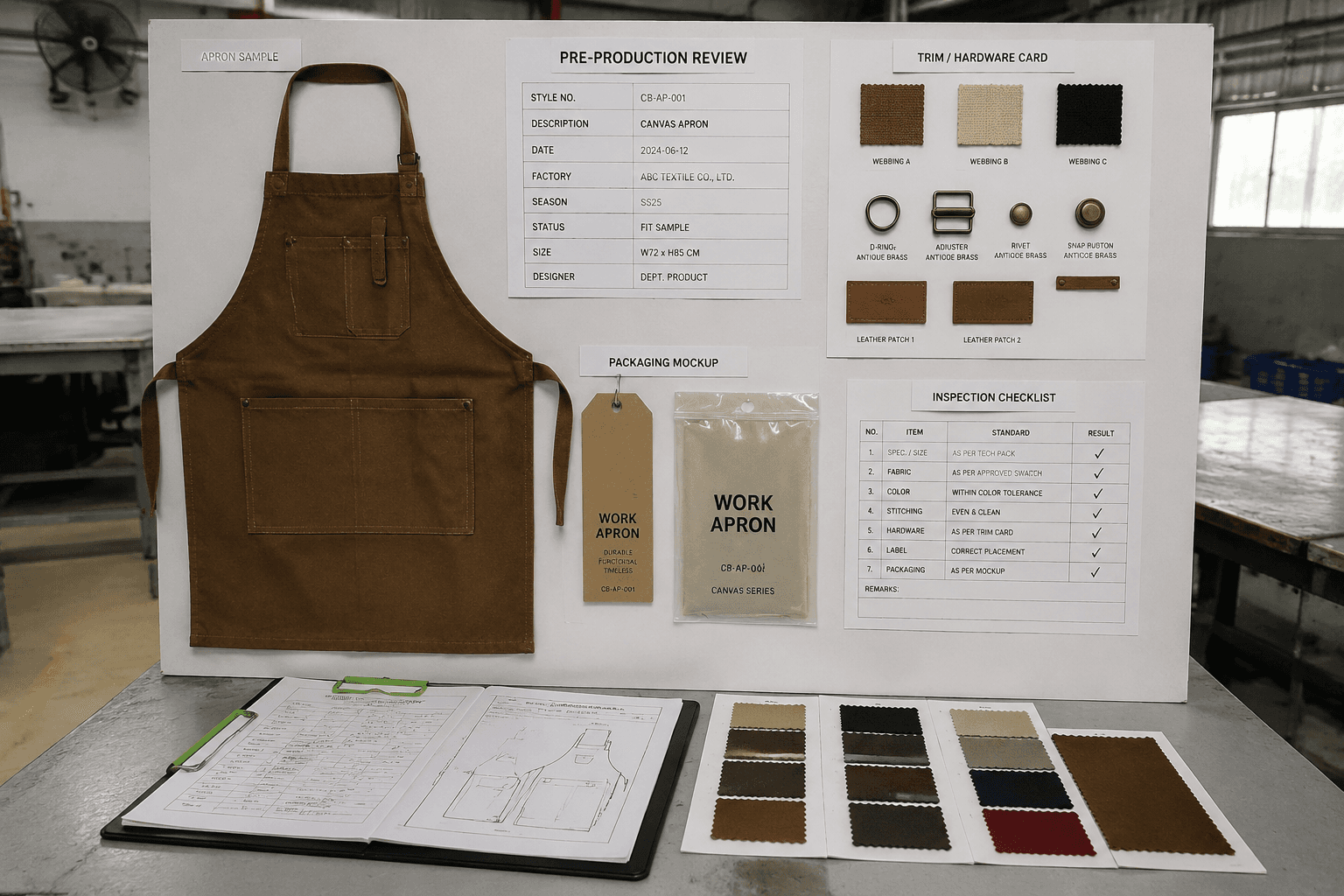
- Include approval checkpoints for sample, lab dip, and pre-production sample.
- Define who pays for remake, reprint, or air freight if the factory misses a written spec.
What belongs in an apron supply agreement
A practical apron supply agreement should read like an operating document, not a general corporate template. The main clauses need to reflect the way aprons are built. Fabric choice is not just a color and composition line; it should include weight, yarn structure, finishing, shrinkage target, and wash performance. For example, a 100% cotton bib apron may be specified as 260 GSM for restaurant use or 12 oz for a heavier retail gift item. If the style uses polyester-cotton twill, the ratio, yarn count, and anti-pilling expectation should be stated clearly.
Measurement control is just as important. Aprons have fit-sensitive details: bib height, body length, waist width, neck strap adjustment range, and pocket position. If you do not define tolerance, a factory may treat a 2 cm shift as acceptable while your buyer sees a display problem. For branded programs, the contract should also identify logo method, placement tolerance, stitch color, and whether color matching follows Pantone, a sealed sample, or a bulk lot standard.
The supply agreement should also manage commercial change. Fabric price moves, carton costs change, and accessory shortages are common in China manufacturing. The buyer should decide in advance which changes require written approval and which are absorbed by the supplier. Otherwise, a margin-sensitive apron program can become unprofitable after the first replenishment.
- Fabric: composition, GSM or oz, shrinkage, color fastness, and finishing.
- Construction: stitch type, seam allowance, bartack count, and reinforcement points.
- Branding: embroidery size, print method, placement, and artwork ownership.
- Packaging: fold method, insert card, polybag thickness, carton spec, and barcode label.
- Commercials: unit price, MOQ, overrun/under-run limit, and payment terms.
Design protection apron: what must be covered by NDA terms
An apron manufacturing nda should cover more than the logo file. In custom apron programs, the most valuable information is often the combination of shape, pocket layout, contrast binding, and finishing details that make the product distinct on shelf. If a factory can take your design brief, remove the branding, and launch a near-identical style for another buyer, the NDA was too narrow.
Design protection apron clauses should define confidential material as any drawing, tech pack, sample photo, 3D render, measurement sheet, supplier quote, and customer feedback shared during development. The clause should also prohibit using the same pattern or visual combination for competing accounts, especially when the design is clearly customer-specific. For example, a cross-back canvas apron with dual utility pockets, brass hardware, and a tonal logo patch may be structurally ordinary, but the exact mix of pocket size, strap geometry, and finishing can still be distinctive enough to warrant protection.
In practice, the strongest protection comes from combining NDA language with operational controls. Limit document sharing, label sample photos as confidential, and separate your branded trims from the factory's standard stock. If possible, hold ownership of printed labels, custom woven tags, and packaging artwork. A factory can often reproduce a garment from a finished sample, but it is harder to replicate a whole branded package if the contract controls the assets.
- Include sketches, patterns, measurement charts, and sample revisions in the confidential definition.
- Ban disclosure to subcontractors unless they are bound by the same terms.
- Prohibit factory use of your design for third-party buyers or showroom display without permission.
- Require return or destruction of unused artworks, labels, and prototype materials after order completion.
- State jurisdiction and remedies for unauthorized copying or sample leakage.
Pricing, MOQ, and factory contract terms that avoid later disputes
Pricing disputes in apron manufacturing usually come from missing assumptions. A quote may look low because it assumes shared stock fabric, one-color print, or standard carton packing. Once the buyer asks for 12 oz washed canvas, a woven neck label, and individual polybagging with barcode stickers, the real cost moves quickly. The apron supplier contract should lock the price basis to a precise bill of materials and a defined production route.
MOQ must be stated by color, print variant, or fabric lot. A supplier may accept 1,000 pieces total but require 500 pieces per color because dyeing and cutting are planned in bulk. If the buyer needs mixed color runs, the contract should price that differently. It is also wise to define whether reorders can retain the same price for 6 or 12 months, because a re-order of 3,000 pieces may use a different fabric batch if the original mill lot is closed.
Lead time should be measured from specific approvals, not from deposit date alone. In apron supply, a factory may need 5 to 7 days for pattern confirmation, 7 to 10 days for lab dip or print strike-off, 20 to 35 days for bulk production, and 3 to 7 days for packing and booking. If the contract does not define when each stage starts, missed approvals will look like factory delay even when the buyer caused the stop.
- Quote basis: confirm whether accessories, labels, and cartons are included.
- MOQ logic: define total order MOQ and minimum per color or per artwork.
- Reorder pricing: state whether repeat orders keep the original unit price.
- Payment terms: link balance payment to passed inspection or shipped documents.
- Delay remedy: specify whether late delivery triggers discount, air freight sharing, or cancellation rights.
Sampling, approvals, and how to tie the contract to production reality
Most apron disputes happen because the approved sample is not treated as the production standard. A proper contract makes the approved sample, not the salesperson's promise, the reference for bulk control. This is especially important when a buyer requests a custom pocket shape, a heavy top-stitch, or a special wash effect on denim aprons. Those features can look acceptable in a one-off sample but behave differently when cut across a full production lay.
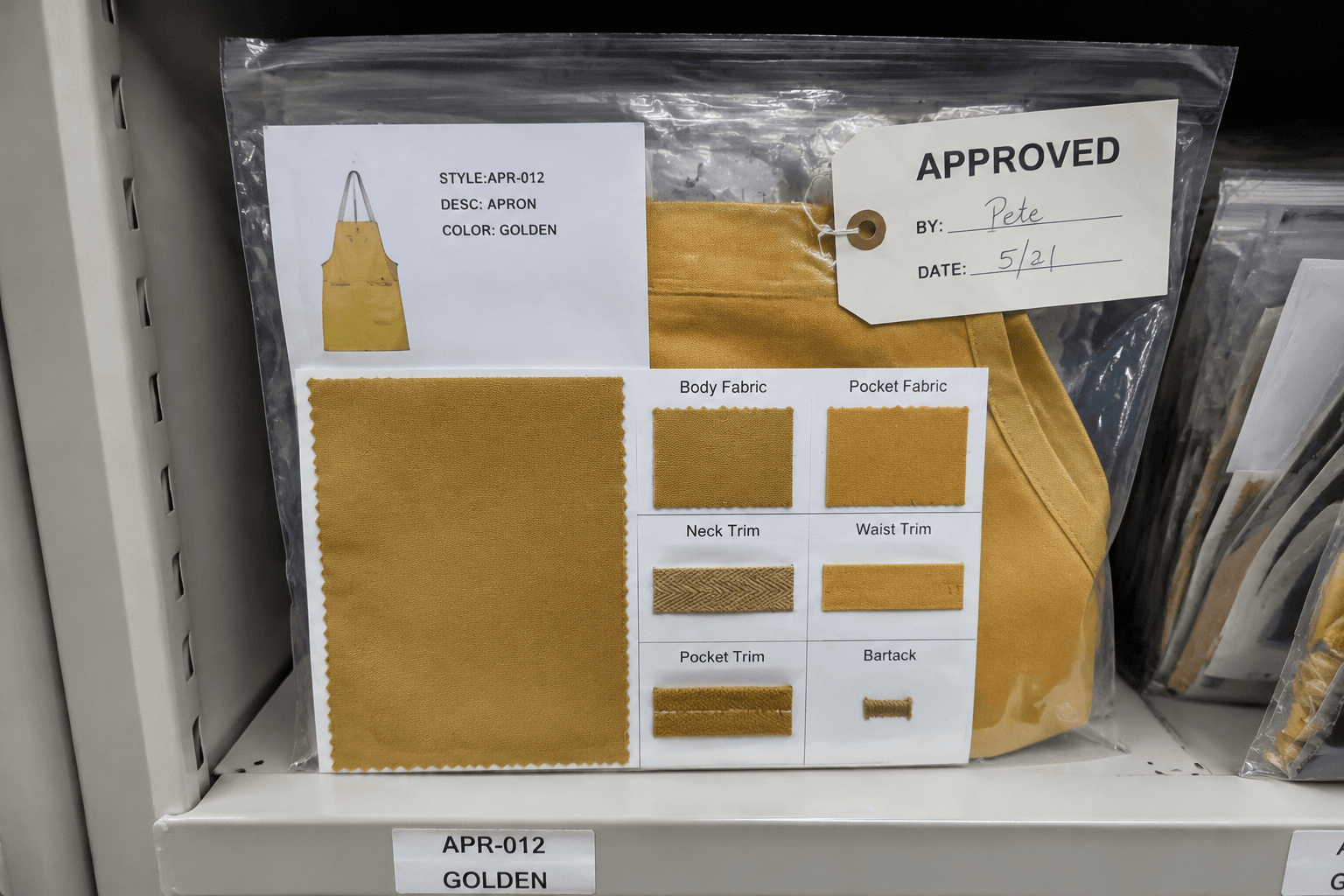
The contract should define a clear approval chain: prototype, pre-production sample, bulk fabric approval, and final packaging sign-off. If there is screen printing or embroidery, the strike-off or sew-out must be approved against the sample within a realistic tolerance. For bulk programs, I recommend allowing a limited and explicit tolerance band for natural materials, such as slight shade variation in cotton twill, while freezing any branded element that affects customer-facing consistency.
Inspection terms should be tied to measurable standards. If the buyer uses AQL 2.5 for major defects and 4.0 for minor defects, that needs to be written. If a strap adjustment buckle is off-center or a pocket is sewn 8 mm out of position, decide in advance whether that is a major or minor defect. Factories can work quickly when the rule is clear; they waste time when every carton becomes a subjective argument.
- Prototype or counter sample
- Pre-production sample with final fabric and trims
- Bulk color approval or lab dip sign-off
- Packaging and carton approval
- Final shipment inspection against agreed AQL
Enforcement, communication, and what to do when the factory pushes back
The best contract is only useful if both sides know it will be used. In China apron sourcing, enforcement is often less about lawsuits and more about clear commercial consequences. If the factory knows that unapproved substitution means rework at its cost, it will usually ask before changing. If it knows the buyer accepts verbal revisions, it will optimize for convenience. That is why the apron supplier contract should be operationally enforceable, not just legally correct.
When a factory pushes back on NDA scope or ownership terms, the reason is usually practical. Some suppliers are willing to sign an apron manufacturing nda for customer artwork but not for their internal sewing methods or standard templates. That is reasonable. The buyer should focus on protecting customer-specific expressions of the product, not trying to own the factory's general know-how. A balanced agreement protects your design protection apron concerns without asking the supplier to give up its core manufacturing competence.
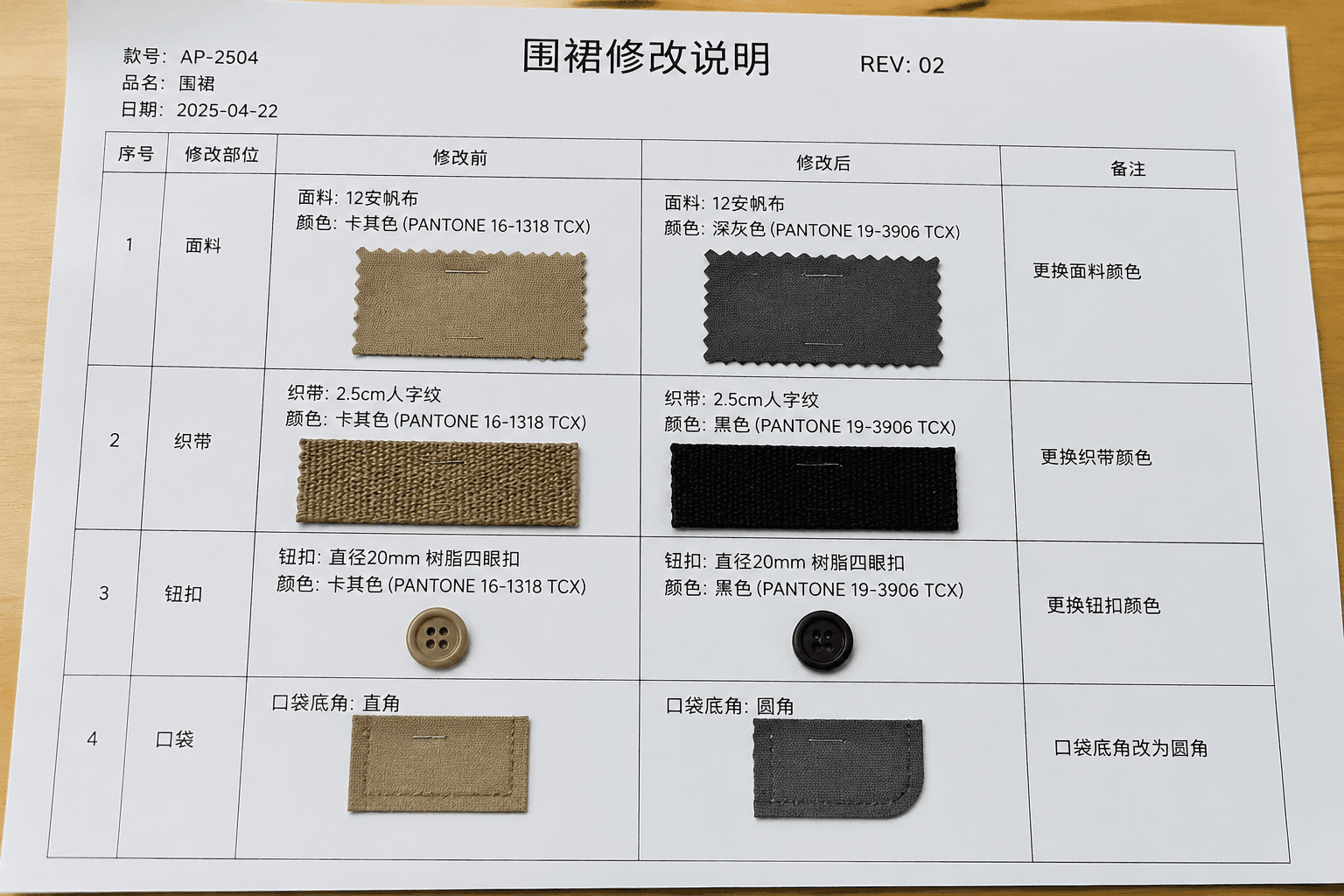
Communication discipline matters after signature. Keep all changes in writing, ideally in the same email thread or change log attached to the apron supply agreement. If the buyer changes pocket position after the fabric is cut, the contract should identify who absorbs the impact. If the buyer requests a faster ship date, the factory should be able to quote the cost of overtime, split shipment, or air freight without reopening the whole contract. This is how professional apron programs stay predictable.
- Use written change orders for any spec, artwork, or packaging revision.
- Store the approved sample, signed tech pack, and final BOM together.
- Escalate only on measurable deviations, not on subjective preferences.
- Reserve the right to audit subcontractors if the order uses outsourced embroidery or printing.
- Keep a repeat-order addendum so the next PO inherits the same factory contract terms unless changed in writing.